ABS Hyundai Elantra 2004 Owner's Manual
[x] Cancel search | Manufacturer: HYUNDAI, Model Year: 2004, Model line: Elantra, Model: Hyundai Elantra 2004Pages: 241, PDF Size: 6.5 MB
Page 11 of 241
YOUR VEHICLE AT A GLANCE
B255A01E-AAT
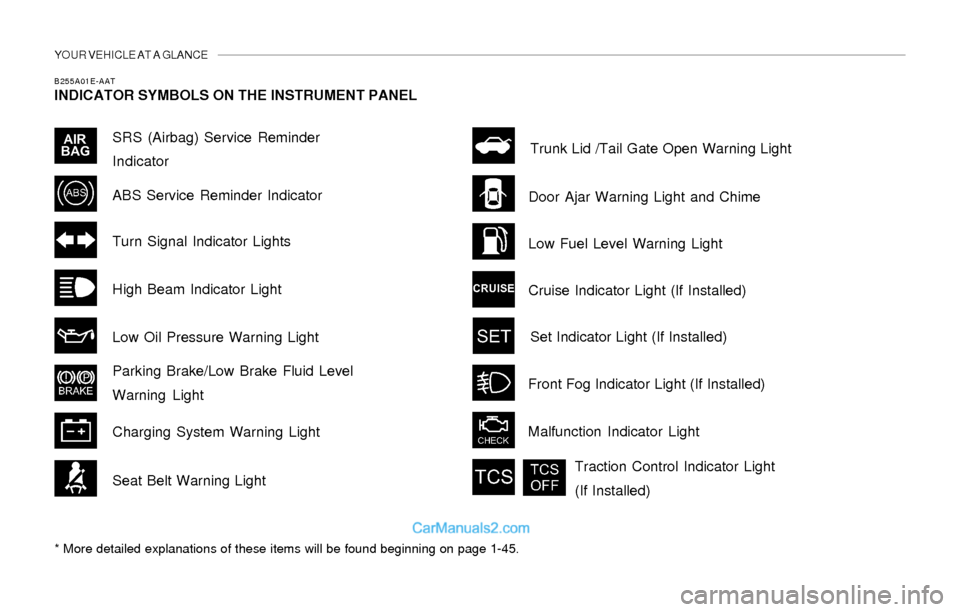
INDICATOR SYMBOLS ON THE INSTRUMENT PANEL
* More detailed explanations of these items will be found beginning on page 1-45.
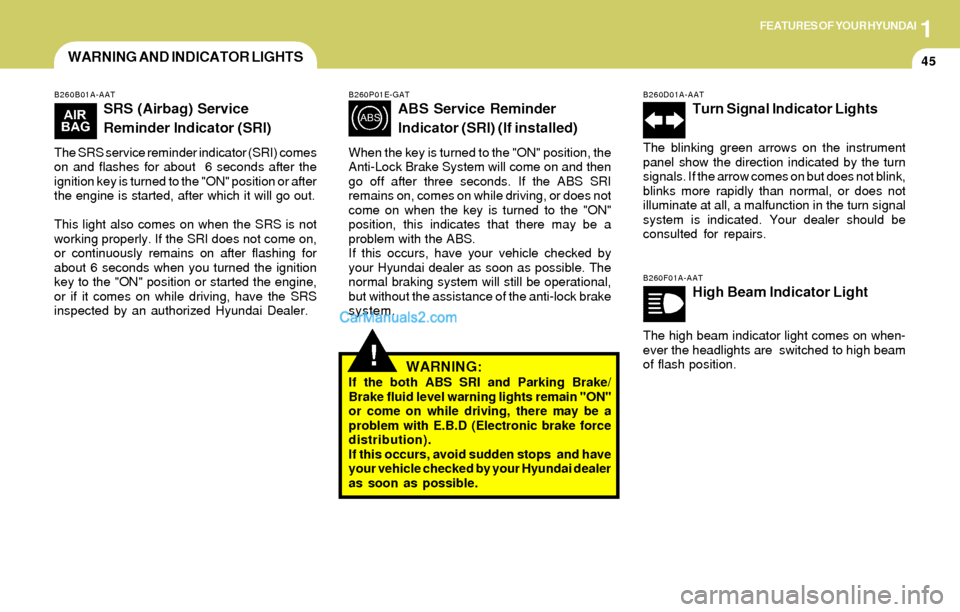
SRS (Airbag) Service Reminder
Indicator
ABS Service Reminder Indicator
Turn Signal Indicator Lights
High Beam Indicator Light
Low Oil Pressure Warning Light
Parking Brake/Low Brake Fluid Level
Warning Light
Charging System Warning Light
Seat Belt Warning LightTrunk Lid /Tail Gate Open Warning Light
Door Ajar Warning Light and Chime
Low Fuel Level Warning Light
Cruise Indicator Light (If Installed)
Front Fog Indicator Light (If Installed)
Malfunction Indicator Light
Traction Control Indicator Light
(If Installed)
Set Indicator Light (If Installed)
Page 34 of 241
1FEATURES OF YOUR HYUNDAI
23
!
B220A02E-AAT
SEAT BELTS - Center Rear Seat
3-Point System With Combination
Locking Retractor
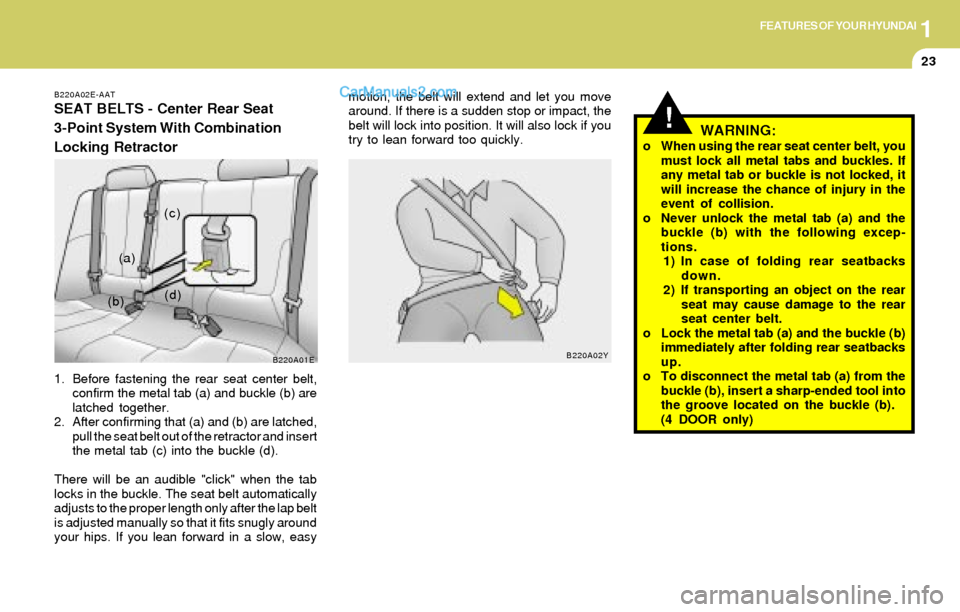
1. Before fastening the rear seat center belt,
confirm the metal tab (a) and buckle (b) are
latched together.
2. After confirming that (a) and (b) are latched,
pull the seat belt out of the retractor and insert
the metal tab (c) into the buckle (d).
There will be an audible "click" when the tab
locks in the buckle. The seat belt automatically
adjusts to the proper length only after the lap belt
is adjusted manually so that it fits snugly around
your hips. If you lean forward in a slow, easymotion, the belt will extend and let you move
around. If there is a sudden stop or impact, the
belt will lock into position. It will also lock if you
try to lean forward too quickly.
WARNING:o When using the rear seat center belt, you
must lock all metal tabs and buckles. If
any metal tab or buckle is not locked, it
will increase the chance of injury in the
event of collision.
o Never unlock the metal tab (a) and the
buckle (b) with the following excep-
tions.
1) In case of folding rear seatbacks
down.
2) If transporting an object on the rear
seat may cause damage to the rear
seat center belt.
o Lock the metal tab (a) and the buckle (b)
immediately after folding rear seatbacks
up.
o To disconnect the metal tab (a) from the
buckle (b), insert a sharp-ended tool into
the groove located on the buckle (b).
(4 DOOR only)
B220A01E
(a)(c)
(b)(d)
B220A02Y
Page 53 of 241
1FEATURES OF YOUR HYUNDAI
42
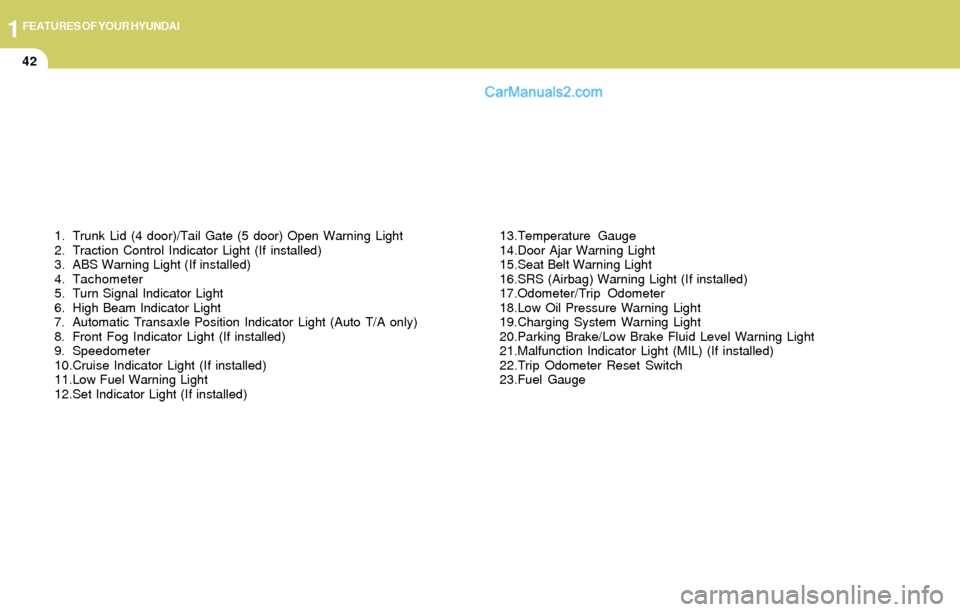
1. Trunk Lid (4 door)/Tail Gate (5 door) Open Warning Light
2. Traction Control Indicator Light (If installed)
3. ABS Warning Light (If installed)
4. Tachometer
5. Turn Signal Indicator Light
6. High Beam Indicator Light
7. Automatic Transaxle Position Indicator Light (Auto T/A only)
8. Front Fog Indicator Light (If installed)
9. Speedometer
10.Cruise Indicator Light (If installed)
11.Low Fuel Warning Light
12.Set Indicator Light (If installed)13.Temperature Gauge
14.Door Ajar Warning Light
15.Seat Belt Warning Light
16.SRS (Airbag) Warning Light (If installed)
17.Odometer/Trip Odometer
18.Low Oil Pressure Warning Light
19.Charging System Warning Light
20.Parking Brake/Low Brake Fluid Level Warning Light
21.Malfunction Indicator Light (MIL) (If installed)
22.Trip Odometer Reset Switch
23.Fuel Gauge
Page 55 of 241
1FEATURES OF YOUR HYUNDAI
44
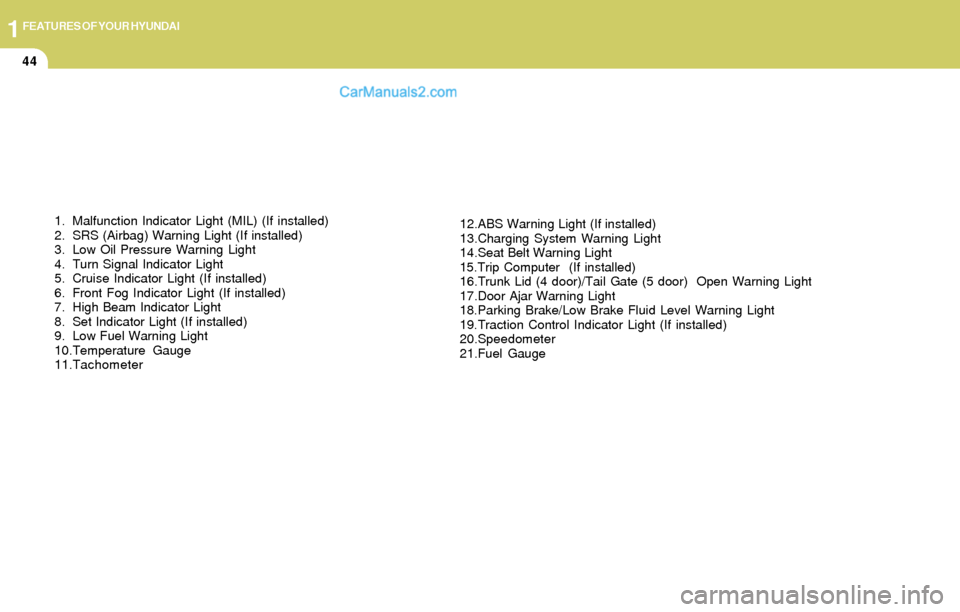
1. Malfunction Indicator Light (MIL) (If installed)
2. SRS (Airbag) Warning Light (If installed)
3. Low Oil Pressure Warning Light
4. Turn Signal Indicator Light
5. Cruise Indicator Light (If installed)
6. Front Fog Indicator Light (If installed)
7. High Beam Indicator Light
8. Set Indicator Light (If installed)
9. Low Fuel Warning Light
10.Temperature Gauge
11.Tachometer12.ABS Warning Light (If installed)
13.Charging System Warning Light
14.Seat Belt Warning Light
15.Trip Computer (If installed)
16.Trunk Lid (4 door)/Tail Gate (5 door) Open Warning Light
17.Door Ajar Warning Light
18.Parking Brake/Low Brake Fluid Level Warning Light
19.Traction Control Indicator Light (If installed)
20.Speedometer
21.Fuel Gauge
Page 56 of 241
1FEATURES OF YOUR HYUNDAI
45WARNING AND INDICATOR LIGHTS
!
B260B01A-AAT
SRS (Airbag) Service
Reminder Indicator (SRI)
The SRS service reminder indicator (SRI) comes
on and flashes for about 6 seconds after the
ignition key is turned to the "ON" position or after
the engine is started, after which it will go out.
This light also comes on when the SRS is not
working properly. If the SRI does not come on,
or continuously remains on after flashing for
about 6 seconds when you turned the ignition
key to the "ON" position or started the engine,
or if it comes on while driving, have the SRS
inspected by an authorized Hyundai Dealer.
B260P01E-GAT
ABS Service Reminder
Indicator (SRI) (If installed)
When the key is turned to the "ON" position, the
Anti-Lock Brake System will come on and then
go off after three seconds. If the ABS SRI
remains on, comes on while driving, or does not
come on when the key is turned to the "ON"
position, this indicates that there may be a
problem with the ABS.
If this occurs, have your vehicle checked by
your Hyundai dealer as soon as possible. The
normal braking system will still be operational,
but without the assistance of the anti-lock brake
system.
B260D01A-AAT
Turn Signal Indicator Lights
The blinking green arrows on the instrument
panel show the direction indicated by the turn
signals. If the arrow comes on but does not blink,
blinks more rapidly than normal, or does not
illuminate at all, a malfunction in the turn signal
system is indicated. Your dealer should be
consulted for repairs.
B260F01A-AAT
High Beam Indicator Light
The high beam indicator light comes on when-
ever the headlights are switched to high beam
of flash position.
WARNING:If the both ABS SRI and Parking Brake/
Brake fluid level warning lights remain "ON"
or come on while driving, there may be a
problem with E.B.D (Electronic brake force
distribution).
If this occurs, avoid sudden stops and have
your vehicle checked by your Hyundai dealer
as soon as possible.
Page 140 of 241
Before Starting the Engine ............................................ 2-3
To Start The Engine ...................................................... 2-3
Key Positions ................................................................ 2-3
Starting ..........................................................................2-4
Operating the Manual Transaxle ................................... 2-5
Automatic Transaxle ..................................................... 2-7
Good Braking Practices..............................................2-10
Anti-Lock Brake System (ABS) ..................................2-11
Traction Control System (TCS) ..................................2-12
Driving for Economy...................................................2-13
Smooth Cornering.......................................................2-14
Winter Driving.............................................................2-15
Trailer or Vehicle Towing ............................................2-17
DRIVING YOUR HYUNDAI
2
2
Page 150 of 241
2DRIVING YOUR HYUNDAI
11ANTI-LOCK BRAKE SYSTEM
(ABS)
o Don't coast down hills with the car out of gear.
This is extremely hazardous. Keep the car
in gear at all times, use the brakes to slow
down, then shift to a lower gear so that engine
braking will help you maintain a safe speed.
o Don't "ride" the brake pedal. Resting your
foot on the brake pedal while driving can be
dangerous because it can result in the brakes
overheating and losing their effectiveness. It
also increases the wear of the brake com-
ponents.
o If a tire goes flat while you are driving, apply
the brakes gently and keep the car pointed
straight ahead while you slow down. When
you are moving slowly enough for it to be safe
to do so, pull off the road and stop in a safe
place.
o If your car is equipped with an automatic
transaxle, don't let your car creep forward.
To avoid creeping forward, keep your foot on
the brake pedal when the car is stopped.
o Use caution when parking on a hill. Engage
the parking brake and place the gear selec-
tor lever in "P" (automatic transaxle) or in first
or reverse gear (manual transaxle). If your
car is facing downhill, turn the front wheels
into the curb to help keep the car from rolling.
If your car is facing uphill, turn the front
wheels away from the curb to help keep the
car from rolling. If there is no curb or if it is
required by other conditions to keep the car
from rolling, block the wheels.o Under some conditions your parking brake
can freeze in the engaged position. This is
most likely to happen when there is an
accumulation of snow or ice around or near
the rear brakes or if the brakes are wet. If
there is a risk that the parking brake may
freeze, apply it only temporarily while you put
the gear selector lever in "P" (automatic) or
in first or reverse gear (manual transaxle)
and block the rear wheels so the car cannot
roll. Then release the parking brake.
o Do not hold the vehicle on the upgrade with
the accelerator pedal. This can cause the
transmission to overheat. Always use the
brake pedal or parking brake.C120A02A-AAT
(If Installed)
The Anti-Lock Brake System (ABS) is designed
to prevent wheel lock-up during sudden braking
or on hazardous road surfaces. The ABS con-
trol module monitors the wheel speed and con-
trols the pressure applied to each brake. Thus,
in emergency situations or on slick roads, ABS
will increase vehicle control during braking.
NOTE:During ABS operation, a slight pulsation
may be felt in the brake pedal when the
brakes are applied. Also, a noise may be
heard in the engine compartment while
braking. These conditions are normal and
indicate that the anti-lock brake system is
functioning properly.
Page 151 of 241
2DRIVING YOUR HYUNDAI
12TRACTION CONTROL SYSTEM
(TCS)
!
C300A02Y-GAT
(If Installed)
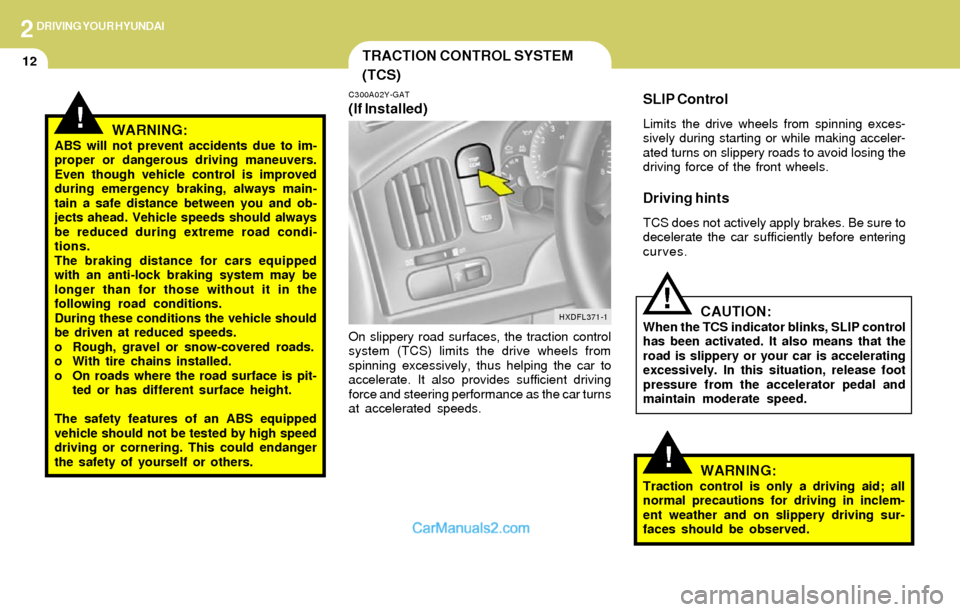
On slippery road surfaces, the traction control
system (TCS) limits the drive wheels from
spinning excessively, thus helping the car to
accelerate. It also provides sufficient driving
force and steering performance as the car turns
at accelerated speeds.
SLIP Control
Limits the drive wheels from spinning exces-
sively during starting or while making acceler-
ated turns on slippery roads to avoid losing the
driving force of the front wheels.
Driving hints
TCS does not actively apply brakes. Be sure to
decelerate the car sufficiently before entering
curves.
CAUTION:When the TCS indicator blinks, SLIP control
has been activated. It also means that the
road is slippery or your car is accelerating
excessively. In this situation, release foot
pressure from the accelerator pedal and
maintain moderate speed.
!
!WARNING:ABS will not prevent accidents due to im-
proper or dangerous driving maneuvers.
Even though vehicle control is improved
during emergency braking, always main-
tain a safe distance between you and ob-
jects ahead. Vehicle speeds should always
be reduced during extreme road condi-
tions.
The braking distance for cars equipped
with an anti-lock braking system may be
longer than for those without it in the
following road conditions.
During these conditions the vehicle should
be driven at reduced speeds.
o Rough, gravel or snow-covered roads.
o With tire chains installed.
o On roads where the road surface is pit-
ted or has different surface height.
The safety features of an ABS equipped
vehicle should not be tested by high speed
driving or cornering. This could endanger
the safety of yourself or others.
WARNING:Traction control is only a driving aid; all
normal precautions for driving in inclem-
ent weather and on slippery driving sur-
faces should be observed.
HXDFL371-1
Page 174 of 241
4CORROSION PREVENTION AND APPEARANCE CARE
4
E030C01A-AATPolishing and Waxing
Always wash and dry the car before polishing
or waxing or using a combination cleaner and
wax. Use a good quality commercial product
and follow the manufacturer's directions on the
container. Polish and wax the bright trim pieces
as well as the paint.
E030B01A-AAT
Spot Cleaning
Don't use gasoline, strong solvents or corro-
sive cleaning agents. These can damage the
finish of the car. To remove road tar, use
turpentine on a clean, soft cloth or commercially
available bug and tar remover. Be gentle.
To remove dead insects or tree sap, use warm
water and mild soap or car-washing solution.
Soak the spot and rub gently. If the paint has lost
its luster, use a commercial car-cleaning polish. To clean whitewall tires, use a stiff brush or
soapy steel-wool scouring pad.
To clean plastic wheel covers, use a clean
sponge or soft cloth and water.
To clean cast aluminum alloy wheels, use a mild
soap or neutral detergent. Do not use abrasive
cleaners. Protect the bare-metal surfaces by
cleaning, polishing and waxing. Because alumi-
num is subject to corrosion, be sure to give
aluminum alloy wheels special attention in win-
ter. If you drive on salted roads, clean the
wheels thoroughly afterwards.
After washing, be sure to rinse thoroughly. If
soapy water dries on the finish, streaking will
result.
When the weather is warm and the humidity low,
you may find it necessary to rinse each section
immediately after washing to avoid streaking.
After rinsing, dry the car using a damp chamois
or soft, absorbent cloth. The reason for drying
the car is to remove water from the car so it will
dry without water spots. Don't rub, this can
damage the finish. If you find any nicks or scratches in the paint,
use touch-up paint to cover them to prevent
corrosion. To protect the paintwork of the car
against corrosion, you must clean your Hyundai
(at least once a month). Give special attention
to the removal of salt, mud and other sub-
stances on the underside of the splashboards
of the car. Make sure that the outlets and the
underside of the doors are open. Paint damage
can be caused by small accumulation of tar,
industrial precipitation, tree resin, insects and
bird droppings, when not removed immediately.
If water alone is not strong enough to remove the
accumulated dirt, use a mild car washing solu-
tion. Be sure to rinse the surface after washing
to remove the solution. Never allow the solution
to dry on the painted surfaces.
Page 218 of 241
6DO-IT-YOURSELF MAINTENANCE
34FUSE PANEL DESCRIPTION
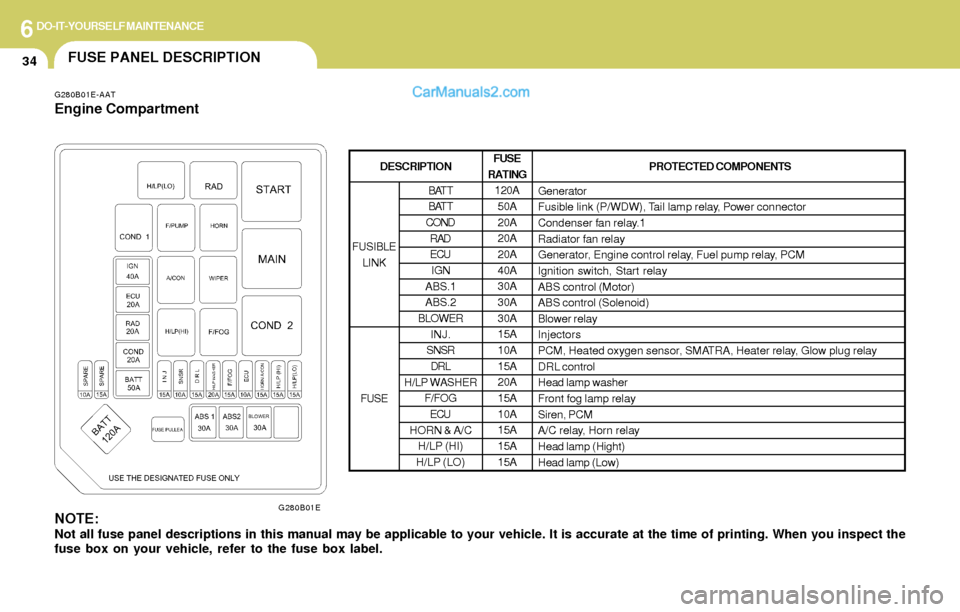
G280B01E-AAT
Engine Compartment
G280B01ENOTE:Not all fuse panel descriptions in this manual may be applicable to your vehicle. It is accurate at the time of printing. When you inspect the
fuse box on your vehicle, refer to the fuse box label.
FUSE
RATING
120A
50A
20A
20A
20A
40A
30A
30A
30A
15A
10A
15A
20A
15A
10A
15A
15A
15APROTECTED COMPONENTS
Generator
Fusible link (P/WDW), Tail lamp relay, Power connector
Condenser fan relay.1
Radiator fan relay
Generator, Engine control relay, Fuel pump relay, PCM
Ignition switch, Start relay
ABS control (Motor)
ABS control (Solenoid)
Blower relay
Injectors
PCM, Heated oxygen sensor, SMATRA, Heater relay, Glow plug relay
DRL control
Head lamp washer
Front fog lamp relay
Siren, PCM
A/C relay, Horn relay
Head lamp (Hight)
Head lamp (Low)
BATT
BATT
COND
RAD
ECU
IGN
ABS.1
ABS.2
BLOWER
INJ.
SNSR
DRL
H/LP WASHER
F/FOG
ECU
HORN & A/C
H/LP (HI)
H/LP (LO) FUSIBLE
LINK
FUSE
DESCRIPTION