maintenance Hyundai Elantra 2004 Owner's Manual
[x] Cancel search | Manufacturer: HYUNDAI, Model Year: 2004, Model line: Elantra, Model: Hyundai Elantra 2004Pages: 241, PDF Size: 6.5 MB
Page 2 of 241
A010A02A-AATWARRANTIES FOR YOUR HYUNDAI VEHICLE
o New Vehicle 60 Months/60,000 Miles Limited Warranty
o New Vehicle 120 Months/100,000 Miles Limited Powertrain Warranty (original owner only)
o Anti-Perforation Limited Warranty
o Emission Defect Warranty - Federal Vehicle
o California Emission Control System Warranty (if applicable)
o Emission Performance Warranty - Federal Vehicle
o Replacement Parts and Accessories Limited Warranty
NOTE:Detailed warranty information is provided in your Hyundai Owner's Handbook.
A020A01A-AAT
RESPONSIBILITY FOR MAINTENANCE
The maintenance requirements for your new Hyundai are found in Section 5. As the owner, it is your responsibility
to see that all maintenance operations specified by the manufacturer are carried out at the appropriate intervals.
When the vehicle is used in severe driving conditions, more frequent maintenance is required for some operations.
Maintenance requirements for severe operating conditions are also included in Section 5.
Page 3 of 241
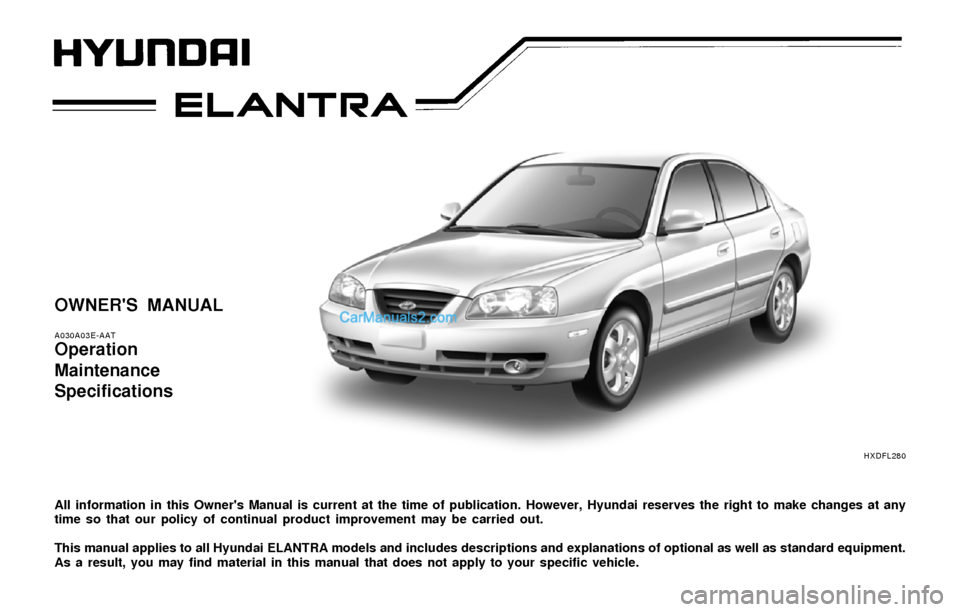
OWNER'S MANUAL
A030A03E-AAT
Operation
Maintenance
Specifications
All information in this Owner's Manual is current at the time of publication. However, Hyundai reserves the right to make changes at any
time so that our policy of continual product improvement may be carried out.
This manual applies to all Hyundai ELANTRA models and includes descriptions and explanations of optional as well as standard equipment.
As a result, you may find material in this manual that does not apply to your specific vehicle.
HXDFL280
Page 4 of 241
A040A01A-AAT
FOREWORD
Thank you for choosing Hyundai. We are pleased to welcome you to the growing number of discriminating people who
drive Hyundais. The advanced engineering and high-quality construction of each Hyundai we build is something of which
we're very proud.
Your Owner's Manual will introduce you to the features and operation of your new Hyundai. It is suggested that you read
it carefully because the information it contains can contribute greatly to the satisfaction you receive from your new car.
The manufacturer also recommends that all service and maintenance on your car be performed by an authorized Hyundai
dealer. Hyundai dealers are prepared to provide high-quality service, maintenance and any other assistance that may
be required.
A050A05A-AATHYUNDAI MOTOR COMPANY
Note: Because future owners will also need the information included in this manual, if you sell this Hyundai, please leave
the manual in the vehicle for their use. Thank you.
CAUTION:Severe engine and transaxle damage may result from the use of poor quality fuels and lubricants that do not
meet Hyundai specifications. You must always use high quality fuels and lubricants that meet the specifica-
tions listed on Page 9-4 in the Vehicle Specifications section of the Owner's Manual and which also appear
in the Service Station Information on the back cover of the Owner's Manual.
Copyright 2003 Hyundai Motor Company. All rights reserved. No part of this publication may be reproduced, stored in
any retrieval system or transmitted in any form or by any means without the prior written permission of Hyundai Motor
Company.
!
Page 8 of 241
TABLE OF CONTENTS
SECTION
5 1
2
3
4
6
7
8
9
10
FEATURES OF YOUR HYUNDAI DRIVING YOUR HYUNDAI
WHAT TO DO IN AN EMERGENCY
CORROSION PREVENTION & APPEARANCE CARE
VEHICLE MAINTENANCE REQUIREMENTS
DO-IT-YOURSELF MAINTENANCE
EMISSION CONTROL SYSTEMS
CONSUMER INFORMATION & REPORTING SAFETY
DEFECTS
VEHICLE SPECIFICATIONS
INDEX
Page 13 of 241
1FEATURES OF YOUR HYUNDAI
2FUEL RECOMMENDATIONS
B010A02A-AAT
Use Unleaded Gasoline
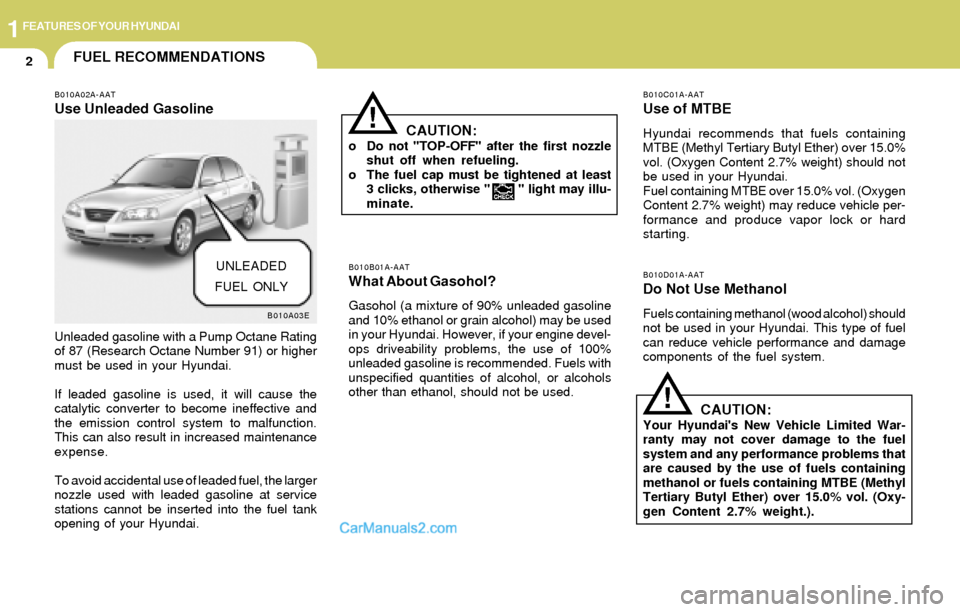
Unleaded gasoline with a Pump Octane Rating
of 87 (Research Octane Number 91) or higher
must be used in your Hyundai.
If leaded gasoline is used, it will cause the
catalytic converter to become ineffective and
the emission control system to malfunction.
This can also result in increased maintenance
expense.
To avoid accidental use of leaded fuel, the larger
nozzle used with leaded gasoline at service
stations cannot be inserted into the fuel tank
opening of your Hyundai.
B010A03E
UNLEADED
FUEL ONLY
CAUTION:o Do not "TOP-OFF" after the first nozzle
shut off when refueling.
o The fuel cap must be tightened at least
3 clicks, otherwise " " light may illu-
minate.
!
B010B01A-AAT
What About Gasohol?
Gasohol (a mixture of 90% unleaded gasoline
and 10% ethanol or grain alcohol) may be used
in your Hyundai. However, if your engine devel-
ops driveability problems, the use of 100%
unleaded gasoline is recommended. Fuels with
unspecified quantities of alcohol, or alcohols
other than ethanol, should not be used.
B010C01A-AAT
Use of MTBE
Hyundai recommends that fuels containing
MTBE (Methyl Tertiary Butyl Ether) over 15.0%
vol. (Oxygen Content 2.7% weight) should not
be used in your Hyundai.
Fuel containing MTBE over 15.0% vol. (Oxygen
Content 2.7% weight) may reduce vehicle per-
formance and produce vapor lock or hard
starting.
B010D01A-AAT
Do Not Use Methanol
Fuels containing methanol (wood alcohol) should
not be used in your Hyundai. This type of fuel
can reduce vehicle performance and damage
components of the fuel system.
!CAUTION:Your Hyundai's New Vehicle Limited War-
ranty may not cover damage to the fuel
system and any performance problems that
are caused by the use of fuels containing
methanol or fuels containing MTBE (Methyl
Tertiary Butyl Ether) over 15.0% vol. (Oxy-
gen Content 2.7% weight.).
Page 50 of 241
1FEATURES OF YOUR HYUNDAI
39
B240C01A-AAT
SRS Care
o The SRS is virtually maintenance free and
there are no parts you can safely service by
yourself. The entire SRS system must be
inspected by an authorized Hyundai dealer
10 years after the date that the vehicle was
manufactured.
o Any work on the SRS system, such as
removing, installing, repairing, or any work
on the steering wheel or front seats must be
performed by a qualified Hyundai technician.
Improper handling of the airbag system may
result in serious personal injury.!
o For best protection from the side impact
airbag system and to avoid being injured
by the deploying side impact airbag,
both front seat occupants should sit in
an upright position with their feet on the
floor and the seat belt properly fastened.
The driver's hands should be placed on
the steering wheel at the 9:00 and 3:00
o'clock positions.
The passenger's arms and hands should
be placed on their laps.
o Do not use any accessory seat covers.
o Use of seat covers could reduce or prevent
the effectiveness of the system.
o Do not install any accessories on the side
or near the side impact airbag.
o Do not use excessive force on the side of
the seat.
o Do not place any objects over the airbag or
between the airbag and yourself.
o Do not place any objects (an umbrella,
bag, etc.) between the front door and the
front seat. Such objects may become dan-
gerous projectiles and cause injury if the
supplemental side impact airbag inflates.
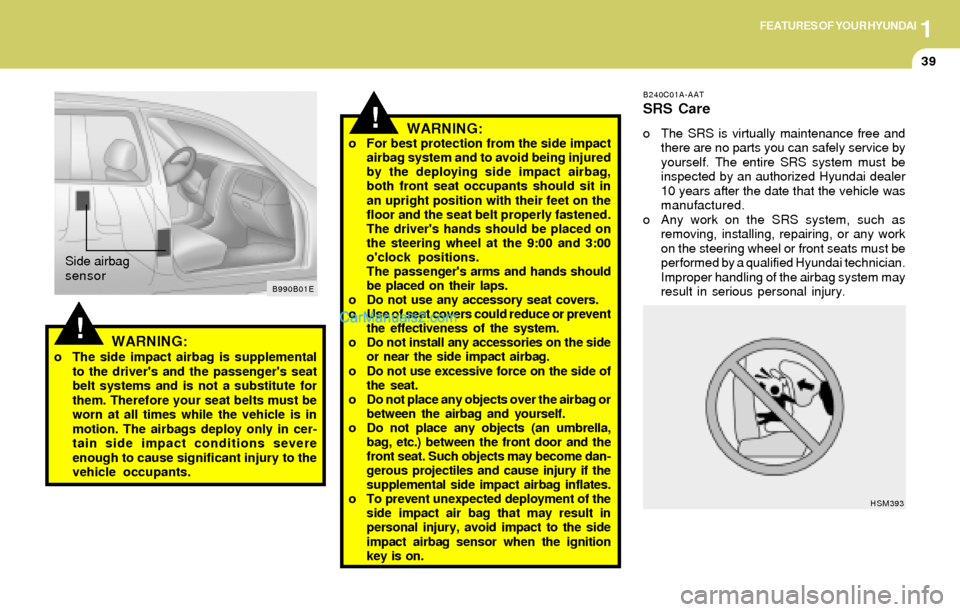
o To prevent unexpected deployment of the
side impact air bag that may result in
personal injury, avoid impact to the side
impact airbag sensor when the ignition
key is on.WARNING:
WARNING:o The side impact airbag is supplemental
to the driver's and the passenger's seat
belt systems and is not a substitute for
them. Therefore your seat belts must be
worn at all times while the vehicle is in
motion. The airbags deploy only in cer-
tain side impact conditions severe
enough to cause significant injury to the
vehicle occupants.
!
B990B01E
Side airbag
sensor
HSM393
Page 62 of 241
1FEATURES OF YOUR HYUNDAI
51
HXDFL077-1
Function of digital odometer/trip odom-
eter
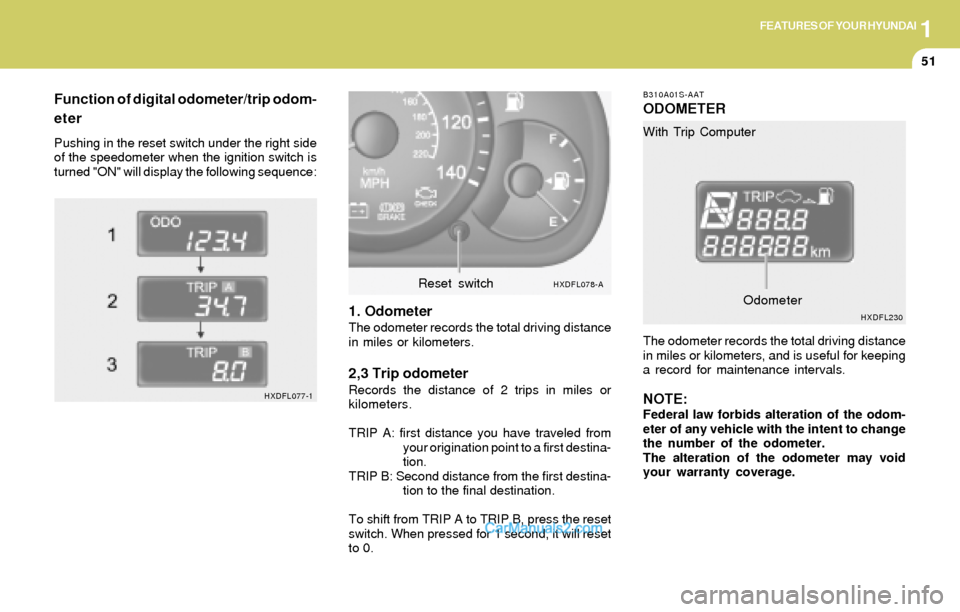
Pushing in the reset switch under the right side
of the speedometer when the ignition switch is
turned "ON" will display the following sequence:
1. OdometerThe odometer records the total driving distance
in miles or kilometers.
2,3 Trip odometerRecords the distance of 2 trips in miles or
kilometers.
TRIP A: first distance you have traveled from
your origination point to a first destina-
tion.
TRIP B: Second distance from the first destina-
tion to the final destination.
To shift from TRIP A to TRIP B, press the reset
switch. When pressed for 1 second, it will reset
to 0.
B310A01S-AAT
ODOMETER
The odometer records the total driving distance
in miles or kilometers, and is useful for keeping
a record for maintenance intervals.
NOTE:Federal law forbids alteration of the odom-
eter of any vehicle with the intent to change
the number of the odometer.
The alteration of the odometer may void
your warranty coverage. With Trip Computer
HXDFL078-AReset switch
HXDFL230Odometer
Page 148 of 241
2DRIVING YOUR HYUNDAI
9
!
C090I02Y-AAT
CAUTION:o Shift into "R" and "P" position only when
the vehicle has completely stopped.
o Do not accelerate the engine in reverse
or any of the forward positions with the
brakes applied.
o Always apply the footbrake when shift-
ing from "P" or "N", to "R", "D", "3", "2"
or "L" position.
o Do not use the "P" (Park) position in
place of the parking brake. Always set
the parking brake, shift the transaxle
into "P" (Park) position and turn off the
ignition when you leave the vehicle, even
momentarily. Never leave the vehicle un-
attended while the engine is running.
o Check the automatic transaxle fluid level
regularly, and add fluid as necessary.
See the maintenance schedule for the
proper fluid recommendation.
C090F01A-AAT
o 2 (Second gear):
Use for driving on a slippery road, hill climbing
or engine braking downhill. "2" automatically
shifts between first and second gears.
This means that no shift-up to 3rd gear is
performed. However, the shift-up to third gear
is done when the car speed exceeds a certain
value to prevent the engine from over-revving.
Manually move the selector to "D" returning to
normal driving condition.
C090G01A-AATo L (Low gear):
Use for driving up a very steep grade or for
engine braking when descending steep hills.
When downshifting to "L", the transaxle will
temporarily remain in second gear until the
vehicle has slowed enough for low gear to
engage. Do not exceed 31 mph (50 km/h) in low
gear.
C090H01Y-AAT
NOTE:o For smooth and safe operation, depress
the brake pedal when shifting from "Neu-
tral" position or "Park" position to a
forward or reverse gear.
o The ignition key must be in the "ON"
position and the brake pedal fully de-
pressed in order to move the shift lever
from the "P" (Park) position to any of the
other positions.
o It is always possible to shift from "R",
"N", "D", "3", "2", "L" position to "P"
position. The vehicle must be fully
stopped to avoid transaxle damage.
Page 153 of 241
2DRIVING YOUR HYUNDAI
14SMOOTH CORNERING
o Remember, your Hyundai does not require
extended warm-up. As soon as the engine
is running smoothly, you can drive away. In
very cold weather, however, give your en-
gine a slightly longer warm-up period.
o Don't "lug" or "over-rev" the engine. Lugging
is driving too slowly in too high a gear result-
ing in the engine bucking. If this happens,
shift to a lower gear. Over-revving is racing
the engine beyond its safe limit. This can be
avoided by shifting at the recommended
speeds.
o Use your air conditioning sparingly. The air
conditioning system is operated by engine
power so your fuel economy is reduced
when you use it.C150A01A-AAT
Avoid braking or gear changing in corners,
especially when roads are wet. Ideally, corners
should always be taken under gentle accelera-
tion. If you follow these suggestions, tire wear
will be held to a minimum. o Be sure that the wheels are aligned cor-
rectly. Improper alignment can result from
hitting curbs or driving too fast over irregular
surfaces. Poor alignment causes faster tire
wear and may also result in other problems
as well as greater fuel consumption.
o Keep your car in good condition. For better
fuel economy and reduced maintenance
costs, maintain your car in accordance with
the maintenance schedule in Section 5. If
you drive your car in severe conditions,
more frequent maintenance is required (see
Section 5 for details).
o Keep your car clean. For maximum service,
your Hyundai should be kept clean and free
of corrosive materials. It is especially impor-
tant that mud, dirt, ice, etc. not be allowed to
accumulate on the underside of the car. This
extra weight can result in increased fuel
consumption and also contribute to corro-
sion.
o Travel lightly. Don't carry unnecessary
weight in your car. Weight reduces fuel
economy.
o Don't let the engine idle longer than neces-
sary. If you are waiting (and not in traffic),
turn off your engine and restart only when
you're ready to go.
Page 156 of 241
2DRIVING YOUR HYUNDAI
17TRAILER OR VEHICLE TOWING
C190A02S-AAT
If you are considering towing with your car, you
should first check with your State's Department
of Motor Vehicles to determine their legal re-
quirements.
Since laws vary from State to State, the require-
ments for towing trailers, cars, other types of
vehicles, or apparatus may differ. Ask your
Hyundai dealer for further details before towing.
CAUTION:Do not do any towing with your car during
its first 1,200 miles (2,000 km) in order to
allow the engine to properly break in. Fail-
ure to heed this caution may result in seri-
ous engine or transaxle damage.
!
C190B01S-AAT
Trailer Hitches
Select the proper hitch and ball combination,
making sure that it's location is compatible with
that of the trailer or vehicle being towed.
Use a quality non-equalizing hitch which distrib-
utes the tongue load uniformly throughout the
chassis.
The hitch should be bolted securely to the car
and installed by a qualified technician. DO NOT
USE A HITCH DESIGNED FOR TEMPORARY
INSTALLATION AND NEVER USE ONE THAT
ATTACHES ONLY TO THE BUMPER.
C190C03S-AATTrailer Brakes
If your trailer is equipped with a braking system,
make sure it conforms to federal and/or local
regulations and that it is properly installed and
operating correctly.
NOTE:If you tow a trailer or vehicle, your car will
require more frequent maintenance due to
the additional load. See "Maintenance Un-
der Severe Usage Conditions" on page 5-6.
C190D01S-AAT
Safety Chains
Should the hitch connection between your car
and the trailer or vehicle you are towing fail, the
trailer or vehicle could wander dangerously
across other lanes of traffic and ultimately leave
the roadway. To eliminate this potentially dan-
gerous situation, safety chains, attached be-
tween your car and the trailer or towed vehicle,
are required in most states.
!CAUTION:o Never connect a trailer brake system
directly to the vehicle brake system.
o When towing a trailer on steep grades (in
excess of 12%) pay close attention to the
engine coolant temperature gauge to
ensure the engine does not overheat. If
the needle of the coolant temperature
gauge moves across the dial towards
"H" (HOT), pull over and stop as soon as
it is safe to do so, and allow the engine
to idle until it cools down. You may
proceed once the engine has cooled
sufficiently.