ABS Hyundai Elantra 2005 User Guide
[x] Cancel search | Manufacturer: HYUNDAI, Model Year: 2005, Model line: Elantra, Model: Hyundai Elantra 2005Pages: 256, PDF Size: 10.4 MB
Page 230 of 256
7
EMISSION CONTROL SYSTEMS2
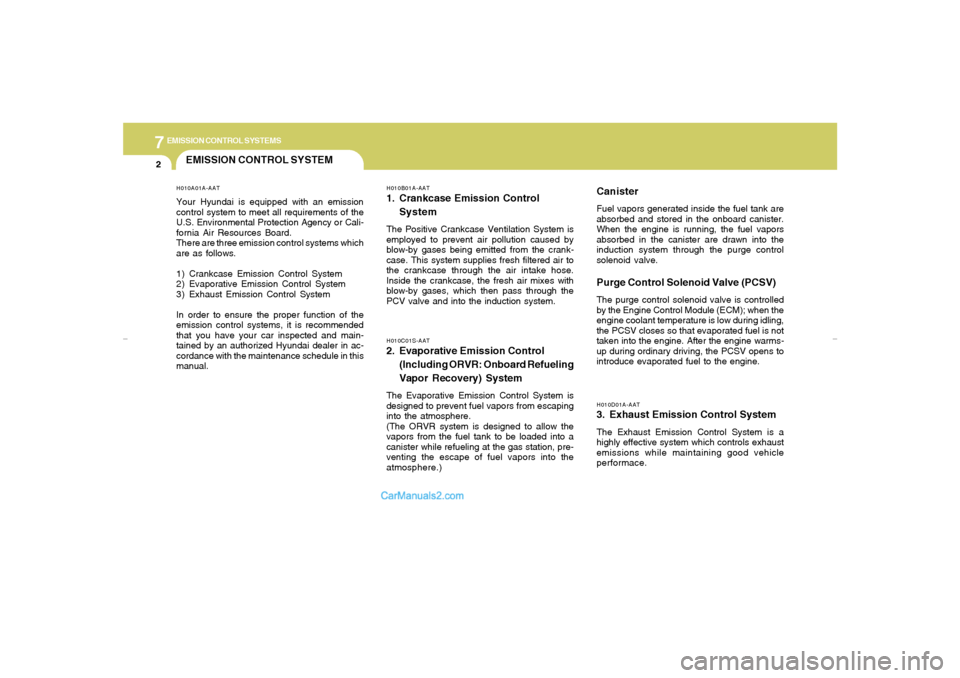
EMISSION CONTROL SYSTEM
H010D01A-AAT3. Exhaust Emission Control SystemThe Exhaust Emission Control System is a
highly effective system which controls exhaust
emissions while maintaining good vehicle
performace.
H010B01A-AAT1. Crankcase Emission Control
SystemThe Positive Crankcase Ventilation System is
employed to prevent air pollution caused by
blow-by gases being emitted from the crank-
case. This system supplies fresh filtered air to
the crankcase through the air intake hose.
Inside the crankcase, the fresh air mixes with
blow-by gases, which then pass through the
PCV valve and into the induction system.
H010A01A-AATYour Hyundai is equipped with an emission
control system to meet all requirements of the
U.S. Environmental Protection Agency or Cali-
fornia Air Resources Board.
There are three emission control systems which
are as follows.
1) Crankcase Emission Control System
2) Evaporative Emission Control System
3) Exhaust Emission Control System
In order to ensure the proper function of the
emission control systems, it is recommended
that you have your car inspected and main-
tained by an authorized Hyundai dealer in ac-
cordance with the maintenance schedule in this
manual.
CanisterFuel vapors generated inside the fuel tank are
absorbed and stored in the onboard canister.
When the engine is running, the fuel vapors
absorbed in the canister are drawn into the
induction system through the purge control
solenoid valve.Purge Control Solenoid Valve (PCSV)The purge control solenoid valve is controlled
by the Engine Control Module (ECM); when the
engine coolant temperature is low during idling,
the PCSV closes so that evaporated fuel is not
taken into the engine. After the engine warms-
up during ordinary driving, the PCSV opens to
introduce evaporated fuel to the engine.
H010C01S-AAT2. Evaporative Emission Control
(Including ORVR: Onboard Refueling
Vapor Recovery) SystemThe Evaporative Emission Control System is
designed to prevent fuel vapors from escaping
into the atmosphere.
(The ORVR system is designed to allow the
vapors from the fuel tank to be loaded into a
canister while refueling at the gas station, pre-
venting the escape of fuel vapors into the
atmosphere.)
xdflhma-7.p652/5/2008, 2:15 PM 2
Page 247 of 256
9
VEHICLE SPECIFICATIONS2
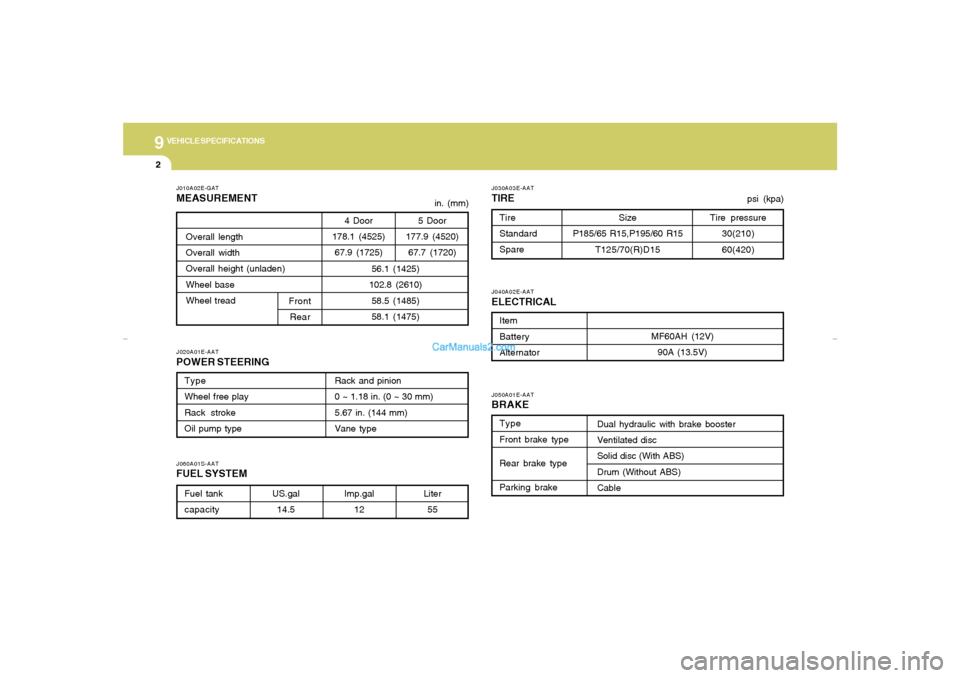
J040A02E-AATELECTRICALJ030A03E-AATTIRE
J060A01S-AATFUEL SYSTEMJ020A01E-AATPOWER STEERINGType
Wheel free play
Rack stroke
Oil pump typeRack and pinion
0 ~ 1.18 in. (0 ~ 30 mm)
5.67 in. (144 mm)
Vane type
Imp.gal
12
Fuel tank
capacity
Tire
Standard
SpareSize
P185/65 R15,P195/60 R15
T125/70(R)D15
MF60AH (12V)
90A (13.5V) Item
Battery
Alternator
US.gal
14.5
Tire pressure
30(210)
60(420)
Liter
55
psi (kpa)
J050A01E-AATBRAKE
Dual hydraulic with brake booster
Ventilated disc
Solid disc (With ABS)
Drum (Without ABS)
Cable Type
Front brake type
Rear brake type
Parking brake
J010A02E-GATMEASUREMENT
56.1 (1425)
102.8 (2610)
58.5 (1485)
58.1 (1475) Overall length
Overall width
Overall height (unladen)
Wheel base
Wheel tread
Front
Rear
in. (mm)
4 Door
178.1 (4525)
67.9 (1725)5 Door
177.9 (4520)
67.7 (1720)
xdflhma-9.p652/5/2008, 2:17 PM 2