engine Hyundai Elantra 2006 Owner's Manual
[x] Cancel search | Manufacturer: HYUNDAI, Model Year: 2006, Model line: Elantra, Model: Hyundai Elantra 2006Pages: 277, PDF Size: 10.18 MB
Page 256 of 277

6
DO-IT-YOURSELF MAINTENANCE
47
G280C01E
G200C01E-GAT
(Diesel Engine)
FUSE
RATING 120A50A 30A 30A30A 40A 30A30A 30A 80A60A 30A 30A15A 10A 15A20A 15A 10A15A 15A 15A PROTECTED COMPONENTS
Generator
Fusible link (P/WDW), Tail lamp relay, Power connector
Condenser fan relay.1
Radiator fan relay
Generator, Engine control relay, Fuel pump relay, PCM
Ignition switch, Start relay ABS control (Motor) ABS control (Solenoid)
Blower relay
Grow plug relay
Heater relay #1
Heater relay #2
Fuel filter relay Injectors
PCM, Heated oxygen sensor, SMATRA, Heater relay, Glow plug relay DRL control Head lamp washer
Front fog lamp relay Siren, PCM
A/C relay, Horn relayHead lamp (Hight)
Head lamp (Low)
BATT
BATT
COND RADECU
IGN
ABS.1
ABS.2
BLOWER
GLOW PLUG HEATER #1
HEATER #2
FUEL FILTER
INJ.
SNSR DRL
H/LP WASHER
F/FOGECU
HORN & A/C
H/LP (HI)
H/LP (LO)
FUSIBLE
LINK
FUSE
DESCRIPTION
Page 259 of 277
7EMISSION CONTROL SYSTEMS
2EMISSION CONTROL SYSTEMS
H010A01A-GAT
(If installed)
Your Hyundai is equipped with an
emission control system to meet all requirements of the Emission prohibi- tion rules of your province.
There are three emission control sys-
tems which are as follows.
(1) Crankcase emission control sys- tem
(2) Evaporative emission control sys- tem
(3) Exhaust emission control system
In order to assure the proper function
of the emission control systems, it is recommended that you have your carinspected and maintained by an au- thorized Hyundai dealer in accordance with the maintenance schedule in thismanual. H010B01A-AAT
1. Crankcase Emission Control
System
The positive crankcase ventilation
system is employed to prevent airpollution caused by blow-by gasesbeing emitted from the crankcase. This system supplies fresh filtered air to the crankcase through the air in-take hose. Inside the crankcase, the fresh air mixes with blow-by gases, then passes through the PCV valveinto the induction system.
H010C02E-GAT
2. Evaporative Emission
Control System
The Evaporative Emission Control
System is designed to prevent fuel vapors from escaping into the atmo- sphere. Canister
While the engine is inoperative, fuel
vapors generated inside the fuel tank are absorbed and stored in the canis-ter. When the engine is running, the fuel vapors absorbed in the canister are drawn into the induction system through the purge control solenoid valve. Purge Control Solenoid Valve (PCSV)
The purge control solenoid valve is
controlled by the Engine Control Mod- ule (ECM); when the engine coolant temperature is low during idling, thePCSV closes so that evaporated fuel is not taken into the engine. After the engine warms-up during ordinary driv-ing, the PCSV opens so as to intro- duce evaporated fuel to the engine.
H010D01A-AAT
3. Exhaust Emission Control
System
The Exhaust Emission Control Sys-
tem is a highly effective system which controls exhaust emissions while maintaining good vehicle performance.
Page 260 of 277
7
EMISSION CONTROL SYSTEMS
3CATALYTIC CONVERTER
H020A01A-GAT
(If installed) ; For a gasoline engine
HXDFL1032
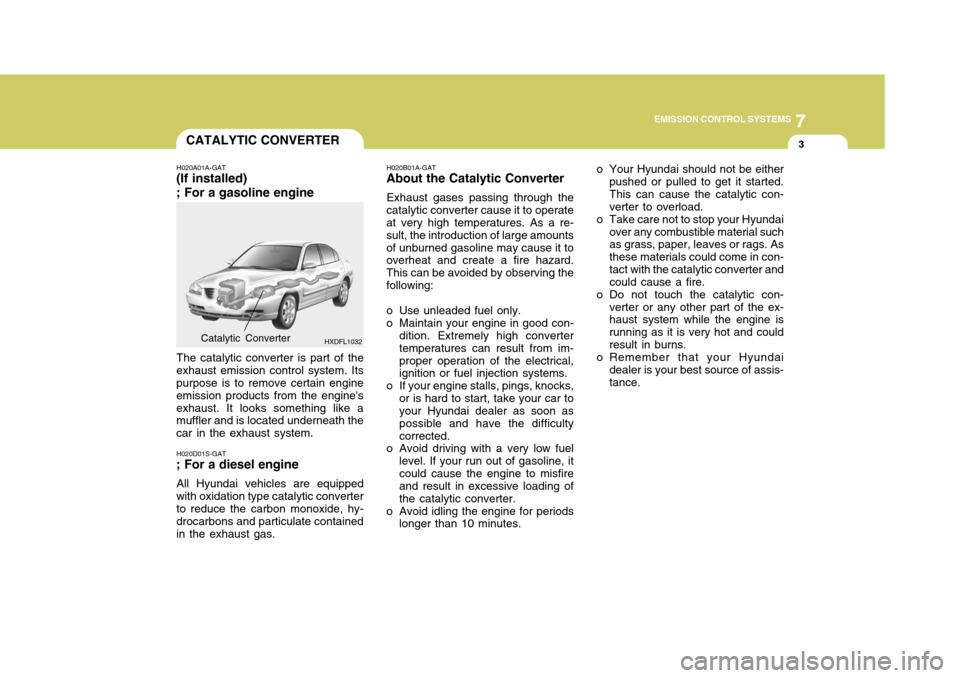
The catalytic converter is part of the
exhaust emission control system. Its purpose is to remove certain engine emission products from the engine'sexhaust. It looks something like a muffler and is located underneath the car in the exhaust system.
Catalytic Converter H020B01A-GAT
About the Catalytic Converter
Exhaust gases passing through the
catalytic converter cause it to operate at very high temperatures. As a re- sult, the introduction of large amountsof unburned gasoline may cause it to overheat and create a fire hazard. This can be avoided by observing thefollowing:
o Use unleaded fuel only.
o Maintain your engine in good con- dition. Extremely high convertertemperatures can result from im-proper operation of the electrical, ignition or fuel injection systems.
o If your engine stalls, pings, knocks, or is hard to start, take your car toyour Hyundai dealer as soon as possible and have the difficultycorrected.
o Avoid driving with a very low fuel
level. If your run out of gasoline, itcould cause the engine to misfire and result in excessive loading of the catalytic converter.
o Avoid idling the engine for periods longer than 10 minutes. o Your Hyundai should not be either
pushed or pulled to get it started.This can cause the catalytic con- verter to overload.
o Take care not to stop your Hyundai over any combustible material suchas grass, paper, leaves or rags. As these materials could come in con-tact with the catalytic converter and could cause a fire.
o Do not touch the catalytic con- verter or any other part of the ex-haust system while the engine is running as it is very hot and couldresult in burns.
o Remember that your Hyundai
dealer is your best source of assis-tance.
H020D01S-GAT
; For a diesel engine
All Hyundai vehicles are equipped
with oxidation type catalytic converter to reduce the carbon monoxide, hy- drocarbons and particulate containedin the exhaust gas.
Page 261 of 277

7EMISSION CONTROL SYSTEMS
4EGR SYSTEM
H020C01S-GAT ; For a diesel engine This system helps control oxides of nitrogen by recirculating a part of the exhaust gas into the engine.
Page 262 of 277
Vehicle Identification Number (VIN) ............................ 8-2
Engine Number ............................................................ 8-2
Recommended Inflation Pressures ............................. 8-3
Snow Tires ................................................................... 8-4
Tire Chains ................................................................... 8-4
Tire Rotation ................................................................ 8-5
Tire Balancing .............................................................. 8-5
Tire Traction ................................................................. 8-5
When to Replace Tires ................................................ 8-5
Spare Tire and Tools ................................................... 8-6
8
CONSUMER INFORMATION
8
Page 263 of 277
8CONSUMER INFORMATION
2VEHICLE IDENTIFICATION NUMBER (VIN)
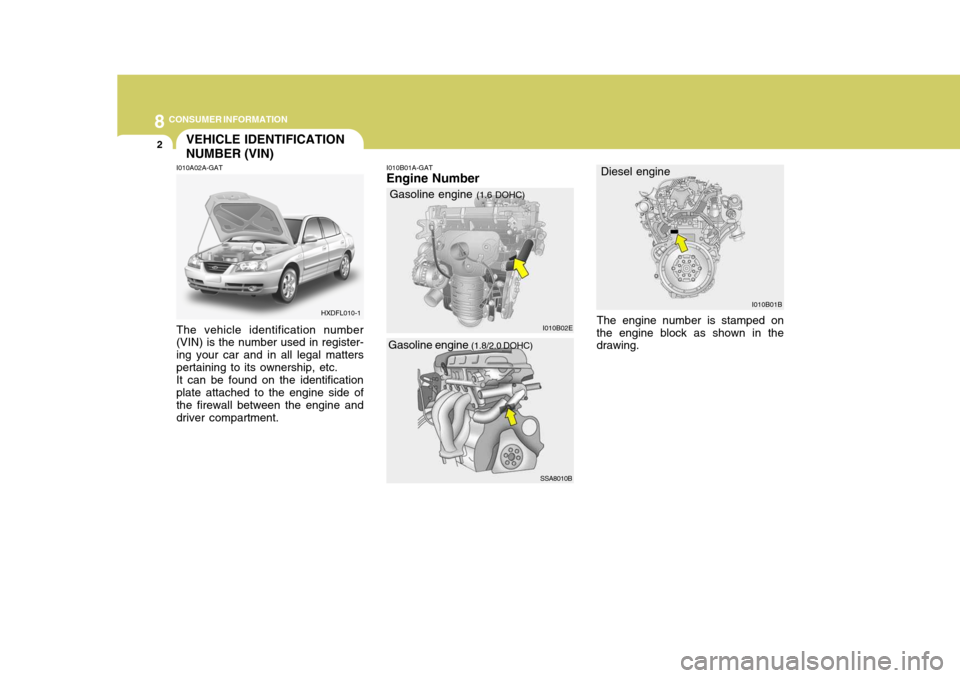
I010B01A-GAT Engine Number
I010A02A-GAT The vehicle identification number (VIN) is the number used in register- ing your car and in all legal matterspertaining to its ownership, etc.It can be found on the identificationplate attached to the engine side of the firewall between the engine and driver compartment. The engine number is stamped on
the engine block as shown in the drawing.
HXDFL010-1
SSA8010B I010B02E
Gasoline engine
(1.6 DOHC)
Gasoline engine (1.8/2.0 DOHC)
I010B01B
Diesel engine
Page 268 of 277
Measurement................................................................ 9-2
Engine ........................................................................... 9-3
Lubrication Chart .......................................................... 9-4
9
VEHICLE SPECIFICATIONS
9
Page 270 of 277

9
VEHICLE SPECIFICATIONS
3ENGINE
J070A06E-GAT
NGK CHAMPION NGKCHAMPION
Unleaded Leaded Unleaded Leaded For adjusting For checking
Engine Type Idle Speed (RPM) Spark Plug Spark Plug Gap Valve Clearance (Cold engine : 20±5°C) Ignition Timing Firing Order
ITEMS
A/CON OFF A/CON ON
DIESEL
2.0 4Cylinder in-line SOHC 750 ± 100800 ± 100
--- - --
AUTO LASH
(1.6 DOHC / Diesel) AUTO LASH
(1.6 DOHC / Diesel) -
GASOLINE
1.6/1.8/2.0 4Cylinder in-line DOHC
700 ± 100 (1.6L), 700 ± 100 (1.8/2.0 L) 750 ± 100 (1.6L), 750 ± 100 (1.8/2.0 L) BKR5ES-11
RC10YC4BKR5ES
RC10YC
1.0 ~ 1.1 mm (0.039 ~ 0.043 in.)0.7 ~ 0.8 mm (0.028 ~ 0.032 in.)
0.17 ~ 0.23 mm (0.0067 ~ 0.0091 in.) (1.8/2.0 DOHC)0.25 ~ 0.31 mm (0.0098 ~ 0.0122 in.) (1.8/2.0 DOHC)
0.12 ~ 0.28 mm (0.0047 ~ 0.011 in.) (1.8/2.0 DOHC)0.20 ~ 0.38 mm (0.0079 ~ 0.015 in.) (1.8/2.0 DOHC)
BTDC 9° ± 5° (1.6L), BTDC 6° ± 5° (1.8L), BTDC 8° ± 5° (2.0L) 1 - 3 - 4 - 2
IntakeExhaustIntake Exhaust
Page 271 of 277
9 VEHICLE SPECIFICATIONS
4
Engine Oil Consumption Transaxle Manual Auto
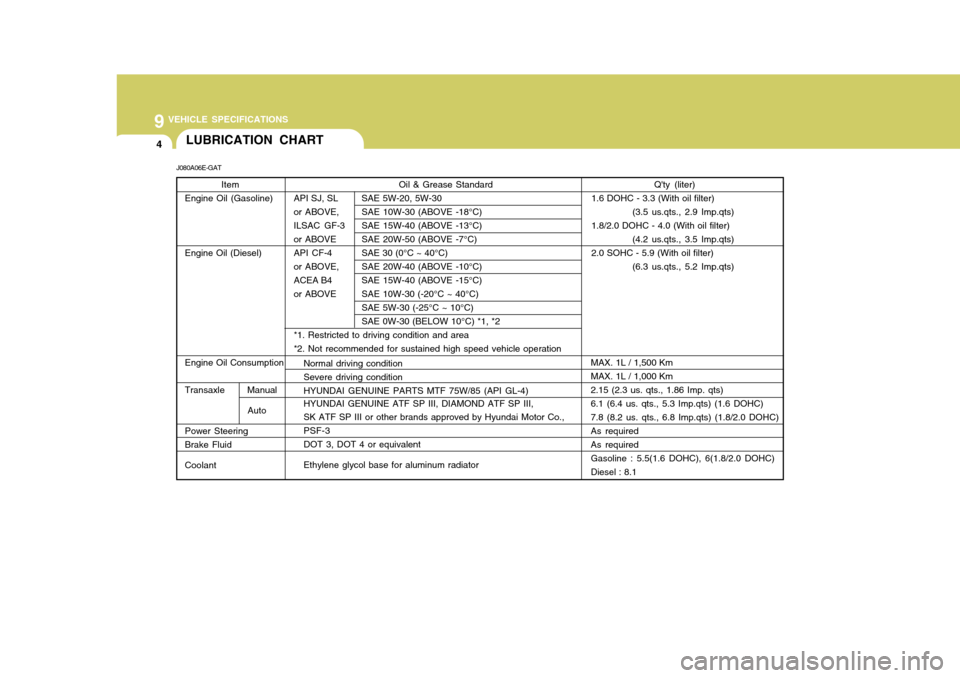
Power Steering Brake Fluid CoolantLUBRICATION CHART
Oil & Grease Standard
API SJ, SL SAE 5W-20, 5W-30
or ABOVE, SAE 10W-30 (ABOVE -18°C)
ILSAC GF-3 SAE 15W-40 (ABOVE -13°C)
or ABOVE SAE 20W-50 (ABOVE -7°C)
API CF-4 SAE 30 (0°C ~ 40°C)
or ABOVE, SAE 20W-40 (ABOVE -10°C)
ACEA B4 SAE 15W-40 (ABOVE -15°C)
or ABOVE SAE 10W-30 (-20°C ~ 40°C) SAE 5W-30 (-25°C ~ 10°C)SAE 0W-30 (BELOW 10°C) *1, *2
*1. Restricted to driving condition and area*2. Not recommended for sustained high speed vehicle operation
J080A06E-GAT
Item
Engine Oil (Gasoline) Engine Oil (Diesel)
Q'ty (liter)
1.6 DOHC - 3.3 (With oil filter) (3.5 us.qts., 2.9 Imp.qts)
1.8/2.0 DOHC - 4.0 (With oil filter) (4.2 us.qts., 3.5 Imp.qts)
2.0 SOHC - 5.9 (With oil filter) (6.3 us.qts., 5.2 Imp.qts)
Normal driving condition Severe driving conditionHYUNDAI GENUINE PARTS MTF 75W/85 (API GL-4) HYUNDAI GENUINE ATF SP III, DIAMOND ATF SP III, SK ATF SP III or other brands approved by Hyundai Motor Co., PSF-3DOT 3, DOT 4 or equivalent Ethylene glycol base for aluminum radiator MAX. 1L / 1,500 Km MAX. 1L / 1,000 Km2.15 (2.3 us. qts., 1.86 Imp. qts)6.1 (6.4 us. qts., 5.3 Imp.qts) (1.6 DOHC)7.8 (8.2 us. qts., 6.8 Imp.qts) (1.8/2.0 DOHC)As requiredAs requiredGasoline : 5.5(1.6 DOHC), 6(1.8/2.0 DOHC)Diesel : 8.1
Page 274 of 277

10
INDEX
3
D Door Central door locks .................................................... 1-9
Door locks ................................................................ 1-7
Locking, unlocking front doors with a key ............... 1-8
Drink Holder .............................................................. 1-67
Drive Belts ................................................................ 6-30
Driving Economical driving ................................................. 2-17
Smooth cornering ................................................... 2-19
Winter driving ......................................................... 2-19
EEmission Control Syst em ........................................... 7-2
Engine
Before starting the engine ....................................... 2-3
Compartment ........................................................... 6-2
Coolant ................................................................... 6-14
Coolant temperature gauge ................................... 1-53
If the engine overheats ............................................ 3-4
Number .................................................................... 8-2
Oil ............................................................................. 6-8
Starting ..................................................................... 2-5
Engine Exhaust Can Be Dangerous ........................... 2-2F
Folding Rear Seatbacks .
.......................................... 1-17
Front Fog Light ......................................................... 1-60
Front Seats Adjustable front seats ............................................ 1-14
Adjustable headrest s .............................................. 1-16
Adjusting seat forward and rear ward..................... 1-15
Adjusting seatback angle .......................................1-15
Lumbar support control .................. ........................ 1-16
Seat cushion height adjustment............................ 1-17
Seat warmer ........................................................... 1-19
Fuel Capacity ................................................................... 9-2
Gauge .................................................................... 1-15
Recommendations ................................................... 1-2
Fuel Filler Lid Remote release ...................................................... 1-80
Fuses ........................................................................ 6-31
Fuse Panel description ............................................. 6-46
GGeneral Checks .......................................................... 6-7
Glove Box ................................................................. 1-74