steering Hyundai Elantra 2006 User Guide
[x] Cancel search | Manufacturer: HYUNDAI, Model Year: 2006, Model line: Elantra, Model: Hyundai Elantra 2006Pages: 277, PDF Size: 10.18 MB
Page 162 of 277
2
DRIVING YOUR HYUNDAI
9
!
AUTOMATIC TRANSAXLE
!
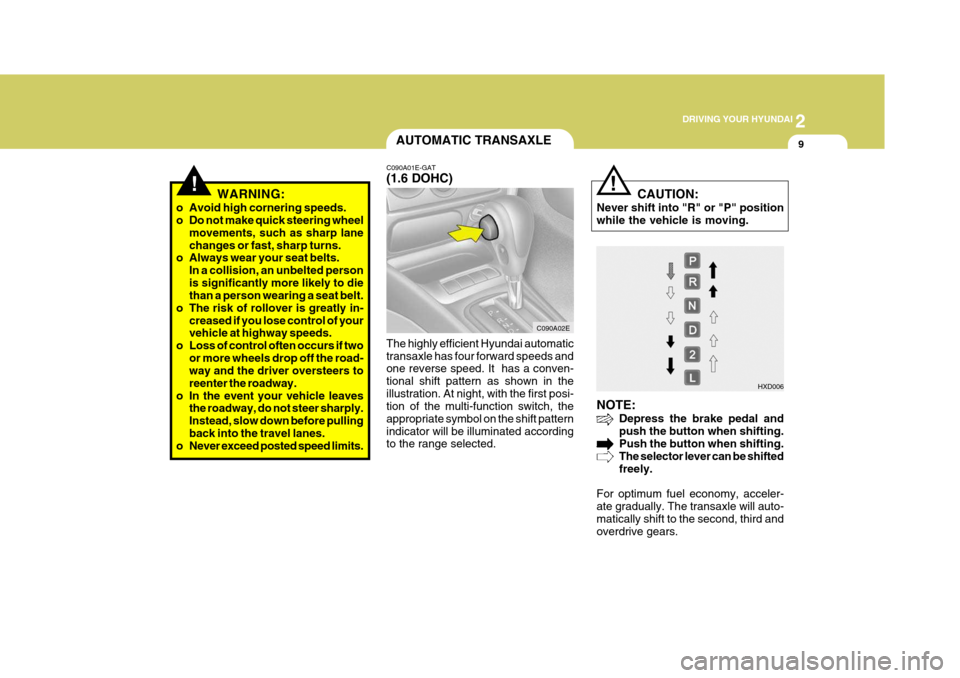
C090A01E-GAT (1.6 DOHC)
C090A02ENOTE:Depress the brake pedal and push the button when shifting. Push the button when shifting. The selector lever can be shiftedfreely.
For optimum fuel economy, acceler-ate gradually. The transaxle will auto- matically shift to the second, third and overdrive gears.
The highly efficient Hyundai automatic transaxle has four forward speeds and one reverse speed. It has a conven- tional shift pattern as shown in theillustration. At night, with the first posi- tion of the multi-function switch, the appropriate symbol on the shift patternindicator will be illuminated according to the range selected.
WARNING:
o Avoid high cornering speeds.
o Do not make quick steering wheel movements, such as sharp lane changes or fast, sharp turns.
o Always wear your seat belts.
In a collision, an unbelted personis significantly more likely to die than a person wearing a seat belt.
o The risk of rollover is greatly in-
creased if you lose control of yourvehicle at highway speeds.
o Loss of control often occurs if two
or more wheels drop off the road-way and the driver oversteers to reenter the roadway.
o In the event your vehicle leaves the roadway, do not steer sharply.Instead, slow down before pullingback into the travel lanes.
o Never exceed posted speed limits. CAUTION:
Never shift into "R" or "P" position while the vehicle is moving.
HXD006
Page 166 of 277
2
DRIVING YOUR HYUNDAI
13
!
C090N03A-AAT Good Driving Practices
o Never move the gear selector lever
from "P" or "N" to any other position with the accelerator pedal de- pressed.
o Never move the gear selector lever into "P" when the vehicle is in mo-tion.
o Be sure the car is completely stopped before you attempt to shift into "R".
o Never take the car out of gear and
coast down a hill. This may be ex- tremely hazardous. Always leave the car in gear when moving.
o Do not "ride" the brakes. This can cause them to overheat and mal-function. Instead, when you are driv- ing down a long hill, slow down andshift to a lower gear. When you do this, engine braking will help slow the car.
o Slow down before shifting to a lower gear. Otherwise, the lower gear maynot be engaged.
o Always use the parking brake. Do not depend on placing the transaxlein "P" to keep the car from moving. o Exercise extreme caution when driv-
ing on a slippery surface. Be espe-cially careful when braking, acceler- ating or shifting gears. On a slippery surface, an abrupt change in ve-hicle speed can cause the drive wheels to lose traction and the ve- hicle to go out of control.
o Turn the overdrive switch on for good fuel economy and smooth driv-ing. If engine braking is needed inthe "D" range or if repeated upshift- ing and downshifting between 3rd and 4th gear is needed when climb-ing a gentle slope, it is recommended that the overdrive switch be turned off. Turn the overdrive switch backon immediately afterward. WARNING:
o Avoid high cornering speeds.
o Do not make quick steering wheel movements, such as sharp lane changes or fast, sharp turns.
o Always wear your seat belts.
In a collision, an unbelted personis significantly more likely to die than a person wearing a seat belt.
o The risk of rollover is greatly in- creased if you lose control of yourvehicle at highway speeds.
o Loss of control often occurs if two or more wheels drop off the road-way and the driver oversteers to reenter the roadway.
o In the event your vehicle leaves the roadway, do not steer sharply.Instead, slow down before pullingback into the travel lanes.
o Never exceed posted speed limits.
o Excessive depressing of the
accelerater pedal under the tire slip condition such as moving out of the mud or fresh snow etc, maycause severe damage to the transaxle. At this time, take other way such as towing.
Page 168 of 277
2
DRIVING YOUR HYUNDAI
15TRACTION CONTROL SYSTEM (TCS)
!
Driving hints TCS does not actively apply brakes. Be sure to decelerate the car suffi-ciently before entering curves.
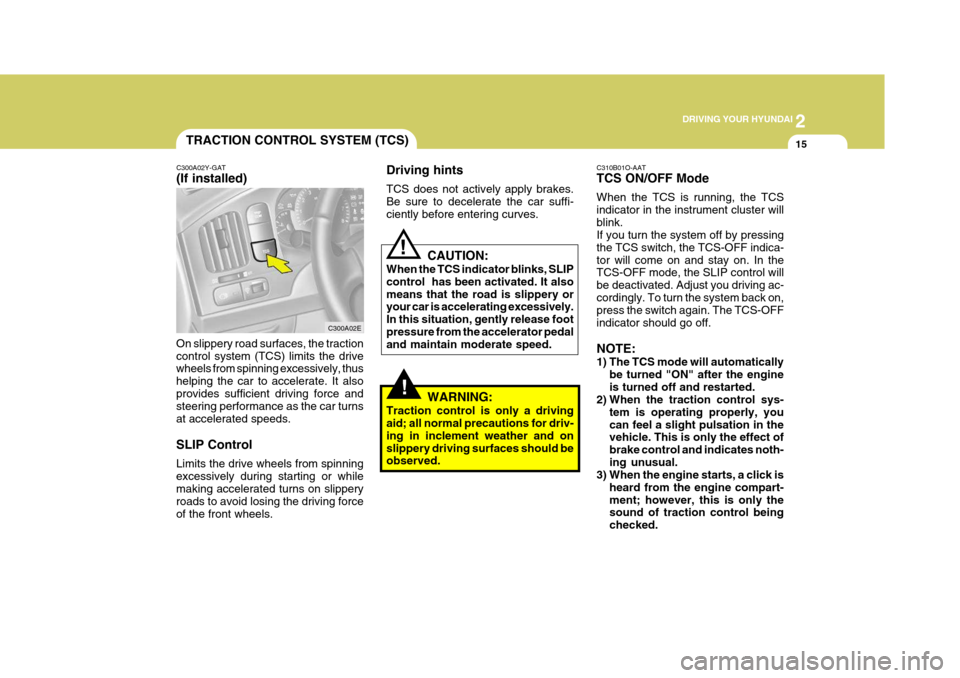
C300A02Y-GAT (If installed)
C300A02E
!
On slippery road surfaces, the traction control system (TCS) limits the drive wheels from spinning excessively, thus helping the car to accelerate. It alsoprovides sufficient driving force and steering performance as the car turns at accelerated speeds. SLIP Control Limits the drive wheels from spinning excessively during starting or while making accelerated turns on slippery roads to avoid losing the driving forceof the front wheels. CAUTION:
When the TCS indicator blinks, SLIPcontrol has been activated. It alsomeans that the road is slippery or your car is accelerating excessively. In this situation, gently release footpressure from the accelerator pedal and maintain moderate speed.
WARNING:
Traction control is only a drivingaid; all normal precautions for driv- ing in inclement weather and onslippery driving surfaces should be observed. C310B01O-AAT TCS ON/OFF Mode When the TCS is running, the TCS indicator in the instrument cluster willblink. If you turn the system off by pressing the TCS switch, the TCS-OFF indica-tor will come on and stay on. In the TCS-OFF mode, the SLIP control will be deactivated. Adjust you driving ac-cordingly. To turn the system back on, press the switch again. The TCS-OFF indicator should go off. NOTE:
1) The TCS mode will automatically
be turned "ON" after the engine is turned off and restarted.
2) When the traction control sys-
tem is operating properly, youcan feel a slight pulsation in the vehicle. This is only the effect of brake control and indicates noth-ing unusual.
3) When the engine starts, a click is
heard from the engine compart-ment; however, this is only the sound of traction control being checked.
Page 174 of 277

2
DRIVING YOUR HYUNDAI
21
C160I01A-AAT Don't Let Your Parking Brake Freeze Under some conditions your parking brake can freeze in the engaged posi-tion. This is most likely to happen when there is an accumulation of snow or ice around or near the rear brakes orif the brakes are wet. If there is a risk the parking brake may freeze, apply it only temporarily while you put the gearselector lever in "P" (automatic) or in first or reverse gear (manual transaxle) and block the rear wheels so the carcannot roll. Then release the parking brake. C160J01A-AAT Don't Let Ice and Snow Accumu- late Underneath Under some conditions, snow and ice can build up under the fenders andinterfere with the steering. When driv- ing in severe winter conditions where this may happen, you should periodi-cally check underneath the car to be sure the movement of the front wheels and the steering components is notobstructed. C160K01A-AAT Carry Emergency Equipment Depending on the severity of the weather where you drive your car, you should carry appropriate emergency equipment. Some of the items youmay want to carry include tire chains, tow straps or chains, flashlight, emer- gency flares, sand, a shovel, jumpercables, a window scraper, gloves, ground cloth, coveralls, a blanket, etc. C170A01A-AAT HIGHER SPEED MOTORING Pre-Trip Inspections 1. Tires: Adjust the tire inflation pressures tospecification. Low tire inflation pres- sures will result in overheating and possible failure of the tires.Avoid using worn or damaged tires which may result in reduced traction or tire failure. NOTE: Never exceed the maximum tire in- flation pressure shown on the tires. 2. Fuel, engine coolant and engine oil: High speed travel consumes more fuel than urban motoring. Do not forget tocheck both engine coolant and engine oil. 3. Drive belt: A loose or damaged drive belt may result in overheating of the engine.
Page 190 of 277
3
WHAT TO DO IN AN EMERGENCY
11
dolly
air may leak from the tire. If you lose a valve cap, buy another and install it assoon as possible. After you have changed wheels, al- ways secure the flat tire in its place inthe trunk and return the jack and tools to their proper storage locations.
IF YOUR VEHICLE MUST BE TOWED
D080A01O-GAT If your vehicle has to be towed, it should be done by your Hyundai dealeror a commercial tow truck service. This will help assure that your vehicle is not damaged in towing. Also, profes-sionals are generally aware of local laws governing towing. In any case, rather than risk damage to your car, itis suggested that you show this infor- mation to the tow truck operator. Be sure that a safety chain system is usedand that all local laws are observed. It is recommended that your vehicle be towed with a wheel lift and dollies orflatbed equipment with all the wheels off the ground.
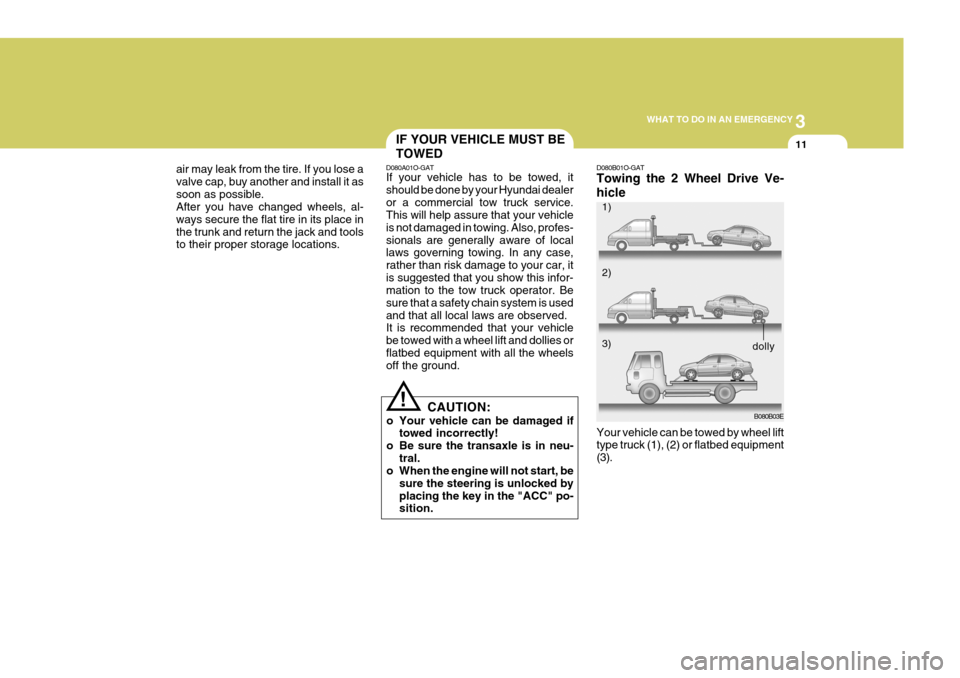
! D080B01O-GAT Towing the 2 Wheel Drive Ve- hicle
B080B03E
Your vehicle can be towed by wheel lift type truck (1), (2) or flatbed equipment (3).
CAUTION:
o Your vehicle can be damaged if towed incorrectly!
o Be sure the transaxle is in neu-
tral.
o When the engine will not start, be
sure the steering is unlocked byplacing the key in the "ACC" po- sition. 1) 2) 3)
Page 192 of 277
3
WHAT TO DO IN AN EMERGENCY
13IF YOU LOSE YOUR KEYSEMERGENCY TOWING
D080D04A-AAT
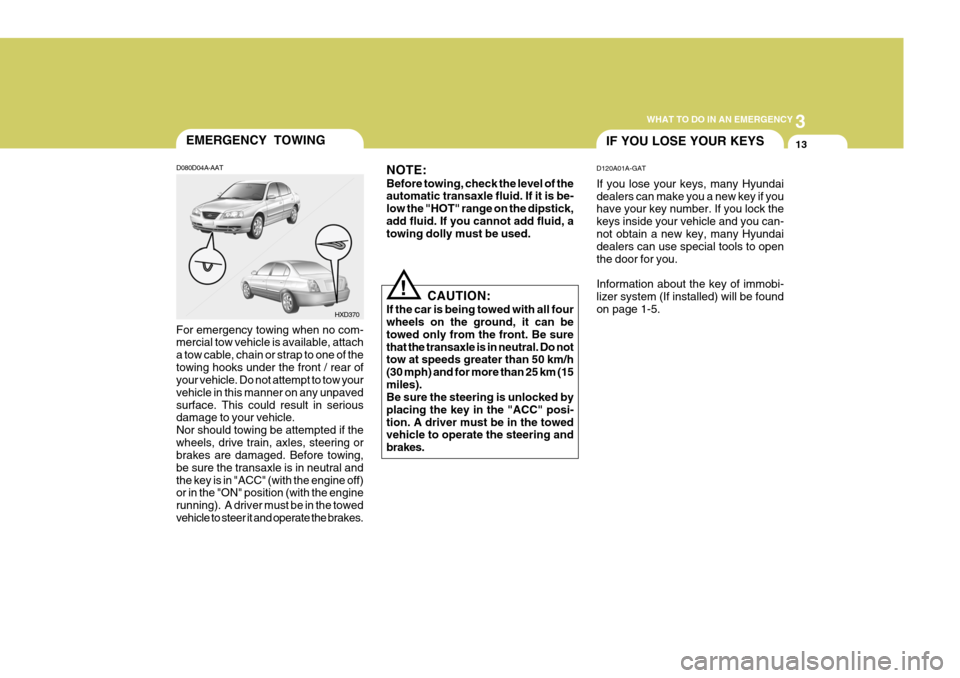
For emergency towing when no com- mercial tow vehicle is available, attach a tow cable, chain or strap to one of thetowing hooks under the front / rear of your vehicle. Do not attempt to tow your vehicle in this manner on any unpavedsurface. This could result in serious damage to your vehicle. Nor should towing be attempted if thewheels, drive train, axles, steering or brakes are damaged. Before towing, be sure the transaxle is in neutral andthe key is in "ACC" (with the engine off) or in the "ON" position (with the engine running). A driver must be in the towedvehicle to steer it and operate the brakes. HXD370
D120A01A-GAT If you lose your keys, many Hyundai dealers can make you a new key if you have your key number. If you lock the keys inside your vehicle and you can-not obtain a new key, many Hyundai dealers can use special tools to open the door for you. Information about the key of immobi- lizer system (If installed) will be foundon page 1-5.
!
NOTE: Before towing, check the level of the automatic transaxle fluid. If it is be- low the "HOT" range on the dipstick,add fluid. If you cannot add fluid, a towing dolly must be used.
CAUTION:
If the car is being towed with all four wheels on the ground, it can be towed only from the front. Be sure that the transaxle is in neutral. Do not tow at speeds greater than 50 km/h (30 mph) and for more than 25 km (15miles). Be sure the steering is unlocked by placing the key in the "ACC" posi-tion. A driver must be in the towed vehicle to operate the steering and brakes.
Page 204 of 277

5VEHICLE MAINTENANCE REQUIREMENTS
6
F030C04E-GAT R : Replace I : Inspect and, after inspection, clean, adjust, repair or replace if necessary
DESCRIPTION
GENERAL MAINTENANCE COOLING SYSTEMCOOLANT MANUAL TRANSAXLE OIL AUTOMATIC TRANSAXLEFLUIDBRAKE HOSES AND LINESBRAKE FLUIDREAR BRAKE DRUMS/LININGS, PARKING BRAKEBRAKE PADS, CALIPERS AND ROTORSEXHAUST PIPE AND MUFFLERSUSPENSION MOUNTING BOLTSSTEERING GEAR BOX, LINKAGE & BOOTS/LOWER ARM BALL JOINTPOWER STEERING PUMP, BELT AND HOSESDRIVE SHAFTS AND BOOTSAIR CONDITIONING REFRIGERANTAIR CONDITIONER FILTER (IN FRONT OF BLOWER UNIT)
NO.
12 3 4 5 6789
101112131415
120 96
I I IIIIIIIIIIII
R
105
84
I I III I IIII I
R
90 72
I I
R I IIIIIIIIII
R
7560
I I III I IIII I
R
60 48
I I IIIIIIIIIIII
R
4536
I I III I IIII I
R
30 24
I I IIIIIIIIIIII
R
1512
I I III I IIII I
R
KILOMETERS X 1000 MONTHS
European Community Only Except European Community
See Note (1)GASOLINE ENGINE DIESEL ENGINE
Note : (1) FOR EVERY 24 MONTHS OR 45,000 KM, WHICHEVER OCCURS FIRST - "R"
Page 205 of 277
5
VEHICLE MAINTENANCE REQUIREMENTS
7
ENGINE OIL AND FILTER AIR CLEANER FILTER SPARK PLUGS TIMING BELTBRAKE PADS, CALIPERS AND ROTORSREAR BRAKE DRUMS/LININGS/PADS,PARKING BRAKESTEERING GEAR RACK, LINKAGE & BOOTS/LOWER ARM BALL JOINT DRIVESHAFTS & BOOTSMANUAL TRANSAXLE OILAUTOMATICTRANSAXLE FLUIDAIR CONDITIONER FILTER (IN FRONT OF BLOWER UNIT)
European Community Only Except European Community
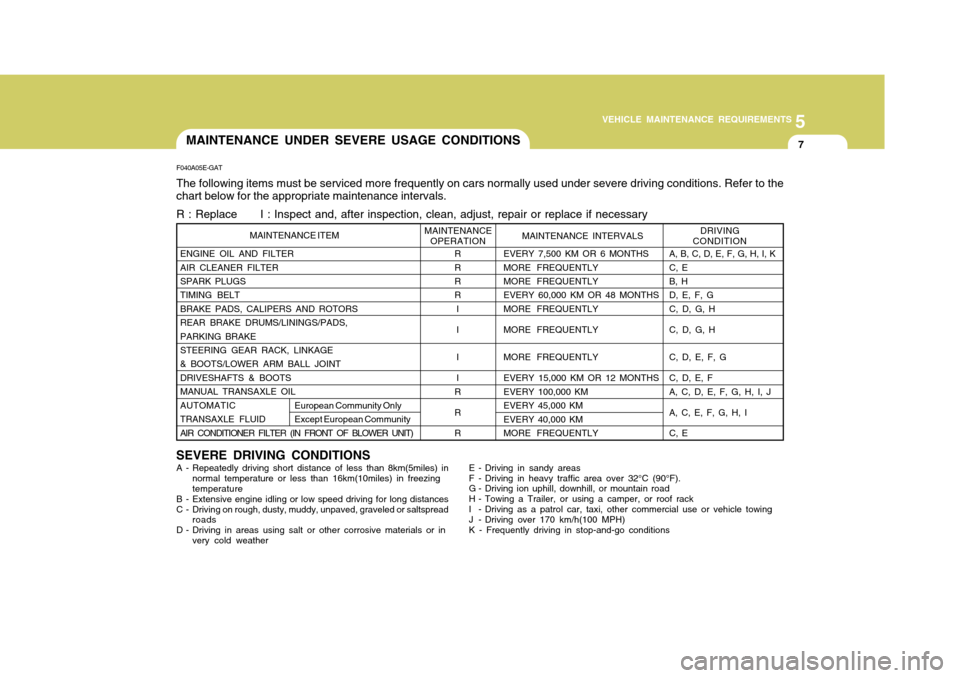
F040A05E-GAT The following items must be serviced more frequently on cars normally used under severe driving conditions. Refer to the chart below for the appropriate maintenance intervals. R : Replace I : Inspect and, after inspection, clean, adjust, repair or replace if necessary
R R R R
I I I I
RR REVERY 7,500 KM OR 6 MONTHS MORE FREQUENTLY MORE FREQUENTLY EVERY 60,000 KM OR 48 MONTHSMORE FREQUENTLY MORE FREQUENTLY MORE FREQUENTLY EVERY 15,000 KM OR 12 MONTHS EVERY 100,000 KMEVERY 45,000 KMEVERY 40,000 KM MORE FREQUENTLY
SEVERE DRIVING CONDITIONS A - Repeatedly driving short distance of less than 8km(5miles) in normal temperature or less than 16km(10miles) in freezing temperature
B - Extensive engine idling or low speed driving for long distances
C - Driving on rough, dusty, muddy, unpaved, graveled or saltspread roads
D - Driving in areas using salt or other corrosive materials or in very cold weather
A, B, C, D, E, F, G, H, I, K C, E B, H D, E, F, GC, D, G, H C, D, G, H C, D, E, F, G C, D, E, F A, C, D, E, F, G, H, I, J A, C, E, F, G, H, I C, E DRIVING
CONDITION
MAINTENANCE INTERVALS
MAINTENANCE
OPERATION
MAINTENANCE ITEM
E - Driving in sandy areas
F - Driving in heavy traffic area over 32°C (90°F).
G - Driving ion uphill, downhill, or mountain road
H - Towing a Trailer, or using a camper, or roof rack
I - Driving as a patrol car, taxi, other commercial use or vehicle towing
J - Driving over 170 km/h(100 MPH)K - Frequently driving in stop-and-go conditions
MAINTENANCE UNDER SEVERE USAGE CONDITIONS
Page 209 of 277
5
VEHICLE MAINTENANCE REQUIREMENTS
11
F070L01A-AAT
o Suspension Mounting Bolts
Check the suspension connections for looseness or damage. Retighten to thespecified torque.F070J01A-AAT
o Brake Pads, Calipers and
Rotors
Check the pads for excessive wear,
discs for run out and wear, and cali- pers for fluid leakage.
F070K01A-AAT
o Exhaust Pipe and Muffler
Visually inspect the exhaust pipes,
muffler and hangers for cracks, dete- rioration, or damage. Start the engineand listen carefully for any exhaust gas leakage. Tighten connections or replace parts as necessary. F070M01A-AAT
o Steering Gear Box, Linkage &
Boots/Lower arm Ball Joint
With the vehicle stopped and engine
off, check for excessive free-play in the steering wheel. Check the linkage for bends or damage. Check the dustboots and ball joints for deterioration, cracks, or damage. Replace any dam- aged parts.
F070N01A-AAT
o Power Steering Pump,
Belt and Hoses
Check the power steering pump and
hoses for leakage and damage. Re- place any damaged or leaking parts immediately. Inspect the power steer-ing belt for evidence of cuts, cracks, excessive wear, oiliness and proper tension. Replace or adjust it if neces-sary. F070P01A-AAT
o Driveshafts and Boots
Check the drive shafts, boots andclamps for cracks, deterioration, or damage. Replace any damaged parts and, if necessary, repack the grease. F070Q01A-AAT
o Air Conditioning Refrigerant
Check the air conditioning lines and connections for leakage and damage.Check air conditioning performance according to the relevant shop manual if necessary.
Page 210 of 277
Engine Compartment ................................................... 6-2
General Checks ........................................................... 6-7
Checking the Engine Oil .............................................. 6-8 Changing the Oil and Filter ......................................... 6-11
Checking and Changing the Engine Coolant ..............6-14
Spark Plugs ................................ ................................. 6-17
Changing the Air Cleaner Filte r ...................................6-19
Checking the Transaxle Oil (Manual) ......................... 6-21
Checking the Transaxle Fluid (Automatic) .................6-22
Checking the Brakes .................................................. 6-24
Checking the Clutch Fluid ........................................... 6-26
Air Conditioning Care .................................................. 6-27
Changing the Air Conditioner Filter
(For Evaporator and Blower Unit) ............................ 6-28
Checking Drive Belts ................................................. 6-30
Checking and Replacing Fuses ................................ 6-31
Checking The Battery ................................................ 6-32
Checking The Eclectric Cooling Fans ........................6-34
Power Steering Fluid Level ......................................... 6-34
Removal of Water From The Fuel F ilter..................... 6-35
Headlight Aiming Adjustment ...................................... 6-36
Replacement of Light Bulbs ........................................6-38
Bulb Wattage ............................................................... 6-45
Fuse Panel D escription ............................................... 6-46
DO-IT-YOURSELF MAINTENANCE
6
6