coolant temperature Hyundai Elantra 2006 Owner's Manual
[x] Cancel search | Manufacturer: HYUNDAI, Model Year: 2006, Model line: Elantra, Model: Hyundai Elantra 2006Pages: 277, PDF Size: 10.18 MB
Page 67 of 277
1
FEATURES OF YOUR HYUNDAI
53
!
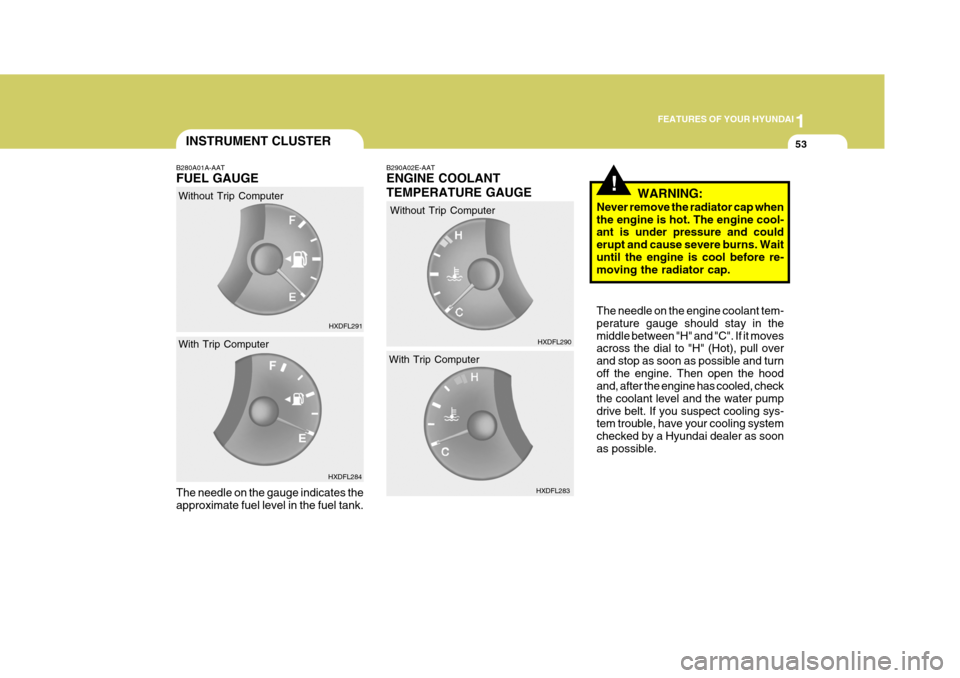
B280A01A-AAT FUEL GAUGE The needle on the gauge indicates the approximate fuel level in the fuel tank. B290A02E-AAT ENGINE COOLANT TEMPERATURE GAUGE
Without Trip Computer With Trip Computer HXDFL291
HXDFL290
HXDFL284 HXDFL283
Without Trip Computer
With Trip Computer WARNING:
Never remove the radiator cap when the engine is hot. The engine cool- ant is under pressure and could erupt and cause severe burns. Waituntil the engine is cool before re- moving the radiator cap. The needle on the engine coolant tem- perature gauge should stay in themiddle between "H" and "C". If it moves across the dial to "H" (Hot), pull over and stop as soon as possible and turnoff the engine. Then open the hood and, after the engine has cooled, check the coolant level and the water pumpdrive belt. If you suspect cooling sys- tem trouble, have your cooling system checked by a Hyundai dealer as soonas possible.
INSTRUMENT CLUSTER
Page 173 of 277

2 DRIVING YOUR HYUNDAI
20
C160H01A-AAT Use Approved Anti-Freeze in Window Washer System To keep the water in the window washer system from freezing, add an approvedanti-freeze solution in accordance with instructions on the container. Window washer anti-freeze is available fromHyundai dealers and most auto parts outlets. Do not use engine coolant or other types of anti-freeze as thesemay damage the finish.
C160G02A-GAT To Keep Locks from Freezing To keep the locks from freezing, squirt an approved de-icer fluid or glycerineinto the key opening. If a lock is cov- ered with ice, squirt it with an approved de-icing fluid to remove the ice. If thelock is frozen internally, you may be able to thaw it out by using a heated key. Handle the heated key with careto avoid injury. NOTE: The proper temperature for using the immobilizer key is from -40°C (- 40°F) to 80°C(176°F). If you heat the immobilizer key over 80°C to openthe frozen lock, it may cause dam- age to the transponder in its head.
C160D01A-AAT Check Battery and Cables Winter puts additional burdens on the battery system. Visually inspect thebattery and cables as described in Section 6. The level of charge in your battery can be checked by your Hyundaidealer or a service station. C160F01A-AAT Check Spark Plugs and Ignition System Inspect your spark plugs as described in Section 6 and replace them if neces-sary. Also check all ignition wiring and components to be sure they are not cracked, worn or damaged in any way.
C160E01A-AAT Change to "Winter Weight" Oil if Necessary In some climates it is recommended that a lower viscosity "winter weight" oil be used during cold weather. See Section 9 for recommendations. If youaren't sure what weight oil you should use, consult your Hyundai dealer.
Page 176 of 277
2
DRIVING YOUR HYUNDAI
23
NOTE: If you tow a trailer or vehicle, your car will require more frequent main- tenance due to the additional load.See "Maintenance Under Severe Usage Conditions" on page 5-7.
CAUTION:
o Never connect a trailer brake sys- tem directly to the vehicle brakesystem.
o When towing a trailer on steep grades (in excess of 12%) pay close attention to the engine cool-ant temperature gauge to ensure the engine does not overheat. If the needle of the coolant tem-perature gauge moves across the dial towards "H" (HOT), pull over and stop as soon as it is safe todo so, and allow the engine to idle until it cools down. You may proceed once the engine hascooled sufficiently.
! C190D01A-GAT Safety Chains Should the hitch connection between your car and the trailer or vehicle youare towing fail, the trailer or vehicle could wander dangerously across other lanes of traffic and ultimately collidewith another vehicle. To eliminate this potentially dangerous situation, safety chains, attached between your car andthe trailer or towed vehicle, are re- quired in most provinces.
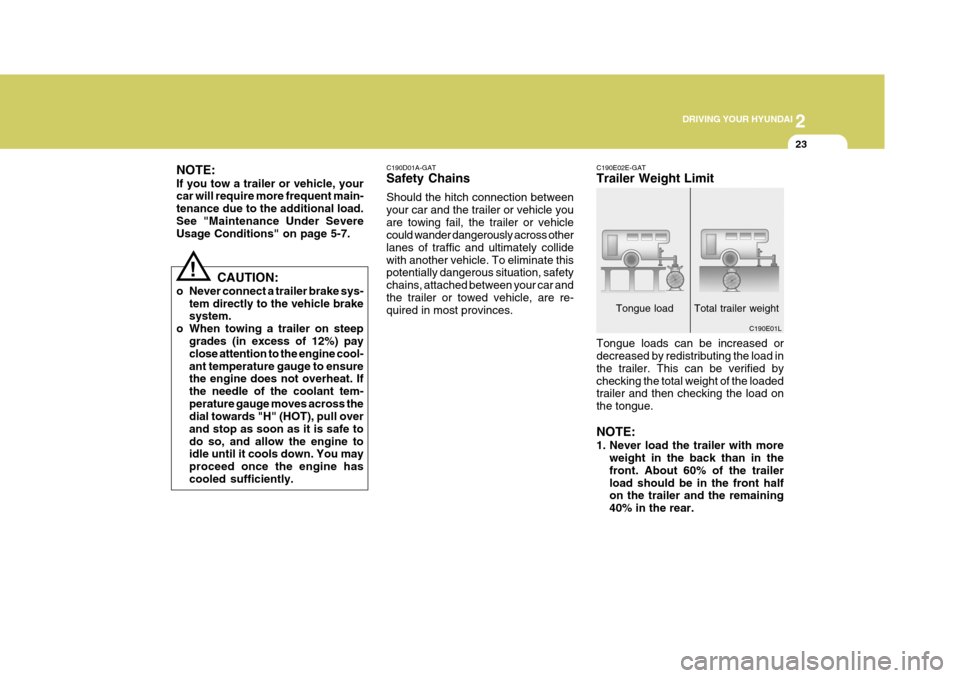
C190E02E-GAT Trailer Weight Limit
Tongue load Total trailer weight C190E01L
Tongue loads can be increased or decreased by redistributing the load in the trailer. This can be verified bychecking the total weight of the loaded trailer and then checking the load on the tongue. NOTE:
1. Never load the trailer with more weight in the back than in the front. About 60% of the trailerload should be in the front half on the trailer and the remaining 40% in the rear.
Page 183 of 277
3 WHAT TO DO IN AN EMERGENCY
4IF THE ENGINE OVERHEATS
D030A02A-AAT If your temperature gauge indicates overheating, you experience a loss of power, or hear loud pinging or knock- ing, the engine is probably too hot. Ifthis happens to you, you should:
1. Pull off the road and stop as soon as it is safe to do so.
2. Place the gear selector lever in "P"
(automatic) or neutral (manual transaxle) and set the parking brake. If the air conditioning is on, turn it off.
3. If engine coolant is running out un- der the car or steam is coming outfrom the hood, stop the engine. Donot open the hood until the engine coolant has stopped running or the steaming has stopped. If there is novisible loss of engine coolant and no steam, leave the engine running and check to be sure the enginecooling fan is operating. If the fan is not running, turn the engine off.
4. Check to see if the water pump drive belt is missing. If it is not missing,check to see that it is tight. If the drive belt seems to be satisfactory,
3. Attach the clamps of the jumper
cable in the exact location shown.first, attach one clamp of the jumper cable to the positive (+) post or cable of the discharged battery. Thenattach the other end of the same cable to the positive (+) post or cable of the booster battery. Next,using the other cable, attach one clamp to the negative (-) post or cable of the booster battery. Thenattach the other end of that cable to a solid metal part of the engine away from the battery. Do not con-nect the cable to any moving part.
4. Start the engine in the car with the
booster battery and let it run for afew minutes. This will help to as- sure that the booster battery is fully charged. During the jumping opera-tion, run the engine in this vehicle at about 2,000 rpm.
5. Start the engine in the car with the discharged battery using the nor-mal starting procedure. After the engine starts, leave the jumpercables connected and let the engine run at fast idle or about 2,000 rpm for several minutes. 6. Carefully remove the jumper cables
in the reverse order of attachment.
If you do not know why your batterybecame discharged (because the lightswere left on, etc.), have the charging system checked by your Hyundai dealer.
Page 184 of 277
3
WHAT TO DO IN AN EMERGENCY
5
!
!
!
check for coolant leaking from the radiator, hoses or under the car. (Ifthe air conditioning had been in use, it is normal for cold water to be draining from it when you stop).
WARNING:
While the engine is running, keephair, hands, and clothing away from moving parts such as the fan and drive belts to prevent injury. 5. If the water pump drive belt is broken
or coolant is leaking out, stop the engine immediately and call the near- est Hyundai dealer for assistance.
WARNING:
Do not remove the radiator cap when the engine is hot. This can allow coolant to be blown out of the open-ing and cause serious burns.
WARNING (Diesel only):
Never work on injection system withengine running or within 30 sec- onds after shutting off engine. High pressure pump, rail, injectors andhigh pressure pipes are subject to high pressure even after the engine stopped. The fuel jet produced byfuel leaks may cause serious in- jury, if it touch the body. People using pacemakers should not movethan 30cm closer to the ECU or wiring harness within the engine
!
6. If you cannot find the cause of the overheating, wait until the engine temperature has returned to nor-mal. Then, if the engine coolant has been lost, carefully add coolant to the reservoir (page 6-16) to bringthe fluid level in the reservoir up to the halfway mark. CAUTION:
Serious loss of engine coolant indi- cates there is a leak in the coolingsystem and this should be checked as soon as possible by a Hyundai dealer.
room while engine is running, sincethe high currents in the CommonRail system produce considerable magnetic fields.
7. Proceed with caution, keeping alert
for further signs of overheating. If overheating happens again, call a Hyundai dealer for assistance.
Page 208 of 277

5VEHICLE MAINTENANCE REQUIREMENTS
10
F070F01A-AAT
o Brake Hoses and Lines
Visually check for proper installation, chafing, cracks, deterioration and anyleakage. Replace any deteriorated or damaged parts immediately. F070G02A-AAT
o Brake Fluid
Check brake fluid level in the brake fluid reservoir. The level should be between "MIN" and "MAX" marks on the side of the reservoir. Use onlyhydraulic brake fluid conforming to DOT 3 or DOT 4.
F070H01A-AAT
o Rear Brake Drums/Linings,
Parking Brake
Check the rear brake drums and lin-
ings for scoring, burning, leaking fluid, broken parts, and excessive wear. Inspect the parking brake system in- cluding the parking brake lever andcables. For detailed service proce- dures, refer to the Shop Manual.
F070D01A-AAT
o Manual Transaxle Oil Inspect the manual transaxle oil ac- cording to the maintenance schedule. NOTE: If the oil level is low, check for possible leaks before adding oil.Do not overfill.
F070C02A-AAT
o Coolant The coolant should be changed at the intervals specified in the mainte- nance schedule.
F070E06A-AAT
o Automatic Transaxle Fluid
The fluid level should be in the "HOT" range of the dipstick, after the engine and transaxle are at normal operating temperature. Check the automatictransaxle fluid level with the engine running and the transaxle in neutral, with the parking brake properly ap-plied. Use HYUNDAI GENUINE ATF SP III, DIAMOND ATF SP III, SK ATF SP III or other brands approved byHyundai Motor Co., when adding or changing fluid. Using the wrong ATF may result in damage to the ATM.
Page 220 of 277
6
DO-IT-YOURSELF MAINTENANCE
11CHANGING THE OIL AND FILTER
!
G040A04FC-GAT
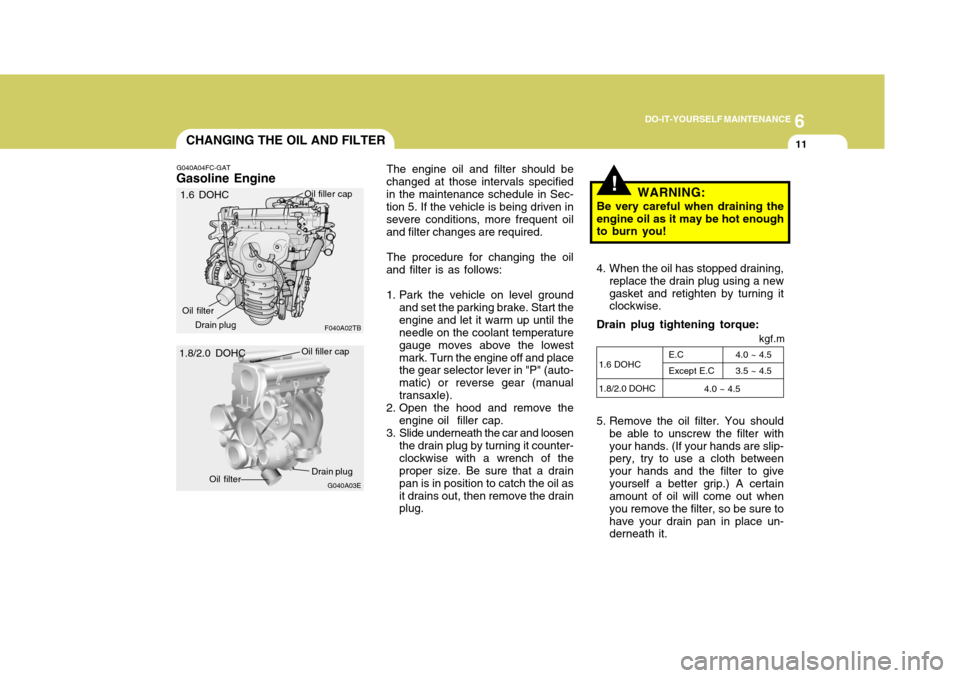
Gasoline Engine
G040A03EThe engine oil and filter should be
changed at those intervals specified in the maintenance schedule in Sec- tion 5. If the vehicle is being driven in severe conditions, more frequent oiland filter changes are required.
The procedure for changing the oil
and filter is as follows:
1. Park the vehicle on level ground
and set the parking brake. Start the engine and let it warm up until the needle on the coolant temperature gauge moves above the lowestmark. Turn the engine off and place the gear selector lever in "P" (auto- matic) or reverse gear (manualtransaxle).
2. Open the hood and remove the engine oil filler cap.
3. Slide underneath the car and loosen
the drain plug by turning it counter-clockwise with a wrench of the proper size. Be sure that a drain pan is in position to catch the oil asit drains out, then remove the drain plug. WARNING:
Be very careful when draining the engine oil as it may be hot enough to burn you!
4. When the oil has stopped draining, replace the drain plug using a new gasket and retighten by turning it clockwise.
Drain plug tightening torque:
Oil filler cap
Drain plug
Oil filter
1.6 DOHC 1.8/2.0 DOHC 4.0 ~ 4.5 3.5 ~ 4.5
E.CExcept E.C
4.0 ~ 4.5
5. Remove the oil filter. You should be able to unscrew the filter with your hands. (If your hands are slip- pery, try to use a cloth between your hands and the filter to giveyourself a better grip.) A certain amount of oil will come out when you remove the filter, so be sure tohave your drain pan in place un- derneath it. kgf.m
F040A02TB
Oil filler cap
Drain plug
Oil filter
1.8/2.0 DOHC 1.6 DOHC
Page 221 of 277
6 DO-IT-YOURSELF MAINTENANCE
12
!
G040B03FC-GAT
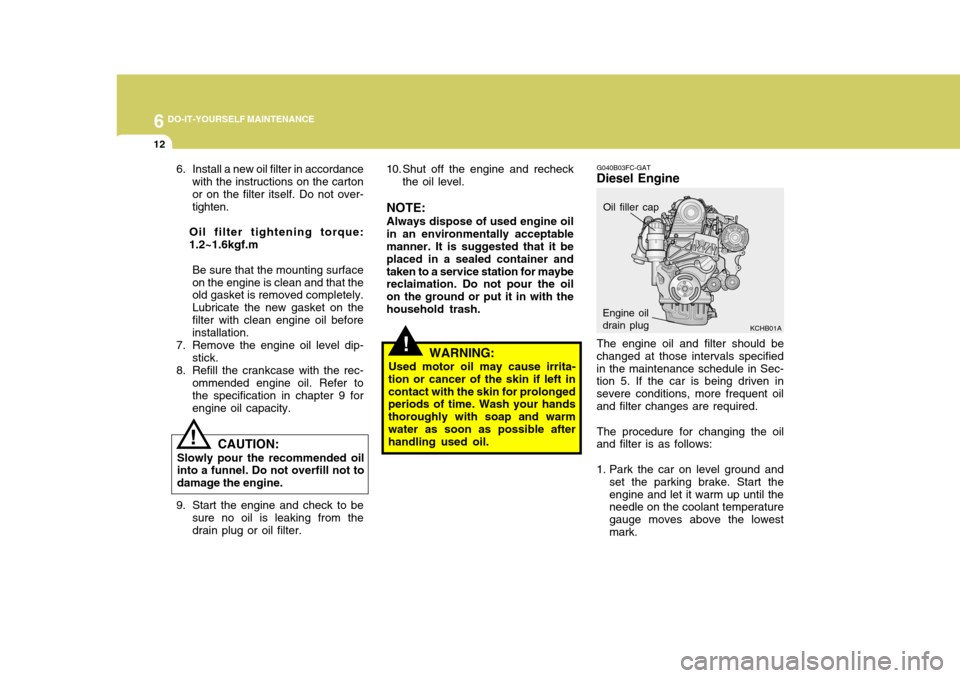
Diesel Engine
KCHB01A
The engine oil and filter should be
changed at those intervals specified in the maintenance schedule in Sec- tion 5. If the car is being driven in severe conditions, more frequent oiland filter changes are required.
The procedure for changing the oil
and filter is as follows:
1. Park the car on level ground and
set the parking brake. Start the engine and let it warm up until the needle on the coolant temperature gauge moves above the lowestmark.
10. Shut off the engine and recheck
the oil level.
NOTE: Always dispose of used engine oil in an environmentally acceptable manner. It is suggested that it be placed in a sealed container andtaken to a service station for maybe reclaimation. Do not pour the oil on the ground or put it in with thehousehold trash.
6. Install a new oil filter in accordance
with the instructions on the cartonor on the filter itself. Do not over- tighten.
Oil filter tightening torque: 1.2~1.6kgf.m Be sure that the mounting surfaceon the engine is clean and that the old gasket is removed completely. Lubricate the new gasket on thefilter with clean engine oil before installation.
7. Remove the engine oil level dip- stick.
8. Refill the crankcase with the rec- ommended engine oil. Refer tothe specification in chapter 9 for engine oil capacity. WARNING:
Used motor oil may cause irrita-
tion or cancer of the skin if left incontact with the skin for prolonged periods of time. Wash your hands thoroughly with soap and warmwater as soon as possible after handling used oil.
Oil filler cap
Engine oil drain plug
! CAUTION:
Slowly pour the recommended oil into a funnel. Do not overfill not to damage the engine.
9. Start the engine and check to be sure no oil is leaking from the drain plug or oil filter.
Page 224 of 277
6
DO-IT-YOURSELF MAINTENANCE
15
Water
65% 60%50%40%
35%40%50%60%
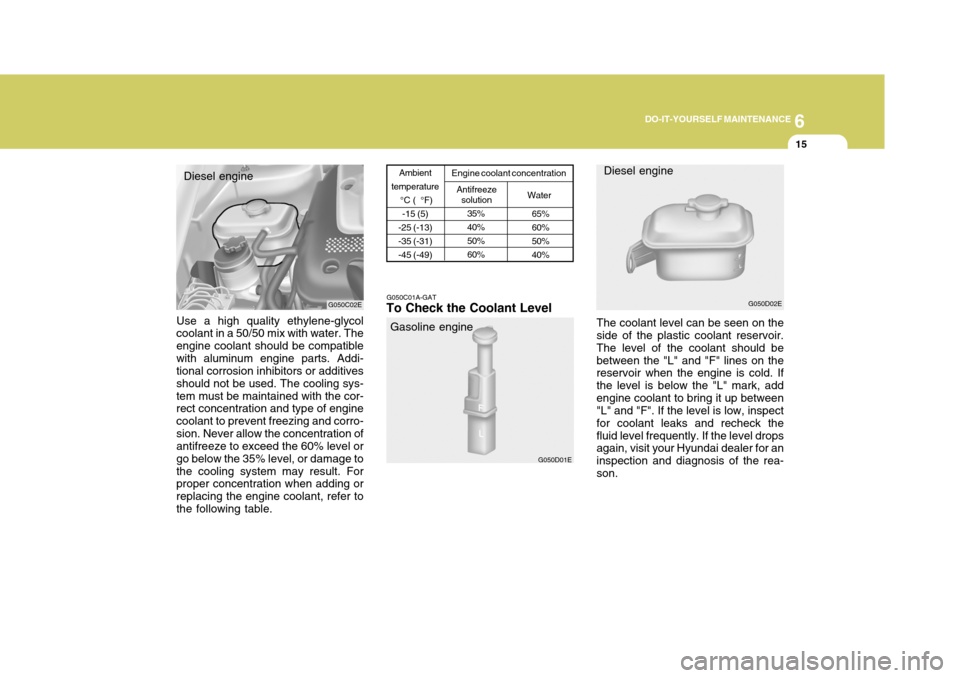
Use a high quality ethylene-glycol coolant in a 50/50 mix with water. The engine coolant should be compatiblewith aluminum engine parts. Addi- tional corrosion inhibitors or additives should not be used. The cooling sys-tem must be maintained with the cor- rect concentration and type of engine coolant to prevent freezing and corro-sion. Never allow the concentration of antifreeze to exceed the 60% level or go below the 35% level, or damage tothe cooling system may result. For proper concentration when adding or replacing the engine coolant, refer tothe following table. G050C02E
Diesel engine
G050C01A-GAT
To Check the Coolant Level
The coolant level can be seen on the side of the plastic coolant reservoir. The level of the coolant should bebetween the "L" and "F" lines on the reservoir when the engine is cold. If the level is below the "L" mark, addengine coolant to bring it up between "L" and "F". If the level is low, inspect for coolant leaks and recheck thefluid level frequently. If the level drops again, visit your Hyundai dealer for an inspection and diagnosis of the rea-son.
G050D01E G050D02E
Gasoline engine Diesel engine
Ambient
temperature °C ( °F)-15 (5)
-25 (-13) -35 (-31)-45 (-49) Engine coolant concentration
Antifreezesolution
Page 226 of 277
6
DO-IT-YOURSELF MAINTENANCE
17
!
SPARK PLUGS
G060A01L
G060B02S-GAT
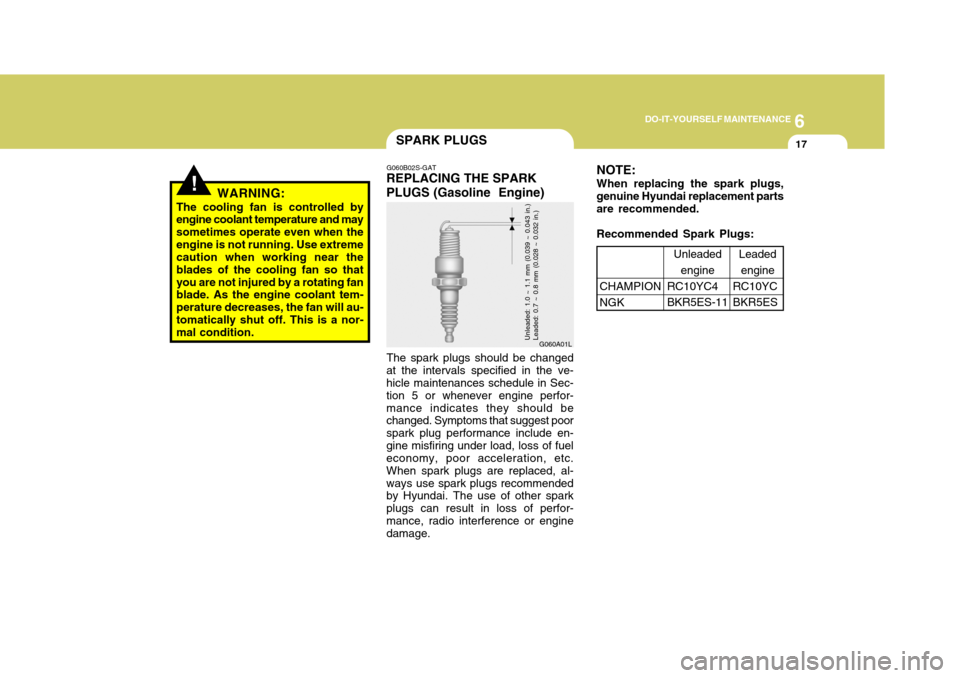
REPLACING THE SPARK PLUGS (Gasoline Engine)
The spark plugs should be changed
at the intervals specified in the ve- hicle maintenances schedule in Sec- tion 5 or whenever engine perfor-mance indicates they should be changed. Symptoms that suggest poor spark plug performance include en-gine misfiring under load, loss of fuel economy, poor acceleration, etc. When spark plugs are replaced, al-ways use spark plugs recommended by Hyundai. The use of other spark plugs can result in loss of perfor-mance, radio interference or engine damage.Unleaded: 1.0 ~ 1.1 mm (0.039 ~ 0.043 in.) Leaded: 0.7 ~ 0.8 mm (0.028 ~ 0.032 in.)
NOTE: When replacing the spark plugs, genuine Hyundai replacement partsare recommended. Recommended Spark Plugs:
CHAMPION NGK Leaded
engine
RC10YCBKR5ES
Unleaded
engine
RC10YC4BKR5ES-11
WARNING:
The cooling fan is controlled by engine coolant temperature and may sometimes operate even when theengine is not running. Use extreme caution when working near the blades of the cooling fan so thatyou are not injured by a rotating fan blade. As the engine coolant tem- perature decreases, the fan will au-tomatically shut off. This is a nor- mal condition.