brakes Hyundai Elantra 2010 Owner's Guide
[x] Cancel search | Manufacturer: HYUNDAI, Model Year: 2010, Model line: Elantra, Model: Hyundai Elantra 2010Pages: 348, PDF Size: 5.78 MB
Page 265 of 348
621
What to do in an emergency
When towing your vehicle in an emer-
gency without wheel dollies :
1. Set the ignition switch in the ACC posi-tion.
2. Place the transaxle shift lever in N (Neutral).
3. Release the parking brake.
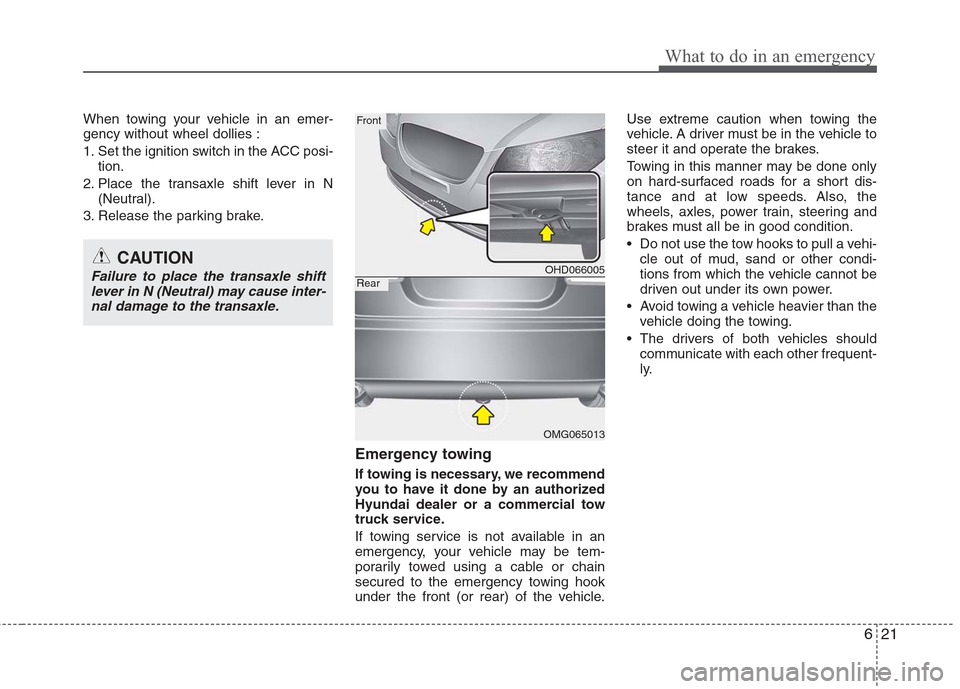
Emergency towing
If towing is necessary, we recommend
you to have it done by an authorized
Hyundai dealer or a commercial tow
truck service.
If towing service is not available in an
emergency, your vehicle may be tem-
porarily towed using a cable or chain
secured to the emergency towing hook
under the front (or rear) of the vehicle. Use extreme caution when towing the
vehicle. A driver must be in the vehicle to
steer it and operate the brakes.
Towing in this manner may be done only
on hard-surfaced roads for a short dis-
tance and at low speeds. Also, the
wheels, axles, power train, steering and
brakes must all be in good condition.
Do not use the tow hooks to pull a vehi-
cle out of mud, sand or other condi-
tions from which the vehicle cannot be
driven out under its own power.
Avoid towing a vehicle heavier than the vehicle doing the towing.
The drivers of both vehicles should communicate with each other frequent-
ly.
CAUTION
Failure to place the transaxle shiftlever in N (Neutral) may cause inter-nal damage to the transaxle.
OHD066005
OMG065013
Front
Rear
Page 267 of 348
623
What to do in an emergency
Emergency towing precautions
Turn the ignition switch to ACC so thesteering wheel isn’t locked.
Place the transaxle shift lever in N (Neutral).
Release the parking bake.
Press the brake pedal with more force than normal since you will have
reduced brake performance.
More steering effort will be required because the power steering system
will be disabled.
If you are driving down a long hill, the brakes may overheat and brake per-
formance will be reduced. Stop often
and let the brakes cool off.
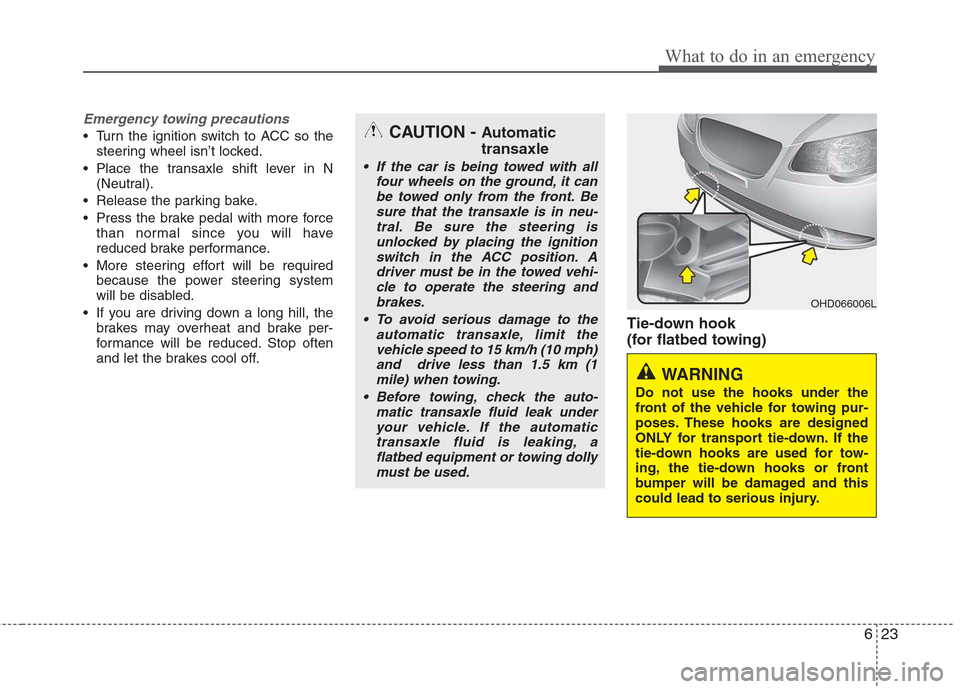
Tie-down hook
(for flatbed towing)
OHD066006L
WARNING
Do not use the hooks under the
front of the vehicle for towing pur-
poses. These hooks are designed
ONLY for transport tie-down. If the
tie-down hooks are used for tow-
ing, the tie-down hooks or front
bumper will be damaged and this
could lead to serious injury.
CAUTION - Automatic
transaxle
If the car is being towed with all four wheels on the ground, it canbe towed only from the front. Besure that the transaxle is in neu-tral. Be sure the steering isunlocked by placing the ignition switch in the ACC position. Adriver must be in the towed vehi-cle to operate the steering andbrakes.
To avoid serious damage to the automatic transaxle, limit thevehicle speed to 15 km/h (10 mph)and drive less than 1.5 km (1mile) when towing.
Before towing, check the auto- matic transaxle fluid leak underyour vehicle. If the automatictransaxle fluid is leaking, aflatbed equipment or towing dollymust be used.
Page 268 of 348
7
Engine compartment / 7-2
Maintenance services / 7-3
Owner maintenance / 7-5
Scheduled maintenance service / 7-7
Explanation of scheduled maintenance items / 7-12
Engine oil / 7-15
Engine coolant / 7-16
Brakes and clutch fluid / 7-19
Automatic transaxle fluid / 7-20
Washer fluid / 7-22
Parking brake / 7-22
Air cleaner / 7-23
Climate control air filter / 7-25
Wiper blades / 7-27
Battery / 7-29
Tires and wheels / 7-32
Fuses / 7-45
Light bulbs / 7-54
Appearance care / 7-59
Emission control system / 7-65
California perchlorate notice / 7-67
Maintenance
Page 274 of 348
77
Maintenance
SCHEDULED MAINTENANCE SERVICE
Follow Normal Maintenance Schedule if
the vehicle is usually operated where
none of the following conditions apply. If
any of the following conditions apply, fol-
low Maintenance Under Severe Usage
Conditions.
Repeated short distance driving.
Driving in dusty conditions or sandyareas.
Extensive use of brakes.
Driving in areas where salt or other corrosive materials are being used.
Driving on rough or muddy roads.
Driving in mountainous areas.
Extended periods of idling or low speed operation.
Driving for a prolonged period in cold temperatures and/or extremely humid
climates.
More than 50% driving in heavy city traffic during hot weather above 90°F
(32°C).If your vehicle is operated under theabove conditions, you should inspect,replace or refill more frequently than thefollowing Normal Maintenance Schedule. After 120 month or 150,000 miles(240,000 km) continue to follow the pre-scribed maintenance intervals.
Page 286 of 348
719
Maintenance
BRAKES AND CLUTCH (IF EQUIPPED) FLUID
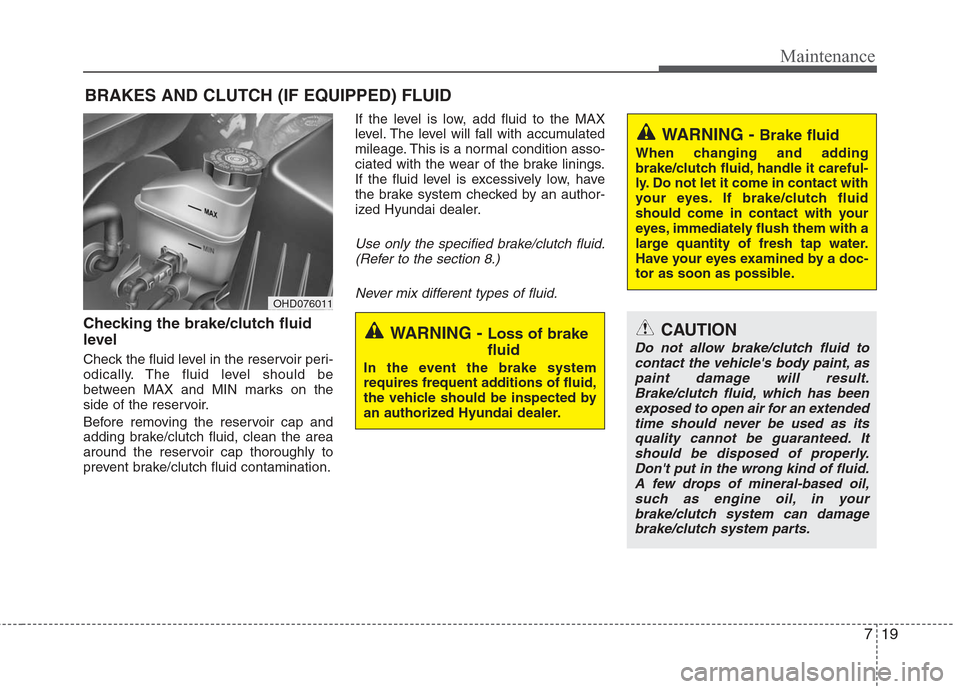
Checking the brake/clutch fluid
level
Check the fluid level in the reservoir peri-
odically. The fluid level should be
between MAX and MIN marks on the
side of the reservoir.
Before removing the reservoir cap and
adding brake/clutch fluid, clean the area
around the reservoir cap thoroughly to
prevent brake/clutch fluid contamination.If the level is low, add fluid to the MAX
level. The level will fall with accumulated
mileage. This is a normal condition asso-
ciated with the wear of the brake linings.
If the fluid level is excessively low, have
the brake system checked by an author-
ized Hyundai dealer.
Use only the specified brake/clutch fluid.
(Refer to the section 8.)
Never mix different types of fluid.
WARNING - Brake fluid
When changing and adding
brake/clutch fluid, handle it careful-
ly. Do not let it come in contact with
your eyes. If brake/clutch fluid
should come in contact with your
eyes, immediately flush them with a
large quantity of fresh tap water.
Have your eyes examined by a doc-
tor as soon as possible.
WARNING - Loss of brake
fluid
In the event the brake system
requires frequent additions of fluid,
the vehicle should be inspected by
an authorized Hyundai dealer.
OHD076011
CAUTION
Do not allow brake/clutch fluid tocontact the vehicle's body paint, aspaint damage will result.Brake/clutch fluid, which has been exposed to open air for an extendedtime should never be used as itsquality cannot be guaranteed. Itshould be disposed of properly.Don't put in the wrong kind of fluid. A few drops of mineral-based oil,such as engine oil, in your brake/clutch system can damagebrake/clutch system parts.
Page 327 of 348
Maintenance
60
7
APPEARANCE CARE
Exterior care
Exterior general caution
It is very important to follow the label
directions when using any chemical
cleaner or polish. Read all warning and
caution statements that appear on the
label.
Finish maintenance
Washing
To help protect your vehicle’s finish from
rust and deterioration, wash it thoroughly
and frequently at least once a month with
lukewarm or cold water.
If you use your vehicle for off-road driv-
ing, you should wash it after each off-
road trip. Pay special attention to the
removal of any accumulation of salt, dirt,
mud, and other foreign materials. Make
sure the drain holes in the lower edges of
the doors and rocker panels are kept
clear and clean.
Insects, tar, tree sap, bird droppings,
industrial pollution and similar deposits
can damage your vehicle’s finish if not
removed immediately.
Even prompt washing with plain water
may not completely remove all these
deposits. A mild soap, safe for use on
painted surfaces, may be used. After washing, rinse the vehicle thor-
oughly with lukewarm or cold water. Do
not allow soap to dry on the finish.
WARNING - Wet brakes
After washing the vehicle, test the
brakes while driving slowly to see if
they have been affected by water. If
braking performance is impaired,
dry the brakes by applying them
lightly while maintaining a slow for-
ward speed.
CAUTION
Do not use strong soap, chemical
detergents or hot water, and donot wash the vehicle in directsunlight or when the body of thevehicle is warm.
Be careful when washing the side windows of your vehicle.Especially, with high-pressure water. Water may leak through thewindows and wet the interior.
To prevent damage to the plastic parts, do not clean with chemicalsolvents or strong detergents.
CAUTION
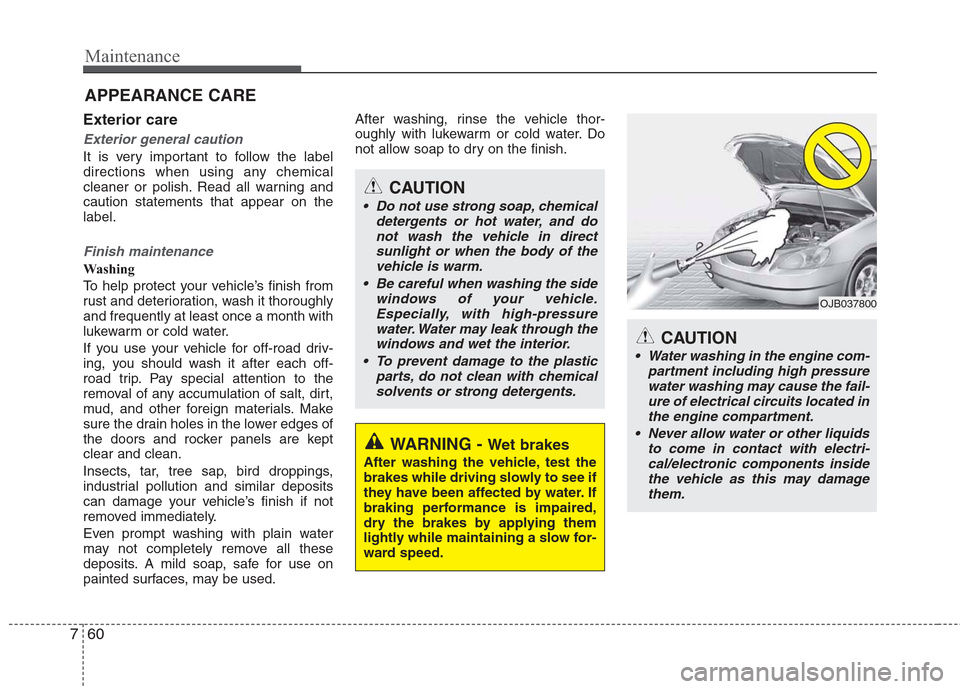
Water washing in the engine com- partment including high pressurewater washing may cause the fail-ure of electrical circuits located inthe engine compartment.
Never allow water or other liquids to come in contact with electri-cal/electronic components insidethe vehicle as this may damagethem.
OJB037800
Page 328 of 348
761
Maintenance
Waxing
Wax the vehicle when water will no
longer bead on the paint.
Always wash and dry the vehicle before
waxing. Use a good quality liquid or
paste wax, and follow the manufacturer’s
instructions. Wax all metal trim to protect
it and to maintain its luster.
Removing oil, tar, and similar materials
with a spot remover will usually strip the
wax from the finish. Be sure to re-wax
these areas even if the rest of the vehicle
does not yet need waxing.Finish damage repair
Deep scratches or stone chips in the
painted surface must be repaired
promptly. Exposed metal will quickly rust
and may develop into a major repair
expense.
✽ ✽NOTICE
If your vehicle is damaged and requires
any metal repair or replacement, be sure
the body shop applies anti-corrosion
materials to the parts repaired or
replaced.
Bright-metal maintenance
To remove road tar and insects, use a
tar remover, not a scraper or other
sharp object.
To protect the surfaces of bright-metal parts from corrosion, apply a coating of
wax or chrome preservative and rub to
a high luster.
During winter weather or in coastal areas, cover the bright metal parts with
a heavier coating of wax or preserva-
tive. If necessary, coat the parts with
non-corrosive petroleum jelly or other
protective compound.
Underbody maintenance
Corrosive materials used for ice and
snow removal and dust control may col-
lect on the underbody. If these materials
are not removed, accelerated rusting can
occur on underbody parts such as the
fuel lines, frame, floor pan and exhaust
system, even though they have been
treated with rust protection.
Thoroughly flush the vehicle underbody
and wheel openings with lukewarm or
cold water once a month, after off-road
driving and at the end of each winter. Pay
special attention to these areas because
it is difficult to see all the mud and dirt. It
will do more harm than good to wet down
the road grime without removing it. The
lower edges of doors, rocker panels, and
frame members have drain holes that
should not be allowed to clog with dirt;
trapped water in these areas can cause
rusting.
CAUTION
Wiping dust or dirt off the body with a dry cloth will scratch thefinish.
Do not use steel wool, abrasive cleaners, or strong detergentscontaining highly alkaline orcaustic agents on chrome-platedor anodized aluminum parts. This may result in damage to the pro-tective coating and cause discol-oration or paint deterioration.
WARNING
After washing the vehicle, test the
brakes while driving slowly to see if
they have been affected by water. If
braking performance is impaired,
dry the brakes by applying them
lightly while maintaining a slow for-
ward speed.
Page 345 of 348

Index
2I
Air cleaner ··················\
··················\
··················\
············· 7-23
Airbag-advanced supplemental restraint system ········· 3-30Driver's and passenger's front air bag ··················\
···· 3-39
SRS components and functions ··················\
············· 3-31
Occupant classification system ··················\
·············· 3-33
Side air bag ···············\
··················\
··················\
············ 3-44
Curtain air bag ··················\
··················\
··················\
···· 3-45
Air bag warning label ··················\
··················\
··········· 3-56
Appearance care ··················\
··················\
··················\
···· 7-60
Audio system ··················\
··················\
··················\
········· 4-92
Automatic climate control system ··················\
············· 4-75
Automatic transaxle ··················\
··················\
················· 5-10 Ignition key interlock system ··················\
················· 5-14
Automatic transaxle operation ··················\
··············· 5-11
Transaxle ranges ··················\
··················\
··················\
· 5-12
Shift lock system ··················\
··················\
··················\
5-14
Automatic transaxle fluid ··················\
··················\
········ 7-20
Battery ················\
··················\
··················\
··················\
··· 7-29
Before driving ··················\
··················\
··················\
·········· 5-3
Binding arbitration (U.S.A only) ··················\
················· 8-9
Brake system ··················\
··················\
··················\
········· 5-16 Anti-lock brake system (ABS) ··················\
··············· 5-19
Parking brake ··················\
··················\
··················\
····· 5-18
Power brakes ··················\
··················\
··················\
······ 5-16 Brakes and clutch fluid ··················\
··················\
············ 7-19
Bulb wattage ··················\
··················\
··················\
············ 8-2
California perchlorate notice ··················\
··················\
·····7-67
Child restraint system ··················\
··················\
·············· 3-22
Tether anchor system ··················\
··················\
··········· 3-26
Child seat lower anchors ··················\
··················\
······ 3-28
Placing a passenger seat belt into the auto lock
mode ·················\
··················\
··················\
··················\
·· 3-24
Climate control air filter ··················\
··················\
·········· 7-25
Consumer information ··················\
··················\
··············· 8-8
Cruise control system ··················\
··················\
·············· 5-26
Defroster ················\
··················\
··················\
··················\
4-65
Dimensions ················\
··················\
··················\
················ 8-2
Door locks ··················\
··················\
··················\
··············· 4-8 Central door lock switch ··················\
··················\
········ 4-9
Child-protector rear door lock ··················\
················ 4-11
Economical operation ··················\
··················\
·············· 5-30
Emergency starting ··················\
··················\
··················\
·· 6-4
Emission control system ··················\
··················\
·········· 7-65
Engine compartment ··················\
··················\
··················\
7-2
A
B
C
D
E
Page 347 of 348

Index
4I
Maintenance services ··················\
··················\
················· 7-3
Manual climate control system ··················\
················· 4-66
Manual transaxle ··················\
··················\
··················\
····· 5-7
Mirrors ················\
··················\
··················\
··················\
··· 4-29
Owner maintenance ··················\
··················\
··················\
· 7-5
Parking brake ··················\
··················\
··················\
········· 7-22
Recommended lubricants and capacities ··················\
····· 8-4
Remote keyless entry ··················\
··················\
················· 4-3
Reporting safety defects ··················\
··················\
············ 8-9
Road warning ··················\
··················\
··················\
··········· 6-2
Scheduled maintenance service ··················\
··················\
· 7-7
Seat ·················\
··················\
··················\
··················\
········· 3-2Armrest ················\
··················\
··················\
··················\
· 3-9
Headrest ················\
··················\
··················\
··················\
3-5 Front seat adjustment ··················\
··················\
············· 3-3
Rear seat adjustment ··················\
··················\
·············· 3-8
Seat warmer ··················\
··················\
··················\
·········· 3-7
Seat belts ··················\
··················\
··················\
················ 3-12 Seat belt precautions ··················\
··················\
············ 3-19
Care of seat belts ··················\
··················\
··················\
3-21
Driver's 3-point system ··················\
··················\
········ 3-14
Passenger's 3-point system ··················\
··················\
··· 3-15
3-point rear center belt ··················\
··················\
········· 3-15
Pre-tensioner belt ··················\
··················\
················· 3-16
Special driving conditions ··················\
··················\
······· 5-32
Starting the engine ··················\
··················\
··················\
··· 5-5
Steering wheel ··················\
··················\
··················\
······· 4-27
Storage compartment ··················\
··················\
··············· 4-85 Center console storage ··················\
··················\
········· 4-86
Glove box ··················\
··················\
··················\
··········· 4-86
Sunglass holder ··················\
··················\
··················\
·· 4-86
Sunroof ················\
··················\
··················\
··················\
·· 4-23
Theft-alarm system ··················\
··················\
··················\
·· 4-6
Tires and wheels ··················\
··················\
··············· 7-32, 8-3
Tires pressure monitoring system (TPMS)··················\
····6-7
Towing ·················\
··················\
··················\
··················\
·· 6-20 Tie-down hook ··················\
··················\
··················\
··· 6-23
Trailer towing ··················\
··················\
··················\
········ 5-39 Hitches ················\
··················\
··················\
··················\
5-40
Safety chains ··················\
··················\
··················\
······ 5-40
Trailer brakes ··················\
··················\
··················\
······ 5-40
M
S
O
P
R
T