Switch Hyundai Elantra 2010 Manual Online
[x] Cancel search | Manufacturer: HYUNDAI, Model Year: 2010, Model line: Elantra, Model: Hyundai Elantra 2010Pages: 348, PDF Size: 5.78 MB
Page 314 of 348
747
Maintenance
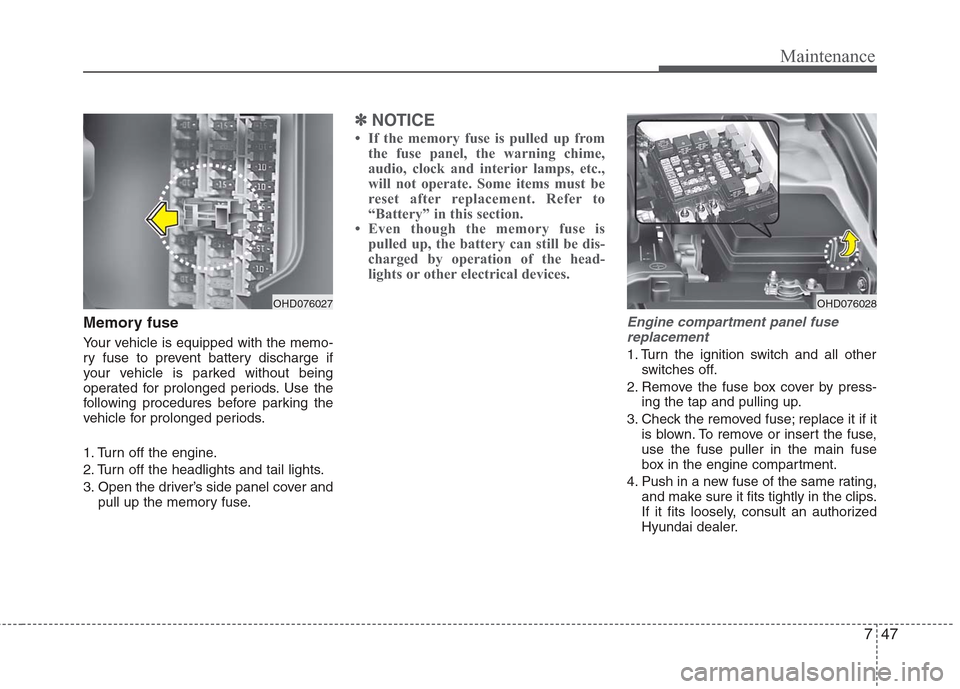
Memory fuse
Your vehicle is equipped with the memo-
ry fuse to prevent battery discharge if
your vehicle is parked without being
operated for prolonged periods. Use the
following procedures before parking the
vehicle for prolonged periods.
1. Turn off the engine.
2. Turn off the headlights and tail lights.
3. Open the driver’s side panel cover andpull up the memory fuse.
✽ ✽NOTICE
• If the memory fuse is pulled up from
the fuse panel, the warning chime,
audio, clock and interior lamps, etc.,
will not operate. Some items must be
reset after replacement. Refer to
“Battery” in this section.
• Even though the memory fuse is pulled up, the battery can still be dis-
charged by operation of the head-
lights or other electrical devices.
Engine compartment panel fuse
replacement
1. Turn the ignition switch and all other switches off.
2. Remove the fuse box cover by press- ing the tap and pulling up.
3. Check the removed fuse; replace it if it is blown. To remove or insert the fuse,
use the fuse puller in the main fuse
box in the engine compartment.
4. Push in a new fuse of the same rating, and make sure it fits tightly in the clips.
If it fits loosely, consult an authorized
Hyundai dealer.
OHD076027
OHD076028
Page 317 of 348

Maintenance
50
7
Driver's side fuse panel
Description Fuse rating Protected component
START 10A Ignition lock switch, Antitheft alarm, Transaxle range switch
A/CON SW 10A A/C control module
HTD MIRR 10A Outside heated mirror motor
SEAT HTR 15A Seat warmer switch
A/CON 10A Blower relay, A/C control module, Sunroof control module
HEAD LAMP 10A Head lamp relay
FR WIPER 25A Front wiper relay
RR WIPER 15A (Spare)
DRL 15A Daytime running lamp unit
WCS 10A Occupant classification sensor
P/WDW DR 25A Power window main switch, Rear power window switch(LH)
CLOCK 10A Digital clock, Audio
C/LIGHTER 15A Power outlet
DR LOCK 20A Sunroof control module, Door unlock/lock relay
DEICER 15A -
STOP 15A Stop lamp switch
ROOM LP 15A Trunk room lamp, Dome lamp, Map lamp, Digital clock, Home link
AUDIO 15A Audio
T/LID 15A Trunk lid relay
AMP 25A Amplifier
SAFETY P/WDW 25A Safety power window module
P/WDW ASS 25A Front & rear power window switch(RH), Power window main switch
P/OUTLET 15A Power outlet
T/SIG 10A Hazard switch
A/BAG IND 10A Airbag indicator(instrument cluster)
Page 318 of 348
751
Maintenance
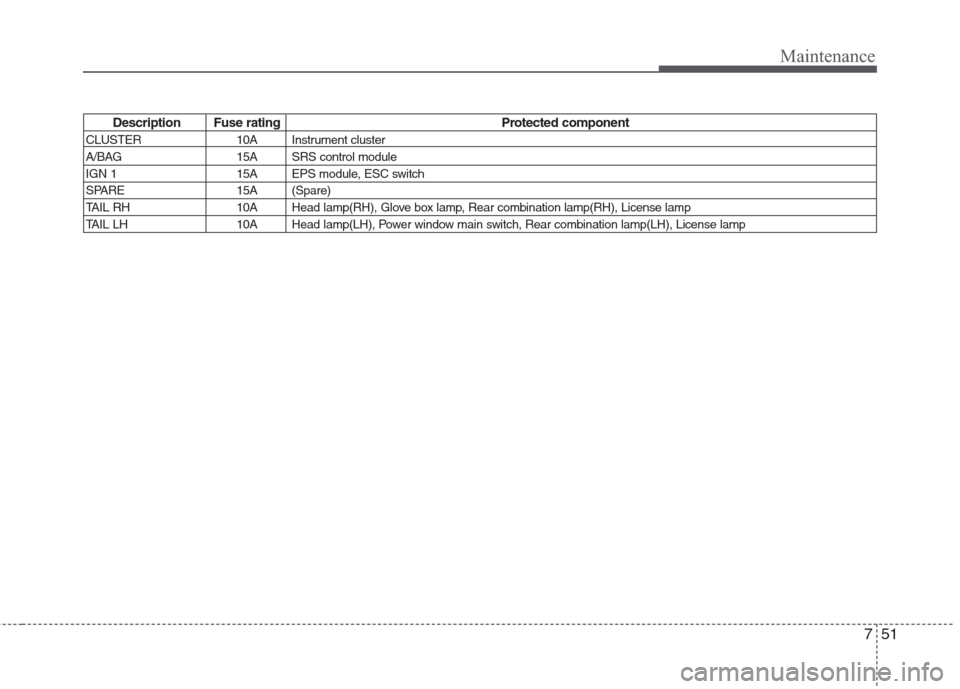
Description Fuse rating Protected component
CLUSTER 10A Instrument cluster
A/BAG 15A SRS control module
IGN 1 15A EPS module, ESC switch
SPARE 15A (Spare)
TAIL RH 10A Head lamp(RH), Glove box lamp, Rear combination lamp(RH), License lamp
TAIL LH 10A Head lamp(LH), Power window main switch, Rear combination lamp(LH), License lamp
Page 319 of 348

Maintenance
52
7
Engine compartment
Description Fuse rating Protected component
ALTERNATOR 150A Generator
EPS 80A EPS control module
ABS.2 20A ESC control module, ABS control module, Multi purpose check connector
ABS.1 40A ESC control module, ABS control module, Multi purpose check connector
B+.1 50A Instrument panel junction box
Fusible link RR HTD 40A Instrument panel junction box BLOWER 40A Blower relay
C/FAN 40A Condenser fan #1, 2 relay
B+.2 50A Instrument panel junction box
IGN.2 40A Ignition switch, Start relay
IGN.1 30A Ignition switch
ECU 30A Main relay, ECM
SPARE.1 20A (Spare)
FR FOG 15A Front fog lamp relay
A/CON 10A A/C relay
Fuse HAZARD 15A Hazard switch, Hazard relay F/PUMP 15A Fuel pump relay
INJ 15A A/C relay, Fuel pump relay, Injector #1,2,3,4, ECM, Idle speed actuator etc.
SNSR.2 10A Pulse generator 'A', 'B’, Stop lamp switch, Vehicle speed sensor etc.
HORN 15A Horn relay
Page 320 of 348
753
Maintenance
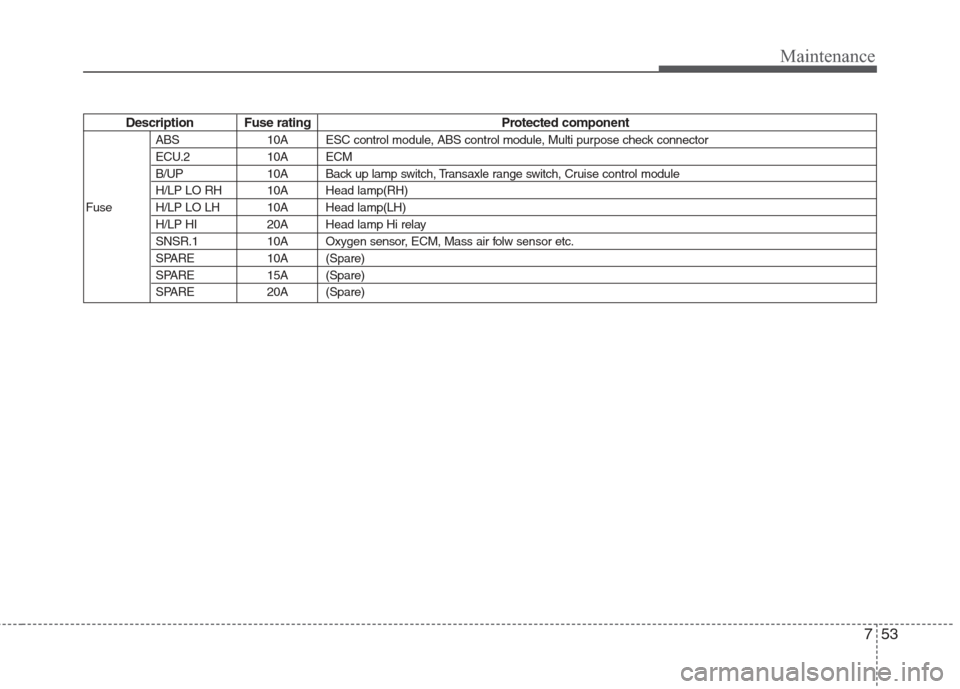
Description Fuse rating Protected component
ABS 10A ESC control module, ABS control module, Multi purpose check connector
ECU.2 10A ECM
B/UP 10A Back up lamp switch, Transaxle range switch, Cruise control module
H/LP LO RH 10A Head lamp(RH)
Fuse H/LP LO LH 10A Head lamp(LH) H/LP HI 20A Head lamp Hi relay
SNSR.1 10A Oxygen sensor, ECM, Mass air folw sensor etc.
SPARE 10A (Spare)
SPARE 15A (Spare)
SPARE 20A (Spare)
Page 321 of 348
Maintenance
54
7
LIGHT BULBS
Use only the bulbs of the specified
wattage.
✽
✽ NOTICE
After heavy, driving rain or washing,
headlight and taillight lenses could
appear frosty. This condition is caused by
the temperature difference between the
lamp inside and outside. This is similar to
the condensation on your windows inside
your vehicle during the rain and doesn’t
indicate a problem with your vehicle. If
the water leaks into the lamp bulb cir-
cuitry, have the vehicle checked by an
authorized Hyundai dealer.
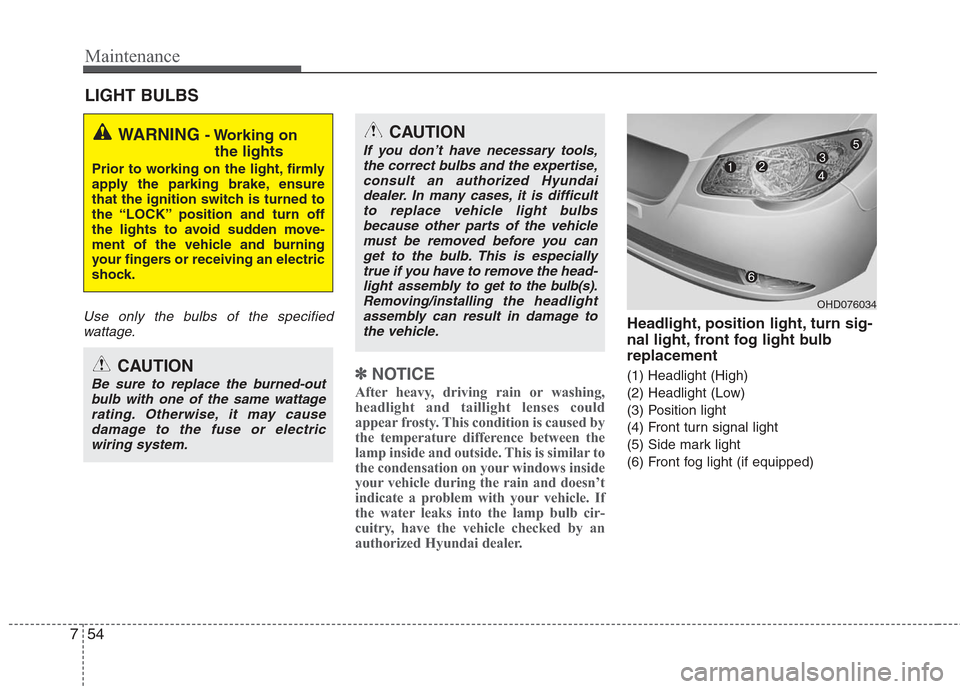
Headlight, position light, turn sig-
nal light, front fog light bulb
replacement
(1) Headlight (High)
(2) Headlight (Low)
(3) Position light
(4) Front turn signal light
(5) Side mark light
(6) Front fog light (if equipped)
WARNING - Working on
the lights
Prior to working on the light, firmly
apply the parking brake, ensure
that the ignition switch is turned to
the “LOCK” position and turn off
the lights to avoid sudden move-
ment of the vehicle and burning
your fingers or receiving an electric
shock.
CAUTION
Be sure to replace the burned-out
bulb with one of the same wattagerating. Otherwise, it may causedamage to the fuse or electric wiring system.
CAUTION
If you don’t have necessary tools,the correct bulbs and the expertise,consult an authorized Hyundaidealer. In many cases, it is difficultto replace vehicle light bulbsbecause other parts of the vehicle must be removed before you canget to the bulb. This is especiallytrue if you have to remove the head-light assembly to
get to the bulb(s).
Removing/installingthe headlight
assembly can result in damage to the vehicle.
OHD076034
Page 332 of 348
765
Maintenance
EMISSION CONTROL SYSTEM
The emission control system of your
vehicle is covered by a written limited
warranty. Please see the warranty infor-
mation contained in the Owner’s
Handbook & Warranty Information book-
let in your vehicle.
Your vehicle is equipped with an emis-
sion control system to meet all emission
regulations.
There are three emission control sys-
tems which are as follows.
(1) Crankcase emission control system
(2) Evaporative emission control system
(3) Exhaust emission control system
In order to assure the proper function of
the emission control systems, it is rec-
ommended that you have your car
inspected and maintained by an author-
ized Hyundai dealer in accordance with
the maintenance schedule in this manu-
al.Caution for the Inspection and
Maintenance Test (With Electronic
Stability Control (ESC) system)
To prevent the vehicle from misfir-
ing during dynamometer testing,
turn the Electronic Stability Control
(ESC) system off by pressing the
ESC switch.
After dynamometer testing is com- pleted, turn the ESC system back on
by pressing the ESC switch again.
1. Crankcase emission control system
The positive crankcase ventilation sys-
tem is employed to prevent air pollution
caused by blow-by gases being emitted
from the crankcase. This system supplies
fresh filtered air to the crankcase through
the air intake hose. Inside the crankcase,
the fresh air mixes with blow-by gases,
which then pass through the PCV valve
into the induction system.
2. Evaporative emission control(including ORVR: Onboard
Refueling Vapor Recovery)
System
The Evaporative Emission Control
System is designed to prevent fuel
vapors from escaping into the atmos-
phere.
(The ORVR system is designed to allow
the vapors from the fuel tank to be
loaded into a canister while refueling at
the gas station, preventing the escape of
fuel vapors into the atmosphere.)
Canister
Fuel vapors generated inside the fuel
tank are absorbed and stored in the
onboard canister. When the engine is
running, the fuel vapors absorbed in the
canister are drawn into the surge tank
through the purge control solenoid valve.
Purge Control Solenoid Valve (PCSV)
The purge control solenoid valve is con-
trolled by the Engine Control Module
(ECM); when the engine coolant temper-
ature is low during idling, the PCSV clos-
es so that evaporated fuel is not taken
into the engine. After the engine warms-
up during ordinary driving, the PCSV
opens to introduce evaporated fuel to the
engine.
Page 345 of 348

Index
2I
Air cleaner ··················\
··················\
··················\
············· 7-23
Airbag-advanced supplemental restraint system ········· 3-30Driver's and passenger's front air bag ··················\
···· 3-39
SRS components and functions ··················\
············· 3-31
Occupant classification system ··················\
·············· 3-33
Side air bag ···············\
··················\
··················\
············ 3-44
Curtain air bag ··················\
··················\
··················\
···· 3-45
Air bag warning label ··················\
··················\
··········· 3-56
Appearance care ··················\
··················\
··················\
···· 7-60
Audio system ··················\
··················\
··················\
········· 4-92
Automatic climate control system ··················\
············· 4-75
Automatic transaxle ··················\
··················\
················· 5-10 Ignition key interlock system ··················\
················· 5-14
Automatic transaxle operation ··················\
··············· 5-11
Transaxle ranges ··················\
··················\
··················\
· 5-12
Shift lock system ··················\
··················\
··················\
5-14
Automatic transaxle fluid ··················\
··················\
········ 7-20
Battery ················\
··················\
··················\
··················\
··· 7-29
Before driving ··················\
··················\
··················\
·········· 5-3
Binding arbitration (U.S.A only) ··················\
················· 8-9
Brake system ··················\
··················\
··················\
········· 5-16 Anti-lock brake system (ABS) ··················\
··············· 5-19
Parking brake ··················\
··················\
··················\
····· 5-18
Power brakes ··················\
··················\
··················\
······ 5-16 Brakes and clutch fluid ··················\
··················\
············ 7-19
Bulb wattage ··················\
··················\
··················\
············ 8-2
California perchlorate notice ··················\
··················\
·····7-67
Child restraint system ··················\
··················\
·············· 3-22
Tether anchor system ··················\
··················\
··········· 3-26
Child seat lower anchors ··················\
··················\
······ 3-28
Placing a passenger seat belt into the auto lock
mode ·················\
··················\
··················\
··················\
·· 3-24
Climate control air filter ··················\
··················\
·········· 7-25
Consumer information ··················\
··················\
··············· 8-8
Cruise control system ··················\
··················\
·············· 5-26
Defroster ················\
··················\
··················\
··················\
4-65
Dimensions ················\
··················\
··················\
················ 8-2
Door locks ··················\
··················\
··················\
··············· 4-8 Central door lock switch ··················\
··················\
········ 4-9
Child-protector rear door lock ··················\
················ 4-11
Economical operation ··················\
··················\
·············· 5-30
Emergency starting ··················\
··················\
··················\
·· 6-4
Emission control system ··················\
··················\
·········· 7-65
Engine compartment ··················\
··················\
··················\
7-2
A
B
C
D
E