Starting Hyundai Elantra 2013 Owner's Guide
[x] Cancel search | Manufacturer: HYUNDAI, Model Year: 2013, Model line: Elantra, Model: Hyundai Elantra 2013Pages: 383, PDF Size: 8.94 MB
Page 264 of 383
65
What to do in an emergency
Jump starting procedure
1. Make sure the booster battery is 12-
volt and that its negative terminal is
grounded.
2. If the booster battery is in another
vehicle, do not allow the vehicles to
touch.
3. Turn off all unnecessary electrical
loads.
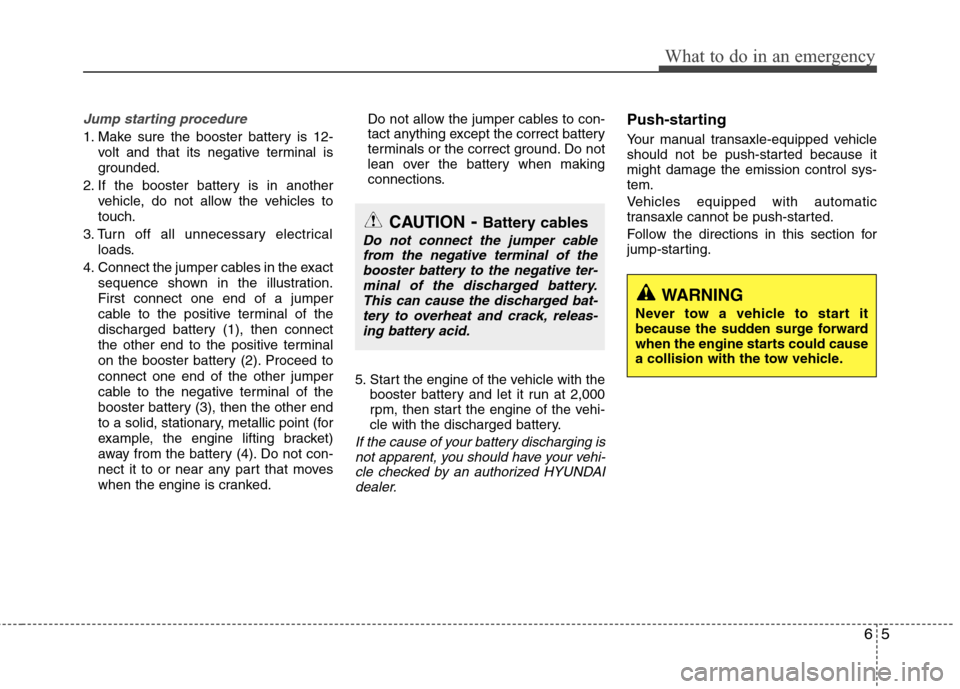
4. Connect the jumper cables in the exact
sequence shown in the illustration.
First connect one end of a jumper
cable to the positive terminal of the
discharged battery (1), then connect
the other end to the positive terminal
on the booster battery (2). Proceed to
connect one end of the other jumper
cable to the negative terminal of the
booster battery (3), then the other end
to a solid, stationary, metallic point (for
example, the engine lifting bracket)
away from the battery (4). Do not con-
nect it to or near any part that moves
when the engine is cranked.Do not allow the jumper cables to con-
tact anything except the correct battery
terminals or the correct ground. Do not
lean over the battery when making
connections.
5. Start the engine of the vehicle with the
booster battery and let it run at 2,000
rpm, then start the engine of the vehi-
cle with the discharged battery.
If the cause of your battery discharging is
not apparent, you should have your vehi-
cle checked by an authorized HYUNDAI
dealer.
Push-starting
Your manual transaxle-equipped vehicle
should not be push-started because it
might damage the emission control sys-
tem.
Vehicles equipped with automatic
transaxle cannot be push-started.
Follow the directions in this section for
jump-starting.
CAUTION- Battery cables
Do not connect the jumper cable
from the negative terminal of the
booster battery to the negative ter-
minal of the discharged battery.
This can cause the discharged bat-
tery to overheat and crack, releas-
ing battery acid.
WARNING
Never tow a vehicle to start it
because the sudden surge forward
when the engine starts could cause
a collision with the tow vehicle.
Page 267 of 383
What to do in an emergency
8 6
✽
✽
NOTICE
If the TPMS indicator does not illu-
minate for 3 seconds when the igni-
tion switch is turned to the ON posi-
tion or engine is running, or if it
comes on after blinking for approxi-
mately one minute, take your car to
your nearest authorized HYUNDAI
dealer and have the system checked.
Low tire pressure tell-
tale
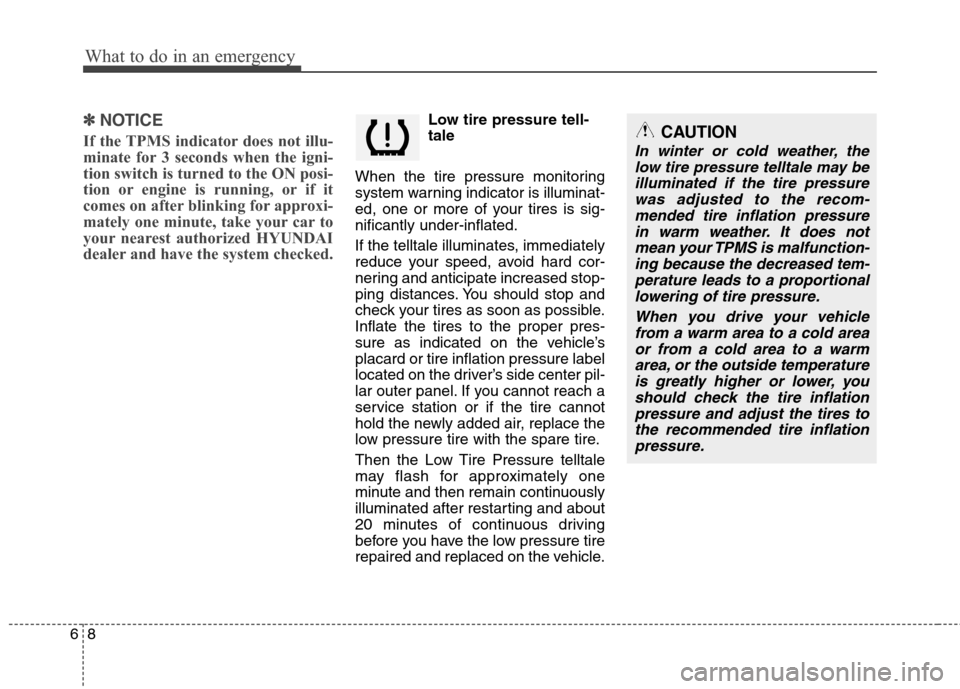
When the tire pressure monitoring
system warning indicator is illuminat-
ed, one or more of your tires is sig-
nificantly under-inflated.
If the telltale illuminates, immediately
reduce your speed, avoid hard cor-
nering and anticipate increased stop-
ping distances. You should stop and
check your tires as soon as possible.
Inflate the tires to the proper pres-
sure as indicated on the vehicle’s
placard or tire inflation pressure label
located on the driver’s side center pil-
lar outer panel. If you cannot reach a
service station or if the tire cannot
hold the newly added air, replace the
low pressure tire with the spare tire.
Then the Low Tire Pressure telltale
may flash for approximately one
minute and then remain continuously
illuminated after restarting and about
20 minutes of continuous driving
before you have the low pressure tire
repaired and replaced on the vehicle.CAUTION
In winter or cold weather, the
low tire pressure telltale may be
illuminated if the tire pressure
was adjusted to the recom-
mended tire inflation pressure
in warm weather. It does not
mean your TPMS is malfunction-
ing because the decreased tem-
perature leads to a proportional
lowering of tire pressure.
When you drive your vehicle
from a warm area to a cold area
or from a cold area to a warm
area, or the outside temperature
is greatly higher or lower, you
should check the tire inflation
pressure and adjust the tires to
the recommended tire inflation
pressure.
Page 296 of 383
Maintenance
8 7
NORMAL MAINTENANCE SCHEDULE (CONT.)
37,500 miles (60,000 km) or 30 months
❑Rotate tire
❑Inspect battery condition
❑Inspect air cleaner filter
❑Inspect vacuum hose
❑Inspect manual transaxle fluid (if equipped)
❑Replace engine oil and filter
(37,500 miles (60,000 km) or 60 months)
❑Add fuel additive *3 (37,500 miles (60,000 km) or 60 months)
*1: Fuel filter & Fuel tank air filter are considered to be maintenance free but peri-
odic inspection is recommended for this maintenance schedule depends on
fuel quality. If there are some important safety matters like fuel flow restric-
tion, surging, loss of power, hard starting problem etc, replace the fuel filter
immediately regardless of maintenance schedule and consult an authorized
HYUNDAI dealer for details.
*
3: If TOP TIER Detergent Gasoline is not available, one bottle of additive is rec-
ommended. Additives are available from your authorized HYUNDAI dealer
along with information on how to use them. Do not mix other additives.
30,000 miles (48,000 km) or 24 months
❑Rotate tire
❑Inspect battery condition
❑Inspect vacuum hose
❑Inspect air conditioning refrigerant
❑Inspect brake hoses and lines
❑Inspect exhaust pipe and muffler
❑Inspect front brake disc/pads, calipers
❑Inspect rear brake disc/pads (if equipped)
❑Inspect rear brake drums/linings (if equipped)
❑Inspect steering gear box, linkage & boots/lower arm ball joint,
upper arm ball joint
❑Inspect suspension mounting bolts
❑Inspect brake/clutch (if equipped) fluid
❑Inspect fuel filter *1
❑Inspect fuel lines, fuel hoses and connections
❑Inspect fuel tank air filter (if equipped) *1
❑Inspect parking brake
❑Inspect vapor hose and fuel filler cap
❑Replace climate control air filter (for evaporator and blower unit)
❑Replace air cleaner filter
❑Replace engine oil and filter
(30,000 miles (48,000 km) or 48 months)
❑Add fuel additive *3 (30,000 miles (48,000 km) or 48 months)
Page 298 of 383
Maintenance
10 7
60,000 miles (96,000 km) or 48 months
❑Rotate tire
❑Inspect battery condition
❑Inspect vacuum hose
❑Inspect air conditioning refrigerant
❑Inspect brake hoses and lines
❑Inspect exhaust pipe and muffler
❑Inspect front brake disc/pads, calipers
❑Inspect rear brake disc/pads (if equipped)
❑Inspect rear brake drums/linings (if equipped)
❑Inspect steering gear box, linkage & boots/lower arm ball joint,
upper arm ball joint
❑Inspect suspension mounting bolts
❑Inspect brake/clutch (if equipped) fluid
❑Inspect fuel filter *1
❑Inspect fuel lines, fuel hoses and connections
❑Inspect fuel tank air filter (if equipped) *1
❑Inspect parking brake
❑Inspect vapor hose and fuel filler cap❑Inspect drive belts *2
(First, 60,000 miles (96,000 km) or 72 months
after every 15,000 miles (24,000 km) or 24 months)
❑Replace climate control air filter (for evaporator and blower unit)
❑Replace air cleaner filter
❑Replace engine oil and filter
(60,000 miles (96,000 km) or 96 months)
❑Add fuel additive *3 (60,000 miles (96,000 km) or 96 months)
67,500 miles (108,000 km) or 54 months
❑Rotate tire
❑Inspect battery condition
❑Inspect air cleaner filter
❑Inspect vacuum hose
❑Replace engine oil and filter
(67,500 miles (108,000 km) or 108 months)
❑Add fuel additive *3 (67,500 miles (108,000 km) or 108 months)
NORMAL MAINTENANCE SCHEDULE (CONT.)
*1: Fuel filter & Fuel tank air filter are considered to be maintenance free but
periodic inspection is recommended for this maintenance schedule depends
on fuel quality. If there are some important safety matters like fuel flow
restriction, surging, loss of power, hard starting problem etc, replace the fuel
filter immediately regardless of maintenance schedule and consult an
authorized HYUNDAI dealer for details.
*
2: The drive belt should be replaced when cracks occur or tension is reduced
excessively.
*
3: If TOP TIER Detergent Gasoline is not available, one bottle of additive is rec-
ommended. Additives are available from your authorized HYUNDAI dealer
along with information on how to use them. Do not mix other additives.
Page 300 of 383
Maintenance
12 7
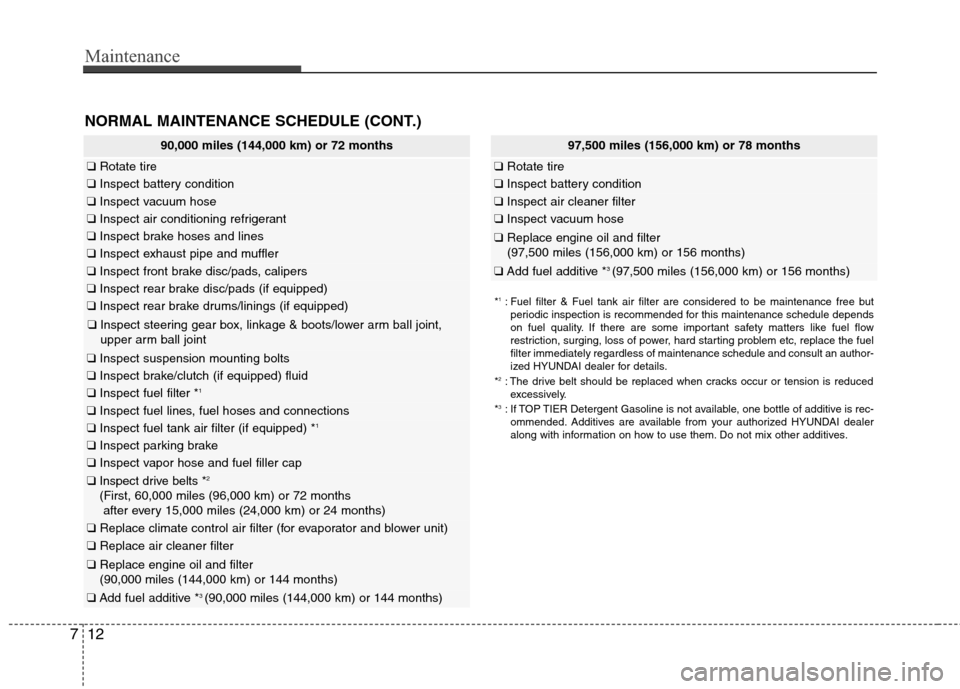
NORMAL MAINTENANCE SCHEDULE (CONT.)
97,500 miles (156,000 km) or 78 months
❑Rotate tire
❑Inspect battery condition
❑Inspect air cleaner filter
❑Inspect vacuum hose
❑Replace engine oil and filter
(97,500 miles (156,000 km) or 156 months)
❑Add fuel additive *3 (97,500 miles (156,000 km) or 156 months)
90,000 miles (144,000 km) or 72 months
❑Rotate tire
❑Inspect battery condition
❑Inspect vacuum hose
❑Inspect air conditioning refrigerant
❑Inspect brake hoses and lines
❑Inspect exhaust pipe and muffler
❑Inspect front brake disc/pads, calipers
❑Inspect rear brake disc/pads (if equipped)
❑Inspect rear brake drums/linings (if equipped)
❑Inspect steering gear box, linkage & boots/lower arm ball joint,
upper arm ball joint
❑Inspect suspension mounting bolts
❑Inspect brake/clutch (if equipped) fluid
❑Inspect fuel filter *1
❑Inspect fuel lines, fuel hoses and connections
❑Inspect fuel tank air filter (if equipped) *1
❑Inspect parking brake
❑Inspect vapor hose and fuel filler cap
❑Inspect drive belts *2
(First, 60,000 miles (96,000 km) or 72 months
after every 15,000 miles (24,000 km) or 24 months)
❑Replace climate control air filter (for evaporator and blower unit)
❑Replace air cleaner filter
❑Replace engine oil and filter
(90,000 miles (144,000 km) or 144 months)
❑Add fuel additive *3 (90,000 miles (144,000 km) or 144 months)
*1: Fuel filter & Fuel tank air filter are considered to be maintenance free but
periodic inspection is recommended for this maintenance schedule depends
on fuel quality. If there are some important safety matters like fuel flow
restriction, surging, loss of power, hard starting problem etc, replace the fuel
filter immediately regardless of maintenance schedule and consult an author-
ized HYUNDAI dealer for details.
*
2: The drive belt should be replaced when cracks occur or tension is reduced
excessively.
*
3: If TOP TIER Detergent Gasoline is not available, one bottle of additive is rec-
ommended. Additives are available from your authorized HYUNDAI dealer
along with information on how to use them. Do not mix other additives.
Page 302 of 383
Maintenance
14 7
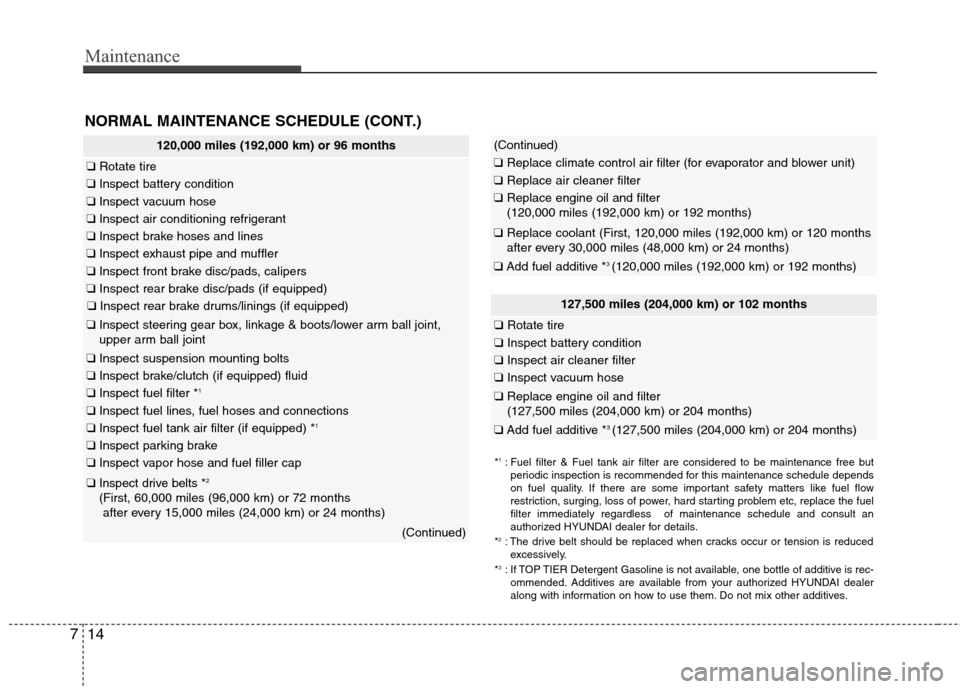
NORMAL MAINTENANCE SCHEDULE (CONT.)
120,000 miles (192,000 km) or 96 months
❑Rotate tire
❑Inspect battery condition
❑Inspect vacuum hose
❑Inspect air conditioning refrigerant
❑Inspect brake hoses and lines
❑Inspect exhaust pipe and muffler
❑Inspect front brake disc/pads, calipers
❑Inspect rear brake disc/pads (if equipped)
❑Inspect rear brake drums/linings (if equipped)
❑Inspect steering gear box, linkage & boots/lower arm ball joint,
upper arm ball joint
❑Inspect suspension mounting bolts
❑Inspect brake/clutch (if equipped) fluid
❑Inspect fuel filter *1
❑Inspect fuel lines, fuel hoses and connections
❑Inspect fuel tank air filter (if equipped) *1
❑Inspect parking brake
❑Inspect vapor hose and fuel filler cap
❑Inspect drive belts *2
(First, 60,000 miles (96,000 km) or 72 months
after every 15,000 miles (24,000 km) or 24 months)
(Continued)
*1: Fuel filter & Fuel tank air filter are considered to be maintenance free but
periodic inspection is recommended for this maintenance schedule depends
on fuel quality. If there are some important safety matters like fuel flow
restriction, surging, loss of power, hard starting problem etc, replace the fuel
filter immediately regardless of maintenance schedule and consult an
authorized HYUNDAI dealer for details.
*
2: The drive belt should be replaced when cracks occur or tension is reduced
excessively.
*
3: If TOP TIER Detergent Gasoline is not available, one bottle of additive is rec-
ommended. Additives are available from your authorized HYUNDAI dealer
along with information on how to use them. Do not mix other additives.
127,500 miles (204,000 km) or 102 months
❑Rotate tire
❑Inspect battery condition
❑Inspect air cleaner filter
❑Inspect vacuum hose
❑Replace engine oil and filter
(127,500 miles (204,000 km) or 204 months)
❑Add fuel additive *3 (127,500 miles (204,000 km) or 204 months)
(Continued)
❑Replace climate control air filter (for evaporator and blower unit)
❑Replace air cleaner filter
❑Replace engine oil and filter
(120,000 miles (192,000 km) or 192 months)
❑Replace coolant (First, 120,000 miles (192,000 km) or 120 months
after every 30,000 miles (48,000 km) or 24 months)
❑Add fuel additive *3 (120,000 miles (192,000 km) or 192 months)
Page 304 of 383
Maintenance
16 7
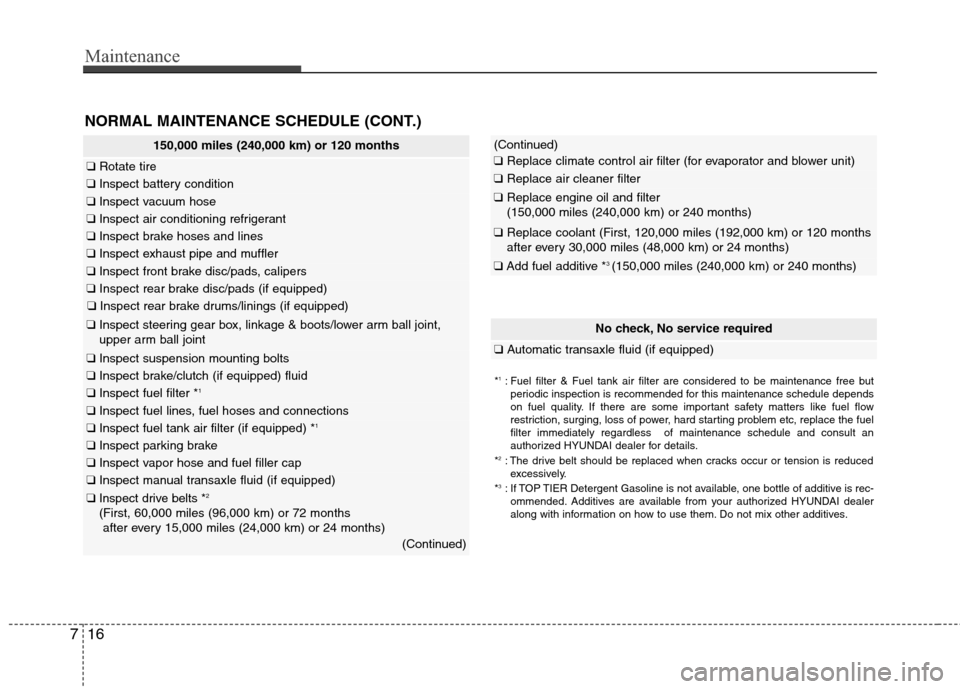
150,000 miles (240,000 km) or 120 months
❑Rotate tire
❑Inspect battery condition
❑Inspect vacuum hose
❑Inspect air conditioning refrigerant
❑Inspect brake hoses and lines
❑Inspect exhaust pipe and muffler
❑Inspect front brake disc/pads, calipers
❑Inspect rear brake disc/pads (if equipped)
❑Inspect rear brake drums/linings (if equipped)
❑Inspect steering gear box, linkage & boots/lower arm ball joint,
upper arm ball joint
❑Inspect suspension mounting bolts
❑Inspect brake/clutch (if equipped) fluid
❑Inspect fuel filter *1
❑Inspect fuel lines, fuel hoses and connections
❑Inspect fuel tank air filter (if equipped) *1
❑Inspect parking brake
❑Inspect vapor hose and fuel filler cap
❑Inspect manual transaxle fluid (if equipped)
❑Inspect drive belts *2
(First, 60,000 miles (96,000 km) or 72 months
after every 15,000 miles (24,000 km) or 24 months)
(Continued)
NORMAL MAINTENANCE SCHEDULE (CONT.)
No check, No service required
❑Automatic transaxle fluid (if equipped)
*1: Fuel filter & Fuel tank air filter are considered to be maintenance free but
periodic inspection is recommended for this maintenance schedule depends
on fuel quality. If there are some important safety matters like fuel flow
restriction, surging, loss of power, hard starting problem etc, replace the fuel
filter immediately regardless of maintenance schedule and consult an
authorized HYUNDAI dealer for details.
*
2: The drive belt should be replaced when cracks occur or tension is reduced
excessively.
*
3: If TOP TIER Detergent Gasoline is not available, one bottle of additive is rec-
ommended. Additives are available from your authorized HYUNDAI dealer
along with information on how to use them. Do not mix other additives.
(Continued)
❑Replace climate control air filter (for evaporator and blower unit)
❑Replace air cleaner filter
❑Replace engine oil and filter
(150,000 miles (240,000 km) or 240 months)
❑Replace coolant (First, 120,000 miles (192,000 km) or 120 months
after every 30,000 miles (48,000 km) or 24 months)
❑Add fuel additive *3 (150,000 miles (240,000 km) or 240 months)
Page 306 of 383
Maintenance
18 7
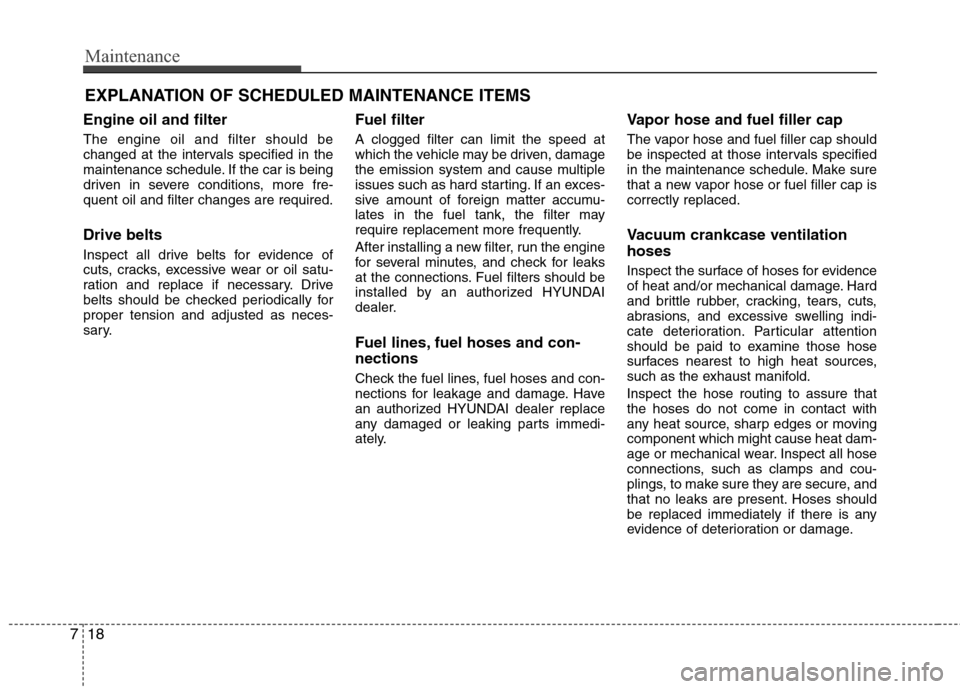
EXPLANATION OF SCHEDULED MAINTENANCE ITEMS
Engine oil and filter
The engine oil and filter should be
changed at the intervals specified in the
maintenance schedule. If the car is being
driven in severe conditions, more fre-
quent oil and filter changes are required.
Drive belts
Inspect all drive belts for evidence of
cuts, cracks, excessive wear or oil satu-
ration and replace if necessary. Drive
belts should be checked periodically for
proper tension and adjusted as neces-
sary.
Fuel filter
A clogged filter can limit the speed at
which the vehicle may be driven, damage
the emission system and cause multiple
issues such as hard starting. If an exces-
sive amount of foreign matter accumu-
lates in the fuel tank, the filter may
require replacement more frequently.
After installing a new filter, run the engine
for several minutes, and check for leaks
at the connections. Fuel filters should be
installed by an authorized HYUNDAI
dealer.
Fuel lines, fuel hoses and con-
nections
Check the fuel lines, fuel hoses and con-
nections for leakage and damage. Have
an authorized HYUNDAI dealer replace
any damaged or leaking parts immedi-
ately.
Vapor hose and fuel filler cap
The vapor hose and fuel filler cap should
be inspected at those intervals specified
in the maintenance schedule. Make sure
that a new vapor hose or fuel filler cap is
correctly replaced.
Vacuum crankcase ventilation
hoses
Inspect the surface of hoses for evidence
of heat and/or mechanical damage. Hard
and brittle rubber, cracking, tears, cuts,
abrasions, and excessive swelling indi-
cate deterioration. Particular attention
should be paid to examine those hose
surfaces nearest to high heat sources,
such as the exhaust manifold.
Inspect the hose routing to assure that
the hoses do not come in contact with
any heat source, sharp edges or moving
component which might cause heat dam-
age or mechanical wear. Inspect all hose
connections, such as clamps and cou-
plings, to make sure they are secure, and
that no leaks are present. Hoses should
be replaced immediately if there is any
evidence of deterioration or damage.
Page 377 of 383
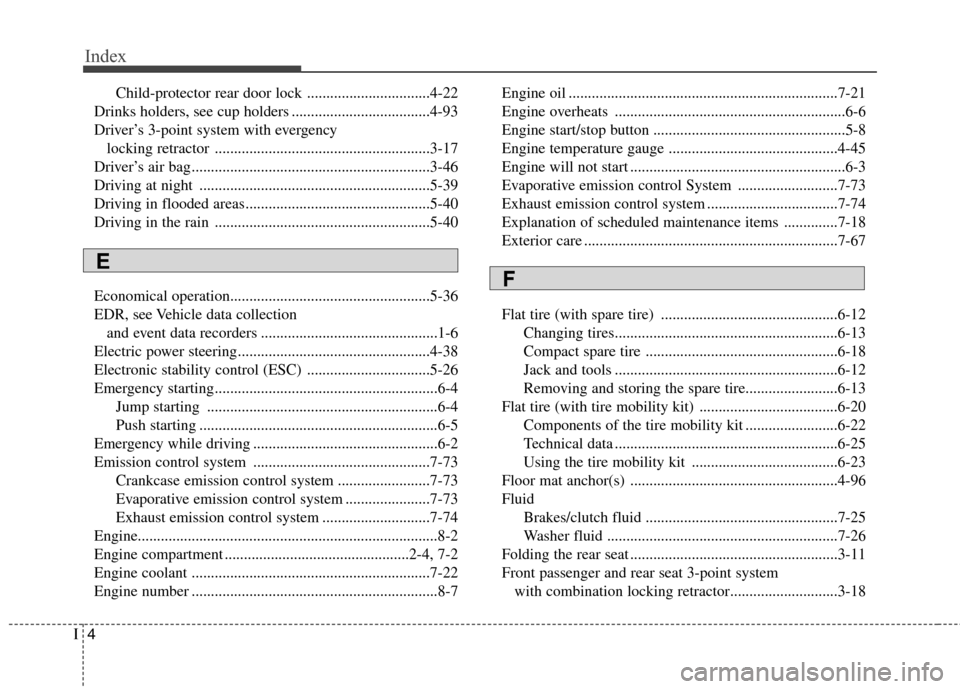
Index
4I
Child-protector rear door lock ................................4-22
Drinks holders, see cup holders ....................................4-93
Driver’s 3-point system with evergency
locking retractor ........................................................3-17
Driver’s air bag ..............................................................3-46
Driving at night ............................................................5-39
Driving in flooded areas................................................5-40
Driving in the rain ........................................................5-40
Economical operation....................................................5-36
EDR, see Vehicle data collection
and event data recorders ..............................................1-6
Electric power steering..................................................4-38
Electronic stability control (ESC) ................................5-26
Emergency starting..........................................................6-4
Jump starting ............................................................6-4
Push starting ..............................................................6-5
Emergency while driving ................................................6-2
Emission control system ..............................................7-73
Crankcase emission control system ........................7-73
Evaporative emission control system ......................7-73
Exhaust emission control system ............................7-74
Engine..............................................................................8-2
Engine compartment ................................................2-4, 7-2
Engine coolant ..............................................................7-22
Engine number ................................................................8-7Engine oil ......................................................................7-21
Engine overheats ............................................................6-6
Engine start/stop button ..................................................5-8
Engine temperature gauge ............................................4-45
Engine will not start ........................................................6-3
Evaporative emission control System ..........................7-73
Exhaust emission control system ..................................7-74
Explanation of scheduled maintenance items ..............7-18
Exterior care ..................................................................7-67
Flat tire (with spare tire) ..............................................6-12
Changing tires..........................................................6-13
Compact spare tire ..................................................6-18
Jack and tools ..........................................................6-12
Removing and storing the spare tire........................6-13
Flat tire (with tire mobility kit) ....................................6-20
Components of the tire mobility kit ........................6-22
Technical data ..........................................................6-25
Using the tire mobility kit ......................................6-23
Floor mat anchor(s) ......................................................4-96
Fluid
Brakes/clutch fluid ..................................................7-25
Washer fluid ............................................................7-26
Folding the rear seat ......................................................3-11
Front passenger and rear seat 3-point system
with combination locking retractor............................3-18
F
E
Page 380 of 383
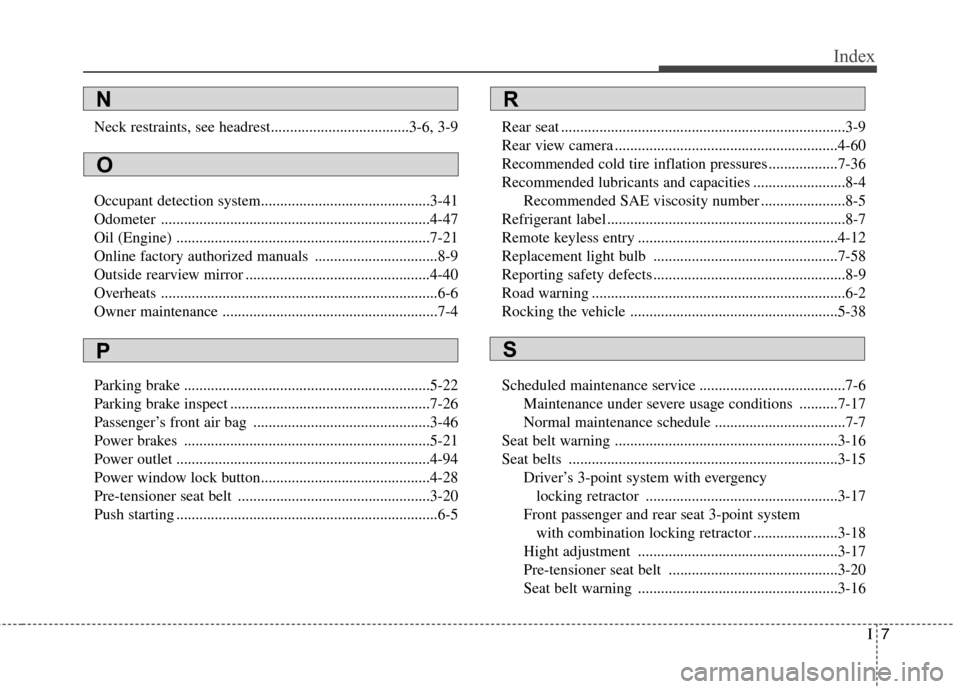
I7
Index
Neck restraints, see headrest....................................3-6, 3-9
Occupant detection system............................................3-41
Odometer ......................................................................4-47
Oil (Engine) ..................................................................7-21
Online factory authorized manuals ................................8-9
Outside rearview mirror ................................................4-40
Overheats ........................................................................6-6
Owner maintenance ........................................................7-4
Parking brake ................................................................5-22
Parking brake inspect ....................................................7-26
Passenger’s front air bag ..............................................3-46
Power brakes ................................................................5-21
Power outlet ..................................................................4-94
Power window lock button............................................4-28
Pre-tensioner seat belt ..................................................3-20
Push starting ....................................................................6-5Rear seat ..........................................................................3-9
Rear view camera ..........................................................4-60
Recommended cold tire inflation pressures ..................7-36
Recommended lubricants and capacities ........................8-4
Recommended SAE viscosity number ......................8-5
Refrigerant label ..............................................................8-7
Remote keyless entry ....................................................4-12
Replacement light bulb ................................................7-58
Reporting safety defects ..................................................8-9
Road warning ..................................................................6-2
Rocking the vehicle ......................................................5-38
Scheduled maintenance service ......................................7-6
Maintenance under severe usage conditions ..........7-17
Normal maintenance schedule ..................................7-7
Seat belt warning ..........................................................3-16
Seat belts ......................................................................3-15
Driver’s 3-point system with evergency
locking retractor ..................................................3-17
Front passenger and rear seat 3-point system
with combination locking retractor ......................3-18
Hight adjustment ....................................................3-17
Pre-tensioner seat belt ............................................3-20
Seat belt warning ....................................................3-16
O
P
NR
S