service Hyundai Elantra 2013 Owner's Guide
[x] Cancel search | Manufacturer: HYUNDAI, Model Year: 2013, Model line: Elantra, Model: Hyundai Elantra 2013Pages: 383, PDF Size: 8.94 MB
Page 321 of 383
733
Maintenance
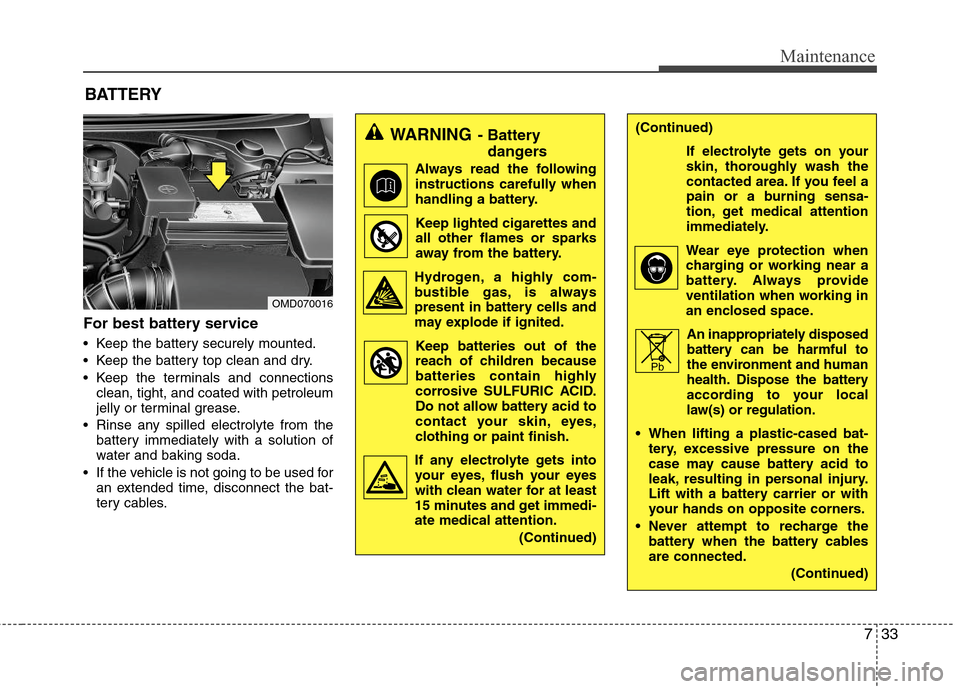
For best battery service
Keep the battery securely mounted.
Keep the battery top clean and dry.
Keep the terminals and connections
clean, tight, and coated with petroleum
jelly or terminal grease.
Rinse any spilled electrolyte from the
battery immediately with a solution of
water and baking soda.
If the vehicle is not going to be used for
an extended time, disconnect the bat-
tery cables.
BATTERY
OMD070016
WARNING- Battery
dangers
Always read the following
instructions carefully when
handling a battery.
Keep lighted cigarettes and
all other flames or sparks
away from the battery.
Hydrogen, a highly com-
bustible gas, is always
present in battery cells and
may explode if ignited.
Keep batteries out of the
reach of children because
batteries contain highly
corrosive SULFURIC ACID.
Do not allow battery acid to
contact your skin, eyes,
clothing or paint finish.
If any electrolyte gets into
your eyes, flush your eyes
with clean water for at least
15 minutes and get immedi-
ate medical attention.
(Continued)
(Continued)
If electrolyte gets on your
skin, thoroughly wash the
contacted area. If you feel a
pain or a burning sensa-
tion, get medical attention
immediately.
Wear eye protection when
charging or working near a
battery. Always provide
ventilation when working in
an enclosed space.
An inappropriately disposed
battery can be harmful to
the environment and human
health. Dispose the battery
according to your local
law(s) or regulation.
When lifting a plastic-cased bat-
tery, excessive pressure on the
case may cause battery acid to
leak, resulting in personal injury.
Lift with a battery carrier or with
your hands on opposite corners.
Never attempt to recharge the
battery when the battery cables
are connected.
(Continued)
Pb
Page 331 of 383
743
Maintenance
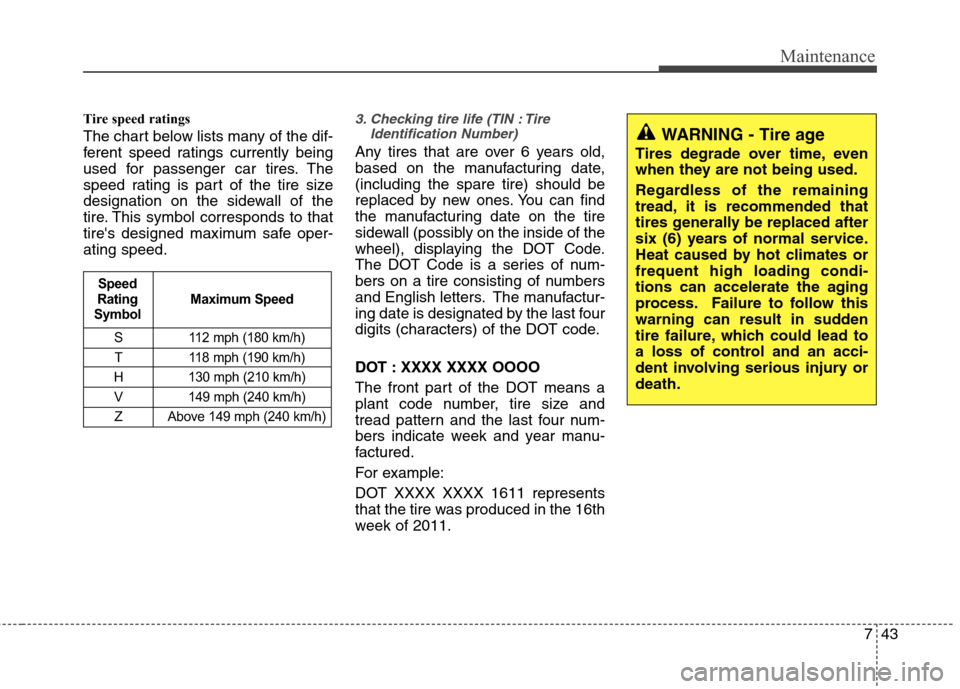
Tire speed ratings
The chart below lists many of the dif-
ferent speed ratings currently being
used for passenger car tires. The
speed rating is part of the tire size
designation on the sidewall of the
tire. This symbol corresponds to that
tire's designed maximum safe oper-
ating speed.
3. Checking tire life (TIN : Tire
Identification Number)
Any tires that are over 6 years old,
based on the manufacturing date,
(including the spare tire) should be
replaced by new ones. You can find
the manufacturing date on the tire
sidewall (possibly on the inside of the
wheel), displaying the DOT Code.
The DOT Code is a series of num-
bers on a tire consisting of numbers
and English letters. The manufactur-
ing date is designated by the last four
digits (characters) of the DOT code.
DOT : XXXX XXXX OOOO
The front part of the DOT means a
plant code number, tire size and
tread pattern and the last four num-
bers indicate week and year manu-
factured.
For example:
DOT XXXX XXXX 1611 represents
that the tire was produced in the 16th
week of 2011.
S 112 mph (180 km/h)
T 118 mph (190 km/h)
H 130 mph (210 km/h)
V 149 mph (240 km/h)
Z Above 149 mph (240 km/h)
Maximum Speed Speed
Rating
Symbol
WARNING - Tire age
Tires degrade over time, even
when they are not being used.
Regardless of the remaining
tread, it is recommended that
tires generally be replaced after
six (6) years of normal service.
Heat caused by hot climates or
frequent high loading condi-
tions can accelerate the aging
process. Failure to follow this
warning can result in sudden
tire failure, which could lead to
a loss of control and an acci-
dent involving serious injury or
death.
Page 332 of 383
Maintenance
44 7
4. Tire ply composition and material
The number of layers or plies of rub-
ber-coated fabric in the tire. Tire man-
ufacturers also must indicate the
materials in the tire, which include
steel, nylon, polyester, and others. The
letter "R" means radial ply construc-
tion; the letter "D" means diagonal or
bias ply construction; and the letter "B"
means belted-bias ply construction.
5. Maximum permissible inflation
pressure
This number is the greatest amount
of air pressure that should be put in
the tire. Do not exceed the maximum
permissible inflation pressure. Refer
to the Tire and Loading Information
label for recommended inflation
pressure.
6. Maximum load rating
This number indicates the maximum
load in kilograms and pounds that can
be carried by the tire. When replacing
the tires on the vehicle, always use a
tire that has the same load rating as
the factory installed tire.
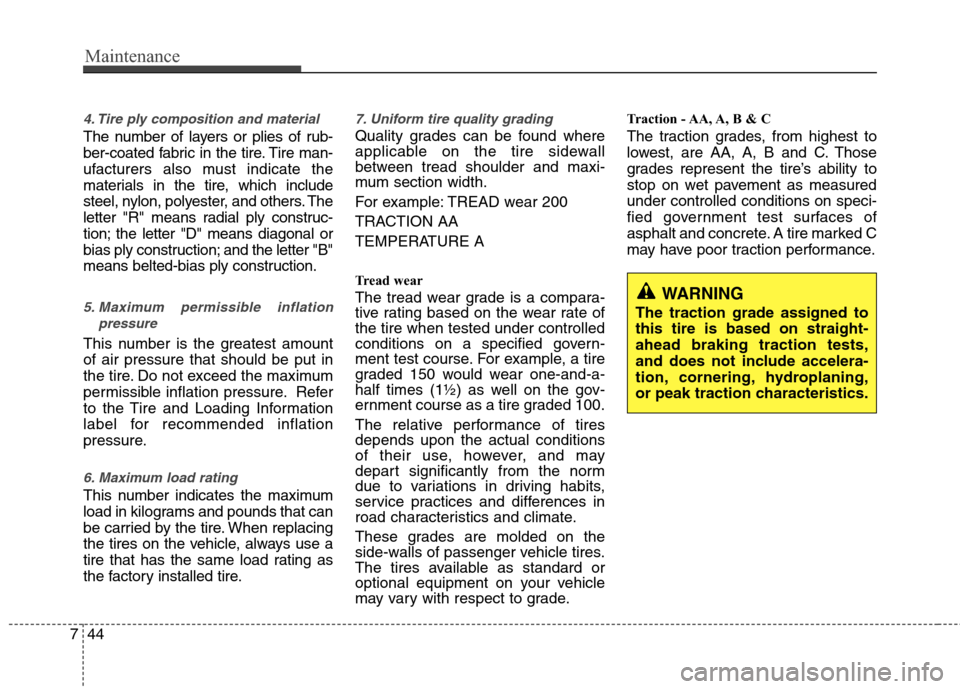
7. Uniform tire quality grading
Quality grades can be found where
applicable on the tire sidewall
between tread shoulder and maxi-
mum section width.
For example: TREAD wear 200
TRACTION AA
TEMPERATURE A
Tread wear
The tread wear grade is a compara-
tive rating based on the wear rate of
the tire when tested under controlled
conditions on a specified govern-
ment test course. For example, a tire
graded 150 would wear one-and-a-
half times (1½) as well on the gov-
ernment course as a tire graded 100.
The relative performance of tires
depends upon the actual conditions
of their use, however, and may
depart significantly from the norm
due to variations in driving habits,
service practices and differences in
road characteristics and climate.
These grades are molded on the
side-walls of passenger vehicle tires.
The tires available as standard or
optional equipment on your vehicle
may vary with respect to grade.
Traction - AA, A, B & C
The traction grades, from highest to
lowest, are AA, A, B and C. Those
grades represent the tire’s ability to
stop on wet pavement as measured
under controlled conditions on speci-
fied government test surfaces of
asphalt and concrete. A tire marked C
may have poor traction performance.
WARNING
The traction grade assigned to
this tire is based on straight-
ahead braking traction tests,
and does not include accelera-
tion, cornering, hydroplaning,
or peak traction characteristics.
Page 350 of 383
Maintenance
62 7
Side repeater light bulb replace-
ment (if equipped)
If the light bulb is not operating, have the
vehicle checked by an authorized
HYUNDAI dealer.
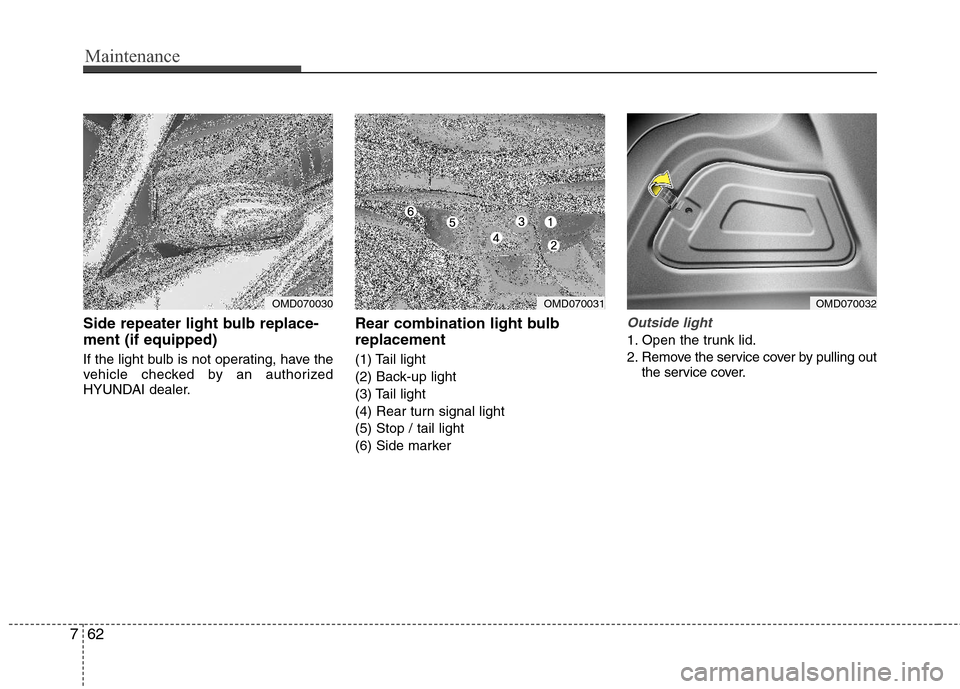
Rear combination light bulb
replacement
(1) Tail light
(2) Back-up light
(3) Tail light
(4) Rear turn signal light
(5) Stop / tail light
(6) Side marker
Outside light
1. Open the trunk lid.
2. Remove the service cover by pulling out
the service cover.
OMD070032OMD070031OMD070030
Page 368 of 383
Specifications, Consumer information, Reporting safety defeccts
4 8
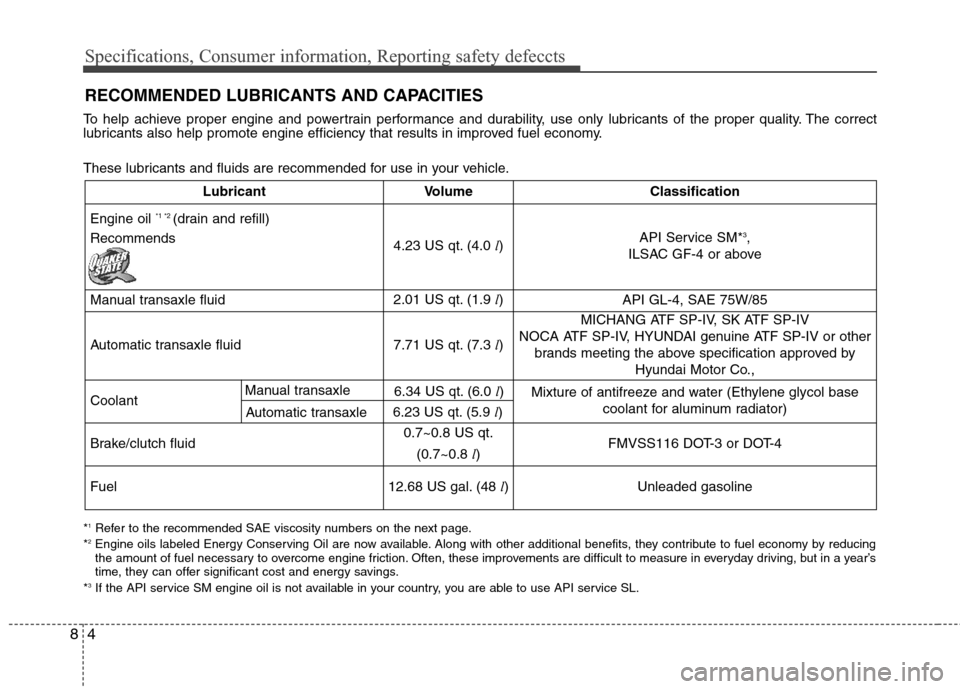
RECOMMENDED LUBRICANTS AND CAPACITIES
To help achieve proper engine and powertrain performance and durability, use only lubricants of the proper quality. The correct
lubricants also help promote engine efficiency that results in improved fuel economy.
These lubricants and fluids are recommended for use in your vehicle.
*1Refer to the recommended SAE viscosity numbers on the next page.
*2Engine oils labeled Energy Conserving Oil are now available. Along with other additional benefits, they contribute to fuel economy by reducing
the amount of fuel necessary to overcome engine friction. Often, these improvements are difficult to measure in everyday driving, but in a year’s
time, they can offer significant cost and energy savings.
*
3If the API service SM engine oil is not available in your country, you are able to use API service SL.
LubricantVolumeClassification
Engine oil *1 *2 (drain and refill)
Recommends
4.23 US qt. (4.0 l)API Service SM*3,
ILSAC GF-4 or above
Manual transaxle fluid2.01 US qt. (1.9 l)API GL-4, SAE 75W/85
Automatic transaxle fluid7.71 US qt. (7.3 l)
MICHANG ATF SP-IV, SK ATF SP-IV
NOCA ATF SP-IV, HYUNDAI genuine ATF SP-IV or other
brands meeting the above specification approved by
Hyundai Motor Co.,
Coolant Mixture of antifreeze and water (Ethylene glycol base
coolant for aluminum radiator)
Brake/clutch fluid0.7~0.8 US qt.
(0.7~0.8 l)FMVSS116 DOT-3 or DOT-4
Fuel12.68 US gal. (48 l)Unleaded gasoline
Automatic transaxle6.23 US qt. (5.9 l) 6.34 US qt. (6.0 l) Manual transaxle
Page 379 of 383
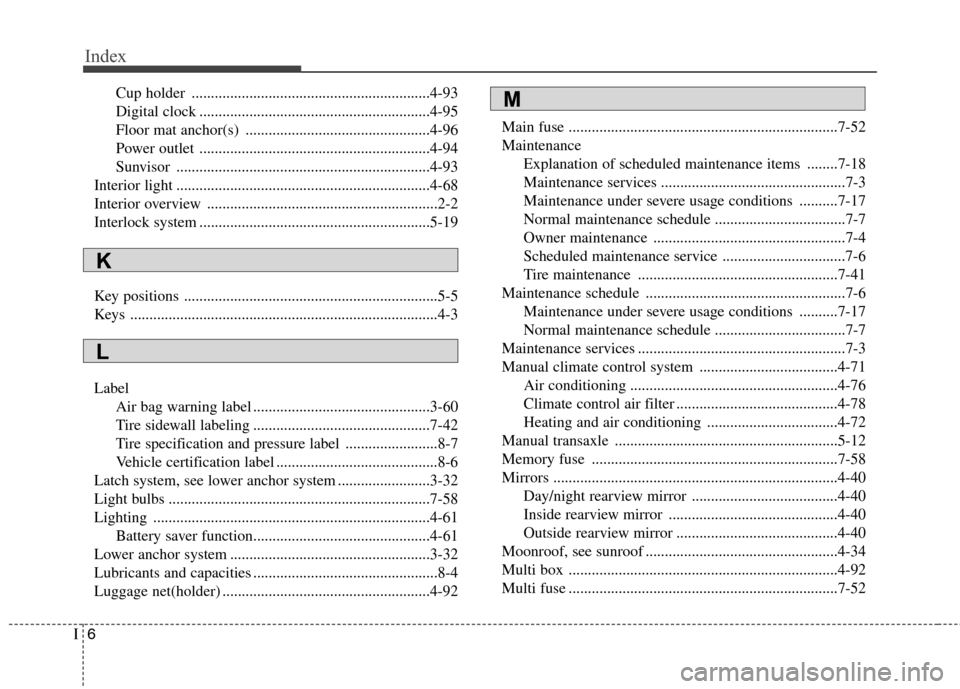
Index
6I
Cup holder ..............................................................4-93
Digital clock ............................................................4-95
Floor mat anchor(s) ................................................4-96
Power outlet ............................................................4-94
Sunvisor ..................................................................4-93
Interior light ..................................................................4-68
Interior overview ............................................................2-2
Interlock system ............................................................5-19
Key positions ..................................................................5-5
Keys ................................................................................4-3
Label
Air bag warning label ..............................................3-60
Tire sidewall labeling ..............................................7-42
Tire specification and pressure label ........................8-7
Vehicle certification label ..........................................8-6
Latch system, see lower anchor system ........................3-32
Light bulbs ....................................................................7-58
Lighting ........................................................................4-61
Battery saver function..............................................4-61
Lower anchor system ....................................................3-32
Lubricants and capacities ................................................8-4
Luggage net(holder) ......................................................4-92Main fuse ......................................................................7-52
Maintenance
Explanation of scheduled maintenance items ........7-18
Maintenance services ................................................7-3
Maintenance under severe usage conditions ..........7-17
Normal maintenance schedule ..................................7-7
Owner maintenance ..................................................7-4
Scheduled maintenance service ................................7-6
Tire maintenance ....................................................7-41
Maintenance schedule ....................................................7-6
Maintenance under severe usage conditions ..........7-17
Normal maintenance schedule ..................................7-7
Maintenance services ......................................................7-3
Manual climate control system ....................................4-71
Air conditioning ......................................................4-76
Climate control air filter ..........................................4-78
Heating and air conditioning ..................................4-72
Manual transaxle ..........................................................5-12
Memory fuse ................................................................7-58
Mirrors ..........................................................................4-40
Day/night rearview mirror ......................................4-40
Inside rearview mirror ............................................4-40
Outside rearview mirror ..........................................4-40
Moonroof, see sunroof ..................................................4-34
Multi box ......................................................................4-92
Multi fuse ......................................................................7-52M
L
K
Page 380 of 383
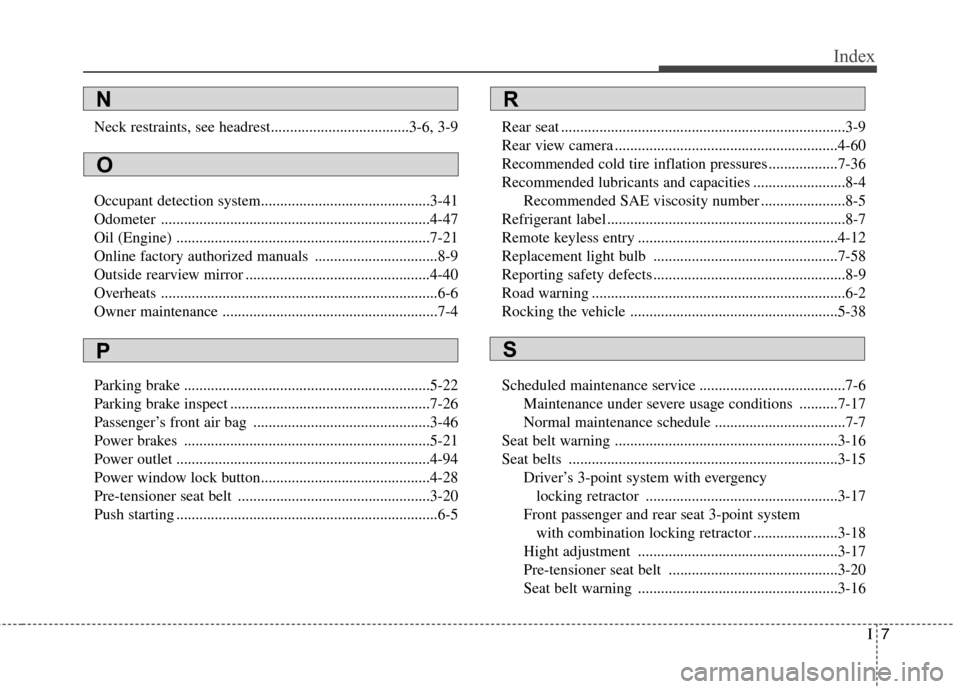
I7
Index
Neck restraints, see headrest....................................3-6, 3-9
Occupant detection system............................................3-41
Odometer ......................................................................4-47
Oil (Engine) ..................................................................7-21
Online factory authorized manuals ................................8-9
Outside rearview mirror ................................................4-40
Overheats ........................................................................6-6
Owner maintenance ........................................................7-4
Parking brake ................................................................5-22
Parking brake inspect ....................................................7-26
Passenger’s front air bag ..............................................3-46
Power brakes ................................................................5-21
Power outlet ..................................................................4-94
Power window lock button............................................4-28
Pre-tensioner seat belt ..................................................3-20
Push starting ....................................................................6-5Rear seat ..........................................................................3-9
Rear view camera ..........................................................4-60
Recommended cold tire inflation pressures ..................7-36
Recommended lubricants and capacities ........................8-4
Recommended SAE viscosity number ......................8-5
Refrigerant label ..............................................................8-7
Remote keyless entry ....................................................4-12
Replacement light bulb ................................................7-58
Reporting safety defects ..................................................8-9
Road warning ..................................................................6-2
Rocking the vehicle ......................................................5-38
Scheduled maintenance service ......................................7-6
Maintenance under severe usage conditions ..........7-17
Normal maintenance schedule ..................................7-7
Seat belt warning ..........................................................3-16
Seat belts ......................................................................3-15
Driver’s 3-point system with evergency
locking retractor ..................................................3-17
Front passenger and rear seat 3-point system
with combination locking retractor ......................3-18
Hight adjustment ....................................................3-17
Pre-tensioner seat belt ............................................3-20
Seat belt warning ....................................................3-16
O
P
NR
S