front brakes Hyundai Elantra 2013 Owner's Manual
[x] Cancel search | Manufacturer: HYUNDAI, Model Year: 2013, Model line: Elantra, Model: Hyundai Elantra 2013Pages: 383, PDF Size: 8.94 MB
Page 229 of 383
Driving your vehicle
22 5
Disc brakes wear indicator
(if equipped)
Your vehicle has disc brakes.
When your brake pads are worn and new
pads are required, you will hear a high-
pitched warning sound from your front
brakes or rear brakes. You may hear this
sound come and go or it may occur
whenever you depress the brake pedal.
Please remember that some driving con-
ditions or climates may cause a brake
squeal when you first apply (or lightly
apply) the brakes. This is normal and does
not indicate a problem with your brakes.
Rear drum brakes (if equipped)
Your rear drum brakes do not have wear
indicators.Therefore, have the rear brake
linings inspected if you hear a rear brake
rubbing noise. Also have your rear
brakes inspected each time you change
or rotate your tires and when you have
the front brakes replaced.
Parking brake
Applying the parking brake
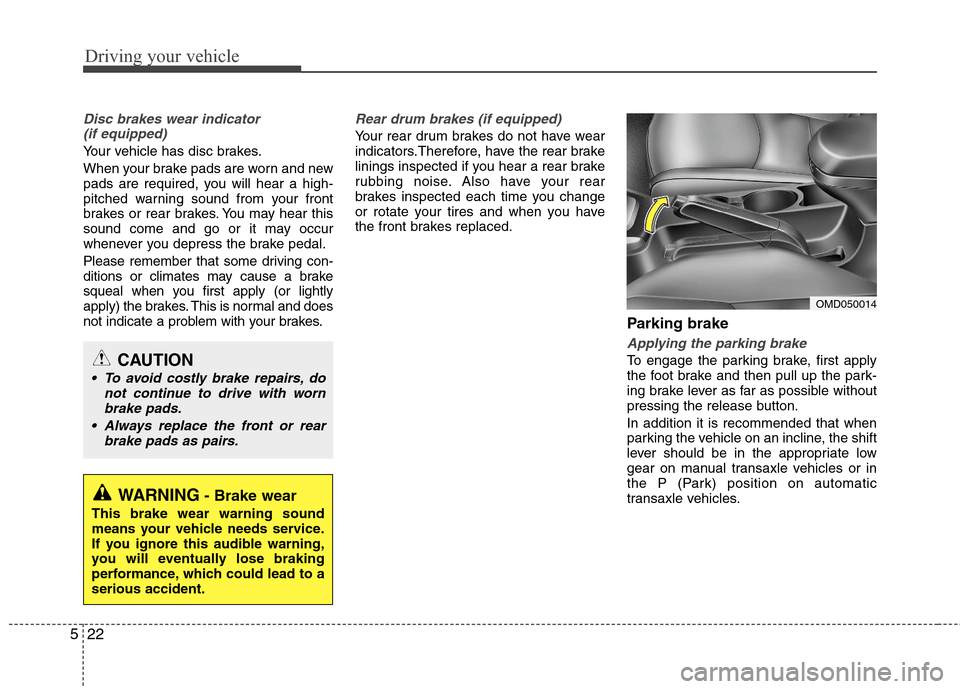
To engage the parking brake, first apply
the foot brake and then pull up the park-
ing brake lever as far as possible without
pressing the release button.
In addition it is recommended that when
parking the vehicle on an incline, the shift
lever should be in the appropriate low
gear on manual transaxle vehicles or in
the P (Park) position on automatic
transaxle vehicles.
WARNING- Brake wear
This brake wear warning sound
means your vehicle needs service.
If you ignore this audible warning,
you will eventually lose braking
performance, which could lead to a
serious accident.
CAUTION
To avoid costly brake repairs, do
not continue to drive with worn
brake pads.
Always replace the front or rear
brake pads as pairs.
OMD050014
Page 232 of 383
525
Driving your vehicle
✽ ✽
NOTICE
A click sound may be heard in the
engine compartment when the vehicle
begins to move after the engine is start-
ed. These conditions are normal and
indicate that the anti-lock brake system
is functioning properly.
Even with the anti-lock brake system,
your vehicle still requires sufficient
stopping distance. Always maintain a
safe distance from the vehicle in front
of you.
Always slow down when cornering.
The anti-lock brake system cannot pre-
vent accidents resulting from exces-
sive speeds.
On loose or uneven road surfaces,
operation of the anti-lock brake system
may result in a longer stopping dis-
tance than for vehicles equipped with a
conventional brake system.
✽ ✽
NOTICE
When you jump start your vehicle
because of a drained battery, the engine
may not run as smoothly and the ABS
warning light may turn on at the same
time. This happens because of the low
battery voltage. It does not mean your
ABS is malfunctioning.
• Do not pump your brakes!
• Have the battery recharged before
driving the vehicle.
W-78
CAUTION
If the ABS warning light is on and
stays on, you may have a problem
with the ABS. In this case, howev-
er, your regular brakes will work
normally.
The ABS warning light will stay on
for approximately 3 seconds after
the ignition switch is ON. During
that time, the ABS will go through
self-diagnosis and the light will go
off if everything is normal. If the
light stays on, you may have a
problem with your ABS. Contact
an authorized HYUNDAI dealer as
soon as possible.
CAUTION
When you drive on a road having
poor traction, such as an icy road,
and operate your brakes continu-
ously, the ABS will be active con-
tinuously and the ABS warning
light may illuminate. Pull your car
over to a safe place and stop the
engine.
Restart the engine. If the ABS
warning light is off, then your
ABS system is normal.
Otherwise, you may have a prob-
lem with the ABS. Contact an
authorized HYUNDAI dealer as
soon as possible.
Page 236 of 383
529
Driving your vehicle
After parking the vehicle, check to be
sure the parking brake is not engaged
and that the parking brake indicator
light is out before driving away.
Driving through water may get the
brakes wet. They can also get wet when
the car is washed. Wet brakes can be
dangerous! Your car will not stop as
quickly if the brakes are wet. Wet brakes
may cause the car to pull to one side.
To dry the brakes, apply the brakes light-
ly until the braking action returns to nor-
mal, taking care to keep the car under
control at all times. If the braking action
does not return to normal, stop as soon
as it is safe to do so and call an author-
ized HYUNDAI dealer for assistance.
Do not coast down hills with the car out
of gear. This is extremely hazardous.
Keep the car in gear at all times, use
the brakes to slow down, then shift to a
lower gear so that engine braking will
help you maintain a safe speed.
Do not "ride" the brake pedal. Resting
your foot on the brake pedal while driv-
ing can be dangerous because it can
result in the brakes overheating and los-
ing their effectiveness. It also increases
the wear of the brake components. If a tire goes flat while you are driving,
apply the brakes gently and keep the
car pointed straight ahead while you
slow down. When you are moving slow-
ly enough for it to be safe to do so, pull
off the road and stop in a safe place.
If your vehicle is equipped with an auto-
matic transaxle, don't let your vehicle
creep forward. To avoid creeping for-
ward, keep your foot firmly on the brake
pedal when the vehicle is stopped.
Use caution when parking on a hill.
Firmly engage the parking brake and
place the shift lever in P (automatic
transaxle) or in first or reverse gear
(manual transaxle). If your vehicle is
facing downhill, turn the front wheels
into the curb to help keep the vehicle
from rolling. If your vehicle is facing
uphill, turn the front wheels away from
the curb to help keep the vehicle from
rolling. If there is no curb or if it is
required by other conditions to keep
the vehicle from rolling, block the
wheels. Under some conditions your parking
brake can freeze in the engaged posi-
tion. This is most likely to happen when
there is an accumulation of snow or ice
around or near the rear brakes or if the
brakes are wet. If there is a risk that the
parking brake may freeze, apply it only
temporarily while you put the gear
selector lever in P (automatic
transaxle) or in first or reverse gear
(manual transaxle) and block the rear
wheels so the vehicle cannot roll. Then
release the parking brake.
Do not hold the vehicle on the upgrade
with the accelerator pedal. This can
cause the transaxle to overheat.
Always use the brake pedal or parking
brake.
Page 252 of 383
545
Driving your vehicle
To keep locks from freezing
To keep the locks from freezing, squirt an
approved de-icer fluid or glycerine into
the key opening. If a lock is covered with
ice, squirt it with an approved de-icing
fluid to remove the ice. If the lock is
frozen internally, you may be able to thaw
it out by using a heated key. Handle the
heated key with care to avoid injury.
Use approved window washer
anti-freeze in system
To keep the water in the window washer
system from freezing, add an approved
window washer anti-freeze solution in
accordance with instructions on the con-
tainer. Window washer anti-freeze is
available from an authorized HYUNDAI
dealer and most auto parts outlets. Do
not use engine coolant or other types of
anti-freeze as these may damage the
paint finish.
Don't let your parking brake
freeze
Under some conditions your parking
brake can freeze in the engaged position.
This is most likely to happen when there
is an accumulation of snow or ice around
or near the rear brakes or if the brakes
are wet. If there is a risk of the parking
brake may freezing, apply it only tem-
porarily while you put the shift lever in P
(automatic transaxle) or in first or reverse
gear (manual transaxle) and block the
rear wheels so the vehicle cannot roll.
Then release the parking brake.
Don't let ice and snow accumu-
late underneath
Under some conditions, snow and ice
can build up under the fenders and inter-
fere with the steering. When driving in
severe winter conditions where this may
happen, you should periodically check
underneath the car to be sure the move-
ment of the front wheels and the steering
components is not obstructed.
Carry emergency equipment
Depending on the severity of the weath-
er where you drive your car, you should
carry appropriate emergency equipment.
Some of the items you may want to carry
include tire chains, tow straps or chains,
flashlight, emergency flares, sand, a
shovel, jumper cables, a window scraper,
gloves, ground cloth, coveralls, a blanket,
etc.
Page 288 of 383
629
What to do in an emergency
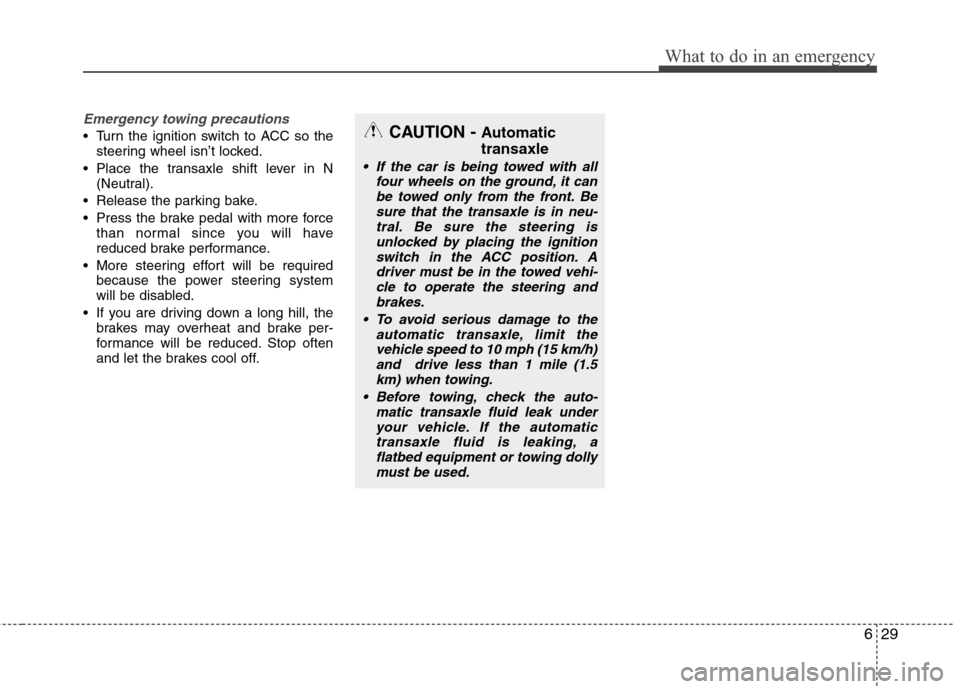
Emergency towing precautions
Turn the ignition switch to ACC so the
steering wheel isn’t locked.
Place the transaxle shift lever in N
(Neutral).
Release the parking bake.
Press the brake pedal with more force
than normal since you will have
reduced brake performance.
More steering effort will be required
because the power steering system
will be disabled.
If you are driving down a long hill, the
brakes may overheat and brake per-
formance will be reduced. Stop often
and let the brakes cool off.CAUTION - Automatic
transaxle
If the car is being towed with all
four wheels on the ground, it can
be towed only from the front. Be
sure that the transaxle is in neu-
tral. Be sure the steering is
unlocked by placing the ignition
switch in the ACC position. A
driver must be in the towed vehi-
cle to operate the steering and
brakes.
To avoid serious damage to the
automatic transaxle, limit the
vehicle speed to 10 mph (15 km/h)
and drive less than 1 mile (1.5
km) when towing.
Before towing, check the auto-
matic transaxle fluid leak under
your vehicle. If the automatic
transaxle fluid is leaking, a
flatbed equipment or towing dolly
must be used.
Page 375 of 383
Index
2I
Air bags ........................................................................3-34
Air bag warning label ..............................................3-60
Air bag warning light ..............................................3-37
Curtain air bag ........................................................3-51
Driver’s and passenger’s front air bag ....................3-46
Occupant detection system ......................................3-41
Side impact air bag ..................................................3-50
SRS components and functions ..............................3-37
Air cleaner ....................................................................7-27
Alarm system ................................................................4-15
Antenna (glass)..............................................................4-98
Anti-lock brake system (ABS) ......................................5-24
Appearance care ............................................................7-67
Exterior care ............................................................7-67
Interior care ............................................................7-71
Armrest ..........................................................................3-11
Audio system ................................................................4-98
Glass antenna ..........................................................4-98
Steering wheel audio control ..................................4-99
Automatic climate control system ................................4-80
Air conditioning ......................................................4-86
Automatic heating and air conditioning ..................4-81
Manual heating and air conditioning ......................4-82Automatic transaxle ......................................................5-15
Ignition key interlock system ..................................5-19
Shift lock system ....................................................5-18
Sports mode ............................................................5-17
Aux, USB and iPod port ..............................................4-97
Battery ..........................................................................7-33
Battery saver function ..................................................4-61
Before driving ................................................................5-3
Bottle holders, see cup holders ....................................4-93
Brake system ................................................................5-21
Anti-lock brake system (ABS) ................................5-24
Electronic stability control (ESC) ..........................5-26
Parking brake ..........................................................5-22
Power brakes............................................................5-21
Vehicle stability management (VSM) ....................5-29
Brakes/clutch fluid ........................................................7-25
Bulb replacement ..........................................................7-58
Bulb wattage....................................................................8-2
Button start/stop, see engine start/stop button ................5-8
A
B
Page 377 of 383
Index
4I
Child-protector rear door lock ................................4-22
Drinks holders, see cup holders ....................................4-93
Driver’s 3-point system with evergency
locking retractor ........................................................3-17
Driver’s air bag ..............................................................3-46
Driving at night ............................................................5-39
Driving in flooded areas................................................5-40
Driving in the rain ........................................................5-40
Economical operation....................................................5-36
EDR, see Vehicle data collection
and event data recorders ..............................................1-6
Electric power steering..................................................4-38
Electronic stability control (ESC) ................................5-26
Emergency starting..........................................................6-4
Jump starting ............................................................6-4
Push starting ..............................................................6-5
Emergency while driving ................................................6-2
Emission control system ..............................................7-73
Crankcase emission control system ........................7-73
Evaporative emission control system ......................7-73
Exhaust emission control system ............................7-74
Engine..............................................................................8-2
Engine compartment ................................................2-4, 7-2
Engine coolant ..............................................................7-22
Engine number ................................................................8-7Engine oil ......................................................................7-21
Engine overheats ............................................................6-6
Engine start/stop button ..................................................5-8
Engine temperature gauge ............................................4-45
Engine will not start ........................................................6-3
Evaporative emission control System ..........................7-73
Exhaust emission control system ..................................7-74
Explanation of scheduled maintenance items ..............7-18
Exterior care ..................................................................7-67
Flat tire (with spare tire) ..............................................6-12
Changing tires..........................................................6-13
Compact spare tire ..................................................6-18
Jack and tools ..........................................................6-12
Removing and storing the spare tire........................6-13
Flat tire (with tire mobility kit) ....................................6-20
Components of the tire mobility kit ........................6-22
Technical data ..........................................................6-25
Using the tire mobility kit ......................................6-23
Floor mat anchor(s) ......................................................4-96
Fluid
Brakes/clutch fluid ..................................................7-25
Washer fluid ............................................................7-26
Folding the rear seat ......................................................3-11
Front passenger and rear seat 3-point system
with combination locking retractor............................3-18
F
E
Page 380 of 383
I7
Index
Neck restraints, see headrest....................................3-6, 3-9
Occupant detection system............................................3-41
Odometer ......................................................................4-47
Oil (Engine) ..................................................................7-21
Online factory authorized manuals ................................8-9
Outside rearview mirror ................................................4-40
Overheats ........................................................................6-6
Owner maintenance ........................................................7-4
Parking brake ................................................................5-22
Parking brake inspect ....................................................7-26
Passenger’s front air bag ..............................................3-46
Power brakes ................................................................5-21
Power outlet ..................................................................4-94
Power window lock button............................................4-28
Pre-tensioner seat belt ..................................................3-20
Push starting ....................................................................6-5Rear seat ..........................................................................3-9
Rear view camera ..........................................................4-60
Recommended cold tire inflation pressures ..................7-36
Recommended lubricants and capacities ........................8-4
Recommended SAE viscosity number ......................8-5
Refrigerant label ..............................................................8-7
Remote keyless entry ....................................................4-12
Replacement light bulb ................................................7-58
Reporting safety defects ..................................................8-9
Road warning ..................................................................6-2
Rocking the vehicle ......................................................5-38
Scheduled maintenance service ......................................7-6
Maintenance under severe usage conditions ..........7-17
Normal maintenance schedule ..................................7-7
Seat belt warning ..........................................................3-16
Seat belts ......................................................................3-15
Driver’s 3-point system with evergency
locking retractor ..................................................3-17
Front passenger and rear seat 3-point system
with combination locking retractor ......................3-18
Hight adjustment ....................................................3-17
Pre-tensioner seat belt ............................................3-20
Seat belt warning ....................................................3-16
O
P
NR
S