warning Hyundai Elantra 2015 Owner's Manual - RHD (UK. Australia)
[x] Cancel search | Manufacturer: HYUNDAI, Model Year: 2015, Model line: Elantra, Model: Hyundai Elantra 2015Pages: 498, PDF Size: 9.45 MB
Page 3 of 498
F3
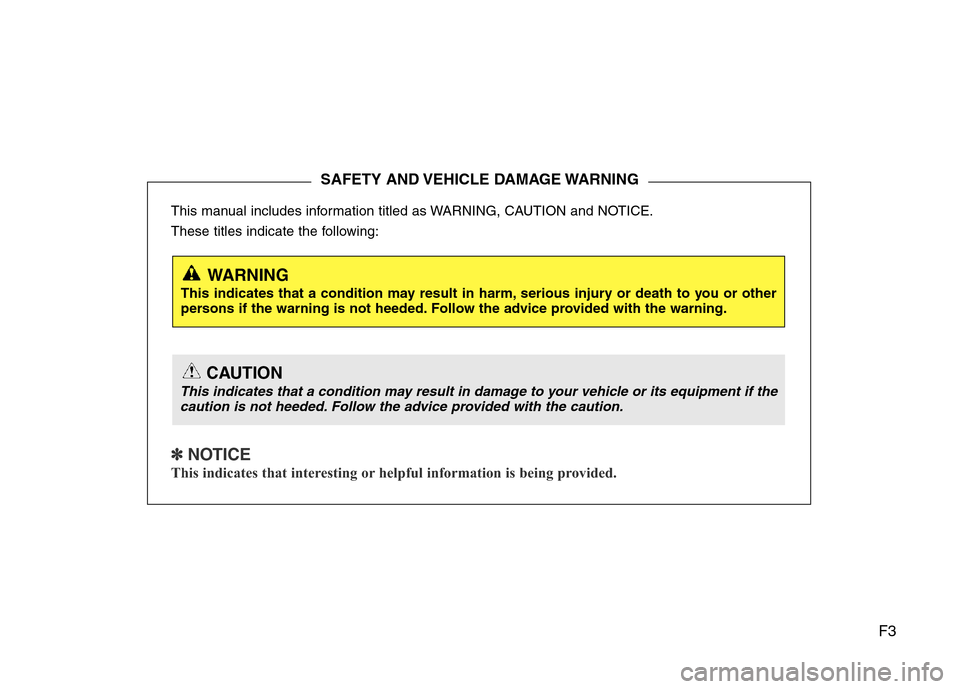
This manual includes information titled as WARNING, CAUTION and NOTICE.
These titles indicate the following:
✽ NOTICE
This indicates that interesting or helpful information is being provided.
SAFETY AND VEHICLE DAMAGE WARNING
WARNING
This indicates that a condition may result in harm, serious injury or death to you or other
persons if the warning is not heeded. Follow the advice provided with the warning.
CAUTION
This indicates that a condition may result in damage to your vehicle or its equipment if the
caution is not heeded. Follow the advice provided with the caution.
Page 9 of 498
Introduction
2 1
HOW TO USE THIS MANUAL
We want to help you get the greatest
possible driving pleasure from your
vehicle. Your Owner’s Manual can
assist you in many ways. We strong-
ly recommend that you read the
entire manual. In order to minimise
the risk of death or injury, you must
read the WARNING and CAUTION
sections in the manual.
Illustrations complement the wording
in this manual to best explain how to
enjoy your vehicle. By reading your
manual, you will learn about fea-
tures, important safety information,
and driving tips under various road
conditions.
The general layout of the manual is
provided in the Table of Contents.
Use the index when looking for a
specific area or subject; it has an
alphabetical listing of all information
in your manual.
Sections: This manual has eight sec-
tions plus an index. Each section
begins with a brief list of contents so
you can tell at a glance if that section
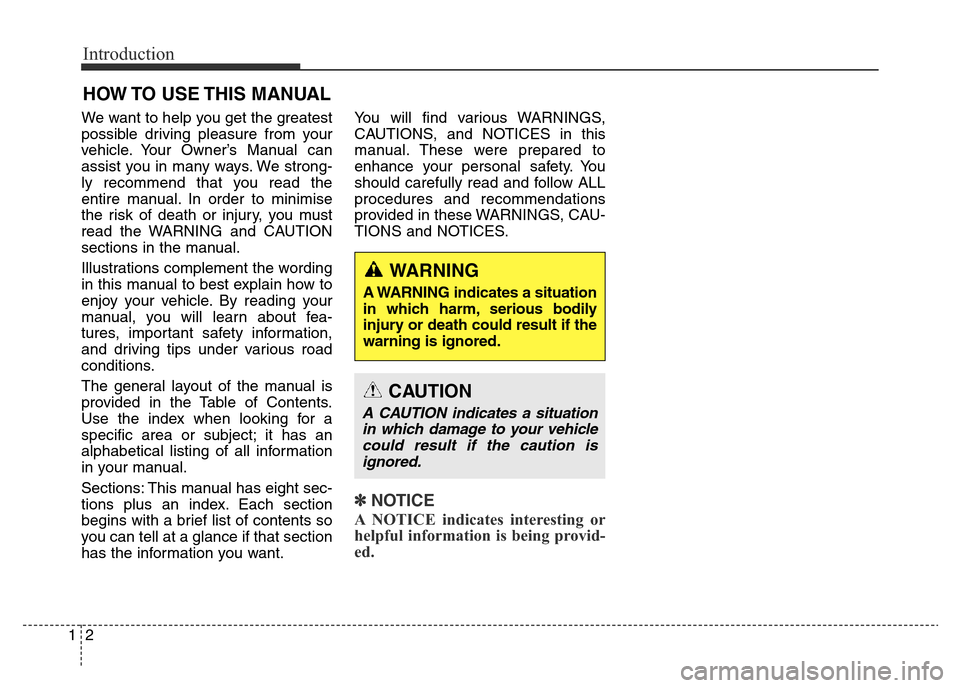
has the information you want.You will find various WARNINGS,
CAUTIONS, and NOTICES in this
manual. These were prepared to
enhance your personal safety. You
should carefully read and follow ALL
procedures and recommendations
provided in these WARNINGS, CAU-
TIONS and NOTICES.
✽ NOTICE
A NOTICE indicates interesting or
helpful information is being provid-
ed.
WARNING
A WARNING indicates a situation
in which harm, serious bodily
injury or death could result if the
warning is ignored.
CAUTION
A CAUTION indicates a situation
in which damage to your vehicle
could result if the caution is
ignored.
Page 10 of 498
13
Introduction
Petrol engine
Unleaded
Your new vehicle is designed to use
only unleaded fuel having an Octane
Rating of RON (Research Octane
Number) 91 / AKI (Anti-Knock Index)
87 or higher. (Do not use methanol
blended fuels.)
Your new vehicle is designed to
obtain maximum performance with
UNLEADED FUEL, as well as min-
imise exhaust emissions and spark
plug fouling.
FUEL REQUIREMENTS
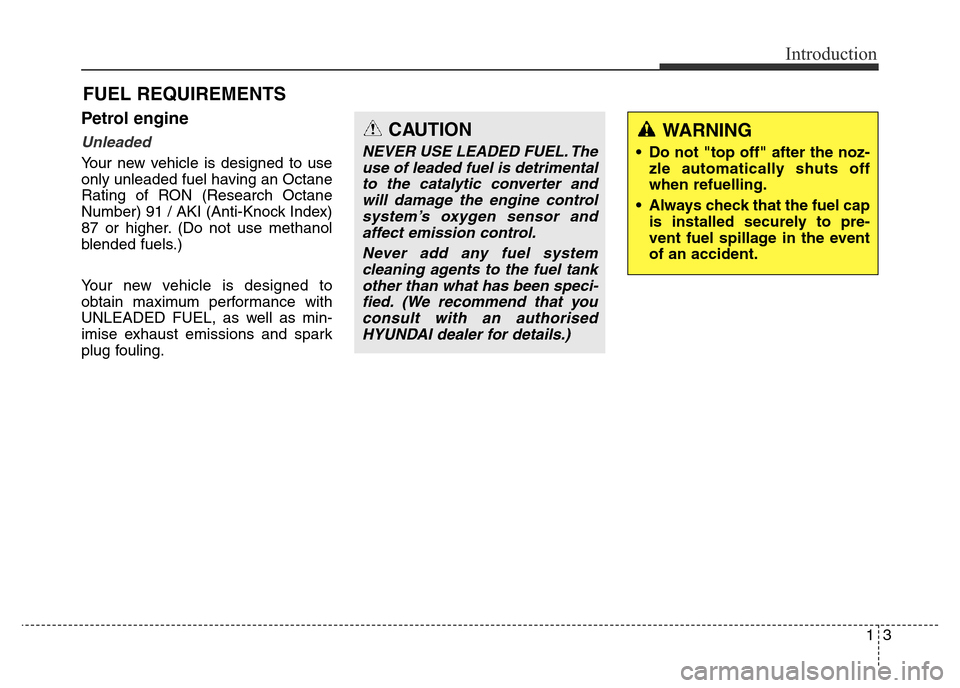
CAUTION
NEVER USE LEADED FUEL. The
use of leaded fuel is detrimental
to the catalytic converter and
will damage the engine control
system’s oxygen sensor and
affect emission control.
Never add any fuel system
cleaning agents to the fuel tank
other than what has been speci-
fied. (We recommend that you
consult with an authorised
HYUNDAI dealer for details.)
WARNING
• Do not "top off" after the noz-
zle automatically shuts off
when refuelling.
• Always check that the fuel cap
is installed securely to pre-
vent fuel spillage in the event
of an accident.
Page 17 of 498
25
Your vehicle at a glance
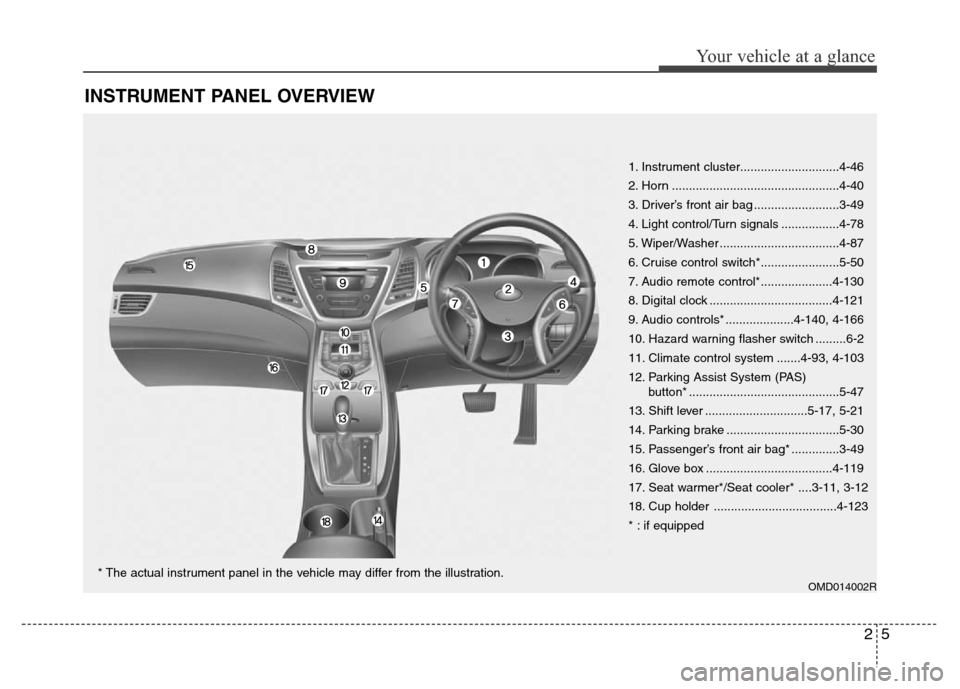
INSTRUMENT PANEL OVERVIEW
OMD014002R
1. Instrument cluster.............................4-46
2. Horn .................................................4-40
3. Driver’s front air bag .........................3-49
4. Light control/Turn signals .................4-78
5. Wiper/Washer ...................................4-87
6. Cruise control switch*.......................5-50
7. Audio remote control*.....................4-130
8. Digital clock ....................................4-121
9. Audio controls* ....................4-140, 4-166
10. Hazard warning flasher switch .........6-2
11. Climate control system .......4-93, 4-103
12. Parking Assist System (PAS)
button* ............................................5-47
13. Shift lever ..............................5-17, 5-21
14. Parking brake .................................5-30
15. Passenger’s front air bag* ..............3-49
16. Glove box .....................................4-119
17. Seat warmer*/Seat cooler* ....3-11, 3-12
18. Cup holder ....................................4-123
* : if equipped
* The actual instrument panel in the vehicle may differ from the illustration.
Page 19 of 498
Safety features of your vehicle
Seats . . . . . . . . . . . . . . . . . . . . . . . . . . . . . . . . . . . . . . 3-2
• Front seat adjustment . . . . . . . . . . . . . . . . . . . . . . . . . . 3-5
• Seat warmer . . . . . . . . . . . . . . . . . . . . . . . . . . . . . . . . 3-11
• Seat cooler (Air ventilation seat) . . . . . . . . . . . . . . . 3-12
• Rear seat . . . . . . . . . . . . . . . . . . . . . . . . . . . . . . . . . . . 3-13
Seat belts . . . . . . . . . . . . . . . . . . . . . . . . . . . . . . . . . 3-20
• Seat belt restraint system . . . . . . . . . . . . . . . . . . . . . . 3-20
• Pre-tensioner seat belt. . . . . . . . . . . . . . . . . . . . . . . . . 3-26
• Seat belt precautions . . . . . . . . . . . . . . . . . . . . . . . . . . 3-28
• Care of seat belts . . . . . . . . . . . . . . . . . . . . . . . . . . . . . 3-31
Child restraint system . . . . . . . . . . . . . . . . . . . . . . 3-33
• Using a child restraint system . . . . . . . . . . . . . . . . . . 3-35
Air bag - Supplemental Restraint System (SRS) . 3-42
• How does the air bag system operate? . . . . . . . . . . . 3-43
• Do not install a child restraint on
the front passenger's seat . . . . . . . . . . . . . . . . . . . . . 3-44
• Air bag warning and indicator . . . . . . . . . . . . . . . . . 3-45
• SRS components and functions . . . . . . . . . . . . . . . . . 3-46
• Driver's and passenger's front air bag . . . . . . . . . . . 3-49
• Side impact air bag . . . . . . . . . . . . . . . . . . . . . . . . . . 3-52
• Curtain air bag . . . . . . . . . . . . . . . . . . . . . . . . . . . . . . 3-53
• SRS Care . . . . . . . . . . . . . . . . . . . . . . . . . . . . . . . . . . . 3-60
• Air bag warning label . . . . . . . . . . . . . . . . . . . . . . . . . 3-62
3
Page 21 of 498
33
Safety features of your vehicle
WARNING - Uprighting
seat
When you return the seatback
to its upright position, hold the
seatback and return it slowly.
Ensure there are no other occu-
pants around the seat. If the
seatback is returned without
being held and controlled, the
back of the seat could move for-
ward or rearward resulting in
accidental injury to a person
struck by the seatback.
WARNING- Driver
responsibility for passen-
gers
Travelling in a vehicle with the
seatback reclined could lead to
serious or fatal injury in an acci-
dent. If a seat is reclined during
an accident, the occupant’s hips
may slide under the lap portion
of the seat belt applying great
force to the unprotected
abdomen. The protection of your
restraint system (seat belt and
air bags) is greatly reduced by
reclining your seat. Serious or
fatal internal injuries could
result. The driver must advise the
passenger to keep the seatback
in an upright position whenever
the vehicle is in motion.WARNING- Loose
objects
Loose objects in the driver’s
foot area could interfere with
the operation of the foot pedals,
possibly causing an accident.
Do not place anything under the
front seats.WARNING
Do not use a cushion that
reduces friction between the
seat and passenger. The passen-
ger's hips may slide under the
lap portion of the seat belt dur-
ing an accident or a sudden
stop. Serious or fatal internal
injuries could result because the
seat belt can't operate normally.
WARNING - Driver’s seat
• Never attempt to adjust the
seat whilst the vehicle is mov-
ing. This could result in loss of
control, and an accident caus-
ing death, serious injury, or
property damage.
• Do not allow anything to inter-
fere with the normal position of
the seatback. Storing items
against a seatback or in any
other way interfering with prop-
er locking of a seatback could
result in serious or fatal injury
in a sudden stop or collision.
(Continued)
Page 22 of 498
Safety features of your vehicle
4 3
(Continued)
• Always drive and travel with
your seatback upright and the
lap portion of the seat belt
snug and low across the hips.
This is the best position to
protect you in case of an acci-
dent.
• To avoid unnecessary and
perhaps severe air bag
injuries, always sit as far back
as possible from the steering
wheel whilst maintaining
comfortable control of the
vehicle. We recommend that
your chest be at least 250 mm
away from the steering wheel.WARNING- Rear seat-
backs
• The rear seatback must be
securely latched. If not, pas-
sengers and objects could be
thrown forward resulting in
serious injury or death in the
event of a sudden stop or colli-
sion.
• Luggage and other cargo
should be laid flat in the lug-
gage compartment. If objects
are large, heavy, or must be
stacked, they must be secured.
Under no circumstances
should cargo be stacked high-
er than the seatbacks. Failure
to follow these warnings could
result in serious injury or death
in the event of a sudden stop,
collision or rollover.
• No passenger should travel in
the luggage compartment or
sit or lie on folded seatbacks
whilst the vehicle is moving. All
passengers must be properly
seated in seats and restrained
properly whilst travelling.
(Continued)(Continued)
• When resetting the seatback
to the upright position, make
sure it is securely latched by
pushing it forward and back-
wards.
• To avoid the possibility of
burns, do not remove the car-
pet in the luggage compart-
ment. Emission control
devices beneath this floor
generate high temperatures.
WARNING
After adjusting the seat, always
check that it is securely locked
into place by attempting to
move the seat forward or rear-
ward without using the lock
release lever. Sudden or unex-
pected movement of the dri-
ver's seat could cause you to
lose control of the vehicle
resulting in an accident.
Page 23 of 498
35
Safety features of your vehicle
Front seat adjustment
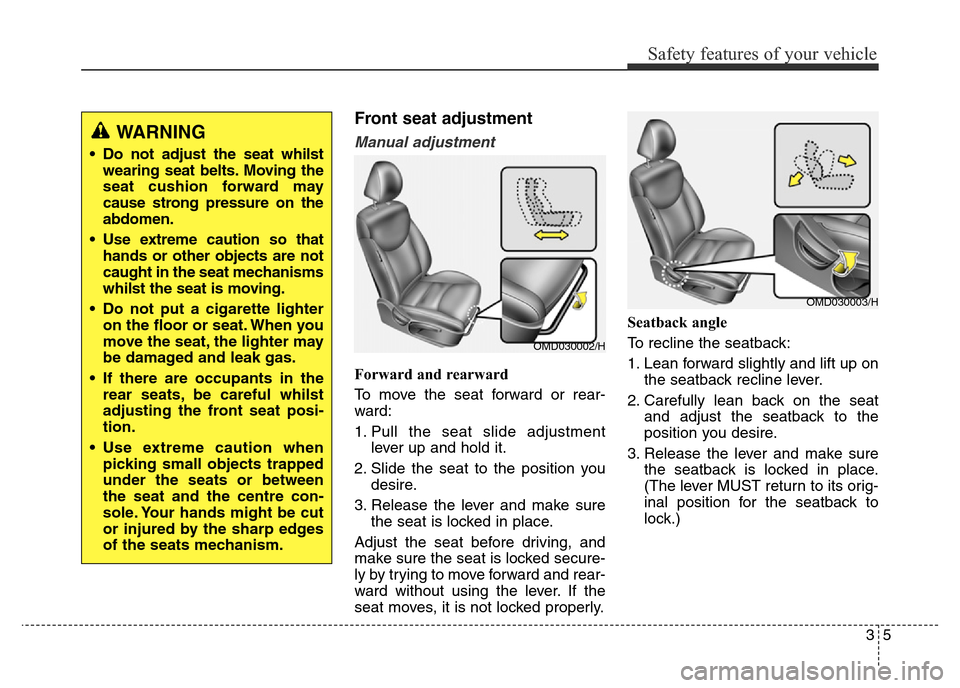
Manual adjustment
Forward and rearward
To move the seat forward or rear-
ward:
1. Pull the seat slide adjustment
lever up and hold it.
2. Slide the seat to the position you
desire.
3. Release the lever and make sure
the seat is locked in place.
Adjust the seat before driving, and
make sure the seat is locked secure-
ly by trying to move forward and rear-
ward without using the lever. If the
seat moves, it is not locked properly.Seatback angle
To recline the seatback:
1. Lean forward slightly and lift up on
the seatback recline lever.
2. Carefully lean back on the seat
and adjust the seatback to the
position you desire.
3. Release the lever and make sure
the seatback is locked in place.
(The lever MUST return to its orig-
inal position for the seatback to
lock.)
WARNING
• Do not adjust the seat whilst
wearing seat belts. Moving the
seat cushion forward may
cause strong pressure on the
abdomen.
• Use extreme caution so that
hands or other objects are not
caught in the seat mechanisms
whilst the seat is moving.
• Do not put a cigarette lighter
on the floor or seat. When you
move the seat, the lighter may
be damaged and leak gas.
• If there are occupants in the
rear seats, be careful whilst
adjusting the front seat posi-
tion.
• Use extreme caution when
picking small objects trapped
under the seats or between
the seat and the centre con-
sole. Your hands might be cut
or injured by the sharp edges
of the seats mechanism.
OMD030002/H
OMD030003/H
Page 24 of 498
Safety features of your vehicle
6 3
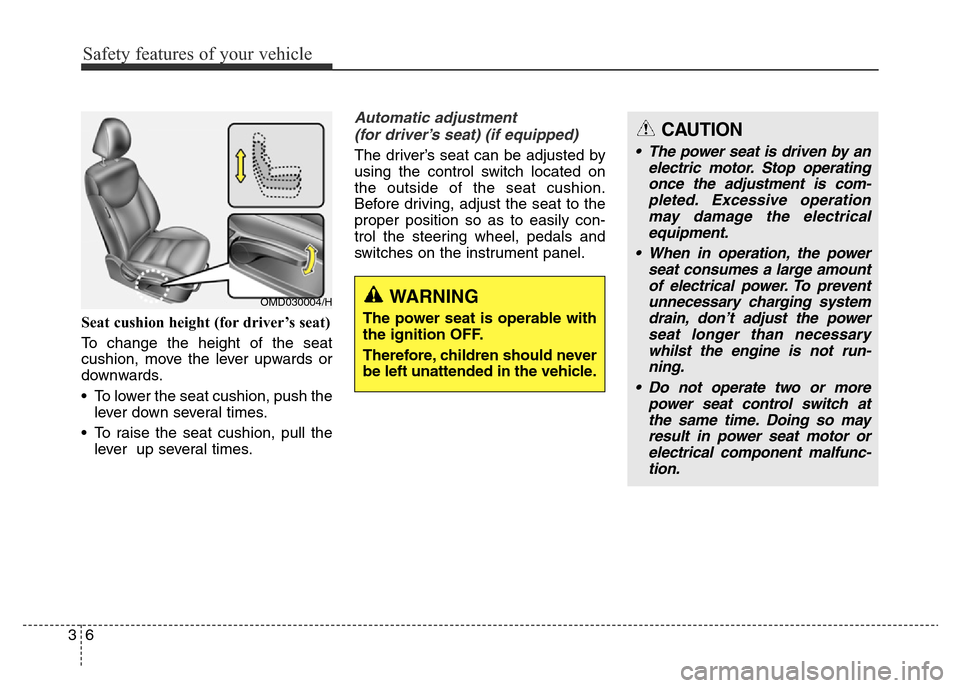
Seat cushion height (for driver’s seat)
To change the height of the seat
cushion, move the lever upwards or
downwards.
• To lower the seat cushion, push the
lever down several times.
• To raise the seat cushion, pull the
lever up several times.
Automatic adjustment
(for driver’s seat) (if equipped)
The driver’s seat can be adjusted by
using the control switch located on
the outside of the seat cushion.
Before driving, adjust the seat to the
proper position so as to easily con-
trol the steering wheel, pedals and
switches on the instrument panel.
OMD030004/HWARNING
The power seat is operable with
the ignition OFF.
Therefore, children should never
be left unattended in the vehicle.
CAUTION
• The power seat is driven by an
electric motor. Stop operating
once the adjustment is com-
pleted. Excessive operation
may damage the electrical
equipment.
• When in operation, the power
seat consumes a large amount
of electrical power. To prevent
unnecessary charging system
drain, don’t adjust the power
seat longer than necessary
whilst the engine is not run-
ning.
• Do not operate two or more
power seat control switch at
the same time. Doing so may
result in power seat motor or
electrical component malfunc-
tion.
Page 26 of 498
Safety features of your vehicle
8 3
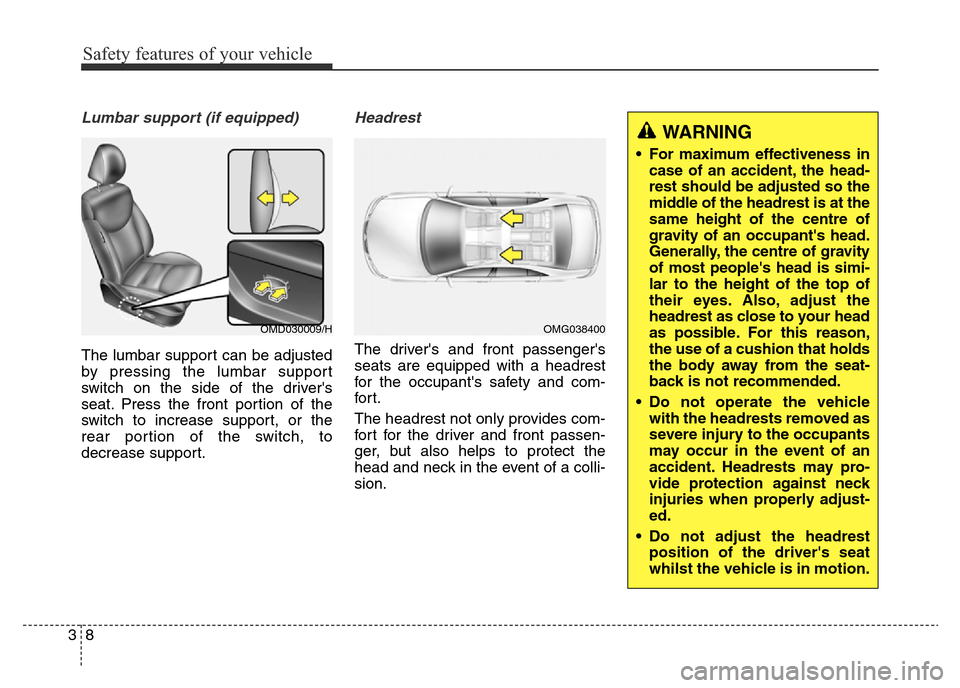
Lumbar support (if equipped)
The lumbar support can be adjusted
by pressing the lumbar support
switch on the side of the driver's
seat. Press the front portion of the
switch to increase support, or the
rear portion of the switch, to
decrease support.
Headrest
The driver's and front passenger's
seats are equipped with a headrest
for the occupant's safety and com-
for t.
The headrest not only provides com-
fort for the driver and front passen-
ger, but also helps to protect the
head and neck in the event of a colli-
sion.
OMD030009/HOMG038400
WARNING
• For maximum effectiveness in
case of an accident, the head-
rest should be adjusted so the
middle of the headrest is at the
same height of the centre of
gravity of an occupant's head.
Generally, the centre of gravity
of most people's head is simi-
lar to the height of the top of
their eyes. Also, adjust the
headrest as close to your head
as possible. For this reason,
the use of a cushion that holds
the body away from the seat-
back is not recommended.
• Do not operate the vehicle
with the headrests removed as
severe injury to the occupants
may occur in the event of an
accident. Headrests may pro-
vide protection against neck
injuries when properly adjust-
ed.
• Do not adjust the headrest
position of the driver's seat
whilst the vehicle is in motion.