brakes Hyundai Elantra 2015 Owner's Guide
[x] Cancel search | Manufacturer: HYUNDAI, Model Year: 2015, Model line: Elantra, Model: Hyundai Elantra 2015Pages: 668, PDF Size: 35.58 MB
Page 523 of 668
✽
✽NOTICE
An inappropriately disposed
battery can be harmful to
the environment and human
health. Dispose the battery
according to your local
law(s) or regulation.
Jump starting procedure
1.Position the vehicles close enough
that the jumper cables will reach,
but do not allow the vehicles to
touch.
2.Avoid fans or any moving parts in the engine compartment at all
times, even when the vehicles are
turned off.
3.Turn off all electrical devices such as radios, lights, air conditioning,
etc. Put the vehicles in P (Park, for
automatic transaxle vehicle) or
neutral (for manual transaxle vehi-
cle), and set the parking brakes.
Turn both vehicles OFF.
What to do in an emergency
66
(Continued)
NEVER attempt to rechargethe battery when the vehicle’s
battery cables are connected
to the battery.
The electrical ignition system works with high voltage.
NEVER touch these compo-
nents with the engine running
or when the ignition switch is
in the ON position.
Pb
CAUTION
To prevent damage to your vehi-cle:
Only use a 12-volt power sup- ply (battery or jumper system)to jump start your vehicle.
Do not attempt to jump start your vehicle by push-starting.
Page 531 of 668
Changing a Tire with TPMS
If you have a flat tire, the Low Tire
Pressure Telltale will illuminate. If you
believe you have a flat tire or feel any
vehicle instability, take your foot off
the accelerator pedal and let the
vehicle slow down while driving
straight ahead. Do not apply the
brakes immediately or attempt to pull
off the road as this may cause a loss
of control resulting in an accident.
When the vehicle has slowed to such
a speed that it is safe to do so, brake
carefully and pull off the road. Drive
off the road as far as possible and
park on firm, level ground. If you are
on a divided highway, do not park in
the median area between the two
traffic lanes. Replace the flat tire with
the spare tire (if equipped).The spare tire (if equipped) does not
come with a tire pressure monitoring
sensor. When the low pressure tire or
the flat tire is replaced with the spare
tire, the Low Tire Pressure Telltale
will remain on. Also, the TPMS
Malfunction Indicator will illuminate
after blinking for one minute if the
vehicle is driven at speed above 15.5
mph (25 km/h) for approximately 20
minutes.
Once the original tire equipped with
a tire pressure monitoring sensor is
reinflated to the recommended pres-
sure and reinstalled on the vehicle,
the Low Tire Pressure Telltale and
TPMS Malfunction Indicator will go
off within a few minutes.
If the indicators do not extinguish
after a few minutes, please visit an
authorized HYUNDAI dealer.
Each wheel is equipped with a tire
pressure sensor mounted inside the
tire behind the valve stem (except for
the spare tire). You must use TPMS
specific wheels. It is recommended
that you always have your tires serv-
iced by an authorized HYUNDAI
dealer as soon as possible.
What to do in an emergency
14
6
CAUTION
To prevent damaging your tire
pressure sensor, never use apuncture-repairing agents ortire sealants to repair and/orinflate a low pressure tire. Ifused, you will have to replacethe tire pressure sensor.
Page 547 of 668
What to do in an emergency
30
6
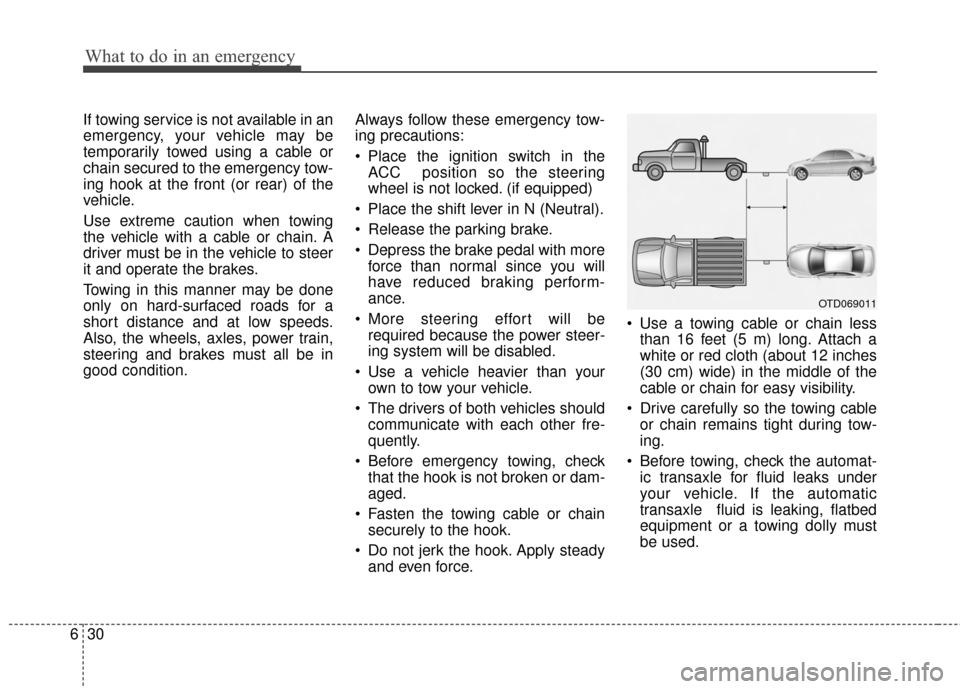
If towing service is not available in an
emergency, your vehicle may be
temporarily towed using a cable or
chain secured to the emergency tow-
ing hook at the front (or rear) of the
vehicle.
Use extreme caution when towing
the vehicle with a cable or chain. A
driver must be in the vehicle to steer
it and operate the brakes.
Towing in this manner may be done
only on hard-surfaced roads for a
short distance and at low speeds.
Also, the wheels, axles, power train,
steering and brakes must all be in
good condition. Always follow these emergency tow-
ing precautions:
Place the ignition switch in the
ACC position so the steering
wheel is not locked. (if equipped)
Place the shift lever in N (Neutral).
Release the parking brake.
Depress the brake pedal with more force than normal since you will
have reduced braking perform-
ance.
More steering effort will be required because the power steer-
ing system will be disabled.
Use a vehicle heavier than your own to tow your vehicle.
The drivers of both vehicles should communicate with each other fre-
quently.
Before emergency towing, check that the hook is not broken or dam-
aged.
Fasten the towing cable or chain securely to the hook.
Do not jerk the hook. Apply steady and even force. Use a towing cable or chain less
than 16 feet (5 m) long. Attach a
white or red cloth (about 12 inches
(30 cm) wide) in the middle of the
cable or chain for easy visibility.
Drive carefully so the towing cable or chain remains tight during tow-
ing.
Before towing, check the automat- ic transaxle for fluid leaks under
your vehicle. If the automatic
transaxle fluid is leaking, flatbed
equipment or a towing dolly must
be used.
OTD069011
Page 556 of 668
Maintenance
87
At least twice a year:(i.e., every Spring and Fall):
Check radiator, heater and air con- ditioning hoses for leaks or dam-
age.
Check windshield washer spray and wiper operation. Clean wiper
blades with clean cloth dampened
with washer fluid.
Check headlight alignment.
Check muffler, exhaust pipes, shields and clamps.
Check the seat belts for wear and function.
At least once a year:
Clean body and door drain holes.
Lubricate door hinges and hoodhinges.
Lubricate door and hood locks and latches.
Lubricate door rubber weather strips.
Check the air conditioning system.
Inspect and lubricate automatic transaxle linkage and controls.
Clean the battery and terminals.
Check the brake/clutch fluid level. Follow Normal Maintenance
Schedule if the vehicle is usually
operated where none of the following
conditions apply. If any of the follow-
ing conditions apply, you must follow
the Maintenance Under Severe
Usage Conditions.
Repeated short distance driving.
Driving in dusty conditions or
sandy areas.
Extensive use of brakes.
Driving in areas where salt or other corrosive materials are used.
Driving on rough or muddy roads.
Driving in mountainous areas.
Extended periods of idling or low speed operation.
Driving for a prolonged period in cold temperatures and/or extreme-
ly humid climates.
More than 50% driving in heavy city traffic during hot weather
above 90°F (32°C).
For additional information or assis-
tance see your authorized HYUNDAI
dealer.
SCHEDULED MAINTENANCE
SERVICES
Page 635 of 668
787
Maintenance
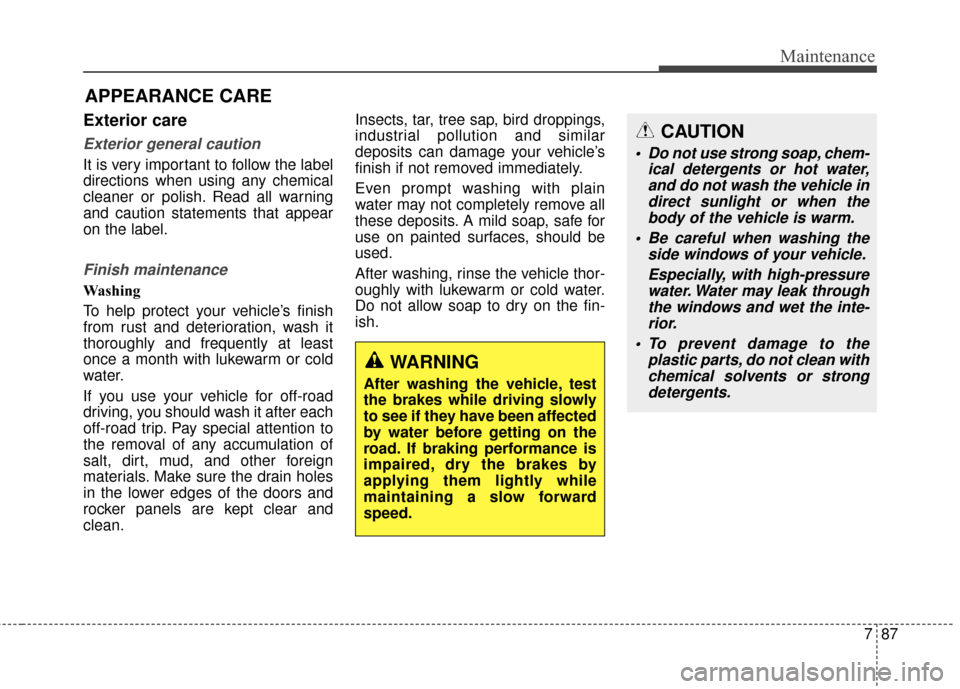
APPEARANCE CARE
Exterior care
Exterior general caution
It is very important to follow the label
directions when using any chemical
cleaner or polish. Read all warning
and caution statements that appear
on the label.
Finish maintenance
Washing
To help protect your vehicle’s finish
from rust and deterioration, wash it
thoroughly and frequently at least
once a month with lukewarm or cold
water.
If you use your vehicle for off-road
driving, you should wash it after each
off-road trip. Pay special attention to
the removal of any accumulation of
salt, dirt, mud, and other foreign
materials. Make sure the drain holes
in the lower edges of the doors and
rocker panels are kept clear and
clean.Insects, tar, tree sap, bird droppings,
industrial pollution and similar
deposits can damage your vehicle’s
finish if not removed immediately.
Even prompt washing with plain
water may not completely remove all
these deposits. A mild soap, safe for
use on painted surfaces, should be
used.
After washing, rinse the vehicle thor-
oughly with lukewarm or cold water.
Do not allow soap to dry on the fin-
ish.
WARNING
After washing the vehicle, test
the brakes while driving slowly
to see if they have been affected
by water before getting on the
road. If braking performance is
impaired, dry the brakes by
applying them lightly while
maintaining a slow forward
speed.
CAUTION
Do not use strong soap, chem-
ical detergents or hot water,and do not wash the vehicle indirect sunlight or when thebody of the vehicle is warm.
Be careful when washing the side windows of your vehicle.
Especially, with high-pressurewater. Water may leak throughthe windows and wet the inte-rior.
To prevent damage to the plastic parts, do not clean withchemical solvents or strongdetergents.
Page 638 of 668
Maintenance
90
7
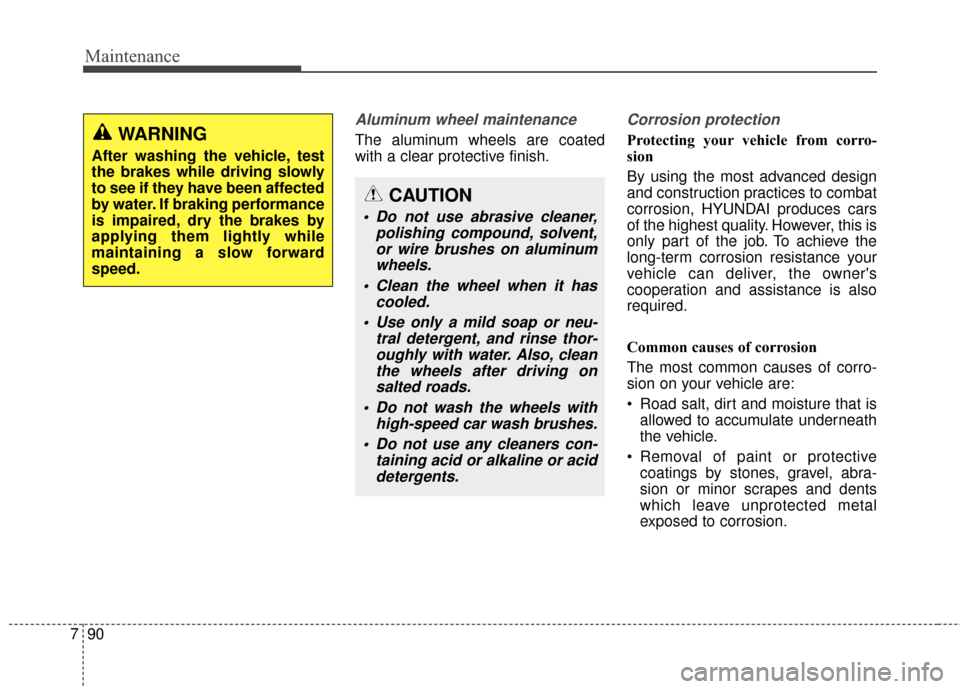
Aluminum wheel maintenance
The aluminum wheels are coated
with a clear protective finish.
Corrosion protection
Protecting your vehicle from corro-
sion
By using the most advanced design
and construction practices to combat
corrosion, HYUNDAI produces cars
of the highest quality. However, this is
only part of the job. To achieve the
long-term corrosion resistance your
vehicle can deliver, the owner's
cooperation and assistance is also
required.
Common causes of corrosion
The most common causes of corro-
sion on your vehicle are:
• Road salt, dirt and moisture that is
allowed to accumulate underneath
the vehicle.
coatings by stones, gravel, abra-
sion or minor scrapes and dents
which leave unprotected metal
exposed to corrosion.WARNING
After washing the vehicle, test
the brakes while driving slowly
to see if they have been affected
by water. If braking performance
is impaired, dry the brakes by
applying them lightly while
maintaining a slow forward
speed.
CAUTION
• Do not use abrasive cleaner, polishing compound, solvent,or wire brushes on aluminumwheels.
Clean the wheel when it has cooled.
Use only a mild soap or neu- tral detergent, and rinse thor-oughly with water. Also, cleanthe wheels after driving onsalted roads.
Do not wash the wheels with high-speed car wash brushes.
Do not use any cleaners con- taining acid or alkaline or aciddetergents.
Page 658 of 668
I3
Index
Manual heating and air conditioning ..........................4-96
Mode selection ............................................................4-96
OFF mode ..................................................................4-101
Temperature control ....................................................4-97
Automatic transaxle ........................................................5-22 Good driving practices ................................................5-27
Ignition key interlock system ......................................5-27
Parking ........................................................................\
5-27
Shift lock system ........................................................5-25
Shift-lock release ........................................................5-26
Sports mode ................................................................5-24
Automatic turn off function ............................................4-78
Aux, USB and iPod ......................................................3-102 Battery ........................................................................\
....7-43
Battery recharging ......................................................7-45
Battery saver function ....................................................4-77
Before driving ..................................................................5-3
Blind zone mirror............................................................4-49
Blue Link
®center ..........................................................4-42
Brake system ..................................................................5-29 Anti-lock brake system (ABS) ....................................5-32
Disc brakes wear indicator ..........................................5-30
Electronic stability control (ESC) ..............................5-34
Good braking practices................................................5-39
Hill-Start Assist Control (HAC) ................................5-39
Parking brake ..............................................................5-30
Power brakes ..............................................................5-29
Vehicle stability management (VSM) ........................5-38
Brake/clutch fluid ..........................................................7-35
Bulb replacement ............................................................7-76 Front side marker ........................................................7-79
Front turn signal light ..................................................7-79
High mounted stop light ..............................................7-84
Interior light ................................................................7-85
License plate light ......................................................7-85
Rear combination light ................................................7-81
Side repeater light ......................................................7-80
Bulb wattage ....................................................................8-2
Button start/stop, see engine start/stop button ..................5-9
B
Page 664 of 668
I9
Index
Fan speed control ........................................................4-89
Heating and air conditioning ......................................4-85
MAX A/C-Level ..........................................................4-87
Mode selection ............................................................4-86
Temperature control ....................................................4-87
Manual transaxle ............................................................5-18 Downshifting ..............................................................5-19
Good driving practices ................................................5-20
Using the clutch ..........................................................5-19
Map lamp ........................................................................\
4-79
Memory fuse ..................................................................7-65
Mirrors ........................................................................\
....4-42 Blind zone mirror ........................................................4-49
Blue Link
®center ........................................................4-42
Day/night rearview mirror ..........................................4-42
Electric chromic mirror (ECM) with compass and
HomeLink
®system ..................................................4-43
Folding the outside rearview mirror............................4-50
Inside rearview mirror ................................................4-42
Outside rearview mirror ..............................................4-48
Outside rearview mirror remote control......................4-49
Moonroof, see sunroof ....................................................4-34
Multi fuse ........................................................................\
7-67 Occupant Classification System (OCS)..........................3-55
Odometer ........................................................................\
4-55
Oil (Engine) ....................................................................7-30\
Outside rearview mirror..................................................4-48
Outside temperature ......................................................4-114
Owner maintenance ..........................................................7-6
Parking brake ........................................................5-30, 7-36
Parking light position......................................................4-72
Passenger's front air bag ................................................3-47
Power brakes ..................................................................5-29
Power outlet ..................................................................4-116
Power window lock switch ............................................4-27
Pre-tensioner seat belt ....................................................3-27
O
P