engine Hyundai Elantra 2016 Owner's Manual
[x] Cancel search | Manufacturer: HYUNDAI, Model Year: 2016, Model line: Elantra, Model: Hyundai Elantra 2016Pages: 669, PDF Size: 31.96 MB
Page 644 of 669
795
Maintenance
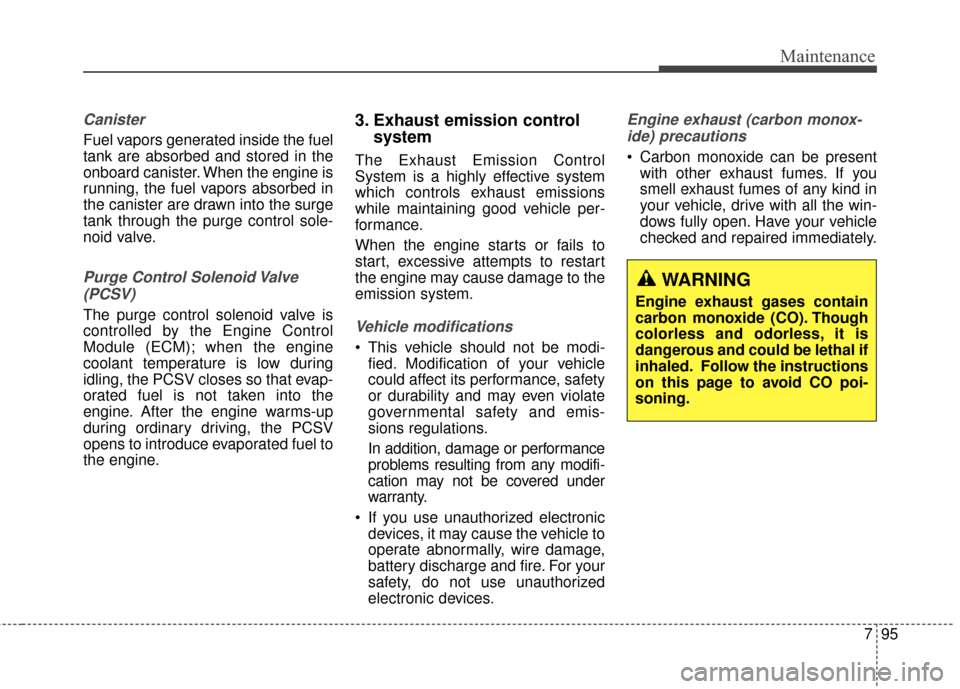
Canister
Fuel vapors generated inside the fuel
tank are absorbed and stored in the
onboard canister. When the engine is
running, the fuel vapors absorbed in
the canister are drawn into the surge
tank through the purge control sole-
noid valve.
Purge Control Solenoid Valve(PCSV)
The purge control solenoid valve is
controlled by the Engine Control
Module (ECM); when the engine
coolant temperature is low during
idling, the PCSV closes so that evap-
orated fuel is not taken into the
engine. After the engine warms-up
during ordinary driving, the PCSV
opens to introduce evaporated fuel to
the engine.
3. Exhaust emission control system
The Exhaust Emission Control
System is a highly effective system
which controls exhaust emissions
while maintaining good vehicle per-
formance.
When the engine starts or fails to
start, excessive attempts to restart
the engine may cause damage to the
emission system.
Vehicle modifications
This vehicle should not be modi-
fied. Modification of your vehicle
could affect its performance, safety
or durability and may even violate
governmental safety and emis-
sions regulations.
In addition, damage or performance
problems resulting from any modifi-
cation may not be covered under
warranty.
If you use unauthorized electronic devices, it may cause the vehicle to
operate abnormally, wire damage,
battery discharge and fire. For your
safety, do not use unauthorized
electronic devices.
Engine exhaust (carbon monox-
ide) precautions
Carbon monoxide can be present with other exhaust fumes. If you
smell exhaust fumes of any kind in
your vehicle, drive with all the win-
dows fully open. Have your vehicle
checked and repaired immediately.
WARNING
Engine exhaust gases contain
carbon monoxide (CO). Though
colorless and odorless, it is
dangerous and could be lethal if
inhaled. Follow the instructions
on this page to avoid CO poi-
soning.
Page 645 of 669
Maintenance
96
7
Do not operate the engine in con-
fined or closed areas (such as
garages) any more than what is
necessary to move the vehicle in or
out of the area.
When the vehicle is stopped in an open area for more than a short
time with the engine running,
adjust the ventilation system (as
needed) to draw outside air into the
vehicle.
Never sit in a parked or stopped vehicle for any extended time with
the engine running.
When the engine stalls or fails to start, excessive attempts to restart
the engine may cause damage to
the emission control system.Operating precautions for catalyt-
ic converters (if equipped)
WARNING
The exhaust system and cat- alytic converter are very hot
during and immediately after
the engine has been running.
To avoid SERIOUS INJURY or
DEATH.
Do not park, idle, or drive the vehicle over or near flamma-
ble objects, such as grass,
vegetation, paper, leaves, etc.
A hot exhaust system can
ignite flammable items under
your vehicle.
Keep away from the exhaust system and catalytic convert-
er or you may get burned.
Also, Do not remove the heat
sink around the exhaust sys-
tem, do not seal the bottom of
the vehicle, and do not coat
the vehicle for corrosion con-
trol. It may present a fire risk
under certain conditions.
WARNING- CALIFORNIA
PROPOSITION 65 WARNING
Engine exhaust and a wide vari-
ety of automobile components
and parts, including compo-
nents found in the interior fur-
nishings in a vehicle, contain or
emit chemicals known to the
State of California to cause can-
cer and birth defects and repro-
ductive harm. In addition, cer-
tain fluids contained in vehicles
and certain products of compo-
nent wear contain or emit chem-
icals known to the State of
California to cause cancer and
birth defects or other reproduc-
tive harm.
Page 646 of 669
797
Maintenance
Your vehicle is equipped with a cat-
alytic converter emission control
device.
To prevent damage to the catalytic
converter and to your vehicle, take
the following precautions:(Continued) Do not modify or tamper with any part of the engine or emis-sion control system. Allinspections and adjustmentsmust be made by an author-ized HYUNDAI dealer.
Avoid driving with extremely low fuel level. If you run out ofgasoline, it could cause theengine to misfire and result inexcessive loading of the cat-alytic converter.
CAUTION
Use only UNLEADED FUEL for gasoline engines.
Do not operate the vehicle when there are signs ofengine malfunction, such asmisfire or a noticeable loss ofperformance.
Do not misuse or abuse the engine. Examples of misuseare coasting with the engineoff and descending steepgrades in gear with the engineoff.
Do not operate the engine at high idle speed for extendedperiods (5 minutes or more).
(Continued)
Page 648 of 669
Specifications, Consumer information and Reporting safety defects
Dimensions . . . . . . . . . . . . . . . . . . . . . . . . . . . . . . . . 8-2
Bulb wattage . . . . . . . . . . . . . . . . . . . . . . . . . . . . . . . 8-2
Tires and wheels . . . . . . . . . . . . . . . . . . . . . . . . . . . . 8-3
Capacity/Weight . . . . . . . . . . . . . . . . . . . . . . . . . . . . 8-3
Recommended lubricants and capacities . . . . . . . . 8-4
• Recommended SAE viscosity number. . . . . . . . . . . . . 8-5
Vehicle identification number (VIN) . . . . . . . . . . . 8-6
Vehicle certification label. . . . . . . . . . . . . . . . . . . . . 8-6
Tire specification and pressure label . . . . . . . . . . . 8-7
Engine number . . . . . . . . . . . . . . . . . . . . . . . . . . . . . 8-7
Refrigerant label. . . . . . . . . . . . . . . . . . . . . . . . . . . . 8-7
Consumer information. . . . . . . . . . . . . . . . . . . . . . . 8-8
Reporting safety defects. . . . . . . . . . . . . . . . . . . . . . 8-9
8
Page 651 of 669
Specifications, Consumer information, Reporting safety defects
48
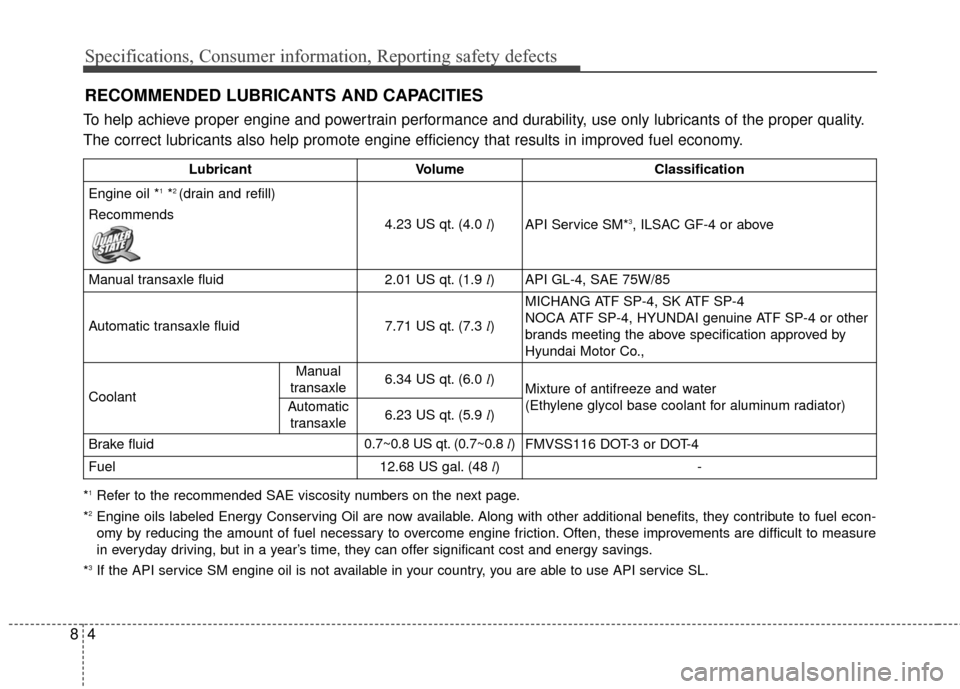
RECOMMENDED LUBRICANTS AND CAPACITIES
To help achieve proper engine and powertrain performance and durability, use only lubricants of the proper quality.
The correct lubricants also help promote engine efficiency that results in improved fuel economy.
LubricantVolumeClassification
Engine oil *1*2 (drain and refill)
Recommends
4.23 US qt. (4.0 l)API Service SM*3, ILSAC GF-4 or above
Manual transaxle fluid2.01 US qt. (1.9 l)API GL-4, SAE 75W/85
Automatic transaxle fluid7.71 US qt. (7.3 l)
MICHANG ATF SP-4, SK ATF SP-4
NOCA ATF SP-4, HYUNDAI genuine ATF SP-4 or other
brands meeting the above specification approved by
Hyundai Motor Co.,
Coolant
Manual
transaxle6.34 US qt. (6.0 l)Mixture of antifreeze and water
(Ethylene glycol base coolant for aluminum radiator)
Automatic
transaxle6.23 US qt. (5.9 l)
Brake fluid0.7~0.8 US qt. (0.7~0.8 l)FMVSS116 DOT-3 or DOT-4
Fuel12.68 US gal. (48 l)-
*1Refer to the recommended SAE viscosity numbers on the next page.
*
2Engine oils labeled Energy Conserving Oil are now available. Along with other additional benefits, they contribute to fuel econ-
omy by reducing the amount of fuel necessary to overcome engine friction. Often, these improvements are difficult to measure
in everyday driving, but in a year’s time, they can offer significant cost and energy savings.
*
3If the API service SM engine oil is not available in your country, you are able to use API service SL.
Page 652 of 669
85
Specifications, Consumer information, Reporting safety defects
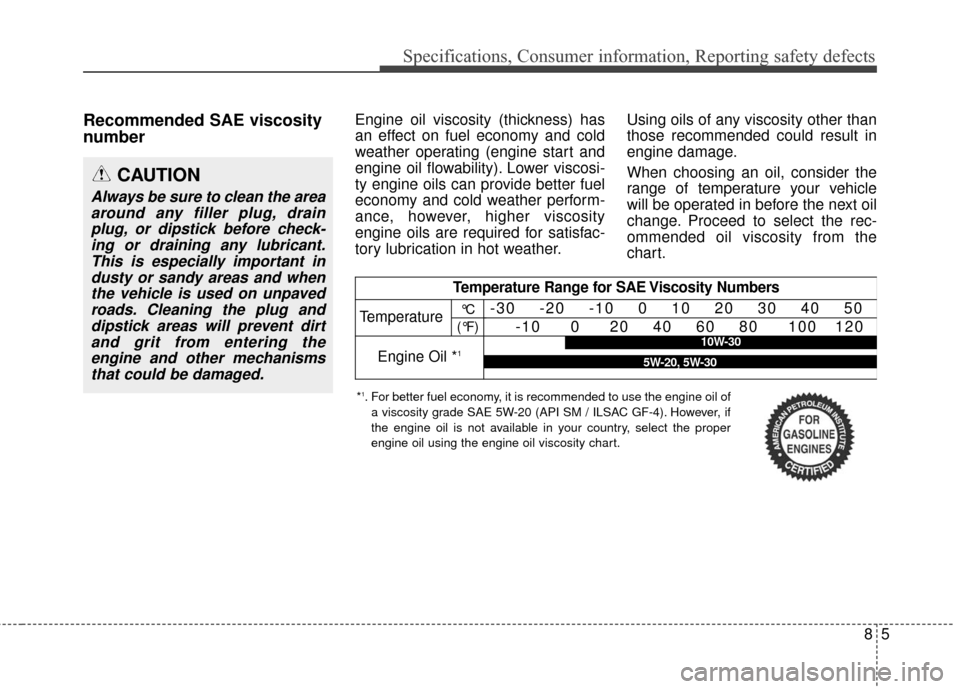
Recommended SAE viscosity
number Engine oil viscosity (thickness) has
an effect on fuel economy and cold
weather operating (engine start and
engine oil flowability). Lower viscosi-
ty engine oils can provide better fuel
economy and cold weather perform-
ance, however, higher viscosity
engine oils are required for satisfac-
tory lubrication in hot weather.Using oils of any viscosity other than
those recommended could result in
engine damage.
When choosing an oil, consider the
range of temperature your vehicle
will be operated in before the next oil
change. Proceed to select the rec-
ommended oil viscosity from the
chart.
CAUTION
Always be sure to clean the area
around any filler plug, drainplug, or dipstick before check-ing or draining any lubricant.This is especially important industy or sandy areas and whenthe vehicle is used on unpavedroads. Cleaning the plug anddipstick areas will prevent dirtand grit from entering theengine and other mechanismsthat could be damaged.
*1. For better fuel economy, it is recommended to use the engine oil of
a viscosity grade SAE 5W-20 (API SM / ILSAC GF-4). However, if
the engine oil is not available in your country, select the proper
engine oil using the engine oil viscosity chart.
Temperature Range for SAE Viscosity Numbers
Temperature -30 -20 -10 0 10 20 30 40 50
-10 0 20 40 60 80 100 120
Engine Oil *110W-30
5W-20, 5W-30
°C
(°F)
Page 654 of 669
87
Specifications, Consumer information, Reporting safety defects
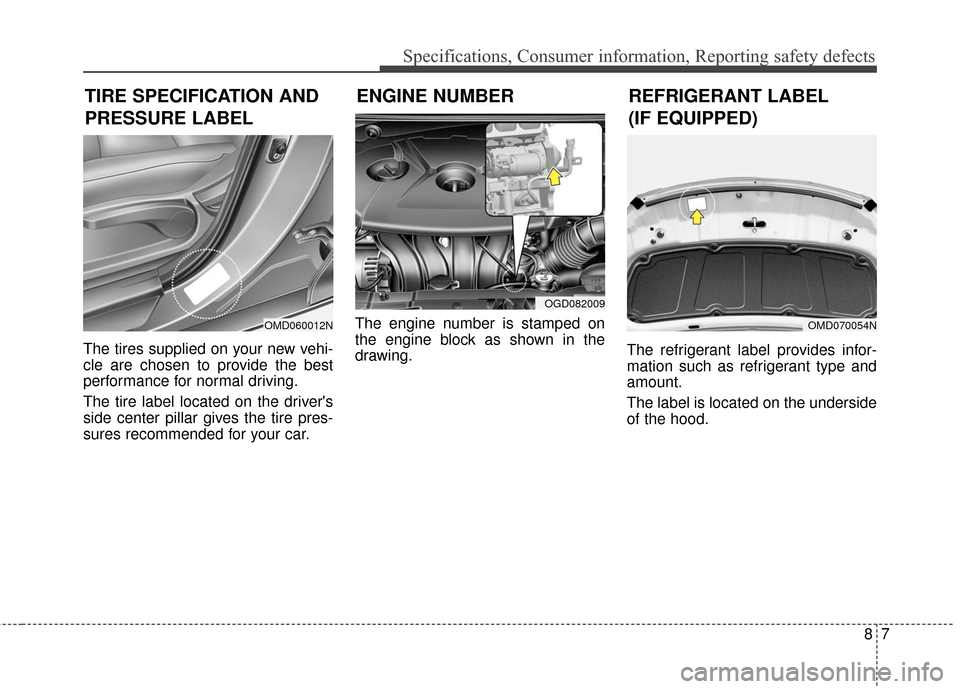
The tires supplied on your new vehi-
cle are chosen to provide the best
performance for normal driving.
The tire label located on the driver's
side center pillar gives the tire pres-
sures recommended for your car.The engine number is stamped on
the engine block as shown in the
drawing.
The refrigerant label provides infor-
mation such as refrigerant type and
amount.
The label is located on the underside
of the hood.
OMD060012N
ENGINE NUMBER
REFRIGERANT LABEL
(IF EQUIPPED)
TIRE SPECIFICATION AND
PRESSURE LABEL
OGD082009
OMD070054N
Page 659 of 669
I3
Index
Manual heating and air conditioning ..........................4-96
Mode selection ............................................................4-96
OFF mode ..................................................................4-101
Temperature control ....................................................4-97
Automatic transaxle ........................................................5-22 Good driving practices ................................................5-27
Ignition key interlock system ......................................5-27
Parking ........................................................................\
5-27
Shift lock system ........................................................5-25
Shift-lock release ........................................................5-26
Sports mode ................................................................5-24
Automatic turn off function ............................................4-78
Aux, USB and iPod ......................................................3-102 Battery ........................................................................\
....7-43
Battery recharging ......................................................7-45
Battery saver function ....................................................4-77
Before driving ..................................................................5-3
Blind zone mirror............................................................4-49
Blue Link
®center ..........................................................4-42
Brake system ..................................................................5-29 Anti-lock brake system (ABS) ....................................5-32
Disc brakes wear indicator ..........................................5-30
Electronic stability control (ESC) ..............................5-34
Good braking practices................................................5-39
Hill-Start Assist Control (HAC) ................................5-39
Parking brake ..............................................................5-30
Power brakes ..............................................................5-29
Vehicle stability management (VSM) ........................5-38
Brake/clutch fluid ..........................................................7-35
Bulb replacement ............................................................7-76 Front side marker ........................................................7-79
Front turn signal light ..................................................7-79
High mounted stop light ..............................................7-84
Interior light ................................................................7-85
License plate light ......................................................7-85
Rear combination light ................................................7-81
Side repeater light ......................................................7-80
Bulb wattage ....................................................................8-2
Button start/stop, see engine start/stop button ..................5-9
B
Page 660 of 669
Index
4I
Capacities (Lubricants) ....................................................3-4
Capacity/Weight ................................................................8-3
CareExterior care ................................................................7-87
Interior care ................................................................7-93
Tire care ......................................................................7-\
47
CD player ....................................................................4-13\
5
Center console storage ..................................................4-110
Central door lock switch ................................................4-17
Certification label ............................................................8-6
Chains Tire chains ..................................................................5-51
Changing a Tire with TPMS ..........................................6-14
Check tire inflation pressure ..........................................7-49
Child restraint system (CRS) ..........................................3-34 Booster seats ................................................................3-37
Forward-facing child restraints ..................................3-37
Installing a Child Restraint System (CRS) ................3-37
Lower Anchors and Tether for Children (LATCH) System ......................................................................3-\
38
Rear-facing child seats ................................................3-36
Securing a child restraint seat with “Tether Anchor” system ........................................................................\
3-41
Securing a child restraint with the LATCH anchors system ........................................................................\
3-40
Selecting a Child Restraint System (CRS)..................3-35 Child-safety rear door lock ............................................4-19
Climate control air filter ................................................4-92
Climate control air filter (replacement) ..........................7-39
Clock ........................................................................\
....4-113
Clothes hanger ..............................................................4-117
Combined instrument, see instrument cluster ................4-51
Compact spare tire replacement ....................................7-52
Consumer information ....................................................8-8
Coolant ........................................................................\
....7-32
Cooling fluid, see engine coolant ..................................7-32
Crankcase emission control system ................................7-94
Cruise control system ....................................................5-43
Cup holder ....................................................................4-115
Curtain air bags ..............................................................3-49
Dashboard illumination, see instrument panel
illumination ..................................................................4-52
Dashboard, see instrument cluster ..................................4-51
Day/night rearview mirror ..............................................4-42
Daytime running light ....................................................4-78
Defogging (Windshield) ..............................................4-105
Defroster (Rear window) ................................................4-83
Defrosting (Windshield) ..............................................4-105
Dimensions ......................................................................8-\
2
Display illumination, see instrument panel illumination ..4-52
Displays, see instrument cluster ....................................4-51
D
C
Page 661 of 669

I5
Index
Door locks ......................................................................4-\
14Auto door lock/unlock features ..................................4-18
Central door lock switch ............................................4-17
Child-safety rear door lock..........................................4-19
Door lock button..........................................................4-16
Impact sensing door unlock system ............................4-18
Remote key ..................................................................4-14
Smart key ....................................................................4-15\
Speed sensing door lock system..................................4-18
Drinks holders, see cup holders ....................................4-115
Driver selectable steering mode ....................................4-39
Driver’s air bag ..............................................................3-47
Driving assist system Active ECO system ....................................................5-41
Driving at night ..............................................................5-49
Driving in flooded areas ................................................5-50
Driving in the rain ..........................................................5-50 Electric chromic mirror (ECM) with compass and
HomeLink
®system ......................................................4-43
Electric power steering (EPS) ........................................4-38
Electronic stability control (ESC) ..................................5-34
Emergency towing ..........................................................6-29
Emission control system ................................................7-94 Crankcase emission control system ............................7-94
Evaporative emission control system ..........................7-94
Exhaust emission control system ................................7-95
Engine compartment..................................................2-6, 7-2
Engine compartment panel fuse ....................................7-66
Engine coolant ................................................................7-32
Engine coolant temperature gauge ................................4-54
Engine number ..................................................................8-7
Engine oil ........................................................................\
7-30
Engine Start/Stop button ..................................................5-9
Evaporative emission control system ............................7-94
Exhaust emission control system....................................7-95
Explanation of scheduled maintenance items ................7-26
Exterior care....................................................................7-87\
Exterior lights ................................................................4-72
Exterior overview Front ........................................................................\
......2-2
Rear........................................................................\
........2-3
E