sae Hyundai Elantra 2016 Owner's Manual
[x] Cancel search | Manufacturer: HYUNDAI, Model Year: 2016, Model line: Elantra, Model: Hyundai Elantra 2016Pages: 669, PDF Size: 31.96 MB
Page 509 of 669
Driving your vehicle
52
5
✽
✽
NOTICE
• Install tire chains on the front
tires. It should be noted that
installing tire chains on the tires
will provide a greater driving
force, but will not prevent side
skids.
• Do not install studded tires with- out first checking local and munic-
ipal regulations for possible
restrictions against their use.
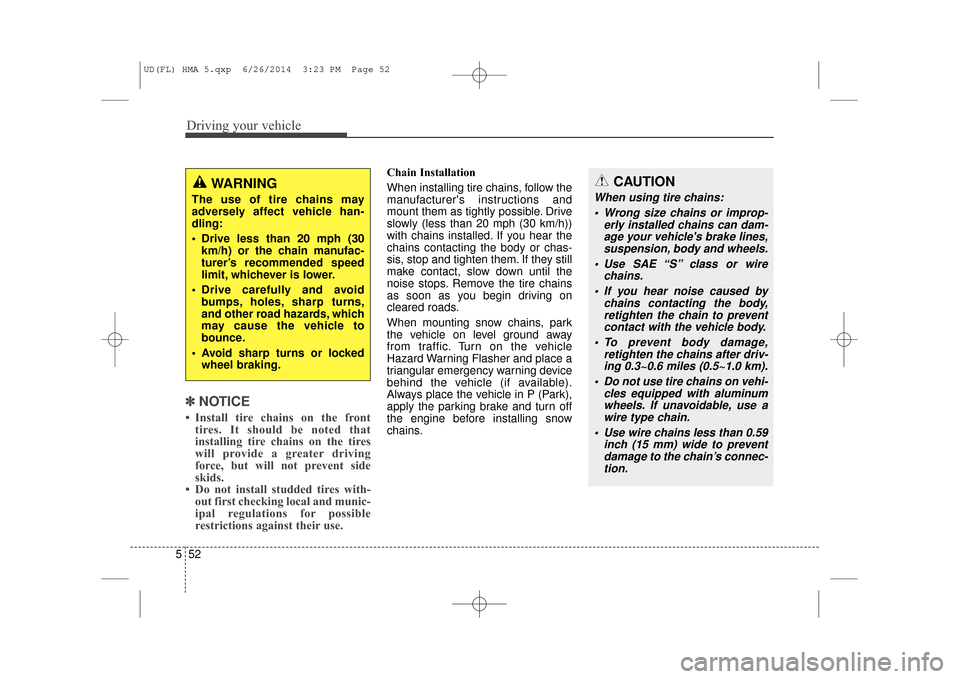
Chain Installation
When installing tire chains, follow the
manufacturer's instructions and
mount them as tightly possible. Drive
slowly (less than 20 mph (30 km/h))
with chains installed. If you hear the
chains contacting the body or chas-
sis, stop and tighten them. If they still
make contact, slow down until the
noise stops. Remove the tire chains
as soon as you begin driving on
cleared roads.
When mounting snow chains, park
the vehicle on level ground away
from traffic. Turn on the vehicle
Hazard Warning Flasher and place a
triangular emergency warning device
behind the vehicle (if available).
Always place the vehicle in P (Park),
apply the parking brake and turn off
the engine before installing snow
chains.
WARNING
The use of tire chains may
adversely affect vehicle han-
dling:
Drive less than 20 mph (30
km/h) or the chain manufac-
turer’s recommended speed
limit, whichever is lower.
Drive carefully and avoid bumps, holes, sharp turns,
and other road hazards, which
may cause the vehicle to
bounce.
Avoid sharp turns or locked wheel braking.
CAUTION
When using tire chains:
Wrong size chains or improp- erly installed chains can dam-age your vehicle's brake lines,suspension, body and wheels.
Use SAE “S” class or wire chains.
If you hear noise caused by chains contacting the body,retighten the chain to preventcontact with the vehicle body.
To prevent body damage, retighten the chains after driv-ing 0.3~0.6 miles (0.5~1.0 km).
Do not use tire chains on vehi- cles equipped with aluminumwheels. If unavoidable, use awire type chain.
Use wire chains less than 0.59 inch (15 mm) wide to preventdamage to the chain’s connec-tion.
UD(FL) HMA 5.qxp 6/26/2014 3:23 PM Page 52
Page 648 of 669
Specifications, Consumer information and Reporting safety defects
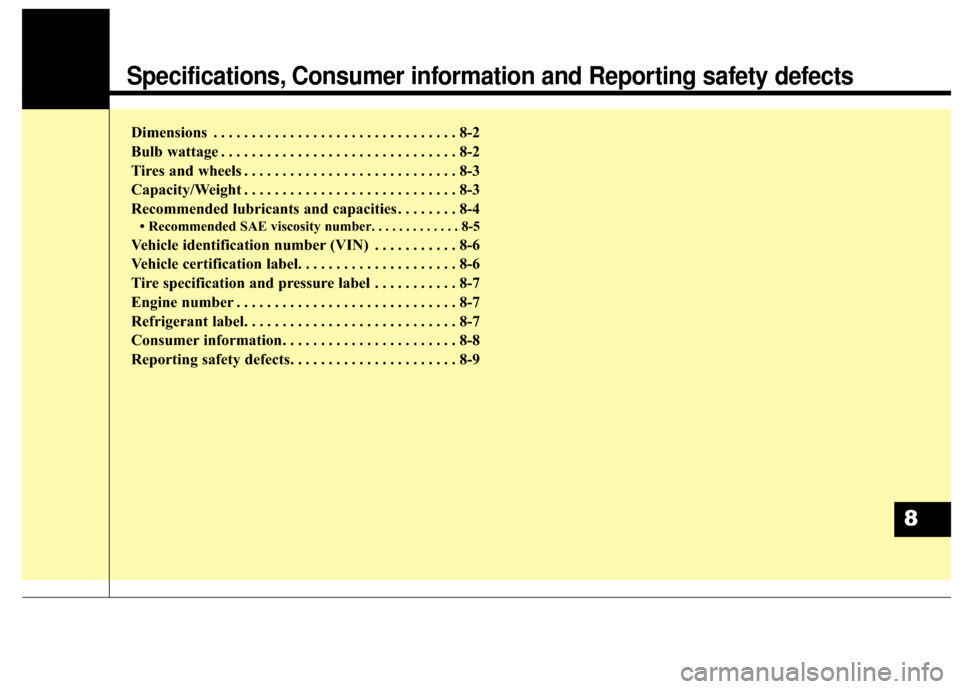
Dimensions . . . . . . . . . . . . . . . . . . . . . . . . . . . . . . . . 8-2
Bulb wattage . . . . . . . . . . . . . . . . . . . . . . . . . . . . . . . 8-2
Tires and wheels . . . . . . . . . . . . . . . . . . . . . . . . . . . . 8-3
Capacity/Weight . . . . . . . . . . . . . . . . . . . . . . . . . . . . 8-3
Recommended lubricants and capacities . . . . . . . . 8-4
• Recommended SAE viscosity number. . . . . . . . . . . . . 8-5
Vehicle identification number (VIN) . . . . . . . . . . . 8-6
Vehicle certification label. . . . . . . . . . . . . . . . . . . . . 8-6
Tire specification and pressure label . . . . . . . . . . . 8-7
Engine number . . . . . . . . . . . . . . . . . . . . . . . . . . . . . 8-7
Refrigerant label. . . . . . . . . . . . . . . . . . . . . . . . . . . . 8-7
Consumer information. . . . . . . . . . . . . . . . . . . . . . . 8-8
Reporting safety defects. . . . . . . . . . . . . . . . . . . . . . 8-9
8
Page 651 of 669
Specifications, Consumer information, Reporting safety defects
48
RECOMMENDED LUBRICANTS AND CAPACITIES
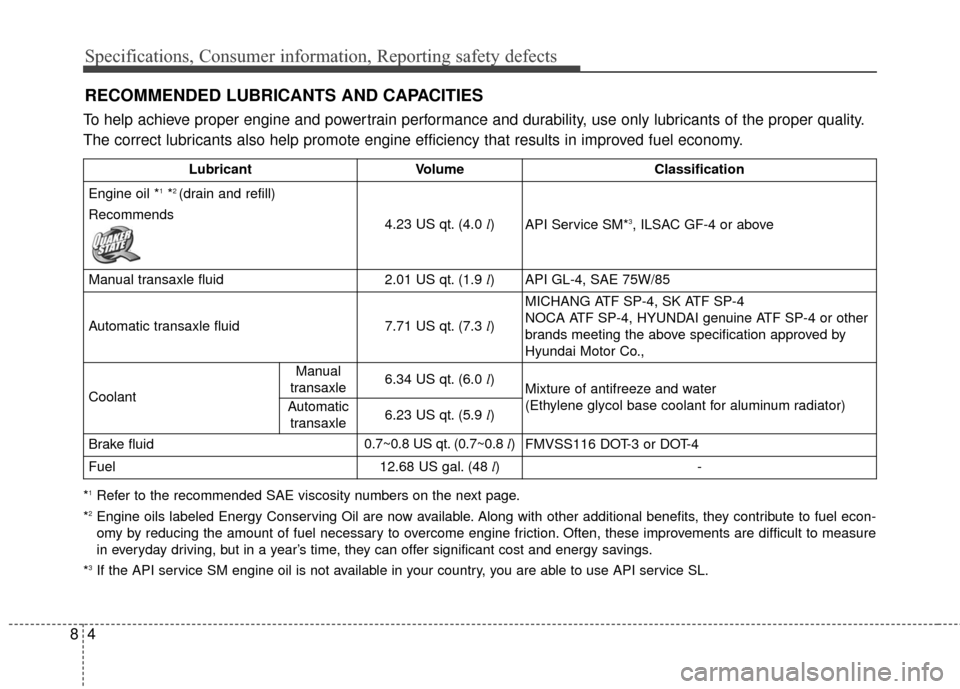
To help achieve proper engine and powertrain performance and durability, use only lubricants of the proper quality.
The correct lubricants also help promote engine efficiency that results in improved fuel economy.
LubricantVolumeClassification
Engine oil *1*2 (drain and refill)
Recommends
4.23 US qt. (4.0 l)API Service SM*3, ILSAC GF-4 or above
Manual transaxle fluid2.01 US qt. (1.9 l)API GL-4, SAE 75W/85
Automatic transaxle fluid7.71 US qt. (7.3 l)
MICHANG ATF SP-4, SK ATF SP-4
NOCA ATF SP-4, HYUNDAI genuine ATF SP-4 or other
brands meeting the above specification approved by
Hyundai Motor Co.,
Coolant
Manual
transaxle6.34 US qt. (6.0 l)Mixture of antifreeze and water
(Ethylene glycol base coolant for aluminum radiator)
Automatic
transaxle6.23 US qt. (5.9 l)
Brake fluid0.7~0.8 US qt. (0.7~0.8 l)FMVSS116 DOT-3 or DOT-4
Fuel12.68 US gal. (48 l)-
*1Refer to the recommended SAE viscosity numbers on the next page.
*
2Engine oils labeled Energy Conserving Oil are now available. Along with other additional benefits, they contribute to fuel econ-
omy by reducing the amount of fuel necessary to overcome engine friction. Often, these improvements are difficult to measure
in everyday driving, but in a year’s time, they can offer significant cost and energy savings.
*
3If the API service SM engine oil is not available in your country, you are able to use API service SL.
Page 652 of 669
85
Specifications, Consumer information, Reporting safety defects
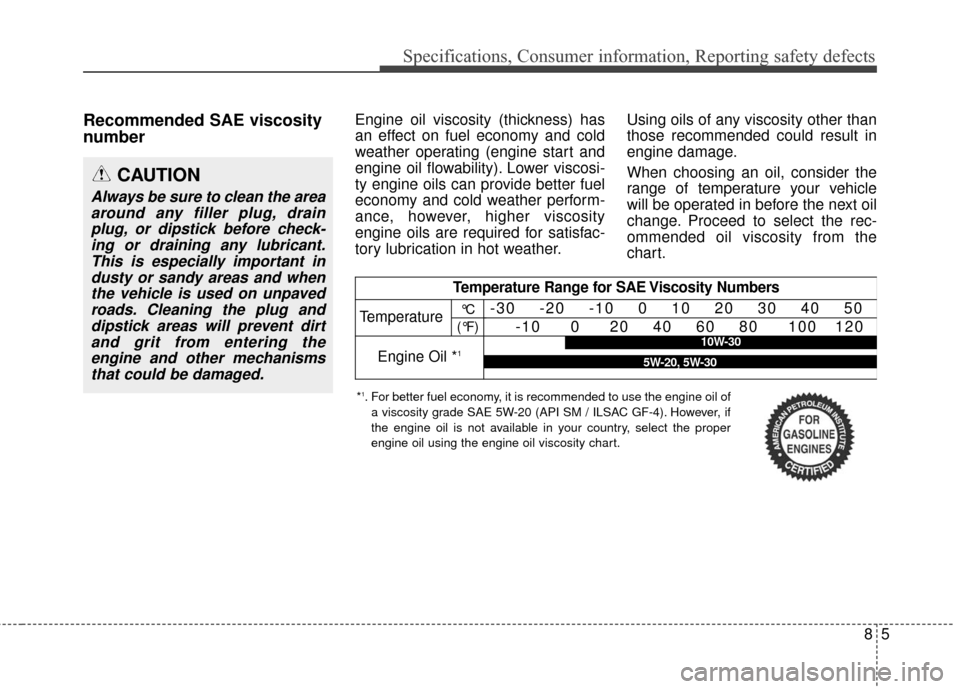
Recommended SAE viscosity
number Engine oil viscosity (thickness) has
an effect on fuel economy and cold
weather operating (engine start and
engine oil flowability). Lower viscosi-
ty engine oils can provide better fuel
economy and cold weather perform-
ance, however, higher viscosity
engine oils are required for satisfac-
tory lubrication in hot weather.Using oils of any viscosity other than
those recommended could result in
engine damage.
When choosing an oil, consider the
range of temperature your vehicle
will be operated in before the next oil
change. Proceed to select the rec-
ommended oil viscosity from the
chart.
CAUTION
Always be sure to clean the area
around any filler plug, drainplug, or dipstick before check-ing or draining any lubricant.This is especially important industy or sandy areas and whenthe vehicle is used on unpavedroads. Cleaning the plug anddipstick areas will prevent dirtand grit from entering theengine and other mechanismsthat could be damaged.
*1. For better fuel economy, it is recommended to use the engine oil of
a viscosity grade SAE 5W-20 (API SM / ILSAC GF-4). However, if
the engine oil is not available in your country, select the proper
engine oil using the engine oil viscosity chart.
Temperature Range for SAE Viscosity Numbers
Temperature -30 -20 -10 0 10 20 30 40 50
-10 0 20 40 60 80 100 120
Engine Oil *110W-30
5W-20, 5W-30
°C
(°F)
Page 666 of 669

Index
10I
Rear combination light replacement ..............................7-81
Rear seat........................................................................\
..3-12
Rearview camera ............................................................4-71
Recommended cold tire inflation pressures ..................7-48
Recommended lubricants and capacities ..........................8-4Recommended SAE viscosity number ..........................8-5
Refrigerant label ..............................................................8-7
Remote key ......................................................................4-\
3 Battery replacement ......................................................4-6
Removable towing hook ................................................6-29
Replacement light bulb ..................................................7-76
Reporting safety defects ..................................................8-9
Rocking the vehicle ........................................................5-48
Room lamp......................................................................4-\
79
Rotation (Tire) ................................................................7-50 Scheduled maintenance service ........................................7-8
Seat belt warning light ....................................................3-22
Seat belts ........................................................................\
3-21
Additional seat belt safety precautions ......................3-29
Care of seat belts ........................................................3-32
Do not lie down ..........................................................3-32
Emergency Fastening Device (EFD) ..........................3-27
Height adjustment........................................................3-23
Keep belts clean and dry ............................................3-32
One person per belt ....................................................3-31
Passenger’s 3-point system with combination locking retractor ........................................................3-25
Periodic inspection ......................................................3-32
Pre-tensioner seat belt ................................................3-27
Retractor Pre-tensioner ................................................3-27
Seat belt restraint system ............................................3-23
Seat belt safety precautions ........................................3-21
Seat belt use and children............................................3-30
Seat belt warning light ................................................3-22
Seat Belt-Driver’s 3-point system with emergency locking retractor ........................................................3-23
Transporting an injured person....................................3-31
When to replace seat belts ..........................................3-33
Seat warmers ..................................................................3-19
Seatback pocket ..............................................................3-11
RS