air condition Hyundai Elantra 2017 Owner's Manual - RHD (UK. Australia)
[x] Cancel search | Manufacturer: HYUNDAI, Model Year: 2017, Model line: Elantra, Model: Hyundai Elantra 2017Pages: 571, PDF Size: 65.66 MB
Page 12 of 571

F12F12
Exterior overview (I) .............................................1-2
Exterior overview (II) ............................................1-3
Interior overview ....................................................1-4
Instrument panel overview ...................................1-5
Engine compartment .............................................1-6
Important safety precautions...............................2-2
Always wear your seat belt ..........................................2-2
Restrain all children .........................................................2-2
Air bag hazards ................................................................2-2
Driver distraction .............................................................2-2
Control your speed ..........................................................2-3
Keep your vehicle in a safe condition ........................2-3
Seats ........................................................................2-4
Safety precautions ..........................................................2-5
Front seats ..........................................................................2-6
Rear seats .........................................................................2-12
Headrest ...........................................................................2-15
Seat warmers and air ventilation seats.....................2-19
Seat belts .............................................................2-23
Seat belt safety precautions ......................................2-23
Seat belt restraint system ...........................................2-27
Additional seat belt safety precautions ...................2-32
Care of seat belts ..........................................................2-35
1Yo u r v e h i c l e a t a g l a n c e2Safety system of your vehicle
Page 14 of 571
F14F14
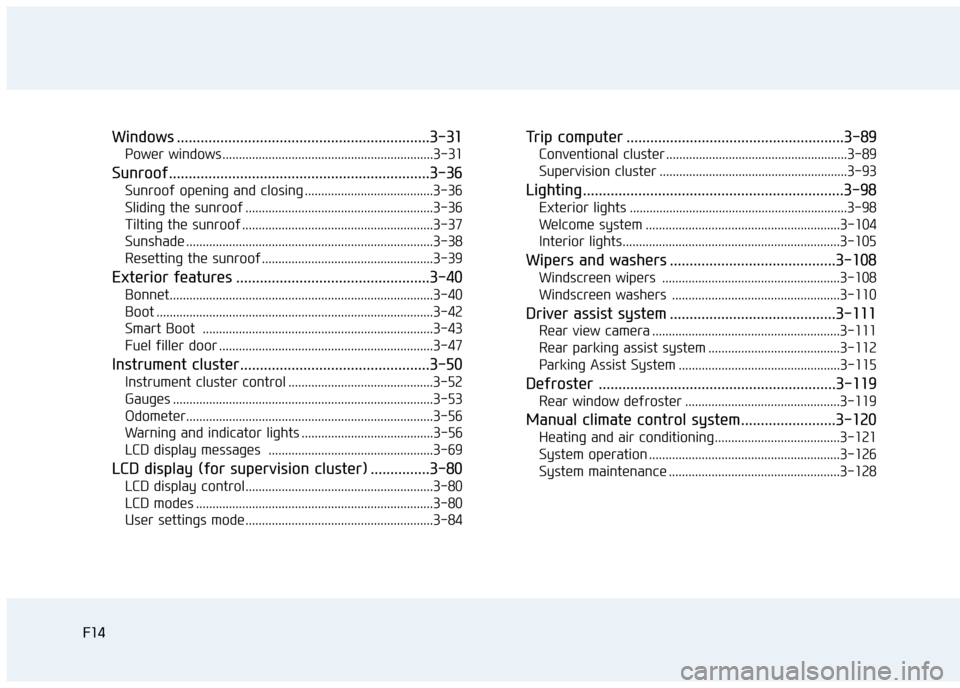
Windows ................................................................3-31
Power windows ................................................................3-31
Sunroof..................................................................3-36
Sunroof opening and closing .......................................3-36
Sliding the sunroof .........................................................3-36
Tilting the sunroof ..........................................................3-37
Sunshade ...........................................................................3-38
Resetting the sunroof ....................................................3-39
Exterior features .................................................3-40
Bonnet................................................................................3-40
Boot ....................................................................................3-42
Smart Boot ......................................................................3-43
Fuel filler door .................................................................3-47
Instrument cluster................................................3-50
Instrument cluster control ............................................3-52
Gauges ...............................................................................3-53
Odometer...........................................................................3-56
Warning and indicator lights ........................................3-56
LCD display messages ..................................................3-69
LCD display (for supervision cluster) ...............3-80
LCD display control.........................................................3-80
LCD modes ........................................................................3-80
User settings mode.........................................................3-84
Tr i p c o m p u t e r . . . . . . . . . . . . . . . . . . . . . . . . . . . . . . . . . . . . . . . . . . . . . . . . . . . . . . . 3 - 8 9
Conventional cluster .......................................................3-89
Supervision cluster .........................................................3-93
Lighting..................................................................3-98
Exterior lights ..................................................................3-98
Welcome system ...........................................................3-104
Interior lights..................................................................3-105
Wipers and washers ..........................................3-108
Windscreen wipers ......................................................3-108
Windscreen washers ...................................................3-110
Driver assist system ..........................................3-111
Rear view camera .........................................................3-111
Rear parking assist system ........................................3-112
Parking Assist System .................................................3-115
Defroster ............................................................3-119
Rear window defroster ...............................................3-119
Manual climate control system........................3-120
Heating and air conditioning......................................3-121
System operation ..........................................................3-126
System maintenance ....................................................3-128
Page 15 of 571

F15F15
Automatic climate control system ...................3-130
Automatic heating and air conditioning ..................3-131
Manual heating and air conditioning .......................3-132
System operation ..........................................................3-139
System maintenance ....................................................3-141
Windscreen defrosting and defogging ...........3-143
Manual climate control system .................................3-143
Automatic climate control system ............................3-144
Defogging logic..............................................................3-145
Auto defogging system ...............................................3-146
Climate control additional features.................3-147
Cluster ionizer ................................................................3-147
Sunroof inside air recirculation.................................3-147
Storage compartment ........................................3-148
Centre console storage ...............................................3-148
Sliding armrest ...............................................................3-148
Glove box ........................................................................3-149
Sunglasses holder .........................................................3-149
Multi box .........................................................................3-150
Interior features.................................................3-151
Ashtray ............................................................................3-151
Cup holder.......................................................................3-151
Sunvisor ...........................................................................3-152
Power outlet ...................................................................3-153
USB charger ...................................................................3-154
Cigarette lighter ............................................................3-154
Clock .................................................................................3-155
Clothes hanger ..............................................................3-155
Floor mat anchor(s)......................................................3-156
Luggage net (holder) ...................................................3-156
Page 21 of 571

F21F21
Dimensions ..............................................................8-2
Engine ......................................................................8-2
Bulb wattage ...........................................................8-3
Ty r e s a n d w h e e l s . . . . . . . . . . . . . . . . . . . . . . . . . . . . . . . . . . . . . . . . . . . . . . . . . . . 8 - 4
Air conditioning system ........................................8-4
Ty r e l o a d a n d s p e e d c a p a c i t y . . . . . . . . . . . . . . . . . . . . . . . . . . . . . . 8 - 5
Vo l u m e a n d w e i g h t . . . . . . . . . . . . . . . . . . . . . . . . . . . . . . . . . . . . . . . . . . . . . . . . 8 - 5
Recommended lubricants and capacities ...........8-6
Recommended SAE viscosity number ..........................8-8
Ve h i c l e i d e n t i fi c a t i o n nu m b e r ( V I N ) . . . . . . . . . . . . . . . . . . . . 8 - 9
Ve h i c l e c e r t i fi c a t i o n l ab e l . . . . . . . . . . . . . . . . . . . . . . . . . . . . . . . . . . . . . 8 - 9
Ty r e s p e c i f i c a t i o n a n d p r e s s u r e l a b e l . . . . . . . . . . . . . . 8 - 1 0
Engine number .....................................................8-10
Air conditioner compressor label ......................8-10
8Specifications & Consumer information
Page 28 of 571

Safety system of your vehicle
2
Important safety precautions...............................2-2
Always wear your seat belt ..........................................2-2
Restrain all children .........................................................2-2
Air bag hazards ................................................................2-2
Driver distraction .............................................................2-2
Control your speed ..........................................................2-3
Keep your vehicle in a safe condition ........................2-3
Seats ........................................................................2-4
Safety precautions ..........................................................2-5
Front seats ..........................................................................2-6
Rear seats .........................................................................2-12
Headrest ...........................................................................2-15
Seat warmers and air ventilation seats.....................2-19
Seat belts .............................................................2-23
Seat belt safety precautions ......................................2-23
Seat belt restraint system ...........................................2-27
Additional seat belt safety precautions ...................2-32
Care of seat belts ..........................................................2-35
Child restraint system (CRS) .............................2-36
Children always in the rear seat .................................2-36
Selecting a Child Restraint System (CRS) ................2-37
Installing a Child Restraint System (CRS)..................2-39
Air bag
- supplemental restraint system.....................2-47
Where are the air bags? ..............................................2-49
How does the air bag system operate? ...................2-52
What to expect after an air bag inflates ................2-56
Why didn't my air bag go off in a collision? ...........2-58
SRS care ...........................................................................2-63
Additional safety precautions .....................................2-64
Air bag warning labels ...................................................2-65
This chapter provides you with important information about how to protect yourself and your passengers.
It explains how to properly use your seats and seat belts, and how your air bags work.
Additionally, this chapter explains how to properly restrain infants and children in your vehicle.
Page 29 of 571

2-2
Yo u w i l l f i n d m a n y s a f e t y p r e c a u t i o n s
and recommendations throughout
this section, and throughout this man-
ual. The safety precautions in this sec-
tion are among the most important.
Always wear your seat belt
A seat belt is your best protection in
all types of accidents. Air bags are
designed to supplement seat belts,
not replace them. So even though
your vehicle is equipped with air bags,
ALWAYS make sure you and your
passengers wear your seat belts, and
wear them properly.
Restrain all children
All children under age 13 should ride
in your vehicle properly restrained in
a rear seat, not the front seat. Infants
and small children should be
restrained in an appropriate child
restraint. Larger children should use
a booster seat with the lap/shoulder
belt until they can use the seat belt
properly without a booster seat.
Air bag hazards
Whilst air bags can save lives, they
can also cause serious or fatal
injuries to occupants who sit too
close to them, or who are not prop-
erly restrained. Infants, young chil-
dren, and short adults are at the
greatest risk of being injured by an
inflating air bag. Follow all instruc-
tions and warnings in this manual.
Driver distraction
Driver distraction presents a serious
and potentially deadly danger, espe-
cially for inexperienced drivers. Safety
should be the first concern when
behind the wheel and drivers need to
be aware of the wide array of potential
distractions, such as drowsiness,
reaching for objects, eating, personal
grooming, other passengers, and
using mobile phones.
Drivers can become distracted when
they take their eyes and attention off
the road or their hands off the wheel
to focus on activities other than driv-
ing. To reduce your risk of distraction
and an accident:
•ALWAYS set up your mobile devices
(i.e., MP3 players, phones, naviga-
tion units, etc.) when your vehicle is
parked or safely stopped.
•ONLY use your mobile device when
allowed by laws and conditions per-
mit safe use. NEVER text or email
whilst driving. Most countries have
laws prohibiting drivers from texting.
Some countries and cities also pro-
hibit drivers from using handheld
phones.
IIMMPPOORRTTAANNTT SSAAFFEETTYY PPRREECCAAUUTTIIOONNSS
Safety system of your vehicle
Page 58 of 571

2-31
Safety system of your vehicle
2
The Pre-Tensioner Seat Belt System
consists mainly of the following com-
ponents. Their locations are shown in
the illustration above:
(1) SRS air bag warning light
(2) Retractor pre-tensioner
(3) SRS control module
The sensor that activates the SRS
air bag is connected with the
pre–tensioner seat belts. The SRS
air bag warning light on the instru-
ment panel will illuminate for
approximately 6 seconds after the
ignition switch is placed in the ON
position, and then it should turn off.
If the pre-tensioner is not working
properly, the warning light will illu-
minate even if the SRS air bag is
not malfunctioning. If the warning
light does not illuminate, stays illu-
minated or illuminates when the
vehicle is being driven, we recom-
mend the pre-tensioner seat belts
and/or SRS air bags be inspected
by an authorised HYUNDAI dealer
as soon as possible.
•Both the driver's and front pas-
senger's pre-tensioner seat
belts may be activated in certain
frontal or side collisions.
•The pre-tensioners will be acti-
vated even if the seat belts are
not worn at the time of the colli-
sion.
•When the pre-tensioner seat
belts are activated, a loud noise
may be heard and fine dust,
which may appear to be smoke,
may be visible in the passenger
compartment. These are normal
operating conditions and are not
hazardous.
•Although it is non-toxic,the fine
dust may cause skin irritation
and should not be breathed for
prolonged periods. Wash all
exposed skin areas thoroughly
after an accident in which the
pre-tensioner seat belts were
activated.
NOTICENOTICE
OLMB033040/H/Q
Page 80 of 571
2-53
Safety system of your vehicle
2
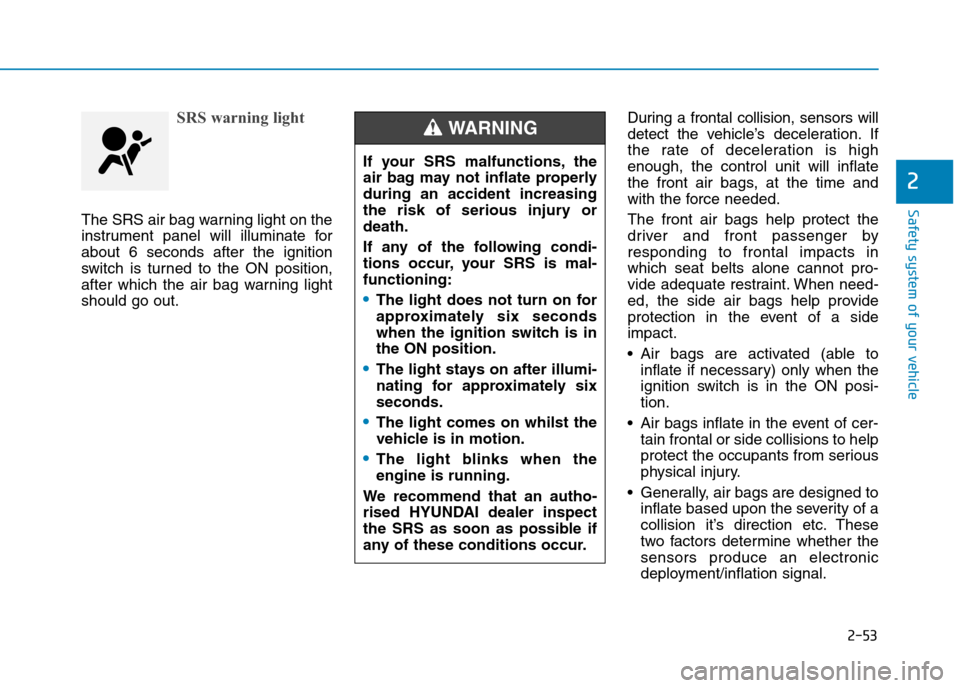
SRS warning light
The SRS air bag warning light on the
instrument panel will illuminate for
about 6 seconds after the ignition
switch is tur ned to the ON position,
after which the air bag warning light
should go out.
During a frontal collision, sensors will
detect the vehicle’s deceleration. If
the rate of deceleration is high
enough, the control unit will inflate
the front air bags, at the time and
with the force needed.
The front air bags help protect the
driver and front passenger by
responding to frontal impacts in
which seat belts alone cannot pro-
vide adequate restraint. When need-
ed, the side air bags help provide
protection in the event of a side
impact.
•Air bags are activated (able to
inflate if necessary) only when the
ignition switch is in the ON posi-
tion.
•Air bags inflate in the event of cer-
tain frontal or side collisions to help
protect the occupants from serious
physical injury.
•Generally, air bags are designed to
inflate based upon the severity of a
collision it’s direction etc. These
two factors determine whether the
sensors produce an electronic
deployment/inflation signal.
If your SRS malfunctions, the
air bag may not inflate properly
during an accident increasing
the risk of serious injury or
death.
If any of the following condi-
tions occur, your SRS is mal-
functioning:
•The light does not turn on for
approximately six seconds
when the ignition switch is in
the ON position.
•The light stays on after illumi-
nating for approximately six
seconds.
•The light comes on whilst the
vehicle is in motion.
•The light blinks when the
engine is running.
We recommend that an autho-
rised HYUNDAI dealer inspect
the SRS as soon as possible if
any of these conditions occur.
WA R N I N G
Page 87 of 571

2-60
Safety system of your vehicle
Air bag inflation conditions
Front air bags
Front air bags are designed to inflate
in a frontal collision depending on
the severity of impact of the front col-
lision.
.
Side and curtain air bags
Side and curtain air bags are
designed to inflate when an impact is
detected by side collision sensors
depending on the severity of impact
resulting from a side impact collision.
Although the driver’s and front pas-
senger’s air bags are designed to
inflate only in frontal collisions, they
also may inflate in other types of col-
lisions if the front impact sensors
detect a sufficient impact. Side and
curtain air bags are designed to
inflate only in side impact collisions,
but they may inflate in other colli-
sions if the side impact sensors
detect a sufficient impact.
If the vehicle chassis is impacted by
bumps or objects on unimproved
roads, the air bags may deploy. Drive
carefully on unimproved roads or on
surfaces not designed for vehicle
traffic to prevent unintended air bag
deployment.
OAD035045
OAD035046
OLF034050/H
Page 88 of 571

2-61
Safety system of your vehicle
2
Air bag non-inflation conditions
In certain low-speed collisions the air
bags may not deploy. The air bags
are designed not to deploy in such
cases because they may not provide
benefits beyond the protection of the
seat belts.
Front air bags are not designed to
inflate in rear collisions, because
occupants are moved rearward by
the force of the impact. In this case,
inflated air bags would not provide
any additional benefit.
Front air bags may not inflate in side
impact collisions, because occupants
move in the direction of the collision,
and thus in side impacts, front air bag
deployment would not provide addi-
tional occupant protection.
However, side and curtain air bags
may inflate depending on the severity
of impact.
OAD035049OAD035048/H
OAD035047/H