lock Hyundai Elantra 2017 User Guide
[x] Cancel search | Manufacturer: HYUNDAI, Model Year: 2017, Model line: Elantra, Model: Hyundai Elantra 2017Pages: 637, PDF Size: 15.02 MB
Page 46 of 637
2-16
Safety system of your vehicle
Headrest
The vehicle’s front and rear seats
have adjustable headrests. The head-
rests provide comfort for passengers,
but more importantly they are
designed to help protect passengers
from whiplash and other neck and
spinal injuries during an accident,
especially in a rear impact collision.To prevent damage, NEVER hit or
pull on the headrests.
NOTICE
When there is no occupant in
the rear seats, adjust the height
of the headrest to the lowest
position. The rear seat headrest
can reduce the visibility of the
rear area.
CAUTION
To reduce the risk of serious
injury or death in an accident,
take the following precautions
when adjusting your headrests:
•Always properly adjust the
headrests for all passengers
BEFORE starting the vehicle.
•NEVER let anyone ride in a seat
with the headrest removed.
(Continued)
(Continued)
•
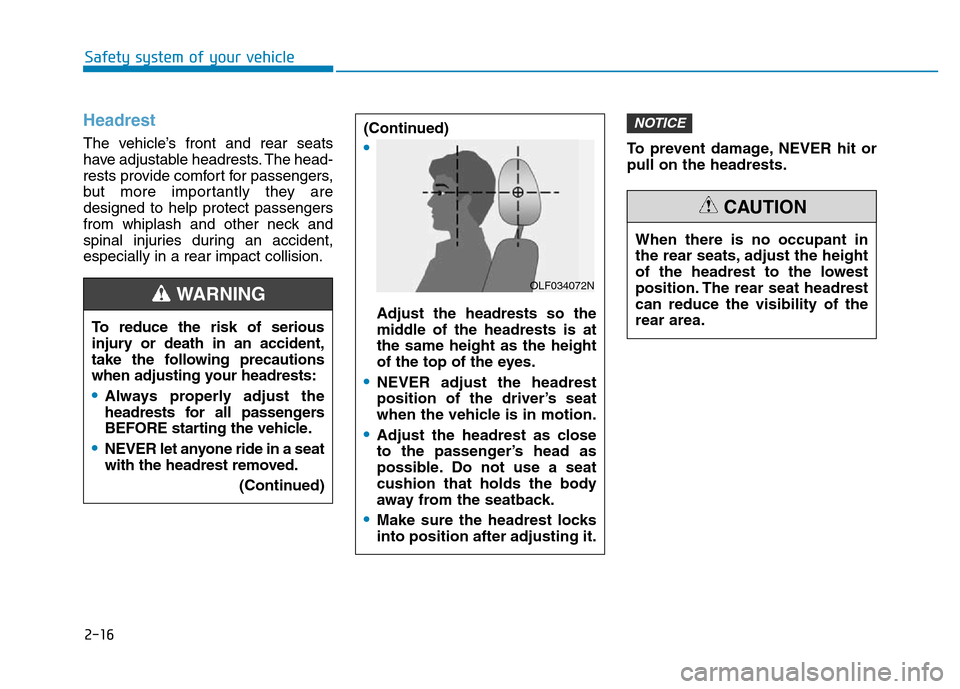
Adjust the headrests so the
middle of the headrests is at
the same height as the height
of the top of the eyes.
•NEVER adjust the headrest
position of the driver’s seat
when the vehicle is in motion.
•Adjust the headrest as close
to the passenger’s head as
possible. Do not use a seat
cushion that holds the body
away from the seatback.
•Make sure the headrest locks
into position after adjusting it.
WARNING OLF034072N
Page 49 of 637
2-19
Safety system of your vehicle
2
4. Recline the seatback (4) with the
seatback angle switch (3).Rear seat headrests
The rear seats are equipped with
headrests in all the seating positions
for the passenger’s safety and com-
for t.
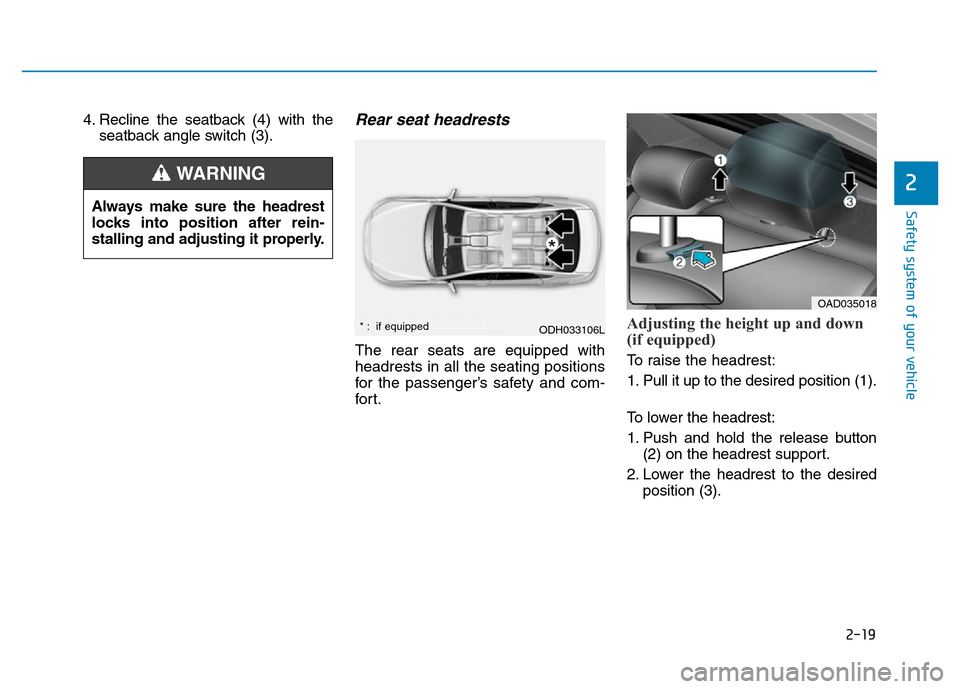
Adjusting the height up and down
(if equipped)
To raise the headrest:
1. Pull it up to the desired position (1).
To lower the headrest:
1. Push and hold the release button
(2) on the headrest support.
2. Lower the headrest to the desired
position (3).
ODH033106L* : if equipped
*
Always make sure the headrest
locks into position after rein-
stalling and adjusting it properly.
WARNING
OAD035018
Page 53 of 637

2-23
Safety system of your vehicle
2
Rear seat warmers (if equipped)
While the engine is running, push
either of the switches to warm the rear
seat.
During mild weather or under condi-
tions where the operation of the seat
warmer is not needed, keep the
switches in the OFF position.Each time you push the switch, the
temperature setting of the seat is
changed as follows :
The seat warmer defaults to the OFF
position whenever the ignition switch
is placed in the ON position.
Information
With the seat warmer switch in the
ON position, the heating system in the
seat turns off or on automatically
depending on the seat temperature.
i
(Continued)
•Avoid spilling liquids on the
surface of the front seats and
seatbacks; this may cause the
air vent holes to become
blocked and not work properly.
•Do not place materials such
as plastic bags or newspa-
pers under the seats. They
may block the air intake caus-
ing the air vents to not work
properly.
•Do not change the seat cov-
ers. It may damage the seat
warmer or air ventilation seat.
•If the air vents do not operate,
restart the vehicle. If there is
no change, we recommend
that you have your vehicle
inspected by an authorized
HYUNDAI dealer.
OAD035024
OFF →HIGH ( ) →LOW ( )
→
Page 56 of 637
2-26
Safety system of your vehicle
Seat belt restraint system
Lap/shoulder belt
To fasten your seat belt:
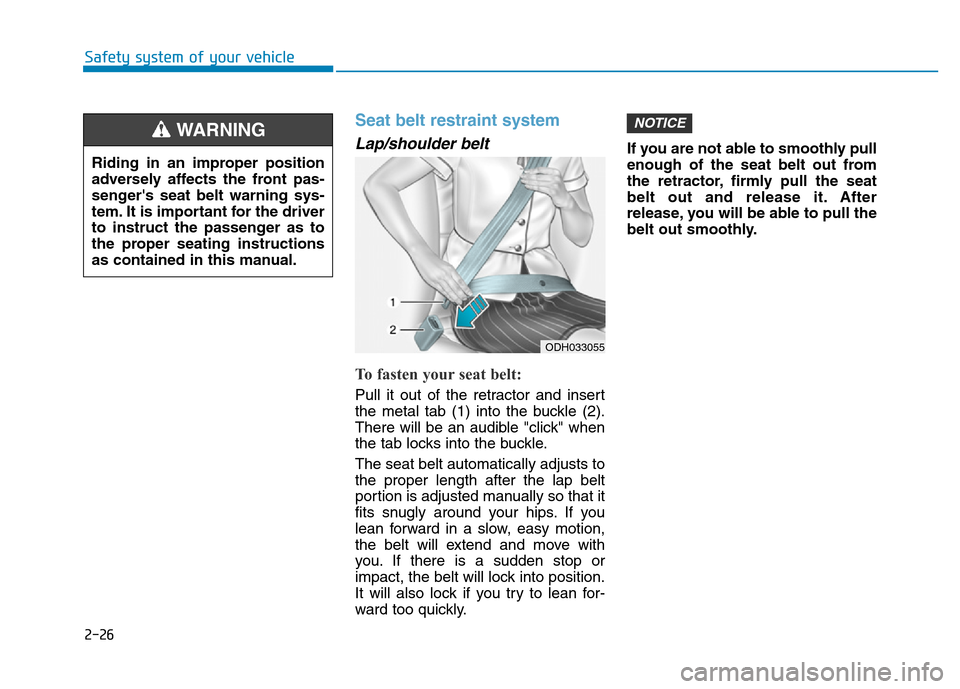
Pull it out of the retractor and insert
the metal tab (1) into the buckle (2).
There will be an audible "click" when
the tab locks into the buckle.
The seat belt automatically adjusts to
the proper length after the lap belt
portion is adjusted manually so that it
fits snugly around your hips. If you
lean forward in a slow, easy motion,
the belt will extend and move with
you. If there is a sudden stop or
impact, the belt will lock into position.
It will also lock if you try to lean for-
ward too quickly.If you are not able to smoothly pull
enough of the seat belt out from
the retractor, firmly pull the seat
belt out and release it. After
release, you will be able to pull the
belt out smoothly.
NOTICE
Riding in an improper position
adversely affects the front pas-
senger's seat belt warning sys-
tem. It is important for the driver
to instruct the passenger as to
the proper seating instructions
as contained in this manual.
WARNING
ODH033055
Page 57 of 637
2-27
Safety system of your vehicle
2
Height adjustment
You can adjust the height of the
shoulder belt anchor to one of the
four different positions for maximum
comfort and safety.
The shoulder portion should be
adjusted so it lies across your chest
and midway over your shoulder near-
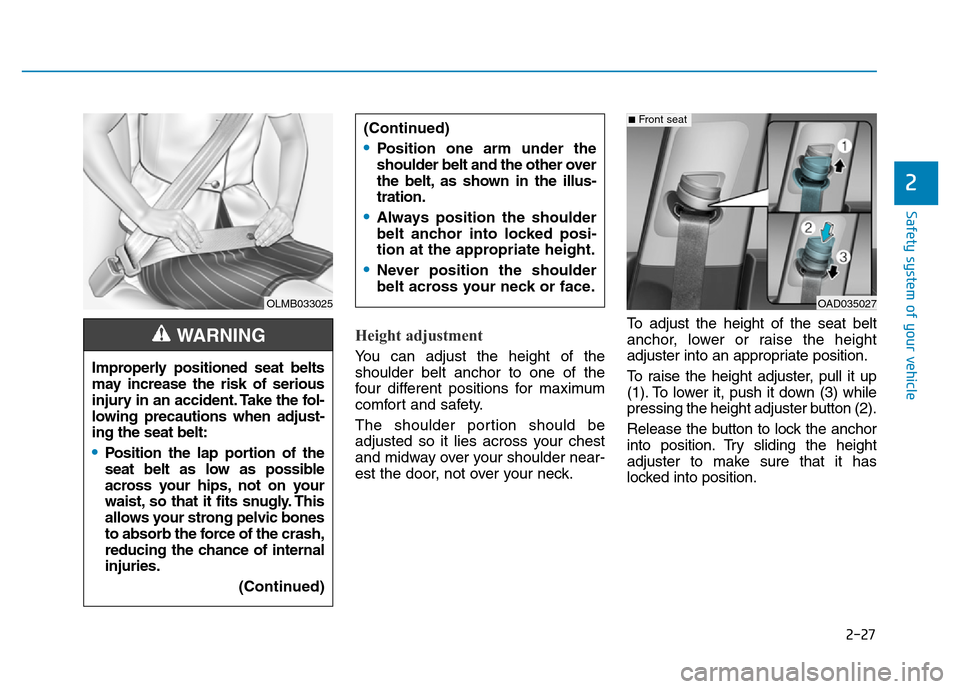
est the door, not over your neck.To adjust the height of the seat belt
anchor, lower or raise the height
adjuster into an appropriate position.
To raise the height adjuster, pull it up
(1). To lower it, push it down (3) while
pressing the height adjuster button (2).
Release the button to lock the anchor
into position. Try sliding the height
adjuster to make sure that it has
locked into position.
OLMB033025
Improperly positioned seat belts
may increase the risk of serious
injury in an accident. Take the fol-
lowing precautions when adjust-
ing the seat belt:
•Position the lap portion of the
seat belt as low as possible
across your hips, not on your
waist, so that it fits snugly. This
allows your strong pelvic bones
to absorb the force of the crash,
reducing the chance of internal
injuries.
(Continued)
WARNING
(Continued)
•Position one arm under the
shoulder belt and the other over
the belt, as shown in the illus-
tration.
•Always position the shoulder
belt anchor into locked posi-
tion at the appropriate height.
•Never position the shoulder
belt across your neck or face.
OAD035027
■Front seat
Page 58 of 637

2-28
Safety system of your vehicle
Rear center seatbelt
When using the rear center seat belt,
the buckle with the “CENTER” mark
must be used.
Information
If you are not able to pull out the safe-
ty belt from the retractor, firmly pull
the belt out and release it. After
release, you will be able to pull the belt
out smoothly.
To release your seat belt:
Press the release button (1) in the
locking buckle.
When it is released, the belt should
automatically draw back into the
retractor. If this does not happen,
check the belt to be sure it is not twist-
ed, then try again.
i
OAD035028
Always have the metal tab
inserted into the buckle.
WARNING
ODH033057
Page 59 of 637

2-29
Safety system of your vehicle
2
Pre-tensioner seat belt
(Driver and front passenger,
if equipped)
Your vehicle is equipped with driver's
and front passenger's Pre-tensioner
Seat Belts. The purpose of the pre-
tensioner is to make sure the seat
belts fit tightly against the occupant's
body in certain frontal collisions. The
pre-tensioner seat belts may be acti-
vated in crashes where the frontal col-
lision is severe enough, together with
the air bags.When the vehicle stops suddenly, or
if the occupant tries to lean forward
too quickly, the seat belt retractor will
lock into position. In certain frontal
collisions, the pre-tensioner will acti-
vate and pull the seat belt into tighter
contact against the occupant's body.
ODH033058
•Always wear your seat belt and
sit properly in your seat.
•Do not use the seat belt if it is
loose or twisted. A loose or
twisted seat belt will not pro-
tect you properly in an acci-
dent.
•Do not place anything near the
buckle. This may adversely
affect the buckle and cause it
to function improperly.
•Always replace your pre-ten-
sioners after activation or an
accident.
•NEVER inspect, service, repair
or replace the pre-tensioners
yourself. This must be done by
an authorized HYUNDAI dealer.
(Continued)
WARNING
(Continued)
•Do not hit the seat belt assem-
blies.
Do not touch the pre-tensioner
seat belt assemblies for several
minutes after they have been
activated. When the pre-ten-
sioner seat belt mechanism
deploys during a collision, the
pre-tensioner can become hot
and can burn you.
WARNING
Body work on the front area of
the vehicle may damage the
pre-tensioner seat belt system.
Therefore, we recommend that
the system be serviced by an
authorized HYUNDAI dealer.
CAUTION
Page 80 of 637
2-50
Safety system of your vehicle
Side air bags (if equipped)
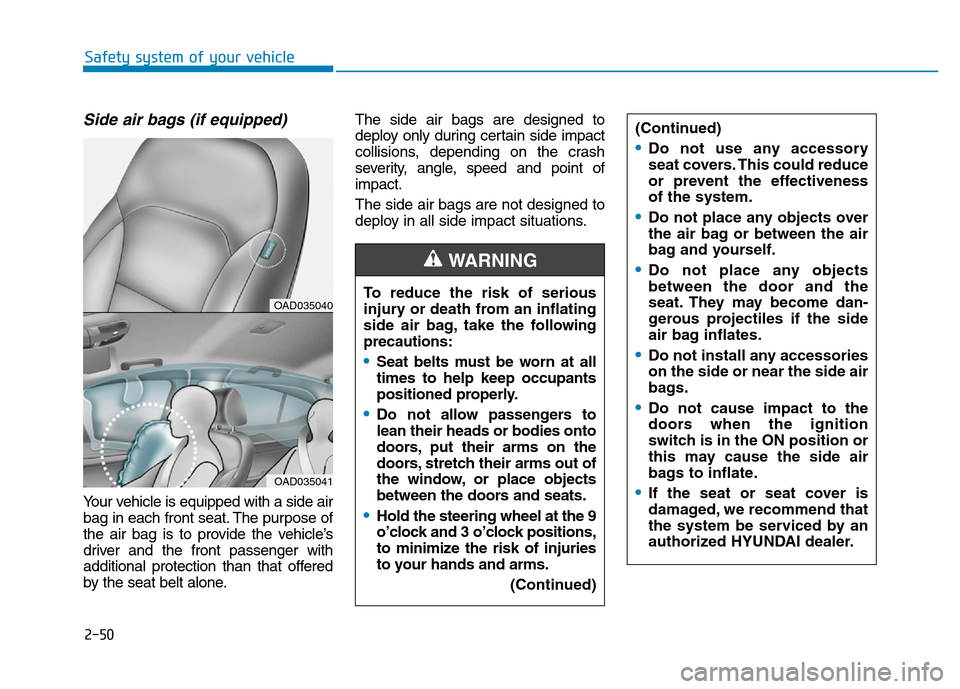
Your vehicle is equipped with a side air
bag in each front seat. The purpose of
the air bag is to provide the vehicle’s
driver and the front passenger with
additional protection than that offered
by the seat belt alone.The side air bags are designed to
deploy only during certain side impact
collisions, depending on the crash
severity, angle, speed and point of
impact.
The side air bags are not designed to
deploy in all side impact situations.
OAD035040
OAD035041
(Continued)
•Do not use any accessory
seat covers. This could reduce
or prevent the effectiveness
of the system.
•Do not place any objects over
the air bag or between the air
bag and yourself.
•Do not place any objects
between the door and the
seat. They may become dan-
gerous projectiles if the side
air bag inflates.
•Do not install any accessories
on the side or near the side air
bags.
•Do not cause impact to the
doors when the ignition
switch is in the ON position or
this may cause the side air
bags to inflate.
•If the seat or seat cover is
damaged, we recommend that
the system be serviced by an
authorized HYUNDAI dealer.
To reduce the risk of serious
injury or death from an inflating
side air bag, take the following
precautions:
•Seat belts must be worn at all
times to help keep occupants
positioned properly.
•Do not allow passengers to
lean their heads or bodies onto
doors, put their arms on the
doors, stretch their arms out of
the window, or place objects
between the doors and seats.
•Hold the steering wheel at the 9
o’clock and 3 o’clock positions,
to minimize the risk of injuries
to your hands and arms.
(Continued)
WARNING
Page 88 of 637
2-58
Safety system of your vehicle
Why didn't my air bag go off in
a collision?
Air bags are not designed to inflate in
every collision.
There are certain types of accidents
in which the air bag would not be
expected to provide additional protec-
tion. These include rear impacts, sec-
ond or third collisions in multiple
impact accidents, as well as low
speed impacts. Damage to the vehicle
indicates a collision energy absorp-
tion, and is not an indicator of whether
or not an air bag should have inflated.
Air bag collision sensors
(if equipped)
To reduce the risk of an air bag
deploying unexpectedly and
causing serious injury or death:
•Do not hit or allow any objects
to impact the locations where
air bags or sensors are
installed.
•Do not perform maintenance
on or around the air bag sen-
sors. If the location or angle of
the sensors is altered, the air
bags may deploy when they
should not or may not deploy
when they should.
•Do not install bumper guards
or replace the bumper with a
non-genuine part. This may
adversely affect the collision
and air bag deployment per-
formance.
(Continued)
WARNING
(Continued)
•Place the ignition switch to
the LOCK/OFF or ACC posi-
tion, when the vehicle is being
towed to prevent inadvertent
air bag deployment.
•We recommend that all air bag
repairs are conducted by an
authorized HYUNDAI dealer.
Page 96 of 637
Convenient features of your vehicle
Accessing your vehicle .........................................3-4
Remote key .........................................................................3-4
Smart key ............................................................................3-8
Immobilizer system .........................................................3-13
Door locks .............................................................3-14
Operating door locks from outside the vehicle ......3-14
Operating door locks from inside the vehicle .........3-16
Auto door lock/unlock features..................................3-18
Child-protector rear door locks ..................................3-19
Theft-alarm system.............................................3-20
Driver position memory system .........................3-21
Storing memory positions .............................................3-21
Easy access function .....................................................3-22
Steering wheel......................................................3-23
Electric power steering (EPS) ......................................3-23
Tilt steering / Telescope steering...............................3-24
Heated steering wheel ...................................................3-25
Horn ....................................................................................3-25
Mirrors ...................................................................3-26
Inside rearview mirror....................................................3-26
Outside rearview mirror ................................................3-27
Windows ................................................................3-31
Power windows ................................................................3-31
Sunroof..................................................................3-37
Sunroof opening and closing .......................................3-37
Sliding the sunroof .........................................................3-37
Tilting the sunroof ..........................................................3-38
Sunshade ...........................................................................3-39
Resetting the sunroof ....................................................3-40
Exterior features .................................................3-41
Hood ...................................................................................3-41
Trunk ..................................................................................3-43
Smart trunk.......................................................................3-44
Fuel filler door .................................................................3-48
Instrument cluster................................................3-51
Instrument cluster control ............................................3-53
Gauges ...............................................................................3-54
Odometer...........................................................................3-57
Warning and indicator lights ........................................3-57
LCD display messages ....................................................3-71
LCD display (for supervision cluster) ...............3-82
LCD display control.........................................................3-82
LCD modes ........................................................................3-82
User settings mode.........................................................3-86
3