belt Hyundai Elantra 2017 Owner's Guide
[x] Cancel search | Manufacturer: HYUNDAI, Model Year: 2017, Model line: Elantra, Model: Hyundai Elantra 2017Pages: 637, PDF Size: 15.02 MB
Page 64 of 637
2-34
Safety system of your vehicle
Children always in the rear
Children under age 13 must always
ride in the rear seats and must
always be properly restrained to min-
imize the risk of injury in an accident,
sudden stop or sudden maneuver.
According to accident statistics, chil-
dren are safer when properly
restrained in the rear seats than in
the front seat. Children too large for a
Child Restraint System must use the
seat belts provided.Most countries have Child Restraint
Systems which require children to
travel in approved Child Restraint
Systems. The laws governing the
age or height/weight restrictions at
which seat belts can be used instead
of Child Restraint System differs
among countries, so you should be
aware of the specific requirements in
your country, and where you are trav-
elling.
Child Restraint Systems must be
properly placed and installed in the
rear seat. You must use a commer-
cially available Child Restraint System
that meets the requirements of the
Safety Standards of your country.
Child Restraint Systems are general-
ly designed to be secured in a vehi-
cle seat by lap belt or the lap belt
portion of a lap/shoulder belt, or by a
top-tether and/or ISOFIX anchorage
in the rear seats of the vehicle.
Child Restraint System (CRS)
always in the rear
Infants and younger children must be
restrained in an appropriate rearward-
facing or forward-facing CRS that has
first been properly secured to the rear
seat of the vehicle. Read and comply
with the instructions for installation
and use provided by the manufacturer
of the Child Restraint System.
CHILD RESTRAINT SYSTEM (CRS)
•Always follow the Child Restraint
System manufacturer’s instruc-
tions for installation and use.
•Always properly restrain your
child in the Child Restraint
System.
•Do not use an infant carrier or a
child safety seat that “hooks”
over a seatback, it may not pro-
vide adequate protection in an
accident.
•After an accident, we recom-
mend a HYUNDAI dealer check
the Child Restraint System, seat
belts, ISOFIX anchorages and
top-tether anchorages.
WARNING
Always properly restrain chil-
dren in the rear seats of the
vehicle, unless the air bag on
the front passenger seat is
deactivated.
Children of all ages are safer
when restrained in the rear seat.
A child riding in the front pas-
senger seat can be forcefully
struck by an inflating air bag
resulting in SERIOUS INJURY
or DEATH.
WARNING
Page 66 of 637
2-36
Safety system of your vehicle
All children under the age of one year
must always ride in a rearward-facing
Child Restraint System. There are dif-
ferent types of rearward-facing Child
Restraint Systems: infant-only Child
Restraint Systems can only be used
rearward-facing. Convertible and 3-in-
1 Child Restraint Systems typically
have higher height and weight limits
for the rearward-facing position, allow-
ing you to keep your child rearward-
facing for a longer period of time.
Keep using Child Restraint Systems
in the rearward-facing position as long
as children fit within the height and
weight limits allowed by the Child
Restraint System's manufacturer.
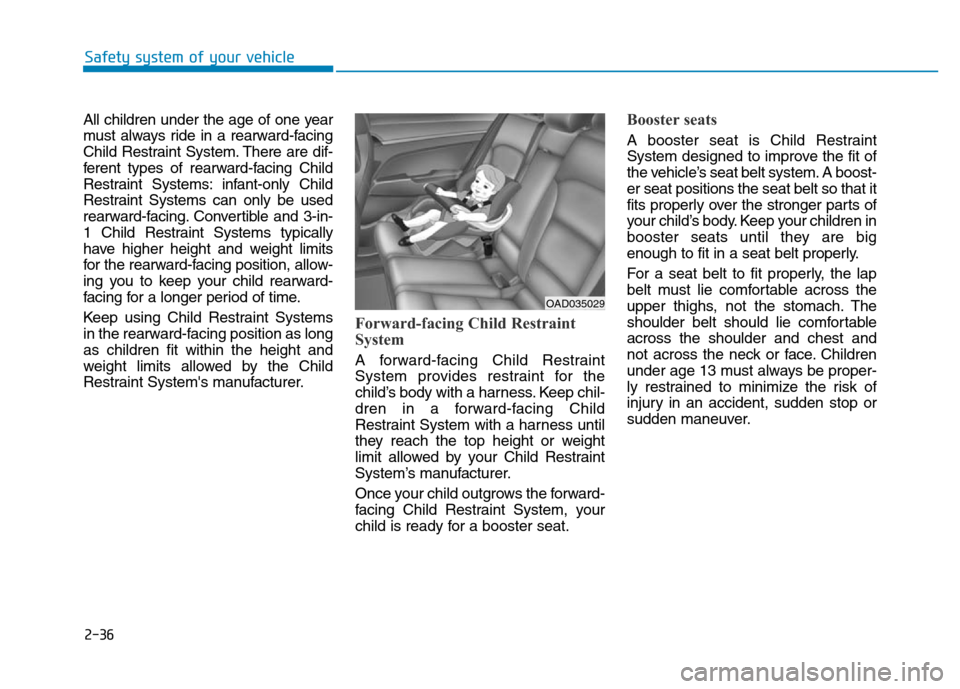
Forward-facing Child Restraint
System
A forward-facing Child Restraint
System provides restraint for the
child’s body with a harness. Keep chil-
dren in a forward-facing Child
Restraint System with a harness until
they reach the top height or weight
limit allowed by your Child Restraint
System’s manufacturer.
Once your child outgrows the forward-
facing Child Restraint System, your
child is ready for a booster seat.
Booster seats
A booster seat is Child Restraint
System designed to improve the fit of
the vehicle’s seat belt system. A boost-
er seat positions the seat belt so that it
fits properly over the stronger parts of
your child’s body. Keep your children in
booster seats until they are big
enough to fit in a seat belt properly.
For a seat belt to fit properly, the lap
belt must lie comfortable across the
upper thighs, not the stomach. The
shoulder belt should lie comfortable
across the shoulder and chest and
not across the neck or face. Children
under age 13 must always be proper-
ly restrained to minimize the risk of
injury in an accident, sudden stop or
sudden maneuver.
OAD035029
Page 67 of 637
2-37
Safety system of your vehicle
2
Installing a Child Restraint
System (CRS)After selecting a proper Child Restraint
System and checking that the Child
Restraint System fits properly in the
rear of this vehicle, you are ready to
install the Child Restraint System
according to the manufacturer’s
instruction. There are three general
steps in installing the Child Restraint
Systemsproperly:
•Properly secure the Child
Restraint System to the vehicle.
All Child Restraint System must be
secured to the vehicle with the lap
belt or lap part of a lap/shoulder
belt or with the ISOFIX top-tether
and/or ISOFIX anchorage.
•Make sure the Child Restraint
System is firmly secured.After
installing a Child Restraint System
to the vehicle, push and pull the
seat forward and from side-to-side
to verify that it is securely attached
to the seat. A Child Restraint
System secured with a seat belt
should be installed as firmly as
possible. However, some side-to-
side movement can be expected.When installing a Child Restraint
System, adjust the vehicle seat (up
and down, forward and rearward)
so that your child fits in the Child
Restraint System in a comfortable
manner.
•Secure the child in the Child
Restraint System.Make sure the
child is properly strapped in the
Child Restraint System according
to the Child Restraint System man-
ufacturer’s instructions. Before installing your Child
Restraint System always:
Read and follow the instructions
provided by the manufacturer of
the Child Restraint System.
Failure to follow all warnings
and instructions could increase
the risk of the SERIOUS INJURY
or DEATH if an accident occurs.
WARNING
If the vehicle headrest prevents
proper installation of a Child
Restraint System, the headrest
of the respective seating posi-
tion shall be readjusted or
entirely removed.
WARNING
A Child Restraint System in a
closed vehicle can become very
hot. To prevent burns, check the
seating surface and buckles
before placing your child in the
Child Restraint System.
CAUTION
Page 68 of 637
2-38
Safety system of your vehicle
ISOFIX anchorage and top-teth-
er anchorage (ISOFIX anchor-
ages system) for children
The ISOFIX system holds a Child
Restraint System during driving and
in an accident. This system is
designed to make installation of the
Child Restraint System easier and
reduce the possibility of improperly
installing your Child Restraint
System. The ISOFIX system uses
anchors in the vehicle and attach-
ments on the Child Restraint System.
The ISOFIX system eliminates the
need to use seat belts to secure the
Child Restraint System to the rear
seats.
ISOFIX anchorages are metal bars
built into the vehicle. There are two
lower anchors for each ISOFIX seat-
ing position that will accommodate a
Child Restraint System with lower
attachments.To use the ISOFIX system in your
vehicle, you must have a Child
Restraint System with ISOFIX attach-
ments.(An ISOFIX Child Restraint
System may only be installed if it has
vehicle-specific or universal approval
in accordance with the requirements
of ECE-R44 or ECE-R129.)
The Child Restraint System manu-
facturer will provide you with instruc-
tions on how to use the Child
Restraint System with its attach-
ments for the ISOFIX anchorages.
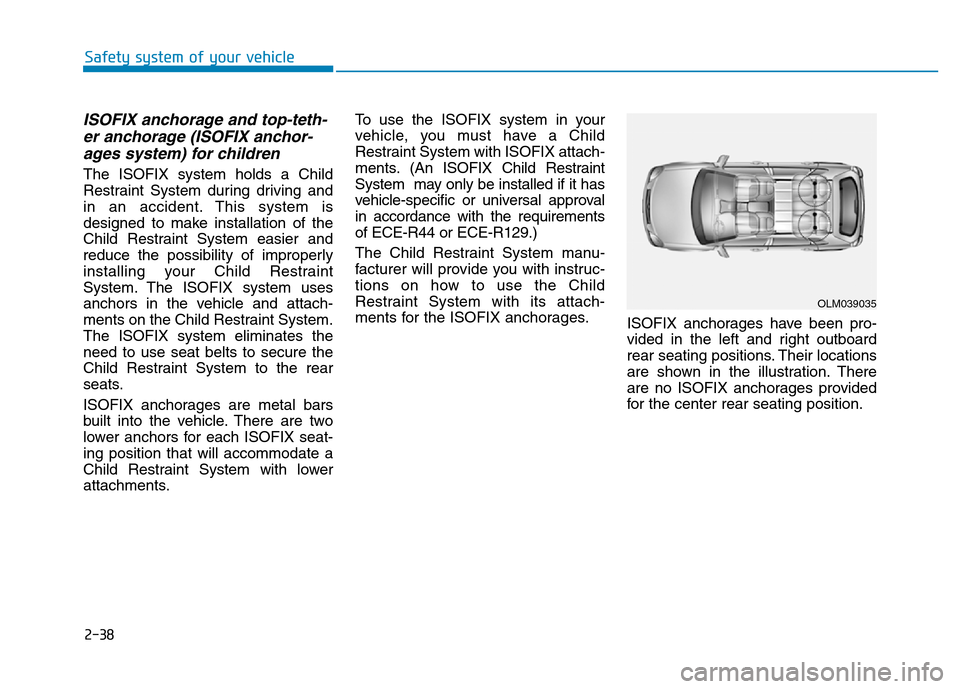
ISOFIX anchorages have been pro-
vided in the left and right outboard
rear seating positions. Their locations
are shown in the illustration. There
are no ISOFIX anchorages provided
for the center rear seating position.
OLM039035
Page 70 of 637

2-40
Safety system of your vehicle
Securing a Child Restraint
System with the “ISOFIX
Anchorage System”
To install a ISOFIX-compatible Child
Restraint System in either of the rear
outboard seating positions:
1. Move the seat belt buckle away
from the ISOFIX anchorages.
2. Move any other objects away from
the anchors that could prevent a
secure connection between the
Child Restraint System and the
ISOFIX anchorages.
3. Place the Child Restraint System
on the vehicle seat, then attach the
seat to the ISOFIX anchorages
according to the instructions provid-
ed by the Child Restraint System
manufacturer.
4. Follow the instructions of the Child
Restraint System's manufacturer
for proper installation and connec-
tion of the ISOFIX attachments on
the Child Restraint System to the
ISOFIX anchorages.Take the following precautions
when using the ISOFIX system:
•Read and follow all installation
instructions provided with
your Child Restraint System.
•To prevent the child from reach-
ing and taking hold of unre-
tracted seat belts, buckle all
unused rear seat belts and
retract the seat belt webbing
behind the child. Children can
be strangled if a shoulder belt
becomes wrapped around their
neck and the seat belt tightens.
•NEVER attach more than one
Child Restraint System to a
single anchorage. This could
cause the anchor or attach-
ment to come loose or break.
(Continued)
(Continued)
•Always have the ISOFIX sys-
tem inspected by your dealer
after an accident. An accident
can damage the ISOFIX system
and may not properly secure
the Child Restraint System.
WARNING
Page 71 of 637

2-41
Safety system of your vehicle
2
Securing a Child Restraint
System seat with “Top-tether
Anchorage” system
Child Restraint hook holders are
located on the package tray.1. Route the Child Restraint System
seat strap over the seatback.
For vehicles with adjustable head-
rest, route the tether strap under
the headrest and between the
headrest posts, otherwise route
the tether strap over the top of the
seatback.
2. Connect the top-tether to the top-
tether anchorage, then tighten the
top-tether according to the instruc-
tions of your Child Restraint
System's manufacturer to firmly
attach the Child Restraint System
to the seat.
OAD035030
OAD035031
Take the following precautions
when installing the top-tether:
•Read and follow all installation
instructions provided with
your Child Restraint System.
•NEVER attach more than one
Child Restraint System to a
single ISOFIX top-tether
anchorage. This could cause
the anchorage or attachment
to come loose or break.
•Do not attach the top-tether to
anything other than the cor-
rect top-tether anchorage. It
may not work properly if
attached to something else.
•Child Restraint anchorages
are designed to withstand only
those loads imposed by cor-
rectly fitted Child Restraint
System.
Under no circumstances are
they to be used for adult seat
belts or harnesses or for
attaching other items or
equipment to the vehicle.
WARNING
Page 73 of 637

2-43
Safety system of your vehicle
2
Securing a Child Restraint
System with a lap/shoulder belt
When not using the ISOFIX system,
all Child Restraint Systems must be
secured to a rear seat with the lap
part of a lap/shoulder belt.
Installing a Child Restraint System
with a lap/shoulder belt
To install a Child Restraint System
on the rear seats, do the following:
1. Place the Child Restraint System
on a rear seat and route the lap/
shoulder belt around or through
the restraint, following the restraint
manufacturer’s instructions.
Make sure the seat belt webbing is
not twisted.
Information
When using the rear center seat belt,
you should also refer to the “3-point
Rear Center Seat Belt” in this chapter.
i
OLMB033044
Page 74 of 637
2-44
Safety system of your vehicle
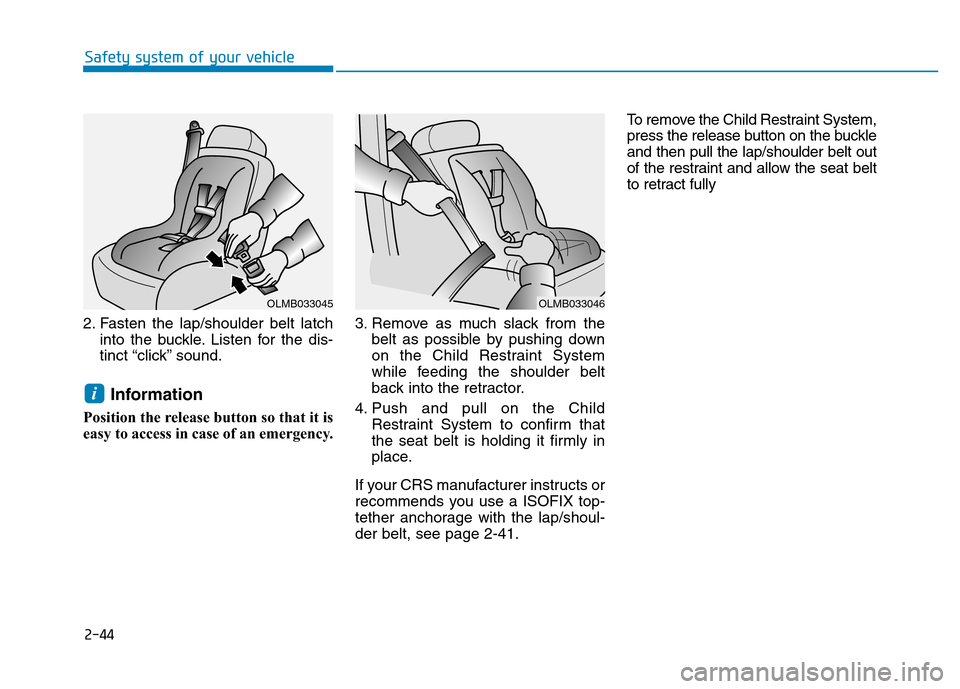
2. Fasten the lap/shoulder belt latch
into the buckle. Listen for the dis-
tinct “click” sound.
Information
Position the release button so that it is
easy to access in case of an emergency.3. Remove as much slack from the
belt as possible by pushing down
on the Child Restraint System
while feeding the shoulder belt
back into the retractor.
4. Push and pull on the Child
Restraint System to confirm that
the seat belt is holding it firmly in
place.
If your CRS manufacturer instructs or
recommends you use a ISOFIX top-
tether anchorage with the lap/shoul-
der belt, see page 2-41.To remove the Child Restraint System,
press the release button on the buckle
and then pull the lap/shoulder belt out
of the restraint and allow the seat belt
to retract fully
i
OLMB033045OLMB033046
Page 75 of 637

2-45
Safety system of your vehicle
2
Child Seat Restraint Suitability for Seat Position using the Seat Belt
Suitability of each seating position for "universal" category belted Child Restraint Systems according to ECE regulations
Use Child Restraint Systems that have been officially approved and are appropriate for your children.
When using the Child Restraint Systems, refer to the following table.
U : Suitable for "universal" category restraints approved for use in this mass group
UF : Suitable for forward-facing "universal" category restraints approved for use in this mass group
X : Seat position not suitable for children in this mass group
Mass Group
Seating Position
FRONT
PassengerREAR
OutboardREAR
Center
0 : Up to 10 kg
(0 - 9 months)XUU
0+ : Up to 13 kg
(0 - 2 years)XUU
I : 9 kg to 18 kg
(9 months - 4 years)XUU
II & III : 15 kg to 36 kg
(4 - 12 years)XUU
Page 78 of 637

2-48
Safety system of your vehicle
Vehicles are equipped with a
Supplemental Air Bag System for the
driver’s seat and front passenger’s
seats.
The front air bags are designed to
supplement the three-point seat
belts. For these air bags to provide
protection, the seat belts must be
worn at all times when driving.
You can be severely injured or killed
in an accident if you are not wearing
a seat belt. Air bags are designed to
supplement seat belts, but do not
replace them. Also, air bags are not
designed to deploy in every collision.
In some accidents, the seat belts are
the only restraint protecting you.AIR BAG SAFETY PRECAUTIONS
ALWAYS use seat belts and child restraints - every trip, every time,
everyone! Even with air bags, you can be seriously injured or killed in
a collision if you are improperly belted or not wearing your seat belt
when the air bag inflates.
NEVER place a child in any child restraint or booster seat in the front
passenger seat. An inflating air bag could forcefully strike the infant
or child causing serious or fatal injuries.
ABC - Always Buckle Children under age 13 in the back seat. It is the
safest place for children of any age to ride. If a child age 13 or older
must be seated in the front seat, he or she must be properly belted
and the seat should be moved as far back as possible.
All occupants should sit upright with the seatback in an upright posi-
tion, centered on the seat cushion with their seat belt on, legs com-
fortably extended and their feet on the floor until the vehicle is parked
and the engine is turned off. If an occupant is out of position during
an accident, the rapidly deploying air bag may forcefully contact the
occupant causing serious or fatal injuries.
You and your passengers should never sit or lean unnecessarily
close to the air bags or lean against the door or center console.
Move your seat as far back as possible from front air bags, while still
maintaining control of the vehicle.
WARNING