engine coolant Hyundai Elantra 2017 Owner's Guide
[x] Cancel search | Manufacturer: HYUNDAI, Model Year: 2017, Model line: Elantra, Model: Hyundai Elantra 2017Pages: 637, PDF Size: 15.02 MB
Page 515 of 637
7-4
Maintenance
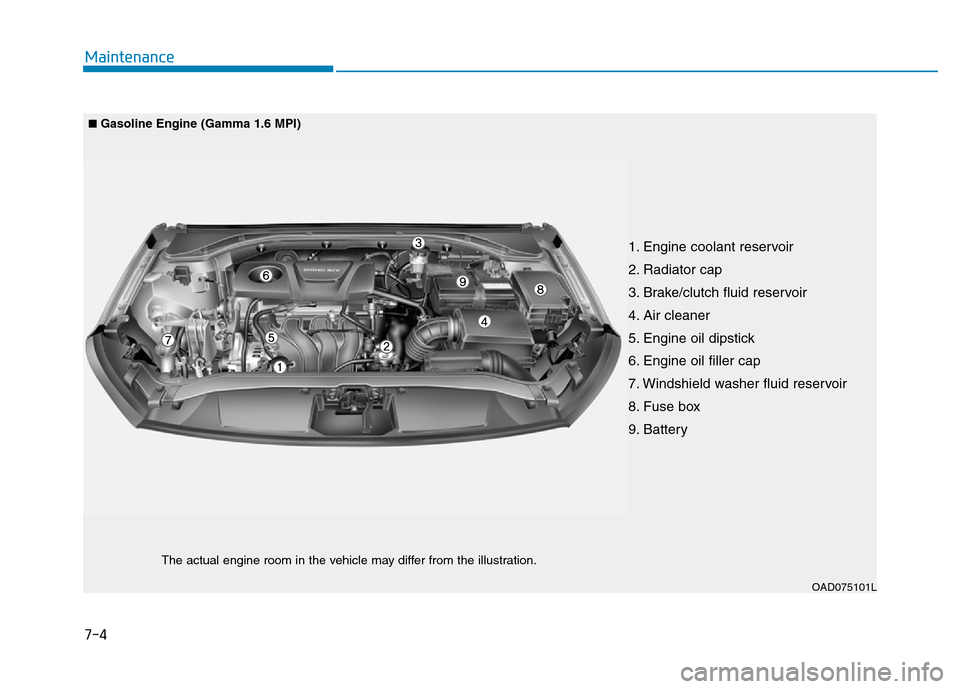
1. Engine coolant reservoir
2. Radiator cap
3. Brake/clutch fluid reservoir
4. Air cleaner
5. Engine oil dipstick
6. Engine oil filler cap
7. Windshield washer fluid reservoir
8. Fuse box
9. Battery
OAD075101L
■Gasoline Engine (Gamma 1.6 MPI)
The actual engine room in the vehicle may differ from the illustration.
Page 516 of 637
7-5
7
Maintenance
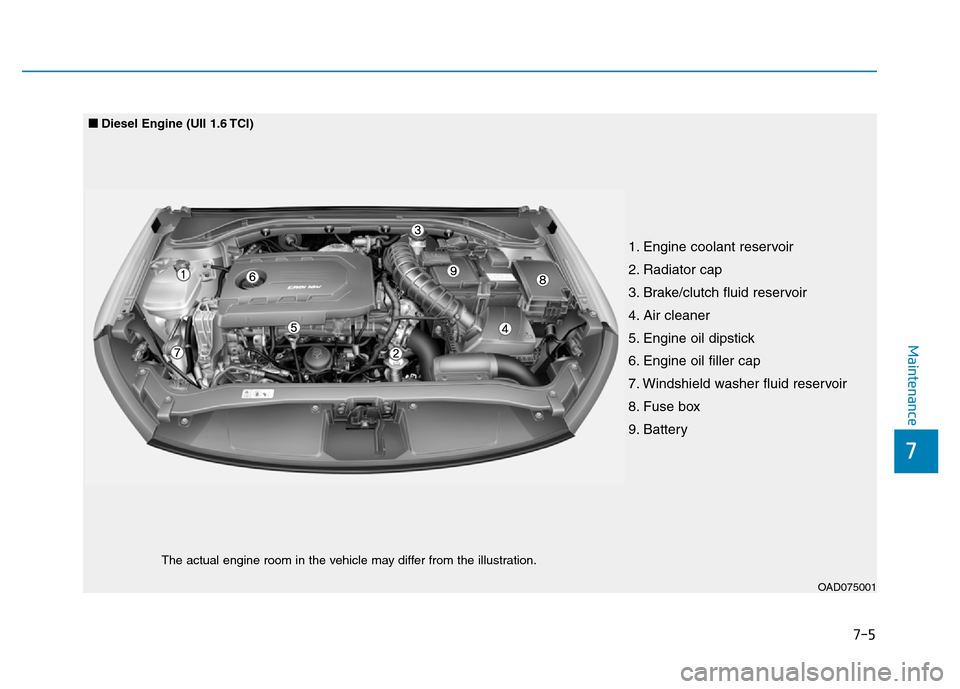
1. Engine coolant reservoir
2. Radiator cap
3. Brake/clutch fluid reservoir
4. Air cleaner
5. Engine oil dipstick
6. Engine oil filler cap
7. Windshield washer fluid reservoir
8. Fuse box
9. Battery
OAD075001
■Diesel Engine (UII 1.6 TCI)
The actual engine room in the vehicle may differ from the illustration.
Page 519 of 637
Owner maintenance schedule
When you stop for fuel:
• Check the engine oil level.
• Check coolant level in the engine
coolant reservoir.
• Check the windshield washer fluid
level.
• Check for low or under-inflated
tires.
While operating your vehicle:
• Note any changes in the sound of
the exhaust or any smell of exhaust
fumes in the vehicle.
• Check for vibrations in the steering
wheel. Notice if there is any
increased steering effort or loose-
ness in the steering wheel, or
change in its straight-ahead position.
• Notice if your vehicle constantly
turns slightly or “pulls” to one side
when traveling on smooth, level
road.
• When stopping, listen and check for
unusual sounds, pulling to one side,
increased brake pedal travel or
“hard-to-push” brake pedal.
• If any slipping or changes in the
operation of your transmission
occurs, check the transmission fluid
level.
• Check the automatic transmission
P (Park) function.
• Check the parking brake.
• Check for fluid leaks under your vehi-
cle (water dripping from the air con-
ditioning system during or after use
is normal).
7-8
Maintenance
Be careful when checking your
engine coolant level when the
engine is hot. This may result in
coolant being blown out of the
opening and cause serious
burns and other injuries.
WARNING
Diesel Engine
Never manipulate or modify the
injection system while running
the diesel engine or within 30
seconds after turning OFF the
diesel engine. The high-pressure
pump, high-pressure pipes, rail,
and injectors are still subject to
the high pressure right after
stopping the diesel engine.
When the fuel leakage vents out,
it may cause serious body injury.
Any people, who are implement-
ed with the artificial cardiac
pacemaker, should remain away
from the ECU or the wiring har-
ness by at least 30 cm, while run-
ning the diesel engine. The high
currents of the electric engine
control system produce a con-
siderable amount of magnetic
fields.
WARNING
Page 520 of 637
At least monthly:
• Check coolant level in the engine
coolant reservoir.
• Check the operation of all exterior
lights, including the stoplights, turn
signals and hazard warning flashers.
• Check the inflation pressures of all
tires including the spare for tires
that are worn, show uneven wear,
or are damaged.
• Check for loose wheel lug nuts.
At least twice a year:
(i.e., every Spring and Fall)
• Check radiator, heater and air condi-
tioning hoses for leaks or damage.
• Check windshield washer spray
and wiper operation. Clean wiper
blades with clean cloth dampened
with washer fluid.
• Check headlamp alignment.
• Check muffler, exhaust pipes,
shields and clamps.
• Check the seat belts for wear and
function.
At least once a year:
• Clean body and door drain holes.
• Lubricate door hinges and hood
hinges.
• Lubricate door and hood locks and
latches.
• Lubricate door rubber weather
strips.
• Lubricate door checker
• Check the air conditioning system.
• Inspect and lubricate automatic
transmission linkage and controls.
• Clean the battery and terminals.
• Check the brake fluid level.
7-9
7
Maintenance
Page 523 of 637
Maintenance
7-12
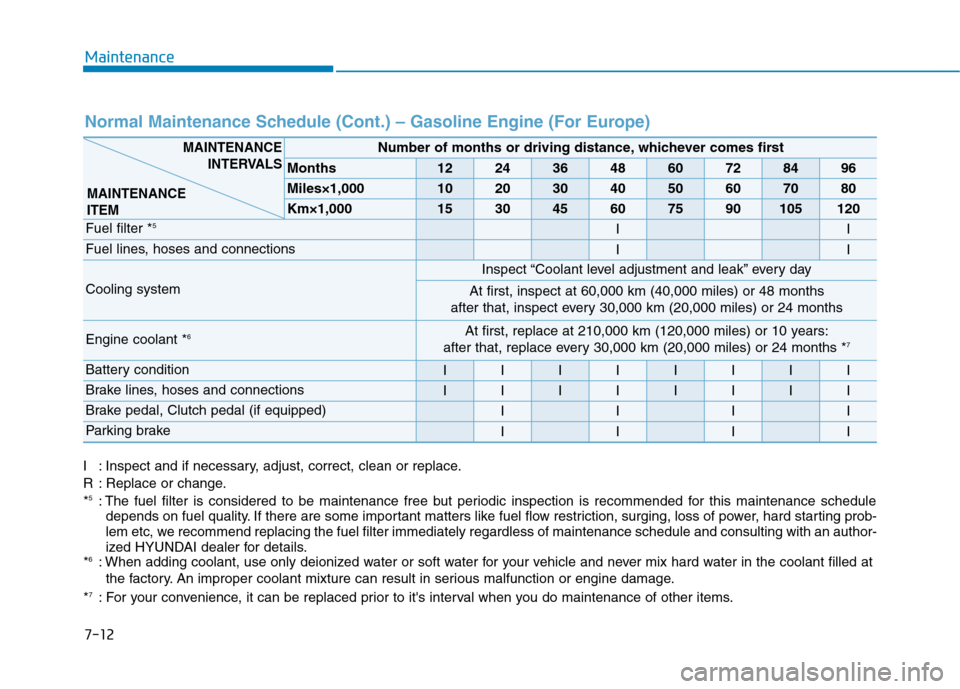
Normal Maintenance Schedule (Cont.) – Gasoline Engine (For Europe)
Number of months or driving distance, whichever comes first
Months1224364860728496
Miles×1,0001020304050607080
Km×1,000153045607590105120
Fuel filter *5II
Fuel lines, hoses and connectionsII
Cooling system
Inspect “Coolant level adjustment and leak” every day
At first, inspect at 60,000 km (40,000 miles) or 48 months
after that, inspect every 30,000 km (20,000 miles) or 24 months
Engine coolant *6At first, replace at 210,000 km (120,000 miles) or 10 years:
after that, replace every 30,000 km (20,000 miles) or 24 months *7
Battery conditionIIIIIIII
Brake lines, hoses and connectionsIIIIIIII
Brake pedal, Clutch pedal (if equipped)IIII
Parking brakeIIII
MAINTENANCE INTERVALS
MAINTENANCE
ITEM
I : Inspect and if necessary, adjust, correct, clean or replace.
R : Replace or change.
*
5: The fuel filter is considered to be maintenance free but periodic inspection is recommended for this maintenance schedule depends on fuel quality. If there are some important matters like fuel flow restriction, surging, loss of power, hard starting p rob-
lem etc, we recommend replacing the fuel filter immediately regardless of maintena\
nce schedule and consulting with an author-
ized HYUNDAI dealer for details.
*
6: When adding coolant, use only deionized water or soft water for your vehicle and never mix hard water in the coolant filled at
the factory. An improper coolant mixture can result in serious malfunction or engine damage.
*
7: For your convenience, it can be replaced prior to it's interval when you do maintenance of other items.
Page 529 of 637
Maintenance
7-18
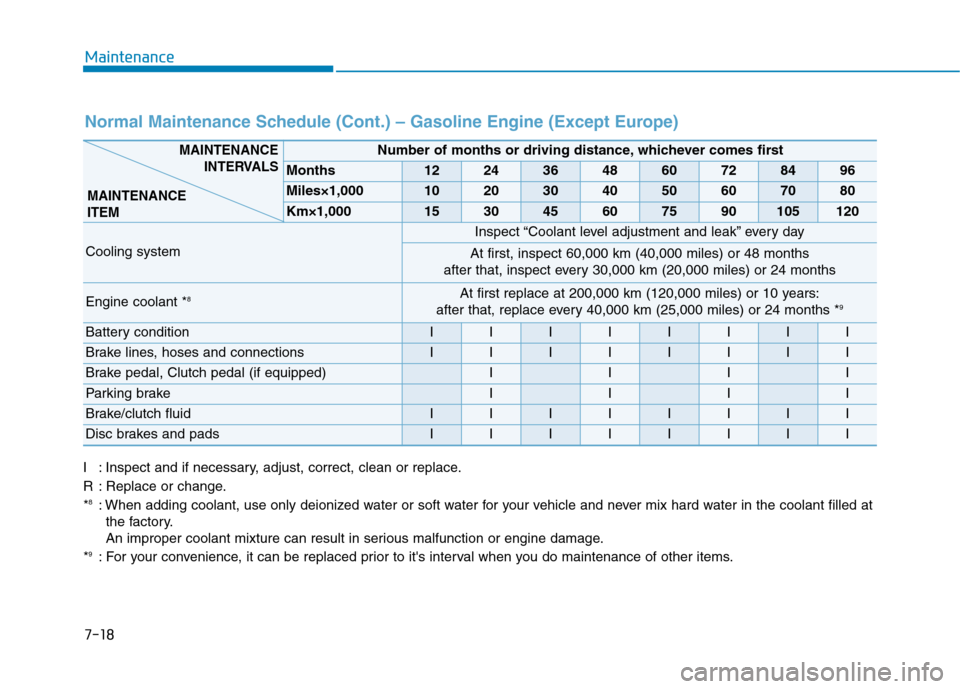
Normal Maintenance Schedule (Cont.) – Gasoline Engine (Except Europe)
I : Inspect and if necessary, adjust, correct, clean or replace.
R : Replace or change.
*
8: When adding coolant, use only deionized water or soft water for your vehicle and never mix hard water in the coolant filled atthe factory.
An improper coolant mixture can result in serious malfunction or engine damage.
*
9: For your convenience, it can be replaced prior to it's interval when you do maintenance of other items.
Number of months or driving distance, whichever comes first
Months1224364860728496
Miles×1,0001020304050607080
Km×1,000153045607590105120
Cooling system
Inspect “Coolant level adjustment and leak” every day
At first, inspect 60,000 km (40,000 miles) or 48 months
after that, inspect every 30,000 km (20,000 miles) or 24 months
Engine coolant *8At first replace at 200,000 km (120,000 miles) or 10 years:
after that, replace every 40,000 km (25,000 miles) or 24 months *9
Battery conditionIIIIIIII
Brake lines, hoses and connectionsIIIIIIII
Brake pedal, Clutch pedal (if equipped)IIII
Parking brakeIIII
Brake/clutch fluidIIIIIIII
Disc brakes and padsIIIIIIII
MAINTENANCE INTERVALS
MAINTENANCE
ITEM
Page 534 of 637
7-23
7
Maintenance
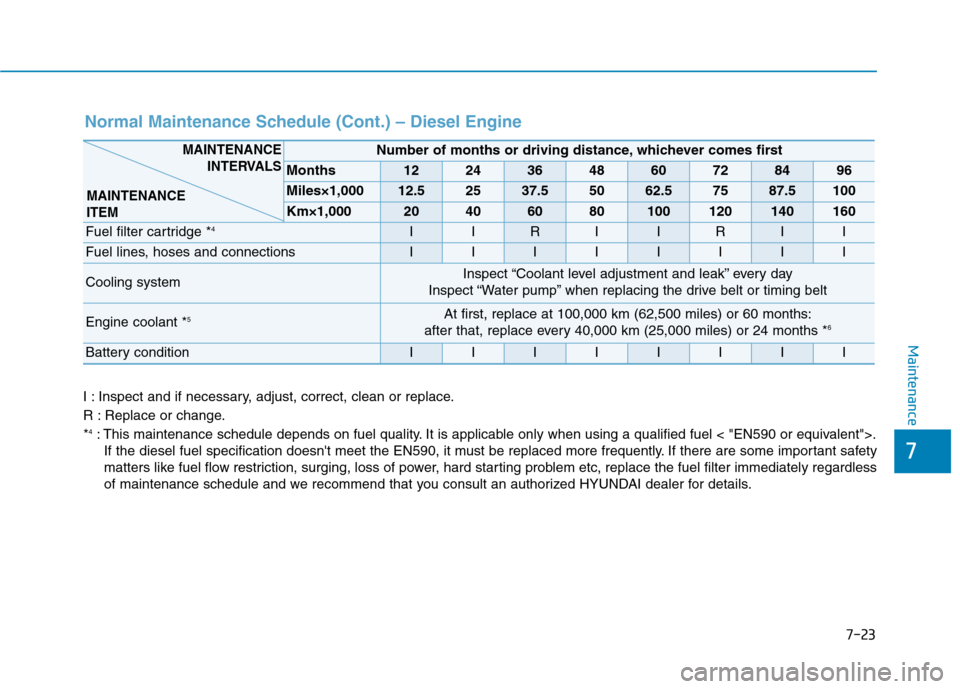
Normal Maintenance Schedule (Cont.) – Diesel Engine
I : Inspect and if necessary, adjust, correct, clean or replace.
R : Replace or change.
*
4: This maintenance schedule depends on fuel quality. It is applicable only when using a qualified fuel < "EN590 or equivalent">.If the diesel fuel specification doesn't meet the EN590, it must be replaced more frequently. If there are some important safety
matters like fuel flow restriction, surging, loss of power, hard starting problem etc, replace the fuel filter immediately regardless
of maintenance schedule and we recommend that you consult an authorized HYUNDAI dealer for details.
Number of months or driving distance, whichever comes first
Months1224364860728496
Miles×1,00012.52537.55062.57587.5100
Km×1,00020406080100120140160
Fuel filter cartridge *4IIRIIRII
Fuel lines, hoses and connectionsIIIIIIII
Cooling systemInspect “Coolant level adjustment and leak” every day
Inspect “Water pump” when replacing the drive belt or timing belt
Engine coolant *5At first, replace at 100,000 km (62,500 miles) or 60 months:
after that, replace every 40,000 km (25,000 miles) or 24 months *6
Battery conditionIIIIIIII
MAINTENANCE INTERVALS
MAINTENANCE
ITEM
Page 535 of 637
Maintenance
7-24
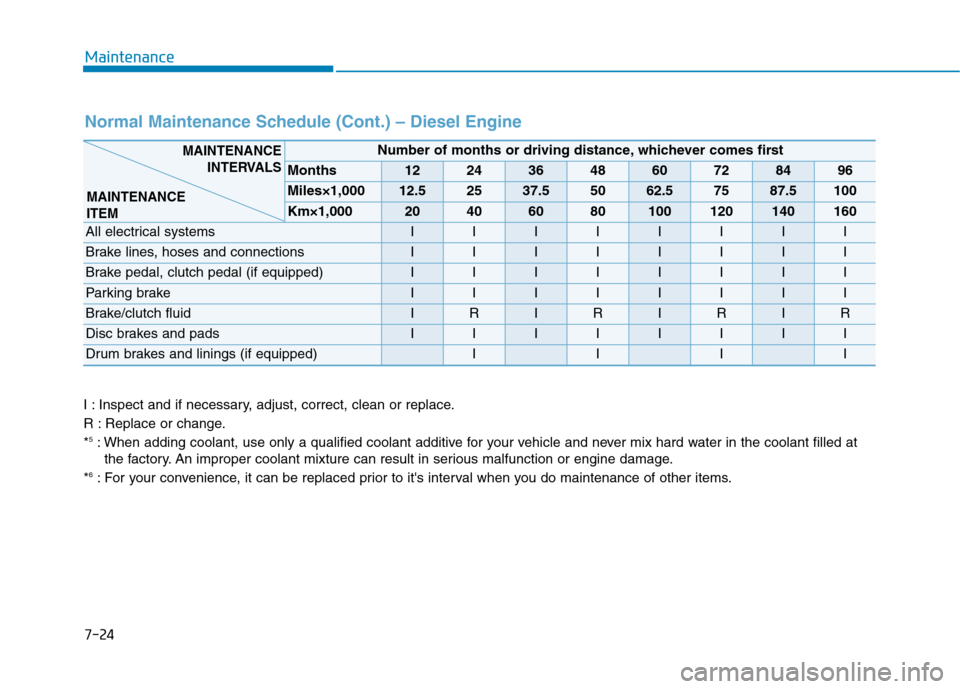
Normal Maintenance Schedule (Cont.) – Diesel Engine
I : Inspect and if necessary, adjust, correct, clean or replace.
R : Replace or change.
*
5: When adding coolant, use only a qualified coolant additive for your vehicle and never mix hard water in the coolant filled atthe factory. An improper coolant mixture can result in serious malfunction or engine damage.
*
6: For your convenience, it can be replaced prior to it's interval when you do maintenance of other items.
Number of months or driving distance, whichever comes first
Months1224364860728496
Miles×1,00012.52537.55062.57587.5100
Km×1,00020406080100120140160
All electrical systemsIIIIIIII
Brake lines, hoses and connectionsIIIIIIII
Brake pedal, clutch pedal (if equipped)IIIIIIII
Parking brakeIIIIIIII
Brake/clutch fluidIRIRIRIR
Disc brakes and padsIIIIIIII
Drum brakes and linings (if equipped)IIII
MAINTENANCE INTERVALS
MAINTENANCE
ITEM
Page 540 of 637
7-29
7
Maintenance
Air cleaner filter
We recommend that the air cleaner
filter be replaced by an authorized
HYUNDAI dealer.
Spark plugs
Make sure to install new spark plugs
of the correct heat range.
Valve clearance
Inspect excessive valve noise and/or
engine vibration and adjust if neces-
sary. We recommend that the system
be serviced by an authorized
HYUNDAI dealer.
Cooling system
Check the cooling system parts,
such as radiator, coolant reservoir,
hoses and connections for leakage
and damage. Replace any damaged
parts.
Engine coolant
The coolant should be changed at
the intervals specified in the mainte-
nance schedule.
Automatic transmission fluid
Automatic transmission fluid should
not be checked under normal usage
conditions.
We recommend that the automatic
transmission fluid changed by an
authorized HYUNDAI dealer accord-
ing to the maintenance schedule.
Information
Automatic transmission fluid color is
basically red.
As the vehicle is driven, the automatic
transmission fluid will begin to look
darker.
It is normal condition and you should
not judge the need to replace the fluid
based upon the changed color.
The use of a non-specified fluid
could result in transmission mal-
function and failure.
Use only specified automatic
transmission fluid. (Refer to
“Recommended lubricants and
capacities” in section 8.)
NOTICE
i
Do not disconnect and inspect
spark plugs when the engine is
hot. You may burn yourself.
WARNING
Page 546 of 637
7
Maintenance
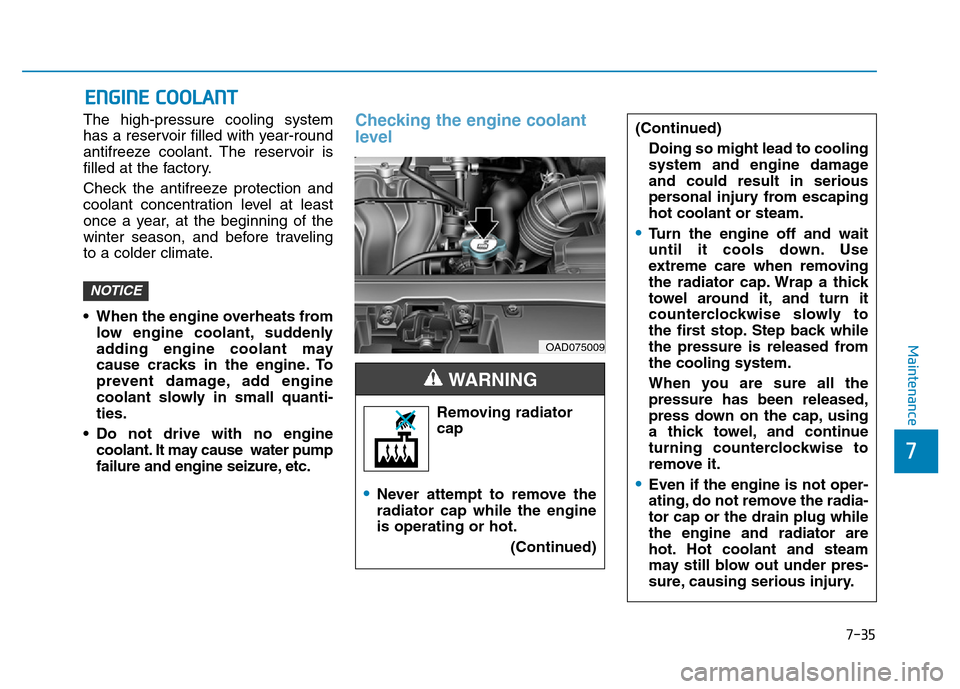
ENGINE COOLANT
Removing radiator
cap
•Never attempt to remove the
radiator cap while the engine
is operating or hot.
(Continued)
WARNING
(Continued)
Doing so might lead to cooling
system and engine damage
and could result in serious
personal injury from escaping
hot coolant or steam.
•Turn the engine off and wait
until it cools down. Use
extreme care when removing
the radiator cap. Wrap a thick
towel around it, and turn it
counterclockwise slowly to
the first stop. Step back while
the pressure is released from
the cooling system.
When you are sure all the
pressure has been released,
press down on the cap, using
a thick towel, and continue
turning counterclockwise to
remove it.
•Even if the engine is not oper-
ating, do not remove the radia-
tor cap or the drain plug while
the engine and radiator are
hot. Hot coolant and steam
may still blow out under pres-
sure, causing serious injury.
OAD075009
The high-pressure cooling system
has a reservoir filled with year-round
antifreeze coolant. The reservoir is
filled at the factory.
Check the antifreeze protection and
coolant concentration level at least
once a year, at the beginning of the
winter season, and before traveling
to a colder climate.
• When the engine overheats from
low engine coolant, suddenly
adding engine coolant may
cause cracks in the engine. To
prevent damage, add engine
coolant slowly in small quanti-
ties.
• Do not drive with no engine
coolant. It may cause water pump
failure and engine seizure, etc.Checking the engine coolant
level
NOTICE
7-35