Fuel Hyundai Elantra 2017 Repair Manual
[x] Cancel search | Manufacturer: HYUNDAI, Model Year: 2017, Model line: Elantra, Model: Hyundai Elantra 2017Pages: 637, PDF Size: 15.02 MB
Page 590 of 637
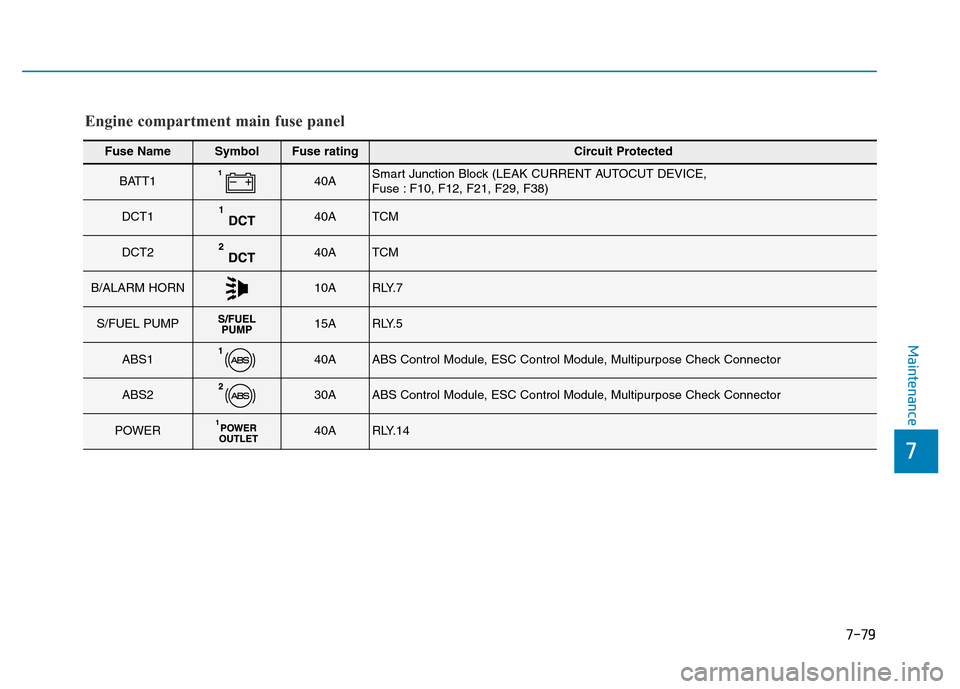
7-79
7
Maintenance
Fuse NameSymbolFuse ratingCircuit Protected
BATT140ASmart Junction Block (LEAK CURRENT AUTOCUT DEVICE,
Fuse : F10, F12, F21, F29, F38)
DCT140ATCM
DCT240ATCM
B/ALARM HORN10AR LY. 7
S/FUEL PUMP15AR LY. 5
ABS140AABS Control Module, ESC Control Module, Multipurpose Check Connector
ABS230AABS Control Module, ESC Control Module, Multipurpose Check Connector
POWER40ARLY.14
Engine compartment main fuse panel
Page 591 of 637
Maintenance
7-80
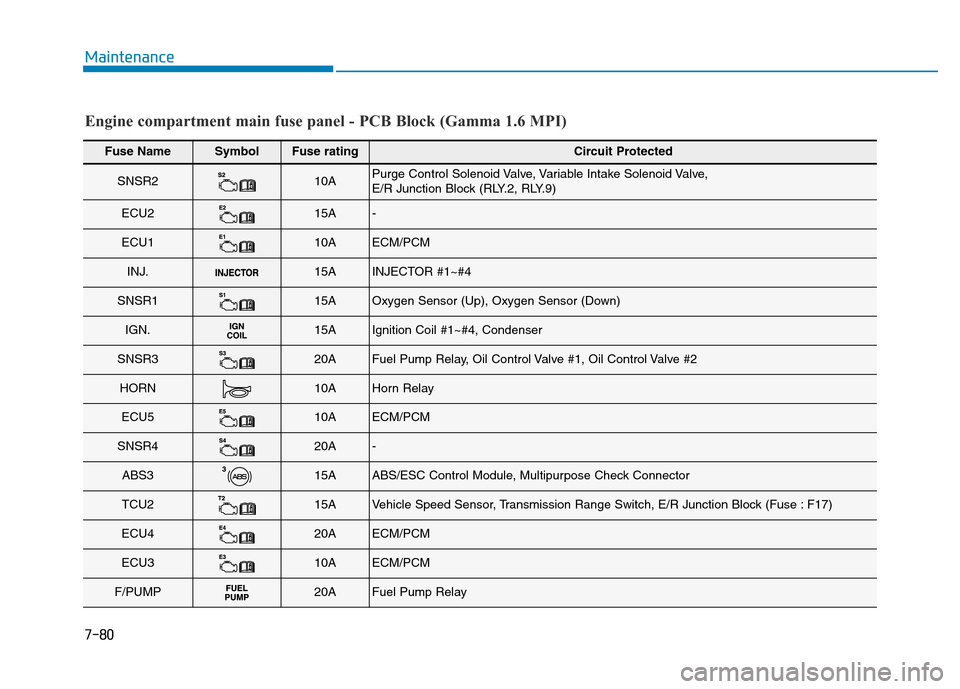
Engine compartment main fuse panel - PCB Block (Gamma 1.6 MPI)
Fuse NameSymbolFuse ratingCircuit Protected
SNSR210APurge Control Solenoid Valve, Variable Intake Solenoid Valve,
E/R Junction Block (RLY.2, RLY.9)
ECU215A-
ECU110AECM/PCM
INJ.15AINJECTOR #1~#4
SNSR115AOxygen Sensor (Up), Oxygen Sensor (Down)
IGN.15AIgnition Coil #1~#4, Condenser
SNSR320AFuel Pump Relay, Oil Control Valve #1, Oil Control Valve #2
HORN10AHorn Relay
ECU510AECM/PCM
SNSR420A-
ABS315AABS/ESC Control Module, Multipurpose Check Connector
TCU215AVehicle Speed Sensor, Transmission Range Switch, E/R Junction Block (Fuse : F17)
ECU420AECM/PCM
ECU310AECM/PCM
F/PUMP20AFuel Pump Relay
Page 592 of 637
7-81
7
Maintenance
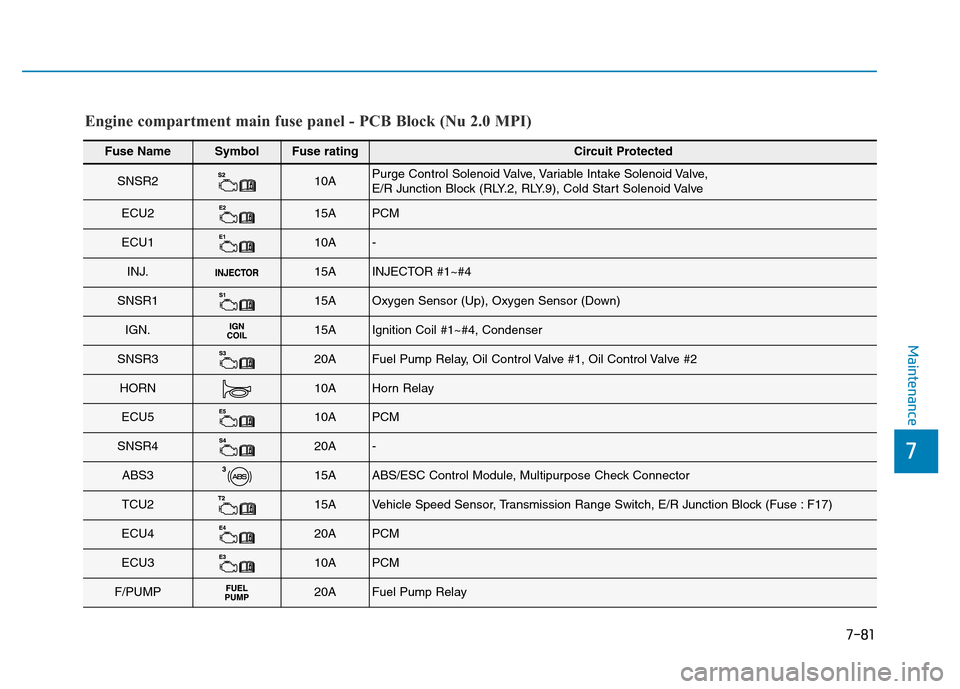
Engine compartment main fuse panel - PCB Block (Nu 2.0 MPI)
Fuse NameSymbolFuse ratingCircuit Protected
SNSR210APurge Control Solenoid Valve, Variable Intake Solenoid Valve,
E/R Junction Block (RLY.2, RLY.9), Cold Start Solenoid Valve
ECU215APCM
ECU110A-
INJ.15AINJECTOR #1~#4
SNSR115AOxygen Sensor (Up), Oxygen Sensor (Down)
IGN.15AIgnition Coil #1~#4, Condenser
SNSR320AFuel Pump Relay, Oil Control Valve #1, Oil Control Valve #2
HORN10AHorn Relay
ECU510APCM
SNSR420A-
ABS315AABS/ESC Control Module, Multipurpose Check Connector
TCU215AVehicle Speed Sensor, Transmission Range Switch, E/R Junction Block (Fuse : F17)
ECU420APCM
ECU310APCM
F/PUMP20AFuel Pump Relay
Page 593 of 637
Maintenance
7-82
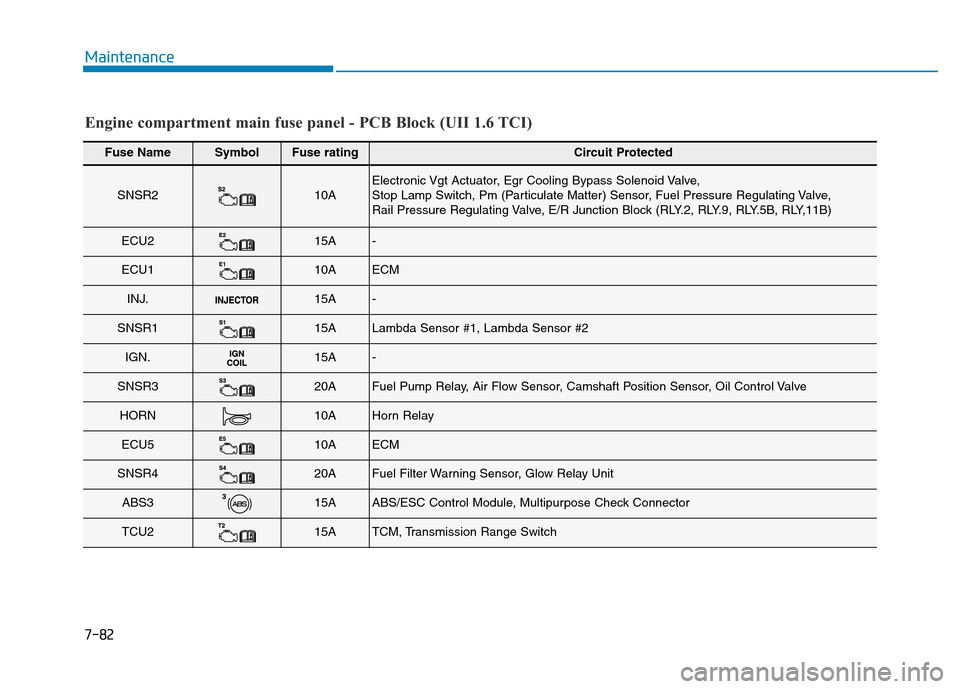
Engine compartment main fuse panel - PCB Block (UII 1.6 TCI)
Fuse NameSymbolFuse ratingCircuit Protected
SNSR210AElectronic Vgt Actuator, Egr Cooling Bypass Solenoid Valve,
Stop Lamp Switch, Pm (Particulate Matter) Sensor, Fuel Pressure Regulating Valve,
Rail Pressure Regulating Valve, E/R Junction Block (RLY.2, RLY.9, RLY.5B, RLY,11B)
ECU215A-
ECU110AECM
INJ.15A-
SNSR115ALambda Sensor #1, Lambda Sensor #2
IGN.15A-
SNSR320AFuel Pump Relay, Air Flow Sensor, Camshaft Position Sensor, Oil Control Valve
HORN10AHorn Relay
ECU510AECM
SNSR420AFuel Filter Warning Sensor, Glow Relay Unit
ABS315AABS/ESC Control Module, Multipurpose Check Connector
TCU215ATCM, Transmission Range Switch
Page 594 of 637
7-83
7
Maintenance
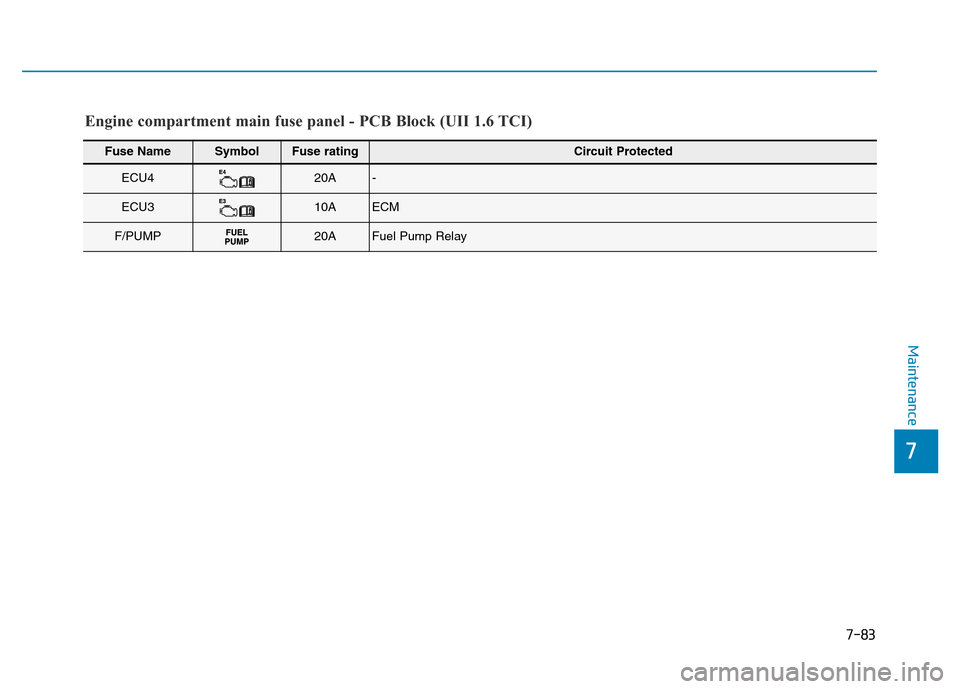
Engine compartment main fuse panel - PCB Block (UII 1.6 TCI)
Fuse NameSymbolFuse ratingCircuit Protected
ECU420A-
ECU310AECM
F/PUMP20AFuel Pump Relay
Page 616 of 637
7-105
7
Maintenance
Finish damage repair
Deep scratches or stone chips in the
painted surface must be repaired
promptly. Exposed metal will quickly
rust and may develop into a major
repair expense.
If your vehicle is damaged and
requires any metal repair or
replacement, be sure the body
shop applies anti-corrosion materi-
als to the parts repaired or replaced.
Bright-metal maintenance
• To remove road tar and insects,
use a tar remover, not a scraper or
other sharp object.
• To protect the surfaces of bright-
metal parts from corrosion, apply a
coating of wax or chrome preser-
vative and rub to a high luster.
• During winter weather or in coastal
areas, cover the bright metal parts
with a heavier coating of wax or
preservative. If necessary, coat the
parts with non-corrosive petroleum
jelly or other protective compound.
Underbody maintenance
Corrosive materials used for ice and
snow removal and dust control may
collect on the underbody. If these
materials are not removed, acceler-
ated rusting can occur on underbody
parts such as the fuel lines, frame,
floor pan and exhaust system, even
though they have been treated with
rust protection.
Thoroughly flush the vehicle under-
body and wheel openings with luke-
warm or cold water once a month,
after off-road driving and at the end of
each winter. Pay special attention to
these areas because it is difficult to
see all the mud and dirt. It will do
more harm than good to wet down the
road grime without removing it. The
lower edges of doors, rocker panels,
and frame members have drain holes
that should not be allowed to clog with
dirt; trapped water in these areas can
cause rusting.
NOTICE
Page 622 of 637

7-111
7
Maintenance
EMISSION CONTROL SYSTEM
The emission control system of your
vehicle is covered by a written limited
warranty. Please see the warranty
information contained in the Service
Passport in your vehicle.
Your vehicle is equipped with an
emission control system to meet all
emission regulations.
There are three emission control
systems which are as follows.
(1) Crankcase emission control sys-
tem
(2) Evaporative emission control sys-
tem
(3) Exhaust emission control system
In order to assure the proper function
of the emission control systems, it is
recommended that you have your
car inspected and maintained by an
authorized HYUNDAI dealer in
accordance with the maintenance
schedule in this manual.1. Crankcase emission control
system
The positive crankcase ventilation
system is employed to prevent air
pollution caused by blow-by gases
being emitted from the crankcase.
This system supplies fresh filtered air
to the crankcase through the air
intake hose. Inside the crankcase,
the fresh air mixes with blow-by
gases, which then pass through the
PCV valve into the induction system.
2. Evaporative emission con-
trol system
The Evaporative Emission Control
System is designed to prevent fuel
vapors from escaping into the atmos-
phere. For the Inspection and
Maintenance Test (With Electronic
Stability Control (ESC) system)
•To prevent the vehicle from
misfiring during dynamome-
ter testing, turn the Electronic
Stability Control (ESC) sys-
tem off by pressing the ESC
switch.
•After dynamometer testing is
completed, turn the ESC sys-
tem back on by pressing the
ESC switch again.
CAUTION
Page 623 of 637
7-112
Maintenance
Canister
Fuel vapors generated inside the fuel
tank are absorbed and stored in the
onboard canister. When the engine is
running, the fuel vapors absorbed in
the canister are drawn into the surge
tank through the purge control sole-
noid valve.
Purge Control Solenoid Valve
(PCSV)
The purge control solenoid valve is
controlled by the Engine Control
Module (ECM); when the engine
coolant temperature is low during
idling, the PCSV closes so that evap-
orated fuel is not taken into the
engine. After the engine warms-up
during ordinary driving, the PCSV
opens to introduce evaporated fuel to
the engine.
3. Exhaust emission control
system
The Exhaust Emission Control
System is a highly effective system
which controls exhaust emissions
while maintaining good vehicle per-
formance.
Vehicle modifications
This vehicle should not be modified.
Modification of your vehicle could
affect its performance, safety or
durability and may even violate gov-
ernmental safety and emissions reg-
ulations.
In addition, damage or performance
problems resulting from any modifi-
cation may not be covered under
warranty.
• If you use unauthorized electronic
devices, it may cause the vehicle to
operate abnormally, wire damage,
battery discharge and fire. For your
safety, do not use unauthorized
electronic devices.
Engine exhaust gas precautions
(carbon monoxide)
• Carbon monoxide can be present
with other exhaust fumes.
Therefore, if you smell exhaust
fumes of any kind inside your vehi-
cle, have it inspected and repaired
immediately. If you ever suspect
exhaust fumes are coming into
your vehicle, drive it only with all
the windows fully open. Have your
vehicle checked and repaired
immediately.
Page 625 of 637
7-114
Maintenance
Your vehicle is equipped with a cat-
alytic converter emission control
device.
Therefore, the following precautions
must be observed:
Failure to observe these precautions
could result in damage to the catalytic
converter and to your vehicle.
Additionally, such actions could void
your warranties.
Diesel particulate filter (DPF)
(if equipped)
The Diesel Particulate Filter (DPF)
system removes the soot in the
exhaust gas.
The DPF system automatically burns
(or oxidizes) the accumulated soot in
accordance with the driving situa-
tions, unlike a disposable air filter.
In other words, the accumulated soot
is automatically purged out by the
engine control system and by the high
exhaust-gas temperature at normal/
high driving speeds.
However, when the vehicle is continu-
ally driven at repeated short distance
or driven at low speed for a long time,
the accumulated soot may not be
automatically removed because of low
exhaust gas temperature. In this case,
the accumulated soot is out of the
detection range, the soot oxidization
process does not occur, and the
Malfunction Indicator Lamp ( )
Illuminates.
•Use only UNLEADED FUEL
for gasoline engine.
•Do not operate the vehicle
when there are signs of
engine malfunction, such as
misfire or a noticeable loss of
performance.
•Do not misuse or abuse the
engine. Examples of misuse
are coasting with the engine
off and descending steep
grades in gear with the engine
off.
(Continued)
(Continued)
•Do not operate the engine at
high idle speed for extended
periods (5 minutes or more).
•Do not modify or tamper with
any part of the engine or
emission control system. All
inspections and adjustments
must be made by an author-
ized HYUNDAI dealer.
•Avoid driving with a very low
fuel level. If you run out of
gasoline, it could cause the
engine to misfire and result in
excessive loading of the cat-
alytic converter.
CAUTION
Page 626 of 637
7-115
7
Maintenance
The Malfunction Indicator Lamp (MIL)
stops illuminating, when the driving
speed exceeds 60 km/h (37mph), or
when the engine rpm is between
1,500 and 2,500 with the gear in the
2nd position or above for approxi-
mately 25 minutes.
When the MIL continuously blinks or
the warning message “Check exhaust
system” illuminates in the above
cases, we recommend you to have the
DPF system checked by an author-
ized HYUNDAI dealer.
When the vehicle is continuously driv-
en with the MIL flashing for an extend-
ed period of time, it may damage the
DPF system and lower the fuel econ-
omy.Lean NOx Trap (if equipped)
The Lean NOx Trap (LNT) system
removes the nitrogen oxide in the
exhaust gas. The smell can occur in
the exhaust gas depending on the
quality of the fuel and it can degrade
NOx reduction performance, please
use the regulated automotive diesel
fuel. Diesel Fuel
(if equipped with DPF)
We recommend you to use only
the regulated diesel fuels, when
your vehicle is equipped with
the DPF system.
When you use other diesel fuels,
which is high in sulfurs (above
50 ppm) or contains unspecified
additives, it may damage the
DPF system and cause the white
smoke emission.CAUTION