pressure Hyundai Elantra 2017 Owner's Manual
[x] Cancel search | Manufacturer: HYUNDAI, Model Year: 2017, Model line: Elantra, Model: Hyundai Elantra 2017Pages: 637, PDF Size: 15.02 MB
Page 18 of 637
F18
Hazard warning flasher ........................................6-2
In case of an emergency while driving ..............6-2
If the engine stalls while driving ...................................6-2
If the engine stalls at a crossroad or crossing .........6-3
If you have a flat tire while driving..............................6-3
If the engine will not start ...................................6-4
If the engine doesn't turn over or turns
over slowly ..........................................................................6-4
If the engine turns over normally but
doesn't start .......................................................................6-4
Jump starting ..........................................................6-4
If the engine overheats ........................................6-8
Tire Pressure Monitoring System (TPMS).......6-10
Check tire pressure .......................................................6-10
Tire Pressure Monitoring System ...............................6-11
Low tire pressure telltale ..............................................6-12
Low tire pressure position and Tire pressure
telltale ................................................................................6-12
TPMS (Tire Pressure Monitoring System)
malfunction indicator .....................................................6-13
Changing a tire with TPMS...........................................6-14
If you have a flat tire..........................................6-16
Jack and tools ..................................................................6-16
Changing tires ..................................................................6-17
Jack label ...........................................................................6-22
EC Declaration of conformity for Jack......................6-23
Towing ...................................................................6-24
Towing service .................................................................6-24
Removable towing hook ................................................6-25
Emergency towing ..........................................................6-26
Emergency commodity ........................................6-28
Fire extinguisher .............................................................6-28
First aid kit ......................................................................6-28
Triangle reflector ............................................................6-28
Tire pressure gauge .......................................................6-28
F18
6What to do in an emergency
Page 20 of 637
F20F20
Tires and wheels ..................................................7-52
Tire care ............................................................................7-52
Recommended cold tire inflation pressures.............7-52
Checking tire inflation pressure ..................................7-54
Tire rotation .....................................................................7-55
Wheel alignment and tire balance ..............................7-56
Tire replacement .............................................................7-56
Wheel replacement .........................................................7-58
Tire traction ......................................................................7-58
Tire maintenance ............................................................7-58
Tire sidewall labeling ......................................................7-58
Low aspect ratio tire ......................................................7-63
Fuses ......................................................................7-64
Fuse/Relay panel description ......................................7-70
Light bulbs.............................................................7-84
Headlamp, position lamp, turn signal lamp and
fog lamp light bulb replacement .................................7-85
Side repeater lamp replacement .................................7-91
Headlamp and front fog lamp aiming (for Europe) ...7-92
Rear combination lamp bulb replacement ................7-97
High mounted stop lamp replacement .....................7-101
License plate light bulb replacement .......................7-101
Interior light bulb replacement ..................................7-102
Appearance care ................................................7-103
Exterior care ..................................................................7-103
Interior care ...................................................................7-109
Emission control system ...................................7-111
Crankcase emission control system .........................7-111
Evaporative emission control system ......................7-111
Exhaust emission control system .............................7-112
Page 21 of 637
F21F21
Dimensions ..............................................................8-2
Engine ......................................................................8-2
Bulb wattage ...........................................................8-3
Tires and wheels ....................................................8-4
Air conditioning system ........................................8-4
Tire load and speed capacity ..............................8-5
Volume and weight ................................................8-5
Recommended lubricants and capacities ...........8-6
Recommended SAE viscosity number ..........................8-8
Vehicle identification number (VIN) ....................8-9
Vehicle certification label .....................................8-9
Tire specification and pressure label ...............8-10
Engine number .....................................................8-10
Air conditioner compressor label ......................8-11
Declaration of conformity ..................................8-11
8Specifications & Consumer information
Page 33 of 637
2-3
Safety system of your vehicle
• NEVER let the use of a mobile
device distract you from driving. You
have a responsibility to your passen-
gers and others on the road to
always drive safely, with your hands
on the wheel as well as your eyes
and attention on the road.
Control your speed
Excessive speed is a major factor in
crash injuries and deaths. Generally,
the higher the speed, the greater the
risk, but serious injuries can also
occur at lower speeds. Never drive
faster than is safe for current condi-
tions, regardless of the maximum
speed posted.
Keep your vehicle in safe condi-
tion
Having a tire blowout or a mechanical
failure can be extremely hazardous. To
reduce the possibility of such prob-
lems, check your tire pressures and
condition frequently, and perform all
regularly scheduled maintenance.
2
Page 82 of 637
2-52
Safety system of your vehicle
How does the air bags system
operate?
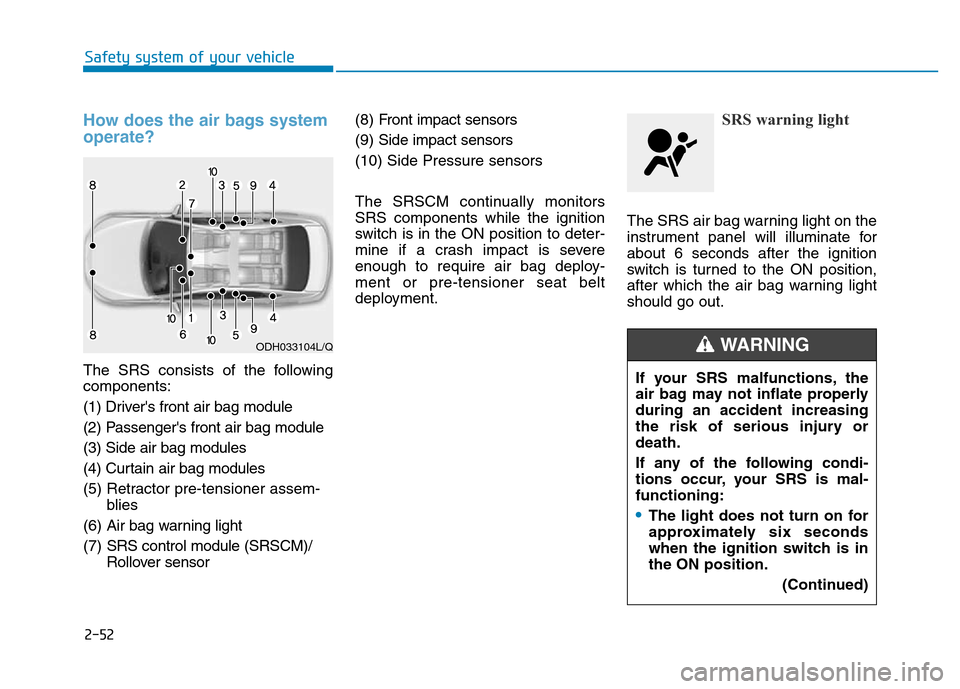
The SRS consists of the following
components:
(1) Driver's front air bag module
(2) Passenger's front air bag module
(3) Side air bag modules
(4) Curtain air bag modules
(5) Retractor pre-tensioner assem-
blies
(6) Air bag warning light
(7) SRS control module (SRSCM)/
Rollover sensor(8) Front impact sensors
(9) Side impact sensors
(10) Side Pressure sensors
The SRSCM continually monitors
SRS components while the ignition
switch is in the ON position to deter-
mine if a crash impact is severe
enough to require air bag deploy-
ment or pre-tensioner seat belt
deployment.
SRS warning light
The SRS air bag warning light on the
instrument panel will illuminate for
about 6 seconds after the ignition
switch is turned to the ON position,
after which the air bag warning light
should go out.
ODH033104L/Q
If your SRS malfunctions, the
air bag may not inflate properly
during an accident increasing
the risk of serious injury or
death.
If any of the following condi-
tions occur, your SRS is mal-
functioning:
•The light does not turn on for
approximately six seconds
when the ignition switch is in
the ON position.
(Continued)
WARNING
Page 85 of 637
2-55
Safety system of your vehicle
2
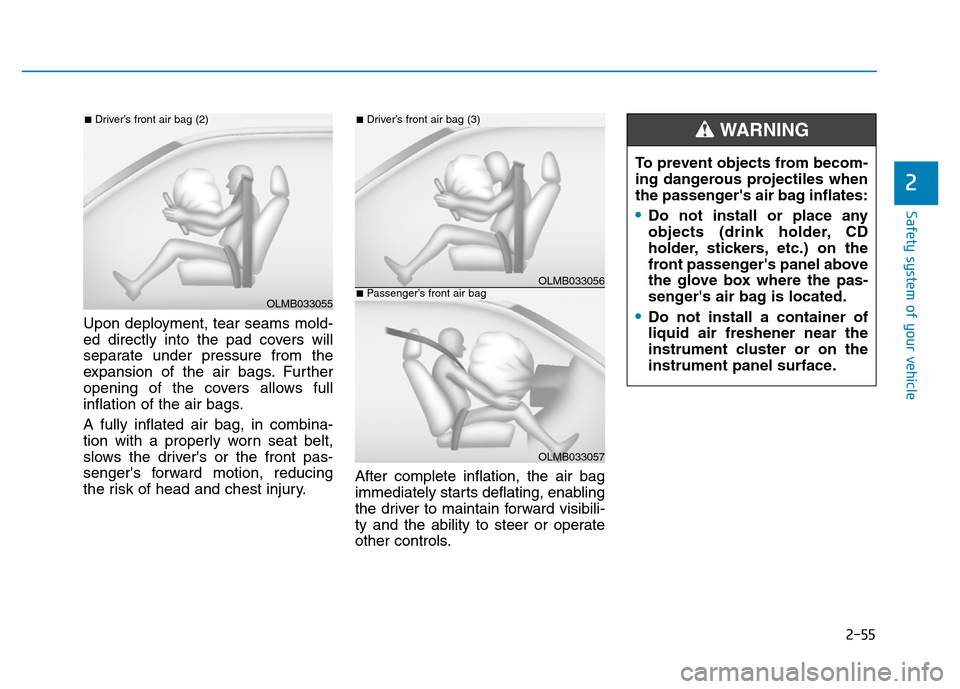
Upon deployment, tear seams mold-
ed directly into the pad covers will
separate under pressure from the
expansion of the air bags. Further
opening of the covers allows full
inflation of the air bags.
A fully inflated air bag, in combina-
tion with a properly worn seat belt,
slows the driver's or the front pas-
senger's forward motion, reducing
the risk of head and chest injury.After complete inflation, the air bag
immediately starts deflating, enabling
the driver to maintain forward visibili-
ty and the ability to steer or operate
other controls.
OLMB033055
■Driver’s front air bag (2)
OLMB033056
■Driver’s front air bag (3)
OLMB033057
■Passenger’s front air bag
To prevent objects from becom-
ing dangerous projectiles when
the passenger's air bag inflates:
•Do not install or place any
objects (drink holder, CD
holder, stickers, etc.) on the
front passenger's panel above
the glove box where the pas-
senger's air bag is located.
•Do not install a container of
liquid air freshener near the
instrument cluster or on the
instrument panel surface.
WARNING
Page 89 of 637

2-59
Safety system of your vehicle
2
1. SRS control module
2. Front impact sensor
3. Side pressure sensor (Front Door)
4. Side impact sensor (B-pillar)
OAD035044/OAD035055/OAD035056/OAD035057/OAD035058
Page 150 of 637
3-55
Convenient features of your vehicle
3
Fuel Gauge
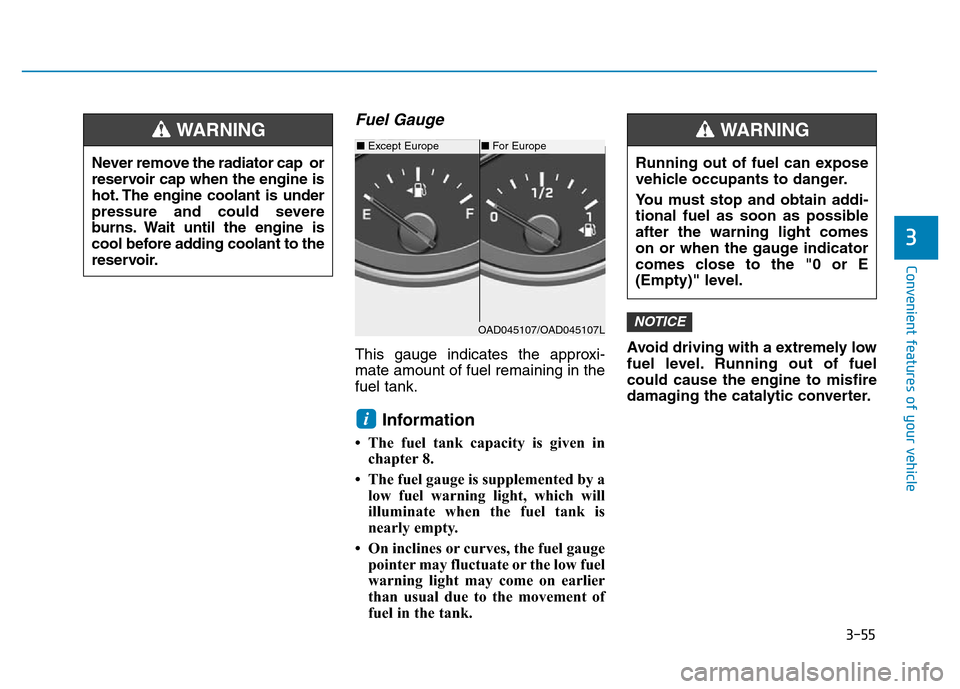
This gauge indicates the approxi-
mate amount of fuel remaining in the
fuel tank.
Information
• The fuel tank capacity is given in
chapter 8.
• The fuel gauge is supplemented by a
low fuel warning light, which will
illuminate when the fuel tank is
nearly empty.
• On inclines or curves, the fuel gauge
pointer may fluctuate or the low fuel
warning light may come on earlier
than usual due to the movement of
fuel in the tank.Avoid driving with a extremely low
fuel level. Running out of fuel
could cause the engine to misfire
damaging the catalytic converter.
NOTICE
i
Never remove the radiator cap or
reservoir cap when the engine is
hot. The engine coolant is under
pressure and could severe
burns. Wait until the engine is
cool before adding coolant to the
reservoir.
WARNING
Running out of fuel can expose
vehicle occupants to danger.
You must stop and obtain addi-
tional fuel as soon as possible
after the warning light comes
on or when the gauge indicator
comes close to the "0 or E
(Empty)" level.
WARNING
OAD045107/OAD045107L
■Except Europe■For Europe
Page 153 of 637
3-58
Convenient features of your vehicle
Seat Belt Warning Light
This warning light informs the driver
that the seat belt is not fastened.
For more details, refer to the “Seat
Belts” in chapter 2.
Parking Brake & Brake
Fluid Warning Light
This warning light illuminates:
• Once you turn the ignition switch or
the Engine Start/Stop button to the
ON position.
- It illuminates for approximately 3
seconds
- It remains on if the parking brake
is applied.
• When the parking brake is applied.
• When the brake fluid level in the
reservoir is low.
- If the warning light illuminates
with the parking brake released, it
indicates the brake fluid level in
reservoir is low.
If the brake fluid level in the reser-
voir is low:
1. Drive carefully to the nearest safe
location and stop your vehicle.
2. With the engine stopped, check the
brake fluid level immediately and
add fluid as required (For more
details, refer to “Brake Fluid” in
chapter 7). After adding brake
fluid, check all brake components
for fluid leaks. If a brake fluid leak is
found, or if the warning light
remains on, or if the brakes do not
operate properly, do not drive the
vehicle. We recommend you to
have the vehicle inspected by an
authorized HYUNDAI dealer.
Dual-diagonal braking system
Your vehicle is equipped with dual-
diagonal braking systems. This
means you still have braking on two
wheels even if one of the dual sys-
tems should fail.
With only one of the dual systems
working, more than normal pedal
travel and greater pedal pressure is
required to stop the vehicle.
Page 157 of 637
3-62
Convenient features of your vehicle
Engine Oil Pressure
Warning Light
This warning light illuminates:
• Once you turn the ignition switch or
the Engine Start/Stop button to the
ON position.
- It remains on until the engine is
started.
• When the engine oil pressure is low.
If the engine oil pressure is low:
1. Drive carefully to the nearest safe
location and stop your vehicle.
2. Turn the engine off and check the
engine oil level (For more details,
refer to “Engine Oil” in chapter 7).
If the level is low, add oil as required.
If the warning light remains on
after adding oil or if oil is not avail-
able, we recommend that you
have the vehicle inspected by an
authorized HYUNDAI dealer as
soon as possible.• If the engine does not stop
immediately after the Engine Oil
Pressure Warning Light is illumi-
nated, severe damage could
result.
• If the warning light stays on
while the engine is running, it
indicates that there may be seri-
ous engine damage or malfunc-
tion. In this case,
1. Stop the vehicle as soon as it
is safe to do so.
2. Turn off the engine and check
the oil level. If the oil level is
low, fill the engine oil to the
proper level.
3. Start the engine again. If the
warning light stays on after the
engine is started, turn the
engine off immediately. In this
case, we recommend that you
have the vehicle inspected by
an authorized HYUNDAI dealer.
Low Fuel Level
Warning Light
This warning light illuminates:
• When the fuel tank is nearly empty.
Add fuel as soon as possible.
Driving with the Low Fuel Level
warning light on or with the fuel
level below "0 or E" can cause the
engine to misfire and damage the
catalytic converter (if equipped).
NOTICE
NOTICE