trailer Hyundai Elantra 2017 Owner's Manual
[x] Cancel search | Manufacturer: HYUNDAI, Model Year: 2017, Model line: Elantra, Model: Hyundai Elantra 2017Pages: 637, PDF Size: 15.02 MB
Page 10 of 637
By following a few simple precautions
for the first 1,000 km (600 miles) you
may add to the performance, econo-
my and life of your vehicle.
Do not race the engine.
While driving, keep your engine
speed (rpm, or revolutions per
minute) between 2,000 rpm and
4,000 rpm.
Do not maintain a single speed for
long periods of time, either fast or
slow. Varying engine speed is need-
ed to properly break-in the engine.
Avoid hard stops, except in emer-
gencies, to allow the brakes to seat
properly.
Don't tow a trailer during the first
2,000 km (1,200 miles) of operation.HYUNDAI promotes an environmen-
tally sound treatment for end of life
vehicles and offers to take back your
HYUNDAI end of life vehicles in
accordance with the European Union
(EU) End of Life Vehicles Directive.
You can get detailed information
from your national HYUNDAI home-
page.
V VE
EH
HI
IC
CL
LE
E
B
BR
RE
EA
AK
K-
-I
IN
N
P PR
RO
OC
CE
ES
SS
SR RE
ET
TU
UR
RN
NI
IN
NG
G
U
US
SE
ED
D
V
VE
EH
HI
IC
CL
LE
ES
S
( (F
FO
OR
R
E
EU
UR
RO
OP
PE
E)
)
Introduction
F10
Page 17 of 637
F17F17
Braking system.....................................................5-41
Power brakes ...................................................................5-41
Disc brakes wear indicator ...........................................5-42
Rear drum brakes ...........................................................5-42
Parking brake ...................................................................5-42
Anti-lock Brake System (ABS) ....................................5-45
Electronic Stability Control (ESC)................................5-47
Vehicle Stability Management (VSM).........................5-50
Hill-start Assist Control (HAC) .....................................5-52
Emergency Stop Signal (ESS) ......................................5-52
Good braking practices..................................................5-53
ISG (Idle Stop and Go) system ...........................5-54
To activate the ISG system ...........................................5-54
To deactivate the ISG system ......................................5-57
ISG system malfunction .................................................5-57
The battery sensor deactivation .................................5-59
Drive mode integrated control system .............5-60
Blind Spot Detection system (BSD) ..................5-62
BSD (Blind Spot Detection) /
LCA (Lane Change Assist) .............................................5-63
RCTA (Rear Cross Traffic Alert) ..................................5-66
Limitations of the system .............................................5-69
Cruise control .......................................................5-71
Cruise Control operation ...............................................5-71
Special driving conditions ...................................5-78
Hazardous driving conditions.......................................5-78
Rocking the vehicle ........................................................5-78
Smooth cornering ...........................................................5-79
Driving at night ................................................................5-79
Driving in the rain ...........................................................5-79
Driving in flooded areas ................................................5-80
Highway driving ...............................................................5-80
Winter driving .......................................................5-81
Snow or icy conditions ..................................................5-81
Winter Precautions .........................................................5-83
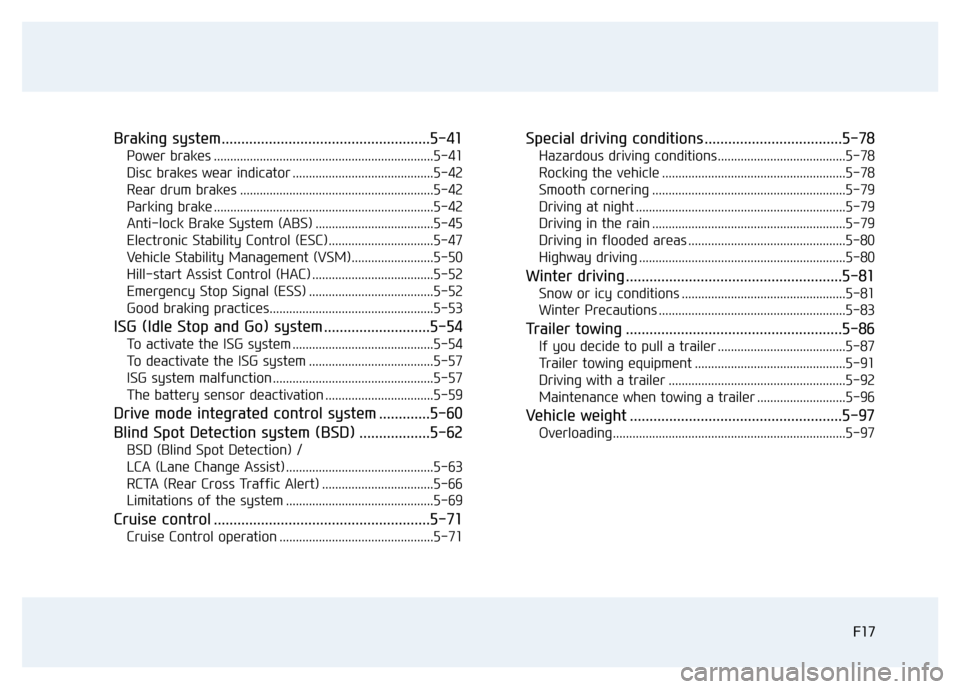
Trailer towing .......................................................5-86
If you decide to pull a trailer .......................................5-87
Trailer towing equipment ..............................................5-91
Driving with a trailer ......................................................5-92
Maintenance when towing a trailer ...........................5-96
Vehicle weight ......................................................5-97
Overloading.......................................................................5-97
Page 388 of 637
5
Winter driving .......................................................5-81
Snow or icy conditions ..................................................5-81
Winter Precautions .........................................................5-83
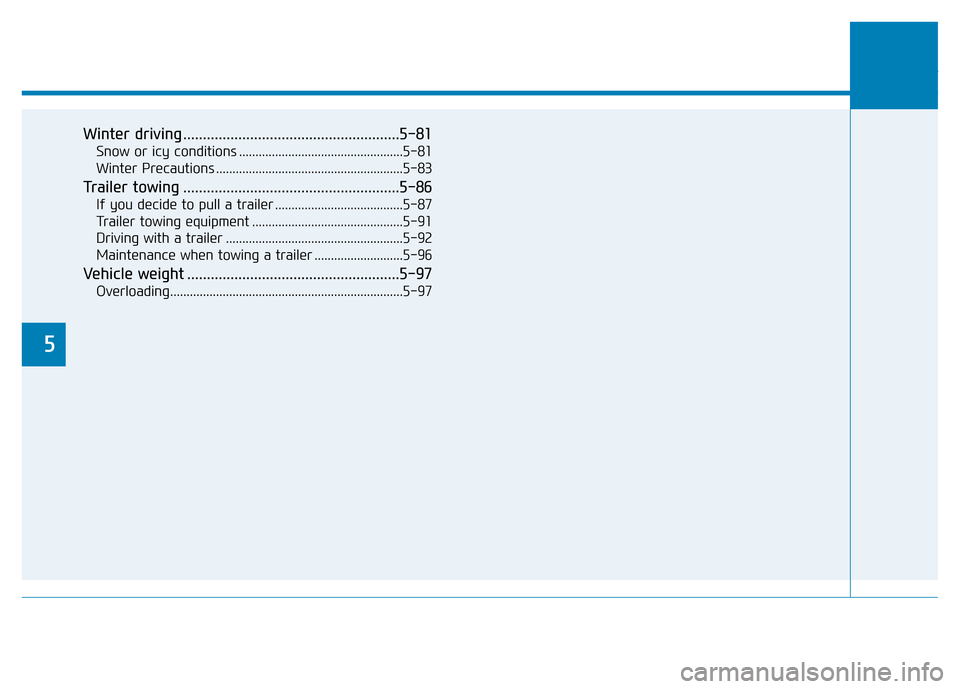
Trailer towing .......................................................5-86
If you decide to pull a trailer .......................................5-87
Trailer towing equipment ..............................................5-91
Driving with a trailer ......................................................5-92
Maintenance when towing a trailer ...........................5-96
Vehicle weight ......................................................5-97
Overloading.......................................................................5-97
Page 456 of 637

5-70
Driving your vehicle
- A motorcycle or bicycle is near.
- A flat trailer is near.
- If the vehicle has started at the
same time as the vehicle next to
you and has accelerated.
- When the other vehicle passes at a
very fast speed.
- While changing lanes.
- While going down or up a steep
road where the height of the lane is
different.
- When the other vehicle approaches
very close.
- When a trailer or carrier is installed.
- When the temperature of the rear
bumper is high.
- When the sensors are blocked by
other vehicles, walls or parking-lot
pillars.
- When the detected vehicle also
moves back, as your vehicle drives
back.
- If there are small objects in the
detecting area such as a shopping
cart or a baby carriage.- If there is a low height vehicle such
as a sports car.
- When other vehicles are close to
your vehicle.
- When the vehicle in the next lane
moves two lanes away from you
OR when the vehicle two lanes
away moves to the next lane from
you.
Page 472 of 637

5-86
Driving your vehicle
If you are considering to tow with
your vehicle, you should first check
with your country's Department of
Motor Vehicles to determine legal
requirements. Since laws vary the
requirements for towing trailers, cars,
or other types of vehicles or appara-
tus may differ. Ask an authorized
HYUNDAI dealer for further details
before towing.
Remember that trailering is different
than just driving your vehicle by itself.
Trailering means changes in han-
dling, durability, and fuel economy.
Successful, safe trailering requires
correct equipment, and it has to be
used properly. Damage to your vehi-
cle caused by improper trailer towing
is not covered by your vehicle manu-
facturer’s warranty.This section contains many time-
tested, important trailering tips and
safety rules. Many of these are
important for your safety and that of
your passengers. Please read this
section carefully before you pull a
trailer.
TRAILER TOWING
Take the following precautions:
•If you don't use the correct
towing equipment, or if you
drive improperly while towing,
you can lose control of the
vehicle when pulling a trailer.
For example, if the trailer is
too heavy, the braking per-
formance may be reduced.
You and your passengers
could be seriously or fatally
injured. Pull a trailer only if
you have followed all the
steps in this section.
•Before towing, make sure the
total trailer weight, GCW
(Gross Combination Weight),
GVW (Gross Vehicle Weight),
GAW (Gross Axle Weight ) and
trailer tongue load are all with-
in the limits.
WARNING
Page 473 of 637
5-87
Driving your vehicle
5
Information - For Europe
• The technically permissible maxi-
mum load on the rear axle(s) may be
exceeded by not more than 15 %
and the technically permissible
maximum laden mass of the vehicle
may be exceeded by not more than
10% or 100 kg (220.4 lbs), whichev-
er value is lower. In this case, do not
exceed 100 km/h (62.1 mph) for
vehicle of category M1 or 80 km/h
(49.7 mph) for vehicle of category
N1.
• When a vehicle of category M1 is
towing a trailer, the additional load
imposed at the trailer coupling
device may cause the tire maximum
load ratings to be exceeded, but not
by more than 15%. In this case, do
not exceed 100 km/h (62.1 mph) and
increase the tire inflation pressure
by at least 0.2 bar.If you decide to pull a trailer
Here are some important points if
you decide to pull a trailer:
• Consider using a sway control. You
can ask a trailer hitch dealer about
sway control.
• Do not do any towing with your
vehicle during its first 2,000 km
(1,200 miles) in order to allow the
engine to properly break in. Failure
to heed this caution may result in
serious engine or transmission
damage.
• When towing a trailer, be sure to
consult an authorized HYUNDAI
dealer for further information on
additional requirements such as a
towing kit, etc.
• Always drive your vehicle at a mod-
erate speed (less than 100 km/h
(60 mph)) or posted towing speed
limit.• On a long uphill grade, do not
exceed 70 km/h (45 mph) or the
posted towing speed limit,
whichever is lower.
• Carefully observe the weight and
load limits provided in the following
pages.
i
Page 474 of 637
5-88
Driving your vehicle
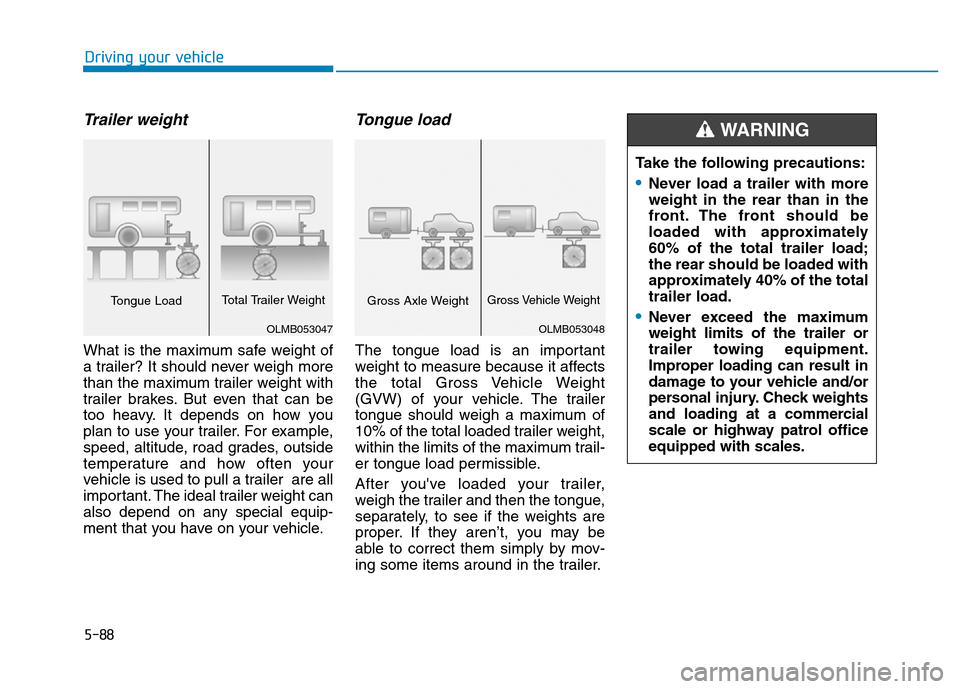
Trailer weight
What is the maximum safe weight of
a trailer? It should never weigh more
than the maximum trailer weight with
trailer brakes. But even that can be
too heavy. It depends on how you
plan to use your trailer. For example,
speed, altitude, road grades, outside
temperature and how often your
vehicle is used to pull a trailer are all
important. The ideal trailer weight can
also depend on any special equip-
ment that you have on your vehicle.
Tongue load
The tongue load is an important
weight to measure because it affects
the total Gross Vehicle Weight
(GVW) of your vehicle. The trailer
tongue should weigh a maximum of
10% of the total loaded trailer weight,
within the limits of the maximum trail-
er tongue load permissible.
After you've loaded your trailer,
weigh the trailer and then the tongue,
separately, to see if the weights are
proper. If they aren’t, you may be
able to correct them simply by mov-
ing some items around in the trailer.Take the following precautions:
•Never load a trailer with more
weight in the rear than in the
front. The front should be
loaded with approximately
60% of the total trailer load;
the rear should be loaded with
approximately 40% of the total
trailer load.
•Never exceed the maximum
weight limits of the trailer or
trailer towing equipment.
Improper loading can result in
damage to your vehicle and/or
personal injury. Check weights
and loading at a commercial
scale or highway patrol office
equipped with scales.
WARNING
OLMB053048
Gross Axle WeightGross Vehicle Weight
OLMB053047
Tongue LoadTotal Trailer Weight
Page 475 of 637

5-89
Driving your vehicle
5
M/T : Manual transmission
A/T : Automatic transmission
DCT : Dual clutch transmission
ItemGasoline Engine
Diesel Engine
1.6 MPI
2.0 MPI1.6 VGT
M/T
A/TM/TA/TM/TDCT
Maximum trailer weight
kg (Ibs.)
Without brake
System610
(1344)610
(1344)610
(1344)610
(1344)300
(661)300
(661)
With brake
System1200
(2645)
1100
(2425)1200
(2645)1100
(2425)300
(661)300
(661)
Maximum permissible static vertical load
on the coupling device
kg (Ibs.) 1115 (2458)
Recommended distance from rear wheel
center to coupling point
mm (inch) 1090 (43)
Reference weight and distance when towing a trailer
■Except Western Europe
Page 476 of 637
5-90
Driving your vehicle
ItemGasoline Engine
1.6 MPI2.0 MPI
M/T
A/TM/TA/T
Maximum trailer weight
kg (Ibs.)
Without brake
System300
(661)300
(661)300
(661)300
(661)
With brake System300
(661)
300
(661)300
(661)300
(661)
Maximum permissible static vertical load on the
coupling device
kg (Ibs.) 1115 (2458)
Recommended distance from rear wheel center to
coupling point
mm (inch) 1090 (43)
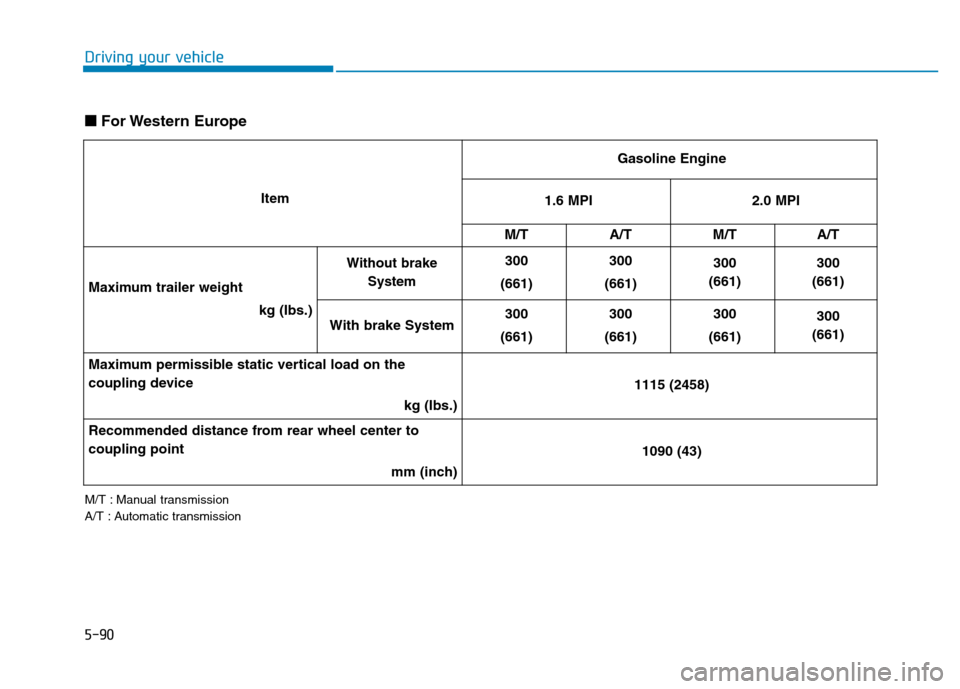
■For Western Europe
M/T : Manual transmission
A/T : Automatic transmission
Page 477 of 637

5-91
Driving your vehicle
5
Trailer towing equipment
Hitches
Information
The mounting hole for hitches are
located on both sides of the underbody
behind the rear tires.It's important to have the correct
hitch equipment. Crosswinds, large
trucks going by, and rough roads are
a few reasons why you’ll need the
right hitch. Here are some rules to
follow:
• Do you have to make any holes in
the body of your vehicle when you
install a trailer hitch? If you do, then
be sure to seal the holes later
when you remove the hitch. If you
don't seal them, carbon monoxide
(CO) from your exhaust can get
into your vehicle, as well as dirt
and water.
• The bumpers on your vehicle are
not intended for hitches. Do not
attach rental hitches or other
bumper-type hitches to them. Use
only a frame-mounted hitch that
does not attach to the bumper.
• A HYUNDAI trailer hitch accessory
is available at an authorized
HYUNDAI dealer.
Safety chains
You should always attach chains
between your vehicle and your trail-
er. Cross the safety chains under the
tongue of the trailer so that the
tongue will not drop to the road if it
becomes separated from the hitch.
Instructions about safety chains may
be provided by the hitch manufactur-
er or trailer manufacturer. Follow the
manufacturer’s recommendation for
attaching safety chains. Always leave
just enough slack so you can turn
with your trailer. And, never allow
safety chains to drag on the ground.
i
OAD065031L