eco Hyundai Elantra 2018 Owner's Guide
[x] Cancel search | Manufacturer: HYUNDAI, Model Year: 2018, Model line: Elantra, Model: Hyundai Elantra 2018Pages: 526, PDF Size: 17.2 MB
Page 59 of 526
2-42
Safety system of your vehicle
The side air bags are designed to deploy
only during certain side impact collisions,
depending on the crash severity, angle,
speed and point of impact.
The side and curtain air bags on both
sides of the vehicle may deploy if a
rollover or possible rollover is detected.
The side air bags are not designed to
deploy in all side impact or rollover situa-
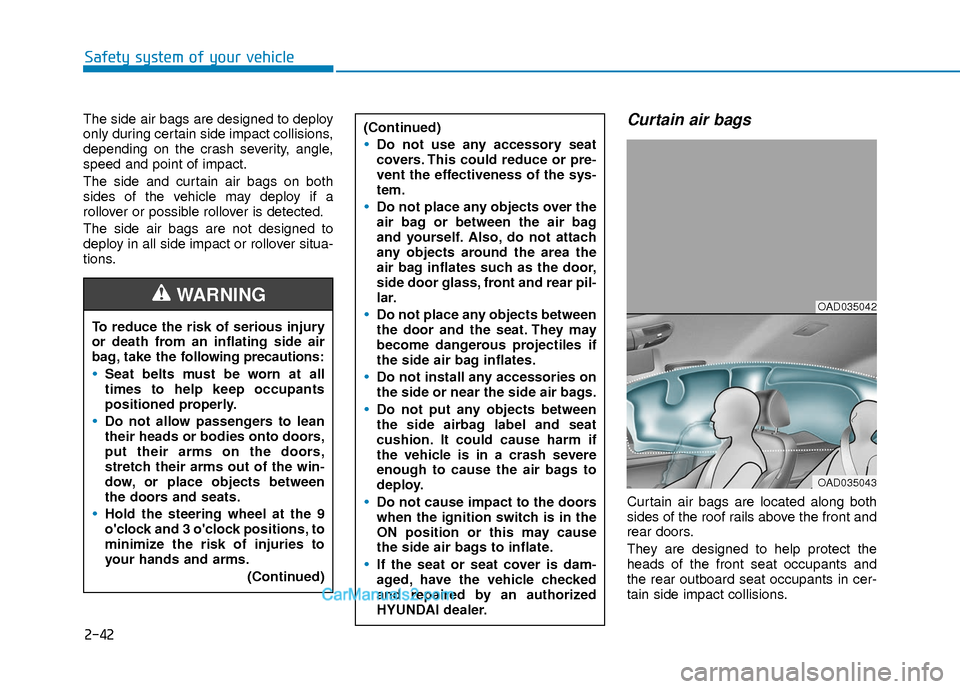
tions.Curtain air bags
Curtain air bags are located along both
sides of the roof rails above the front and
rear doors.
They are designed to help protect the
heads of the front seat occupants and
the rear outboard seat occupants in cer-
tain side impact collisions.
(Continued)
Do not use any accessory seat
covers. This could reduce or pre-
vent the effectiveness of the sys-
tem.
Do not place any objects over the
air bag or between the air bag
and yourself. Also, do not attach
any objects around the area the
air bag inflates such as the door,
side door glass, front and rear pil-
lar.
Do not place any objects between
the door and the seat. They may
become dangerous projectiles if
the side air bag inflates.
Do not install any accessories on
the side or near the side air bags.
Do not put any objects between
the side airbag label and seat
cushion. It could cause harm if
the vehicle is in a crash severe
enough to cause the air bags to
deploy.
Do not cause impact to the doors
when the ignition switch is in the
ON position or this may cause
the side air bags to inflate.
If the seat or seat cover is dam-
aged, have the vehicle checked
and repaired by an authorized
HYUNDAI dealer.
To reduce the risk of serious injury
or death from an inflating side air
bag, take the follo
wing precautions:
Seat belts must be worn at all
times to help keep occupants
positioned properly.
Do not allow passengers to lean
their heads or bodies onto doors,
put their arms on the doors,
stretch their arms out of the win-
dow, or place objects between
the doors and seats.
Hold the steering wheel at the 9
o'clock and 3 o'clock positions, to
minimize the risk of injuries to
your hands and arms.
(Continued)
WARNING OAD035042
OAD035043
Page 61 of 526
2-44
Safety system of your vehicle
12. Emergency Fastening DeviceSystem
13. Occupant classification system
The SRSCM (Supplemental Restraint
System Control Module) continually
monitors all SRS components while the
ignition switch is in the ON position to
determine if a crash impact is severe
enough to require air bag deployment or
pre-tensioner seat belt deployment.
SRS warning light
The SRS (Supplement Restraint System)
air bag warning light on the instrument
panel displays the air bag symbol depict-
ed in the illustration. The system checks
the air bag electrical system for malfunc-
tions. The light indicates that there is a
potential malfunction with your air bag
system, which could include your side
and curtain air bags used for rollover pro-
tection. During a frontal collision, sensors will
detect the vehicle's deceleration. If the
rate of deceleration is high enough, the
control unit will inflate the front air bags.
The front air bags help protect the driver
and front passenger by responding to
frontal impacts in which seat belts alone
cannot provide adequate restraint. When
needed, the side air bags help provide
protection in the event of a side impact or
rollover.
Air bags are activated (able to inflate if
necessary) only when the ignition
switch is in the ON position.
Air bags inflate in the event of certain frontal or side collisions to help protect
the occupants from serious physical
injury.
Generally, air bags are designed to inflate based upon the severity of a col-
lision, its direction, etc. These two fac-
tors determine whether the sensors
produce an electronic deployment/
inflation signal.
If your SRS malfunctions, the air
bag may not inflate properly during
an accident increasing the risk of
serious injury or death.
If any of the following conditions
occur, your SRS is malfunctioning:
The light does not turn on for
approximately six seconds when
the ignition switch is in the ON
position.
The light stays on after illuminat-
ing for approximately six sec-
onds.
The light comes on while the
vehicle is in motion.
The light blinks when the engine
is running.
Have an authorized HYUNDAI deal-
er inspect the SRS as soon as pos-
sible if any of these conditions
occur.
WARNING
Page 62 of 526
2-45
Safety system of your vehicle
2
Air bag deployment depends on anumber of factors including vehicle
speed, angles of impact and the densi-
ty and stiffness of the vehicles or
objects which your vehicle impacts
during a collision. The determining fac-
tors are not limited to those mentioned
above.
The front air bags will completely inflate and deflate in an instant. It is vir-
tually impossible for you to see the air
bags inflate during an accident. It is
much more likely that you will simply
see the deflated air bags hanging out
of their storage compartments after the
collision.
In addition to inflating in certain side collisions, vehicles equipped with a
rollover sensor, side and curtain air
bags will inflate if the sensing system
detects a rollover.
When a rollover is detected, side and
curtain air bags will remain inflated
longer to help provide protection from
ejection, especially when used in con-
junction with the seat belts. To help provide protection, the air bags
must inflate rapidly. The speed of air
bag inflation is a consequence of
extremely short time in which to inflate
the air bag between the occupant and
the vehicle structures before the occu-
pant impacts those structures. This
speed of inflation reduces the risk of
serious or life-threatening injuries and
is thus a necessary part of air bag
design.
However, the rapid air bag inflation can
also cause injuries which can include
facial abrasions, bruises and broken
bones because the inflation speed also
causes the air bags to expand with a
great deal of force.
There are even circumstances under which contact with the air bag can
cause fatal injuries, especially if the
occupant is positioned excessively
close to the air bag.
You can take steps to help reduce the
risk of being injured by an inflating air
bag. The greatest risk is sitting too close
to the air bag. An air bag needs about 10
inches (25 cm) of space to inflate.
NHTSA recommends that drivers allow
at least 10 inches (25 cm) between the
center of the steering wheel and the
chest. To reduce the risk of serious injury
or death from an inflating air bag,
take the following precautions:
NEVER place a child restraint in
the front passenger seat.
Always properly restrain children
under age 13 in the rear seats of
the vehicle.
Adjust the front passenger’s and
driver's seats as far to the rear as
possible while allowing you to
maintain full control of the vehi-
cle.
Hold the steering wheel with
hands at the 9 o'clock and 3
o'clock positions.
Never place anything or anyone
between the air bag and the seat
occupant.
Do not allow the front passenger
to place their feet or legs on the
dashboard.
WARNING
Page 64 of 526
2-47
Safety system of your vehicle
2
What to Expect After an Air
Bag Inflates
After a frontal or side air bag inflates, it
will deflate very quickly. Air bag inflation
will not prevent the driver from seeing out
of the windshield or being able to steer.
Curtain air bags may remain partially
inflated for some time after they deploy.
Noise and smoke from inflatingair bag
When the air bags inflate, they make a
loud noise and may produce smoke and
powder in the air inside of the vehicle.
This is normal and is a result of the igni-
tion of the air bag inflator. After the air
bag inflates, you may feel substantial dis-
comfort in breathing because of the con-
tact of your chest with both the seat belt
and the air bag, as well as from breathing
the smoke and powder. The powder may
aggravate asthma for some people. If you
experience breathing problems after an
air bag deployment, seek medical atten-
tion immediately.
Though the smoke and powder are non-
toxic, they may cause irritation to the
skin, eyes, nose, throat, etc. If this is the
case, wash and rinse with cold water
immediately and seek medical attention
if the symptoms persist.
To prevent objects from becoming
dangerous projectiles when the
passenger's air bag inflates:
Do not install or place any
objects (drink holder, CD holder,
stickers, etc.) on the front pas-
senger's panel above the glove
box where the passenger's air
bag is located.
Do not install a container of liquid
air freshener near the instrument
cluster or on the instrument
panel surface.
WARNING
After an air bag inflates, take the
following precautions:
Open your windows and doors as
soon as possible after impact to
reduce prolonged exposure to
the smoke and powder released
by the inflating air bag.
Do not touch the air bag storage
area's internal components
immediately after an air bag has
inflated. The parts that come into
contact with an inflating air bag
may be very hot.
Always wash exposed skin areas
thoroughly with cold and mild
soap.
(Continued)
WARNING
(Continued)
Always have an authorized
HYUNDAI dealer replace the air
bag immediately after deploy-
ment. Air bags are designed to be
used only once.
Page 66 of 526
2-49
Safety system of your vehicle
2
Always be sure that you and all vehicle
occupants are seated properly and wear-
ing the seat belt properly for the most
effective protection by the air bag and the
seat belt.
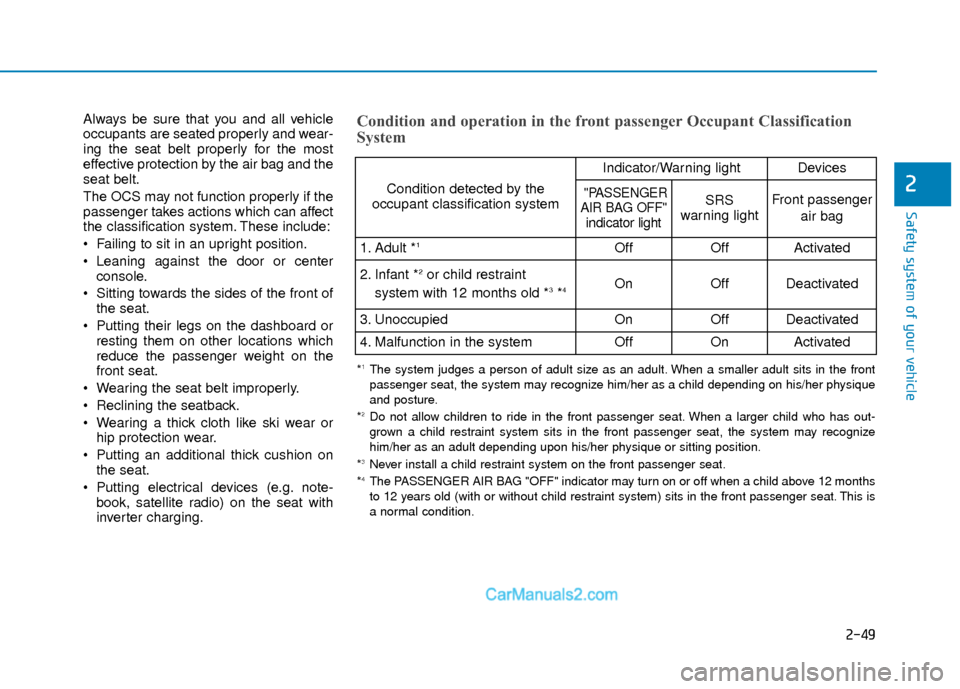
The OCS may not function properly if the
passenger takes actions which can affect
the classification system. These include:
Failing to sit in an upright position.
Leaning against the door or centerconsole.
Sitting towards the sides of the front of the seat.
Putting their legs on the dashboard or resting them on other locations which
reduce the passenger weight on the
front seat.
Wearing the seat belt improperly.
Reclining the seatback.
Wearing a thick cloth like ski wear or hip protection wear.
Putting an additional thick cushion on the seat.
Putting electrical devices (e.g. note- book, satellite radio) on the seat with
inverter charging.Condition and operation in the front passenger Occupant Classification
System
Condition detected by the
occupant classification system
Indicator/Warning lightDevices
"PASSENGER
AIR BAG OFF" indicator lightSRS
warning lightFront passenger
air bag
1. Adult *1OffOffActivated
2. Infant *2or child restraint
system with 12 months old *3*4 OnOffDeactivated
3. Unoccupied OnOffDeactivated
4. Malfunction in the systemOffOnActivated
*1The system judges a person of adult size as an adult. When a smaller adult sits in the front
passenger seat, the system may recognize him/her as a child depending on his/her physique
and posture.
*
2Do not allow children to ride in the front passenger seat. When a larger child who has out- grown a child restraint system sits in the front passenger seat, the system may recognize
him/her as an adult depending upon his/her physique or sitting position.
*
3Never install a child restraint system on the front passenger seat.
*4The PASSENGER AIR BAG "OFF" indicator may turn on or off when a child above 12 months
to 12 years old (with or without child restraint system) sits in the front passenger seat. This is
a normal condition.
Page 69 of 526
2-52
Safety system of your vehicle
Proper seated position for OCS
If the "PASSENGER AIR BAG OFF" indi-
cator is on when an adult is seated in the
front passenger seat, place the ignition
switch in the LOCK/OFF position and
ask the passenger to sit properly (sitting
upright with the seat back in an upright
position, centered on the seat cushion
with their seat belt on, legs comfortably
extended and their feet on the floor).
Restart the engine and have the person
remain in that position. This will allow the
system to detect the person and to
enable the passenger air bag. If the
"PASSENGER AIR BAG OFF" indicator
is still on, ask the passenger to move to
the rear seat.The "PASSENGER AIR BAG OFF"
indicator illuminates for approximate-
ly 4 seconds after the ignition switch
is in the ON position or after the
engine is started. If the front passen-
ger seat is occupied, the OCS will
then classify the front passenger after
several more seconds.
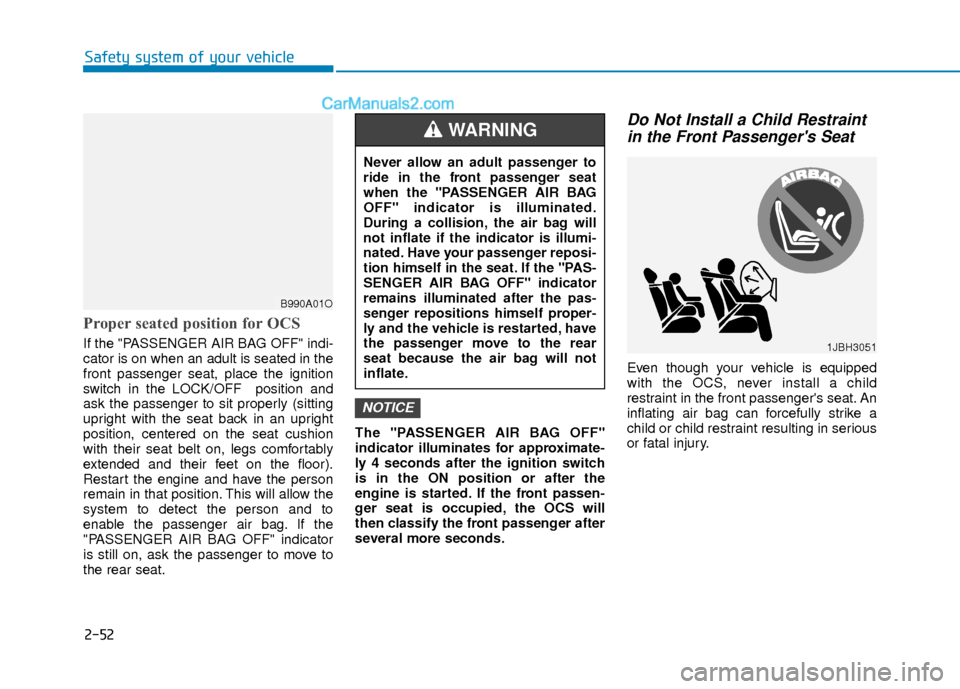
Do Not Install a Child Restraint
in the Front Passenger's Seat
Even though your vehicle is equipped
with the OCS, never install a child
restraint in the front passenger's seat. An
inflating air bag can forcefully strike a
child or child restraint resulting in serious
or fatal injury.
NOTICE
B990A01O
Never allow an adult passenger to
ride in the front passenger seat
when the "PASSENGER AIR BAG
OFF" indicator is illuminated.
During a collision, the air bag will
not inflate if the indicator is illumi-
nated. Have your passenger reposi-
tion himself in the seat. If the "PAS-
SENGER AIR BAG OFF" indicator
remains illuminated after the pas-
senger repositions himself proper-
ly and the vehicle is restarted, have
the passenger move to the rear
seat because the air bag will not
inflate.
WARNING
1JBH3051
Page 70 of 526
2-53
Safety system of your vehicle
2
Why Didn't My Air Bag Go Off
in a Collision?
Air bags are not designed to inflate in
every collision. There are certain types of
accidents in which the air bag would not
be expected to provide additional protec-
tion. These include rear impacts, second
or third collisions in multiple impact acci-
dents, as well as low speed impacts.
Damage to the vehicle indicates a colli-
sion energy absorption, and is not an
indicator of whether or not an air bag
should have inflated.
Air bag collision sensors
NEVER place a rear-facing or
front-facing child restraint in the
front passenger’s seat of the
vehicle.
An inflating frontal air bag could
forcefully strike a child resulting
in serious injury or death.
Always properly restrain children
in an appropriate child restraint
in the rear seat of the vehicle.
WARNING
To reduce the risk of an air bag
deploying unexpectedly and caus-
ing serious injury or death:
Do not hit or allow any objects to
impact the locations where air
bags or sensors are installed.
Do not perform maintenance on
or around the air bag sensors. If
the location or angle of the sen-
sors is altered, the air bags may
deploy when they should not or
may not deploy when they
should.
Do not install bumper guards or
replace the bumper with a non-
genuine HYUNDAI parts. This
may adversely affect the collision
and air bag deployment perform-
ance.
Place the ignition switch in the
LOCK/OFF or ACC position when
the vehicle is being towed to pre-
vent inadvertent air bag deploy-
ment.
Have all air bag repairs conduct-
ed by an authorized HYUNDAI
dealer.
WARNING
Page 80 of 526
3-3
Convenient features of your vehicle
3
Remote Key (if equipped)
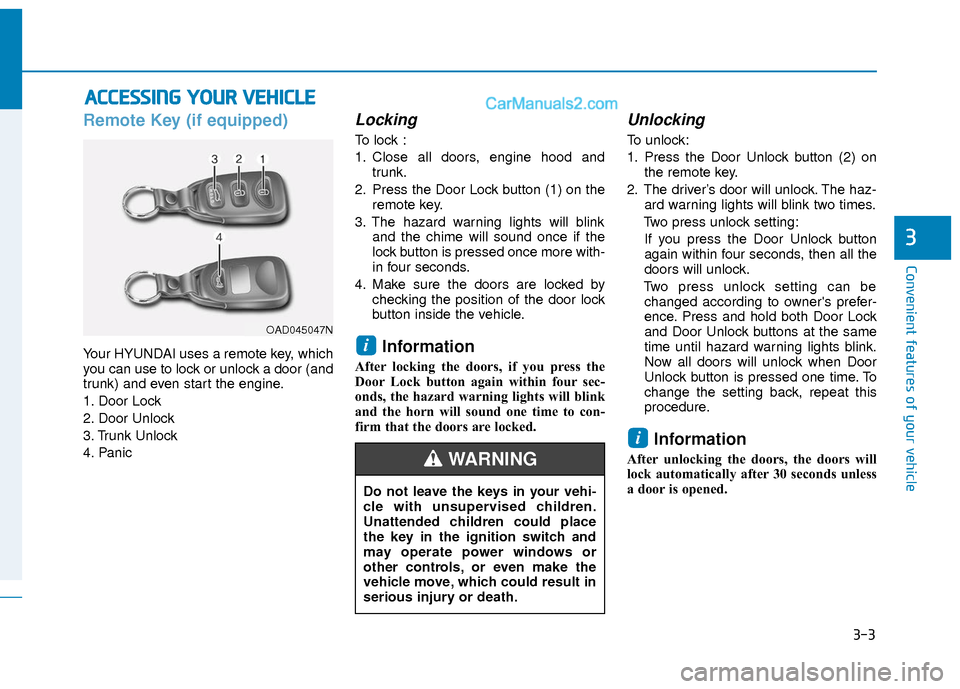
Your HYUNDAI uses a remote key, which
you can use to lock or unlock a door (and
trunk) and even start the engine.
1. Door Lock
2. Door Unlock
3. Trunk Unlock
4. Panic
Locking
To lock :
1. Close all doors, engine hood andtrunk.
2. Press the Door Lock button (1) on the remote key.
3. The hazard warning lights will blink and the chime will sound once if the
lock button is pressed once more with-
in four seconds.
4. Make sure the doors are locked by checking the position of the door lock
button inside the vehicle.
Information
After locking the doors, if you press the
Door Lock button again within four sec-
onds, the hazard warning lights will blink
and the horn will sound one time to con-
firm that the doors are locked.
Unlocking
To unlock:
1. Press the Door Unlock button (2) onthe remote key.
2. The driver’s door will unlock. The haz- ard warning lights will blink two times.
Two press unlock setting: If you press the Door Unlock button
again within four seconds, then all the
doors will unlock.
Two press unlock setting can be changed according to owner's prefer-
ence. Press and hold both Door Lock
and Door Unlock buttons at the same
time until hazard warning lights blink.
Now all doors will unlock when Door
Unlock button is pressed one time. To
change the setting back, repeat this
procedure.
Information
After unlocking the doors, the doors will
lock automatically after 30 seconds unless
a door is opened.
i
i
A A C
CC
CE
E S
SS
SI
IN
N G
G
Y
Y O
O U
UR
R
V
V E
EH
H I
IC
C L
LE
E
OAD045047N
Do not leave the keys in your vehi-
cle with unsupervised children.
Unattended children could place
the key in the ignition switch and
may operate power windows or
other controls, or even make the
vehicle move, which could result in
serious injury or death.
WARNING
Page 81 of 526
3-4
Convenient features of your vehicle
Trunk unlocking
To unlock:
1. Press and hold the Trunk Unlock but-ton (3) on the remote key for more
than one second.
2. The hazard warning lights will blink two times.
Once the trunk is opened and then
closed, the trunk will lock automatically.
Information
• After unlocking the trunk, the trunk will lock automatically.
• The word "HOLD" is written on the button to inform you that you must
press and hold the button for more than
one second.
Panic button (if equipped)
Press and hold the Panic button (4) for
more than one second. The horn sounds
and hazard warning lights flash for about
30 seconds.
To cancel the panic mode, press any but-
ton on the remote key.
Start-up
For more information, refer to the "Key
Ignition Switch" section in chapter 5.
To prevent damaging the remote key:
• Keep the remote key away fromwater or any liquid and fire. If the
inside of the remote key gets damp
(due to drinks or moisture), or is
heated, internal circuit may mal-
function, excluding the car from the
warranty.
Avoid dropping or throwing the remote key.
Protect the remote key from extreme temperatures.
Mechanical key
If the remote key does not operate nor-
mally, you can lock or unlock the door by
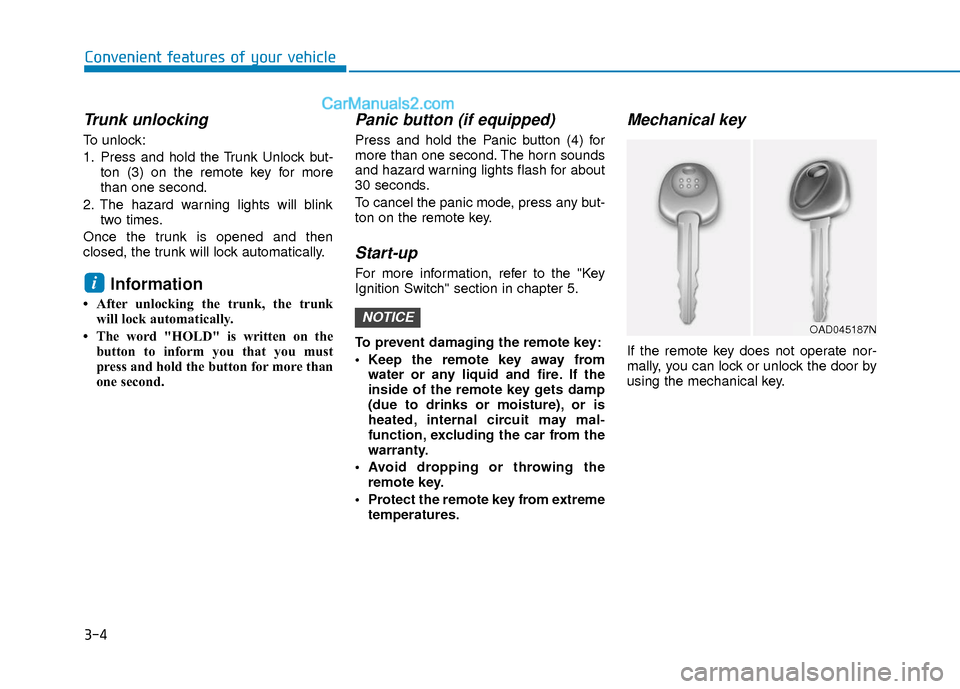
using the mechanical key.
NOTICE
i
OAD045187N
Page 84 of 526
3-7
Convenient features of your vehicle
3
Information
The door handle button will only operate
when the smart key is within 28~40 inches
(0.7~1 m) from the outside door handle.
Even though you press the outside door
handle button, the doors will not lock and
the chime will sound for three seconds if
any of the following occur:
The Smart Key is in the vehicle.
The Engine Start/Stop button is in ACCor ON position.
Any door except the trunk is open.
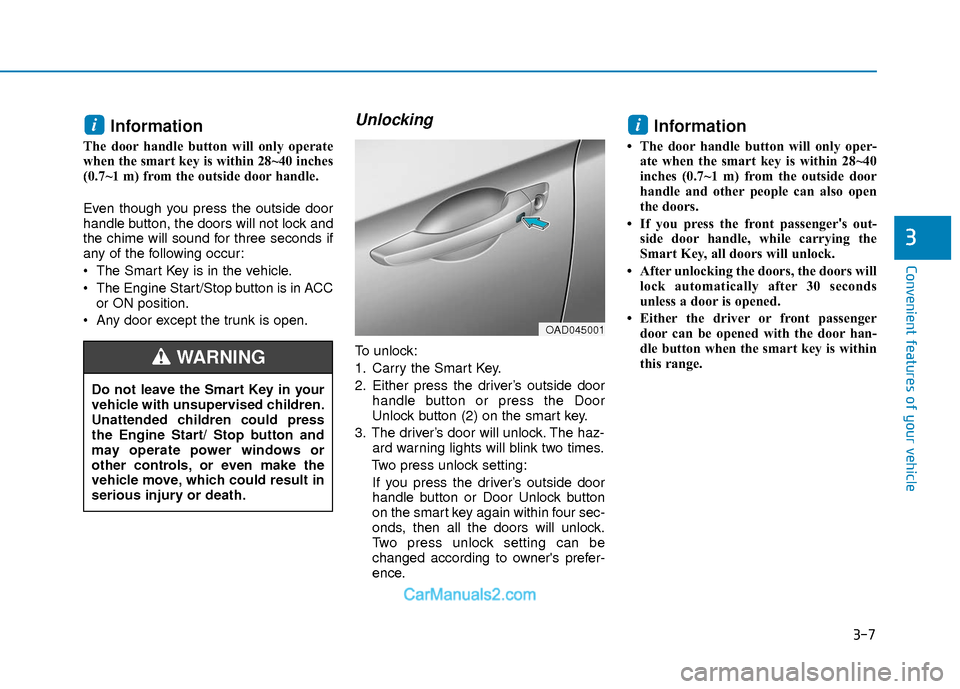
Unlocking
To unlock:
1. Carry the Smart Key.
2. Either press the driver’s outside door handle button or press the Door
Unlock button (2) on the smart key.
3. The driver’s door will unlock. The haz- ard warning lights will blink two times.
Two press unlock setting: If you press the driver’s outside door
handle button or Door Unlock button
on the smart key again within four sec-
onds, then all the doors will unlock.
Two press unlock setting can be
changed according to owner's prefer-
ence.
Information
• The door handle button will only oper- ate when the smart key is within 28~40
inches (0.7~1 m) from the outside door
handle and other people can also open
the doors.
• If you press the front passenger 's out-
side door handle, while carrying the
Smart Key, all doors will unlock.
• After unlocking the doors, the doors will lock automatically after 30 seconds
unless a door is opened.
• Either the driver or front passenger door can be opened with the door han-
dle button when the smart key is within
this range.
ii
Do not leave the Smart Key in your
vehicle with unsupervised children.
Unattended children could press
the Engine Start/ Stop button and
may operate power windows or
other controls, or even make the
vehicle move, which could result in
serious injury or death.
WARNING
OAD045001