ECO mode Hyundai Elantra 2018 Workshop Manual
[x] Cancel search | Manufacturer: HYUNDAI, Model Year: 2018, Model line: Elantra, Model: Hyundai Elantra 2018Pages: 526, PDF Size: 17.2 MB
Page 304 of 526
5-21
Driving your vehicle
5
D (Drive)
This is the normal driving position. The
transmission will automatically shift
through a six-gear sequence, providing
the best fuel economy and power.
For extra power when passing another
vehicle or driving uphill depress the
accelerator pedal further until you feel
the transmission downshift to a lower
gear.
The DRIVE MODE switch, located on the
shift lever console, allows the driver to
switch from NORMAL mode to ECO or
SPORT mode.
For more information, refer to "Drive
Mode Integrated Control System"
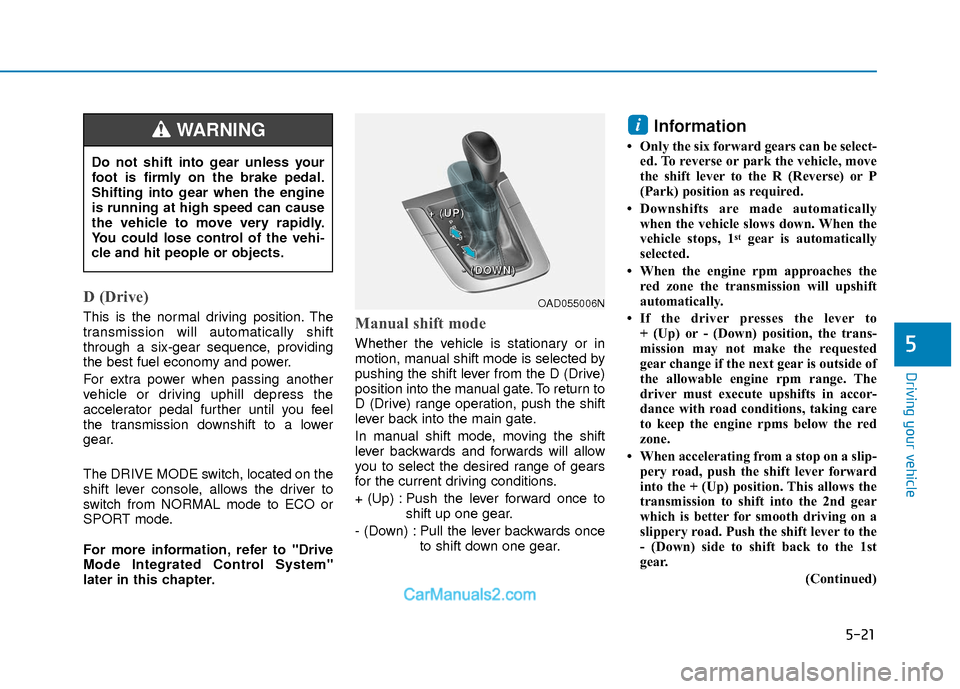
later in this chapter.Manual shift mode
Whether the vehicle is stationary or in
motion, manual shift mode is selected by
pushing the shift lever from the D (Drive)
position into the manual gate. To return to
D (Drive) range operation, push the shift
lever back into the main gate.
In manual shift mode, moving the shift
lever backwards and forwards will allow
you to select the desired range of gears
for the current driving conditions.
+ (Up) : Push the lever forward once toshift up one gear.
- (Down) : Pull the lever backwards once to shift down one gear.
Information
• Only the six forward gears can be select-ed. To reverse or park the vehicle, move
the shift lever to the R (Reverse) or P
(Park) position as required.
• Downshifts are made automatically when the vehicle slows down. When the
vehicle stops, 1
stgear is automatically
selected.
• When the engine rpm approaches the red zone the transmission will upshift
automatically.
• If the driver presses the lever to + (Up) or - (Down) position, the trans-
mission may not make the requested
gear change if the next gear is outside of
the allowable engine rpm range. The
driver must execute upshifts in accor-
dance with road conditions, taking care
to keep the engine rpms below the red
zone.
• When accelerating from a stop on a slip- pery road, push the shift lever forward
into the + (Up) position. This allows the
transmission to shift into the 2nd gear
which is better for smooth driving on a
slippery road. Push the shift lever to the
- (Down) side to shift back to the 1st
gear.
(Continued)
i
Do not shift into gear unless your
foot is firmly on the brake pedal.
Shifting into gear when the engine
is running at high speed can cause
the vehicle to move very rapidly.
You could lose control of the vehi-
cle and hit people or objects.
WARNING
OAD055006N
+
+
+
+
(
(
(
(
U
U
U
U
P
P
P
P
)
)
)
)
-
-
-
-
(
(
(
(
D
D
D
D
O
O
O
O
W
W
W
W
N
N
N
N
)
)
)
)
Page 312 of 526
5-29
Driving your vehicle
5
D (Drive)
This is the normal driving position. The
transmission will automatically shift
through a seven-gear sequence, provid-
ing the best fuel economy and power.
For extra power when passing another
vehicle or driving uphill depress the
accelerator pedal further until you feel
the transmission downshift to a lower
gear.
The DRIVE MODE switch, located on the
shift lever console, allows the driver to
switch from NORMAL mode to SPORT
mode.
For more information, refer to "Drive
Mode Integrated Control System"
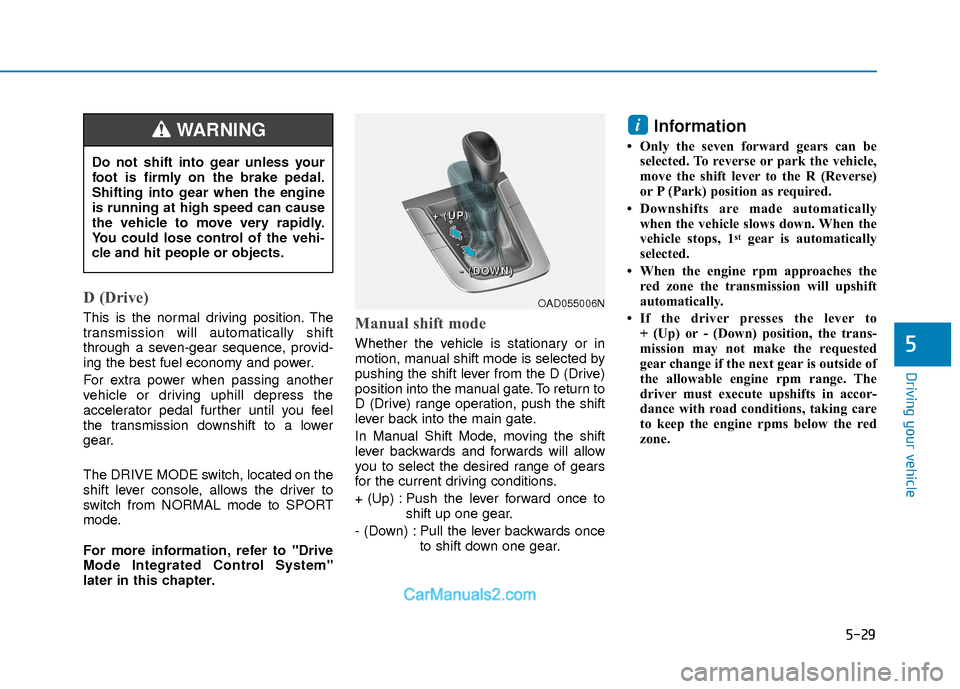
later in this chapter.Manual shift mode
Whether the vehicle is stationary or in
motion, manual shift mode is selected by
pushing the shift lever from the D (Drive)
position into the manual gate. To return to
D (Drive) range operation, push the shift
lever back into the main gate.
In Manual Shift Mode, moving the shift
lever backwards and forwards will allow
you to select the desired range of gears
for the current driving conditions.
+ (Up) : Push the lever forward once toshift up one gear.
- (Down) : Pull the lever backwards once to shift down one gear.
Information
• Only the seven forward gears can beselected. To reverse or park the vehicle,
move the shift lever to the R (Reverse)
or P (Park) position as required.
• Downshifts are made automatically when the vehicle slows down. When the
vehicle stops, 1
stgear is automatically
selected.
• When the engine rpm approaches the red zone the transmission will upshift
automatically.
• If the driver presses the lever to + (Up) or - (Down) position, the trans-
mission may not make the requested
gear change if the next gear is outside of
the allowable engine rpm range. The
driver must execute upshifts in accor-
dance with road conditions, taking care
to keep the engine rpms below the red
zone.
i
Do not shift into gear unless your
foot is firmly on the brake pedal.
Shifting into gear when the engine
is running at high speed can cause
the vehicle to move very rapidly.
You could lose control of the vehi-
cle and hit people or objects.
WARNING
OAD055006N
+
+
+
+
(
(
(
(
U
U
U
U
P
P
P
P
)
)
)
)
-
-
-
-
(
(
(
(
D
D
D
D
O
O
O
O
W
W
W
W
N
N
N
N
)
)
)
)
Page 313 of 526
5-30
Driving your vehicle
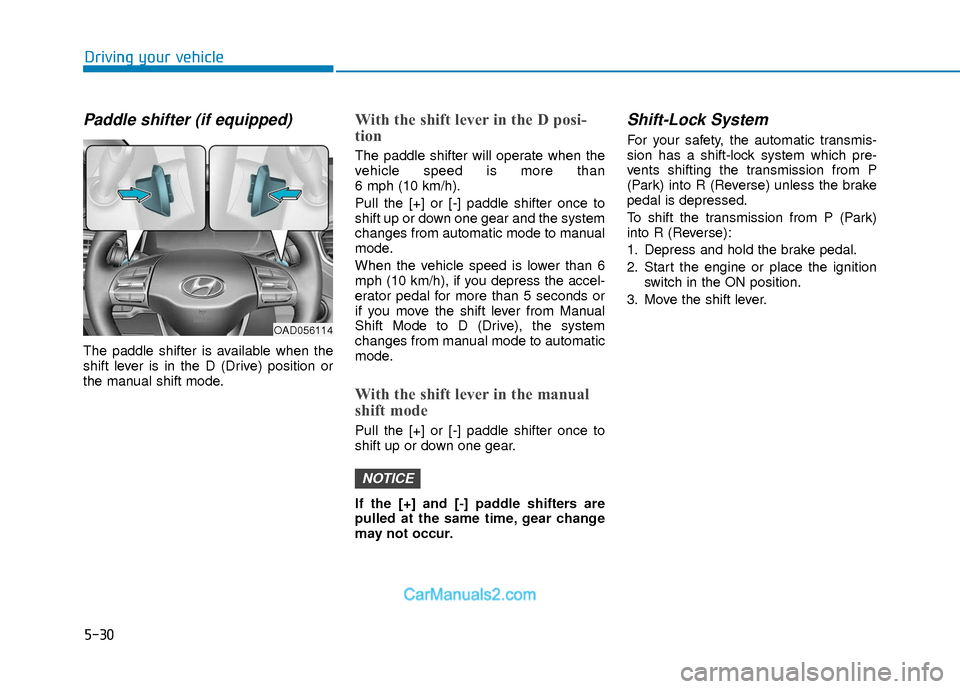
Paddle shifter (if equipped)
The paddle shifter is available when the
shift lever is in the D (Drive) position or
the manual shift mode.
With the shift lever in the D posi-
tion
The paddle shifter will operate when the
vehicle speed is more than
6 mph (10 km/h).
Pull the [+] or [-] paddle shifter once to
shift up or down one gear and the system
changes from automatic mode to manual
mode.
When the vehicle speed is lower than 6
mph (10 km/h), if you depress the accel-
erator pedal for more than 5 seconds or
if you move the shift lever from Manual
Shift Mode to D (Drive), the system
changes from manual mode to automatic
mode.
With the shift lever in the manual
shift mode
Pull the [+] or [-] paddle shifter once to
shift up or down one gear.
If the [+] and [-] paddle shifters are
pulled at the same time, gear change
may not occur.
Shift-Lock System
For your safety, the automatic transmis-
sion has a shift-lock system which pre-
vents shifting the transmission from P
(Park) into R (Reverse) unless the brake
pedal is depressed.
To shift the transmission from P (Park)
into R (Reverse):
1. Depress and hold the brake pedal.
2. Start the engine or place the ignitionswitch in the ON position.
3. Move the shift lever.
NOTICE
OAD056114
Page 315 of 526
5-32
Driving your vehicle
Good Driving Practices
Never move the shift lever from P(Park) or N (Neutral) to any other posi-
tion with the accelerator pedal
depressed.
Never move the shift lever into P (Park) when the vehicle is in motion.
Be sure the vehicle is completely
stopped before you attempt to shift into
R (Reverse) or D (Drive).
Do not move the shift lever to N (Neutral) when driving. Doing so may
result in an accident because of a loss
of engine braking and the transmission
could be damaged.
Do not drive with your foot resting on the brake pedal. Even light, but consis-
tent pedal pressure can result in the
brakes overheating, brake wear and
possibly even brake failure.
Depressing both accelerator and brake pedals at the same time can trigger
logic for engine power reduction to
assure vehicle deceleration. Vehicle
acceleration will resume after the
brake pedal is released.
When driving in Manual Shift Mode, slow down before shifting to a lower
gear. Otherwise, the lower gear may
not be engaged if the engine rpms are
outside of the allowable range. Always apply the parking brake when
leaving the vehicle. Do not depend on
placing the transmission in P (Park) to
keep the vehicle from moving.
Exercise extreme caution when driving on a slippery surface. Be especially
careful when braking, accelerating or
shifting gears. On a slippery surface,
an abrupt change in vehicle speed can
cause the drive wheels to lose traction
and may cause loss of vehicle control
resulting in an accident.
Optimum vehicle performance and economy is obtained by smoothly
depressing and releasing the accelera-
tor. (Continued)The risk of rollover is greatly
increased if you lose control of
your vehicle at highway speeds.
Loss of control often occurs if
two or more wheels drop off the
roadway and the driver over
steers to reenter the roadway.
In the event your vehicle leaves
the roadway, do not steer sharply.
Instead, slow down before pulling
back into the travel lanes.
HYUNDAI recommends you fol-
low all posted speed limits.
To reduce the risk of SERIOUS
INJURY or DEATH:
ALWAYS wear your seatbelt. In a
collision, an unbelted occupant is
significantly more likely to be
seriously injured or killed than a
properly belted occupant.
Avoid high speeds when corner-
ing or turning.
Do not make quick steering
wheel movements, such as sharp
lane changes or fast, sharp turns.
(Continued)
WARNING
Page 320 of 526
5-37
Driving your vehicle
5
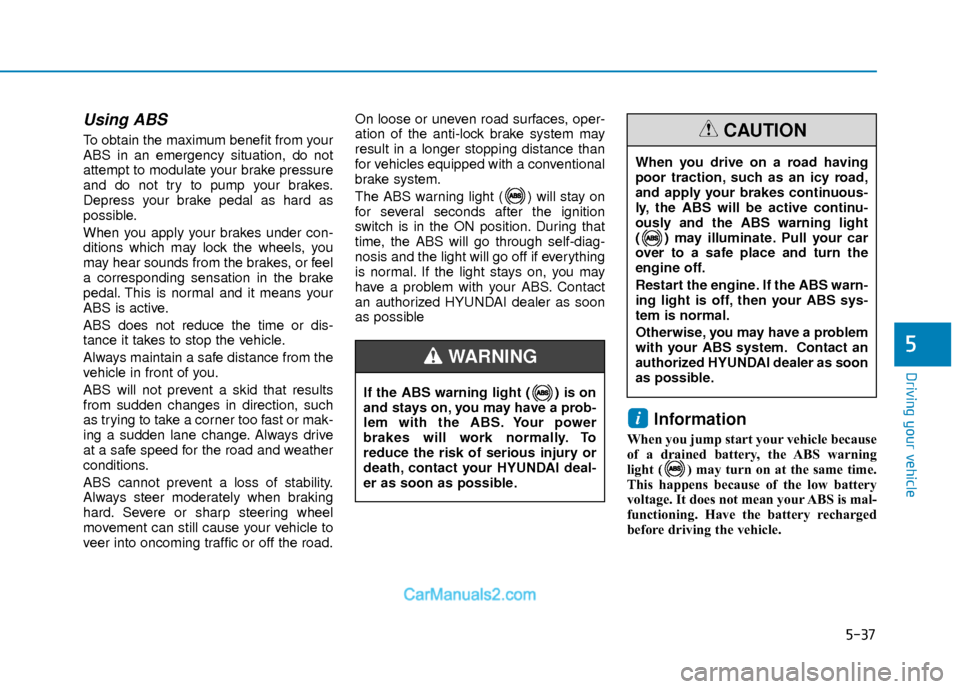
Using ABS
To obtain the maximum benefit from your
ABS in an emergency situation, do not
attempt to modulate your brake pressure
and do not try to pump your brakes.
Depress your brake pedal as hard as
possible.
When you apply your brakes under con-
ditions which may lock the wheels, you
may hear sounds from the brakes, or feel
a corresponding sensation in the brake
pedal. This is normal and it means your
ABS is active.
ABS does not reduce the time or dis-
tance it takes to stop the vehicle.
Always maintain a safe distance from the
vehicle in front of you.
ABS will not prevent a skid that results
from sudden changes in direction, such
as trying to take a corner too fast or mak-
ing a sudden lane change. Always drive
at a safe speed for the road and weather
conditions.
ABS cannot prevent a loss of stability.
Always steer moderately when braking
hard. Severe or sharp steering wheel
movement can still cause your vehicle to
veer into oncoming traffic or off the road.On loose or uneven road surfaces, oper-
ation of the anti-lock brake system may
result in a longer stopping distance than
for vehicles equipped with a conventional
brake system.
The ABS warning light ( ) will stay on
for several seconds after the ignition
switch is in the ON position. During that
time, the ABS will go through self-diag-
nosis and the light will go off if everything
is normal. If the light stays on, you may
have a problem with your ABS. Contact
an authorized HYUNDAI dealer as soon
as possible
Information
When you jump start your vehicle because
of a drained battery, the ABS warning
light ( ) may turn on at the same time.
This happens because of the low battery
voltage. It does not mean your ABS is mal-
functioning. Have the battery recharged
before driving the vehicle.
i
If the ABS warning light ( ) is on
and stays on, you may have a prob-
lem with the ABS. Your power
brakes will work normally. To
reduce the risk of serious injury or
death, contact your HYUNDAI deal-
er as soon as possible.
WARNING
When you drive on a road having
poor traction, such as an icy road,
and apply your brakes continuous-
ly, the ABS will be active continu-
ously and the ABS warning light
( ) may illuminate. Pull your car
over to a safe place and turn the
engine off.
Restart the engine. If the ABS warn-
ing light is off, then your ABS sys-
tem is normal.
Otherwise, you may have a problem
with your ABS system.
Contact an
authorized HYUNDAI dealer as soon
as possible.
CAUTION
Page 326 of 526
5-43
Driving your vehicle
5
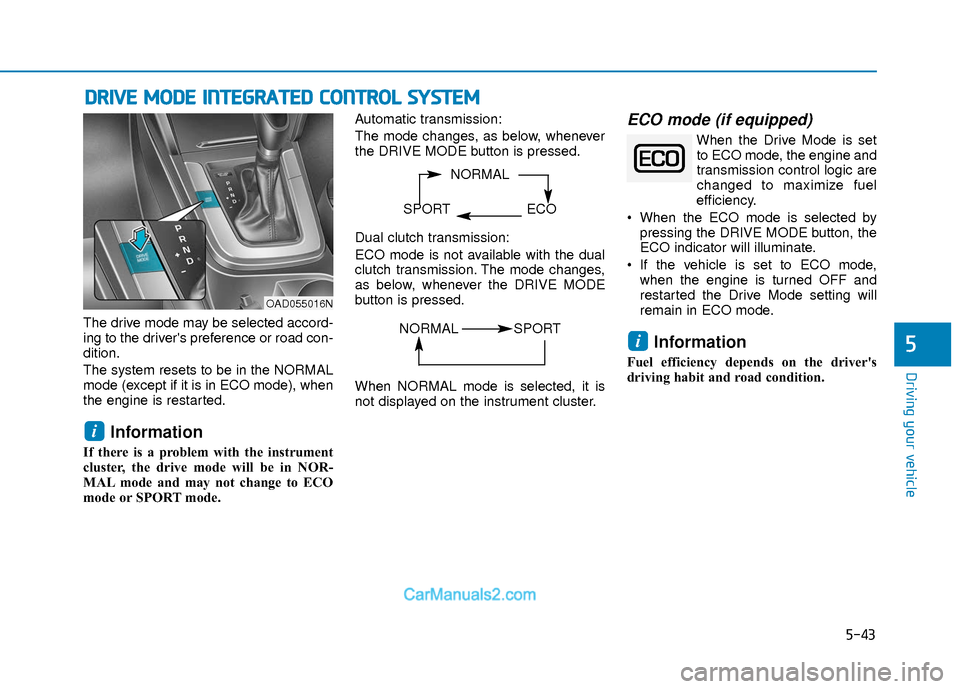
The drive mode may be selected accord-
ing to the driver's preference or road con-
dition.
The system resets to be in the NORMAL
mode (except if it is in ECO mode), when
the engine is restarted.
Information
If there is a problem with the instrument
cluster, the drive mode will be in NOR-
MAL mode and may not change to ECO
mode or SPORT mode. Automatic transmission:
The mode changes, as below, whenever
the DRIVE MODE button is pressed.
Dual clutch transmission:
ECO mode is not available with the dual
clutch transmission. The mode changes,
as below, whenever the DRIVE MODE
button is pressed.
When NORMAL mode is selected, it is
not displayed on the instrument cluster.
ECO mode (if equipped)
When the Drive Mode is set
to ECO mode, the engine and
transmission control logic are
changed to maximize fuel
efficiency.
When the ECO mode is selected by pressing the DRIVE MODE button, the
ECO indicator will illuminate.
If the vehicle is set to ECO mode, when the engine is turned OFF and
restarted the Drive Mode setting will
remain in ECO mode.
Information
Fuel efficiency depends on the driver's
driving habit and road condition.
i
i
D DR
RI
IV
V E
E
M
M O
OD
DE
E
I
IN
N T
TE
EG
G R
RA
A T
TE
ED
D
C
C O
O N
NT
TR
R O
O L
L
S
S Y
Y S
ST
T E
EM
M
NORMAL
SPORT ECO
OAD055016N
NORMAL SPORT
Page 327 of 526
5-44
Driving your vehicle
When the ECO mode is activated:
The acceleration response may beslightly reduced if the accelerator
pedal is depressed moderately.
The air conditioner performance may be limited.
The shift pattern of the automatic transmission/dual clutch transmission
may change.
The engine speed may be lower than when driving in NORMAL mode.
The above situations are normal condi-
tions when the ECO mode is activated to
improve fuel efficiency. Limitation of the ECO mode opera-
tion:
Even though ECO mode is selected and
there is no change in the ECO indicator :
When the coolant temperature is low,
ECO mode will be limited until engine
temperature is at normal operating
temperature.
When driving up a hill, ECO mode will be limited to provide better power
when driving uphill.
When driving the vehicle with the auto- matic transmission/ dual clutch trans-
mission gear shift lever in manual shift
mode, ECO mode will be limited
according to the shift position.SPORT mode
SPORT mode manages the
driving dynamics by automat-
ically adjusting the steering
effort, and the engine and
transmission control logic for enhanced
driver performance.
When SPORT mode is selected by pressing the DRIVE MODE button, the
SPORT indicator will illuminate.
Whenever the engine is restarted, the Drive Mode will revert back to NOR-
MAL mode. If SPORT mode is desired,
re-select SPORT mode from the
DRIVE MODE button.
When SPORT mode is activated: - The engine rpm will tend to remainraised over a certain length of time
even after releasing the accelerator
- Upshifts are delayed when accelerat- ing
Information
In SPORT mode, the fuel efficiency may
decrease.
i
Page 464 of 526
7-46
Maintenance
All Season Tires
HYUNDAI specifies all season tires
on some models to provide good
performance for use all year round,
including snowy and icy road condi-
tions. All season tires are identified
by ALL SEASON and/or M+S (Mud
and Snow) on the tire sidewall. Snow
tires have better snow traction than
all season tires and may be more
appropriate in some areas.
Summer Tires
HYUNDAI specifies summer tires on
some models to provide superior
performance on dry roads. Summer
tire performance is substantially
reduced in snow and ice. Summer
tires do not have the tire traction rat-
ing M+S (Mud and Snow) on the tire
side wall. If you plan to operate your
vehicle in snowy or icy conditions,
HYUNDAI recommends the use of
snow tires or all season tires on all
four wheels.
Snow Tires
If you equip your car with snow tires,
they should be the same size and
have the same load capacity as the
original tires. Snow tires should be
installed on all four wheels; other-
wise, poor handling may result. Snow
tires should carry 4 psi (28 kPa)
more air pressure than the pressure
recommended for the standard tires
on the tire label on the driver’s side of
the center pillar, or up to the maxi-
mum pressure shown on the tire
sidewall, whichever is less. Do not
drive faster than 75 mph (120 km/h)
when your vehicle is equipped with
snow tires.
Radial-Ply Tires
Radial-ply tires provide improved
tread life, road hazard resistance and
smoother high speed ride. The radi-
al-ply tires used on this vehicle are of
belted construction, and are selected
to complement the ride and handling
characteristics of your vehicle.Radial-ply tires have the same load
carrying capacity, as bias-ply or bias
belted tires of the same size, and use
the same recommended inflation
pressure. Mixing of radial-ply tires
with bias-ply or bias belted tires is
not recommended. Any combina-
tions of radial-ply and bias-ply or bias
belted tires when used on the same
vehicle will seriously deteriorate
vehicle handling. The best rule to fol-
low is: Identical pairs of radial-ply
tires should always be used as a set
for the front tires and a set for the
rear tires.
Longer wearing tires can be more
susceptible to irregular tread wear. It
is very important to follow the tire
rotation interval in this chapter to
achieve the tread life potential of
these tires. Cuts and punctures in
radial-ply tires are repairable only in
the tread area, because of sidewall
flexing. Consult your tire dealer for
radial-ply tire repairs.
Page 519 of 526
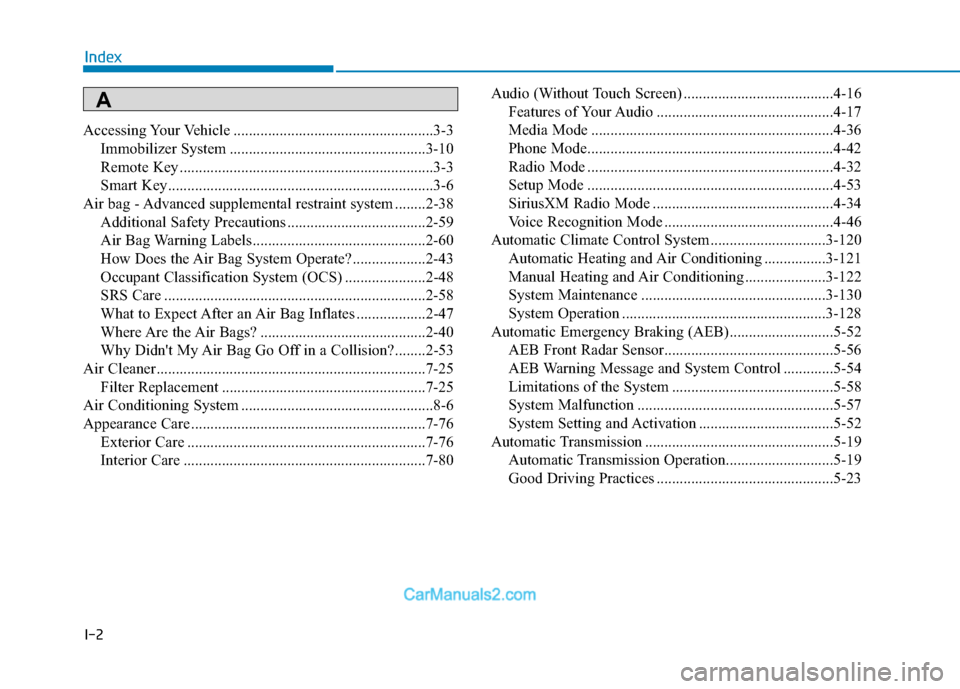
I-2
Accessing Your Vehicle ....................................................3-3Immobilizer System ...................................................3-10
Remote Key ..................................................................3-3
Smart Key.....................................................................3-6\
Air bag - Advanced supplemental restraint system ........2-38 Additional Safety Precautions ....................................2-59
Air Bag Warning Labels.............................................2-60
How Does the Air Bag System Operate? ...................2-43
Occupant Classification System (OCS) .....................2-48
SRS Care ....................................................................2-58\
What to Expect After an Air Bag Inflates ..................2-47
Where Are the Air Bags? ...........................................2-40
Why Didn't My Air Bag Go Off in a Collision?........2-53
Air Cleaner......................................................................7-\
25 Filter Replacement .....................................................7-25
Air Conditioning System ..................................................8-6
Appearance Care .............................................................7-76 Exterior Care ..............................................................7-76
Interior Care ...............................................................7-80 Audio (Without Touch Screen) .......................................4-16
Features of Your Audio ..............................................4-17
Media Mode ...............................................................4-36
Phone Mode................................................................4-42
Radio Mode ................................................................4-32
Setup Mode ................................................................4-53
SiriusXM Radio Mode ...............................................4-34
Voice Recognition Mode ............................................4-46
Automatic Climate Control System..............................3-120 Automatic Heating and Air Conditioning ................3-121
Manual Heating and Air Conditioning .....................3-122
System Maintenance ................................................3-130
System Operation .....................................................3-128
Automatic Emergency Braking (AEB)...........................5-52 AEB Front Radar Sensor............................................5-56
AEB Warning Message and System Control .............5-54
Limitations of the System ..........................................5-58
System Malfunction ...................................................5-57
System Setting and Activation ...................................5-52
Automatic Transmission .................................................5-19 Automatic Transmission Operation............................5-19
Good Driving Practices ..............................................5-23
Index
A
Page 521 of 526
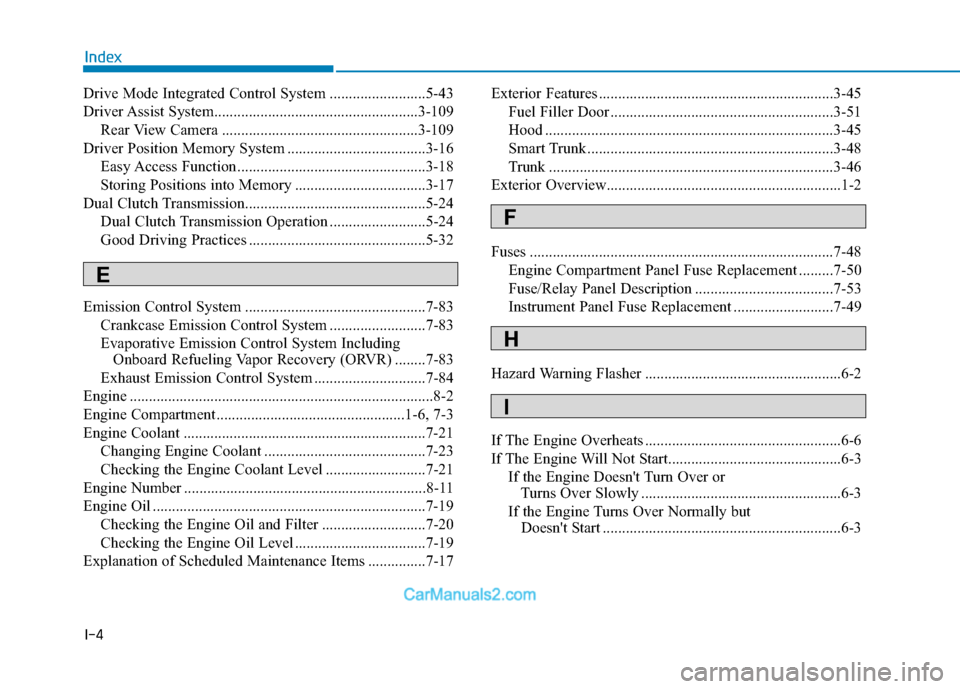
I-4
Drive Mode Integrated Control System .........................5-43
Driver Assist System.....................................................3-109Rear View Camera ...................................................3-109
Driver Position Memory System ....................................3-16 Easy Access Function .................................................3-18
Storing Positions into Memory ..................................3-17
Dual Clutch Transmission...............................................5-24 Dual Clutch Transmission Operation .........................5-24
Good Driving Practices ..............................................5-32
Emission Control System ...............................................7-83 Crankcase Emission Control System .........................7-83
Evaporative Emission Control System Including Onboard Refueling Vapor Recovery (ORVR) ........7-83
Exhaust Emission Control System .............................7-84
Engine ........................................................................\
.......8-2
Engine Compartment.................................................1-6, 7-3
Engine Coolant ...............................................................7-21 Changing Engine Coolant ..........................................7-23
Checking the Engine Coolant Level ..........................7-21
Engine Number ...............................................................8-11
Engine Oil .......................................................................7\
-19 Checking the Engine Oil and Filter ...........................7-20
Checking the Engine Oil Level ..................................7-19
Explanation of Scheduled Maintenance Items ...............7-17 Exterior Features .............................................................3-45
Fuel Filler Door ..........................................................3-51
Hood ........................................................................\
...3-45
Smart Trunk ................................................................3-48
Trunk ........................................................................\
..3-46
Exterior Overview.............................................................1-2
Fuses ........................................................................\
.......7-48 Engine Compartment Panel Fuse Replacement .........7-50
Fuse/Relay Panel Description ....................................7-53
Instrument Panel Fuse Replacement ..........................7-49
Hazard Warning Flasher ...................................................6-2
If The Engine Overheats ...................................................6-6
If The Engine Will Not Start.............................................6-3 If the Engine Doesn't Turn Over or Turns Over Slowly ....................................................6-3
If the Engine Turns Over Normally but Doesn't Start ..............................................................6-3
Index
E
F
H
I