remove Hyundai Elantra 2018 Manual Online
[x] Cancel search | Manufacturer: HYUNDAI, Model Year: 2018, Model line: Elantra, Model: Hyundai Elantra 2018Pages: 526, PDF Size: 17.2 MB
Page 496 of 526
7-78
Maintenance
Bright-metal maintenance
To remove road tar and insects, use atar remover, not a scraper or other
sharp object.
To protect the surfaces of bright-metal parts from corrosion, apply a coating of
wax or chrome preservative and rub to
a high luster.
During winter weather or in coastal areas, cover the bright metal parts with
a heavier coating of wax or preserva-
tive. If necessary, coat the parts with
non-corrosive petroleum jelly or other
protective compound.
Underbody maintenance
Corrosive materials used for ice and
snow removal and dust control may col-
lect on the underbody. If these materials
are not removed, accelerated rusting can
occur on underbody parts such as the
fuel lines, frame, floor pan and exhaust
system, even though they have been
treated with rust protection. Thoroughly flush the vehicle underbody
and wheel openings with lukewarm or
cold water once a month, after off-road
driving and at the end of each winter. Pay
special attention to these areas because
it is difficult to see all the mud and dirt. It
will do more harm than good to wet down
the road grime without removing it. The
lower edges of doors, rocker panels, and
frame members have drain holes that
should not be allowed to clog with dirt;
trapped water in these areas can cause
rusting.
Aluminum wheel maintenance
The aluminum wheels are coated with a
clear protective finish.
Do not use abrasive cleaner, polish-
ing compound, solvent, or wire
brushes on aluminum wheels.
Clean the wheel when it has cooled.
Use only a mild soap or neutral detergent, and rinse thoroughly with
water. Also, clean the wheels after
driving on salted roads.
Do not wash the wheels with high- speed car wash brushes.
Do not use any cleaners containing acid or alkaline detergents.
NOTICE
After washing the vehicle, test the
brakes while driving slowly to see if
they have been affected by water. If
braking performance is impaired,
dry the brakes by applying them
lightly while maintaining a slow for-
ward speed.
WARNING
Page 498 of 526
7-80
Maintenance
Keep your garage dry
Don’t park your car in a damp, poorly
ventilated garage. This creates a favor-
able environment for corrosion. This is
particularly true if you wash your vehicle
in the garage or drive it into the garage
when it is still wet or covered with snow,
ice or mud. Even a heated garage can
contribute to corrosion unless it is well
ventilated so moisture is dispersed.
Keep paint and trim in good condition
Scratches or chips in the finish should be
covered with "touch-up" paint as soon as
possible to reduce the possibility of cor-
rosion. If bare metal is showing through,
the attention of a qualified body and paint
shop is recommended.
Bird droppings are highly corrosive and
may damage painted surfaces in just a
few hours. Always remove bird droppings
as soon as possible.
Interior Care
Interior general precautions
Prevent caustic solutions such as per-
fume and cosmetic oil, from contacting
the interior parts because they may
cause damage or discoloration. If they do
contact the interior parts, wipe them off
immediately. See the instructions for the
proper way to clean vinyl.
Never allow water or other liquids tocome in contact with electrical/elec-
tronic components inside the vehi-
cle as this may damage them.
When cleaning leather products (steering wheel, seats etc.), use neu-
tral detergents or low alcohol con-
tent solutions. If you use high alco-
hol content solutions or acid/ alka-
line detergents, the color of the
leather may fade or the surface may
get stripped off.
Cleaning the upholstery andinterior trim
Vinyl (if equipped)
Remove dust and loose dirt from vinyl
with a whisk broom or vacuum cleaner.
Clean vinyl surfaces with a vinyl cleaner.
Fabric (if equipped)
Remove dust and loose dirt from fabric
with a whisk broom or vacuum cleaner.
Clean with a mild soap solution recom-
mended for upholstery or carpets.
Remove fresh spots immediately with a
fabric spot cleaner. If fresh spots do not
receive immediate attention, the fabric
can be stained and its color can be
affected. Also, its fire-resistant properties
can be reduced if the material is not
properly maintained.
Using anything but recommended
cleaners and procedures may affect
the fabric's appearance and fire-
resistant properties.
NOTICE
NOTICE
Page 499 of 526
7-81
7
Maintenance
Leather (if equipped)
Feature of Seat Leather- Leather is made from the outer skinof an animal, which goes through a
special process to be available for
use. Since it is a natural object, each
part differs in thickness or density.
Wrinkles may appear as a natural result of stretching and shrinking
depending on the temperature and
humidity.
- The seat is made of stretchable fabric to improve comfort.
- The parts contacting the body are curved and the side supporting area
is high which provides driving comfort
and stability.
- Wrinkles may appear naturally from usage. It is not a fault of the products. Caring for the leather seats
- Vacuum the seat periodically toremove dust and sand on the seat. It
will prevent abrasion or damage of
the leather and maintain its quality.
- Wipe the natural leather seat cover often with dry or soft cloth.
- Use of proper leather protective may prevent abrasion of the cover and
helps maintain the color. Be sure to
read the instructions and consult a
specialist when using leather coating
or protective agent.
- Light colored (beige, cream beige) leather is easily contaminated and
the stain is noticeable. Clean the
seats frequently.
- Avoid wiping with wet cloth. It may cause the surface to crack.
Wrinkles or abrasions which
appear naturally from usage are
not covered by warranty.
Belts with metallic accessories,
zippers or keys inside the back
pocket may damage the seat fab-
ric.
Make sure not to wet the seat. It
may change the nature of natural
leather.
Jeans or clothes which could
bleach may contaminate the sur-
face of the seat covering fabric.
CAUTION
Page 500 of 526
7-82
Maintenance
Cleaning the leather seats- Remove all contaminations instantly.Refer to instructions below for
removal of each contaminant.
- Cosmetic products (sunscreen, foun- dation, etc.)
Apply cleansing cream on a cloth and
wipe the contaminate spot. Wipe off
the cream with a wet cloth and
remove water with a dry cloth.
- Beverages (coffee, soft drink, etc.) Apply a small amount of neutral
detergent and wipe until contamina-
tions do not smear.
- Oil Remove oil instantly with absorbable
cloth and wipe with stain remover
used only for natural leather.
- Chewing gum Harden the gum with ice and remove
gradually.Cleaning the seat belt webbing
Clean the belt webbing with any mild
soap solution recommended for cleaning
upholstery or carpet. Follow the instruc-
tions provided with the soap. Do not
bleach or re-dye the webbing because
this may weaken the seat belt.
Cleaning the interior windowglass
If the interior glass surfaces of the vehi-
cle become fogged (that is, covered with
an oily, greasy or waxy film), they should
be cleaned with glass cleaner. Follow the
directions on the glass cleaner container.
Do not scrape or scratch the inside of
the rear window. This may result in
damage to the rear window defroster
grid.
NOTICE
Page 503 of 526
7-85
7
Maintenance
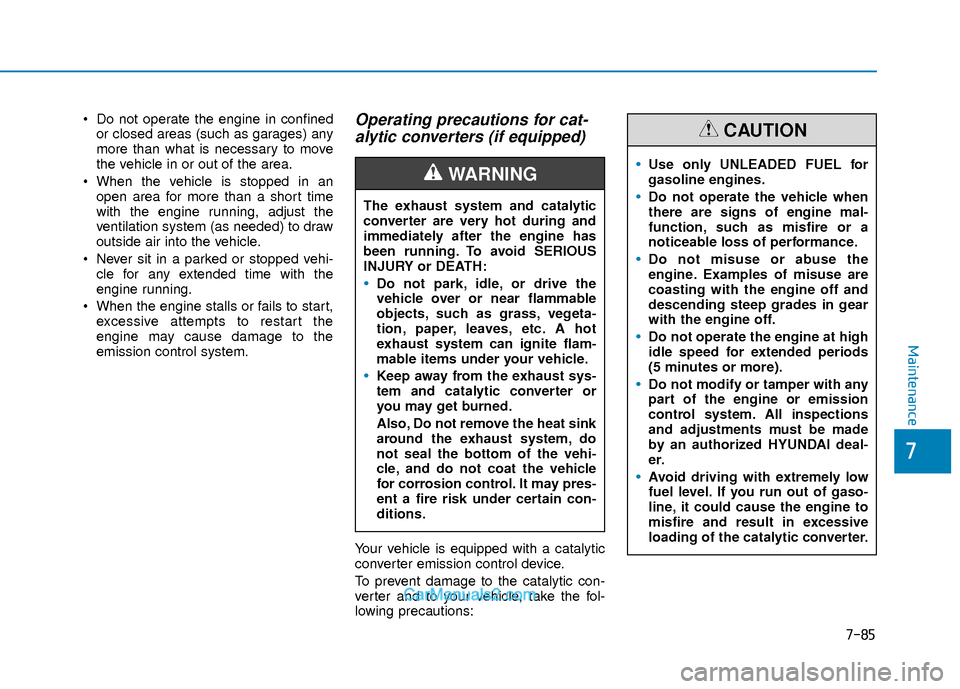
Do not operate the engine in confinedor closed areas (such as garages) any
more than what is necessary to move
the vehicle in or out of the area.
When the vehicle is stopped in an open area for more than a short time
with the engine running, adjust the
ventilation system (as needed) to draw
outside air into the vehicle.
Never sit in a parked or stopped vehi- cle for any extended time with the
engine running.
When the engine stalls or fails to start, excessive attempts to restart the
engine may cause damage to the
emission control system.Operating precautions for cat-alytic converters (if equipped)
Your vehicle is equipped with a catalytic
converter emission control device.
To prevent damage to the catalytic con-
verter and to your vehicle, take the fol-
lowing precautions: The exhaust system and catalytic
converter are very hot during and
immediately after the engine has
been running. To avoid SERIOUS
INJURY or DEATH:
Do not park, idle, or drive the
vehicle over or near flammable
objects, such as grass, vegeta-
tion, paper, leaves, etc. A hot
exhaust system can ignite flam-
mable items under your vehicle.
Keep away from the exhaust sys-
tem and catalytic converter or
you may get burned.
Also, Do not remove the heat sink
around the exhaust system, do
not seal the bottom of the vehi-
cle, and do not coat the vehicle
for corrosion control. It may pres-
ent a fire risk under certain con-
ditions.
WARNING Use only UNLEADED FUEL for
gasoline engines.
Do not operate the vehicle when
there are signs of engine mal-
function, such as misfire or a
noticeable loss of performance.
Do not misuse or abuse the
engine. Examples of misuse are
coasting with the engine off and
descending steep grades in gear
with the engine off.
Do not operate the engine at high
idle speed for extended periods
(5 minutes or more).
Do not modify or tamper with any
part of the engine or emission
control system. All inspections
and adjustments must be made
by an authorized HYUNDAI deal-
er.
Avoid driving with extremely low
fuel level. If you run out of gaso-
line, it could cause the engine to
misfire and result in excessive
loading of the catalytic converter.
CAUTION