coolant reservoir Hyundai Elantra 2018 Owner's Manual
[x] Cancel search | Manufacturer: HYUNDAI, Model Year: 2018, Model line: Elantra, Model: Hyundai Elantra 2018Pages: 526, PDF Size: 17.2 MB
Page 17 of 526
1-6
Your vehicle at a glance
E
EN
N G
GI
IN
N E
E
C
C O
O M
M P
PA
A R
RT
TM
M E
EN
N T
T
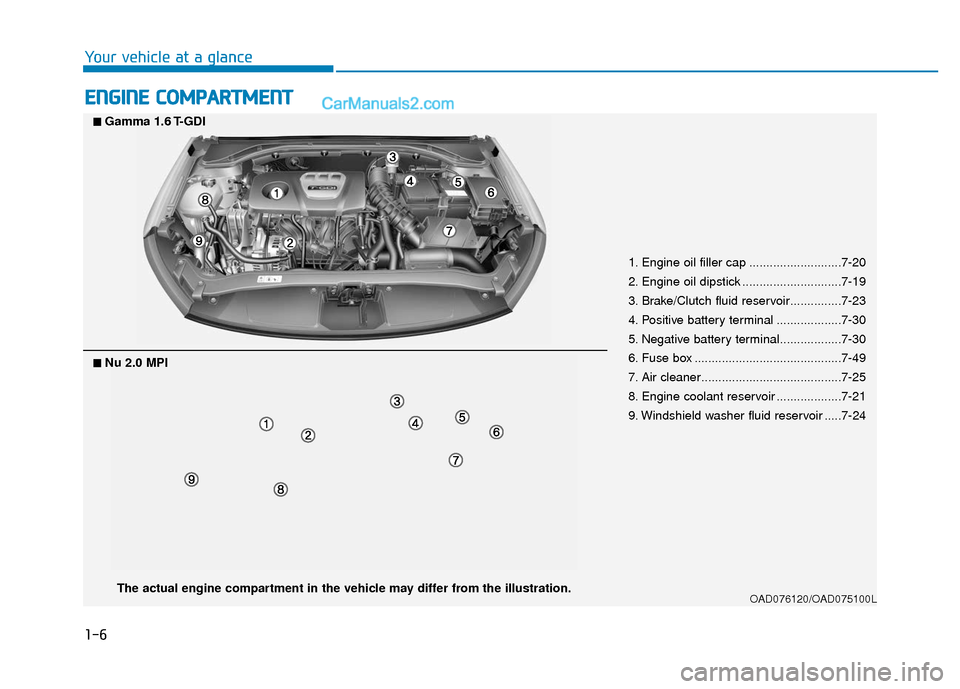
1. Engine oil filler cap ...........................7-20
2. Engine oil dipstick .............................7-19
3. Brake/Clutch fluid reservoir...............7-23
4. Positive battery terminal ...................7-30
5. Negative battery terminal..................7-30
6. Fuse box ...........................................7-49
7. Air cleaner.........................................7-25
8. Engine coolant reservoir ...................7-21
9. Windshield washer fluid reservoir .....7-24
OAD076120/OAD075100LThe actual engine compartment in the vehicle may differ from the illustration.
■
■Nu 2.0 MPI
■
■Gamma 1.6 T-GDI
Page 135 of 526
3-58
Convenient features of your vehicle
If the gauge pointer moves beyond the
normal range area toward the "H"
position, it indicates overheating that
may damage the engine.
Do not continue driving with an over-
heated engine. If your vehicle over-
heats, refer to "If the Engine
Overheats" in chapter 6.
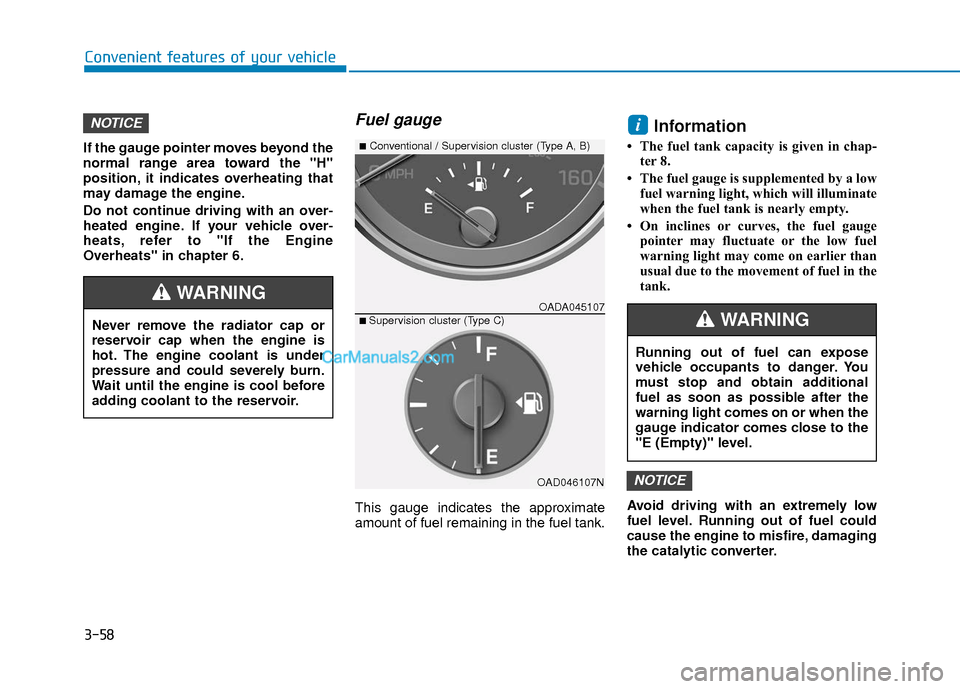
Fuel gauge
This gauge indicates the approximate
amount of fuel remaining in the fuel tank.
Information
• The fuel tank capacity is given in chap-ter 8.
• The fuel gauge is supplemented by a low fuel warning light, which will illuminate
when the fuel tank is nearly empty.
• On inclines or curves, the fuel gauge pointer may fluctuate or the low fuel
warning light may come on earlier than
usual due to the movement of fuel in the
tank.
Avoid driving with an extremely low
fuel level. Running out of fuel could
cause the engine to misfire, damaging
the catalytic converter.
NOTICE
iNOTICE
Running out of fuel can expose
vehicle occupants to danger. You
must stop and obtain additional
fuel as soon as possible after the
warning light comes on or when the
gauge indicator comes close to the
"E (Empty)" level.
WARNINGNever remove the radiator cap or
reservoir cap when the engine is
hot. The engine coolant is under
pressure and could severely burn.
Wait until the engine is cool before
adding coolant to the reservoir.
WARNINGOADA045107
■Conventional / Supervision cluster (Type A, B)
■ Supervision cluster (Type C)
OAD046107N
Page 387 of 526
6-6
What to do in an emergency
If your temperature gauge indicates over-
heating, you experience a loss of power,
or hear loud pinging or knocking, the
engine may be overheating. If this hap-
pens, you should:
1. Pull off the road and stop as soon asit is safe to do so.
2. Place the shift lever in P (Park) and set the parking brake. If the air condi-
tioning is ON, turn it OFF.
3. If engine coolant is running out under the vehicle or steam is coming out
from the hood, stop the engine. Do not
open the hood until the coolant has
stopped running or the steaming has
stopped. If there is no visible loss of
engine coolant and no steam, leave
the engine running and check to be
sure the engine cooling fan is operat-
ing. If the fan is not running, turn the
engine off. 4. Check for coolant leaking from the
radiator, hoses or under the vehicle. (If
the air conditioning had been in use, it
is normal for cold water to be draining
from it when you stop.)
5. If engine coolant is leaking out, stop the engine immediately and call the
nearest authorized HYUNDAI dealer
for assistance. 6. If you cannot find the cause of the
overheating, wait until the engine tem-
perature has returned to normal.
Then, if coolant has been lost, careful-
ly add coolant to the reservoir to bring
the fluid level in the reservoir up to the
halfway mark.
7. Proceed with caution, keeping alert for further signs of overheating. If over-
heating happens again, call an author-
ized HYUNDAI dealer for assistance.
I IF
F
T
T H
H E
E
E
E N
N G
GI
IN
N E
E
O
O V
VE
ER
R H
H E
EA
A T
TS
S
While the engine is run-
ning, keep hands, cloth-
ing and tools away from
the moving parts such
as the cooling fan and
drive belt to prevent
serious injury.
WARNING
Your vehicle is
equipped with a pres-
surized coolant reserve
tank. NEVER remove
the coolant reserve tank
cap or the radiator drain plug while
the engine and radiator are HOT.
Hot coolant and steam may blow
out under pressure, causing seri-
ous injury.
Turn the engine off and wait until
the engine cools down. Use
extreme care when removing the
coolant reserve tank cap. Wrap a
towel or thick rag around it, and
turn it counterclockwise slowly to
release some of the pressure from
the system. Step back while the
pressure is released.
(Continued)
(Continued)
When you are sure all the pressure
has been released, continue turn-
ing the cap counterclockwise to
remove it.
WARNING
Serious loss of coolant indicates a
leak in the cooling system and
should be checked as soon as pos-
sible by an authorized HYUNDAI
dealer.
CAUTION
Page 421 of 526
7-3
7
Maintenance
E
EN
N G
GI
IN
N E
E
C
C O
O M
M P
PA
A R
RT
TM
M E
EN
N T
T
OAD076120/OAD075100L
■
■Nu 2.0 MPI
■
■Gamma 1.6 T-GDI
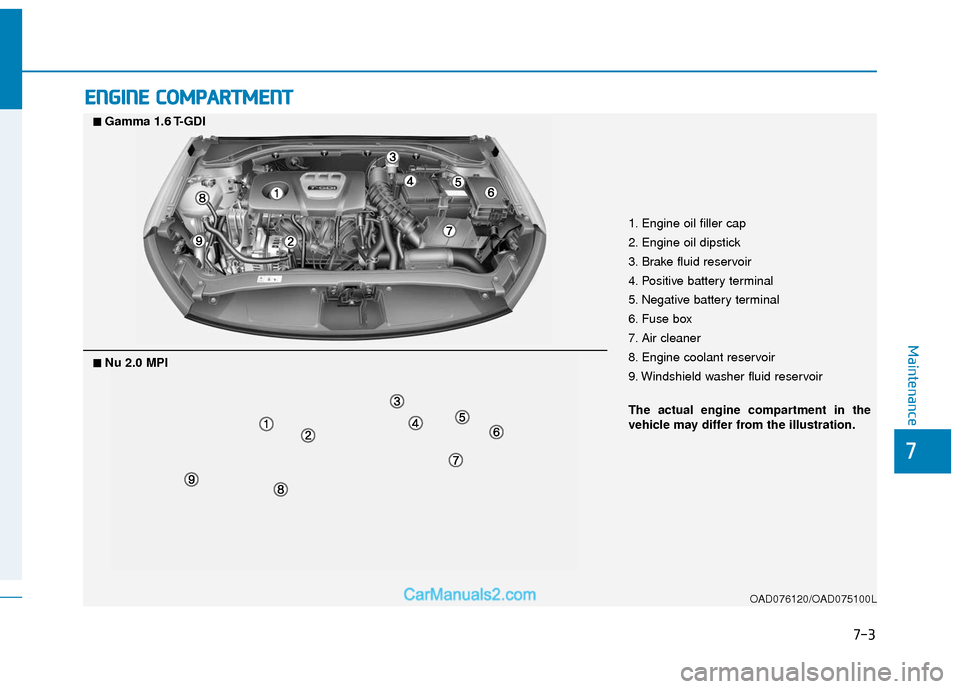
1. Engine oil filler cap
2. Engine oil dipstick
3. Brake fluid reservoir
4. Positive battery terminal
5. Negative battery terminal
6. Fuse box
7. Air cleaner
8. Engine coolant reservoir
9. Windshield washer fluid reservoir
The actual engine compartment in the
vehicle may differ from the illustration.
Page 423 of 526
7-5
7
Maintenance
The following lists are vehicle checks and
inspections that should be performed by
the owner or an authorized HYUNDAI
dealer at the frequencies indicated to
help ensure safe, dependable operation
of your vehicle.
Any adverse conditions should be
brought to the attention of your dealer as
soon as possible.
These Owner Maintenance vehicle
checks are generally not covered by war-
ranties and you may be charged for
labor, parts and lubricants used.Owner Maintenance Schedule
When you stop for fuel:
Check the engine oil level.
Check coolant level in the enginecoolant reservoir.
Check the windshield washer fluid level.
Check for low or under-inflated tires.
While operating your vehicle:
Note any changes in the sound of the exhaust or any smell of exhaust fumes
in the vehicle.
Check for vibrations in the steering wheel. Notice if there is any increased
steering effort or looseness in the
steering wheel, or change in its
straight-ahead position.
Notice if your vehicle constantly turns slightly or "pulls" to one side when trav-
eling on smooth, level road.
When stopping, listen and check for unusual sounds, pulling to one side,
increased brake pedal travel or "hard-
to-push" brake pedal.
If any slipping or changes in the oper- ation of your transmission occurs,
check the transmission fluid level.
Check the automatic transmission/ dual clutch transmission P (Park) func-
tion.
Check the parking brake.
Check for fluid leaks under your vehicle (water dripping from the air condition-
ing system during or after use is nor-
mal).
Be careful when checking your
engine coolant level when the
engine is hot. This may result in
coolant being blown out of the
opening and cause serious burns
and other injuries.
WARNING
Page 424 of 526
7-6
Maintenance
At least monthly:
Check coolant level in the enginecoolant reservoir.
Check the operation of all exterior lights, including the brake lights, turn
signals and hazard warning flashers.
Check the inflation pressures of all tires including the spare for tires that
are worn, show uneven wear, or are
damaged.
Check for loose wheel lug nuts.
At least twice a year: (i.e., every Spring and Fall)
Check radiator, heater and air condi-
tioning hoses for leaks or damage.
Check windshield washer spray and wiper operation. Clean wiper blades
with clean cloth dampened with wash-
er fluid.
Check headlamp alignment.
Check muffler, exhaust pipes, shields and clamps.
Check the seat belts for wear and func- tion.
At least once a year:
Clean body and door drain holes.
Lubricate door hinges and hoodhinges.
Lubricate door and hood locks and latches.
Lubricate door rubber weather strips.
Lubricate door checker.
Check the air conditioning system.
Inspect and lubricate automatic trans- mission linkage and controls.
Clean the battery and terminals.
Check the brake fluid level. Follow Normal Maintenance Schedule if
the vehicle is usually operated where
none of the following conditions apply. If
any of the following conditions apply, you
must follow the Maintenance Under
Severe Usage Conditions.
Repeated short distance driving.
Driving in dusty conditions or sandy
areas.
Extensive use of brakes.
Driving in areas where salt or other corrosive materials are used.
Driving on rough or muddy roads.
Driving in mountainous areas.
Extended periods of idling or low speed operation.
Driving for a prolonged period in cold temperatures and/or extremely humid
climates.
More than 50% driving in heavy city traffic during hot weather above 90°F
(32°C).
For additional information or assistance
see your authorized HYUNDAI dealer.
S S C
C H
H E
ED
D U
U L
LE
E D
D
M
M A
AI
IN
N T
TE
EN
N A
AN
N C
CE
E
S
S E
E R
R V
V I
IC
C E
E S
S
Page 435 of 526
7-17
7
Maintenance
E
EX
X P
PL
LA
A N
N A
AT
TI
IO
O N
N
O
O F
F
S
S C
C H
H E
ED
D U
U L
LE
E D
D
M
M A
AI
IN
N T
TE
EN
N A
AN
N C
CE
E
I
IT
T E
EM
M S
S
Engine Oil and Filter
The engine oil and filter should be
changed at the intervals specified in the
maintenance schedule. If the car is being
driven in severe conditions, more fre-
quent oil and filter changes are required.
Drive Belts
Inspect all drive belts for evidence of
cuts, cracks, excessive wear or oil satu-
ration and replace if necessary. Drive
belts should be checked periodically for
proper tension and adjusted as neces-
sary.
Fuel Filter
A clogged-up fuel filter may limit the vehi-
cle driving speed, damage the emission
system, and cause the hard starting.
When a considerable amount of foreign
substances are accumulated in the fuel
tank, the fuel filter should be replaced.
Upon installing a new fuel filter, operate
the engine for several minutes, and
check the connections for any leakages.
Fuel filters should be installed by an
authorized HYUNDAI dealer.
Fuel Lines, Fuel Hoses and
Connections
Check the fuel lines, fuel hoses and con-
nections for leakage and damage. Have
an authorized HYUNDAI dealer replace
any damaged or leaking parts immedi-
ately.
Vapor Hose and Fuel Filler
Cap
The vapor hose and fuel filler cap should
be inspected at those intervals specified
in the maintenance schedule. Make sure
a new vapor hose or fuel filler cap is cor-
rectly replaced.
Vacuum Crankcase Ventilation
Hoses (if equipped)
Inspect the surface of hoses for evidence
of heat and/or mechanical damage. Hard
and brittle rubber, cracking, tears, cuts,
abrasions, and excessive swelling indi-
cate deterioration. Particular attention
should be paid to examine those hose
surfaces nearest to high heat sources,
such as the exhaust manifold.
Inspect the hose routing to assure that
the hoses do not come in contact with
any heat source, sharp edges or moving
component which might cause heat dam-
age or mechanical wear. Inspect all hose connections, such as
clamps and couplings, to make sure they
are secure, and that no leaks are pres-
ent. Hoses should be replaced immedi-
ately if there is any evidence of deterio-
ration or damage.
Air Cleaner Filter
A genuine HYUNDAI air cleaner filter is
recommended when the filter is
replaced.
Spark Plugs
Make sure to install new spark plugs of
the correct heat range.
Cooling System
Check cooling system components, such
as radiator, coolant reservoir, hoses and
connections for leakage and damage.
Replace any damaged parts.
Engine Coolant
The coolant should be changed at the
intervals specified in the maintenance
schedule.
Page 439 of 526
7-21
7
Maintenance
E
EN
N G
GI
IN
N E
E
C
C O
O O
OL
LA
A N
N T
T
The high-pressure cooling system has a
reservoir filled with year-round antifreeze
coolant. The reservoir is filled at the fac-
tory.
Check the antifreeze protection and
coolant level at least once a year, at the
beginning of the winter season and
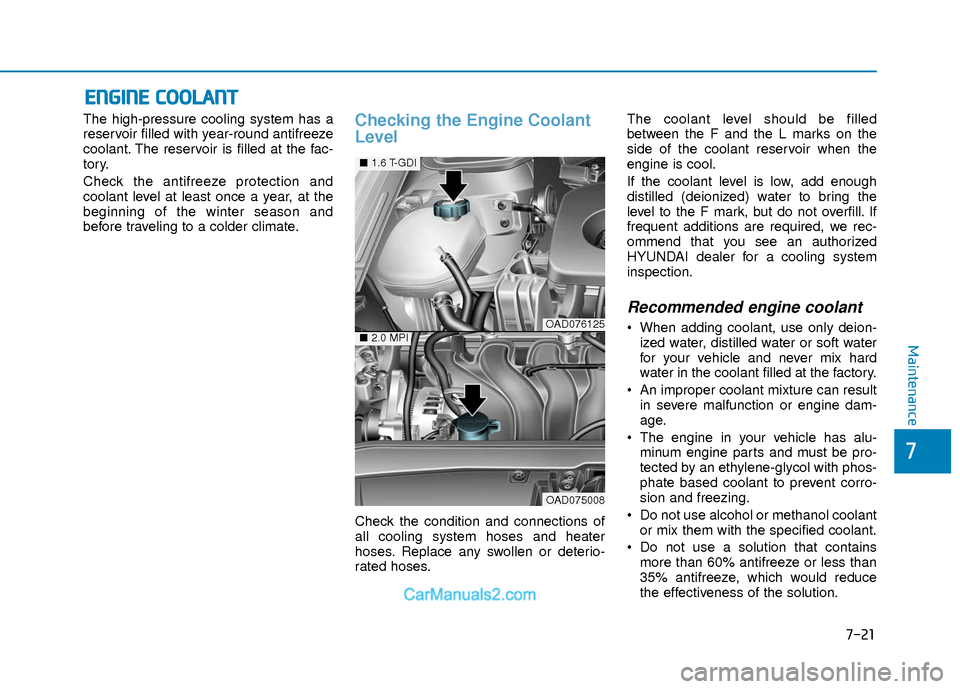
before traveling to a colder climate.Checking the Engine Coolant
Level
Check the condition and connections of
all cooling system hoses and heater
hoses. Replace any swollen or deterio-
rated hoses. The coolant level should be filled
between the F and the L marks on the
side of the coolant reservoir when the
engine is cool.
If the coolant level is low, add enough
distilled (deionized) water to bring the
level to the F mark, but do not overfill. If
frequent additions are required, we rec-
ommend that you see an authorized
HYUNDAI dealer for a cooling system
inspection.
Recommended engine coolant
When adding coolant, use only deion-
ized water, distilled water or soft water
for your vehicle and never mix hard
water in the coolant filled at the factory.
An improper coolant mixture can result in severe malfunction or engine dam-
age.
The engine in your vehicle has alu- minum engine parts and must be pro-
tected by an ethylene-glycol with phos-
phate based coolant to prevent corro-
sion and freezing.
Do not use alcohol or methanol coolant or mix them with the specified coolant.
Do not use a solution that contains more than 60% antifreeze or less than
35% antifreeze, which would reduce
the effectiveness of the solution.OAD076125
OAD075008
■ 1.6 T-GDI
■2.0 MPI
Page 441 of 526
7-23
7
Maintenance
B
BR
RA
A K
KE
E/
/C
C L
LU
U T
TC
CH
H
F
F L
LU
U I
ID
D
Changing Engine Coolant
Have coolant changed by an authorized
HYUNDAI dealer according to the
Maintenance Schedule at the beginning
of this chapter.
To prevent damage to engine parts,
put a thick towel around the radiator
cap before refilling the coolant to pre-
vent the coolant from overflowing into
engine parts, such as the generator.
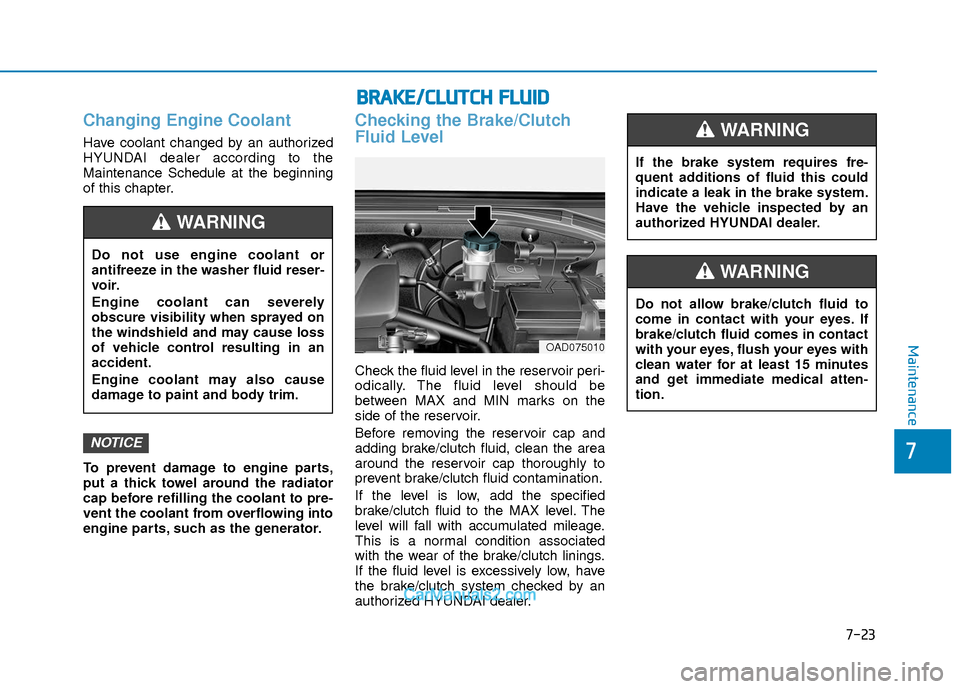
Checking the Brake/Clutch
Fluid Level
Check the fluid level in the reservoir peri-
odically. The fluid level should be
between MAX and MIN marks on the
side of the reservoir.
Before removing the reservoir cap and
adding brake/clutch fluid, clean the area
around the reservoir cap thoroughly to
prevent brake/clutch fluid contamination.
If the level is low, add the specified
brake/clutch fluid to the MAX level. The
level will fall with accumulated mileage.
This is a normal condition associated
with the wear of the brake/clutch linings.
If the fluid level is excessively low, have
the brake/clutch system checked by an
authorized HYUNDAI dealer.
NOTICE
Do not use engine coolant or
antifreeze in the washer fluid reser-
voir.
Engine coolant can severely
obscure visibility when sprayed on
the windshield and may cause loss
of vehicle control resulting in an
accident.
Engine coolant may also cause
damage to paint and body trim.
WARNING
If the brake system requires fre-
quent additions of fluid this could
indicate a leak in the brake system.
Have the vehicle inspected by an
authorized HYUNDAI dealer.
WARNING
Do not allow brake/clutch fluid to
come in contact with your eyes. If
brake/clutch fluid comes in contact
with your eyes, flush your eyes with
clean water for at least 15 minutes
and get immediate medical atten-
tion.
WARNING
OAD075010
Page 442 of 526
7-24
Maintenance
W
WA
AS
SH
H E
ER
R
F
F L
LU
U I
ID
D
Do not allow brake/clutch fluid to
contact the vehicle's body paint, as
paint damage will result.
Brake/clutch fluid, which has been exposed to open air for an extended
time should NEVER be used as its
quality cannot be guaranteed. It
should be disposed of properly.
Do not use the wrong kind of brake/clutch fluid. A few drops of
mineral based oil, such as engine
oil, in your brake/clutch system can
damage brake/clutch system parts.
Information
Use only the specified brake/clutch fluid
(refer to "Recommended Lubricants and
Capacities" in chapter 8).
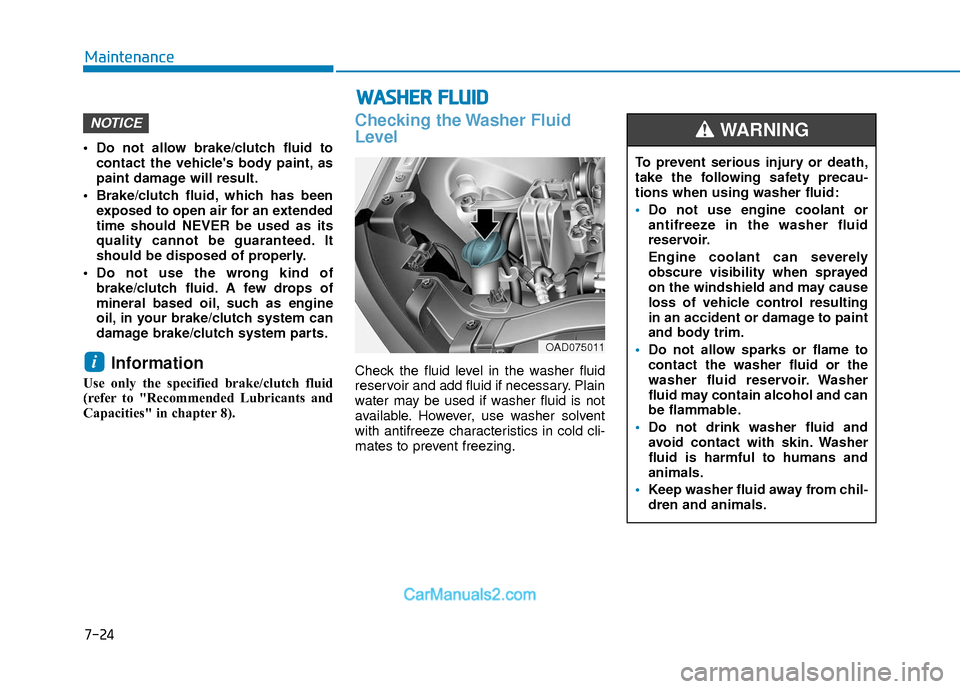
Checking the Washer Fluid
Level
Check the fluid level in the washer fluid
reservoir and add fluid if necessary. Plain
water may be used if washer fluid is not
available. However, use washer solvent
with antifreeze characteristics in cold cli-
mates to prevent freezing.i
NOTICE
OAD075011
To prevent serious injury or death,
take the following safety precau-
tions when using washer fluid:
Do not use engine coolant or
antifreeze in the washer fluid
reservoir.
Engine coolant can severely
obscure visibility when sprayed
on the windshield and may cause
loss of vehicle control resulting
in an accident or damage to paint
and body trim.
Do not allow sparks or flame to
contact the washer fluid or the
washer fluid reservoir. Washer
fluid may contain alcohol and can
be flammable.
Do not drink washer fluid and
avoid contact with skin. Washer
fluid is harmful to humans and
animals.
Keep washer fluid away from chil-
dren and animals.
WARNING