brake Hyundai Elantra 2018 Owner's Manual
[x] Cancel search | Manufacturer: HYUNDAI, Model Year: 2018, Model line: Elantra, Model: Hyundai Elantra 2018Pages: 526, PDF Size: 17.2 MB
Page 9 of 526
F9
Introduction
For customers who do not use TOP Tier
Detergent Gasoline regularly, and have
problems starting or the engine does not
run smoothly, detergent-based fuel addi-
tives that you can purchase separately
may be added to the gasoline. If TOP
TIER Detergent Gasoline is not available,
one bottle of additive added to the fuel
tank according to the maintenance
schedule is recommended (refer to the
Maintenance Schedule in chapter 7).
Additives are available from your author-
ized HYUNDAI dealer along with infor-
mation on how to use them. Do not mix
other additives.
Operation in foreign countries
If you are going to drive your vehicle in
another country, be sure to:
Observe all regulations regarding reg-istration and insurance.
Determine that acceptable fuel is avail- able. This vehicle should not be modified.
Modification of your vehicle could
affect its performance, safety or dura-
bility and may even violate governmen-
tal safety and emissions regulations.
In addition, damage or performance
problems resulting from any modifica-
tion may not be covered under warran-
ty.
If you use unauthorized electronic devices, it may cause the vehicle to
operate abnormally, wire damage, bat-
tery discharge and fire. For your safety,
do not use unauthoriz ed electronic
devices. By following a few simple precautions for
the first 600 miles (1,000 km) you may
add to the performance, economy and
life of your vehicle.
Do not race the engine.
While driving, keep your engine speed
(rpm, or revolutions per minute)
between 2,000 rpm and 4,000 rpm.
Do not maintain a single speed for long periods of time, either fast or slow.
Varying engine speed is needed to
properly break-in the engine.
Avoid hard stops, except in emergen- cies, to allow the brakes to seat prop-
erly.
V VE
EH
H I
IC
C L
LE
E
B
B R
RE
EA
A K
K-
-I
IN
N
P
P R
R O
O C
CE
E S
SS
S
V
V E
EH
H I
IC
C L
LE
E
M
M O
OD
DI
IF
F I
IC
C A
A T
TI
IO
O N
NS
S
Page 10 of 526
F10
Introduction
This vehicle is equipped with an event
data recorder (EDR). The main purpose
of an EDR is to record, in certain crash
or near crash-like situations, such as
an air bag deployment or hitting a road
obstacle, data that will assist in under-
standing how a vehicle’s systems per-
formed. The EDR is designed to record
data related to vehicle dynamics and
safety systems for a short period of
time, typically 30 seconds or less. The
EDR in this vehicle is designed to
record such data as:
were operating;
senger safety belts were buckled/
fastened;
depressing the accelerator and/or
brake pedal; and,
These data can help provide a better
understanding of the circumstances
in which crashes and injuries occur.
NOTE: EDR data are recorded by your
vehicle only if a non-trivial crash situ-
ation occurs; no data are recorded by
the EDR under normal driving condi-
tions and no personal data (e.g.,
name, gender, age, and crash loca-
tion) are recorded. However, other
parties, such as law enforcement,
could combine the EDR data with the
type of personally identifying data
routinely acquired during a crash
investigation.
To read data recorded by an EDR, spe-
cial equipment is required, and
access to the vehicle or the EDR is
needed. In addition to the vehicle
manufacturer, other parties, such as
law enforcement, that have the special
equipment, can read the information if
they have access to the vehicle or the
EDR.
V V
E
EH
H I
IC
C L
LE
E
D
D A
A T
TA
A
C
C O
O L
LL
LE
E C
CT
T I
IO
O N
N
A
A N
N D
D
E
E V
V E
EN
N T
T
D
D A
A T
TA
A
R
R E
EC
CO
O R
RD
D E
ER
R S
S
CALIFORNIA PROPOSITION 65
WARNING
Items contained in motor vehicles
or emitted from them are known to
the State of California to cause can-
cer and birth defects or reproduc-
tive harm. These include:
Gasoline and its vapors
Engine exhaust
Used engine oil
Interior passenger compartment
components and materials
Component parts which are sub-
ject to heat and wear
In addition, battery posts, terminals
and related accessories contain
lead, lead compounds and other
chemicals known to the State of
California to cause cancer and
reproductive harm.
WARNING
Page 15 of 526
1-4
Your vehicle at a glance
I
IN
N T
TE
ER
R I
IO
O R
R
O
O V
VE
ER
R V
V I
IE
E W
W
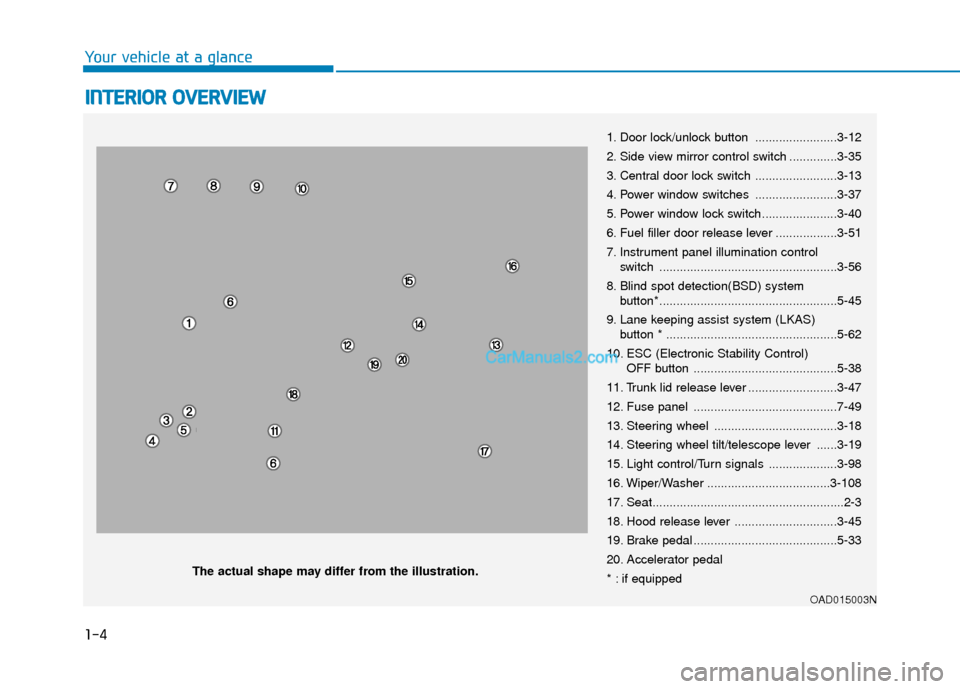
1. Door lock/unlock button ........................3-12
2. Side view mirror control switch ..............3-35
3. Central door lock switch ........................3-13
4. Power window switches ........................3-37
5. Power window lock switch......................3-40
6. Fuel filler door release lever ..................3-51
7. Instrument panel illumination control
switch ....................................................3-56
8. Blind spot detection(BSD) system button* ....................................................5-45
9. Lane keeping assist system (LKAS) button * ..................................................5-62
10. ESC (Electronic Stability Control) OFF button ..........................................5-38
11. Trunk lid release lever ..........................3-47
12. Fuse panel ..........................................7-49
13. Steering wheel ....................................3-18
14. Steering wheel tilt/telescope lever ......3-19
15. Light control/Turn signals ....................3-98
16. Wiper/Washer ....................................3-108
17. Seat........................................................2-3
18. Hood release lever ..............................3-45
19. Brake pedal ..........................................5-33
20. Accelerator pedal
* : if equipped
OAD015003N
The actual shape may differ from the illustration.
Page 16 of 526
I
IN
N S
ST
T R
R U
U M
M E
EN
N T
T
P
P A
A N
N E
EL
L
O
O V
VE
ER
R V
V I
IE
E W
W
The actual shape may differ from the illustration.
1-5
Your vehicle at a glance
1
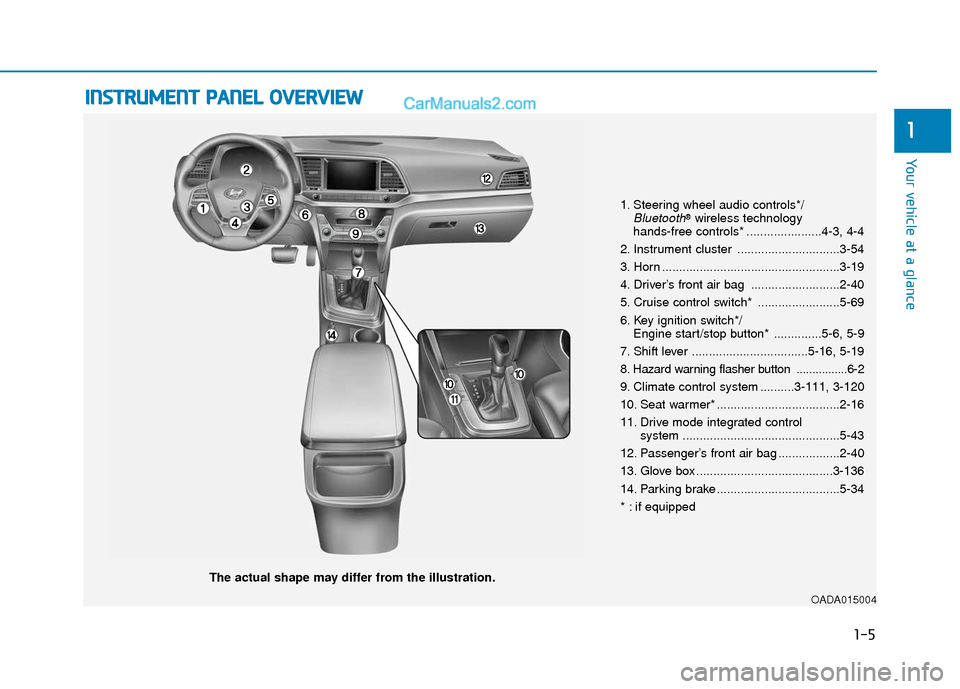
1. Steering wheel audio controls*/Bluetooth®wireless technology
hands-free controls* ......................4-3, 4-4
2. Instrument cluster ..............................3-54
3. Horn ....................................................3-19
4. Driver’s front air bag ..........................2-40
5. Cruise control switch* ........................5-69
6. Key ignition switch*/ Engine start/stop button* ..............5-6, 5-9
7. Shift lever ..................................5-16, 5-19
8
. Hazard warning flasher button ................6-2
9. Climate control system ..........3-111, 3-120
10. Seat warmer* ....................................2-16
11. Drive mode integrated control system ..............................................5-43
12. Passenger’s front air bag ..................2-40
13. Glove box ........................................3-136
14. Parking brake ....................................5-34
* : if equipped
OADA015004
Page 17 of 526
1-6
Your vehicle at a glance
E
EN
N G
GI
IN
N E
E
C
C O
O M
M P
PA
A R
RT
TM
M E
EN
N T
T
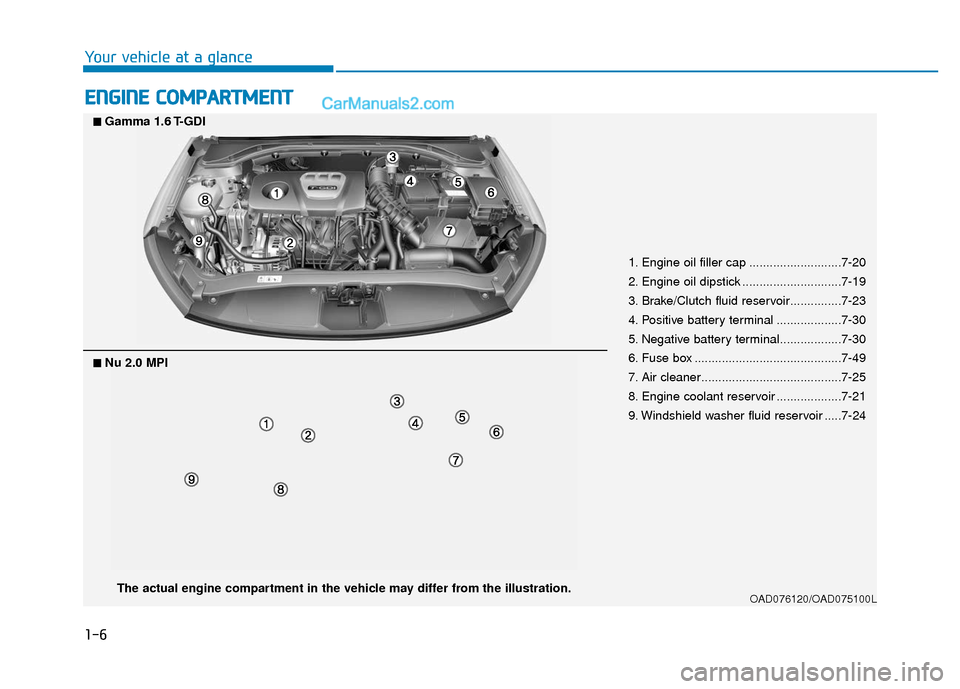
1. Engine oil filler cap ...........................7-20
2. Engine oil dipstick .............................7-19
3. Brake/Clutch fluid reservoir...............7-23
4. Positive battery terminal ...................7-30
5. Negative battery terminal..................7-30
6. Fuse box ...........................................7-49
7. Air cleaner.........................................7-25
8. Engine coolant reservoir ...................7-21
9. Windshield washer fluid reservoir .....7-24
OAD076120/OAD075100LThe actual engine compartment in the vehicle may differ from the illustration.
■
■Nu 2.0 MPI
■
■Gamma 1.6 T-GDI
Page 28 of 526
2-11
Safety system of your vehicle
2
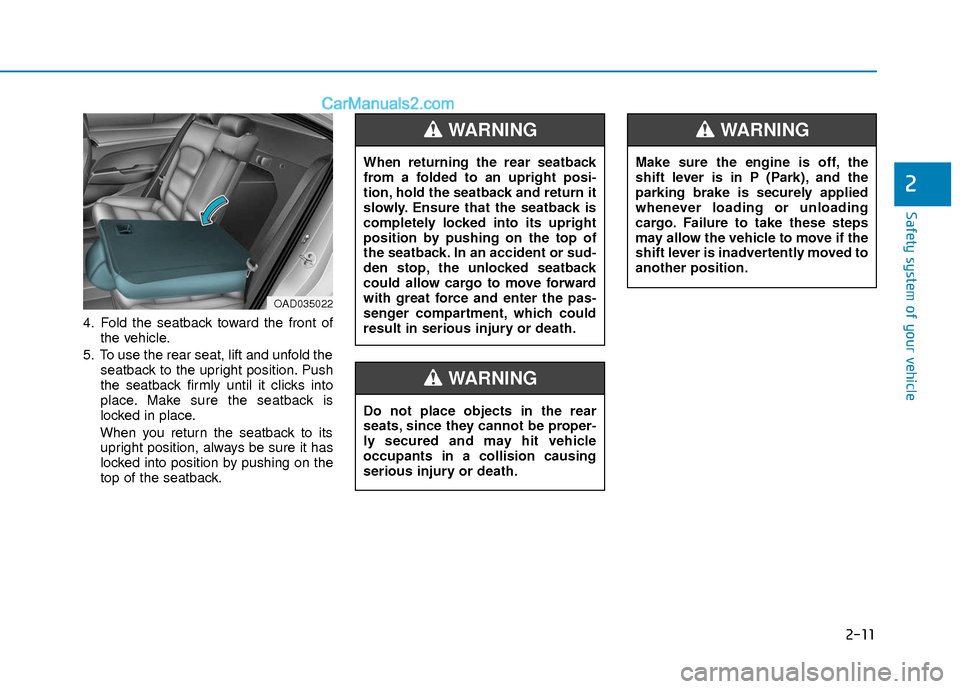
4. Fold the seatback toward the front ofthe vehicle.
5. To use the rear seat, lift and unfold the seatback to the upright position. Push
the seatback firmly until it clicks into
place. Make sure the seatback is
locked in place.
When you return the seatback to its upright position, always be sure it has
locked into position by pushing on the
top of the seatback.
OAD035022
Do not place objects in the rear
seats, since they cannot be proper-
ly secured and may hit vehicle
occupants in a collision causing
serious injury or death.
WARNING
When returning the rear seatback
from a folded to an upright posi-
tion, hold the seatback and return it
slowly. Ensure that the seatback is
completely locked into its upright
position by pushing on the top of
the seatback. In an accident or sud-
den stop, the unlocked seatback
could allow cargo to move forward
with great force and enter the pas-
senger compartment, which could
result in serious injury or death.
WARNING
Make sure the engine is off, the
shift lever is in P (Park), and the
parking brake is securely applied
whenever loading or unloading
cargo. Failure to take these steps
may allow the vehicle to move if the
shift lever is inadvertently moved to
another position.
WARNING
Page 74 of 526
2-57
Safety system of your vehicle
2
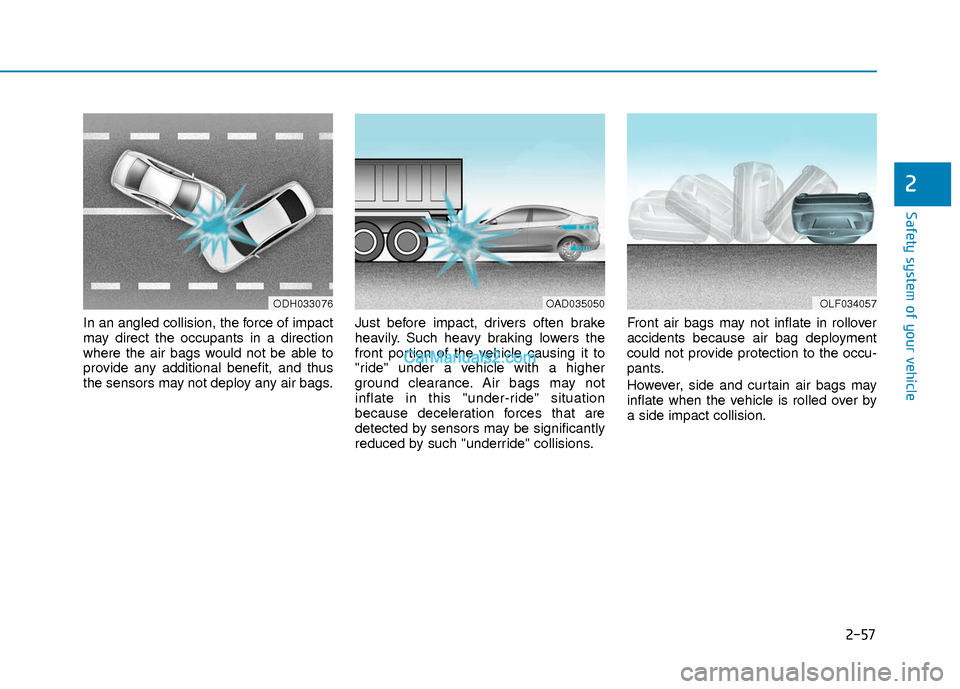
In an angled collision, the force of impact
may direct the occupants in a direction
where the air bags would not be able to
provide any additional benefit, and thus
the sensors may not deploy any air bags.Just before impact, drivers often brake
heavily. Such heavy braking lowers the
front portion of the vehicle causing it to
"ride" under a vehicle with a higher
ground clearance. Air bags may not
inflate in this "under-ride" situation
because deceleration forces that are
detected by sensors may be significantly
reduced by such "underride" collisions.Front air bags may not inflate in rollover
accidents because air bag deployment
could not provide protection to the occu-
pants.
However, side and curtain air bags may
inflate when the vehicle is rolled over by
a side impact collision.
ODH033076OLF034057OAD035050
Page 91 of 526
3-14
Convenient features of your vehicle
Auto Door Lock/
Unlock Features
Impact sensing door unlock
All doors will be automatically unlocked
when an impact causes the air bags to
deploy.
Speed sensing door lock
All doors will be automatically locked
when vehicle speed exceeds 9 mph (15
km/h).
All of the doors will be automatically
unlocked after the engine is turned off.
Shift lever auto door lock
All doors will be automatically locked
when shifting the shift lever out of P
(Park) with the engine running.
You can activate or deactivate the Auto
Door Lock/Unlock features from the User
Settings Mode on the LCD display.
For more information, refer to the
"LCD Display" section in this chapter.
Always secure your vehicle.
Leaving your vehicle unlocked
increases the potential risk to you
or others from someone hiding in
your vehicle.
To secure your vehicle, while
depressing the brake, move the
shift lever to the P (Park) position,
engage the parking brake, and
place the ignition switch in the
LOCK/OFF position, close all win-
dows, lock all doors, and always
take the key with you.
WARNING
Opening a door when something is
approaching may cause damage or
injury. Be careful when opening
doors and watch for vehicles,
motorcycles, bicycles or pedestri-
ans approaching the vehicle in the
path of the door.
CAUTION
If you stay in the vehicle for a long
time while the weather is very hot
or cold, there are risks of injuries or
danger to life. Do not lock the vehi-
cle from the outside when someone
is in the vehicle.
WARNING
Page 122 of 526
3-45
Convenient features of your vehicle
3
E
EX
X T
TE
ER
R I
IO
O R
R
F
F E
E A
A T
TU
U R
RE
ES
S
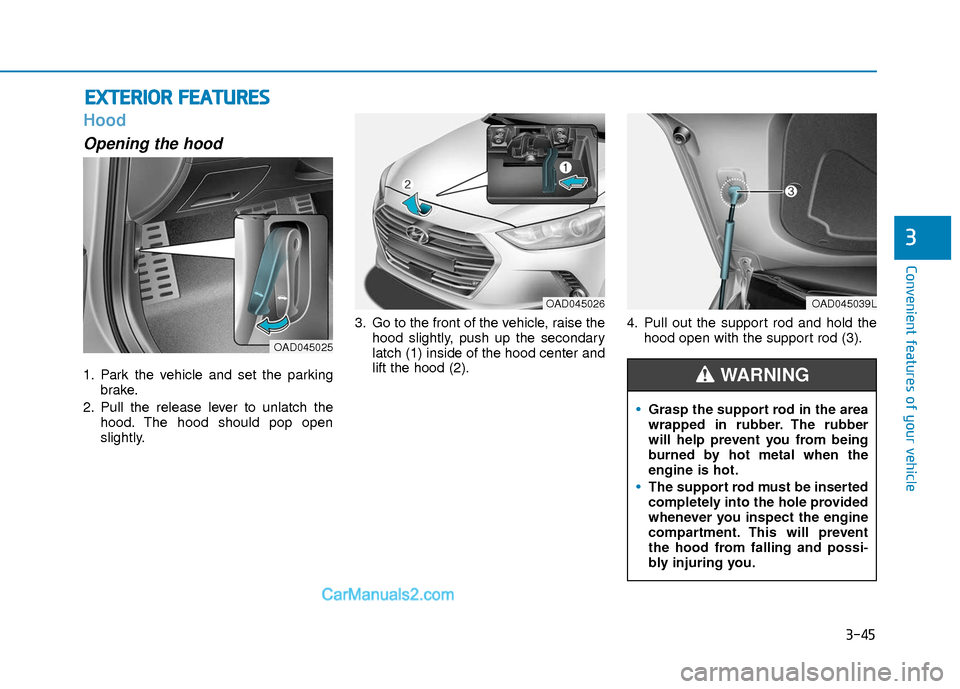
Hood
Opening the hood
1. Park the vehicle and set the parking
brake.
2. Pull the release lever to unlatch the hood. The hood should pop open
slightly. 3. Go to the front of the vehicle, raise the
hood slightly, push up the secondary
latch (1) inside of the hood center and
lift the hood (2). 4. Pull out the support rod and hold the
hood open with the support rod (3).
OAD045025
OAD045039L
Grasp the support rod in the area
wrapped in rubber. The rubber
will help prevent you from being
burned by hot metal when the
engine is hot.
The support rod must be inserted
completely into the hole provided
whenever you inspect the engine
compartment. This will prevent
the hood from falling and possi-
bly injuring you.
WARNING
OAD045026
Page 129 of 526
3-52
Convenient features of your vehicle
Closing the fuel filler door
1. To install the fuel tank cap, turn itclockwise until it "clicks" one time.
2. Close the fuel filler door until it is latched securely.
Gasoline is highly flammable and
explosive. Failure to follow these
guidelines may result in SERIOUS
INJURY or DEATH:
Read and follow all warnings
posted at the gas station.
Before refueling, note the loca-
tion of the Emergency Gasoline
Shut-Off, if available, at the gas
station.
Before touching the fuel nozzle,
you should eliminate the poten-
tial build-up of static electricity
by touching a metal part of the
vehicle, a safe distance away
from the fuel filler neck, nozzle, or
other gas source, with your bare
hand. (Continued)
WARNING
(Continued)
Do not use cellular phones while
refueling. Electric current and/or
electronic interference from cel-
lular phones can potentially
ignite fuel vapors and cause a
fire.
Do not get back into a vehicle
once you have begun refueling.
You can generate a build-up of
static electricity by touching, rub-
bing or sliding against any item
or fabric capable of producing
static electricity. Static electricity
discharge can ignite fuel vapors
causing a fire. If you must re-
enter the vehicle, you should
once again eliminate potentially
dangerous static electricity dis-
charge by touching a metal part
of the vehicle, away from the fuel
filler neck, nozzle or other gaso-
line source, with your bare hand.
When using an approved
portable fuel container, be sure to
place the container on the
ground prior to refueling. Static
electricity discharge from the
container can ignite fuel vapors
causing a fire.(Continued)
(Continued)Once refueling has begun, con-
tact between your bare hand and
the vehicle should be maintained
until the filling is complete.
Use only approved portable plastic
fuel containers designed to carry
and store gasoline.
When refueling, always move the
shift lever to the P (Park) posi-
tion, set the parking brake, and
place the ignition switch to the
LOCK/OFF position. Sparks pro-
duced by electrical components
related to the engine can ignite
fuel vapors causing a fire.
Do not use matches or a lighter
and do not smoke or leave a lit
cigarette in your vehicle while at
a gas station, especially during
refueling.
Do not over-fill or top-off your
vehicle tank, which can cause
gasoline spillage. (Continued)