weight Hyundai Elantra 2018 Owner's Manual
[x] Cancel search | Manufacturer: HYUNDAI, Model Year: 2018, Model line: Elantra, Model: Hyundai Elantra 2018Pages: 526, PDF Size: 17.2 MB
Page 43 of 526
2-26
Safety system of your vehicle
Seat belt use and children
Infant and small children
All 50 states have child restraint laws
which require children to travel in
approved child restraint devices, includ-
ing booster seats. The age at which seat
belts can be used instead of child
restraints differs among states, so you
should be aware of the specific require-
ments in your state, and where you are
travelling. Infant and child restraints must
be properly placed and installed in a rear
seat. For more information refer to the
"Child Restraint Systems" section in this
chapter.Small children are best protected from
injury in an accident when properly
restrained in the rear seat by a child
restraint system that meets the require-
ments of the Federal Motor Vehicle
Safety Standards. Before buying any
child restraint system, make sure that it
has a label certifying that it meets
Federal Motor Vehicle Safety Standard
FMVSS 213. The restraint must be
appropriate for your child’s height and
weight. Check the label on the child
restraint for this information. Refer to the
"Child Restraint Systems" section in this
chapter.
Larger children
Children under age 13 and who are too
large for a booster seat must always
occupy the rear seat and use the avail-
able lap/shoulder belts. A seat belt
should lie across the upper thighs and be
snug across the shoulder and chest to
restrain the child safely. Check belt fit
periodically. Children are afforded the
most safety in the event of an accident
when they are restrained by a proper
restraint system and/or seat belts in the
rear seat. Always have the LATCH sys-
tem inspected by your authorized
HYUNDAI dealer after an accident. An
accident can damage the LATCH system
and may not properly secure the child
restraint.
If a larger child over age 13 must be seat-
ed in the front seat, the child must be
securely restrained by the available
lap/shoulder belt and the seat should be
placed in the rearmost position.
If the shoulder belt portion slightly touch-
es the child's neck or face, try placing the
child closer to the center of the vehicle. If
the shoulder belt still touches their face
or neck they need to be returned to an
appropriate booster seat in the rear seat.
ALWAYS properly restrain infants
and small children in a child
restraint appropriate for the child’s
height and weight.
To reduce the risk of serious injury
or death to a child and other pas-
sengers, NEVER hold a child in
your lap or arms when the vehicle
is moving. The violent forces creat-
ed during an accident will tear the
child from your arms and throw the
child against the interior of the
vehicle.
WARNING
Page 45 of 526
2-28
Safety system of your vehicle
Children Always in the Rear
Children under age 13 must always ride
in the rear seats and must always be
properly restrained to minimize the risk of
injury in an accident, sudden stop or sud-
den maneuver. According to accident
statistics, children are safer when proper-
ly restrained in the rear seats than in the
front seat.Even with air bags, children
can be seriously injured or killed.
Children too large for a child restraint
must use the seat belts provided. All 50 states have child restraint laws
which require children to travel in
approved child restraint devices. The
laws governing the age or height/weight
restrictions at which seat belts can be
used instead of child restraints differs
among states, so you should be aware of
the specific requirements in your state,
and where you are travelling.
Child restraint systems must be properly
placed and installed in the rear seat. You
must use a commercially available child
restraint system that meets the require-
ments of the Federal Motor Vehicle
Safety Standards (FMVSS 213).
Child restraint systems are generally
designed to be secured in a vehicle seat
by lap belt portion of a lap/shoulder belt,
or by a LATCH system in the rear seats
of the vehicle.
Child restraint system (CRS)
Infants and younger children must be
restrained in an appropriate rear-facing
or forward-facing CRS that has first been
properly secured to the rear seat of the
vehicle. Read and comply with the
instructions for installation and use pro-
vided by the manufacturer of the child
restraint.
C C
H
H I
IL
L D
D
R
R E
ES
ST
T R
R A
A I
IN
N T
T
S
S Y
Y S
ST
T E
EM
M
(
( C
C R
R S
S)
)
Always properly restrain children in
the rear seats of the vehicle.
Children of all ages are safer when
restrained in the rear seat. A child
riding in the front passenger seat
can be forcefully struck by an inflat-
ing air bag resulting in SERIOUS
INJURY or DEATH.
WARNING
An improperly secured child
restraint can increase the risk of
SERIOUS INJURY or DEATH in an
accident. Always take the following
precautions when using a child
restraint system:
NEVER install a child or infant
restraint in the front passenger's
seat.
Always properly secure the child
restraint to a rear seat of the vehi-
cle.
Always follow the child restraint
system manufacturer's instruc-
tions for installation and use.
Always properly restrain your
child in the child restraint.
(Continued)
WARNING
Page 46 of 526
2-29
Safety system of your vehicle
2
Selecting a Child Restraint
System (CRS)
When selecting a CRS for your child,
always:
Make sure the CRS has a label certify-ing that it meets applicable Federal
Motor Vehicle Safety Standards
(FMVSS 213).
Select a child restraint based on your child’s height and weight. The required
label or the instructions for use typical-
ly provide this information.
Select a child restraint that fits the vehicle seating position where it will be
used.
Read and comply with the warnings and instructions for installation and use
provided with the child restraint sys-
tem.
Child restraint system types
There are three main types of child
restraint systems: rear-facing seats, for-
ward-facing seats, and booster seats.
They are classified according to the
child’s age, height and weight.
Rear-facing child seats
(Continued)
If the vehicle head restraint pre-
vents proper installation of a
child seat (as described in the
child restraint system manual),
the head restraint of the respec-
tive seating position shall be
readjusted or entirely removed.
Do not use an infant carrier or a
child safety seat that "hooks"
over a seatback, it may not pro-
vide adequate protection in an
accident.
After an accident, have a
HYUNDAI dealer check the child
restraint system, seat belts, teth-
er anchors and lower anchors.
NEVER install a child or infant
restraint in the front passenger’s
seat.
Placing a rear-facing child restraint
in the front seat can result in SERI-
OUS INJURY or DEATH if the child
restraint is struck by an inflating air
bag.
WARNING
Page 47 of 526
2-30
Safety system of your vehicle
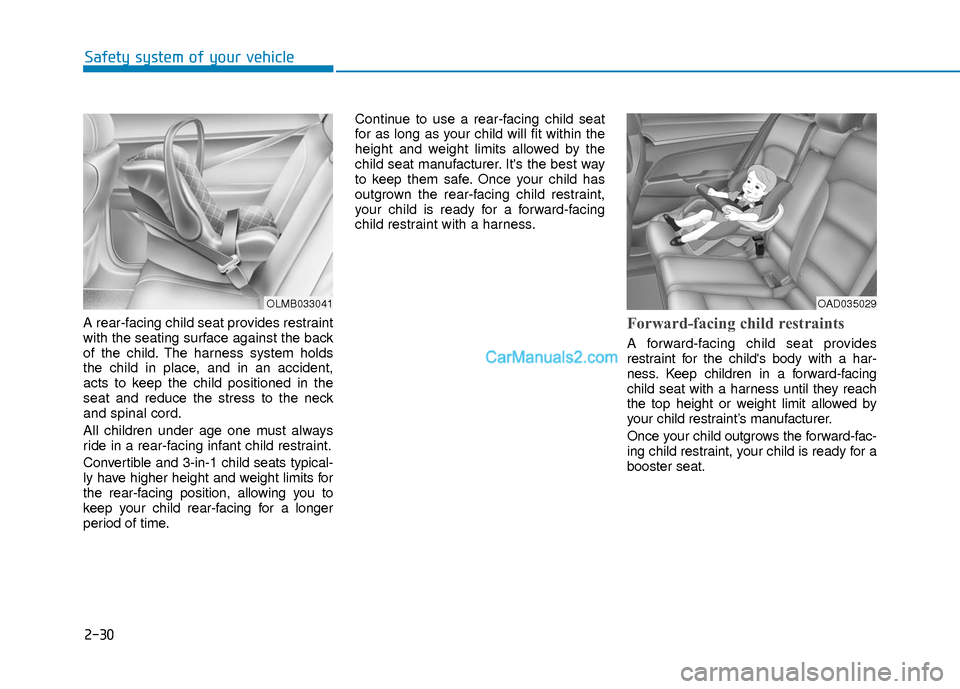
A rear-facing child seat provides restraint
with the seating surface against the back
of the child. The harness system holds
the child in place, and in an accident,
acts to keep the child positioned in the
seat and reduce the stress to the neck
and spinal cord.
All children under age one must always
ride in a rear-facing infant child restraint.
Convertible and 3-in-1 child seats typical-
ly have higher height and weight limits for
the rear-facing position, allowing you to
keep your child rear-facing for a longer
period of time.Continue to use a rear-facing child seat
for as long as your child will fit within the
height and weight limits allowed by the
child seat manufacturer. It's the best way
to keep them safe. Once your child has
outgrown the rear-facing child restraint,
your child is ready for a forward-facing
child restraint with a harness.Forward-facing child restraints
A forward-facing child seat provides
restraint for the child's body with a har-
ness. Keep children in a forward-facing
child seat with a harness until they reach
the top height or weight limit allowed by
your child restraint’s manufacturer.
Once your child outgrows the forward-fac-
ing child restraint, your child is ready for a
booster seat.
OLMB033041OAD035029
Page 51 of 526
2-34
Safety system of your vehicle
The recommended weight for the
LATCH system is under 65 lb (30 kg).
How to determine an appropriate child
restraint weight:
Child weight + Child restraint weight <
65 lb (30kg)
Securing a child restraint seatwith "Tether Anchor" system
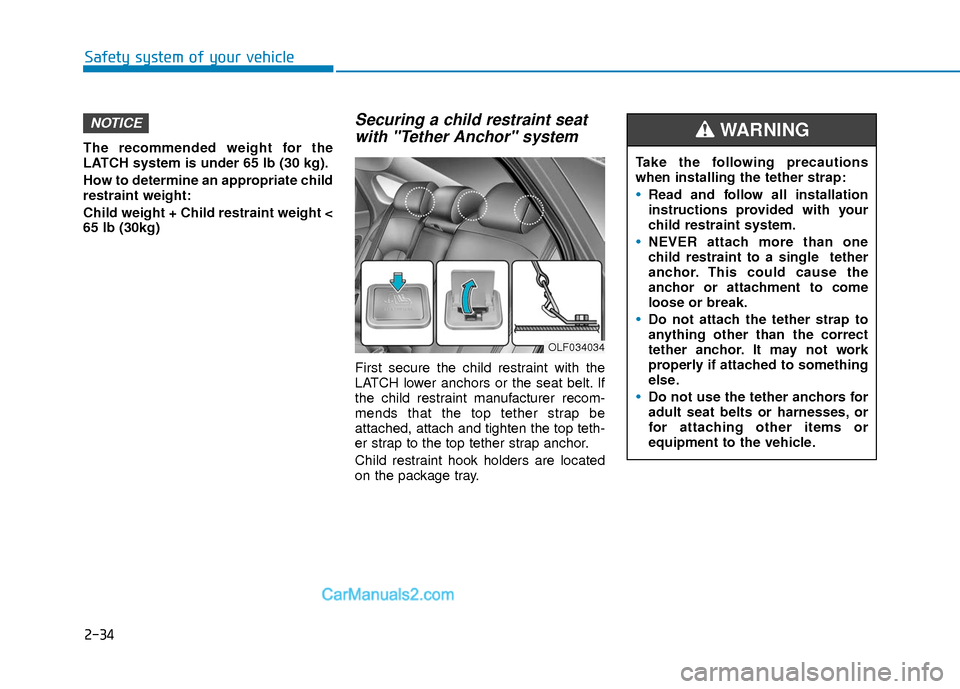
First secure the child restraint with the
LATCH lower anchors or the seat belt. If
the child restraint manufacturer recom-
mends that the top tether strap be
attached, attach and tighten the top teth-
er strap to the top tether strap anchor.
Child restraint hook holders are located
on the package tray.
NOTICE
OLF034034
Take the following precautions
when installing the tether strap:
Read and follow all installation
instructions provided with your
child restraint system.
NEVER attach more than one
child restraint to a single tether
anchor. This could cause the
anchor or attachment to come
loose or break.
Do not attach the tether strap to
anything other than the correct
tether anchor. It may not work
properly if attached to something
else.
Do not use the tether anchors for
adult seat belts or harnesses, or
for attaching other items or
equipment to the vehicle.
WARNING
Page 66 of 526
2-49
Safety system of your vehicle
2
Always be sure that you and all vehicle
occupants are seated properly and wear-
ing the seat belt properly for the most
effective protection by the air bag and the
seat belt.
The OCS may not function properly if the
passenger takes actions which can affect
the classification system. These include:
Failing to sit in an upright position.
Leaning against the door or centerconsole.
Sitting towards the sides of the front of the seat.
Putting their legs on the dashboard or resting them on other locations which
reduce the passenger weight on the
front seat.
Wearing the seat belt improperly.
Reclining the seatback.
Wearing a thick cloth like ski wear or hip protection wear.
Putting an additional thick cushion on the seat.
Putting electrical devices (e.g. note- book, satellite radio) on the seat with
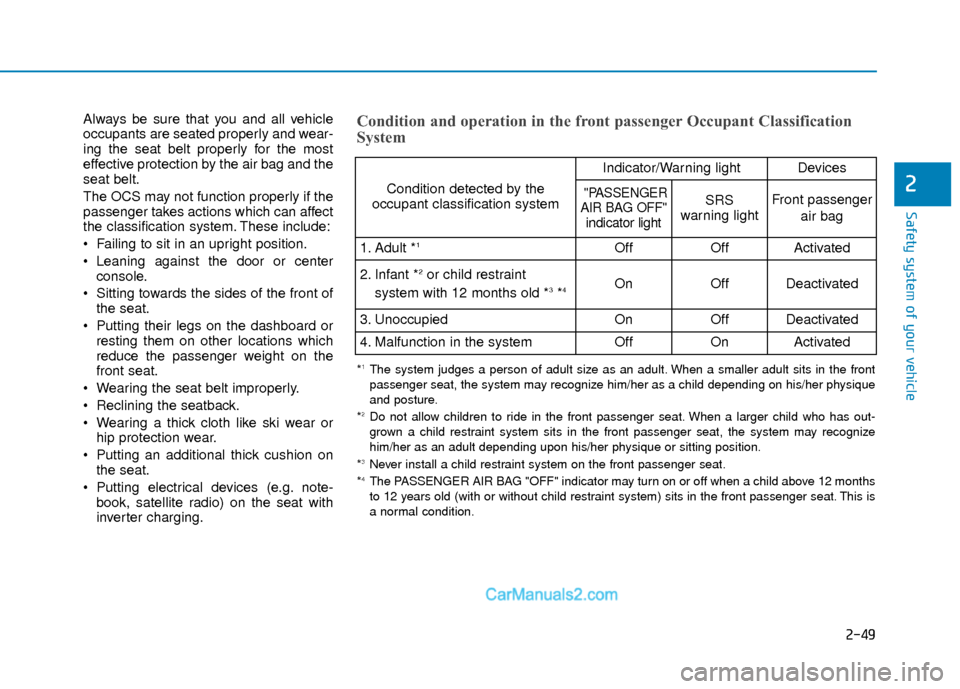
inverter charging.Condition and operation in the front passenger Occupant Classification
System
Condition detected by the
occupant classification system
Indicator/Warning lightDevices
"PASSENGER
AIR BAG OFF" indicator lightSRS
warning lightFront passenger
air bag
1. Adult *1OffOffActivated
2. Infant *2or child restraint
system with 12 months old *3*4 OnOffDeactivated
3. Unoccupied OnOffDeactivated
4. Malfunction in the systemOffOnActivated
*1The system judges a person of adult size as an adult. When a smaller adult sits in the front
passenger seat, the system may recognize him/her as a child depending on his/her physique
and posture.
*
2Do not allow children to ride in the front passenger seat. When a larger child who has out- grown a child restraint system sits in the front passenger seat, the system may recognize
him/her as an adult depending upon his/her physique or sitting position.
*
3Never install a child restraint system on the front passenger seat.
*4The PASSENGER AIR BAG "OFF" indicator may turn on or off when a child above 12 months
to 12 years old (with or without child restraint system) sits in the front passenger seat. This is
a normal condition.
Page 67 of 526
2-50
Safety system of your vehicle
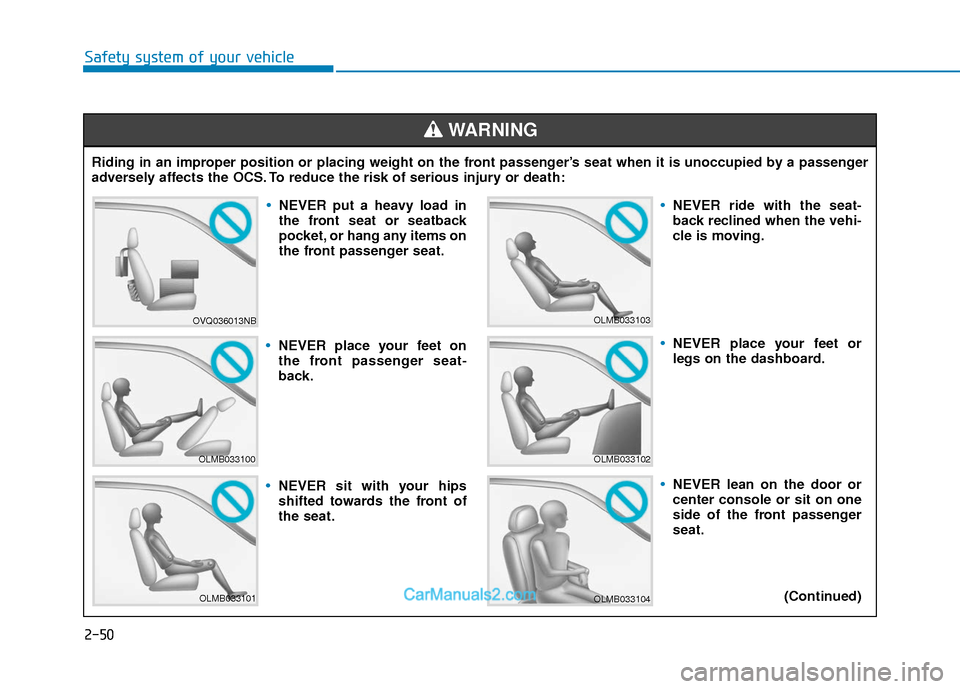
Riding in an improper position or placing weight on the front passenger’s seat when it is unoccupied by a passenger
adversely affects the OCS. To reduce the risk of serious injury or death:
WARNING
OVQ036013NB
OLMB033100
OLMB033101
OLMB033103
OLMB033102
OLMB033104
NEVER put a heavy load in
the front seat or seatback
pocket, or hang any items on
the front passenger seat.
NEVER place your feet on
the front passenger seat-
back.
NEVER sit with your hips
shifted towards the front of
the seat.
NEVER ride with the seat-
back reclined when the vehi-
cle is moving.
NEVER place your feet or
legs on the dashboard.
NEVER lean on the door or
center console or sit on one
side of the front passenger
seat.(Continued)
Page 375 of 526
5-92
Driving your vehicle
Winter Precautions
Use high quality ethylene glycolcoolant
Your vehicle is delivered with high quality
ethylene glycol coolant in the cooling
system. It is the only type of coolant that
should be used because it helps prevent
corrosion in the cooling system, lubri-
cates the water pump and prevents
freezing. Be sure to replace or replenish
your coolant in accordance with the
maintenance schedule in chapter 7.
Before winter, have your coolant tested to
assure that its freezing point is sufficient
for the temperatures anticipated during
the winter.
Change to "winter weight" oil ifnecessary
In some climates it is recommended that
a lower viscosity "winter weight" oil be
used during cold weather. See chapter 8
for recommendations. If you aren't sure
what weight oil you should use, consult
an authorized HYUNDAI dealer.
Check battery and cables
Winter puts additional burdens on the
battery system. Visually inspect the bat-
tery and cables as described in chapter
7. The level of charge in your battery can
be checked by an authorized HYUNDAI
dealer or a service station.
Check spark plugs and ignitionsystem
Inspect your spark plugs as described in
chapter 7 and replace them if necessary.
Also check all ignition wiring and compo-
nents to be sure they are not cracked,
worn or damaged in any way.
Use approved window washeranti-freeze in system
To keep the water in the window washer
system from freezing, add an approved
window washer anti-freeze solution in
accordance with instructions on the con-
tainer. Window washer anti-freeze is
available from an authorized HYUNDAI
dealer and most auto parts outlets. Do
not use engine coolant or other types of
anti-freeze as these may damage the
paint finish.
Do not let your parking brakefreeze
Under some conditions your parking
brake can freeze in the engaged position.
This is most likely to happen when there
is an accumulation of snow or ice around
or near the rear brakes or if the brakes
are wet. If there is a risk the parking
brake may freeze, apply it only temporar-
ily while you put the gear selector lever in
P and block the rear wheels so the car
cannot roll. Then release the parking
brake.
Do not let ice and snow accu-mulate underneath
Under some conditions, snow and ice
can build up under the fenders and inter-
fere with the steering. When driving in
severe winter conditions where this may
happen, you should periodically check
underneath the car to be sure the move-
ment of the front wheels and the steering
components is not obstructed.
Page 376 of 526
5-93
Driving your vehicle
V
VE
EH
H I
IC
C L
LE
E
L
L O
O A
AD
D
L
L I
IM
M I
IT
T
5
Don't place foreign objects or
materials in the engine com-partment
Placement of foreign object or materials
which prevent cooling of the engine, in
the engine compartment, may cause a
failure or combustion. The manufacturer
is not responsible for the damage caused
by such placement.
To keep locks from freezing
To keep the locks from freezing, squirt an
approved de-icer fluid or glycerine into
the key opening. If a lock is covered with
ice, squirt it with an approved de-icing
fluid to remove the ice. If the lock is
frozen internally, you may be able to thaw
it out by using a heated key. Handle the
heated key with care to avoid injury.
Two labels on your driver's door sill
show how much weight your vehicle
was designed to carry: the Tire and
Loading Information Label and the
Certification Label.
Before loading your vehicle, familiar-
ize yourself with the following terms
for determining your vehicle’s weight
ratings, from the vehicle's specifica-
tions and the Certification Label:
Base Curb Weight
This is the weight of the vehicle
including a full tank of fuel and all
standard equipment. It does not
include passengers, cargo, or option-
al equipment.
Vehicle Curb Weight
This is the weight of your new vehicle
when you picked it up from your deal-
er plus any aftermarket equipment.
Cargo Weight
This figure includes all weight added
to the Base Curb Weight, including
cargo and optional equipment. GAW (Gross Axle Weight)
This is the total weight placed on
each axle (front and rear) - including
vehicle curb weight and all payload.
GAWR (Gross Axle Weight Rating)
This is the maximum allowable
weight that can be carried by a single
axle (front or rear). These numbers
are shown on the Certification Label.
The total load on each axle must
never exceed its GAWR.
GVW (Gross Vehicle Weight)
This is the Base Curb Weight plus
actual Cargo Weight plus passen-
gers.
GVWR (Gross Vehicle Weight
Rating)
This is the maximum allowable
weight of the fully loaded vehicle
(including all options, equipment,
passengers and cargo). The GVWR
is shown on the Certification Label
located on the driver’s door sill.
Page 377 of 526
5-94
Driving your vehicle
OAD055111N/OAD055110N/OAD055109N/OAD055108N
■ Type A
■ Type B
■ Type C
■ Type D
The label located on the driver's door sill gives the original tire size, cold
tire pressures recommended for your vehicle, the number of people that
can be in your vehicle and vehicle capacity weight.
Tire Loading Information LabelVehicle capacity weight
849 lbs. (385 kg)
Vehicle capacity weight is the maxi-
mum combined weight of occupants
and cargo. If your vehicle is equipped
with a trailer, the combined weight
includes the tongue load.
Seating capacity
Total : 5 persons (Front seat : 2 persons,
Rear seat : 3 persons)
Seating capacity is the maximum
number of occupants including a
driver, your vehicle may carry.
However, the seating capacity may
be reduced based upon the weight of
all of the occupants, and the weight
of the cargo being carried or towed.
Do not overload the vehicle as there
is a limit to the total weight, or load
limit including occupants and cargo,
the vehicle can carry.
Towing capacity
We do not recommend using this
vehicle for trailer towing.