Rear HYUNDAI ELANTRA 2021 User Guide
[x] Cancel search | Manufacturer: HYUNDAI, Model Year: 2021, Model line: ELANTRA, Model: HYUNDAI ELANTRA 2021Pages: 570, PDF Size: 52.21 MB
Page 39 of 570
3-8
Reclining seatback
Sitting in a reclined position when the
vehicle is in motion can be dangerous.
Even when buckled up, the protection of
your restraint system (seat belts and air
bags) is greatly reduced by reclining your
seatback.
WARNING
NEVER ride with a reclined seatback
when the vehicle is moving. Riding
with a reclined seatback increases your
chance of serious or fatal injuries in
the event of a collision or sudden stop.
Driver and passengers should ALWAYS
sit well back in their seats, properly
belted, and with the seatbacks upright.
Seat belts must be snug against your hips
and chest to work properly. When the
seatback is reclined, the shoulder belt
cannot do its job because it will not be
snug against your chest. Instead, it will
be in front of you. During an accident,
you could be thrown into the seat belt,
causing neck or other injuries. The more
the seatback is reclined, the greater
chance the passenger’s hips will slide
under the lap belt or the passenger’s
neck will strike the shoulder belt.OCN7030007
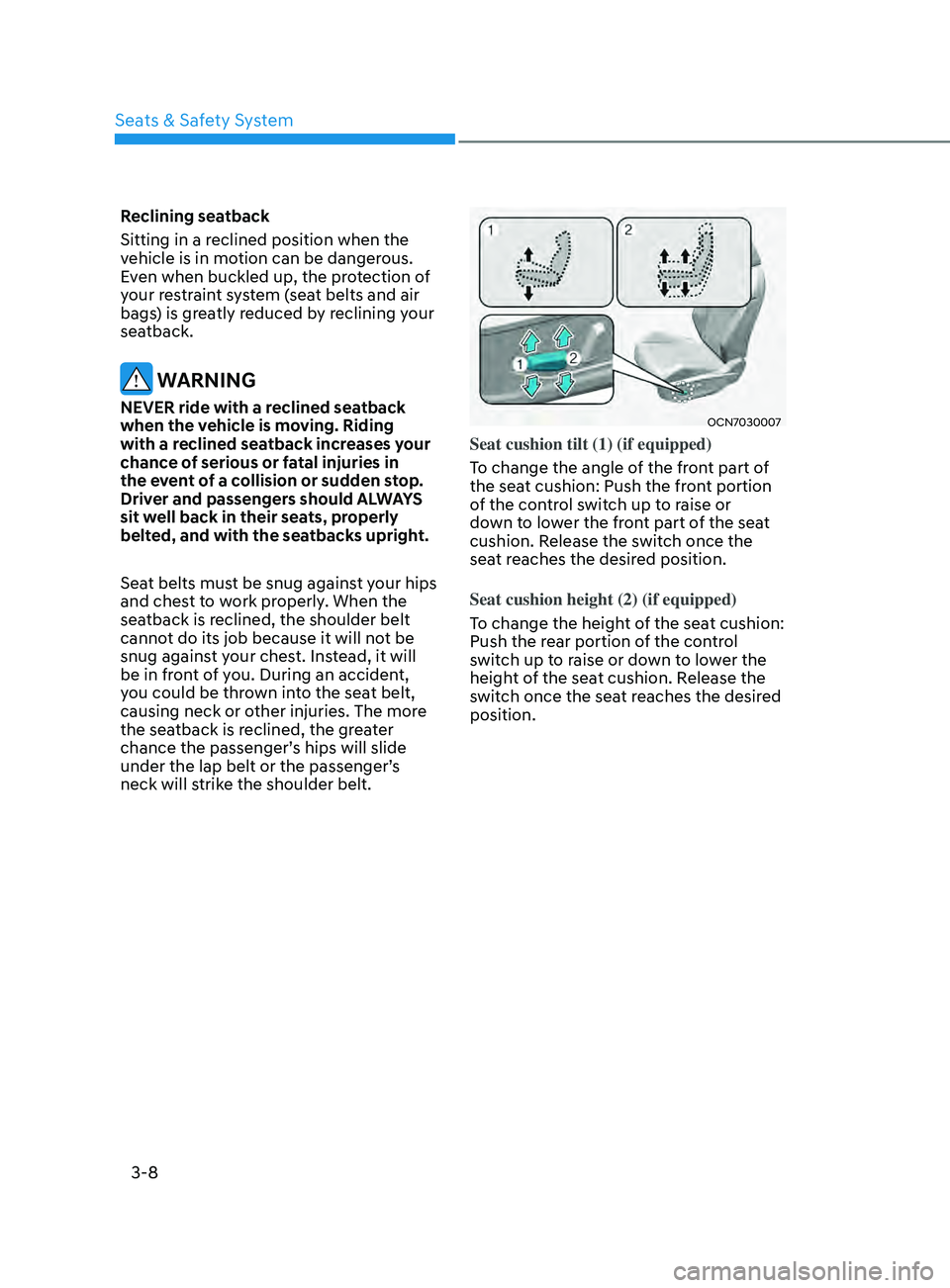
Seat cushion tilt (1) (if equipped)
To change the angle of the front part of
the seat cushion: Push the front portion
of the control switch up to raise or
down to lower the front part of the seat
cushion. Release the switch once the
seat reaches the desired position.
Seat cushion height (2) (if equipped)
To change the height of the seat cushion:
Push the rear portion of the control
switch up to raise or down to lower the
height of the seat cushion. Release the
switch once the seat reaches the desired
position.
Seats & Safety System
Page 40 of 570
03
3-9
OCN7030008
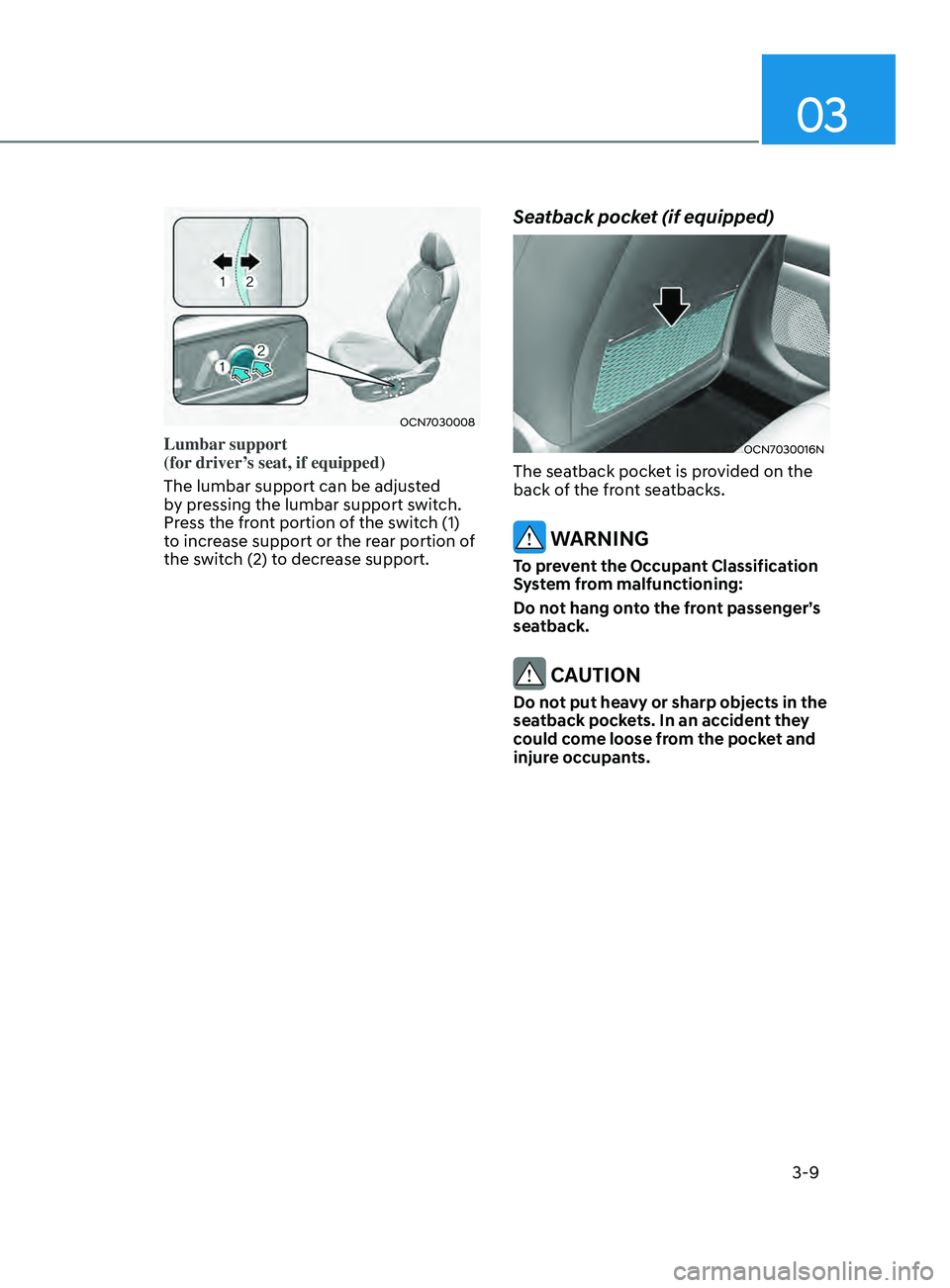
Lumbar support
(for driver’s seat, if equipped)
The lumbar support can be adjusted
by pressing the lumbar support switch.
Press the front portion of the switch (1)
to increase support or the rear portion of
the switch (2) to decrease support.
Seatback pocket (if equipped)
OCN7030016N
The seatback pocket is provided on the
back of the front seatbacks.
WARNING
To prevent the Occupant Classification
System from malfunctioning:
Do not hang onto the front passenger’s
seatback.
CAUTION
Do not put heavy or sharp objects in the
seatback pockets. In an accident they
could come loose from the pocket and
injure occupants.
Page 41 of 570
3-10
Rear Seats
Folding the rear seat (if equipped)
The rear seatbacks can be folded to
facilitate carrying long items or to
increase the luggage capacity of the
vehicle.
WARNING
• Never allow passengers to sit on top
of the folded down seatback while
the vehicle is moving. This is not a
proper seating position and no seat
belts are available for use. This could
result in serious injury or death in
case of an accident or sudden stop.
• Objects carried on the folded down
seatback should not extend higher
than the top of the front seatbacks.
This could allow cargo to slide
forward and cause injury or damage
during sudden stops.
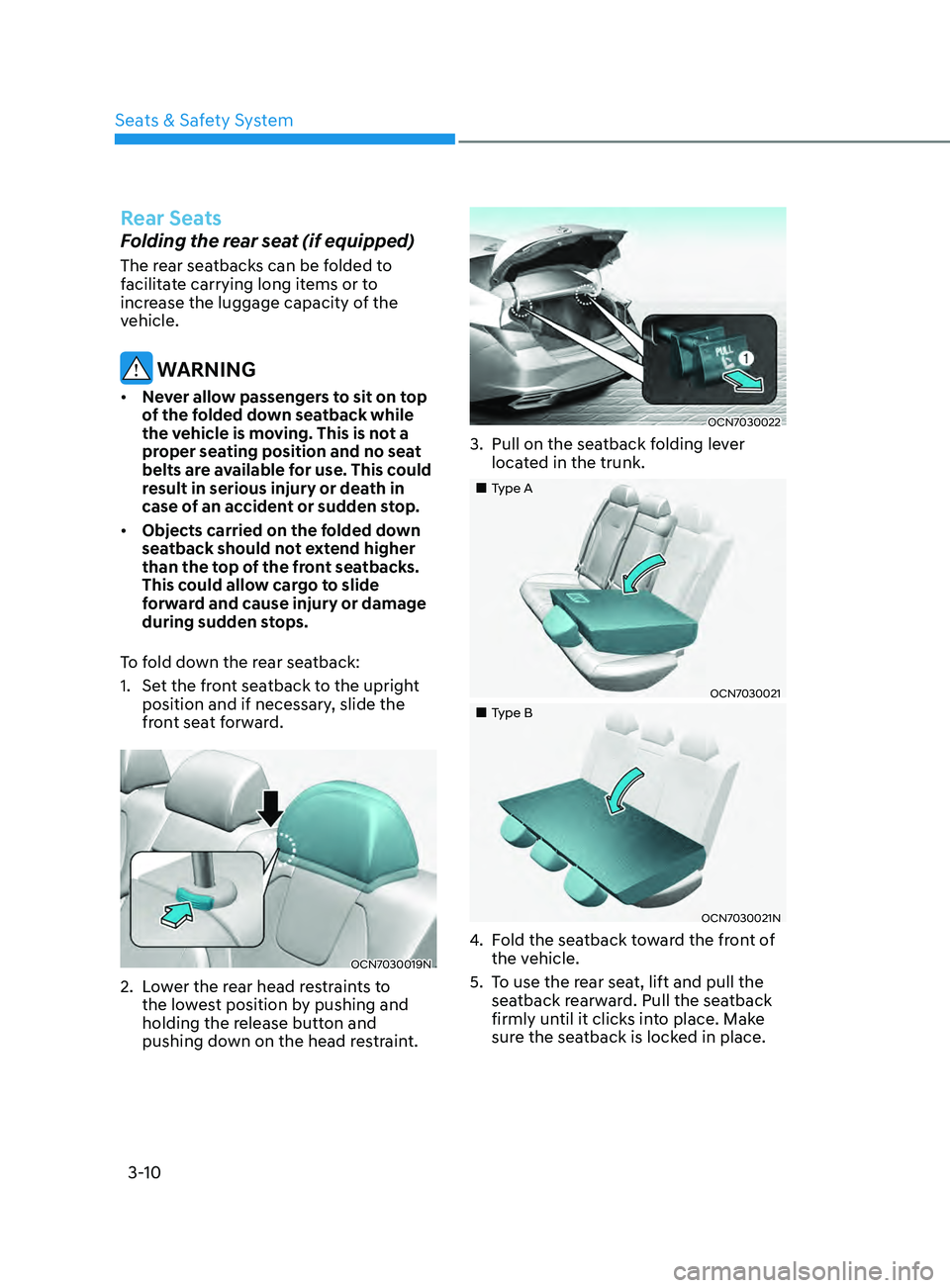
To fold down the rear seatback:
1.
Set the fr
ont seatback to the upright
position and if necessary, slide the
front seat forward.
OCN7030019N
2. Lower the rear head restraints to
the lo west position by pushing and
holding the release button and
pushing down on the head restraint.
OCN7030022
3. Pull on the seatback f olding lever
located in the trunk.
„„Type A
OCN7030021
„„Type B
OCN7030021N
4. Fold the seatback toward the front of
the v ehicle.
5.
To use the r
ear seat, lift and pull the
seatback rearward. Pull the seatback
firmly until it clicks into place. Make
sure the seatback is locked in place.
Seats & Safety System
Page 42 of 570
03
3-11
WARNING
When returning the rear seatback from
a folded to an upright position, hold the
seatback and return it slowly. Ensure
that the seatback is completely locked
into its upright position by pushing on
the top of the seatback. In an accident
or sudden stop, an unlocked seatback
could allow cargo to move forward with
great force and enter the passenger
compartment, which could result in
serious injury or death.
WARNING
Do not place objects in the rear seats,
since they cannot be properly secured
and may hit vehicle occupants in a
collision causing serious injury or death.
WARNING
Make sure the vehicle is off, the shift
button is in P (Park), and the parking
brake is securely applied whenever
loading or unloading cargo. Failure
to take these steps may allow the
vehicle to move if the shift button
is inadvertently moved to another
position.
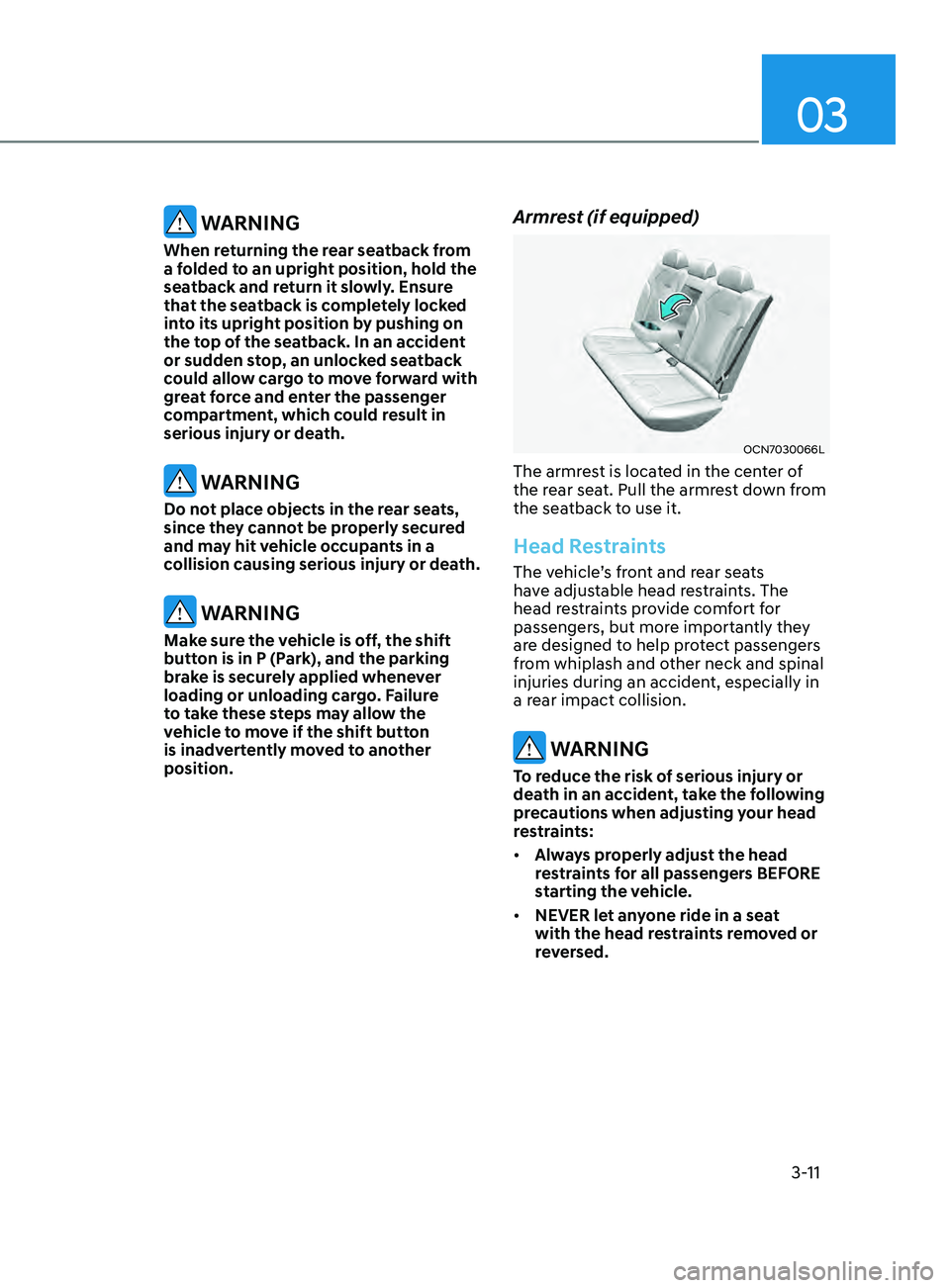
Armrest (if equipped)
OCN7030066L
The armrest is located in the center of
the rear seat. Pull the armrest down from
the seatback to use it.
Head Restraints
The vehicle’s front and rear seats
have adjustable head restraints. The
head restraints provide comfort for
passengers, but more importantly they
are designed to help protect passengers
from whiplash and other neck and spinal
injuries during an accident, especially in
a rear impact collision.
WARNING
To reduce the risk of serious injury or
death in an accident, take the following
precautions when adjusting your head
restraints:
• Always properly adjust the head
restraints for all passengers BEFORE
starting the vehicle.
• NEVER let anyone ride in a seat
with the head restraints removed or
reversed.
Page 43 of 570
3-12
OLF034072N
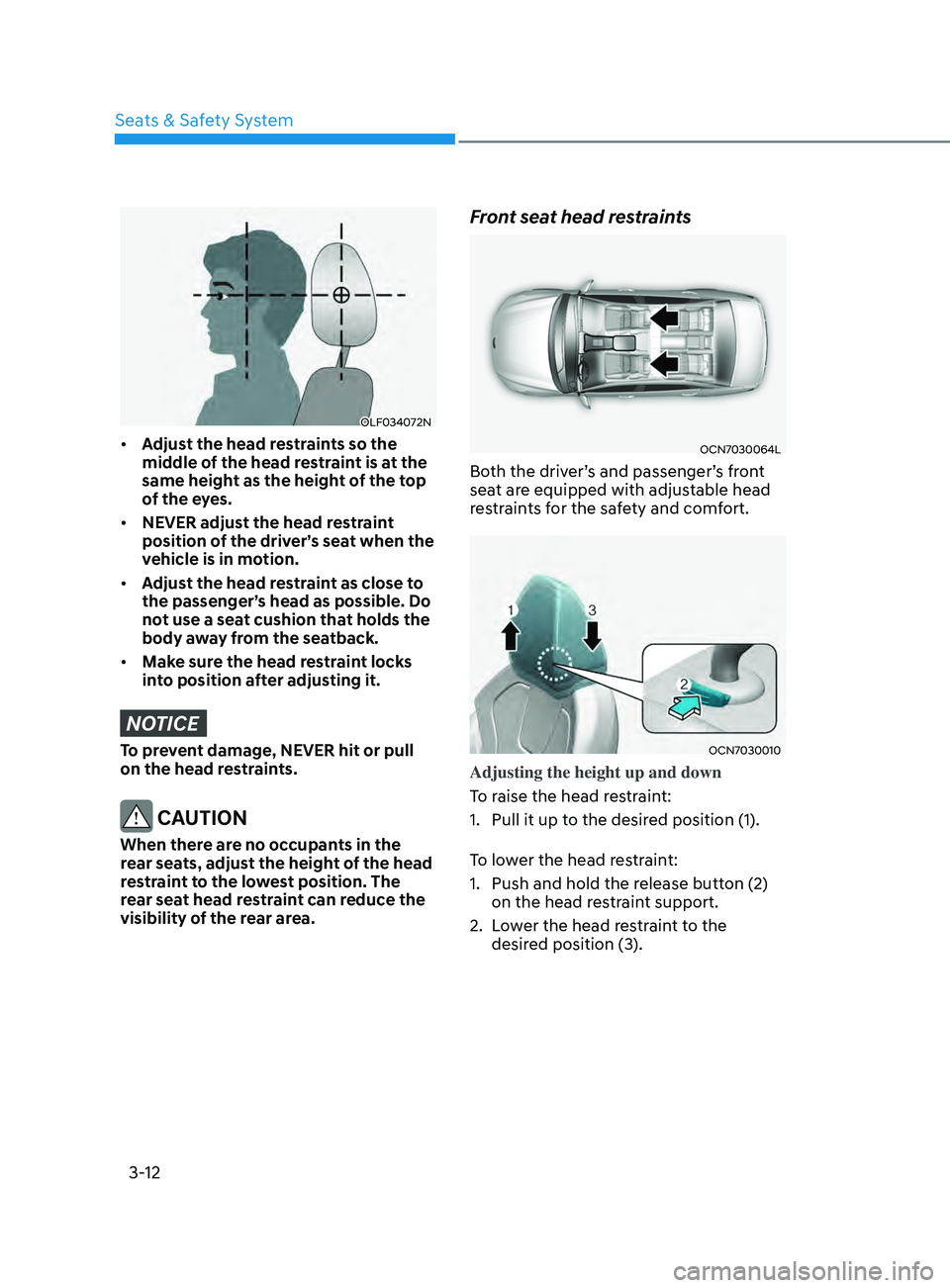
• Adjust the head restraints so the
middle of the head restraint is at the
same height as the height of the top
of the eyes.
• NEVER adjust the head restraint
position of the driver’s seat when the
vehicle is in motion.
• Adjust the head restraint as close to
the passenger’s head as possible. Do
not use a seat cushion that holds the
body away from the seatback.
• Make sure the head restraint locks
into position after adjusting it.
NOTICE
To prevent damage, NEVER hit or pull
on the head restraints.
CAUTION
When there are no occupants in the
rear seats, adjust the height of the head
restraint to the lowest position. The
rear seat head restraint can reduce the
visibility of the rear area.
Front seat head restraints
OCN7030064L
Both the driver’s and passenger’s front
seat are equipped with adjustable head
restraints for the safety and comfort.
OCN7030010
Adjusting the height up and down
To raise the head restraint:
1.
Pull it up to the desir
ed position (1).
To lower the head restraint:
1.
Push and hold the release butt
on (2)
on the head restraint support.
2.
Lo
wer the head restraint to the
desired position (3).
Seats & Safety System
Page 44 of 570
03
3-13
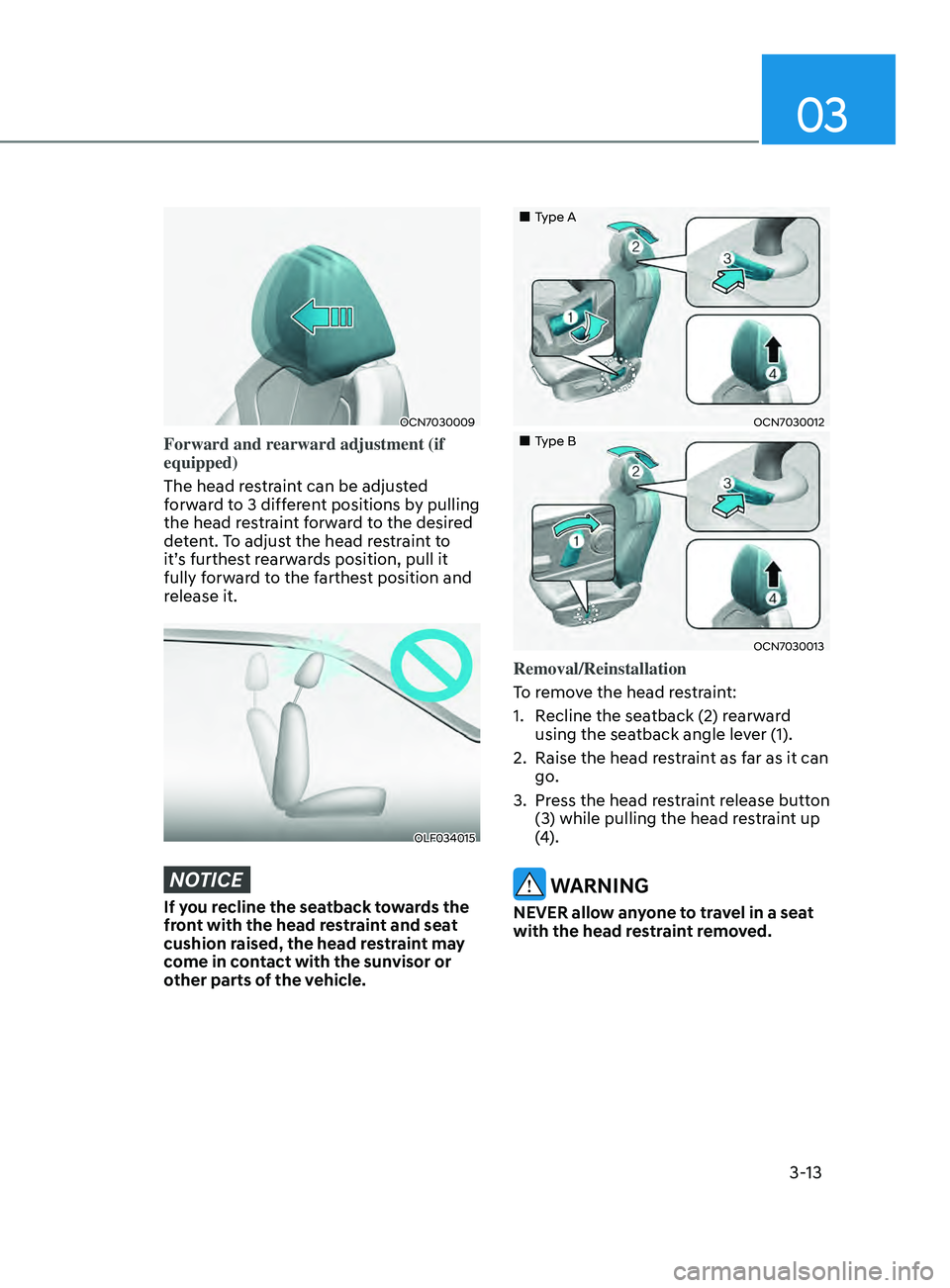
OCN7030009
Forward and rearward adjustment (if
equipped)
The head restraint can be adjusted
forward to 3 different positions by pulling
the head restraint forward to the desired
detent. To adjust the head restraint to
it’s furthest rearwards position, pull it
fully forward to the farthest position and
release it.
OLF034015
NOTICE
If you recline the seatback towards the
front with the head restraint and seat
cushion raised, the head restraint may
come in contact with the sunvisor or
other parts of the vehicle.
„„Type A
OCN7030012
„„Type B
OCN7030013
Removal/Reinstallation
To remove the head restraint:
1.
Recline the sea
tback (2) rearward
using the seatback angle lever (1).
2.
Raise the head res
traint as far as it can
go.
3.
Press the head r
estraint release button
(3) while pulling the head restraint up
(4).
WARNING
NEVER allow anyone to travel in a seat
with the head restraint removed.
Page 45 of 570
3-14
„„Type A
OCN7030014
„„Type B
OCN7030015
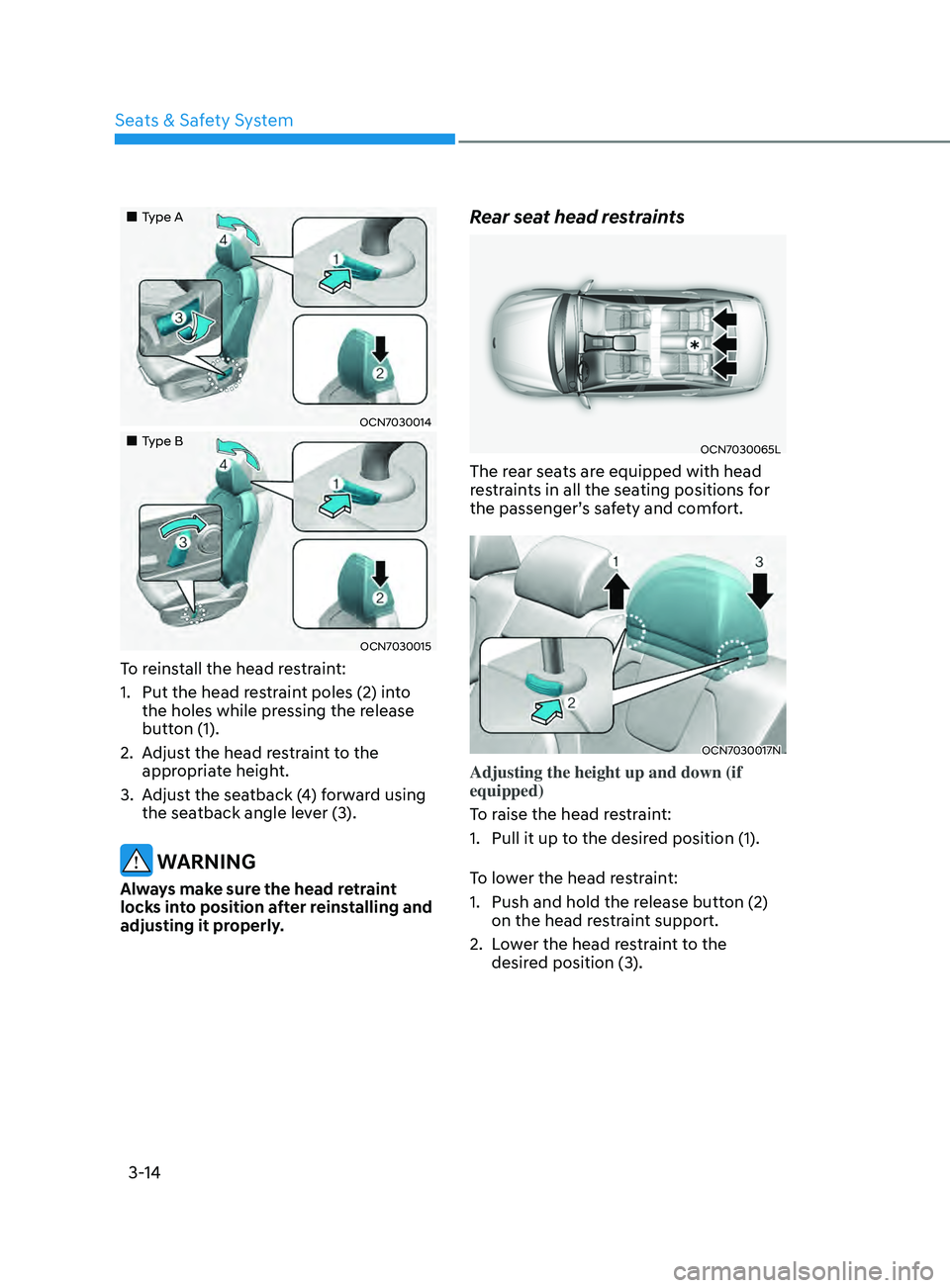
To reinstall the head restraint:
1.
Put the head res
traint poles (2) into
the holes while pressing the release
button (1).
2.
Adjus
t the head restraint to the
appropriate height.
3.
Adjus
t the seatback (4) forward using
the seatback angle lever (3).
WARNING
Always make sure the head retraint
locks into position after reinstalling and
adjusting it properly.
Rear seat head restraints
OCN7030065L
The rear seats are equipped with head
restraints in all the seating positions for
the passenger’s safety and comfort.
OCN7030017N
Adjusting the height up and down (if
equipped)
To raise the head restraint:
1.
Pull it up to the desir
ed position (1).
To lower the head restraint:
1.
Push and hold the release butt
on (2)
on the head restraint support.
2.
Lo
wer the head restraint to the
desired position (3).
Seats & Safety System
Page 48 of 570
03
3-17
Seat BeltS
This section describes how to use the
seat belts properly. It also describes
some of the things to avoid when using
seat belts.
Seat Belt Safety Precautions
Always fasten your seat belt and make
sure all passengers have fastened their
seat belts before starting any trip. Air
bags are designed to supplement the
seat belt as an additional safety device,
but they are not a substitute. Most states
require all occupants of a vehicle to wear
seat belts.
WARNING
Seat belts must be used by ALL
passengers whenever the vehicle is
moving. Take the following precautions
when adjusting and wearing seat belts:
• ALWAYS properly restrain children
under age 13 in the rear seats.
• NEVER allow children to ride in the
front passenger seat. If a child age 13
or older must be seated in the front
seat, move the seat as far back as
possible and properly restrain them
in the seat.
• NEVER allow an infant or child to be
carried on an occupant’s lap.
• NEVER ride with the seatback
reclined when the vehicle is moving.
• Do not allow children to share a seat
or seat belt.
• Do not wear the shoulder belt under
your arm or behind your back.
• Always wear both the shoulder
portion and lap portion of the lap/
shoulder belt.
• Do not use the seat belt if it is
twisted. A twisted seat belt will not
protect you properly in an accident.
• Do not use a seat belt if the webbing
or hardware is damaged. •
Do not latch the seat belt into the
buckles of other seats.
• NEVER unfasten the seat belt
while driving. This may cause loss
of vehicle control resulting in an
accident.
• Make sure there is nothing in the
buckle interfering with the seat belt
latch mechanism. This may prevent
the seat belt from fastening securely.
• No modifications or additions
should be made by the user which
will either prevent the seat belt
adjusting devices from operating to
remove slack, or prevent the seat
belt assembly from being adjusted to
remove slack.
WARNING
Damaged seat belts and seat belt
assemblies will not operate properly.
Always replace:
• Frayed, contaminated, or damaged
webbing
• Damaged hardware
• The entire seat belt assembly after it
has been worn in an accident, even
if damage to webbing or assembly is
not apparent
Page 51 of 570
3-20
OHI038142
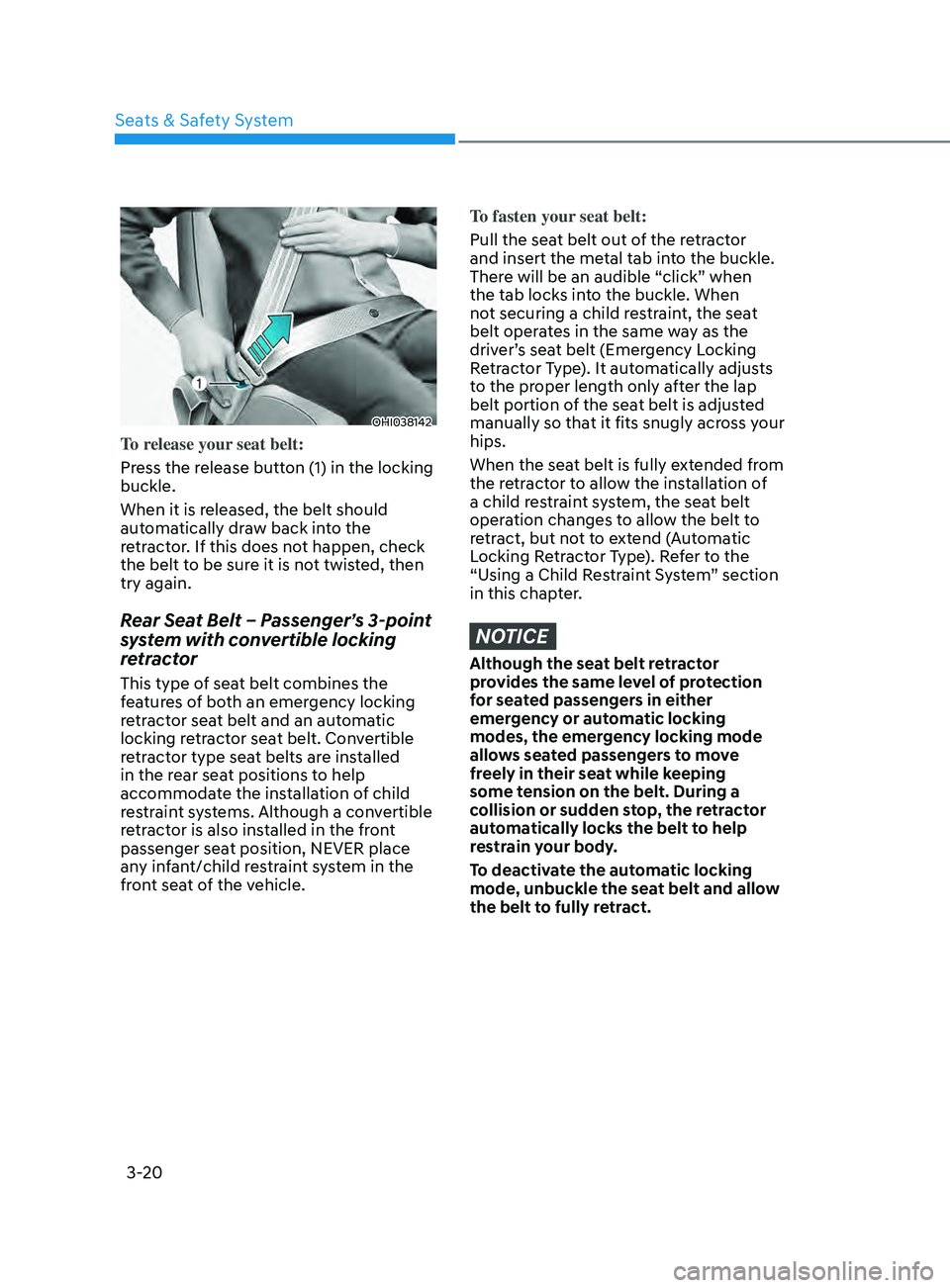
To release your seat belt:
Press the release button (1) in the locking
buckle.
When it is released, the belt should
automatically draw back into the
retractor. If this does not happen, check
the belt to be sure it is not twisted, then
try again.
Rear Seat Belt – Passenger’s 3-point
system with convertible locking
retractor
This type of seat belt combines the
features of both an emergency locking
retractor seat belt and an automatic
locking retractor seat belt. Convertible
retractor type seat belts are installed
in the rear seat positions to help
accommodate the installation of child
restraint systems. Although a convertible
retractor is also installed in the front
passenger seat position, NEVER place
any infant/child restraint system in the
front seat of the vehicle.
To fasten your seat belt:
Pull the seat belt out of the retractor
and insert the metal tab into the buckle.
There will be an audible “click” when
the tab locks into the buckle. When
not securing a child restraint, the seat
belt operates in the same way as the
driver’s seat belt (Emergency Locking
Retractor Type). It automatically adjusts
to the proper length only after the lap
belt portion of the seat belt is adjusted
manually so that it fits snugly across your
hips.
When the seat belt is fully extended from
the retractor to allow the installation of
a child restraint system, the seat belt
operation changes to allow the belt to
retract, but not to extend (Automatic
Locking Retractor Type). Refer to the
“Using a Child Restraint System” section
in this chapter.
NOTICE
Although the seat belt retractor
provides the same level of protection
for seated passengers in either
emergency or automatic locking
modes, the emergency locking mode
allows seated passengers to move
freely in their seat while keeping
some tension on the belt. During a
collision or sudden stop, the retractor
automatically locks the belt to help
restrain your body.
To deactivate the automatic locking
mode, unbuckle the seat belt and allow
the belt to fully retract.
Seats & Safety System
Page 52 of 570
03
3-21
Rear center seat belt
OCN7030027L
When using the rear center seat belt, the
buckle with the “CENTER” mark must be
used.
WARNING
Make sure that the seatback is locked in
place when using the rear center seat
belt.
If not, the seatback may move when
there is a sudden stop or collision,
which could result in serious injury.
Pre-tensioner seat belt
(Driver and front passenger)
OHI038143L
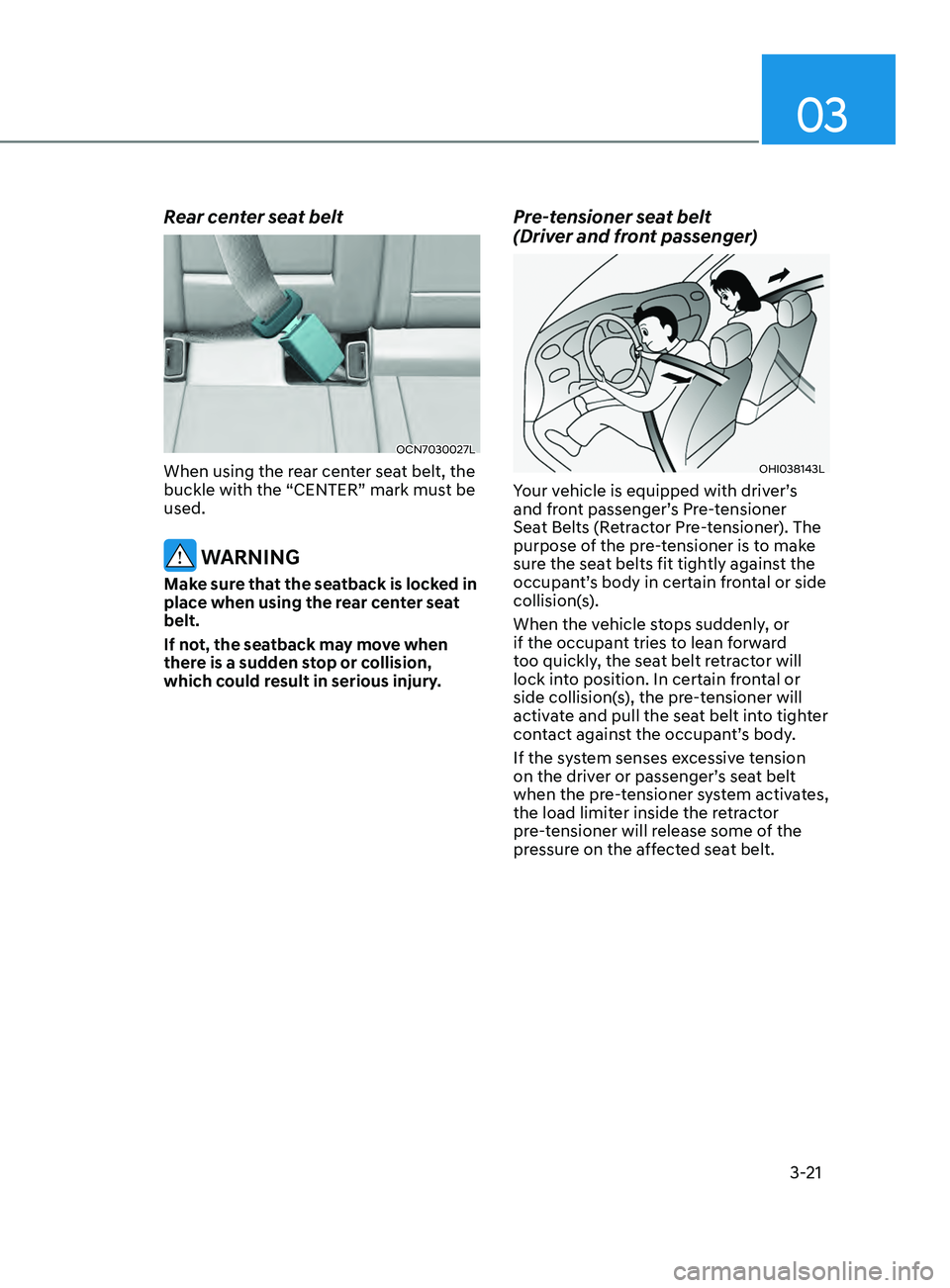
Your vehicle is equipped with driver’s
and front passenger’s Pre-tensioner
Seat Belts (Retractor Pre-tensioner). The
purpose of the pre-tensioner is to make
sure the seat belts fit tightly against the
occupant’s body in certain frontal or side
collision(s).
When the vehicle stops suddenly, or
if the occupant tries to lean forward
too quickly, the seat belt retractor will
lock into position. In certain frontal or
side collision(s), the pre-tensioner will
activate and pull the seat belt into tighter
contact against the occupant’s body.
If the system senses excessive tension
on the driver or passenger’s seat belt
when the pre-tensioner system activates,
the load limiter inside the retractor
pre-tensioner will release some of the
pressure on the affected seat belt.