Rear HYUNDAI ELANTRA 2021 Owners Manual
[x] Cancel search | Manufacturer: HYUNDAI, Model Year: 2021, Model line: ELANTRA, Model: HYUNDAI ELANTRA 2021Pages: 570, PDF Size: 52.21 MB
Page 18 of 570
2-3
02
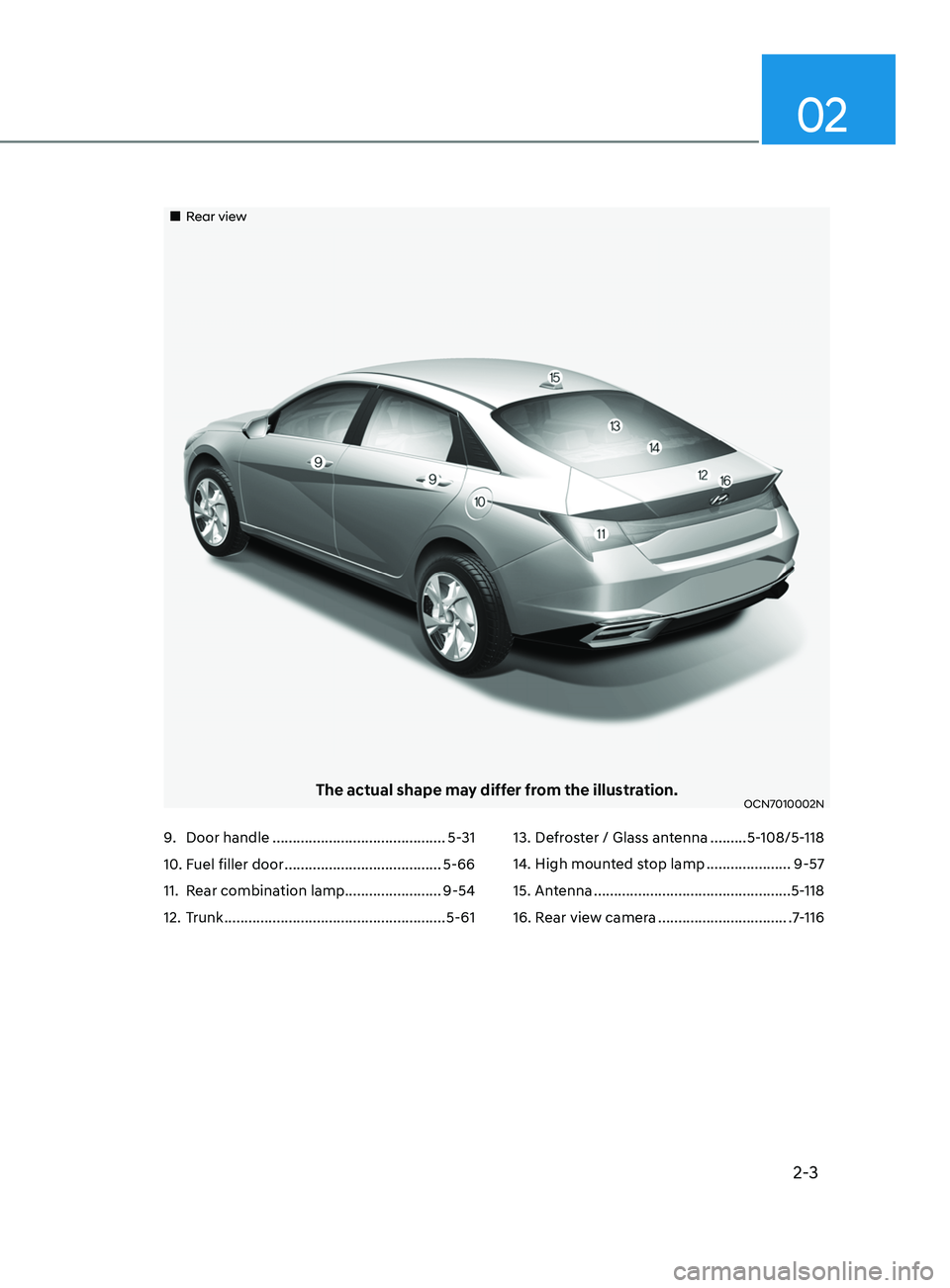
„„Rear view
The actual shape may differ from the illustration.OCN7010002N
9.Door handle ...........................................5-31
10 .
Fuel filler door ....................................... 5-66
11.
Rear combination lamp
........................ 9-54
12.
Trunk ....................................................... 5-6113.
Defros
ter / Glass antenna .........
5-108/5- 118
14.
High mounted s
top lamp
.....................9-57
15.
Antenna ................................................. 5-118
16.
Rear view camer
a
.................................7
-116
Page 22 of 570
02
2-7
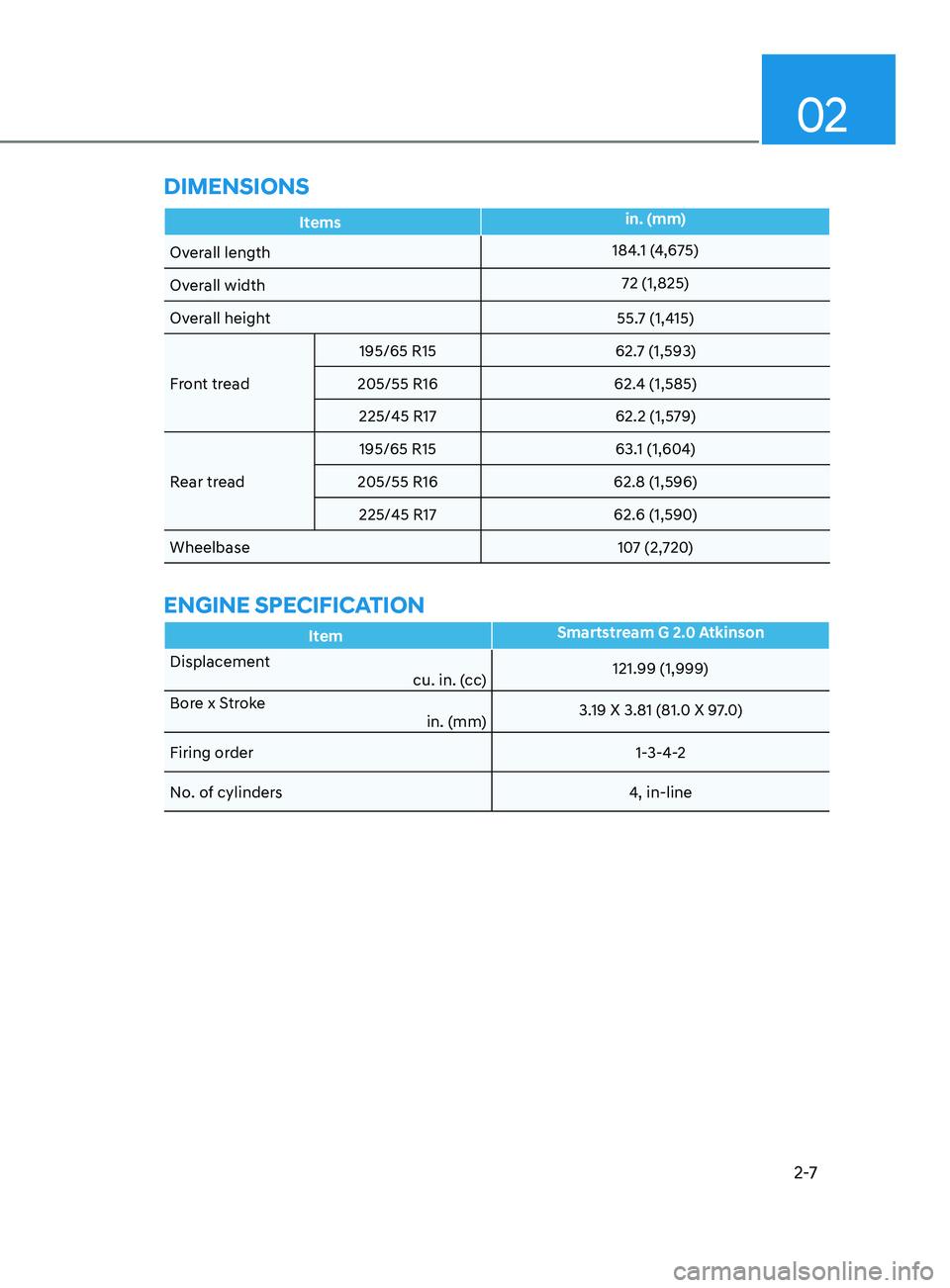
DimEnsions
Itemsin. (mm)
Overall length 184.1 (4,675)
Overall width 72 (1,825)
Overall height 55.7 (1,415)
Front tread 195/65 R15
62.7 (1,593)
205/55 R16 62.4 (1,585)
225/45 R17 62.2 (1,579)
Rear tread 195/65 R15
63.1 (1,604)
205/55 R16 62.8 (1,596)
225/45 R17 62.6 (1,590)
Wheelbase 107 (2,720)
EnginE sPECifiCation
ItemSmartstream G 2.0 Atkinson
Displacement cu. in. (cc) 121.99 (1,999)
Bore x Stroke in. (mm)3.19 X 3.81 (81.0 X 97.0)
Firing order 1-3-4-2
No. of cylinders 4, in-line
Page 23 of 570
Vehicle Information
2-8
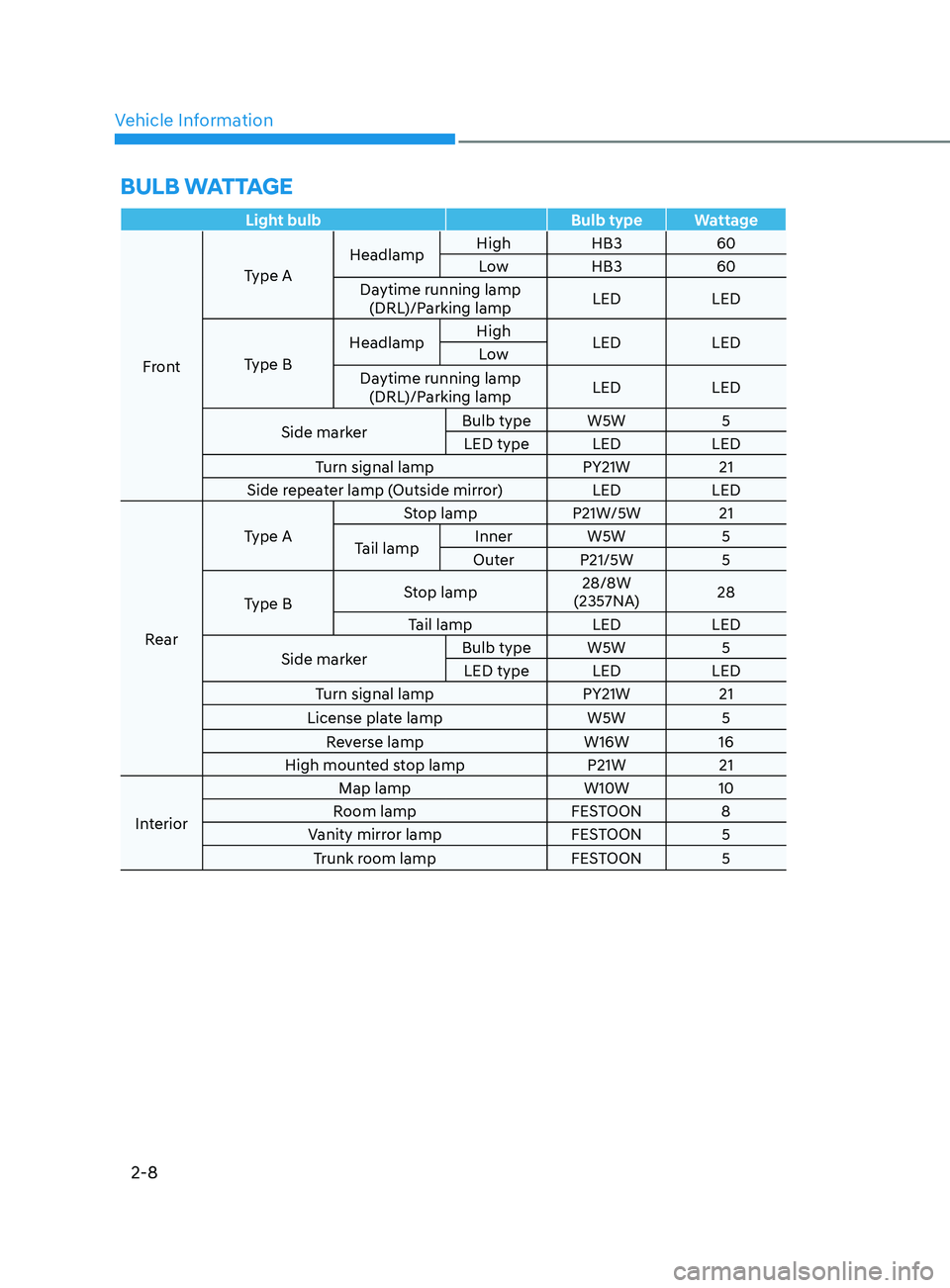
BulB wattagE
Light bulbBulb type Wattage
Front Type A
Headlamp
High HB3
60
Low HB3 60
Daytime running lamp (DRL)/Parking lamp LED
LED
Type B Headlamp
High
LED LED
Low
Daytime running lamp (DRL)/Parking lamp LED
LED
Side marker Bulb type W5W
5
LED type LED LED
Turn signal lamp PY21W21
Side repeater lamp (Outside mirror) LEDLED
Rear Type A
Stop lamp
P21W/5W 21
Tail lamp Inner W5W
5
Outer P21/5W 5
Type B Stop lamp
28/8W
(2357NA) 28
Tail lamp LEDLED
Side marker Bulb type W5W
5
LED type LED LED
Turn signal lamp PY21W21
License plate lamp W5W5
Reverse lamp W16W16
High mounted stop lamp P21W21
Interior Map lamp
W10W10
Room lamp FESTOON 8
Vanity mirror lamp FESTOON 5
Trunk room lamp FESTOON 5
Page 24 of 570
02
2-9
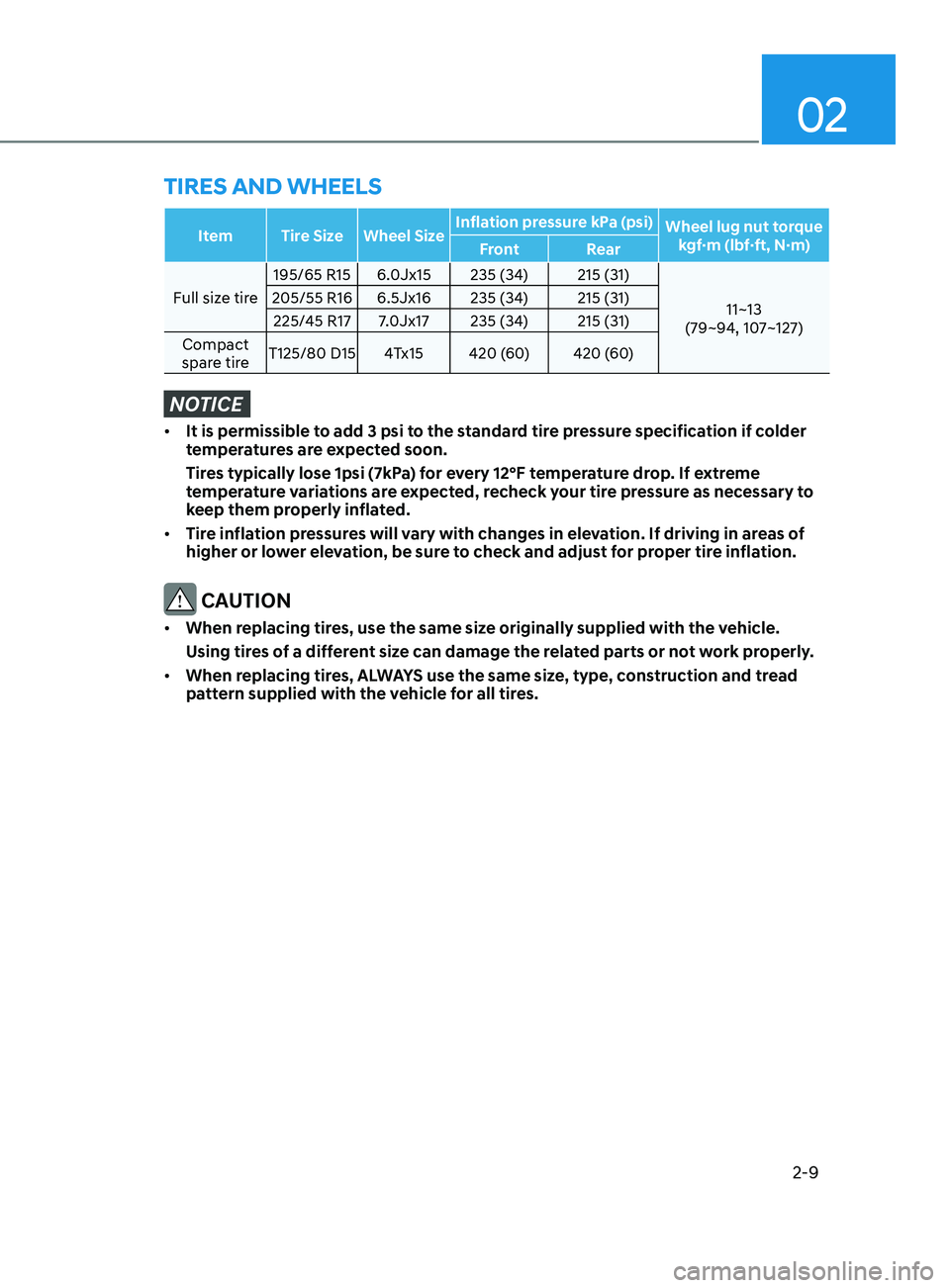
tirEs anD whEEls
Item Tire Size Wheel SizeInflation pressure kPa (psi)
Wheel lug nut torque
kgf·m (lbf·ft, N·m)
Front Rear
Full size tire 195/65 R15 6.0Jx15 235 (34) 215 (31)
11~13
(79~94, 107~127)
205/55 R16 6.5Jx16 235 (34) 215 (31)
225/45 R17 7.0Jx17 235 (34) 215 (31)
Compact
spare tire T125/80 D15 4Tx15 420 (60) 420 (60)
NOTICE
•
It is permissible to add 3 psi to the standard tire pressure specification if colder
temperatures are expected soon.
Tires typically lose 1psi (7kPa) for every 12°F temperature drop. If extreme
temperature variations are expected, recheck your tire pressure as necessary to
keep them properly inflated.
• Tire inflation pressures will vary with changes in elevation. If driving in areas of
higher or lower elevation, be sure to check and adjust for proper tire inflation.
CAUTION
•When replacing tires, use the same size originally supplied with the vehicle.
Using tires of a different size can damage the related parts or not work properly.
• When replacing tires, ALWAYS use the same size, type, construction and tread
pattern supplied with the vehicle for all tires.
Page 32 of 570
Safety System
3. Seats & Safety System
3
Important Safety Precautions ....................................................................... 3-2Always Wear Your Seat Belt ........................................................................\
............. 3-2
R estrain All Children ........................................................................\
......................... 3
-2
Air Bag Hazards
........................................................................\
................................ 3
-2
Driver Distraction
........................................................................\
............................. 3
-2
Control Your Speed
........................................................................\
.......................... 3
-2
Keep Your Vehicle in Safe Condition
....................................................................... 3-2
Seats ........................................................................\
....................................... 3-3Safety Precautions ........................................................................\
...........................3-4
Fr ont Seats ........................................................................\
..................................... ...3-5
Rear Seats
........................................................................\
........................................ 3-
10
Head Restraints
........................................................................\
................................ 3-
11
Seat Warmers
........................................................................\
.................................. 3-
15
Seat Belts ........................................................................\
...............................3-17Seat Belt Safety Precautions ........................................................................\
..........3-17
Sea t belt warning light ........................................................................\
.................... 3-
18
Seat Belt Restraint System
........................................................................\
............. 3-
18
Additional Seat Belt Safety Precautions
............................................................... 3-
23
Care of Seat Belts
........................................................................\
........................... 3-
25
Child Restraint System (CRS) ......................................................................3-26Children Always in the Rear ........................................................................\
........... 3-26
Selecting a Child R estraint System (CRS) .............................................................. 3-
27
Installing a Child Restraint System (CRS)
............................................................. 3-
28
Air Bag - Advanced Supplemental Restraint System ................................3-35Where Are the Air Bags? ........................................................................\
................ 3-37
H ow Does the Air Bag System Operate? ............................................................... 3-40
Wha
t to Expect After an Air Bag Inflates
.............................................................. 3-43
Occupan
t Classification System (OCS)
................................................................. 3-44
Wh
y Didn’t My Air Bag Go Off in a Collision?
....................................................... 3-50
SRS Car
e
........................................................................\
......................................... 3-54
A
dditional Safety Precautions
........................................................................\
....... 3-55
Air Bag W
arning Labels
........................................................................\
.................. 3-55
This chapter provides you with important information about how to protect yourself and your
passengers. It explains how to properly use your seats and seat belts, and how your air bags work.
Additionally, this chapter explains how to properly restrain infants and children in your vehicle.
Page 33 of 570
3-2
You will find many safety precautions
and recommendations throughout this
section, and throughout this manual.
The safety precautions in this section are
among the most important.
Always Wear Your Seat Belt
A seat belt is your best protection in all
types of accidents. Air bags are designed
to supplement seat belts, not replace
them. So even though your vehicle is
equipped with air bags, ALWAYS make
sure you and your passengers wear your
seat belts, and wear them properly.
Restrain All Children
All children under age 13 should ride
in your vehicle properly restrained in a
rear seat, not the front seat. Infants and
small children should be restrained in
an appropriate child restraint. Larger
children should use a booster seat with
the lap/shoulder belt until they can use
the seat belt properly without a booster
seat.
Air Bag Hazards
While air bags can save lives, they can
also cause serious or fatal injuries to
occupants who sit too close to them, or
who are not properly restrained. Infants,
young children, and shorter adults are at
the greatest risk of being injured by an
inflating air bag. Follow all instructions
and warnings in this manual.
Driver Distraction
Driver distraction presents a serious and
potentially deadly danger, especially for
inexperienced drivers. Safety should be
the first concern when behind the wheel,
and drivers need to be aware of the wide
array of potential distractions, such as
drowsiness, reaching for objects, eating,
personal grooming, other passengers,
and using cellular phones.Drivers can become distracted when
they take their eyes and attention off
the road or their hands off the wheel to
focus on activities other than driving. To
reduce your risk of distraction or getting
into an accident:
•
ALWAYS set up your mobile devices
(i.e., MP3 players, phones, navigation
units, etc.) when your vehicle is
parked or safely stopped.
• ONLY use your mobile device when
allowed by laws and when conditions
permit safe use. NEVER text or email
while driving. Most states have laws
prohibiting drivers from texting. Some
states and cities also prohibit drivers
from using handheld phones.
• NEVER let the use of a mobile device
distract you from driving. You have a
responsibility to your passengers and
others on the road to always drive
safely, with your hands on the wheel
as well as your eyes and attention on
the road.
Control Your Speed
Excessive speed is a major factor in crash
injuries and deaths. Generally, the higher
the speed, the greater the risk, but
serious injuries can also occur at lower
speeds. Never drive faster than is safe
for current conditions, regardless of the
maximum speed posted.
Keep Your Vehicle in Safe
Condition
Having a tire blowout or a mechanical
failure can be extremely hazardous. To
reduce the possibility of such problems,
check your tire pressures and condition
frequently, and perform all regularly
scheduled maintenance.
Important Safety precautIonS
Seats & Safety System
Page 34 of 570
3-3
03
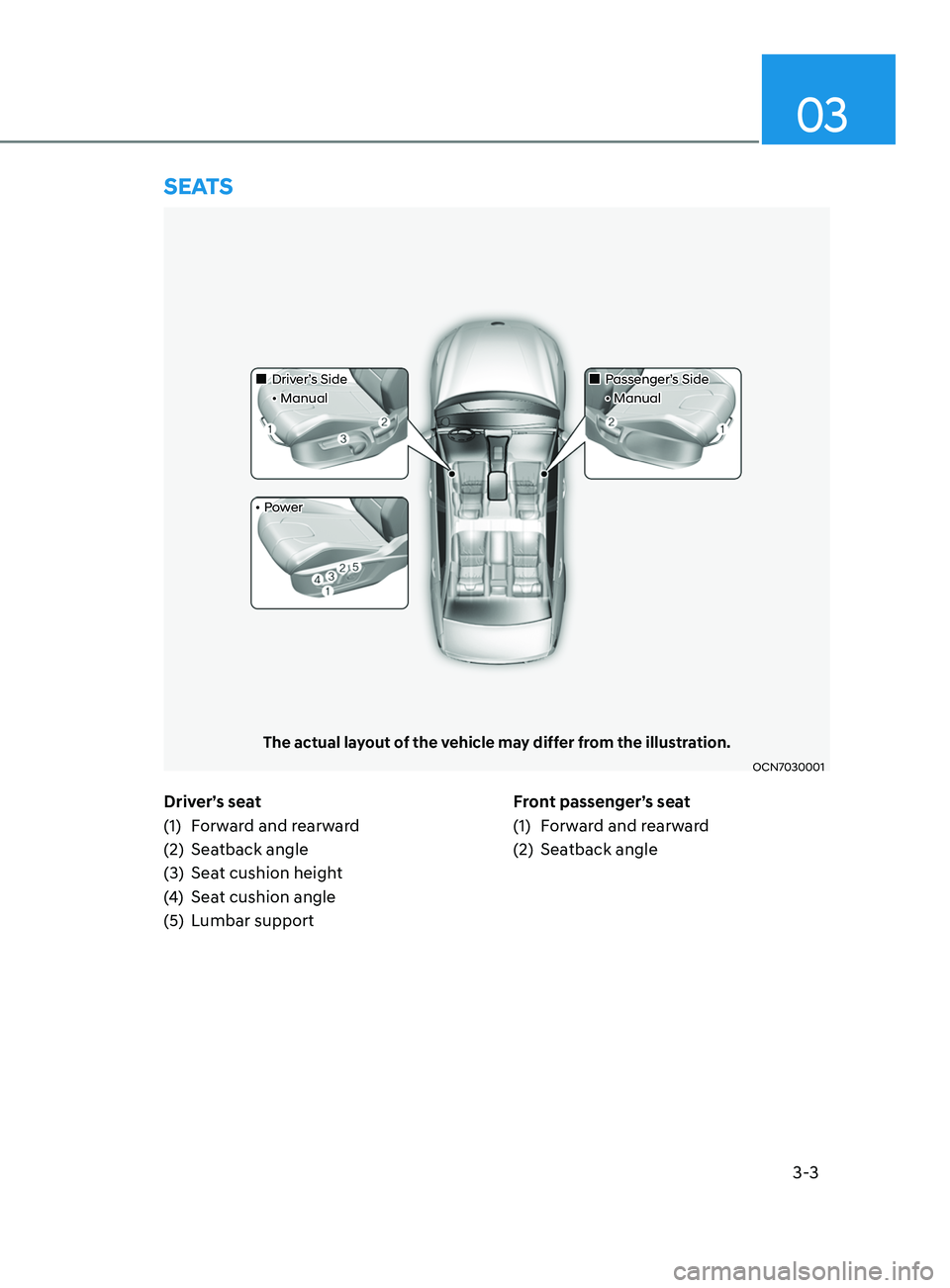
Driver’s seat
(1)
Forw
ard and rearward
(2)
Seatback angle
(3
)
Seat cushion heigh
t
(4)
Seat cushion angle
(5)
Lumbar support F
ront passenger’s seat
(1)
Forw
ard and rearward
(2)
Seatback angle
SeatS
OCN7030001
The actual layout of the vehicle may differ from the illustration.
„„Driver’s Side • Manual „„Passenger’s Side • Manual
• Power
Page 35 of 570
3-4
Safety Precautions
Adjusting the seats so that you are sitting
in a safe, comfortable position plays an
important role in driver and passenger
safety together with the seat belts and
air bags in an accident.
WARNING
Do not use a cushion that reduces
friction between the seat and the
passenger. The passenger’s hips may
slide under the lap portion of the seat
belt during an accident or a sudden
stop. Serious or fatal internal injuries
could result because the seat belt
cannot operate properly.
Air bags
You can take steps to reduce the risk
of being injured by an inflating air bag.
Sitting too close to an air bag greatly
increases the risk of injury in the event
the air bag inflates.
The National Highway Traffic Safety
Administration (NHTSA) recommends
that drivers allow at least 10 inches (25
cm) between the center of the steering
wheel and their chest.
WARNING
To reduce the risk of serious injury or
death from an inflating air bag, take the
following precautions:
• Adjust the driver’s seat as far to the
rear as possible while maintaining
the ability to maintain full control of
the vehicle.
• Adjust the front passenger seat as far
to the rear as possible.
• Hold the steering wheel by the rim
with hands at the 9 o’clock and 3
o’clock positions to minimize the risk
of injuries to your hands and arms. •
NEVER place anything or anyone
between the steering wheel and the
air bag.
• Do not allow the front passenger to
place feet or legs on the dashboard
to minimize the risk of leg injuries.
Seat belts
Always fasten your seat belt before
starting any trip.
At all times, passengers should sit
upright and be properly restrained.
Infants and small children must be
restrained in appropriate child restraint
systems. Adults and children who
have outgrown a booster seat must be
restrained using the seat belts.
WARNING
Take the following precautions when
adjusting your seat belt:
• NEVER use one seat belt for more
than one occupant.
• Always position the seatback upright
with the lap portion of the seat belt
snug and low across the hips.
• NEVER allow children or small infants
to ride on a passenger’s lap.
• Do not route the seat belt across your
neck, across sharp edges, or reroute
the shoulder strap away from your
body.
• Do not allow the seat belt to become
caught or jammed.
Seats & Safety System
Page 36 of 570
03
3-5
Front Seats
WARNING
Take the following precautions when
adjusting your seat:
• NEVER attempt to adjust the seat
while the vehicle is moving. The seat
could respond with unexpected
movement and may cause loss
of vehicle control resulting in an
accident.
• Do not place anything under the
front seats. Loose objects in the
driver’s foot area could interfere
with the operation of the foot pedals,
causing an accident.
• Do not allow anything to interfere
with the normal position and proper
locking of the seatback.
• Do not place a cigarette lighter on
the floor or seat. When you operate
the seat, gas may exit out of the
lighter causing a fire.
• Use extreme caution when picking
up small objects trapped under the
seats or between the seat and the
center console. Your hands might be
cut or injured by the sharp edges of
the seat mechanism.
• If there are occupants in the rear
seats, be careful while adjusting the
front seat position.
• Make sure that the seat is locked in
place after the adjustment. If not,
the seat might move unexpectedly
resulting in an accident.
CAUTION
To prevent injury:
• Do not adjust your seat while
wearing your seat belt. Moving the
seat cushion forward may cause
strong pressure on your abdomen.
• Do not allow your hands or fingers to
get caught in the seat mechanisms
while the seat is moving.
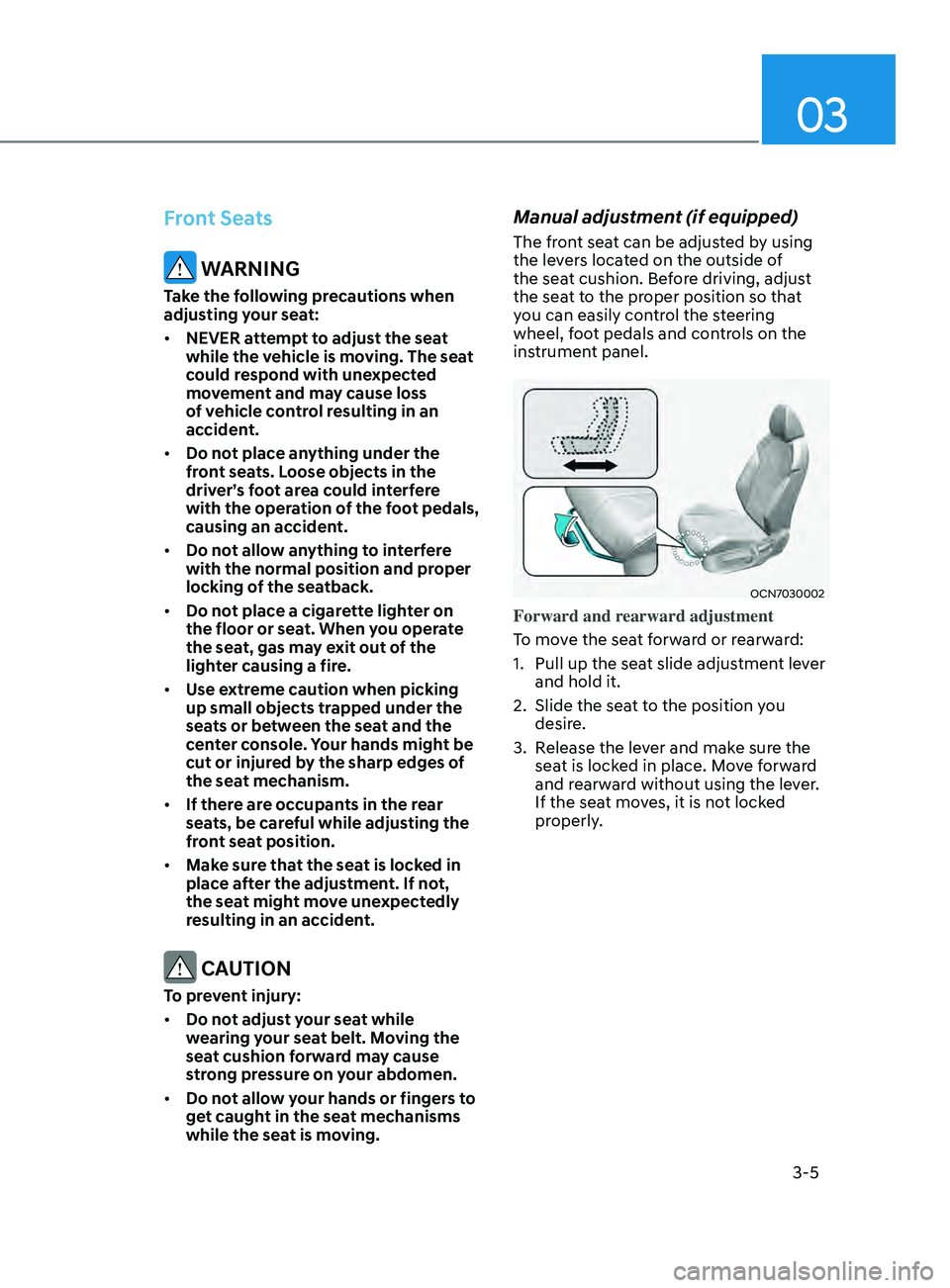
Manual adjustment (if equipped)
The front seat can be adjusted by using
the levers located on the outside of
the seat cushion. Before driving, adjust
the seat to the proper position so that
you can easily control the steering
wheel, foot pedals and controls on the
instrument panel.
OCN7030002
Forward and rearward adjustment
To move the seat forward or rearward:
1.
Pull up the seat slide adjus
tment lever
and hold it.
2.
Slide the seat t
o the position you
desire.
3.
Release the le
ver and make sure the
seat is locked in place. Move forward
and rearward without using the lever.
If the seat moves, it is not locked
properly.
Page 38 of 570
03
3 -7
Power adjustment (if equipped)
The front seat can be adjusted by
using the control switches located on
the outside of the seat cushion.Before
driving, adjust the seat to the proper
position so that you can easily control
the steering wheel, foot pedals and
controls on the instrument panel.
WARNING
NEVER allow children in the vehicle
unattended. The power seats are
operable when the vehicle is turned off.
NOTICE
To prevent damage to the seats:
• Always stop adjusting the seats when
the seat has moved as far forward or
rearward as possible.
• Do not adjust the seats for longer
than necessary when the vehicle
is turned off. This may result in
unnecessary battery drain.
• Do not operate two or more seats at
the same time. This may result in an
electrical malfunction.
OCN7030005
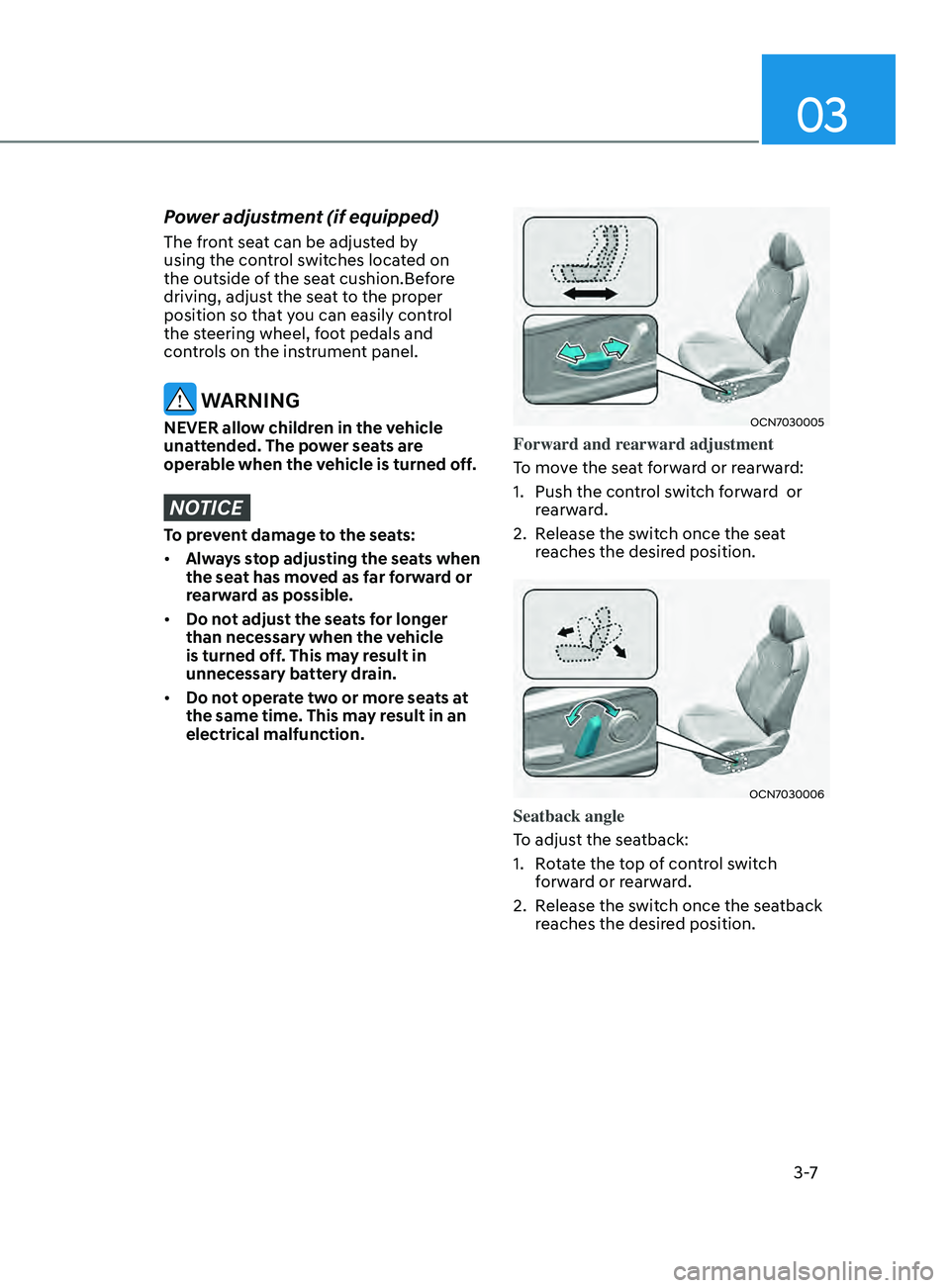
Forward and rearward adjustment
To move the seat forward or rearward:
1.
Push the contr
ol switch forward or
rearward.
2.
Release the s
witch once the seat
reaches the desired position.
OCN7030006
Seatback angle
To adjust the seatback:
1.
Ro
tate the top of control switch
forward or rearward.
2.
Release the s
witch once the seatback
reaches the desired position.