engine HYUNDAI ELANTRA 2021 Owners Manual
[x] Cancel search | Manufacturer: HYUNDAI, Model Year: 2021, Model line: ELANTRA, Model: HYUNDAI ELANTRA 2021Pages: 570, PDF Size: 52.21 MB
Page 532 of 570
Maintenance
9-46
OCN7090014N
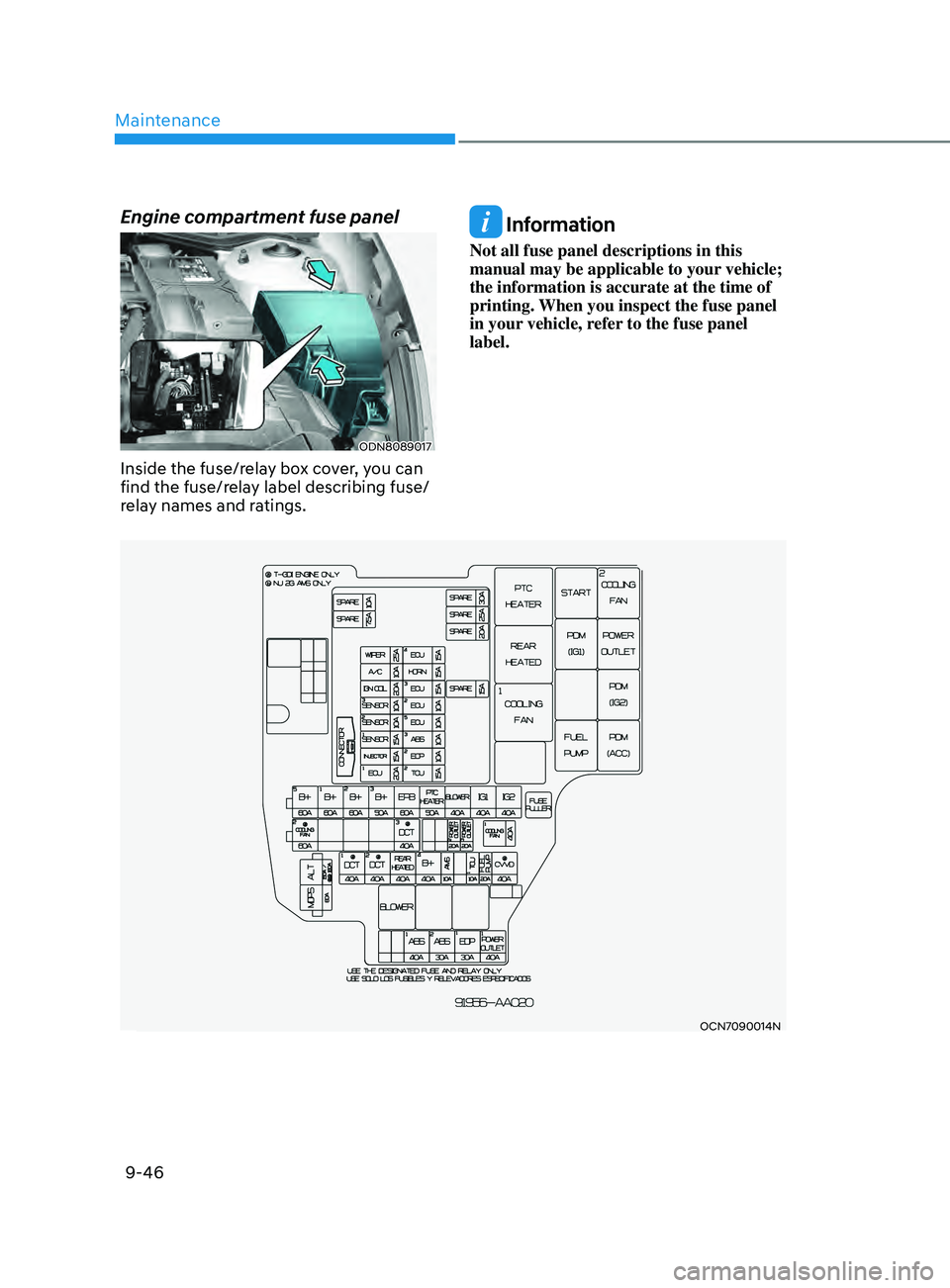
Engine compartment fuse panel
ODN8089017
Inside the fuse/relay box cover, you can
find the fuse/relay label describing fuse/
relay names and ratings.
Information
Not all fuse panel descriptions in this
manual may be applicable to your vehicle;
the information is accurate at the time of
printing. When you inspect the fuse panel
in your vehicle, refer to the fuse panel
label.
Page 533 of 570
![HYUNDAI ELANTRA 2021 Owners Manual 09
9-47
Engine compartment fuse panel
Type Fuse NameFuse Rating
Circuit Protected
MULTI
FUSE-3 A LT
150A
180A [G4NS-W/O AMS2] Alternator, (Fuse - ABS1,
ABS2, EOP1, POWER OUTLET1)
[G4FP/G4NS-WIth AMS2](/img/35/41160/w960_41160-532.png "HYUNDAI ELANTRA 2021 Owners Manual 09
9-47
Engine compartment fuse panel
Type Fuse NameFuse Rating
Circuit Protected
MULTI
FUSE-3 A LT
150A
180A [G4NS-W/O AMS2] Alternator, (Fuse - ABS1,
ABS2, EOP1, POWER OUTLET1)
[G4FP/G4NS-WIth AMS2")
09
9-47
Engine compartment fuse panel
Type Fuse NameFuse Rating
Circuit Protected
MULTI
FUSE-3 A LT
150A
180A [G4NS-W/O AMS2] Alternator, (Fuse - ABS1,
ABS2, EOP1, POWER OUTLET1)
[G4FP/G4NS-WIth AMS2] Alternator, (Fuse -
ABS1, ABS2, EOP1, POWER OUTLET1)
MDPS1 80A
MDPS Unit
MULTI
FUSE-1 B+5
60APCB Block (Engine Control Relay, Fuse -
ECU3, ECU4, HORN, WIPER, A/C)
B+1 60AICU Junction Block (IPS2/IPS5/IPS6/IPS7/
IPS14)
B+2 60AICU Junction Block (IPS1/IPS4/IPS8/IPS9/
IPS10)
B+3 50AICU Junction Block (Fuse - TRUNK, AMP,
SAFETY P/WINDOW DRV, P/SEAT DRV, P/
SEAT PASS, S/HEATER FRT, S/HEATER RR,
Long Term Load Latch Relay)
EPB 60A
ESC Control Module
PTC HEATER 50A
PTC HEATER
BLOWER 40A
BLOWER, DATC
IG1 40AE/R Junction Block (PDM (IG1/ACC) Relay),
Ignition Switch
IG2 40AE/R Junction Block (PDM (IG2) Relay, Start
Relay), Ignition Switch
Page 534 of 570
Maintenance
9-48
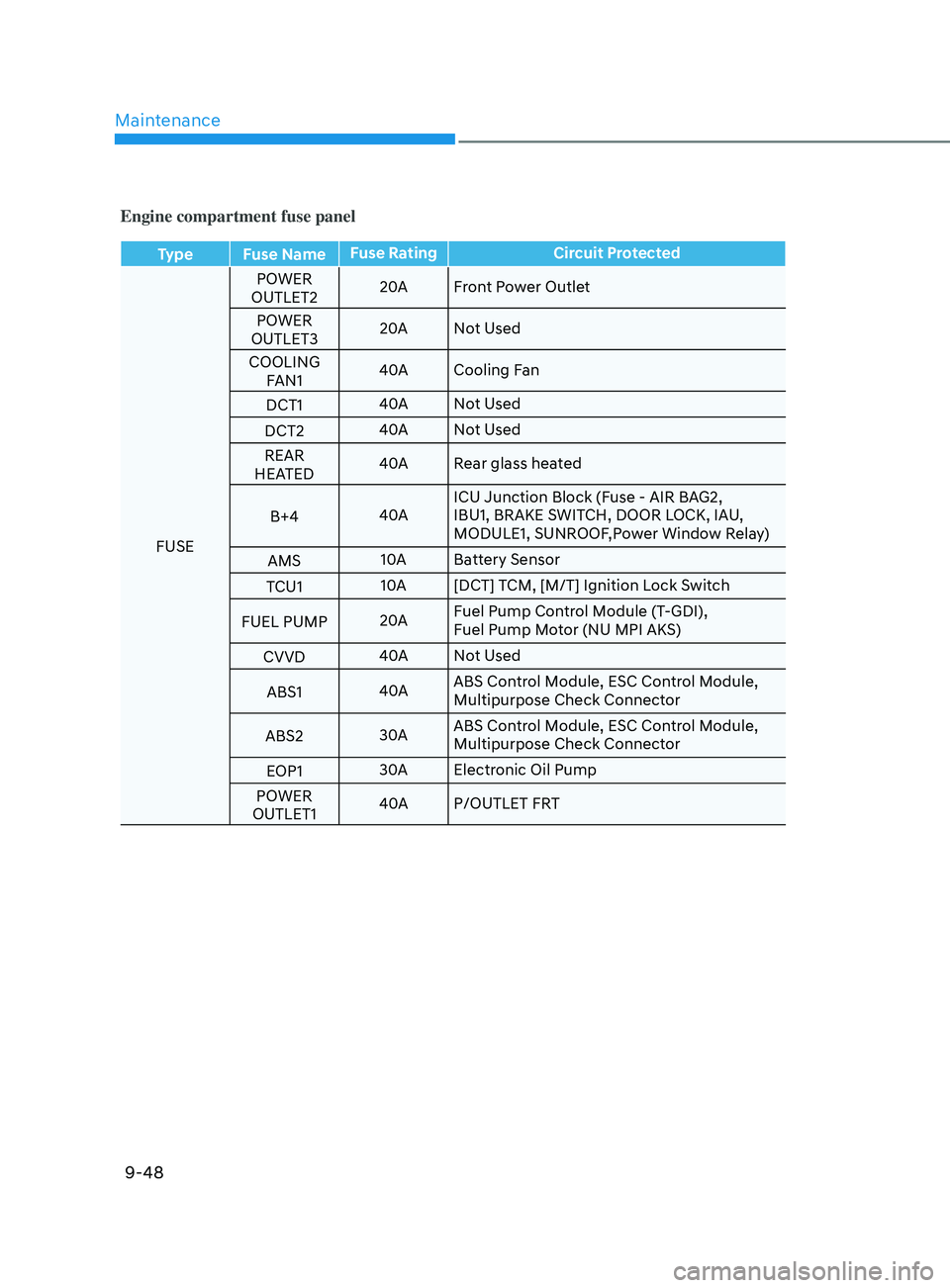
Engine compartment fuse panel
Type Fuse NameFuse Rating
Circuit Protected
FUSE POWER
OUTLET2 20A
Front Power Outlet
POWER
OUTLET3 20A
Not Used
COOLING FAN1 40A
Cooling Fan
DCT1 40A
Not Used
DCT2 40A
Not Used
REAR
HEATED 40A
Rear glass heated
B+4 40AICU Junction Block (Fuse - AIR BAG2,
IBU1, BRAKE SWITCH, DOOR LOCK, IAU,
MODULE1, SUNROOF,Power Window Relay)
AMS 10A
Battery Sensor
TCU1 10A
[DCT] TCM, [M/T] Ignition Lock Switch
FUEL PUMP 20AFuel Pump Control Module (T-GDI),
Fuel Pump Motor (NU MPI AKS)
CVVD 40A
Not Used
ABS1 40AABS Control Module, ESC Control Module,
Multipurpose Check Connector
ABS2 30AABS Control Module, ESC Control Module,
Multipurpose Check Connector
EOP1 30A
Electronic Oil Pump
POWER
OUTLET1 40A
P/OUTLET FRT
Page 535 of 570
![HYUNDAI ELANTRA 2021 Owners Manual 09
9-49
Engine compartment fuse panel
Fuse NameFuse Rating
Circuit Protected
WIPER 25A Wiper Motor
ECU4 15A PCM/ECM
A/C 10A
[G4FM] A/C Compressor
HORN 15A Horn
IGN COIL 20A
Ignition Coil #1~#4
ECU3 15](/img/35/41160/w960_41160-534.png "HYUNDAI ELANTRA 2021 Owners Manual 09
9-49
Engine compartment fuse panel
Fuse NameFuse Rating
Circuit Protected
WIPER 25A Wiper Motor
ECU4 15A PCM/ECM
A/C 10A
[G4FM] A/C Compressor
HORN 15A Horn
IGN COIL 20A
Ignition Coil #1~#4
ECU3 15")
09
9-49
Engine compartment fuse panel
Fuse NameFuse Rating
Circuit Protected
WIPER 25A Wiper Motor
ECU4 15A PCM/ECM
A/C 10A
[G4FM] A/C Compressor
HORN 15A Horn
IGN COIL 20A
Ignition Coil #1~#4
ECU3 15A PCM/ECM
SENSOR3 10A
E/R Junction Block (Fuel Pump Relay)
ECU2 10A
Not Used
SENSOR2 10A[G4NS] Variable Intake Solenoid Valve, Oil Pump
Solenoid Valve, Oil Control Valve #1/#2, Canister Close
Valve, Purge Control Solenoid Valve,
PCB Block (A/C Relay), E/R Junction Block (Cooling
Fan1/2 Relay)
ECU5 10A
ECM/PCM, [MT] Ignition Lock Switch
SENSOR1 15A Oxygen Sensor (UP/DOWN)
ABS3 10A
ABS Control Module, ESC Control Module
INJECTOR 15A [G4FM/G4FG/G4NA] Injector #1~#4
ECU1 20A
PCM/ECM
TCU2 15A Transaxle Range Switch
Page 546 of 570
Maintenance
9-60
WARNING
After washing the vehicle, test the
brakes while driving slowly to see
if they have been affected by water
before getting on the road. If braking
performance is impaired, dry the
brakes by applying them lightly while
maintaining a slow forward speed.
NOTICE
• Do not use strong soap, chemical
detergents or hot water, and do not
wash the vehicle in direct sunlight
or when the body of the vehicle is
warm.
• Be careful when washing the side
windows of your vehicle.
Especially, with high-pressure water,
water may leak through the windows
and wet the interior.
• To prevent damage to the plastic
parts, do not clean with chemical
solvents or strong detergents.ODN8A089039
NOTICE
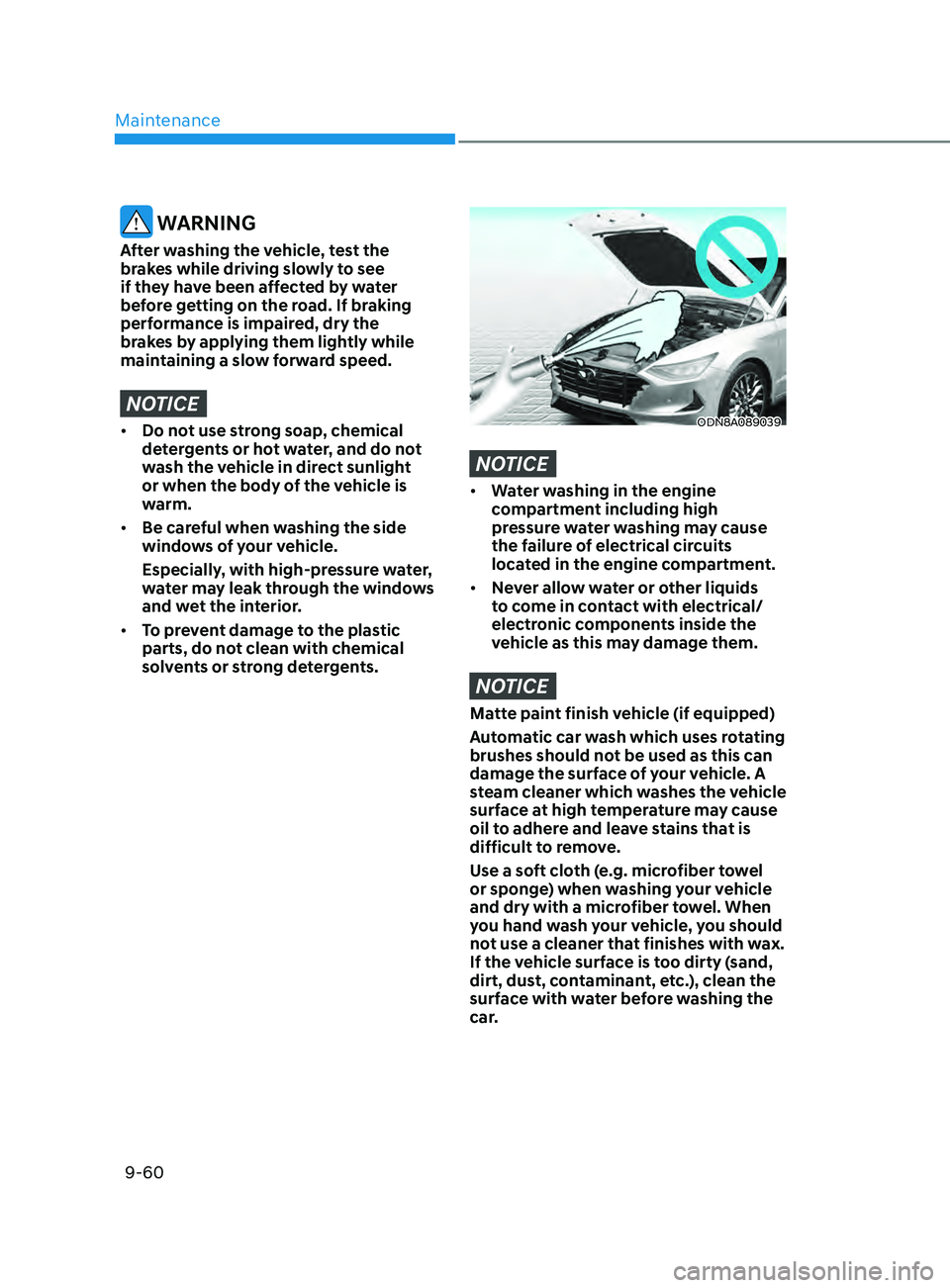
• Water washing in the engine
compartment including high
pressure water washing may cause
the failure of electrical circuits
located in the engine compartment.
• Never allow water or other liquids
to come in contact with electrical/
electronic components inside the
vehicle as this may damage them.
NOTICE
Matte paint finish vehicle (if equipped)
Automatic car wash which uses rotating
brushes should not be used as this can
damage the surface of your vehicle. A
steam cleaner which washes the vehicle
surface at high temperature may cause
oil to adhere and leave stains that is
difficult to remove.
Use a soft cloth (e.g. microfiber towel
or sponge) when washing your vehicle
and dry with a microfiber towel. When
you hand wash your vehicle, you should
not use a cleaner that finishes with wax.
If the vehicle surface is too dirty (sand,
dirt, dust, contaminant, etc.), clean the
surface with water before washing the
car.
Page 554 of 570
Maintenance
9-68
The emission control system of your
vehicle is covered by a written limited
warranty. Please see the warranty
information contained in the Owner’s
Handbook & Warranty Information
booklet in your vehicle.
Your vehicle is equipped with an
emission control system to meet all
applicable emission regulations. There
are three emission control systems, as
follows.
(1)
Crank
case emission control system
(2)
Ev
aporative emission control system
(3)
Exhaust emission con
trol system
In order to ensure the proper function
of the emission control systems, it
is recommended that you have your
vehicle inspected and maintained
by an authorized HYUNDAI dealer in
accordance with the maintenance
schedule in this manual.
NOTICE
For the Inspection and Maintenance
Test (with Electronic Stability Control
(ESC) system)
• To prevent the vehicle from misfiring
during dynamometer testing, turn
the Electronic Stability Control
(ESC) system off by pressing the ESC
switch (ESC OFF light illuminated).
• After dynamometer testing is
completed, turn the ESC system back
on by pressing the ESC switch again.
1. Crankcase Emission Control
Sy
stem
The positive crankcase ventilation system
is employed to prevent air pollution
caused by blow-by gases being emitted
from the crankcase. This system supplies
fresh filtered air to the crankcase through
the air intake hose. Inside the crankcase,
the fresh air mixes with blow-by gases,
which then pass through the PCV valve
into the induction system.
2. Evaporative Emission Control
System Including Onboard
Refueling Vapor Recovery
(ORVR)
The Evaporative Emission Control System
is designed to prevent fuel vapors from
escaping into the atmosphere. The
ORVR system is designed to allow the
vapors from the fuel tank to be loaded
into a canister while refueling at the gas
station, preventing the escape of fuel
vapors into the atmosphere.
Canister
Fuel vapors generated inside the fuel
tank are absorbed and stored in the
onboard canister. When the engine is
running, the fuel vapors absorbed in the
canister are drawn into the surge tank
through the purge control solenoid valve.
Purge Control Solenoid Valve (PCSV)
The purge control solenoid valve
is controlled by the Engine Control
Module (ECM); when the engine coolant
temperature is low during idling, the
PCSV closes so that evaporated fuel
is not taken into the engine. After the
engine warms-up during ordinary
driving, the PCSV opens to introduce
evaporated fuel to the engine.
EmiSSion Control SyStEm
Page 555 of 570
09
9-69
3. Exhaust Emission Control
System
The Exhaust Emission Control System is
a highly effective system which controls
exhaust emissions while maintaining
good vehicle performance.
When the engine starts or fails to start,
excessive attempts to restart the engine
may cause damage to the emission
system.
Engine exhaust (carbon monoxide)
precautions
• Carbon monoxide can be present
with other exhaust fumes. If you smell
exhaust fumes of any kind in your
vehicle, drive with all the windows
fully open. Have your vehicle checked
and repaired immediately.
WARNING
Engine exhaust gases contain carbon
monoxide (CO). Though colorless and
odorless, it is dangerous and could be
lethal if inhaled. Follow the instructions
on this page to avoid CO poisoning.
WARNING
CALIFORNIA PROPOSITION 65
WARNING
Engine exhaust and a wide variety of
automobile components and parts,
including components found in the
interior furnishings in a vehicle, contain
or emit chemicals known to the State
of California to cause cancer and
birth defects and reproductive harm.
In addition, certain fluids contained
in vehicles and certain products of
component wear contain or emit
chemicals known to the State of
California to cause cancer and birth
defects or other reproductive harm. •
Do not operate the engine in confined
or closed areas (such as garages) any
more than what is necessary to move
the vehicle in or out of the area.
• When the vehicle is stopped in an
open area for more than a short time
with the engine running, adjust the
ventilation system (as needed) to draw
outside air into the vehicle.
• Never sit in a parked or stopped
vehicle for any extended time with the
engine running.
• When the engine stalls or fails to
start, excessive attempts to restart
the engine may cause damage to the
emission control system.
Page 556 of 570
Maintenance
9-70
Operating precautions for catalytic
converters (if equipped)
WARNING
The exhaust system and catalytic
converter are very hot during and
immediately after the engine has been
running. To avoid SERIOUS INJURY or
DEATH:
• Do not park, idle, or drive the vehicle
over or near flammable objects, such
as grass, vegetation, paper, leaves,
etc. A hot exhaust system can ignite
flammable items under your vehicle.
• Keep away from the exhaust system
and catalytic converter or you may
get burned.
Also, do not remove the heat sink
around the exhaust system, do not
seal the bottom of the vehicle, and
do not coat the vehicle for corrosion
control. It may present a fire risk
under certain conditions. Your vehicle is equipped with a catalytic
converter emission control device.
To prevent damage to the catalytic
converter and to your vehicle, take the
following precautions:
•
Use only UNLEADED FUEL for
gasoline engines.
• Do not operate the vehicle when
there are signs of engine malfunction,
such as misfire or a noticeable loss of
performance.
• Do not misuse or abuse the engine.
Examples of misuse are coasting with
the engine off and descending steep
grades in gear with the engine off.
• Do not operate the engine at high
idle speed for extended periods (5
minutes or more).
• Do not modify or tamper with any
part of the engine or emission
control system. All inspections and
adjustments must be made by an
authorized HYUNDAI dealer.
• Avoid driving with extremely low
fuel level. If you run out of gasoline,
it could cause the engine to misfire
and result in excessive loading of the
catalytic converter.
Page 561 of 570

Index
I-4
C
Cabin Air Filter
........................................................................\
............................9-21
California Perchlorate notice
........................................................................\
....... 9-71
Child Restraint System (CRS)
........................................................................\
..... 3-26
Children Always in the Rear ........................................................................\
....3-26
Installing a Child Restraint System (CRS) .......................................................3-28
Selecting a Child Restraint System (CRS) .......................................................3-27
Climate Control
Additional Features
................................................................. 5-109
Auto comfort control (for driver’
s seat)
......................................................... 5-109
Automatic ventilation ........................................................................\
............. 5-109
Sunroof inside air recirculation ......................................................................5-109
Consumer Information
........................................................................\
................. 2-15
Cruise Control (CC)
........................................................................\
.................... 7-77
Function operation ........................................................................\
...................7-77
D
Declaration of Conformity
........................................................................\
......... 7-150
Dimensions
........................................................................\
.................................... 2-7
Drive Mode Integrated Control System
............................................................... 6-39
Drive Mode ........................................................................\
.............................. 6-39
Smart shift on trip computer ........................................................................\
.....6-42
Driver Attention
Warning (DAW)
...................................................................... 7-71
Function malfunction and limitations ..............................................................7-74
Function settings ........................................................................\
..................... 7-71
System operation ........................................................................\
...................... 7-72
E
Emission Control System
........................................................................\
............ 9-68
Engine Compartment
........................................................................\
............. 2-6/ 9-3
Engine Coolant
........................................................................\
............................ 9-16
Changing Engine Coolant ........................................................................\
........9-17
Checking the Engine Coolant Level .................................................................9-16
Engine Number
........................................................................\
............................ 2-14
Engine Oil
........................................................................\
.................................... 9-15
Checking the Engine Oil and Filter ..................................................................9-15
Checking the Engine Oil Level ........................................................................\
9-15
Engine Specification
........................................................................\
...................... 2-7
Explanation of Scheduled Maintenance Items
.................................................... 9-13
Page 562 of 570

I
I-5
Exterior Lights ........................................................................\
.............................5-68
Battery saver function ........................................................................\
..............5-71
Headlamp delay function ........................................................................\
.........5-71
High beam operation ........................................................................\
................ 5-69
Lighting control ........................................................................\
........................ 5-68
Turn signals and lane change signals ...............................................................5-70
Exterior Overview
........................................................................\
......................... 2-2
F
Filter Inspection
........................................................................\
........................... 9-21
Filter replacement ........................................................................\
.....................9-21
Forward Collision–A
voidance Assist (FCA) (front view camera only)
...............7-2
Function malfunction and limitations ................................................................ 7-7
Function operation ........................................................................\
...................... 7-5
Function settings ........................................................................\
........................ 7-3
Forward Collision–A
voidance Assist (FCA) (sensor fusion)
..............................7-14
Function malfunction and limitations .............................................................. 7-22
Function operation ........................................................................\
.................... 7-18
Function settings ........................................................................\
...................... 7-16
Fuel Filler Door
........................................................................\
........................... 5-66
Fuel Requirements
........................................................................\
......................... 1-5
Fuses
........................................................................\
............................................ 9-40
Engine Compartment Panel Fuse Replacement ...............................................9-42
Fuse/Relay Panel Description ........................................................................\
.. 9-43
Instrument Panel Fuse Replacement ................................................................9-41
G
Guide to Hyundai Genuine Parts
........................................................................\
... 1-3
H
Hazard W
arning Flasher
........................................................................\
................ 8-2
High Beam
Assist (HBA)
........................................................................\
........... 5-72
Detecting sensor (Front view camera) .............................................................5-72
Function malfunction and limitations .............................................................. 5-73
Function operation ........................................................................\
.................... 5-73
Function settings ........................................................................\
...................... 5-72