engine HYUNDAI ELANTRA 2021 Owners Manual
[x] Cancel search | Manufacturer: HYUNDAI, Model Year: 2021, Model line: ELANTRA, Model: HYUNDAI ELANTRA 2021Pages: 570, PDF Size: 52.21 MB
Page 467 of 570
Emergency Situations
8-4
Jump starting can be dangerous if done
incorrectly. Follow the jump starting
procedure in this section to avoid serious
injury or damage to your vehicle. If in
doubt about how to properly jump start
your vehicle, we strongly recommend
that you have a service technician or
towing service do it for you.
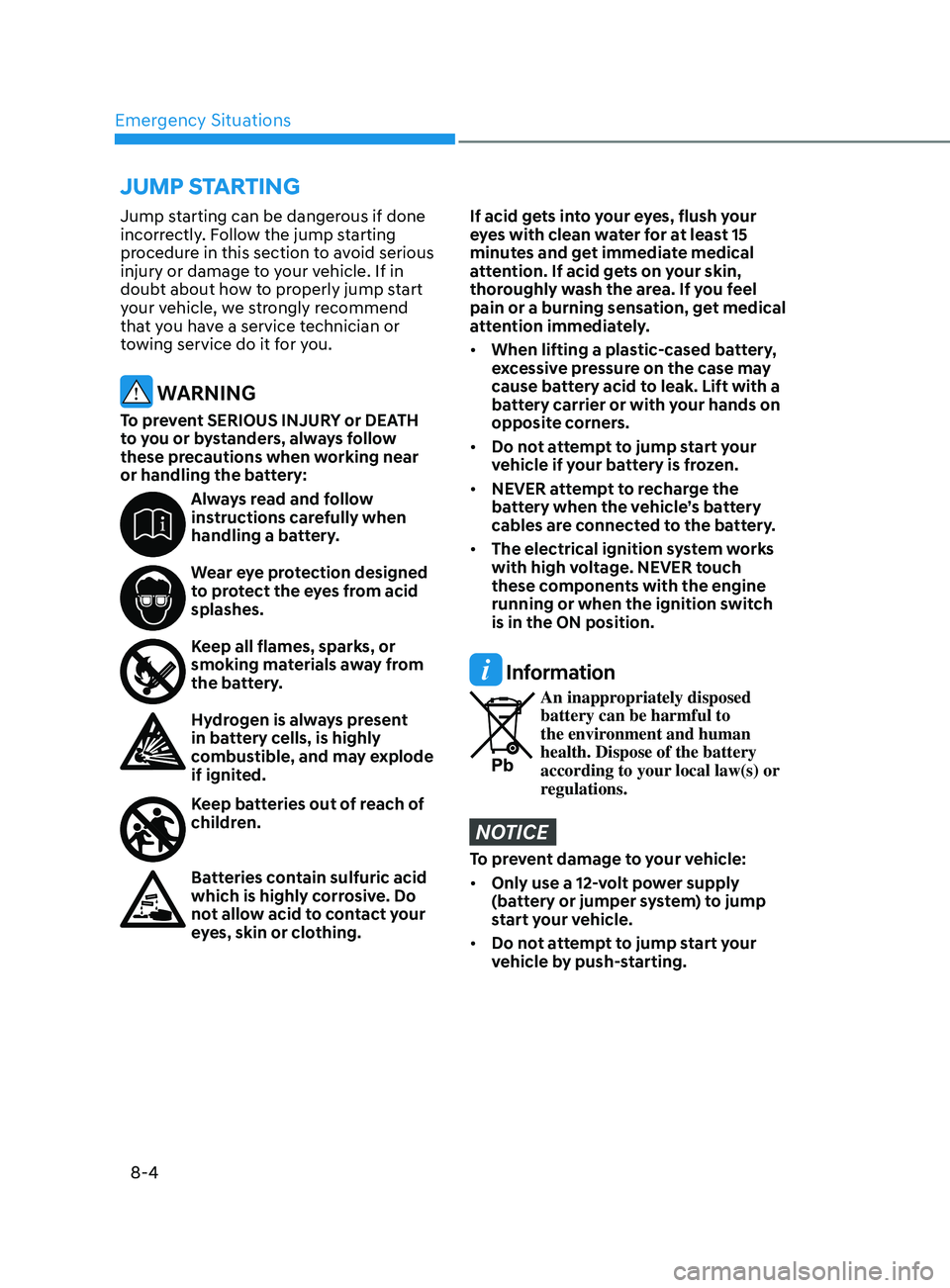
WARNING
To prevent SERIOUS INJURY or DEATH
to you or bystanders, always follow
these precautions when working near
or handling the battery:
Always read and follow
instructions carefully when
handling a battery.
Wear eye protection designed
to protect the eyes from acid
splashes.
Keep all flames, sparks, or
smoking materials away from
the battery.
Hydrogen is always present
in battery cells, is highly
combustible, and may explode
if ignited.
Keep batteries out of reach of
children.
Batteries contain sulfuric acid
which is highly corrosive. Do
not allow acid to contact your
eyes, skin or clothing.
If acid gets into your eyes, flush your
eyes with clean water for at least 15
minutes and get immediate medical
attention. If acid gets on your skin,
thoroughly wash the area. If you feel
pain or a burning sensation, get medical
attention immediately.
• When lifting a plastic-cased battery,
excessive pressure on the case may
cause battery acid to leak. Lift with a
battery carrier or with your hands on
opposite corners.
• Do not attempt to jump start your
vehicle if your battery is frozen.
• NEVER attempt to recharge the
battery when the vehicle’s battery
cables are connected to the battery.
• The electrical ignition system works
with high voltage. NEVER touch
these components with the engine
running or when the ignition switch
is in the ON position.
Information
An inappropriately disposed
battery can be harmful to
the environment and human
health. Dispose of the battery
according to your local law(s) or
regulations.
NOTICE
To prevent damage to your vehicle:
• Only use a 12-volt power supply
(battery or jumper system) to jump
start your vehicle.
• Do not attempt to jump start your
vehicle by push-starting.
Jump startIng
Page 468 of 570
08
8-5
Jump starting procedure
1. Position the vehicles close enough
that the jumper cables will reach, but
do not allow the vehicles to touch.
2.
Av
oid fans or any moving parts in the
engine compartment at all times, even
when the vehicles are turned off.
3.
Turn o
ff all electrical devices such as
radios, lights, air conditioning, etc.
Put the vehicle in P (Park), and set the
parking brakes. Turn both vehicles
OFF.
OCN7070002
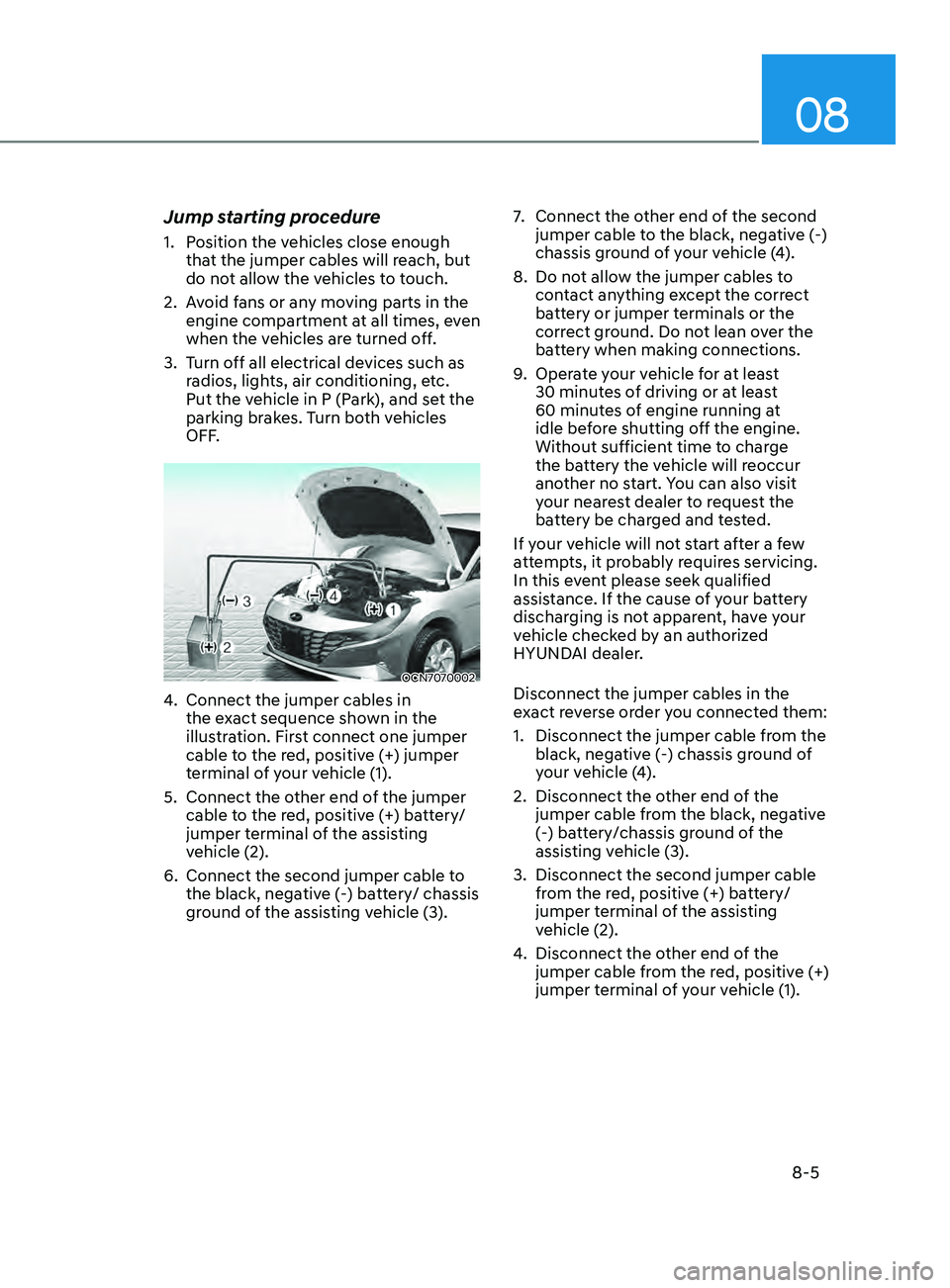
4. Connect the jumper cables in
the ex act sequence shown in the
illustration. First connect one jumper
cable to the red, positive (+) jumper
terminal of your vehicle (1).
5.
Connect the other end o
f the jumper
cable to the red, positive (+) battery/
jumper terminal of the assisting
vehicle (2).
6.
Connect the second jumper cable to
the black, nega
tive (-) battery/ chassis
ground of the assisting vehicle (3). 7.
Connect the other end o
f the second
jumper cable to the black, negative (-)
chassis ground of your vehicle (4).
8.
Do not allo
w the jumper cables to
contact anything except the correct
battery or jumper terminals or the
correct ground. Do not lean over the
battery when making connections.
9.
Opera
te your vehicle for at least
30 minutes of driving or at least
60 minutes of engine running at
idle before shutting off the engine.
Without sufficient time to charge
the battery the vehicle will reoccur
another no start. You can also visit
your nearest dealer to request the
battery be charged and tested.
If your vehicle will not start after a few
attempts, it probably requires servicing.
In this event please seek qualified
assistance. If the cause of your battery
discharging is not apparent, have your
vehicle checked by an authorized
HYUNDAI dealer.
Disconnect the jumper cables in the
exact reverse order you connected them:
1.
Disconnect the jumper cable from the
black, nega
tive (-) chassis ground of
your vehicle (4).
2.
Disconnect the other end o
f the
jumper cable from the black, negative
(-) battery/chassis ground of the
assisting vehicle (3).
3.
Disconnect the second jumper cable
from the r
ed, positive (+) battery/
jumper terminal of the assisting
vehicle (2).
4.
Disconnect the other end o
f the
jumper cable from the red, positive (+)
jumper terminal of your vehicle (1).
Page 469 of 570
Emergency Situations
8-6
If your temperature gauge indicates
overheating, you experience a loss of
power, or hear loud pinging or knocking,
the engine may be overheating. If this
happens, you should:
1.
Pull off the r
oad and stop as soon as it
is safe to do so.
2.
Put the vehicle in P (P
ark), and set the
parking brake. If the air conditioning is
ON, turn it OFF.
3.
If engine coolant is running out under
the v
ehicle or steam is coming out
from the hood, stop the engine. Do
not open the hood until the coolant
has stopped running or the steaming
has stopped. If there is no visible
loss of engine coolant and no steam,
leave the engine running and check
to be sure the engine cooling fan is
operating. If the fan is not running,
turn the engine off.
WARNING
While the engine is running,
keep hands, clothing and tools
away from the moving parts
such as the cooling fan and
drive belt to prevent serious
injury. 4.
Check to see if the w
ater pump drive
belt is missing.
(1)
If it is not missing, check t
o see that
it is tight.
(2)
If the drive belt seems t
o be
satisfactory, check for coolant leaking
from the radiator, hoses or under
the vehicle. (If the air conditioning
had been in use, it is normal for cold
water to be draining from it when you
stop.)
5.
If the wa
ter pump drive belt is
broken or engine coolant is leaking
out, stop the engine immediately
and we recommend that you call
an authorized HYUNDAI dealer for
assistance.
WARNING
NEVER remove the radiator
cap or the drain plug while
the engine and radiator are
hot. Hot coolant and steam
may blow out under pressure,
causing serious injury.
Turn the engine off and wait until the
engine cools down. Use extreme care
when removing the radiator cap. Wrap
a thick towel around it, and turn it
counterclockwise slowly to the first
stop. Step back while the pressure is
released from the cooling system. When
you are sure all the pressure has been
released, press down on the cap, using
a thick towel, and continue turning
counterclockwise to remove it.
If the engIne overheats
Page 470 of 570
08
8 -7
6. If you cannot find the cause of the
overheating, wait until the engine
temperature has returned to normal.
Then, if coolant has been lost,
carefully add coolant to the reservoir
to bring the fluid level in the reservoir
up to the halfway mark.
7.
Proceed with caution, k
eeping alert
for further signs of overheating.
If overheating happens again,
we recommend that you call an
authorized HYUNDAI dealer for
assistance.NOTICE
• Serious loss of coolant indicates a
leak in the cooling system and we
recommend the system be checked
by an authorized HYUNDAI dealer.
• When the engine overheats from
low engine coolant, suddenly adding
engine coolant may cause cracks
in the engine. To prevent damage,
add engine coolant slowly in small
quantities.
Page 471 of 570
Emergency Situations8-8
Tire Pressure MoniToring sysTeM (TPMs)
OCN7070020
OCN7080055L
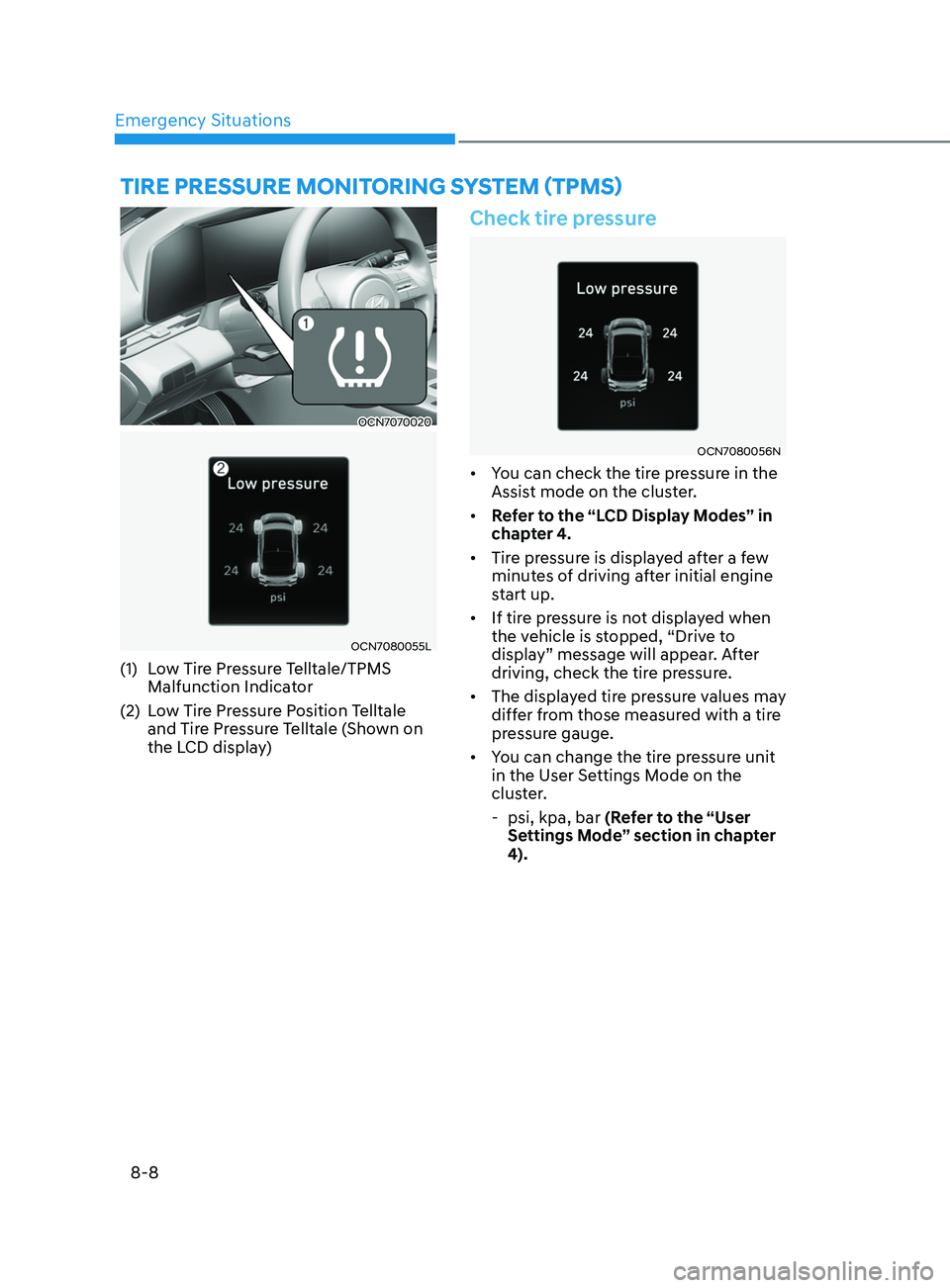
(1) Low Tire Pressure Telltale/TPMS
Malfunction Indica tor
(2)
Lo
w Tire Pressure Position Telltale
and Tire Pressure Telltale (Shown on
the LCD display)
Check tire pressure
OCN7080056N
• You can check the tire pressure in the
Assist mode on the cluster.
• Refer to the “LCD Display Modes” in
chapter 4.
• Tire pressure is displayed after a few
minutes of driving after initial engine
start up.
• If tire pressure is not displayed when
the vehicle is stopped, “Drive to
display” message will appear. After
driving, check the tire pressure.
• The displayed tire pressure values may
differ from those measured with a tire
pressure gauge.
• You can change the tire pressure unit
in the User Settings Mode on the
cluster.
- psi, kpa, bar (R
efer to the “User
Settings Mode” section in chapter
4).
Page 473 of 570
Emergency Situations
8-10
NOTICE
If any of the below happens, have
the system checked by an authorized
HYUNDAI dealer.
1.
The Lo
w Tire Pressure Telltale/ TPMS
Malfunction Indicator does not
illuminate for 3 seconds when the
ignition switch is placed to the ON
position or engine is running.
2.
The TPMS Malfunction Indica
tor
remains illuminated after blinking for
approximately 1 minute.
3.
The Lo
w Tire Pressure Position
Telltale remains illuminated.
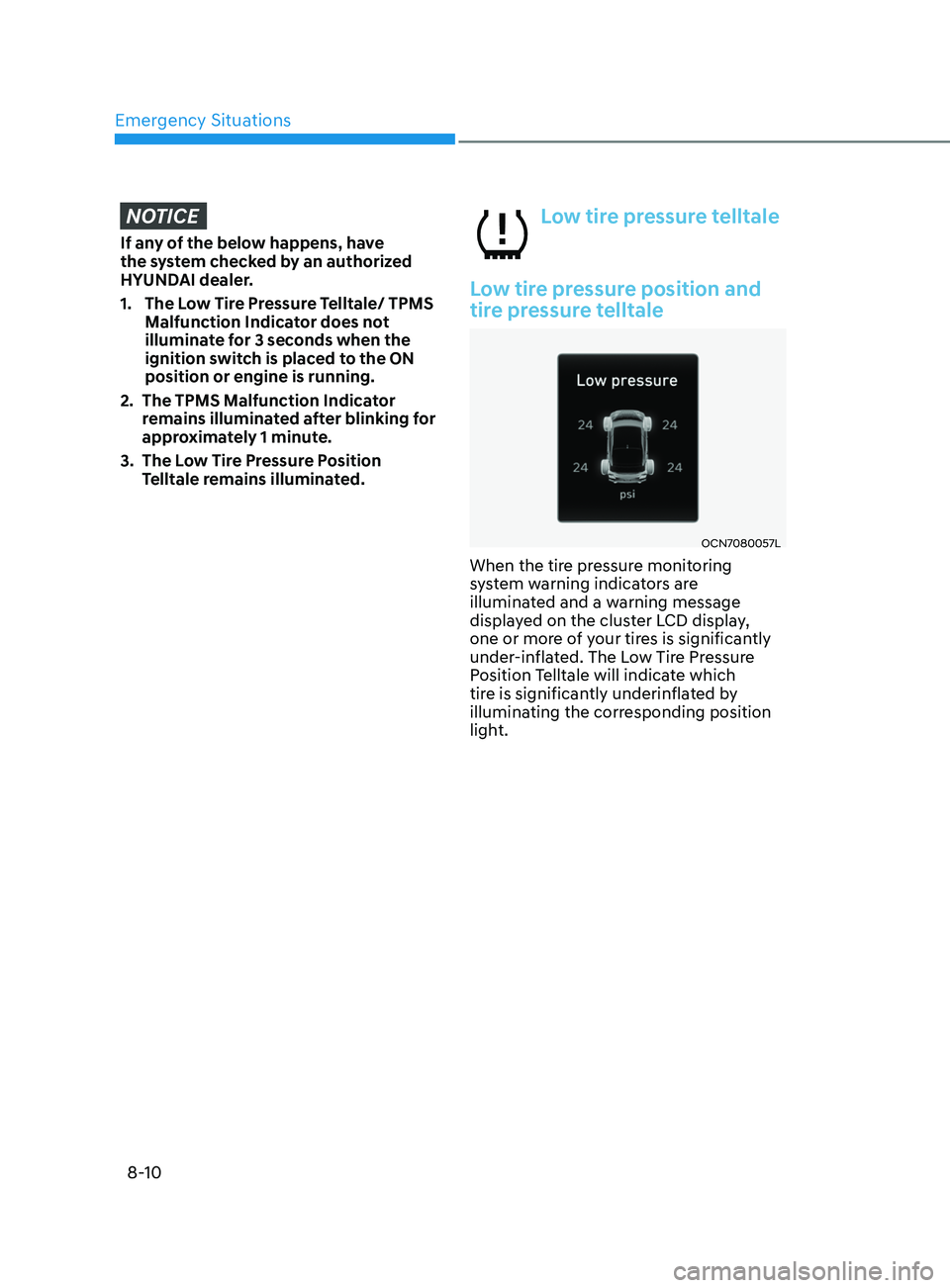
Low tire pressure telltale
Low tire pressure position and
tire pressure telltale
OCN7080057L
When the tire pressure monitoring
system warning indicators are
illuminated and a warning message
displayed on the cluster LCD display,
one or more of your tires is significantly
under-inflated. The Low Tire Pressure
Position Telltale will indicate which
tire is significantly underinflated by
illuminating the corresponding position
light.
Page 478 of 570
08
8-15
Changing Tires
WARNING
A vehicle can slip or roll off of a jack
causing serious injury or death to you or
those nearby. Take the following safety
precautions:
• Never place any portion of your body
under a vehicle that is supported by
a jack.
• NEVER attempt to change a tire in
the lane of traffic. ALWAYS move the
vehicle completely off the road on
level, firm ground away from traffic
before trying to change a tire. If you
cannot find a level, firm place off
the road, call a towing service for
assistance.
• Be sure to use the jack provided with
the vehicle.
• ALWAYS place the jack on the
designated jacking positions on the
vehicle and NEVER on the bumpers
or any other part of the vehicle for
jacking support.
• Do not start or run the engine while
the vehicle is on the jack.
• Do not allow anyone to remain in the
vehicle while it is on the jack.
• Keep children away from the road
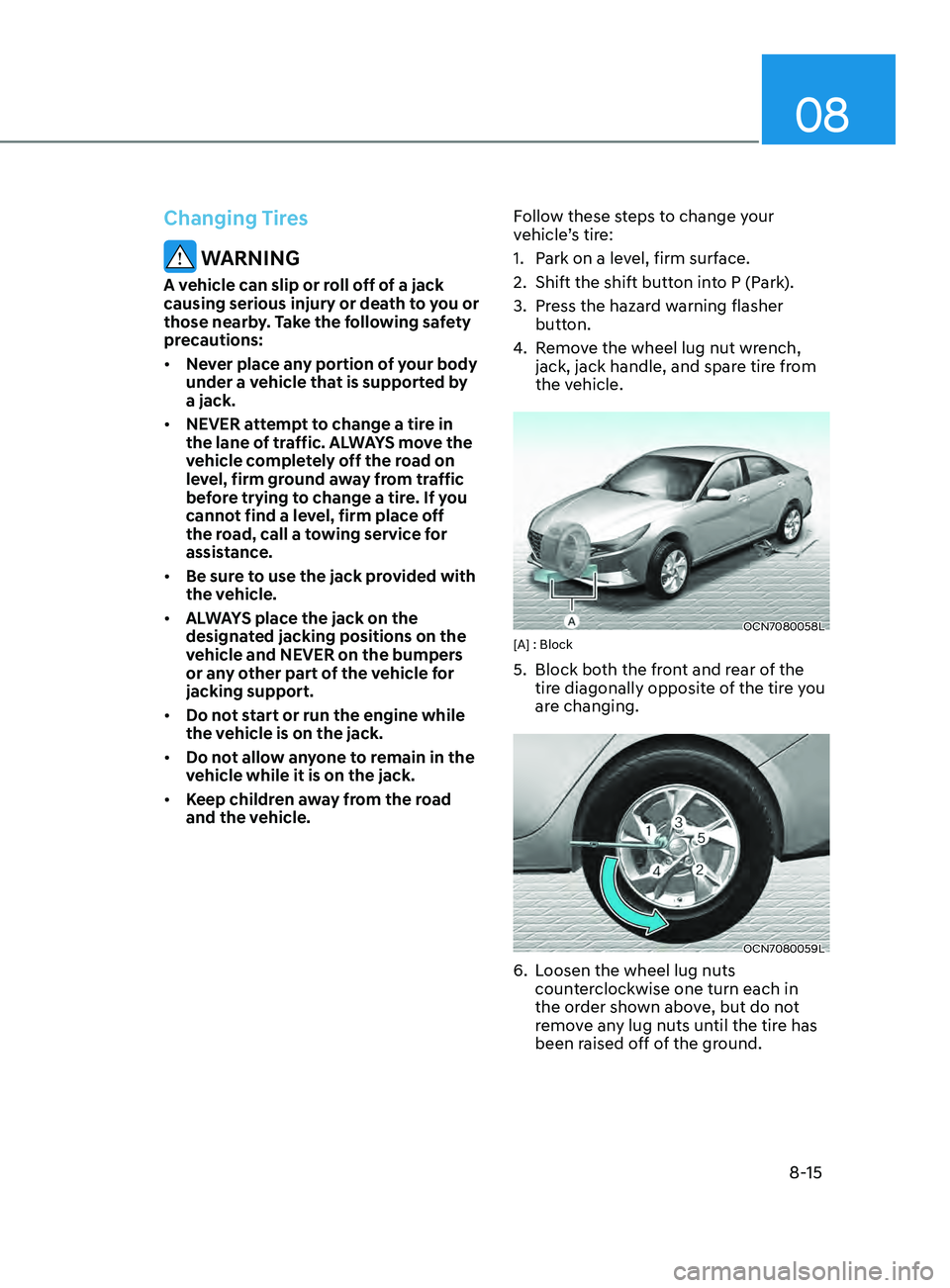
and the vehicle. Follow these steps to change your
vehicle’s tire:
1.
Park on a le
vel, firm surface.
2. Shift the shift button in to P (Park).
3.
Press the hazar
d warning flasher
button.
4.
Remo
ve the wheel lug nut wrench,
jack, jack handle, and spare tire from
the vehicle.
OCN7080058L[A] : Block
5. Block both the fr ont and rear of the
tire diagonally opposite of the tire you
are changing.
OCN7080059L
6. Loosen the wheel lug nuts
coun terclockwise one turn each in
the order shown above, but do not
remove any lug nuts until the tire has
been raised off of the ground.
Page 482 of 570
08
8-19
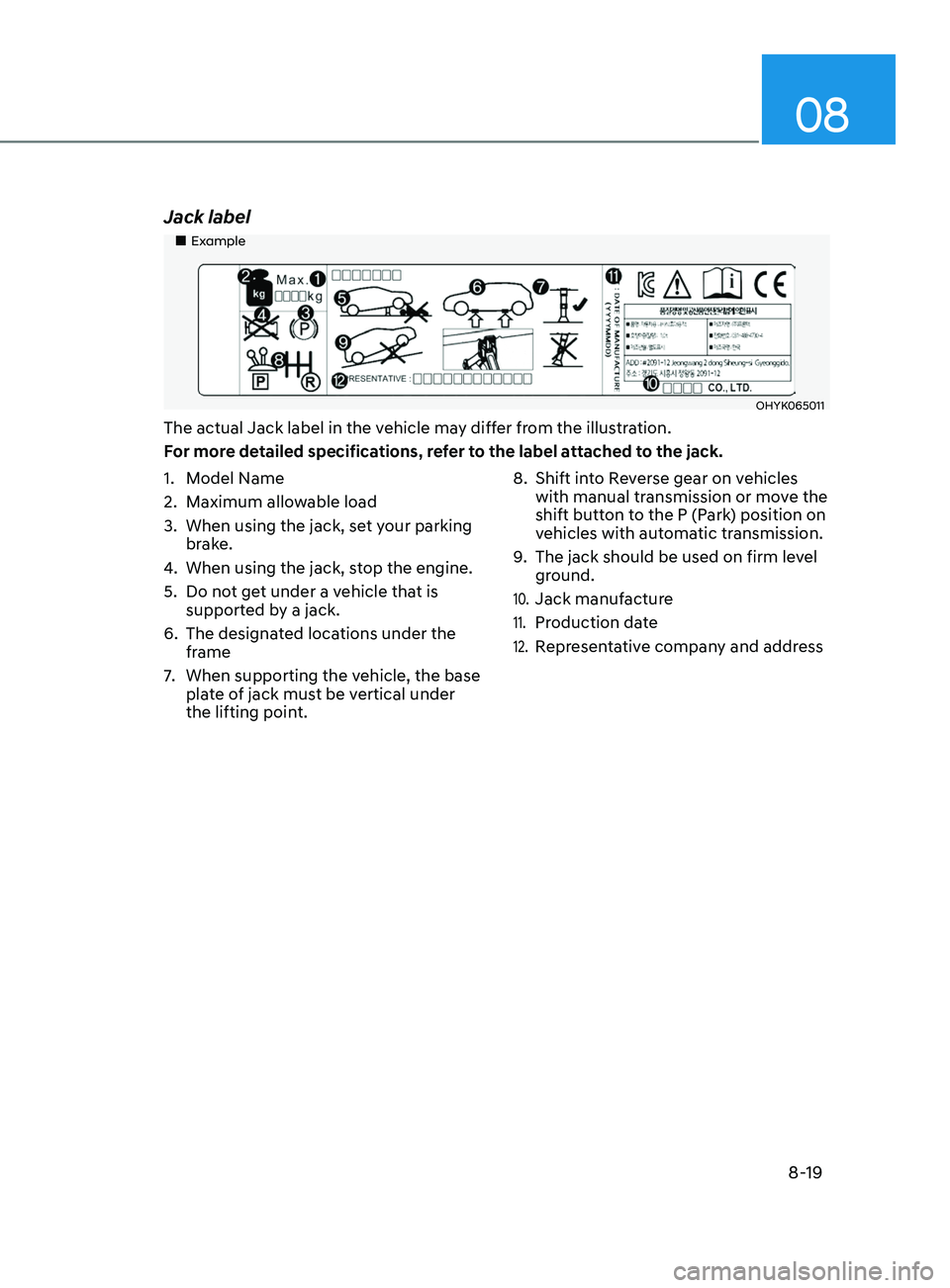
Jack label
„„Example
OHYK065011
The actual Jack label in the vehicle may differ from the illustration.
For more detailed specifications, refer to the label attached to the jack.
1.
Model Name
2.
Maximum allow
able load
3.
When using the jack, set y
our parking
brake.
4.
When using the jack, st
op the engine.
5.
Do not ge
t under a vehicle that is
supported by a jack.
6.
The designat
ed locations under the
frame
7.
When supporting the vehicle, the base
pla
te of jack must be vertical under
the lifting point. 8.
Shift int
o Reverse gear on vehicles
with manual transmission or move the
shift button to the P (Park) position on
vehicles with automatic transmission.
9.
The jack should be used on firm lev
el
ground.
10. Jack manufacture
11. Production date
12. Representative company and address
Page 487 of 570

Engine Compartment ........................................................................\
............9-3
Main tenance Services
........................................................................\
........... 9-4
Owner’s Responsibility ........................................................................\
.................... 9-4
Owner Maint enance Precautions ........................................................................\
.... 9-4
Owner Maintenance ........................................................................\
.............. 9-5Owner Maintenance Schedule ........................................................................\
........9-5
Scheduled Maintenance Services ................................................................9 -7Normal Maintenance Schedule (Smartstream G2.0 Atkinson) .............................9-8
Maint enance Under Severe Usage Conditions ..................................................... 9-
11
Explanation of Scheduled Maintenance Items ...........................................9-13
E ngine Oil
........................................................................\
.............................. 9-
15
Checking the Engine Oil Level ........................................................................\
........9-15
Checking the E ngine Oil and Filter ........................................................................\
9-
15
Engine Coolant ........................................................................\
.....................9-16Checking the Engine Coolant Level .......................................................................9- 16
Changing Engine Coolant ........................................................................\
............... 9-
17
Brake fluid ........................................................................\
............................9-18Checking the brake fluid level ........................................................................\
........9-18
Washer Fluid ........................................................................\
......................... 9-19Checking the Washer Fluid Level ........................................................................\
...9-19
Parking brake ........................................................................\
....................... 9-19Checking the parking brake ........................................................................\
...........9-19
Air cleaner ........................................................................\
............................ 9-20Filter replacement ........................................................................\
..........................9-20
CABIN Air Filter ........................................................................\
.....................9-21
Filt er Inspection
........................................................................\
.................... 9-
21
Filter replacement ........................................................................\
...........................9-21
Wiper Blades ........................................................................\
........................9-22Blade Inspection ........................................................................\
............................ 9-22
Blade R eplacement ........................................................................\
........................ 9-
22
Battery ........................................................................\
..................................9-2 4
For Best Battery Service ........................................................................\
................9-25
Ba ttery capacity label ........................................................................\
.................... 9-
25
Battery Recharging
........................................................................\
........................ 9-
26
Reset items
........................................................................\
..................................... 9-
26
Maintenance
9. Maintenance
9
Page 489 of 570

9-3
09
Tires and Wheels ........................................................................\
..................9-27Tire Care ........................................................................\
.......................................... 9-27
Recommended Cold Tire Inflation Pressures ....................................................... 9-27
Check Tire Inflation Pressure ........................................................................\
......... 9-28
Tire Rotation ........................................................................\
................................... 9-29
Wheel Alignment and Tire Balance ....................................................................... 9-30
Tire Replacement ........................................................................\
........................... 9-30
Wheel Replacement ........................................................................\
....................... 9-32
Tire Traction ........................................................................\
.................................... 9-32
Tire Maintenance........................................................................\
............................ 9-32
Tire Sidewall Labeling ........................................................................\
.................... 9-32
Tire Terminology and Definitions ........................................................................\
.. 9-35
All Season Tires ........................................................................\
............................... 9-38
Summer Tires ........................................................................\
................................. 9-38
Snow Tires........................................................................\
....................................... 9-38
Radial-Ply Tires ........................................................................\
............................... 9-38
Low Aspect Ratio Tires ........................................................................\
................... 9-39
Fuses ........................................................................\
....................................9-40Instrument Panel Fuse Replacement ..................................................................... 9-41
Engine Compartment Panel Fuse Replacement .................................................. 9-42
Fuse/Relay Panel Description........................................................................\
........ 9-43
Light Bulbs ........................................................................\
............................ 9-50Headlamp, Parking Lamp, Daytime Running Light, Turn Signal Lamp and
Side Marker ........................................................................\
...................................... 9-51
Side repeater lamp replacement ........................................................................\
.. 9-54
Rear combination lamp bulb replacement .......................................................... 9-54
High mounted stop lamp replacement ................................................................ 9-57
License Plate Light Bulb Replacement ................................................................. 9-57
Interior Light Bulb Replacement ........................................................................\
... 9-58
Appearance Care ........................................................................\
................. 9-59Exterior Care ........................................................................\
................................... 9-59
Interior Care ........................................................................\
.................................... 9-65
Emission Control System ........................................................................\
.... 9-68
California perchlorate notice ....................................................................... 9-71
1. Engine coolant reservoir
2.
Brak
e fluid reservoir
3.
Air cleaner
4.
Engine oil dips
tick
5.
Engine oil filler cap 6.
Windshield washer fluid r
eservoir
7.
Fuse bo
x
8.
Batt
ery
9.
Radiat
or cap
EnginE CompartmEnt
„„Smartstream G2.0
The actual engine compartment in the vehicle may differ from the illustration.OCN7080064L