towing HYUNDAI ELANTRA 2021 Owner's Manual
[x] Cancel search | Manufacturer: HYUNDAI, Model Year: 2021, Model line: ELANTRA, Model: HYUNDAI ELANTRA 2021Pages: 570, PDF Size: 52.21 MB
Page 485 of 570
Emergency Situations
8-22
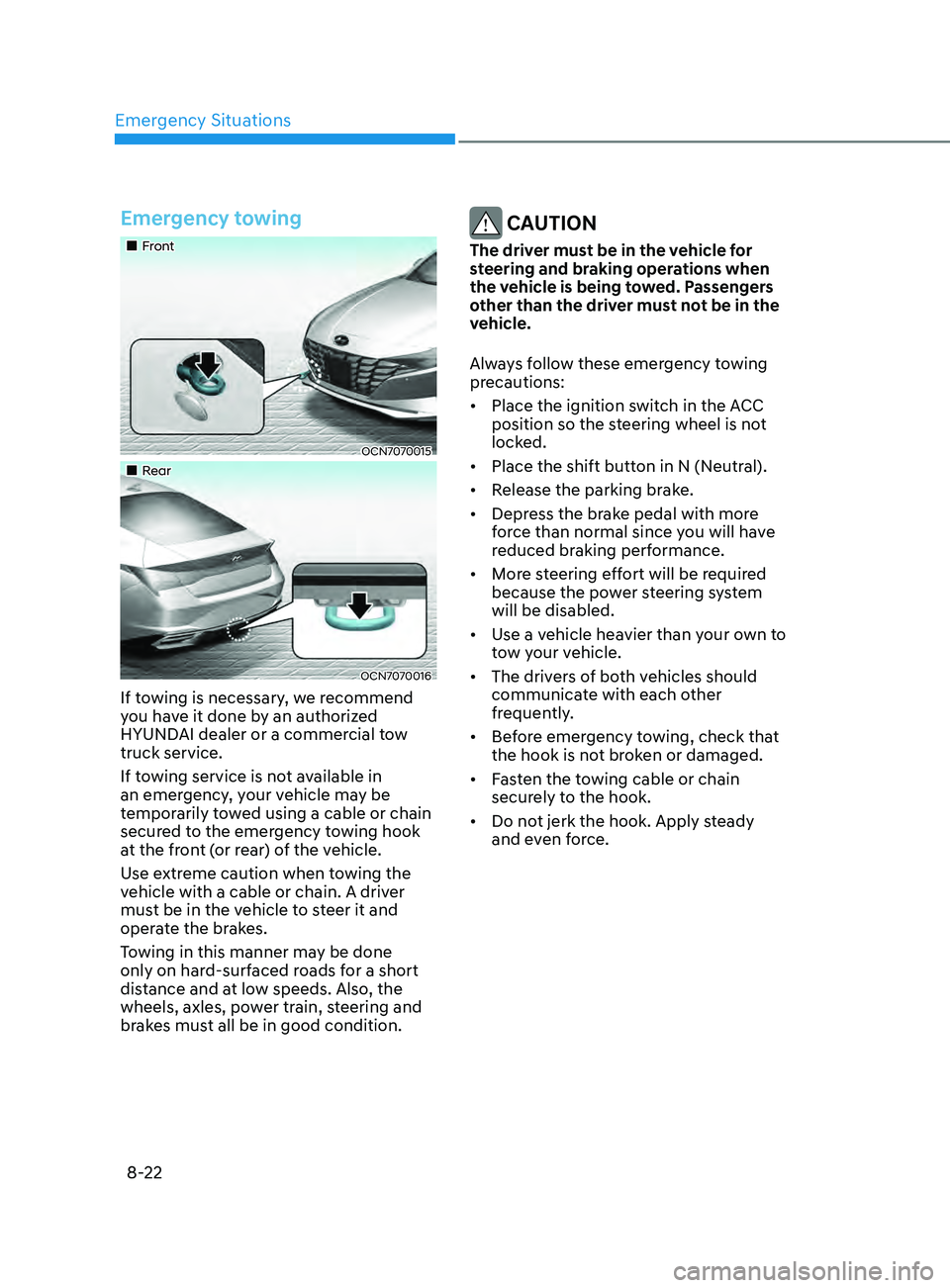
Emergency towing
„„Front
OCN7070015
„„Rear
OCN7070016
If towing is necessary, we recommend
you have it done by an authorized
HYUNDAI dealer or a commercial tow
truck service.
If towing service is not available in
an emergency, your vehicle may be
temporarily towed using a cable or chain
secured to the emergency towing hook
at the front (or rear) of the vehicle.
Use extreme caution when towing the
vehicle with a cable or chain. A driver
must be in the vehicle to steer it and
operate the brakes.
Towing in this manner may be done
only on hard-surfaced roads for a short
distance and at low speeds. Also, the
wheels, axles, power train, steering and
brakes must all be in good condition.
CAUTION
The driver must be in the vehicle for
steering and braking operations when
the vehicle is being towed. Passengers
other than the driver must not be in the
vehicle.
Always follow these emergency towing
precautions:
• Place the ignition switch in the ACC
position so the steering wheel is not
locked.
• Place the shift button in N (Neutral).
• Release the parking brake.
• Depress the brake pedal with more
force than normal since you will have
reduced braking performance.
• More steering effort will be required
because the power steering system
will be disabled.
• Use a vehicle heavier than your own to
tow your vehicle.
• The drivers of both vehicles should
communicate with each other
frequently.
• Before emergency towing, check that
the hook is not broken or damaged.
• Fasten the towing cable or chain
securely to the hook.
• Do not jerk the hook. Apply steady
and even force.
Page 486 of 570
08
8-23
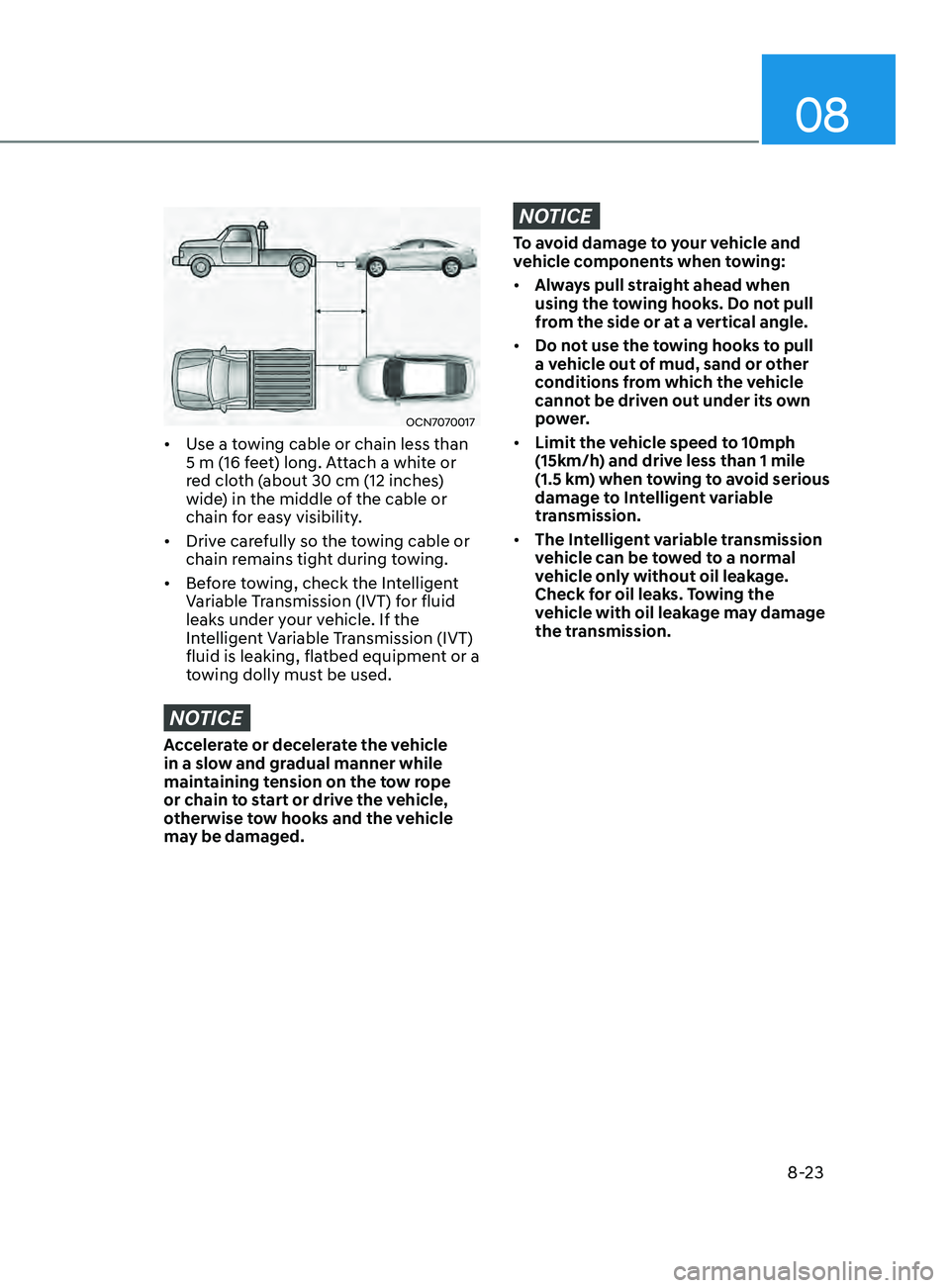
OCN7070017
• Use a towing cable or chain less than
5 m (16 feet) long. Attach a white or
red cloth (about 30 cm (12 inches)
wide) in the middle of the cable or
chain for easy visibility.
• Drive carefully so the towing cable or
chain remains tight during towing.
• Before towing, check the Intelligent
Variable Transmission (IVT) for fluid
leaks under your vehicle. If the
Intelligent Variable Transmission (IVT)
fluid is leaking, flatbed equipment or a
towing dolly must be used.
NOTICE
Accelerate or decelerate the vehicle
in a slow and gradual manner while
maintaining tension on the tow rope
or chain to start or drive the vehicle,
otherwise tow hooks and the vehicle
may be damaged.
NOTICE
To avoid damage to your vehicle and
vehicle components when towing:
• Always pull straight ahead when
using the towing hooks. Do not pull
from the side or at a vertical angle.
• Do not use the towing hooks to pull
a vehicle out of mud, sand or other
conditions from which the vehicle
cannot be driven out under its own
power.
• Limit the vehicle speed to 10mph
(15km/h) and drive less than 1 mile
(1.5 km) when towing to avoid serious
damage to Intelligent variable
transmission.
• The Intelligent variable transmission
vehicle can be towed to a normal
vehicle only without oil leakage.
Check for oil leaks. Towing the
vehicle with oil leakage may damage
the transmission.
Page 498 of 570
Maintenance
9-12
Severe driving conditions
A. Repeatedly driving short distance of less than 5 miles (8 km) in normal temperature
or less than 10 miles (16 km) in freezing temperature
B.
Extensiv
e engine idling or low speed driving for long distances
C.
Driving on rough, dus
ty, muddy, unpaved, graveled or saltspread roads
D.
Driving in areas using salt or o
ther corrosive materials or in very cold weather
E.
Driving in the condition of in
flowing sand or dust into engine
F.
Driving in heavy tr
affic area
G.
Driving on uphill, downhill, or moun
tain roads
H.
To
wing a trailer
I.
Driving for pa
trol car, taxi, commercial car or vehicle towing
J.
Driving ov
er 106 mph (170 km/h)
K.
Fr
equently driving in stop-and-go conditions
L.
Engine oil usage which is no
t recommended (mineral type, lower grade spec, etc.)
Page 569 of 570

Index
I-12
Tire Care ........................................................................\
...................................9-27
Tire Maintenance ........................................................................\
......................9-32
Tire Replacement ........................................................................\
.....................9-30
Tire Rotation ........................................................................\
............................. 9-29
Tire Sidewall Labeling ........................................................................\
.............9-32
Tire
Terminology and Definitions
.................................................................... 9-35
Tire T
raction
........................................................................\
............................. 9-32
Wheel Alignment and
Tire Balance
................................................................. 9-30
Wheel Replacement ........................................................................\
.................. 9-32
T
owing
........................................................................\
......................................... 8-20
Emergency towing ........................................................................\
....................8-22
Emergency T
owing
........................................................................\
.................. 8-21
Removable towing hook ........................................................................\
...........8-21
Towing Service ........................................................................\
......................... 8-20
T
railer Towing
........................................................................\
............................. 6-54
T
runk
........................................................................\
............................................ 5-61
Emergency trunk safety release ........................................................................\
5-62
Smart Trunk
release
........................................................................\
.................. 5-63
V
V
ehicle Break-In Process
........................................................................\
............... 1-7
V
ehicle Certification Label
........................................................................\
.......... 2-13
Vehicle Data Collection and Event Data Recorders
.............................................. 1-8
V
ehicle Identification Number (
VIN) .................................................................. 2-13
V
ehicle load limit
........................................................................\
......................... 6-49
Tire Loading Information Label .......................................................................6-50
V
ehicle Modifications
........................................................................\
.................... 1-7
V
olume and Weight
........................................................................\
...................... 2-10