mainten HYUNDAI ELANTRA 2021 Repair Manual
[x] Cancel search | Manufacturer: HYUNDAI, Model Year: 2021, Model line: ELANTRA, Model: HYUNDAI ELANTRA 2021Pages: 570, PDF Size: 52.21 MB
Page 546 of 570
Maintenance
9-60
WARNING
After washing the vehicle, test the
brakes while driving slowly to see
if they have been affected by water
before getting on the road. If braking
performance is impaired, dry the
brakes by applying them lightly while
maintaining a slow forward speed.
NOTICE
• Do not use strong soap, chemical
detergents or hot water, and do not
wash the vehicle in direct sunlight
or when the body of the vehicle is
warm.
• Be careful when washing the side
windows of your vehicle.
Especially, with high-pressure water,
water may leak through the windows
and wet the interior.
• To prevent damage to the plastic
parts, do not clean with chemical
solvents or strong detergents.ODN8A089039
NOTICE
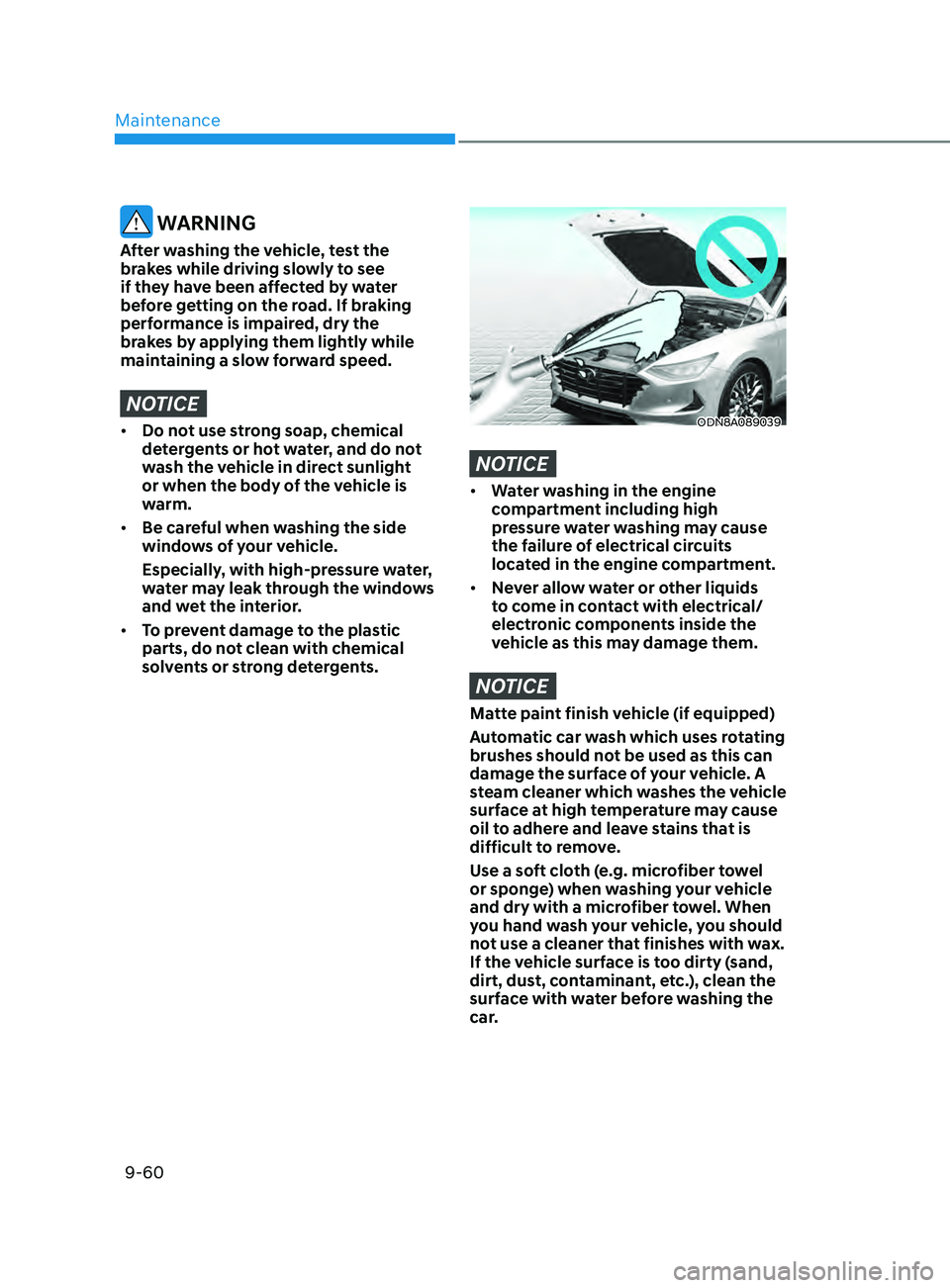
• Water washing in the engine
compartment including high
pressure water washing may cause
the failure of electrical circuits
located in the engine compartment.
• Never allow water or other liquids
to come in contact with electrical/
electronic components inside the
vehicle as this may damage them.
NOTICE
Matte paint finish vehicle (if equipped)
Automatic car wash which uses rotating
brushes should not be used as this can
damage the surface of your vehicle. A
steam cleaner which washes the vehicle
surface at high temperature may cause
oil to adhere and leave stains that is
difficult to remove.
Use a soft cloth (e.g. microfiber towel
or sponge) when washing your vehicle
and dry with a microfiber towel. When
you hand wash your vehicle, you should
not use a cleaner that finishes with wax.
If the vehicle surface is too dirty (sand,
dirt, dust, contaminant, etc.), clean the
surface with water before washing the
car.
Page 547 of 570
09
9-61
Waxing
A good coat of wax provides a barrier
between your paint and environmental
contamination.
Keeping a good coat of wax on your
vehicle will help protect it.
Wax the vehicle when water will no
longer bead on the paint.
Always wash and dry the vehicle before
waxing. Use a good quality liquid or
paste wax, and follow the manufacturer’s
instructions. Wax all metal trim to protect
it and to maintain its luster.
Removing oil, tar, and similar materials
with a spot remover will usually strip the
wax from the finish. Be sure to re-wax
these areas even if the rest of the vehicle
does not yet need waxing.
NOTICE
• Wiping dust or dirt off the body with
a dry cloth will scratch the finish.
• Do not use steel wool, abrasive
cleaners, or strong detergents
containing highly alkaline or
caustic agents on chrome-plated or
anodized aluminum parts. This may
result in damage to the protective
coating and cause discoloration or
paint deterioration.
NOTICE
Matte paint finish vehicle (if equipped)
Do not use any polish protector such as
a detergent, an abrasive and a polish.
In case wax is applied, remove the wax
immediately using a silicon remover
and if any tar or tar contaminant is on
the surface use a tar remover to clean.
However, be careful not to apply too
much pressure on the painted area.
Repairing your vehicle’s finish
Deep scratches or stone chips in the
painted surface must be repaired
promptly. Exposed metal will quickly
rust and may develop into a major repair
expense.
NOTICE
If your vehicle is damaged and requires
any metal repair or replacement,
be sure the body shop applies anti-
corrosion materials to the parts
repaired or replaced.
NOTICE
Matte paint finish vehicle (if equipped)
In case of matte paint finish vehicles,
it is impossible to modify only the
damaged area and repair of the whole
part is necessary. If the vehicle is
damaged and painting is required,
we recommend that you have your
vehicle maintained and repaired by
an authorized HYUNDAI dealer. Take
extreme care, as it is difficult to restore
the quality after the repair.
Bright-metal maintenance
• To remove road tar and insects, use
a tar remover, not a scraper or other
sharp object.
• To protect the surfaces of bright metal
parts from corrosion, apply a coating
of wax or chrome preservative and rub
to a high luster.
• During winter weather or in coastal
areas, cover the bright metal parts
with a heavier coating of wax or
preservative. If necessary, coat the
parts with non-corrosive petroleum
jelly or other protective compound.
Page 548 of 570
Maintenance
9-62
Underbody maintenance
Corrosive materials used for ice and
snow removal and dust control may
collect on the underbody. If these
materials are not removed, accelerated
rusting can occur on underbody parts
such as the fuel lines, frame, floor pan
and exhaust system, even though they
have been treated with rust protection.
Thoroughly flush the vehicle underbody
and wheel openings with lukewarm or
cold water once a month, after off-road
driving and at the end of each winter. Pay
special attention to these areas because
it is difficult to see all the mud and dirt.
It will do more harm than good to wet
down the road grime without removing
it. The lower edges of doors, rocker
panels, and frame members have drain
holes that should not be allowed to clog
with dirt; trapped water in these areas
can cause rusting.
WARNING
After washing the vehicle, test the
brakes while driving slowly to see if
they have been affected by water. If
braking performance is impaired, dry
the brakes by applying them lightly
while maintaining a slow forward
speed.
Aluminum wheel maintenance
The aluminum wheels are coated with a
clear protective finish.
NOTICE
• Do not use abrasive cleaner,
polishing compound, solvent, or wire
brushes on aluminum wheels.
• Clean the wheel when it has cooled.
• Use only a mild soap or neutral
detergent, and rinse thoroughly with
water. Also, clean the wheels after
driving on salted roads.
• Do not wash the wheels with high-
speed car wash brushes.
• Do not use any cleaners containing
acid or alkaline detergents.
Page 550 of 570
Maintenance
9-64
To help prevent corrosion
Keep your vehicle clean
The best way to prevent corrosion is
to keep your vehicle clean and free of
corrosive materials. Attention to the
underside of the vehicle is particularly
important.
• If you live in a high-corrosion area —
where road salts are used, near the
ocean, areas with industrial pollution,
acid rain, etc.—, you should take extra
care to prevent corrosion. In winter,
hose off the underside of your vehicle
at least once a month and be sure to
clean the underside thoroughly when
winter is over.
• When cleaning underneath the
vehicle, pay particular attention to the
components under the fenders and
other areas that are hidden from view.
Do a thorough job; just dampening
the accumulated mud rather than
washing it away will accelerate
corrosion rather than prevent it. Water
under high pressure and steam are
particularly effective in removing
accumulated mud and corrosive
materials.
• When cleaning lower door panels,
rocker panels and frame members, be
sure that drain holes are kept open so
that moisture can escape and not be
trapped inside to accelerate corrosion. Keep your garage dry
Don’t park your vehicle in a damp,
poorly ventilated garage. This creates
a favorable environment for corrosion.
This is particularly true if you wash your
vehicle in the garage or drive it into the
garage when it is still wet or covered with
snow, ice or mud. Even a heated garage
can contribute to corrosion unless it is
well ventilated so moisture is dispersed.
Keep paint and trim in good condition
Scratches or chips in the finish should
be covered with “touch-up” paint as
soon as possible to reduce the possibility
of corrosion. If bare metal is showing
through, the attention of a qualified body
and paint shop is recommended.
Bird droppings are highly corrosive and
may damage painted surfaces in just a
few hours. Always remove bird droppings
as soon as possible.
Page 552 of 570
Maintenance
9-66
Leather (if equipped)
• Features of seat leather
- Lea
ther is made from the outer skin
of an animal, which goes through a
special process to be available for
use. Since it is a natural product,
each part differs in thickness or
density.
Wrinkles may appear as a natural
result of stretching and shrinking
depending on the temperature and
humidity.
- The seat is made o
f stretchable
fabric to improve comfort.
- The parts contacting the body ar
e
curved and the side supporting
area is high which provides driving
comfort and stability.
- Wrinkles ma
y appear naturally
from usage. It is not a fault of the
products.
CAUTION
• Wrinkles or abrasions which appear
naturally from usage are not covered
by warranty.
• Belts with metallic accessories,
zippers or keys inside the back
pocket may damage the seat fabric.
• Make sure not to wet the seat. It may
change the nature of natural leather.
• Jeans or clothes which could bleach
may contaminate the surface of the
seat covering fabric. •
Caring for the leather seats
- Vacuum the sea
t periodically to
remove dust and sand on the seat. It
will prevent abrasion or damage of
the leather and maintain its quality.
- Wipe the natur
al leather seat cover
often with dry or soft cloth.
- Use o
f proper leather protector may
prevent abrasion of the cover and
helps maintain the color. Be sure to
read the instructions and consult
a specialist when using leather
coating or protective agent.
- Light color
ed (beige, cream beige)
leather is easily contaminated and
the stain is noticeable. Clean the
seats frequently.
- Av
oid wiping with wet cloth. It may
cause the surface to crack.
• Cleaning the leather seats
- Remo
ve all contaminations
instantly. Refer to instructions below
for removal of each contaminant. - Cosmetic pr oducts (sunscreen,
foundation, etc.)
Apply cleansing cream on a cloth
and wipe the contaminated spot.
Wipe off the cream with a wet cloth
and remove water with a dry cloth.
- Bev
erages (coffee, soft drink, etc.)
Apply a small amount of neutral
detergent and wipe until
contaminations do not smear.
- Oil Remo
ve oil instantly with
absorbable cloth and wipe with
stain remover used only for natural
leather.
- Chewing gum
Har
den the gum with ice and
remove gradually.
Page 554 of 570
Maintenance
9-68
The emission control system of your
vehicle is covered by a written limited
warranty. Please see the warranty
information contained in the Owner’s
Handbook & Warranty Information
booklet in your vehicle.
Your vehicle is equipped with an
emission control system to meet all
applicable emission regulations. There
are three emission control systems, as
follows.
(1)
Crank
case emission control system
(2)
Ev
aporative emission control system
(3)
Exhaust emission con
trol system
In order to ensure the proper function
of the emission control systems, it
is recommended that you have your
vehicle inspected and maintained
by an authorized HYUNDAI dealer in
accordance with the maintenance
schedule in this manual.
NOTICE
For the Inspection and Maintenance
Test (with Electronic Stability Control
(ESC) system)
• To prevent the vehicle from misfiring
during dynamometer testing, turn
the Electronic Stability Control
(ESC) system off by pressing the ESC
switch (ESC OFF light illuminated).
• After dynamometer testing is
completed, turn the ESC system back
on by pressing the ESC switch again.
1. Crankcase Emission Control
Sy
stem
The positive crankcase ventilation system
is employed to prevent air pollution
caused by blow-by gases being emitted
from the crankcase. This system supplies
fresh filtered air to the crankcase through
the air intake hose. Inside the crankcase,
the fresh air mixes with blow-by gases,
which then pass through the PCV valve
into the induction system.
2. Evaporative Emission Control
System Including Onboard
Refueling Vapor Recovery
(ORVR)
The Evaporative Emission Control System
is designed to prevent fuel vapors from
escaping into the atmosphere. The
ORVR system is designed to allow the
vapors from the fuel tank to be loaded
into a canister while refueling at the gas
station, preventing the escape of fuel
vapors into the atmosphere.
Canister
Fuel vapors generated inside the fuel
tank are absorbed and stored in the
onboard canister. When the engine is
running, the fuel vapors absorbed in the
canister are drawn into the surge tank
through the purge control solenoid valve.
Purge Control Solenoid Valve (PCSV)
The purge control solenoid valve
is controlled by the Engine Control
Module (ECM); when the engine coolant
temperature is low during idling, the
PCSV closes so that evaporated fuel
is not taken into the engine. After the
engine warms-up during ordinary
driving, the PCSV opens to introduce
evaporated fuel to the engine.
EmiSSion Control SyStEm
Page 556 of 570
Maintenance
9-70
Operating precautions for catalytic
converters (if equipped)
WARNING
The exhaust system and catalytic
converter are very hot during and
immediately after the engine has been
running. To avoid SERIOUS INJURY or
DEATH:
• Do not park, idle, or drive the vehicle
over or near flammable objects, such
as grass, vegetation, paper, leaves,
etc. A hot exhaust system can ignite
flammable items under your vehicle.
• Keep away from the exhaust system
and catalytic converter or you may
get burned.
Also, do not remove the heat sink
around the exhaust system, do not
seal the bottom of the vehicle, and
do not coat the vehicle for corrosion
control. It may present a fire risk
under certain conditions. Your vehicle is equipped with a catalytic
converter emission control device.
To prevent damage to the catalytic
converter and to your vehicle, take the
following precautions:
•
Use only UNLEADED FUEL for
gasoline engines.
• Do not operate the vehicle when
there are signs of engine malfunction,
such as misfire or a noticeable loss of
performance.
• Do not misuse or abuse the engine.
Examples of misuse are coasting with
the engine off and descending steep
grades in gear with the engine off.
• Do not operate the engine at high
idle speed for extended periods (5
minutes or more).
• Do not modify or tamper with any
part of the engine or emission
control system. All inspections and
adjustments must be made by an
authorized HYUNDAI dealer.
• Avoid driving with extremely low
fuel level. If you run out of gasoline,
it could cause the engine to misfire
and result in excessive loading of the
catalytic converter.
Page 559 of 570

Index
I-2
A
Accessing Your Vehicle
........................................................................\
.................5-4
Automatic Door Lock and Unlock Features ....................................................5-35
Child-Protector Rear Door Locks .................................................................... 5-35
Hyundai Digital Key ........................................................................\
................ 5-15
Immobilizer System ........................................................................\
................5-14
Operating Door Locks from Inside the V
ehicle................................................ 5-33
Operating Door Locks from Outside the V
ehicle
.............................................5-31
Rear Occupant Alert (ROA) System ................................................................ 5-36
Remote Key ........................................................................\
................................ 5-4
Smart Key ........................................................................\
................................... 5-7
Air Bag -
Advanced Supplemental Restraint System
.......................................... 3-35
Additional Safety Precautions ........................................................................\
.. 3-55
Air Bag W
arning Labels
........................................................................\
........... 3-55
How Does the Air Bag System Operate? .........................................................3-40
Occupant Classification System (OCS) ........................................................... 3-44
SRS Care ........................................................................\
.................................. 3-54
What to Expect After an
Air Bag Inflates
........................................................ 3-43
Where Are
the Air Bags?
........................................................................\
.......... 3-37
Why Didn’t My
Air Bag Go Off in a Collision?
.............................................. 3-50
Air Cleaner
........................................................................\
................................... 9-20
Filter replacement ........................................................................\
..................... 9-20
Air Conditioning System
........................................................................\
............. 2-10
Anti-lock Brake System (ABS)
........................................................................\
... 6-29
Electronic Stability Control (ESC) ..................................................................6-31
Good Braking Practices ........................................................................\
............ 6-34
Hill-Start Assist Control (HAC) .......................................................................6-34
Vehicle Stability Management (VSM) ............................................................6-33
Appearance Care
........................................................................\
.......................... 9-59
Exterior Care ........................................................................\
............................ 9-59
Interior Care ........................................................................\
............................. 9-65
Automatic Climate Control System
..................................................................... 5-92
Automatic heating and air conditioning ...........................................................5-93
Manual heating and air conditioning ................................................................ 5-94
System Maintenance ........................................................................\
.............. 5-102
System operation ........................................................................\
.................... 5-100
Page 561 of 570

Index
I-4
C
Cabin Air Filter
........................................................................\
............................9-21
California Perchlorate notice
........................................................................\
....... 9-71
Child Restraint System (CRS)
........................................................................\
..... 3-26
Children Always in the Rear ........................................................................\
....3-26
Installing a Child Restraint System (CRS) .......................................................3-28
Selecting a Child Restraint System (CRS) .......................................................3-27
Climate Control
Additional Features
................................................................. 5-109
Auto comfort control (for driver’
s seat)
......................................................... 5-109
Automatic ventilation ........................................................................\
............. 5-109
Sunroof inside air recirculation ......................................................................5-109
Consumer Information
........................................................................\
................. 2-15
Cruise Control (CC)
........................................................................\
.................... 7-77
Function operation ........................................................................\
...................7-77
D
Declaration of Conformity
........................................................................\
......... 7-150
Dimensions
........................................................................\
.................................... 2-7
Drive Mode Integrated Control System
............................................................... 6-39
Drive Mode ........................................................................\
.............................. 6-39
Smart shift on trip computer ........................................................................\
.....6-42
Driver Attention
Warning (DAW)
...................................................................... 7-71
Function malfunction and limitations ..............................................................7-74
Function settings ........................................................................\
..................... 7-71
System operation ........................................................................\
...................... 7-72
E
Emission Control System
........................................................................\
............ 9-68
Engine Compartment
........................................................................\
............. 2-6/ 9-3
Engine Coolant
........................................................................\
............................ 9-16
Changing Engine Coolant ........................................................................\
........9-17
Checking the Engine Coolant Level .................................................................9-16
Engine Number
........................................................................\
............................ 2-14
Engine Oil
........................................................................\
.................................... 9-15
Checking the Engine Oil and Filter ..................................................................9-15
Checking the Engine Oil Level ........................................................................\
9-15
Engine Specification
........................................................................\
...................... 2-7
Explanation of Scheduled Maintenance Items
.................................................... 9-13
Page 565 of 570

............................")
Index
I-8
J
Jump Starting
........................................................................\
.................................8-4
L
Lane Following
Assist (LFA)
........................................................................\
... 7-105
Function malfunction and limitations ............................................................7-108
Function operation ........................................................................\
.................. 7-106
Function settings ........................................................................\
.................... 7-105
Lane Keeping
Assist (LKA)
........................................................................\
....... 7-30
Function malfunction and limitations ..............................................................7-34
Function operation ........................................................................\
.................... 7-32
Function settings ........................................................................\
..................... 7-30
LCD Display (T
ype A)
........................................................................\
................. 4-25
LCD Display Control ........................................................................\
...............4-25
LCD display modes ........................................................................\
.................. 4-26
Trip Computer ........................................................................\
.......................... 4-36
User settings mode ........................................................................\
...................4-29
LCD display (T
ype B)
........................................................................\
................. 4-40
LCD Display Control ........................................................................\
...............4-40
User settings mode ........................................................................\
................... 4-44
Utility group ........................................................................\
............................. 4-42
View modes ........................................................................\
.............................. 4-41
Light Bulbs
........................................................................\
.................................. 9-50
Headlamp, Parking Lamp, Daytime Running Light, T
urn Signal Lamp and
Side Marker ........................................................................\
............................ 9-51
High mounted stop lamp replacement ..............................................................9-57
Interior Light Bulb Replacement ...................................................................... 9-58
License Plate Light Bulb Replacement ............................................................9-57
Rear combination lamp bulb replacement ........................................................9-54
Side repeater lamp replacement ....................................................................... 9-54
M
Maintenance Services
........................................................................\
.................... 9-4
Owner Maintenance Precautions ........................................................................\
9-4
Owner’
s Responsibility
........................................................................\
.............. 9-4