check engine light Hyundai Elantra Coupe 2014 Owner's Guide
[x] Cancel search | Manufacturer: HYUNDAI, Model Year: 2014, Model line: Elantra Coupe, Model: Hyundai Elantra Coupe 2014Pages: 550, PDF Size: 45.11 MB
Page 404 of 550
IF THE ENGINE WILL NOT START
If the engine doesn't turn over
or turns over slowly
Be sure the shift lever is in N
(Neutral) or P (Park) if it is an auto-
matic transaxle vehicle. The engine
starts only when the shift lever is in
N (Neutral) or P (Park).
Check the battery connections to
be sure they are clean and tight.
Turn on the interior light. If the light
dims or goes out when you operate
the starter, the battery is drained.
Do not push or pull the vehicle to
start it. This could cause damage to
your vehicle. See instructions for
"Jump Starting" provided in this
chapter.
If the engine turns over nor-
mally but doesn’t start
Check the fuel level and add fuel if
necessary.
If the engine still does not start, call
an authorized HYUNDAI dealer for
assistance.
What to do in an emergency
4 6
WARNING
Push or pull starting the vehicle
may cause the catalytic con-
verter to overload which can
lead to damage to the emission
control system.
Page 437 of 550
77
Maintenance
Owner maintenance schedule
When you stop for fuel:
Check the engine oil level.
Check coolant level in the engine
coolant reservoir.
Check the windshield washer fluid
level.
Check for low or under-inflated
tires
While operating your vehicle:
Note any changes in the sound of
the exhaust or any smell of
exhaust fumes in the vehicle.
Check for vibrations in the steering
wheel. Notice if there is any
increased steering effort or loose-
ness in the steering wheel, or
change in its straight-ahead posi-
tion.
Notice if your vehicle constantly
turns slightly or “pulls” to one side
when traveling on smooth, level
road.
When stopping, listen and check
for unusual sounds, pulling to one
side, increased brake pedal travel
or “hard-to-push” brake pedal.
If any slipping or changes in the
operation of your transaxle occurs,
check the transaxle fluid level.
Check the automatic transaxle P
(Park) function.
Check the parking brake.
Check for fluid leaks under your
vehicle (water dripping from the air
conditioning system during or after
use is normal).
At least monthly:
Check coolant level in the engine
coolant reservoir.
Check the operation of all exterior
lights, including the stoplights, turn
signals and hazard warning flash-
ers.
Check the inflation pressures of all
tires including the spare for tires
that are worn, show uneven wear,
or are damaged.
Check for loose wheel lug nuts.
WARNING
Be careful when checking your
engine coolant level when the
engine is hot. This may result
in coolant being blown out of
the opening and cause seri-
ous burns and other injuries.
Page 493 of 550
763
Maintenance
FUSES
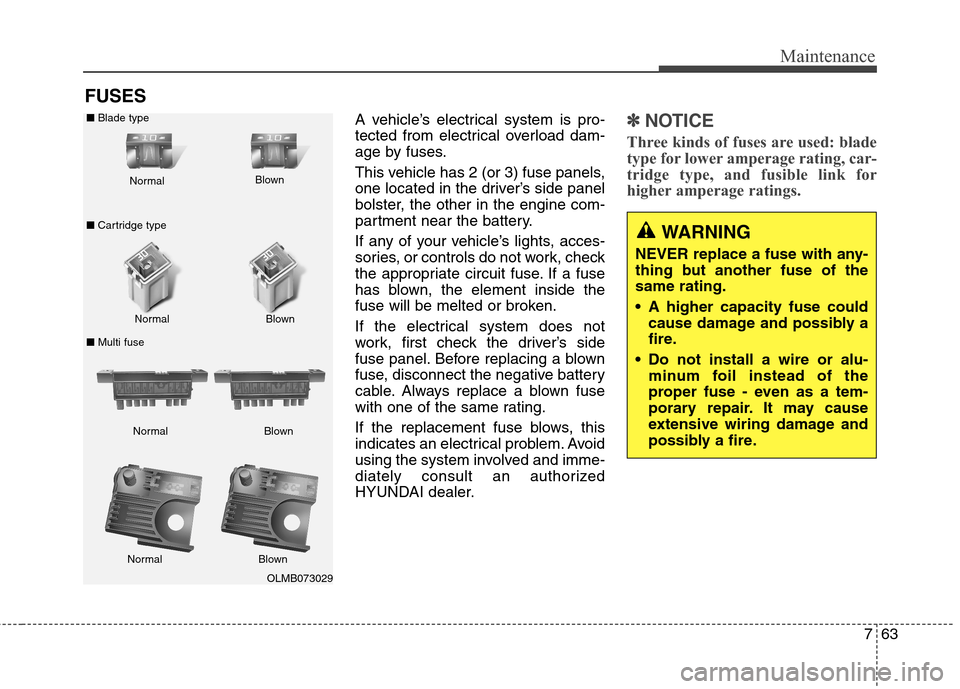
A vehicle’s electrical system is pro-
tected from electrical overload dam-
age by fuses.
This vehicle has 2 (or 3) fuse panels,
one located in the driver’s side panel
bolster, the other in the engine com-
partment near the battery.
If any of your vehicle’s lights, acces-
sories, or controls do not work, check
the appropriate circuit fuse. If a fuse
has blown, the element inside the
fuse will be melted or broken.
If the electrical system does not
work, first check the driver’s side
fuse panel. Before replacing a blown
fuse, disconnect the negative battery
cable. Always replace a blown fuse
with one of the same rating.
If the replacement fuse blows, this
indicates an electrical problem. Avoid
using the system involved and imme-
diately consult an authorized
HYUNDAI dealer.✽ ✽
NOTICE
Three kinds of fuses are used: blade
type for lower amperage rating, car-
tridge type, and fusible link for
higher amperage ratings.
OLMB073029 Normal Normal ■Blade type
■Cartridge type
■Multi fuseBlown
Blown
Normal Blown
Normal Blown
WARNING
NEVER replace a fuse with any-
thing but another fuse of the
same rating.
A higher capacity fuse could
cause damage and possibly a
fire.
Do not install a wire or alu-
minum foil instead of the
proper fuse - even as a tem-
porary repair. It may cause
extensive wiring damage and
possibly a fire.
Page 495 of 550
765
Maintenance
In an emergency, if you do not have
a spare fuse, use a fuse of the same
rating from a circuit you may not
need for operating the vehicle, such
as the cigarette lighter fuse.
If the headlights or other electrical
components do not work and the
fuses are OK, check the fuse panel
in the engine compartment. If a fuse
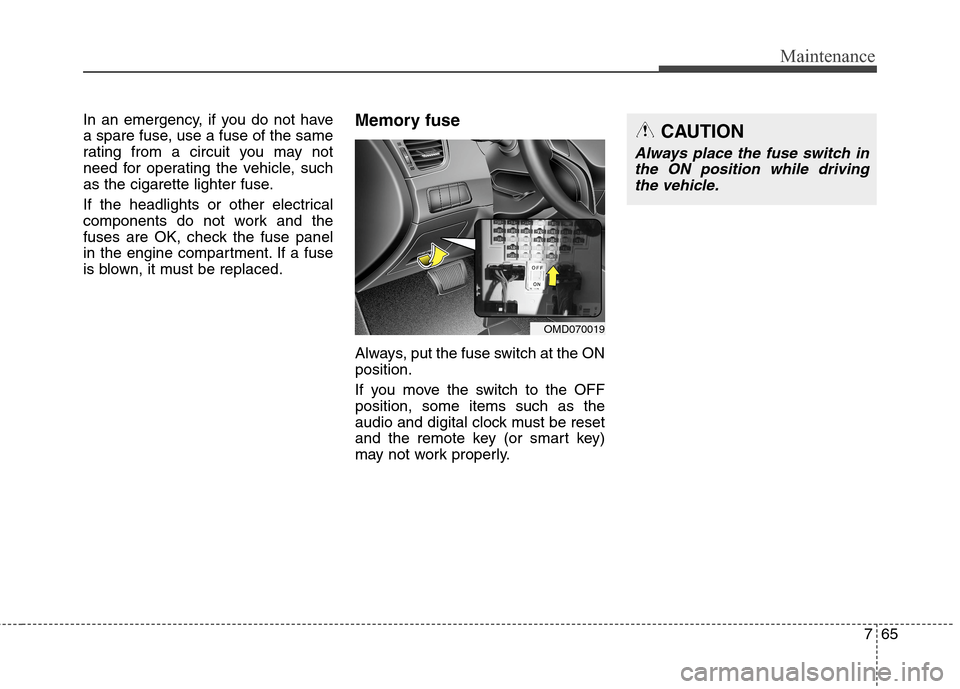
is blown, it must be replaced.Memory fuse
Always, put the fuse switch at the ON
position.
If you move the switch to the OFF
position, some items such as the
audio and digital clock must be reset
and the remote key (or smart key)
may not work properly.
OMD070019
CAUTION
Always place the fuse switch in
the ON position while driving
the vehicle.
Page 541 of 550
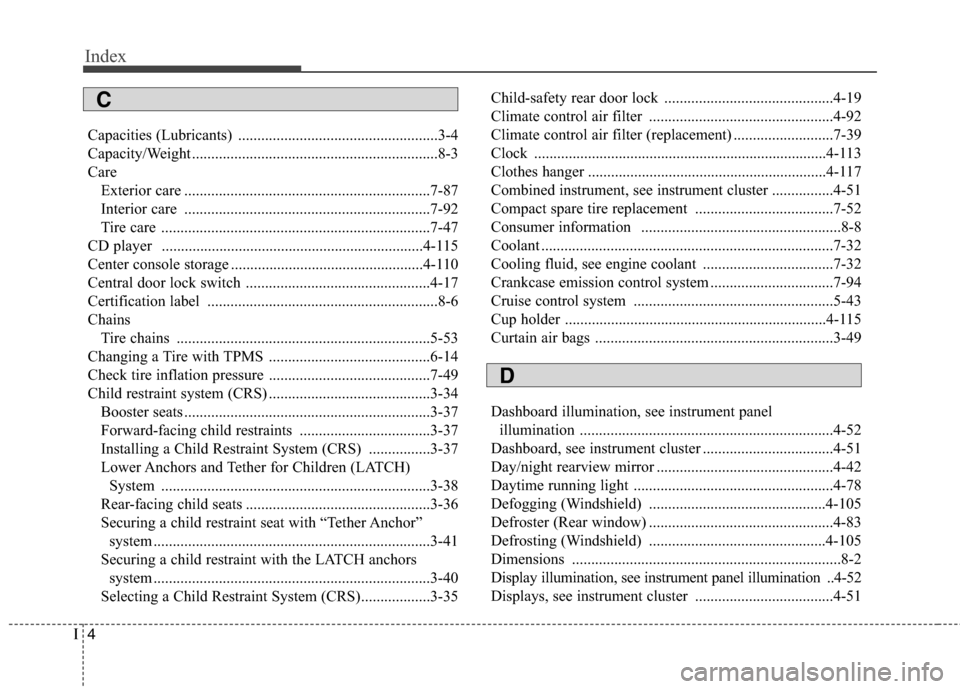
Index
4I
Capacities (Lubricants) ....................................................3-4
Capacity/Weight ................................................................8-3
Care
Exterior care ................................................................7-87
Interior care ................................................................7-92
Tire care ......................................................................7-47
CD player ....................................................................4-115
Center console storage ..................................................4-110
Central door lock switch ................................................4-17
Certification label ............................................................8-6
Chains
Tire chains ..................................................................5-53
Changing a Tire with TPMS ..........................................6-14
Check tire inflation pressure ..........................................7-49
Child restraint system (CRS) ..........................................3-34
Booster seats ................................................................3-37
Forward-facing child restraints ..................................3-37
Installing a Child Restraint System (CRS) ................3-37
Lower Anchors and Tether for Children (LATCH)
System ......................................................................3-38
Rear-facing child seats ................................................3-36
Securing a child restraint seat with “Tether Anchor”
system ........................................................................3-41
Securing a child restraint with the LATCH anchors
system ........................................................................3-40
Selecting a Child Restraint System (CRS)..................3-35Child-safety rear door lock ............................................4-19
Climate control air filter ................................................4-92
Climate control air filter (replacement) ..........................7-39
Clock ............................................................................4-113
Clothes hanger ..............................................................4-117
Combined instrument, see instrument cluster ................4-51
Compact spare tire replacement ....................................7-52
Consumer information ....................................................8-8
Coolant ............................................................................7-32
Cooling fluid, see engine coolant ..................................7-32
Crankcase emission control system ................................7-94
Cruise control system ....................................................5-43
Cup holder ....................................................................4-115
Curtain air bags ..............................................................3-49
Dashboard illumination, see instrument panel
illumination ..................................................................4-52
Dashboard, see instrument cluster ..................................4-51
Day/night rearview mirror ..............................................4-42
Daytime running light ....................................................4-78
Defogging (Windshield) ..............................................4-105
Defroster (Rear window) ................................................4-83
Defrosting (Windshield) ..............................................4-105
Dimensions ......................................................................8-2
Display illumination, see instrument panel illumination ..4-52
Displays, see instrument cluster ....................................4-51
D
C