ignition Hyundai Elantra Coupe 2014 Manual PDF
[x] Cancel search | Manufacturer: HYUNDAI, Model Year: 2014, Model line: Elantra Coupe, Model: Hyundai Elantra Coupe 2014Pages: 550, PDF Size: 45.11 MB
Page 428 of 550
What to do in an emergency
28 6
When towing your vehicle in an
emergency without wheel dollies:
1.Place the ignition switch in the
ACC position.
2.Place the shift lever in N (Neutral).
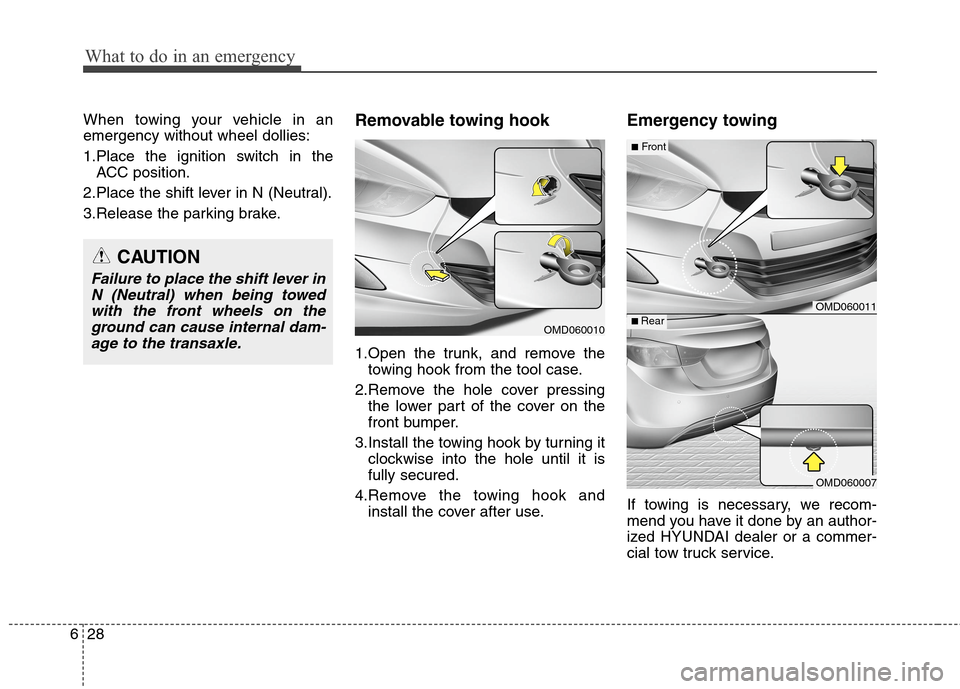
3.Release the parking brake.Removable towing hook
1.Open the trunk, and remove the
towing hook from the tool case.
2.Remove the hole cover pressing
the lower part of the cover on the
front bumper.
3.Install the towing hook by turning it
clockwise into the hole until it is
fully secured.
4.Remove the towing hook and
install the cover after use.
Emergency towing
If towing is necessary, we recom-
mend you have it done by an author-
ized HYUNDAI dealer or a commer-
cial tow truck service.
CAUTION
Failure to place the shift lever in
N (Neutral) when being towed
with the front wheels on the
ground can cause internal dam-
age to the transaxle.
OMD060010
OMD060011
OMD060007
■Front
■ Rear
Page 429 of 550
629
What to do in an emergency
If towing service is not available in an
emergency, your vehicle may be
temporarily towed using a cable or
chain secured to the emergency tow-
ing hook at the front (or rear) of the
vehicle.
Use extreme caution when towing
the vehicle with a cable or chain. A
driver must be in the vehicle to steer
it and operate the brakes.
Towing in this manner may be done
only on hard-surfaced roads for a
short distance and at low speeds.
Also, the wheels, axles, power train,
steering and brakes must all be in
good condition.Always follow these emergency tow-
ing precautions:
Place the ignition switch in the
ACC position so the steering
wheel is not locked. (if equipped)
Place the shift lever in N (Neutral).
Release the parking brake.
Depress the brake pedal with more
force than normal since you will
have reduced braking perform-
ance.
More steering effort will be
required because the power steer-
ing system will be disabled.
Use a vehicle heavier than your
own to tow your vehicle.
The drivers of both vehicles should
communicate with each other fre-
quently.
Before emergency towing, check
that the hook is not broken or dam-
aged.
Fasten the towing cable or chain
securely to the hook.
Do not jerk the hook. Apply steady
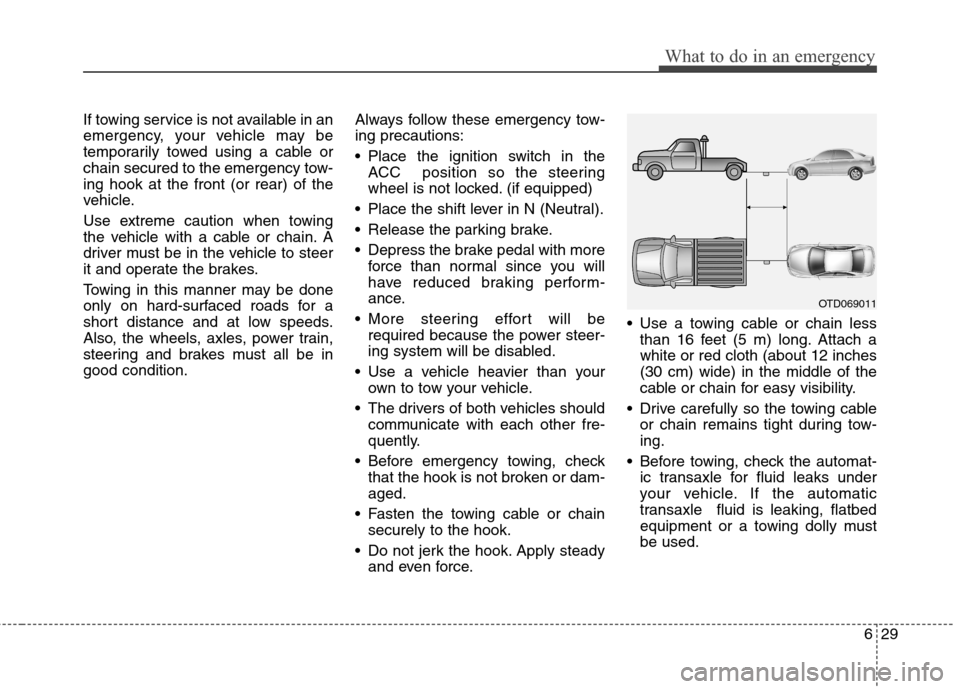
and even force. Use a towing cable or chain less
than 16 feet (5 m) long. Attach a
white or red cloth (about 12 inches
(30 cm) wide) in the middle of the
cable or chain for easy visibility.
Drive carefully so the towing cable
or chain remains tight during tow-
ing.
Before towing, check the automat-
ic transaxle for fluid leaks under
your vehicle. If the automatic
transaxle fluid is leaking, flatbed
equipment or a towing dolly must
be used.
OTD069011
Page 436 of 550
Maintenance
6 7
OWNER MAINTENANCE
The following lists are vehicle checks
and inspections that should be per-
formed by the owner or an author-
ized HYUNDAI dealer at the frequen-
cies indicated to help ensure safe,
dependable operation of your vehi-
cle.
Any adverse conditions should be
brought to the attention of your deal-
er as soon as possible.
These Owner Maintenance vehicle
checks are generally not covered by
warranties and you may be charged
for labor, parts and lubricants used.
WARNING
Performing maintenance work
on a vehicle can be dangerous.
If you lack sufficient knowledge
and experience or the proper
tools and equipment to do the
work, have it done by an author-
ized HYUNDAI dealer. ALWAYS
follow these precautions for
performing maintenance work:
Park your vehicle on level
ground, move the shift lever
into the P (Park, for automatic
transaxle vehicle) position or
neutral (for manual transaxle
vehicle, apply the parking
brake, place the ignition
switch in the OFF position.
Block the tires (front and
back) to prevent the vehicle
from moving.
Remove loose clothing or jew-
elry that can become entan-
gled in moving parts.
(Continued)
(Continued)
If you must run the engine
during maintenance, do so
out doors or in an area with
plenty of ventilation.
Keep flames, sparks, or smok-
ing materials away from the
battery and fuel-related parts.
Page 474 of 550
Maintenance
44 7
For best battery service
Keep the battery securely mount-
ed.
Keep the battery top clean and dry.
Keep the terminals and connec-
tions clean, tight, and coated with
petroleum jelly or terminal grease.
Rinse any spilled acid from the bat-
tery immediately with a solution of
water and baking soda.(Continued)
NEVER attempt to recharge
the battery when the vehicle’s
battery cables are connected
to the battery.
The electrical ignition system
works with high voltage.
NEVER touch these compo-
nents with the engine running
or when the ignition switch is
in the ON position.
WARNING- CALIFORNIA
PROPOSITION 65 WARNING
Battery posts, terminals, and
related accessories contain
lead and lead compounds,
chemicals known to the State of
California to cause cancer, birth
defects and reproductive harm.
Batteries also contain other
chemicals known to the State of
California to cause cancer.
Wash hands after handling.
CAUTION
When you do not use the vehi-
cle for a long time in a low
temperature area, disconnect
the battery and keep it
indoors.
Always charge the battery
fully to prevent battery case
damage in low temperature
areas.
Page 475 of 550
745
Maintenance
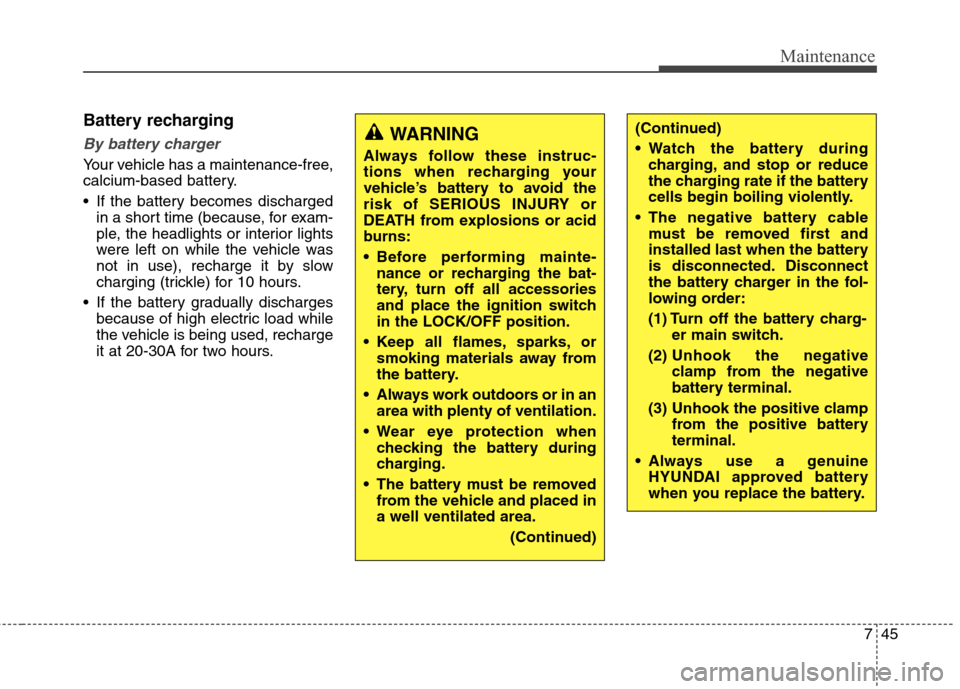
Battery recharging
By battery charger
Your vehicle has a maintenance-free,
calcium-based battery.
If the battery becomes discharged
in a short time (because, for exam-
ple, the headlights or interior lights
were left on while the vehicle was
not in use), recharge it by slow
charging (trickle) for 10 hours.
If the battery gradually discharges
because of high electric load while
the vehicle is being used, recharge
it at 20-30A for two hours.
WARNING
Always follow these instruc-
tions when recharging your
vehicle’s battery to avoid the
risk of SERIOUS INJURY or
DEATH from explosions or acid
burns:
Before performing mainte-
nance or recharging the bat-
tery, turn off all accessories
and place the ignition switch
in the LOCK/OFF position.
Keep all flames, sparks, or
smoking materials away from
the battery.
Always work outdoors or in an
area with plenty of ventilation.
Wear eye protection when
checking the battery during
charging.
The battery must be removed
from the vehicle and placed in
a well ventilated area.
(Continued)
(Continued)
Watch the battery during
charging, and stop or reduce
the charging rate if the battery
cells begin boiling violently.
The negative battery cable
must be removed first and
installed last when the battery
is disconnected. Disconnect
the battery charger in the fol-
lowing order:
(1) Turn off the battery charg-
er main switch.
(2) Unhook the negative
clamp from the negative
battery terminal.
(3) Unhook the positive clamp
from the positive battery
terminal.
Always use a genuine
HYUNDAI approved battery
when you replace the battery.
Page 500 of 550
Maintenance
70 7
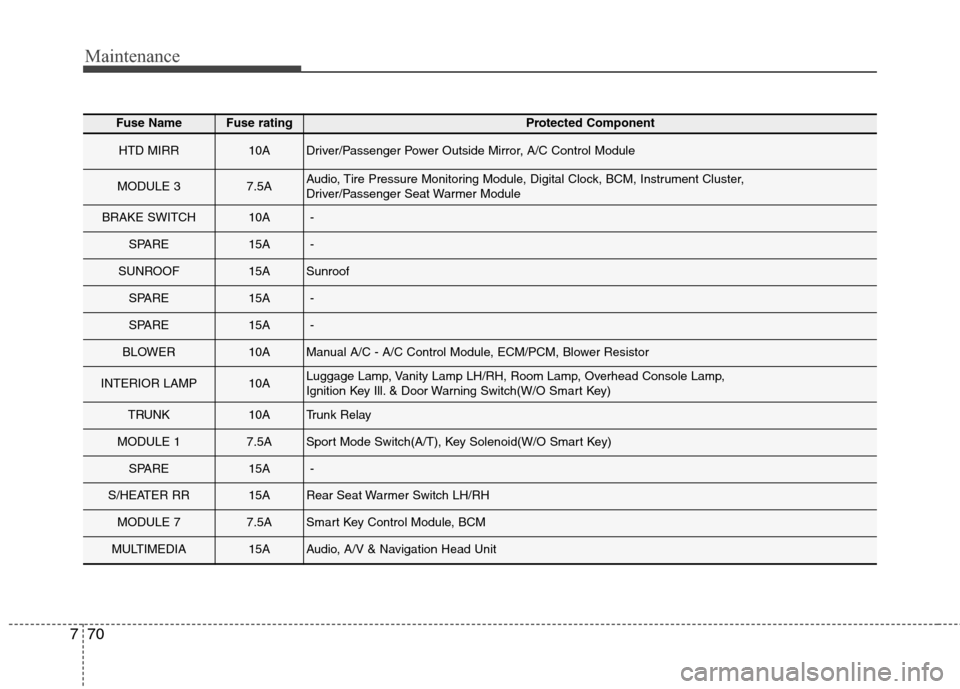
Fuse NameFuse ratingProtected Component
HTD MIRR10ADriver/Passenger Power Outside Mirror, A/C Control Module
MODULE 37.5AAudio, Tire Pressure Monitoring Module, Digital Clock, BCM, Instrument Cluster,
Driver/Passenger Seat Warmer Module
BRAKE SWITCH10A-
SPARE15A-
SUNROOF15ASunroof
SPARE15A-
SPARE15A-
BLOWER10AManual A/C - A/C Control Module, ECM/PCM, Blower Resistor
INTERIOR LAMP10ALuggage Lamp, Vanity Lamp LH/RH, Room Lamp, Overhead Console Lamp,
Ignition Key Ill. & Door Warning Switch(W/O Smart Key)
TRUNK10ATrunk Relay
MODULE 17.5ASport Mode Switch(A/T), Key Solenoid(W/O Smart Key)
SPARE15A-
S/HEATER RR15ARear Seat Warmer Switch LH/RH
MODULE 77.5ASmart Key Control Module, BCM
MULTIMEDIA15AAudio, A/V & Navigation Head Unit
Page 504 of 550
Maintenance
74 7
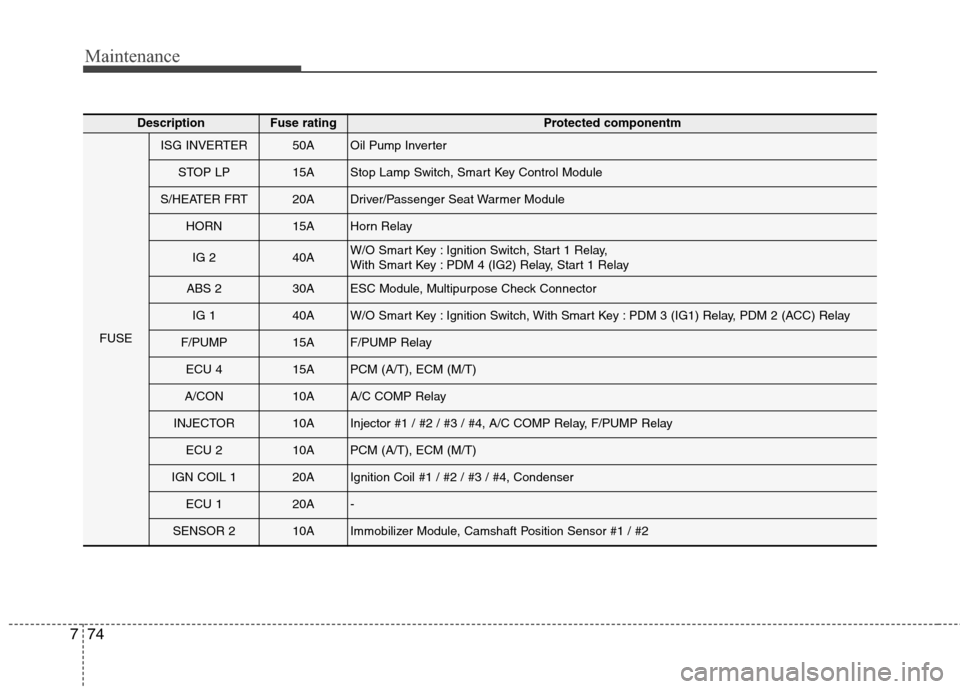
DescriptionFuse ratingProtected componentm
FUSE
ISG INVERTER50AOil Pump Inverter
STOP LP15AStop Lamp Switch, Smart Key Control Module
S/HEATER FRT20ADriver/Passenger Seat Warmer Module
HORN15AHorn Relay
IG 240AW/O Smart Key : Ignition Switch, Start 1 Relay,
With Smart Key : PDM 4 (IG2) Relay, Start 1 Relay
ABS 230AESC Module, Multipurpose Check Connector
IG 140AW/O Smart Key : Ignition Switch, With Smart Key : PDM 3 (IG1) Relay, PDM 2 (ACC) Relay
F/PUMP15AF/PUMP Relay
ECU 415APCM (A/T), ECM (M/T)
A/CON10AA/C COMP Relay
INJECTOR10AInjector #1 / #2 / #3 / #4, A/C COMP Relay, F/PUMP Relay
ECU 210APCM (A/T), ECM (M/T)
IGN COIL 120AIgnition Coil #1 / #2 / #3 / #4, Condenser
ECU 120A-
SENSOR 210AImmobilizer Module, Camshaft Position Sensor #1 / #2
Page 506 of 550
Maintenance
76 7
LIGHT BULBS
Consult an authorized HYUNDAI
dealer to replace most vehicle light
bulbs. It is difficult to replace vehicle
light bulbs because other parts of the
vehicle must be removed before you
can get to the bulb. This is especially
true for removing the headlight
assembly to get to the bulb(s).
Removing/installing the headlight
assembly can result in damage to
the vehicle.
✽ ✽
NOTICE
After heavy driving, rain or wash-
ing, headlight and taillight lenses
could appear frosty. This condition
is caused by the temperature differ-
ence between the lamp inside and
the outside temperature. This is sim-
ilar to the condensation on your win-
dows inside your vehicle during the
rain and doesn’t indicate a problem
with your vehicle. If the water leaks
into the lamp bulb circuitry, have
your vehicle checked by an author-
ized HYUNDAI dealer.
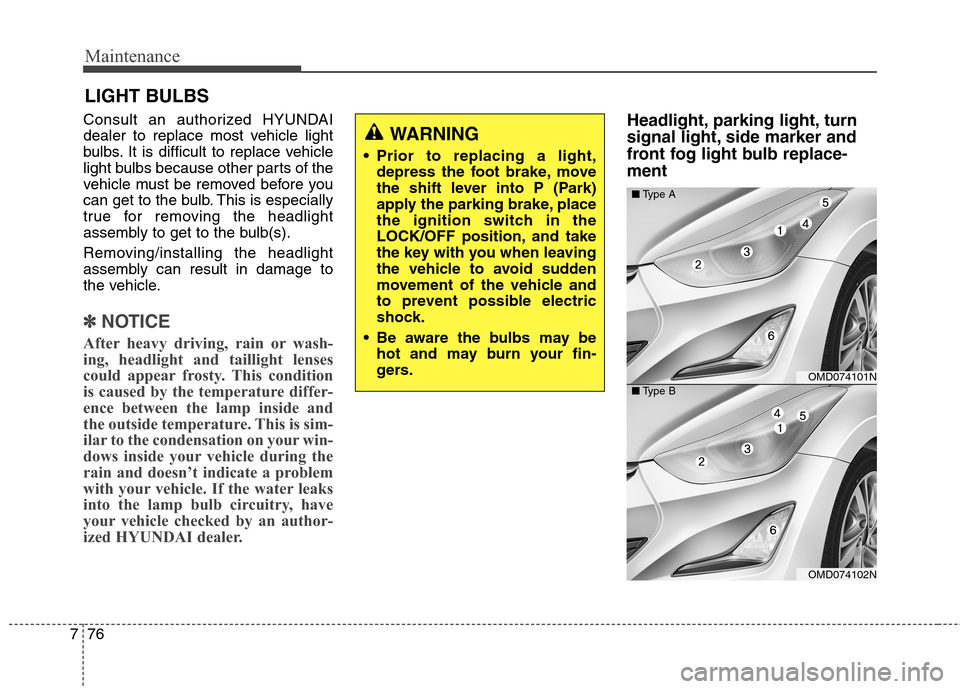
Headlight, parking light, turn
signal light, side marker and
front fog light bulb replace-
ment WARNING
Prior to replacing a light,
depress the foot brake, move
the shift lever into P (Park)
apply the parking brake, place
the ignition switch in the
LOCK/OFF position, and take
the key with you when leaving
the vehicle to avoid sudden
movement of the vehicle and
to prevent possible electric
shock.
Be aware the bulbs may be
hot and may burn your fin-
gers.
OMD074101N
■Type A
OMD074102N
■Type B
Page 540 of 550
I3
Index
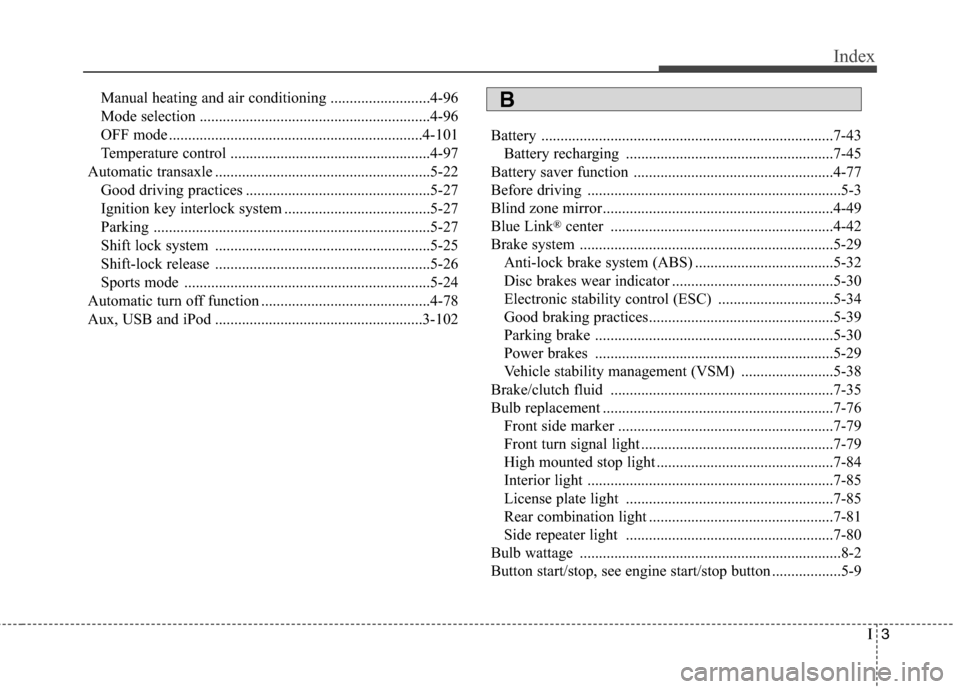
Manual heating and air conditioning ..........................4-96
Mode selection ............................................................4-96
OFF mode ..................................................................4-101
Temperature control ....................................................4-97
Automatic transaxle ........................................................5-22
Good driving practices ................................................5-27
Ignition key interlock system ......................................5-27
Parking ........................................................................5-27
Shift lock system ........................................................5-25
Shift-lock release ........................................................5-26
Sports mode ................................................................5-24
Automatic turn off function ............................................4-78
Aux, USB and iPod ......................................................3-102Battery ............................................................................7-43
Battery recharging ......................................................7-45
Battery saver function ....................................................4-77
Before driving ..................................................................5-3
Blind zone mirror............................................................4-49
Blue Link
®center ..........................................................4-42
Brake system ..................................................................5-29
Anti-lock brake system (ABS) ....................................5-32
Disc brakes wear indicator ..........................................5-30
Electronic stability control (ESC) ..............................5-34
Good braking practices................................................5-39
Parking brake ..............................................................5-30
Power brakes ..............................................................5-29
Vehicle stability management (VSM) ........................5-38
Brake/clutch fluid ..........................................................7-35
Bulb replacement ............................................................7-76
Front side marker ........................................................7-79
Front turn signal light ..................................................7-79
High mounted stop light ..............................................7-84
Interior light ................................................................7-85
License plate light ......................................................7-85
Rear combination light ................................................7-81
Side repeater light ......................................................7-80
Bulb wattage ....................................................................8-2
Button start/stop, see engine start/stop button ..................5-9
B
Page 544 of 550
I7
Index
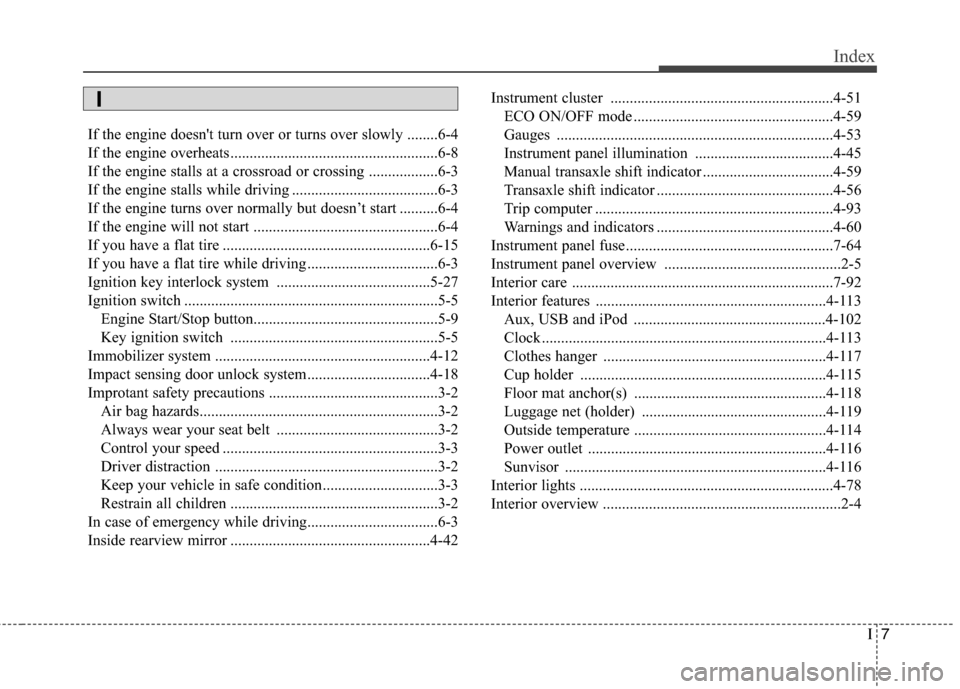
If the engine doesn't turn over or turns over slowly ........6-4
If the engine overheats ......................................................6-8
If the engine stalls at a crossroad or crossing ..................6-3
If the engine stalls while driving ......................................6-3
If the engine turns over normally but doesn’t start ..........6-4
If the engine will not start ................................................6-4
If you have a flat tire ......................................................6-15
If you have a flat tire while driving ..................................6-3
Ignition key interlock system ........................................5-27
Ignition switch ..................................................................5-5
Engine Start/Stop button................................................5-9
Key ignition switch ......................................................5-5
Immobilizer system ........................................................4-12
Impact sensing door unlock system ................................4-18
Improtant safety precautions ............................................3-2
Air bag hazards..............................................................3-2
Always wear your seat belt ..........................................3-2
Control your speed ........................................................3-3
Driver distraction ..........................................................3-2
Keep your vehicle in safe condition..............................3-3
Restrain all children ......................................................3-2
In case of emergency while driving..................................6-3
Inside rearview mirror ....................................................4-42Instrument cluster ..........................................................4-51
ECO ON/OFF mode ....................................................4-59
Gauges ........................................................................4-53
Instrument panel illumination ....................................4-45
Manual transaxle shift indicator ..................................4-59
Transaxle shift indicator ..............................................4-56
Trip computer ..............................................................4-93
Warnings and indicators ..............................................4-60
Instrument panel fuse......................................................7-64
Instrument panel overview ..............................................2-5
Interior care ....................................................................7-92
Interior features ............................................................4-113
Aux, USB and iPod ..................................................4-102
Clock ..........................................................................4-113
Clothes hanger ..........................................................4-117
Cup holder ................................................................4-115
Floor mat anchor(s) ..................................................4-118
Luggage net (holder) ................................................4-119
Outside temperature ..................................................4-114
Power outlet ..............................................................4-116
Sunvisor ....................................................................4-116
Interior lights ..................................................................4-78
Interior overview ..............................................................2-4
I