rear Hyundai Elantra Coupe 2014 Owner's Manual
[x] Cancel search | Manufacturer: HYUNDAI, Model Year: 2014, Model line: Elantra Coupe, Model: Hyundai Elantra Coupe 2014Pages: 550, PDF Size: 45.11 MB
Page 14 of 550
Exterior overview I . . . . . . . . . . . . . . . . . . . . . . . . . 2-2
Exterior overview II. . . . . . . . . . . . . . . . . . . . . . . . . 2-3
Interior overview . . . . . . . . . . . . . . . . . . . . . . . . . . . 2-4
Instrument panel overview . . . . . . . . . . . . . . . . . . . 2-5
Engine compartment . . . . . . . . . . . . . . . . . . . . . . . . 2-6
2
Your vehicle at a glance
Exterior overview (front) . . . . . . . . . . . . . . . . . . . . . 2-2
Exterior overview (rear) . . . . . . . . . . . . . . . . . . . . . 2-3
Interior overview . . . . . . . . . . . . . . . . . . . . . . . . . . . 2-4
Instrument panel overview . . . . . . . . . . . . . . . . . . . 2-5
Engine compartment . . . . . . . . . . . . . . . . . . . . . . . . 2-6
2
Page 16 of 550
23
Your vehicle at a glance
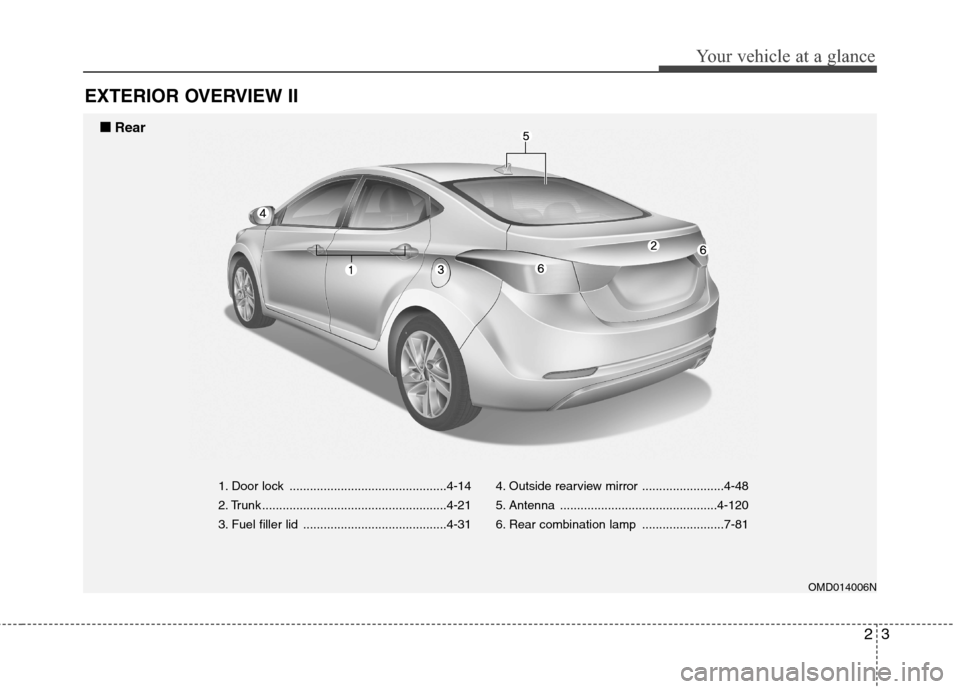
EXTERIOR OVERVIEW II
1. Door lock ..............................................4-14
2. Trunk ......................................................4-21
3. Fuel filler lid ..........................................4-314. Outside rearview mirror ........................4-48
5. Antenna ..............................................4-120
6. Rear combination lamp ........................7-81
OMD014006N
■ ■
Rear
Page 17 of 550
Your vehicle at a glance
4 2
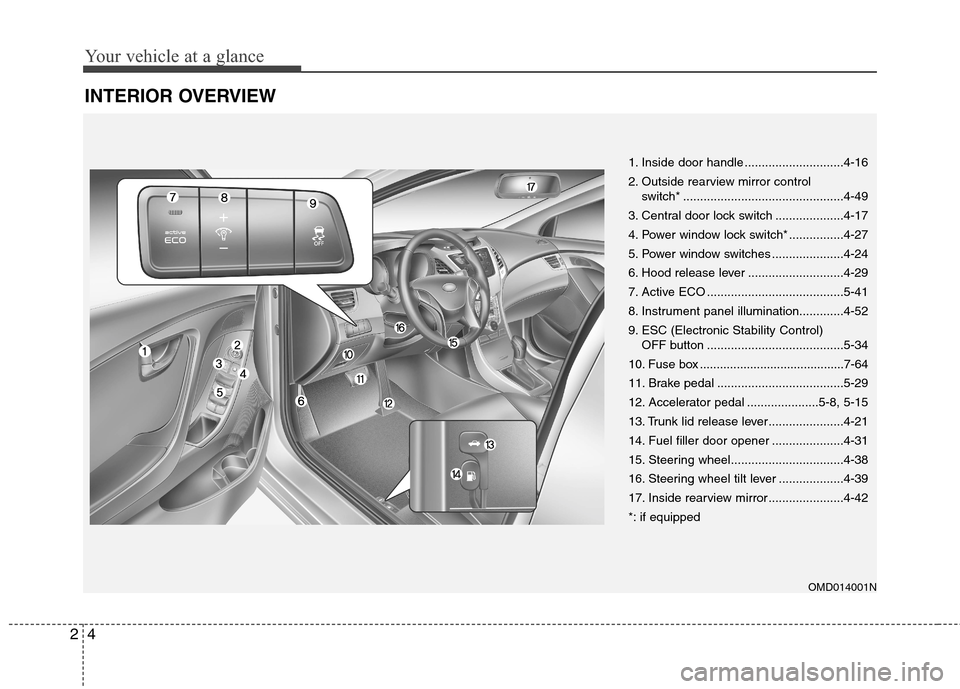
INTERIOR OVERVIEW
OMD014001N
1. Inside door handle .............................4-16
2. Outside rearview mirror control
switch* ...............................................4-49
3. Central door lock switch ....................4-17
4. Power window lock switch* ................4-27
5. Power window switches .....................4-24
6. Hood release lever ............................4-29
7. Active ECO ........................................5-41
8. Instrument panel illumination.............4-52
9. ESC (Electronic Stability Control)
OFF button ........................................5-34
10. Fuse box ...........................................7-64
11. Brake pedal .....................................5-29
12. Accelerator pedal .....................5-8, 5-15
13. Trunk lid release lever......................4-21
14. Fuel filler door opener .....................4-31
15. Steering wheel.................................4-38
16. Steering wheel tilt lever ...................4-39
17. Inside rearview mirror ......................4-42
*: if equipped
Page 21 of 550
You will find many safety precautions
and recommendations throughout
this section, and throughout this man-
ual. The safety precautions in this sec-
tion are among the most important.
Always wear your seat belt
A seat belt is your best protection in
all types of accidents. Air bags are
designed to supplement seat belts,
not replace them. So even though
your vehicle is equipped with air bags,
ALWAYS make sure you and your
passengers wear your seat belts, and
wear them properly.
Restrain all children
All children under age 13 should ride
in your vehicle properly restrained in
a rear seat, not the front seat. Infants
and small children should be
restrained in an appropriate child
restraint. Larger children should use
a booster seat with the lap/shoulder
belt until they can use the seat belt
properly without a booster seat.
Air bag hazards
While air bags can save lives, they
can also cause serious or fatal
injuries to occupants who sit too
close to them, or who are not prop-
erly restrained. Infants, young chil-
dren, and shorter adults are at the
greatest risk of being injured by an
inflating air bag. Follow all instruc-
tions and warnings in this manual.
Driver distraction
Driver distraction presents a serious
and potentially deadly danger, espe-
cially for inexperienced drivers. Safety
should be the first concern when
behind the wheel and drivers need to
be aware of the wide array of potential
distractions, such as drowsiness,
reaching for objects, eating, personal
grooming, other passengers, and
using cellular phones, to name a few.
Drivers can become distracted when
they take their eyes and attention off
the road or their hands off the wheel
to focus on activities other than driv-
ing. To reduce your risk of distraction
or getting into an accident:
• ALWAYS set up your mobile devices
(i.e., MP3 players, phones, naviga-
tion units, etc.) when your vehicle is
parked or safely stopped.
ONLY use your mobile device when
allowed by laws and when conditions
permit safe use. NEVER text or
email while driving. Most states have
laws prohibiting drivers from texting.
Some states and cities also prohibit
drivers from using handheld phones.
IMPORTANT SAFETY PRECAUTIONS Safety features of your vehicle
2 3
Page 23 of 550
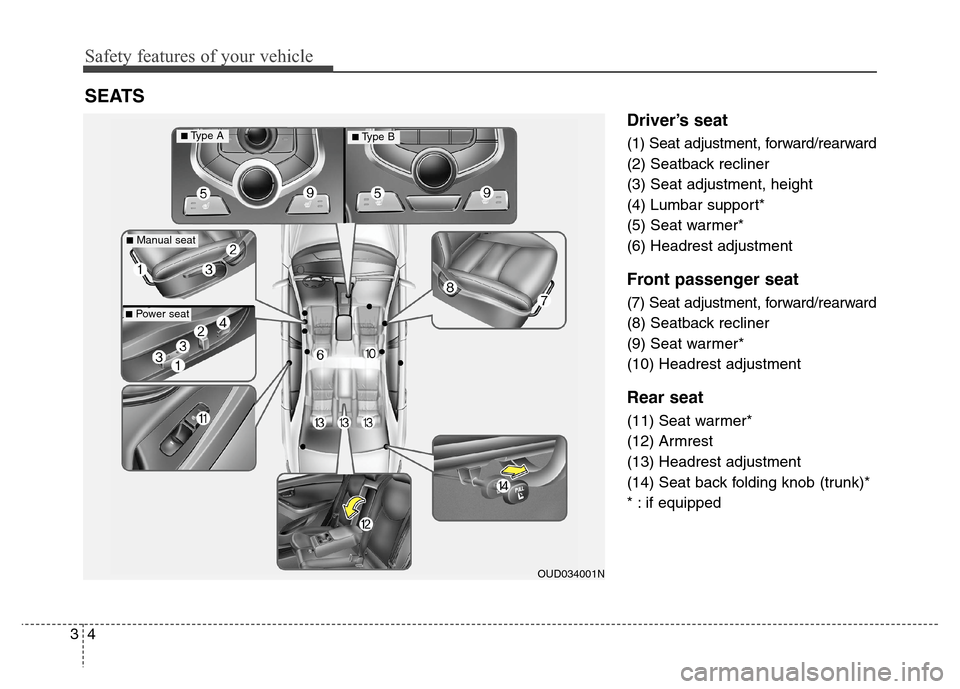
SEATS Safety features of your vehicle
4 3
Driver’s seat
(1) Seat adjustment, forward/rearward
(2) Seatback recliner
(3) Seat adjustment, height
(4) Lumbar support*
(5) Seat warmer*
(6) Headrest adjustment
Front passenger seat
(7) Seat adjustment, forward/rearward
(8) Seatback recliner
(9) Seat warmer*
(10) Headrest adjustment
Rear seat
(11) Seat warmer*
(12) Armrest
(13) Headrest adjustment
(14) Seat back folding knob (trunk)*
* : if equipped
OUD034001N
■Manual seat
■Power seat
■Type A■Type B
Page 24 of 550
Safety precautions
Adjusting the seats so that you are sit-
ting in a safe, comfortable position
plays an important role in driver and
passenger safety together with the
seat belts and air bags in an accident.
Air bags
You can take steps to reduce the risk
of being injured by an inflating air
bag. Sitting too close to an air bag
greatly increases the risk of injury in
the event the air bag inflates.
The National Highway Traffic Safety
Administration (NHTSA) recommends
that drivers allow at least 10 inches
(25 cm) between the center of the
steering wheel and their chest.
Safety features of your vehicle
35
WARNING
Do not use a cushion that
reduces friction between the
seat and the passenger. The
passenger's hips may slide
under the lap portion of the seat
belt during an accident or a
sudden stop. Serious or fatal
internal injuries could result
because the seat belt cannot
operate normally.
WARNING
To reduce the risk of serious
injury or death from an inflating
air bag, take the following pre-
cautions:
Adjust the driver’s seat as far to
the rear as possible while main-
taining the ability to maintain
full control of the vehicle.
Adjust the front passenger seat
as far to the rear as possible.
Hold the steering wheel by the
rim with hands at the 9 o’clock
and 3 o’clock positions to mini-
mize the risk of injuries to your
hands and arms.
NEVER place anything or any-
one between the steering wheel
and the air bag.
Do not allow the front passen-
ger to place feet or legs on the
dashboard to minimize the risk
of leg injuries.
Page 26 of 550
Safety features of your vehicle
37
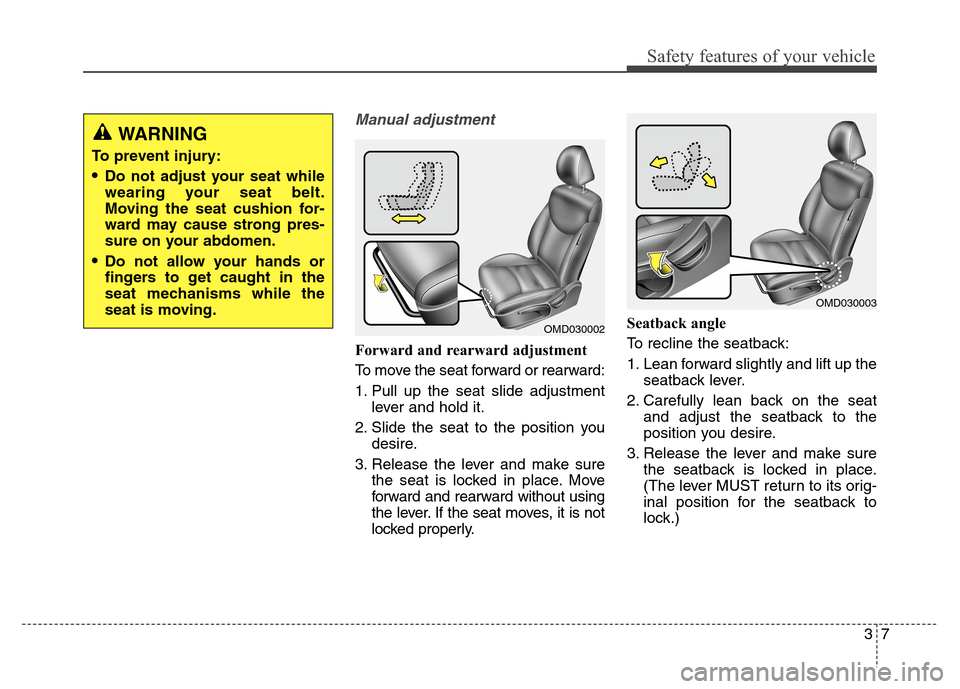
Manual adjustment
Forward and rearward adjustment
To move the seat forward or rearward:
1. Pull up the seat slide adjustment
lever and hold it.
2. Slide the seat to the position you
desire.
3. Release the lever and make sure
the seat is locked in place. Move
forward and rearward without using
the lever. If the seat moves, it is not
locked properly.Seatback angle
To recline the seatback:
1. Lean forward slightly and lift up the
seatback lever.
2. Carefully lean back on the seat
and adjust the seatback to the
position you desire.
3. Release the lever and make sure
the seatback is locked in place.
(The lever MUST return to its orig-
inal position for the seatback to
lock.)
WARNING
To prevent injury:
Do not adjust your seat while
wearing your seat belt.
Moving the seat cushion for-
ward may cause strong pres-
sure on your abdomen.
Do not allow your hands or
fingers to get caught in the
seat mechanisms while the
seat is moving.
OMD030002
OMD030003
Page 28 of 550
Safety features of your vehicle
39
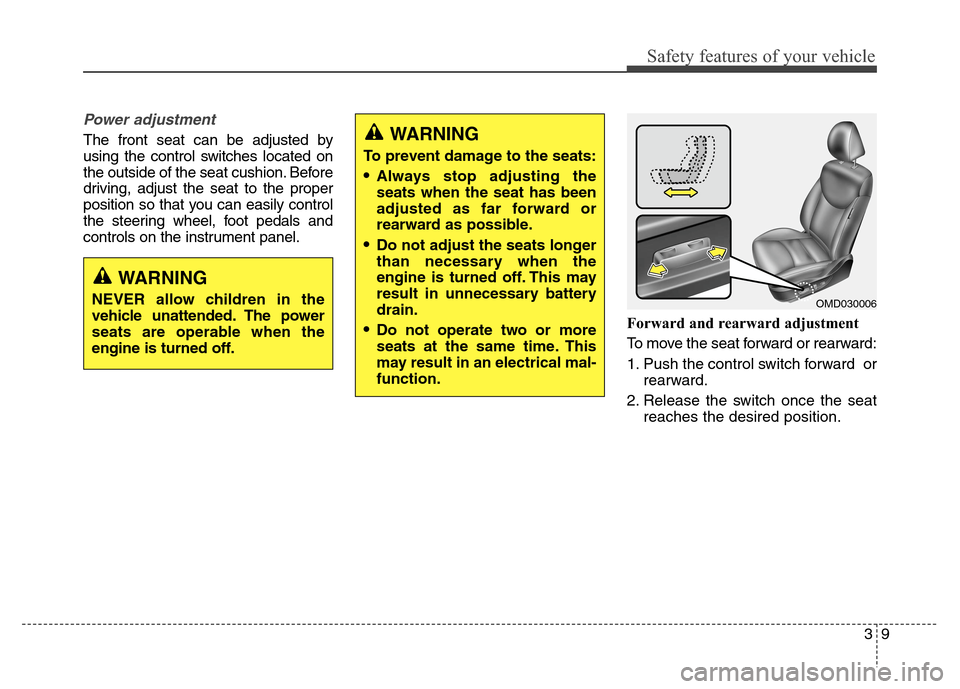
Power adjustment
The front seat can be adjusted by
using the control switches located on
the outside of the seat cushion. Before
driving, adjust the seat to the proper
position so that you can easily control
the steering wheel, foot pedals and
controls on the instrument panel.
Forward and rearward adjustment
To move the seat forward or rearward:
1. Push the control switch forward or
rearward.
2. Release the switch once the seat
reaches the desired position.
WARNING
NEVER allow children in the
vehicle unattended. The power
seats are operable when the
engine is turned off.
WARNING
To prevent damage to the seats:
Always stop adjusting the
seats when the seat has been
adjusted as far forward or
rearward as possible.
Do not adjust the seats longer
than necessary when the
engine is turned off. This may
result in unnecessary battery
drain.
Do not operate two or more
seats at the same time. This
may result in an electrical mal-
function.
OMD030006
Page 29 of 550
Safety features of your vehicle
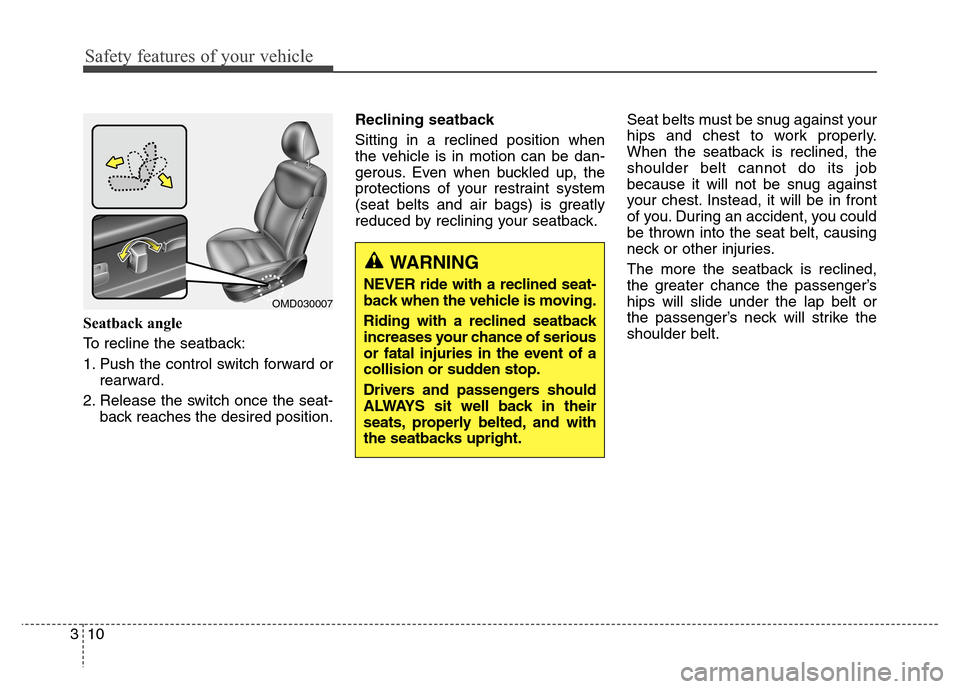
10 3Seatback angle
To recline the seatback:
1. Push the control switch forward or
rearward.
2. Release the switch once the seat-
back reaches the desired position.Reclining seatback
Sitting in a reclined position when
the vehicle is in motion can be dan-
gerous. Even when buckled up, the
protections of your restraint system
(seat belts and air bags) is greatly
reduced by reclining your seatback.Seat belts must be snug against your
hips and chest to work properly.
When the seatback is reclined, the
shoulder belt cannot do its job
because it will not be snug against
your chest. Instead, it will be in front
of you. During an accident, you could
be thrown into the seat belt, causing
neck or other injuries.
The more the seatback is reclined,
the greater chance the passenger’s
hips will slide under the lap belt or
the passenger’s neck will strike the
shoulder belt.
OMD030007
WARNING
NEVER ride with a reclined seat-
back when the vehicle is moving.
Riding with a reclined seatback
increases your chance of serious
or fatal injuries in the event of a
collision or sudden stop.
Drivers and passengers should
ALWAYS sit well back in their
seats, properly belted, and with
the seatbacks upright.
Page 30 of 550
Safety features of your vehicle
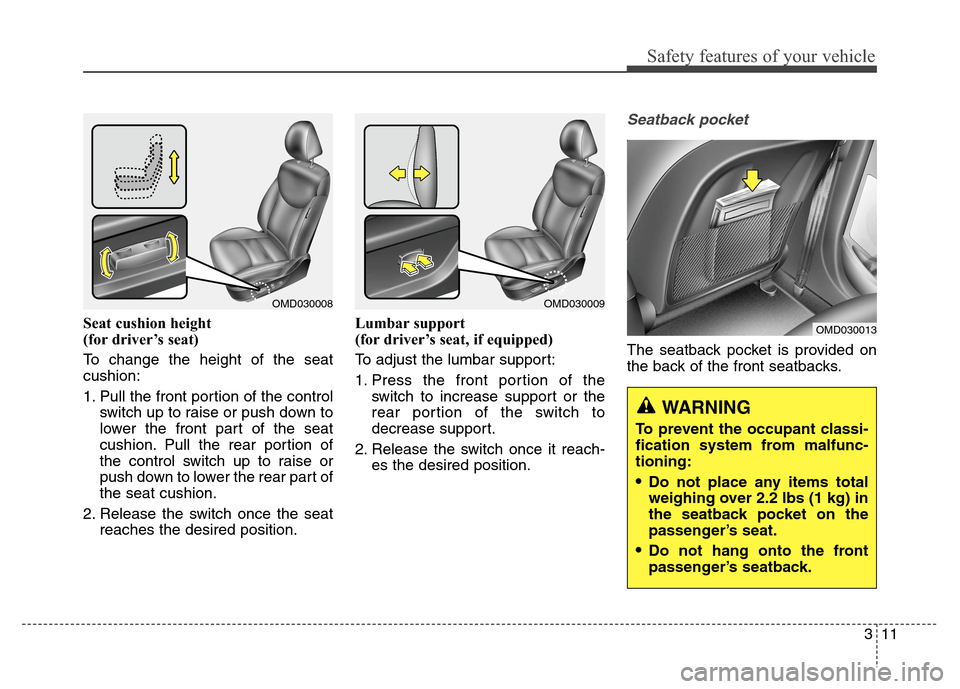
311 Seat cushion height
(for driver’s seat)
To change the height of the seat
cushion:
1. Pull the front portion of the control
switch up to raise or push down to
lower the front part of the seat
cushion. Pull the rear portion of
the control switch up to raise or
push down to lower the rear part of
the seat cushion.
2. Release the switch once the seat
reaches the desired position.Lumbar support
(for driver’s seat, if equipped)
To adjust the lumbar support:
1. Press the front portion of the
switch to increase support or the
rear portion of the switch to
decrease support.
2. Release the switch once it reach-
es the desired position.
Seatback pocket
The seatback pocket is provided on
the back of the front seatbacks.
OMD030008OMD030009
OMD030013
WARNING
To prevent the occupant classi-
fication system from malfunc-
tioning:
Do not place any items total
weighing over 2.2 lbs (1 kg) in
the seatback pocket on the
passenger’s seat.
Do not hang onto the front
passenger’s seatback.