warning light HYUNDAI ELANTRA GT 2014 User Guide
[x] Cancel search | Manufacturer: HYUNDAI, Model Year: 2014, Model line: ELANTRA GT, Model: HYUNDAI ELANTRA GT 2014Pages: 476, PDF Size: 31.71 MB
Page 60 of 476
341
Safety features of your vehicle
Air bag warning light
The purpose of air bag warning light
in your instrument panel is to alert
you of a potential problem with your
air bag - Supplemental Restraint
System (SRS).
When the ignition switch is turned
ON, the indicator light should illumi-
nate for approximately 6 seconds,
then go off.
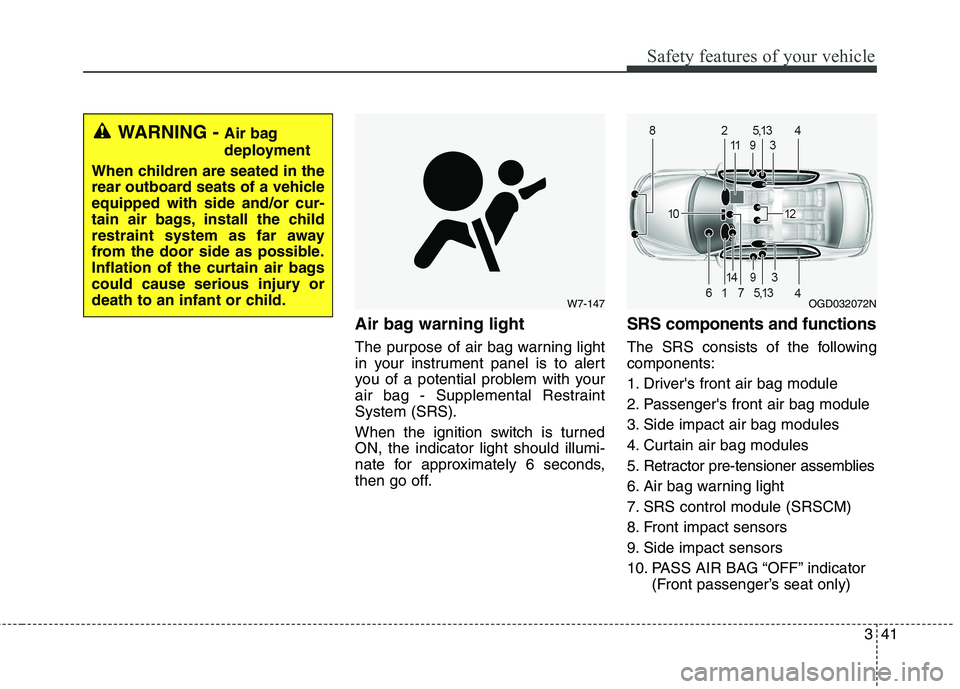
SRS components and functions
The SRS consists of the following
components:
1. Driver's front air bag module
2. Passenger's front air bag module
3. Side impact air bag modules
4. Curtain air bag modules
5. Retractor pre-tensioner assemblies
6. Air bag warning light
7. SRS control module (SRSCM)
8. Front impact sensors
9. Side impact sensors
10. PASS AIR BAG “OFF” indicator
(Front passenger’s seat only)
W7-147
WARNING - Air bag
deployment
When children are seated in the
rear outboard seats of a vehicle
equipped with side and/or cur-
tain air bags, install the child
restraint system as far away
from the door side as possible.
Inflation of the curtain air bags
could cause serious injury or
death to an infant or child.
OGD032072N
Page 61 of 476
Safety features of your vehicle
42 3
11. Occupant classification system
(Front passenger’s seat only)
12. Driver’s and front passenger’s
seat belt buckle sensors
13. Emergency fastening device
(EFD)
14. Driver’s knee air bag module
The SRSCM continually monitors all
SRS components while the ignition
switch is ON to determine if a crash
impact is severe enough to require
air bag deployment or pre-tensioner
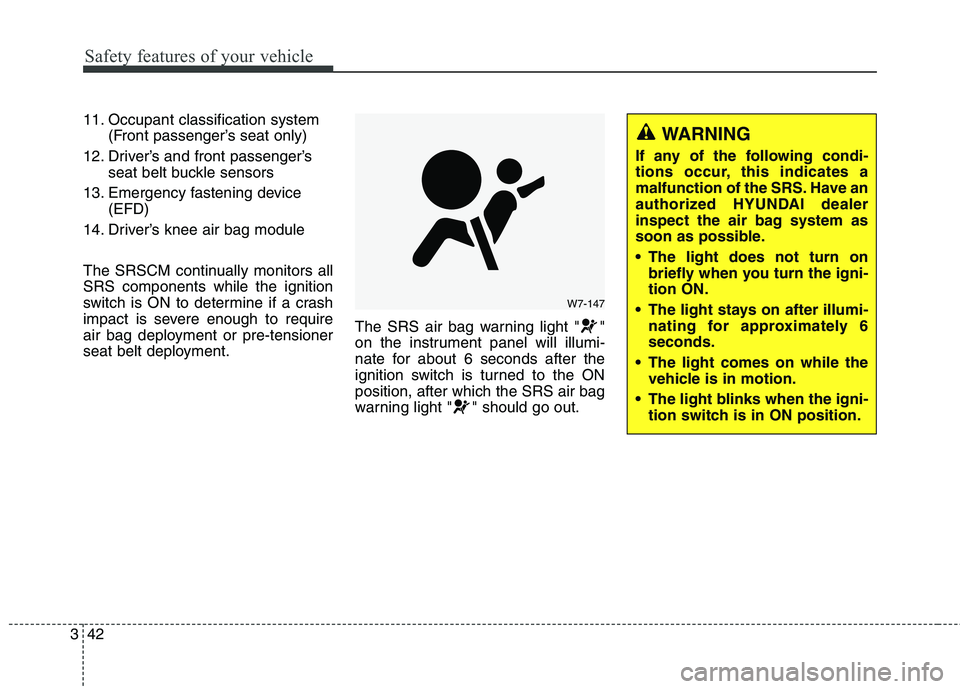
seat belt deployment.The SRS air bag warning light " "
on the instrument panel will illumi-
nate for about 6 seconds after the
ignition switch is turned to the ON
position, after which the SRS air bag
warning light " " should go out.
W7-147
WARNING
If any of the following condi-
tions occur, this indicates a
malfunction of the SRS. Have an
authorized HYUNDAI dealer
inspect the air bag system as
soon as possible.
The light does not turn on
briefly when you turn the igni-
tion ON.
The light stays on after illumi-
nating for approximately 6
seconds.
The light comes on while the
vehicle is in motion.
The light blinks when the igni-
tion switch is in ON position.
Page 64 of 476
345
Safety features of your vehicle
Occupant classification system
Your vehicle is equipped with an
occupant classification system in the
front passenger's seat.
The occupant classification system
is designed to detect the presence of
a properly-seated front passenger
and determine if the passenger's
front air bag should be enabled (may
inflate) or not. The driver's front air
bag is not affected or controlled by
the occupant classification system.
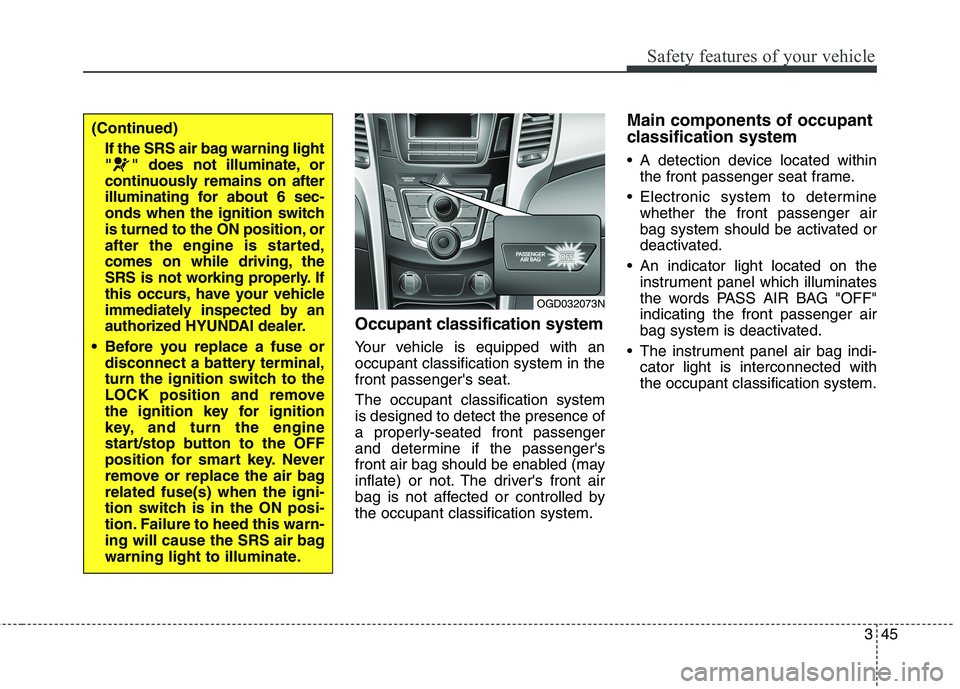
Main components of occupant
classification system
A detection device located within
the front passenger seat frame.
Electronic system to determine
whether the front passenger air
bag system should be activated or
deactivated.
An indicator light located on the
instrument panel which illuminates
the words PASS AIR BAG "OFF"
indicating the front passenger air
bag system is deactivated.
The instrument panel air bag indi-
cator light is interconnected with
the occupant classification system.
(Continued)
If the SRS air bag warning light
" " does not illuminate, or
continuously remains on after
illuminating for about 6 sec-
onds when the ignition switch
is turned to the ON position, or
after the engine is started,
comes on while driving, the
SRS is not working properly. If
this occurs, have your vehicle
immediately inspected by an
authorized HYUNDAI dealer.
Before you replace a fuse or
disconnect a battery terminal,
turn the ignition switch to the
LOCK position and remove
the ignition key for ignition
key, and turn the engine
start/stop button to the OFF
position for smart key. Never
remove or replace the air bag
related fuse(s) when the igni-
tion switch is in the ON posi-
tion. Failure to heed this warn-
ing will cause the SRS air bag
warning light to illuminate.
OGD032073N
Page 66 of 476
347
Safety features of your vehicle
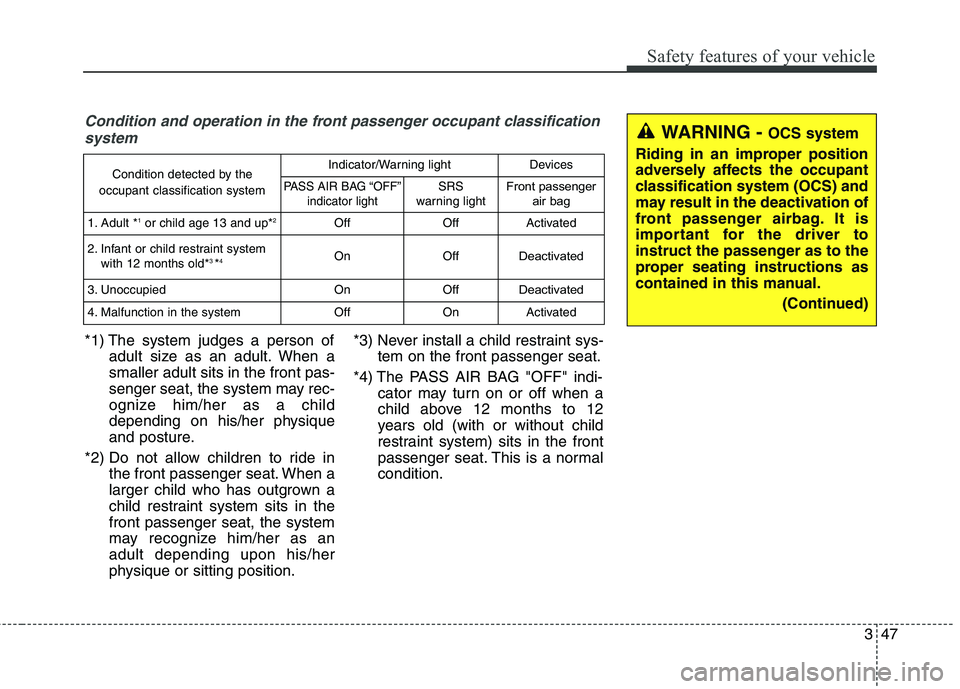
Condition and operation in the front passenger occupant classification
system
*1) The system judges a person of
adult size as an adult. When a
smaller adult sits in the front pas-
senger seat, the system may rec-
ognize him/her as a child
depending on his/her physique
and posture.
*2) Do not allow children to ride in
the front passenger seat. When a
larger child who has outgrown a
child restraint system sits in the
front passenger seat, the system
may recognize him/her as an
adult depending upon his/her
physique or sitting position.*3) Never install a child restraint sys-
tem on the front passenger seat.
*4) The PASS AIR BAG "OFF" indi-
cator may turn on or off when a
child above 12 months to 12
years old (with or without child
restraint system) sits in the front
passenger seat. This is a normal
condition.
WARNING - OCS system
Riding in an improper position
adversely affects the occupant
classification system (OCS) and
may result in the deactivation of
front passenger airbag. It is
important for the driver to
instruct the passenger as to the
proper seating instructions as
contained in this manual.
(Continued)
Condition detected by the
occupant classification systemIndicator/Warning lightDevices
PASS AIR BAG “OFF”
indicator lightSRS
warning lightFront passenger
air bag
1. Adult *1or child age 13 and up*2OffOffActivated
2. Infant or child restraint system
with 12 months old*3 *4OnOffDeactivated
3. Unoccupied OnOffDeactivated
4. Malfunction in the systemOffOnActivated
Page 68 of 476
349
Safety features of your vehicle
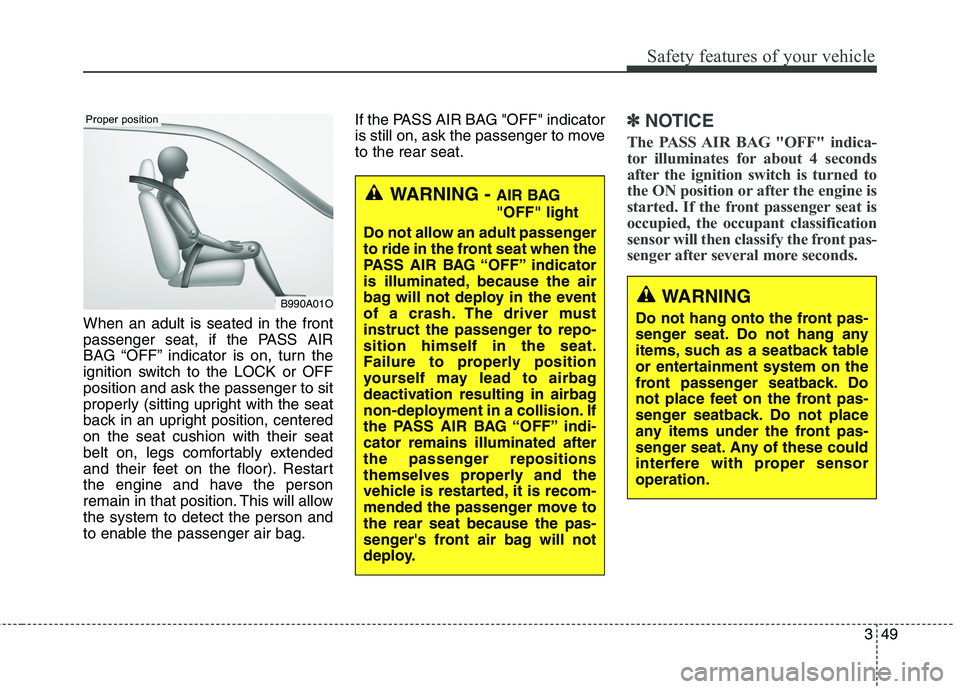
When an adult is seated in the front
passenger seat, if the PASS AIR
BAG “OFF” indicator is on, turn the
ignition switch to the LOCK or OFF
position and ask the passenger to sit
properly (sitting upright with the seat
back in an upright position, centered
on the seat cushion with their seat
belt on, legs comfortably extended
and their feet on the floor). Restart
the engine and have the person
remain in that position. This will allow
the system to detect the person and
to enable the passenger air bag.If the PASS AIR BAG "OFF" indicator
is still on, ask the passenger to move
to the rear seat.
✽ ✽
NOTICE
The PASS AIR BAG "OFF" indica-
tor illuminates for about 4 seconds
after the ignition switch is turned to
the ON position or after the engine is
started. If the front passenger seat is
occupied, the occupant classification
sensor will then classify the front pas-
senger after several more seconds.
B990A01O
Proper position
WARNING
Do not hang onto the front pas-
senger seat. Do not hang any
items, such as a seatback table
or entertainment system on the
front passenger seatback. Do
not place feet on the front pas-
senger seatback. Do not place
any items under the front pas-
senger seat. Any of these could
interfere with proper sensor
operation.
WARNING - AIR BAG
"OFF" light
Do not allow an adult passenger
to ride in the front seat when the
PASS AIR BAG “OFF” indicator
is illuminated, because the air
bag will not deploy in the event
of a crash. The driver must
instruct the passenger to repo-
sition himself in the seat.
Failure to properly position
yourself may lead to airbag
deactivation resulting in airbag
non-deployment in a collision. If
the PASS AIR BAG “OFF” indi-
cator remains illuminated after
the passenger repositions
themselves properly and the
vehicle is restarted, it is recom-
mended the passenger move to
the rear seat because the pas-
senger's front air bag will not
deploy.
Page 69 of 476
Safety features of your vehicle
50 3
WARNING
Even though your vehicle is
equipped with the occupant
classification system, never
install a child restraint system
in the front passenger's seat.
A deploying air bag can force-
fully strike a child resulting in
serious injuries or death. Any
child age 12 and under should
ride in the rear seat. Children
too large for child restraints
should use the available
lap/shoulder belts. No matter
what type of crash, children of
all ages are safer when
restrained in the rear seat.
(Continued)
(Continued)
If the PASS AIR BAG "OFF"
indicator is illuminated when
the front passenger's seat is
occupied by an adult and
he/she sits properly (sitting
upright with the seatback in
an upright position, centered
on the seat cushion with their
seat belt on, legs comfortably
extended and their feet on the
floor), have that person sit in
the rear seat.
Do not modify or replace the
front passenger seat. Don't
place anything on or attach
anything such as a blanket or
seat heater to the front pas-
senger seat. This can adverse-
ly affect the occupant classifi-
cation system.
Do not sit on sharp objects
such as tools when occupying
the front passenger seat. This
can adversely affect the occu-
pant classification system.
(Continued)WARNING - Folding
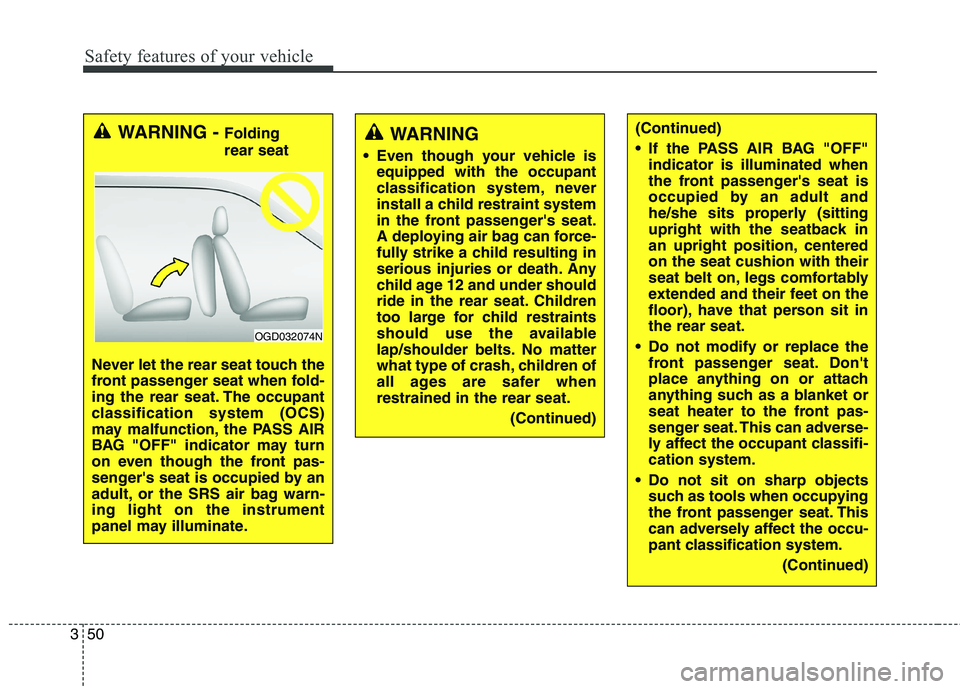
rear seat
Never let the rear seat touch the
front passenger seat when fold-
ing the rear seat. The occupant
classification system (OCS)
may malfunction, the PASS AIR
BAG "OFF" indicator may turn
on even though the front pas-
senger's seat is occupied by an
adult, or the SRS air bag warn-
ing light on the instrument
panel may illuminate.
OGD032074N
Page 70 of 476
351
Safety features of your vehicle
WARNING
If the occupant classification
system is not working properly,
the SRS air bag warning light
on the instrument panel will illu-
minate because the passenger's
front air bag is connected with
the occupant classification sys-
tem. If there is a malfunction of
the occupant classification sys-
tem, the PASS AIR BAG "OFF"
indicator will not illuminate and
the passenger's front air bag
will inflate in frontal impact
crashes even if there is no occu-
pant in the front passenger's
seat. If the SRS air bag warning
light does not illuminate when
the ignition switch is turned to
the ON position, remains illumi-
nated after approximately 6 sec-
onds when the ignition switch is
turned to the ON position, or if it
illuminates while the vehicle is
being driven, have an author-
ized HYUNDAI dealer inspect
the occupant classification sys-
tem and the SRS air bag system
as soon as possible.
(Continued)
A smaller-stature adult in the
front passenger’ seat who is
not seated correctly (for exam-
ple: seat excessively reclined,
leaning on the door or center
console, or hips shifted for-
ward in the seat) can cause a
condition where the occupant
classification system senses
less weight than if the occu-
pant were seated properly (sit-
ting upright with the seatback
in an upright position, cen-
tered on the seat cushion with
their seat belt on, legs com-
fortably extended and their
feet on the floor).
This condition can result in an
adult potentially being mis-
classified and illumination of
the PASS AIR BAG "OFF" indi-
cator.(Continued)
Do not use accessory seat
covers on the front seats.
Accident statistics show that
children are safer if they are
restrained in the rear, as
opposed to the front seat. It is
recommended that child
restraints be secured in a rear
seat, including an infant riding
in a rear-facing infant seat, a
child riding in a forward-fac-
ing child seat and an older
child riding in a booster seat.
Air bags can only be used
once – have an authorized
HYUNDAI dealer replace the
air bag immediately after
deployment.
(Continued)
Page 73 of 476
Safety features of your vehicle
54 3
(Continued)
If the SRS air bag warning
light remains illuminated while
the vehicle is being driven,
have an authorized HYUNDAI
dealer inspect the air bag sys-
tem as soon as possible.
Air bags can only be used once
– have an authorized HYUNDAI
dealer replace the air bag
immediately after deployment.
The SRS is designed to deploy
the front air bags only when a
frontal impact is sufficiently
severe and when the impact
angle is toward the forward
longitudinal axis of the vehi-
cle. Additionally, the air bags
will only deploy once. Seat
belts must be worn at all times.
Front air bags are not intended
to deploy in side-impact, rear-
impact or rollover crashes. In
addition, front air bags will not
deploy in frontal crashes below
the deployment threshold.
(Continued)(Continued)
No objects should be placed
over or near the air bag mod-
ules on the steering wheel,
instrument panel, and the
front passenger's panel above
the glove box, because any
such object could cause harm
if the vehicle is in a crash
severe enough to cause the
air bags to deploy.
Never place covers, blankets
or seat warmers on the pas-
senger seat as these may
interfere with the occupant
classification system.
Do not tamper with or discon-
nect SRS wiring or other com-
ponents of the SRS system.
Doing so could result in injury,
due to accidental deployment
of the air bags or by rendering
the SRS inoperative.
(Continued)(Continued)
Front and side air bags can
injure occupants improperly
positioned in the front seats.
Move your seat as far back as
practical from the front air
bags, while still maintaining
control of the vehicle.
You and your passengers
should never sit or lean unnec-
essarily close to the air bags.
Improperly positioned driver
and passengers can be severe-
ly injured by inflating air bags.
Never lean against the door or
center console – always sit in
an upright position.
Do not allow a passenger to
ride in the front seat when the
PASS AIR BAG "OFF" indica-
tor is illuminated, because the
air bag will not deploy in the
event of a moderate or severe
frontal crash.
(Continued)
Page 83 of 476
Safety features of your vehicle
64 3
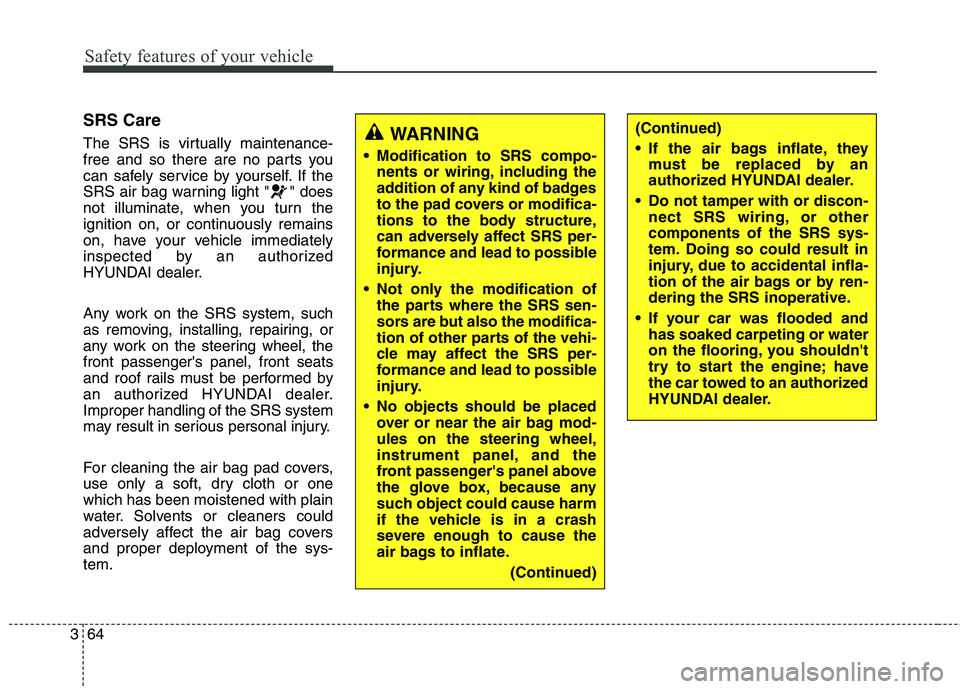
SRS Care
The SRS is virtually maintenance-
free and so there are no parts you
can safely service by yourself. If the
SRS air bag warning light " " does
not illuminate, when you turn the
ignition on, or continuously remains
on, have your vehicle immediately
inspected by an authorized
HYUNDAI dealer.
Any work on the SRS system, such
as removing, installing, repairing, or
any work on the steering wheel, the
front passenger's panel, front seats
and roof rails must be performed by
an authorized HYUNDAI dealer.
Improper handling of the SRS system
may result in serious personal injury.
For cleaning the air bag pad covers,
use only a soft, dry cloth or one
which has been moistened with plain
water. Solvents or cleaners could
adversely affect the air bag covers
and proper deployment of the sys-
tem.WARNING
Modification to SRS compo-
nents or wiring, including the
addition of any kind of badges
to the pad covers or modifica-
tions to the body structure,
can adversely affect SRS per-
formance and lead to possible
injury.
Not only the modification of
the parts where the SRS sen-
sors are but also the modifica-
tion of other parts of the vehi-
cle may affect the SRS per-
formance and lead to possible
injury.
No objects should be placed
over or near the air bag mod-
ules on the steering wheel,
instrument panel, and the
front passenger's panel above
the glove box, because any
such object could cause harm
if the vehicle is in a crash
severe enough to cause the
air bags to inflate.
(Continued)
(Continued)
If the air bags inflate, they
must be replaced by an
authorized HYUNDAI dealer.
Do not tamper with or discon-
nect SRS wiring, or other
components of the SRS sys-
tem. Doing so could result in
injury, due to accidental infla-
tion of the air bags or by ren-
dering the SRS inoperative.
If your car was flooded and
has soaked carpeting or water
on the flooring, you shouldn't
try to start the engine; have
the car towed to an authorized
HYUNDAI dealer.
Page 92 of 476
47
Features of your vehicle
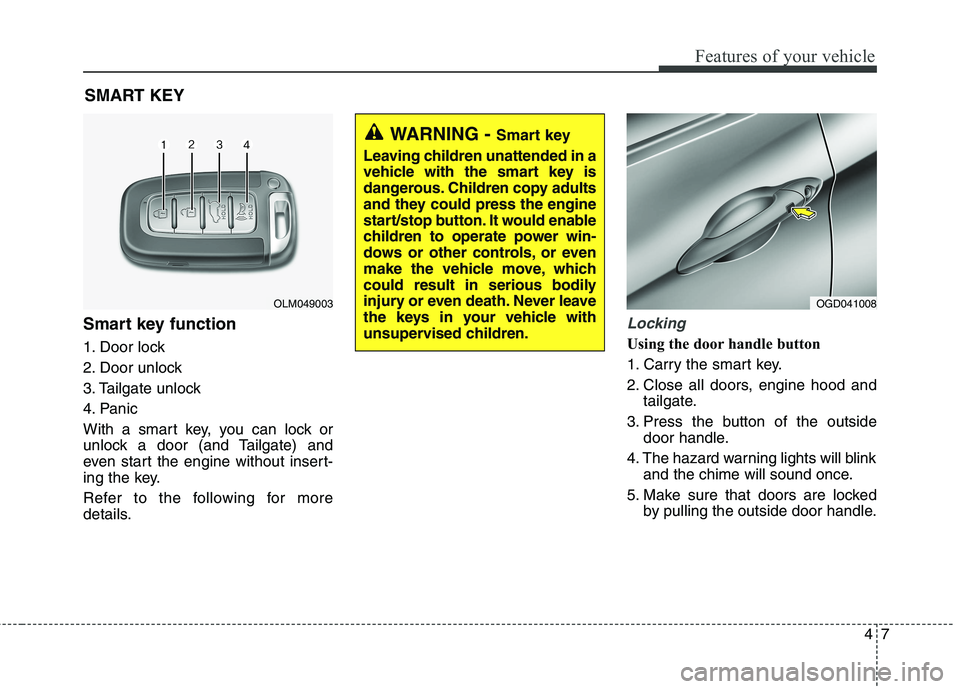
Smart key function
1. Door lock
2. Door unlock
3. Tailgate unlock
4. Panic
With a smart key, you can lock or
unlock a door (and Tailgate) and
even start the engine without insert-
ing the key.
Refer to the following for more
details.
Locking
Using the door handle button
1. Carry the smart key.
2. Close all doors, engine hood and
tailgate.
3. Press the button of the outside
door handle.
4. The hazard warning lights will blink
and the chime will sound once.
5. Make sure that doors are locked
by pulling the outside door handle.
SMART KEY
OLM049003OGD041008
WARNING - Smart key
Leaving children unattended in a
vehicle with the smart key is
dangerous. Children copy adults
and they could press the engine
start/stop button. It would enable
children to operate power win-
dows or other controls, or even
make the vehicle move, which
could result in serious bodily
injury or even death. Never leave
the keys in your vehicle with
unsupervised children.