start stop button HYUNDAI ELANTRA GT 2014 Owner's Manual
[x] Cancel search | Manufacturer: HYUNDAI, Model Year: 2014, Model line: ELANTRA GT, Model: HYUNDAI ELANTRA GT 2014Pages: 476, PDF Size: 31.71 MB
Page 286 of 476
Driving your vehicle
14 5
Manual transaxle operation
The manual transaxle has 6 forward
gears.
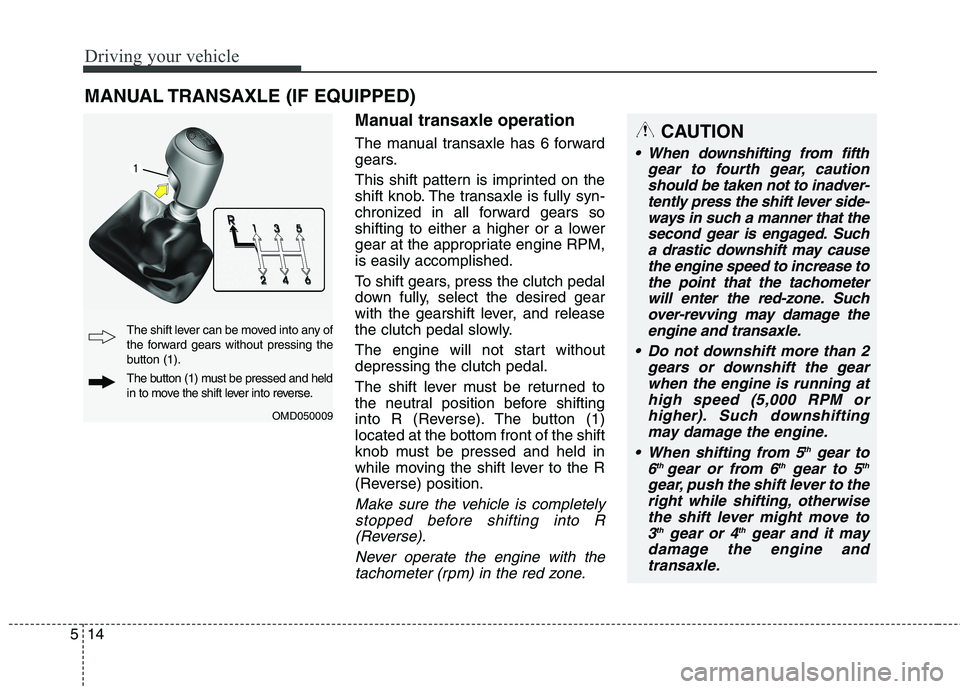
This shift pattern is imprinted on the
shift knob. The transaxle is fully syn-
chronized in all forward gears so
shifting to either a higher or a lower
gear at the appropriate engine RPM,
is easily accomplished.
To shift gears, press the clutch pedal
down fully, select the desired gear
with the gearshift lever, and release
the clutch pedal slowly.
The engine will not start without
depressing the clutch pedal.
The shift lever must be returned to
the neutral position before shifting
into R (Reverse). The button (1)
located at the bottom front of the shift
knob must be pressed and held in
while moving the shift lever to the R
(Reverse) position.
Make sure the vehicle is completely
stopped before shifting into R
(Reverse).
Never operate the engine with the
tachometer (rpm) in the red zone.
MANUAL TRANSAXLE (IF EQUIPPED)
OMD050009
The shift lever can be moved into any of
the forward gears without pressing the
button (1).
The button (1) must be pressed and held
in to move the shift lever into reverse.
CAUTION
When downshifting from fifth
gear to fourth gear, caution
should be taken not to inadver-
tently press the shift lever side-
ways in such a manner that the
second gear is engaged. Such
a drastic downshift may cause
the engine speed to increase to
the point that the tachometer
will enter the red-zone. Such
over-revving may damage the
engine and transaxle.
Do not downshift more than 2
gears or downshift the gear
when the engine is running at
high speed (5,000 RPM or
higher). Such downshifting
may damage the engine.
When shifting from 5
thgear to
6th gear or from 6thgear to 5th
gear, push the shift lever to the
right while shifting,otherwise
the shift lever might move to
3
thgear or 4thgear and it may
damage the engine and
transaxle.
Page 293 of 476
521
Driving your vehicle
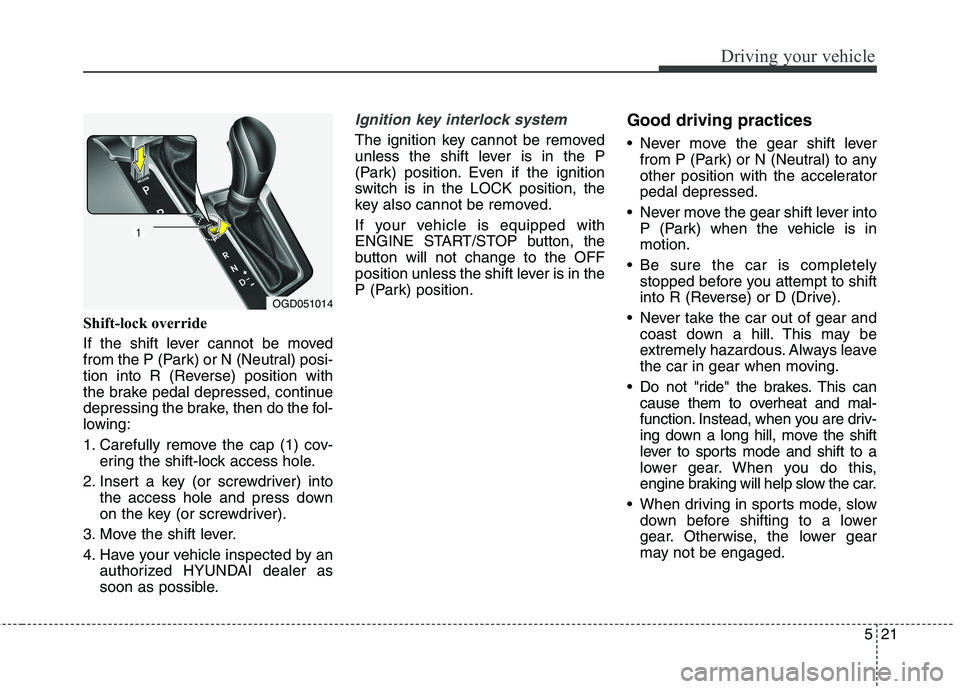
Shift-lock override
If the shift lever cannot be moved
from the P (Park) or N (Neutral) posi-
tion into R (Reverse) position with
the brake pedal depressed, continue
depressing the brake, then do the fol-
lowing:
1. Carefully remove the cap (1) cov-
ering the shift-lock access hole.
2. Insert a key (or screwdriver) into
the access hole and press down
on the key (or screwdriver).
3. Move the shift lever.
4. Have your vehicle inspected by an
authorized HYUNDAI dealer as
soon as possible.
Ignition key interlock system
The ignition key cannot be removed
unless the shift lever is in the P
(Park) position. Even if the ignition
switch is in the LOCK position, the
key also cannot be removed.
If your vehicle is equipped with
ENGINE START/STOP button, the
button will not change to the OFF
position unless the shift lever is in the
P (Park) position.
Good driving practices
Never move the gear shift lever
from P (Park) or N (Neutral) to any
other position with the accelerator
pedal depressed.
Never move the gear shift lever into
P (Park) when the vehicle is in
motion.
Be sure the car is completely
stopped before you attempt to shift
into R (Reverse) or D (Drive).
Never take the car out of gear and
coast down a hill. This may be
extremely hazardous. Always leave
the car in gear when moving.
Do not "ride" the brakes. This can
cause them to overheat and mal-
function. Instead, when you are driv-
ing down a long hill, move the shift
lever to sports mode and shift to a
lower gear. When you do this,
engine braking will help slow the car.
When driving in sports mode, slow
down before shifting to a lower
gear. Otherwise, the lower gear
may not be engaged.
OGD051014
Page 300 of 476
Driving your vehicle
28 5
Electric parking brake (EPB)
(if equipped)
Applying the parking brake
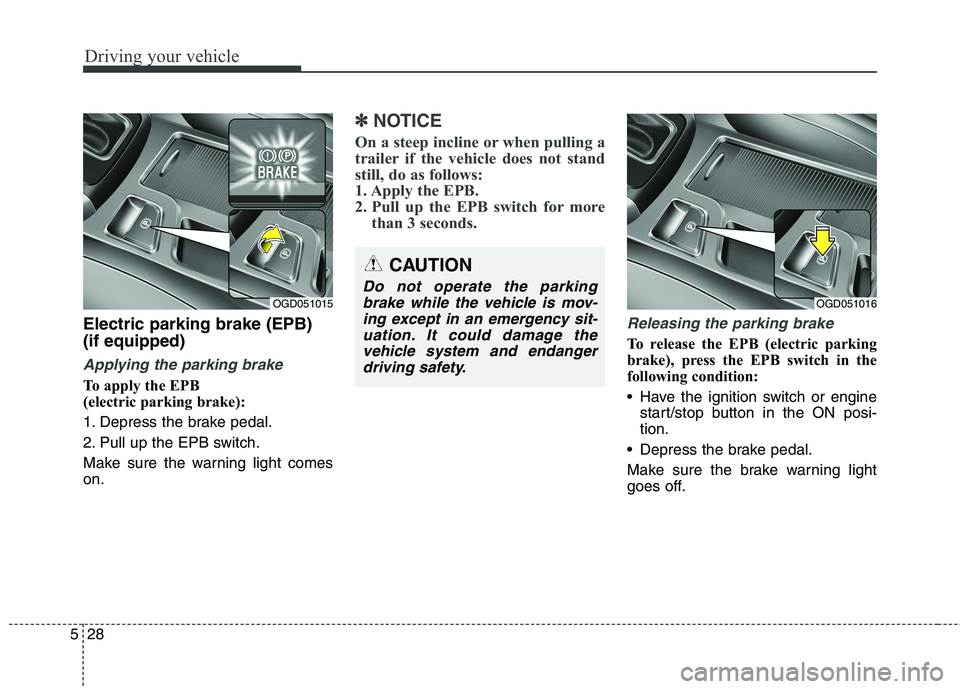
To apply the EPB
(electric parking brake):
1. Depress the brake pedal.
2. Pull up the EPB switch.
Make sure the warning light comes
on.
✽ ✽
NOTICE
On a steep incline or when pulling a
trailer if the vehicle does not stand
still, do as follows:
1. Apply the EPB.
2. Pull up the EPB switch for more
than 3 seconds.
Releasing the parking brake
To release the EPB (electric parking
brake), press the EPB switch in the
following condition:
Have the ignition switch or engine
start/stop button in the ON posi-
tion.
Depress the brake pedal.
Make sure the brake warning light
goes off.
OGD051015
CAUTION
Do not operate the parking
brake while the vehicle is mov-
ing except in an emergency sit-
uation. It could damage the
vehicle system and endanger
driving safety.
OGD051016
Page 301 of 476
529
Driving your vehicle
To release EPB (electric parking
brake) automatically:
Manual transaxle vehicle
1. Start the engine.
2. Fasten the driver's seat belt.
3. Close the driver's door, engine
hood and tailgate.
4. Depress the clutch pedal with
the gear engaged.
5. Depress the accelerator pedal
while releasing the clutch pedal.
Automatic transaxle vehicle
1. Start the engine.
2. Fasten the driver's seat belt.
3. Close the driver's door, engine
hood and tailgate.
4. Depress the accelerator pedal
while the shift lever is in R
(Rear), D (Drive). Shift lever in P (Park)
With the engine running depress
the brake pedal and shift out of P
(Park) to R (Rear) or D (Drive).
Shift lever in N (Neutral)
With the engine running depress
the brake pedal and shift out of N
(Neutral) to R (Rear) or D (Drive).
Make sure the brake warning light
goes off.
✽ ✽
NOTICE
• For your safety, you can engage
the EPB even though the ignition
switch or engine stop/start button
is in the OFF position, but you
cannot release it.
• For your safety, depress the brake
pedal and release the parking
brake manually with the EPB
switch when you drive downhill or
when backing up the vehicle.
✽ ✽
NOTICE - Manual transaxle
A vehicle towing a trailer on a hill or
on an incline may slightly roll back-
wards when starting the vehicle. To
prevent the situation follow the
below instructions.
1. Depress the clutch pedal and
select a gear.
2. Keep pulling up the EPB switch.
3. Depress the accelerator pedal and
slowly release the clutch pedal.
4. If the vehicle starts off with
enough driving power release the
EPB switch.
Do not follow the above procedure
when driving on a flat level ground.
The vehicle may suddenly move for-
ward.
Page 303 of 476
531
Driving your vehicle
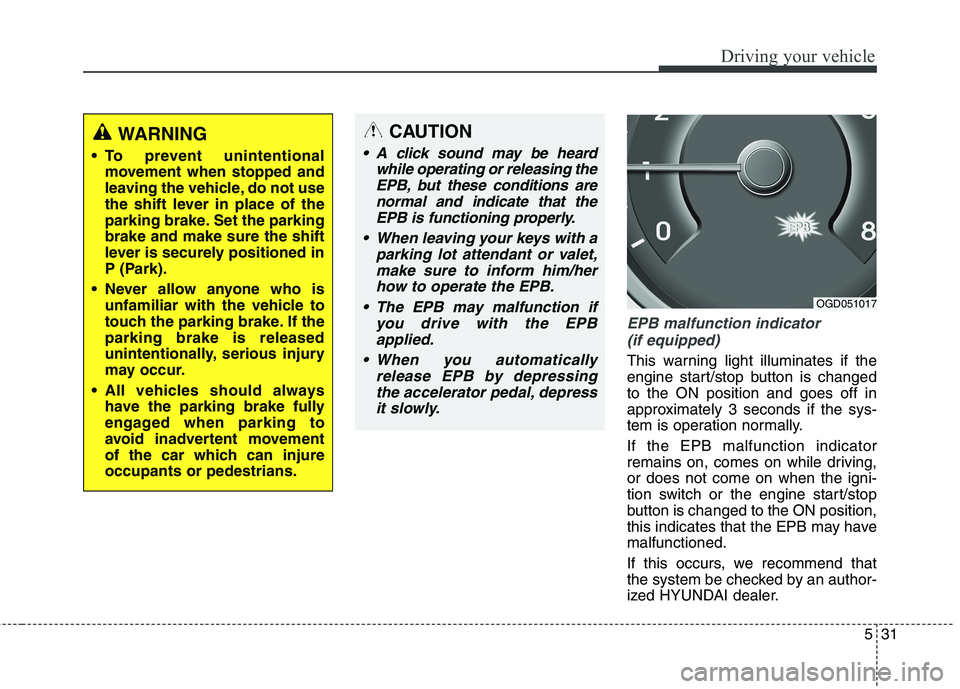
EPB malfunction indicator
(if equipped)
This warning light illuminates if the
engine start/stop button is changed
to the ON position and goes off in
approximately 3 seconds if the sys-
tem is operation normally.
If the EPB malfunction indicator
remains on, comes on while driving,
or does not come on when the igni-
tion switch or the engine start/stop
button is changed to the ON position,
this indicates that the EPB may have
malfunctioned.
If this occurs, we recommend that
the system be checked by an author-
ized HYUNDAI dealer.
WARNING
To prevent unintentional
movement when stopped and
leaving the vehicle, do not use
the shift lever in place of the
parking brake. Set the parking
brake and make sure the shift
lever is securely positioned in
P (Park).
Never allow anyone who is
unfamiliar with the vehicle to
touch the parking brake. If the
parking brake is released
unintentionally, serious injury
may occur.
All vehicles should always
have the parking brake fully
engaged when parking to
avoid inadvertent movement
of the car which can injure
occupants or pedestrians.
CAUTION
A click sound may be heard
while operating or releasing the
EPB, but these conditions are
normal and indicate that the
EPB is functioning properly.
When leaving your keys with a
parking lot attendant or valet,
make sure to inform him/her
how to operate the EPB.
The EPB may malfunction if
you drive with the EPB
applied.
When you automatically
release EPB by depressing
the accelerator pedal, depress
it slowly.
OGD051017
Page 425 of 476
Maintenance
64 7
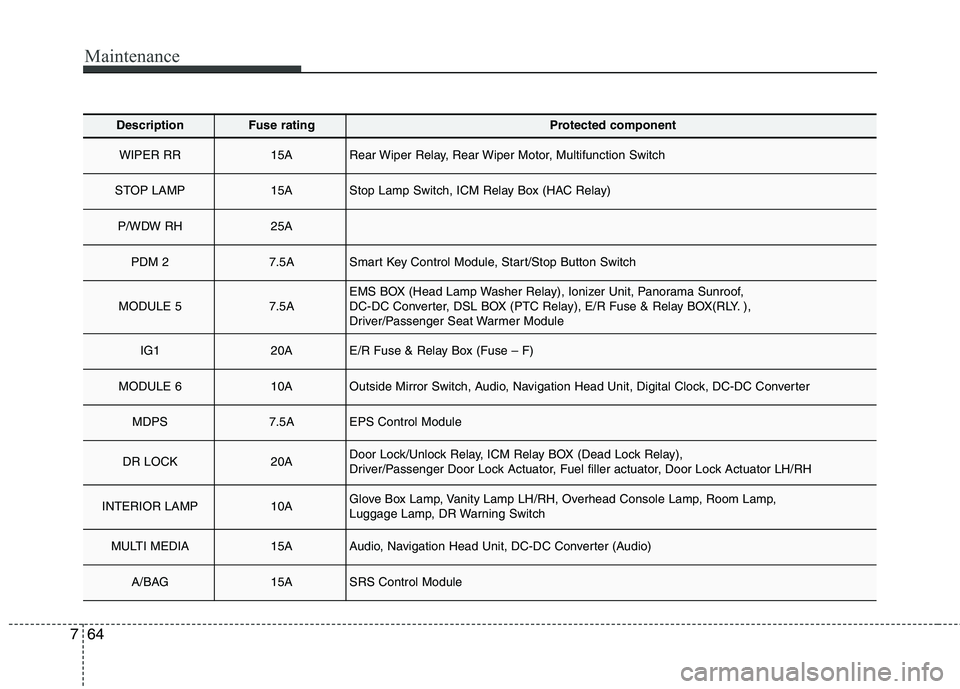
DescriptionFuse ratingProtected component
WIPER RR15ARear Wiper Relay, Rear Wiper Motor, Multifunction Switch
STOP LAMP15AStop Lamp Switch, ICM Relay Box (HAC Relay)
P/WDW RH25A
PDM 27.5ASmart Key Control Module, Start/Stop Button Switch
MODULE 57.5AEMS BOX (Head Lamp Washer Relay), Ionizer Unit, Panorama Sunroof,
DC-DC Converter, DSL BOX (PTC Relay), E/R Fuse & Relay BOX(RLY. ),
Driver/Passenger Seat Warmer Module
IG120AE/R Fuse & Relay Box (Fuse – F)
MODULE 610AOutside Mirror Switch, Audio, Navigation Head Unit, Digital Clock, DC-DC Converter
MDPS7.5AEPS Control Module
DR LOCK20ADoor Lock/Unlock Relay, ICM Relay BOX (Dead Lock Relay),
Driver/Passenger Door Lock Actuator, Fuel filler actuator, Door Lock Actuator LH/RH
INTERIOR LAMP10AGlove Box Lamp, Vanity Lamp LH/RH, Overhead Console Lamp, Room Lamp,
Luggage Lamp, DR Warning Switch
MULTI MEDIA15AAudio, Navigation Head Unit, DC-DC Converter (Audio)
A/BAG15ASRS Control Module
Page 428 of 476
767
Maintenance
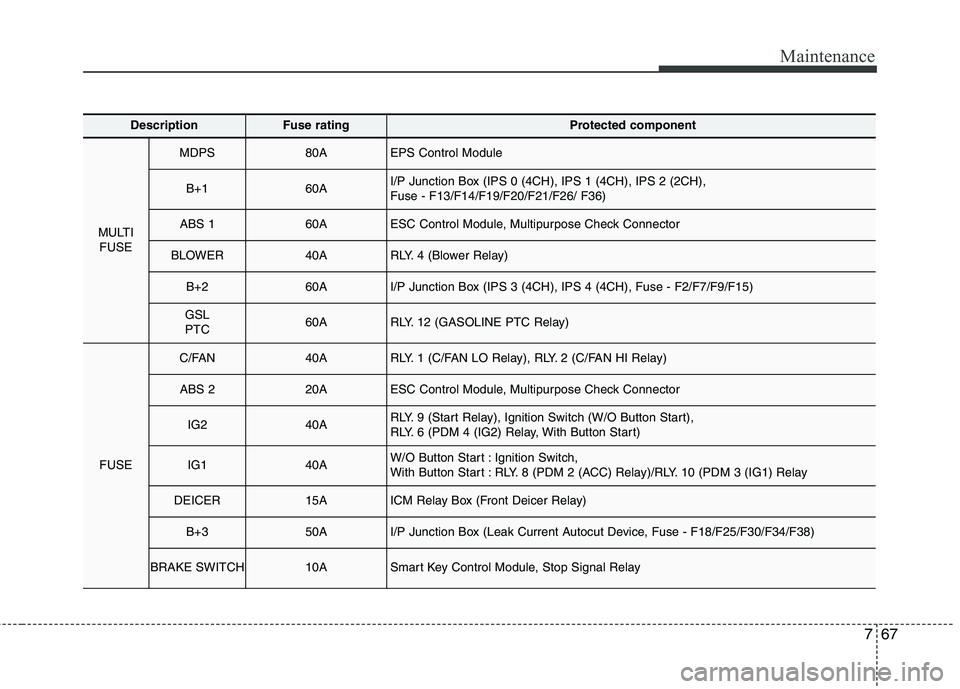
DescriptionFuse ratingProtected component
MULTI
FUSE
MDPS80AEPS Control Module
B+160AI/P Junction Box (IPS 0 (4CH), IPS 1 (4CH), IPS 2 (2CH),
Fuse - F13/F14/F19/F20/F21/F26/ F36)
ABS 160AESC Control Module, Multipurpose Check Connector
BLOWER40ARLY. 4 (Blower Relay)
B+260AI/P Junction Box (IPS 3 (4CH), IPS 4 (4CH), Fuse - F2/F7/F9/F15)
GSL
PTC60ARLY. 12 (GASOLINE PTC Relay)
FUSE
C/FAN40ARLY. 1 (C/FAN LO Relay), RLY. 2 (C/FAN HI Relay)
ABS 220AESC Control Module, Multipurpose Check Connector
IG240ARLY. 9 (Start Relay), Ignition Switch (W/O Button Start),
RLY. 6 (PDM 4 (IG2) Relay, With Button Start)
IG140AW/O Button Start : Ignition Switch,
With Button Start : RLY. 8 (PDM 2 (ACC) Relay)/RLY. 10 (PDM 3 (IG1) Relay
DEICER15AICM Relay Box (Front Deicer Relay)
B+350AI/P Junction Box (Leak Current Autocut Device, Fuse - F18/F25/F30/F34/F38)
BRAKE SWITCH10ASmart Key Control Module, Stop Signal Relay
Page 470 of 476
Index
4I
Drinks holders, see cup holders ..................................4-121
Driver's 3-point seat belt ..............................................3-19
Driver's and passenger's front air bag ..........................3-52
Driving at night ............................................................5-50
Driving in flooded areas................................................5-52
Driving in the rain ........................................................5-51
Economical operation....................................................5-47
Electric chromic mirror with homelink system ............4-49
Electric parking brake(EPB) ........................................5-28
Electric power steering..................................................4-43
Electronic stability control (ESC) ................................5-35
Emergency starting..........................................................6-5
Jump starting ................................................................6-5
Push starting ................................................................6-7
Emergency while driving ................................................6-3
Emission control system ..............................................7-90
Crankcase emission control system ..........................7-90
Evaporative emission control System ........................7-90
Exhaust emission control system ..............................7-91
Engine..............................................................................8-2
Engine compartment ......................................................2-6
Engine coolant ..............................................................7-29
Engine number ................................................................8-9
Engine oil ......................................................................7-27
Engine overheats ............................................................6-8Engine start/stop button ..................................................5-9
Engine temperature gauge ............................................4-58
Engine will not start ........................................................6-4
Evaporative emission control System ..........................7-90
Exhaust emission control system ..................................7-91
Explanation of scheduled maintenance items ..............7-23
Exterior care ..................................................................7-83
Exterior features
Mounting bracket for roof carrier ............................4-128
Exterior overview(Front) ................................................2-2
Exterior overview(Rear) ..................................................2-3
Flat tire ..........................................................................6-14
Changing tires ............................................................6-15
Compact spare tire......................................................6-20
Jack and tools ............................................................6-14
Removing and storing the spare tire ..........................6-15
FLEX STEER................................................................4-45
Floor mat anchor(s) ....................................................4-124
Fluid
Brakes/clutch fluid ....................................................7-32
Washer fluid ..............................................................7-33
Folding the rear seat ......................................................3-13
Front passenger and rear seat belt ................................3-21
Front seat adjustment ......................................................3-5
Fuel filler lid..................................................................4-34
F
E