clutch Hyundai Elantra GT 2017 Owner's Manual
[x] Cancel search | Manufacturer: HYUNDAI, Model Year: 2017, Model line: Elantra GT, Model: Hyundai Elantra GT 2017Pages: 493, PDF Size: 11.53 MB
Page 19 of 493
Your vehicle at a glance
62
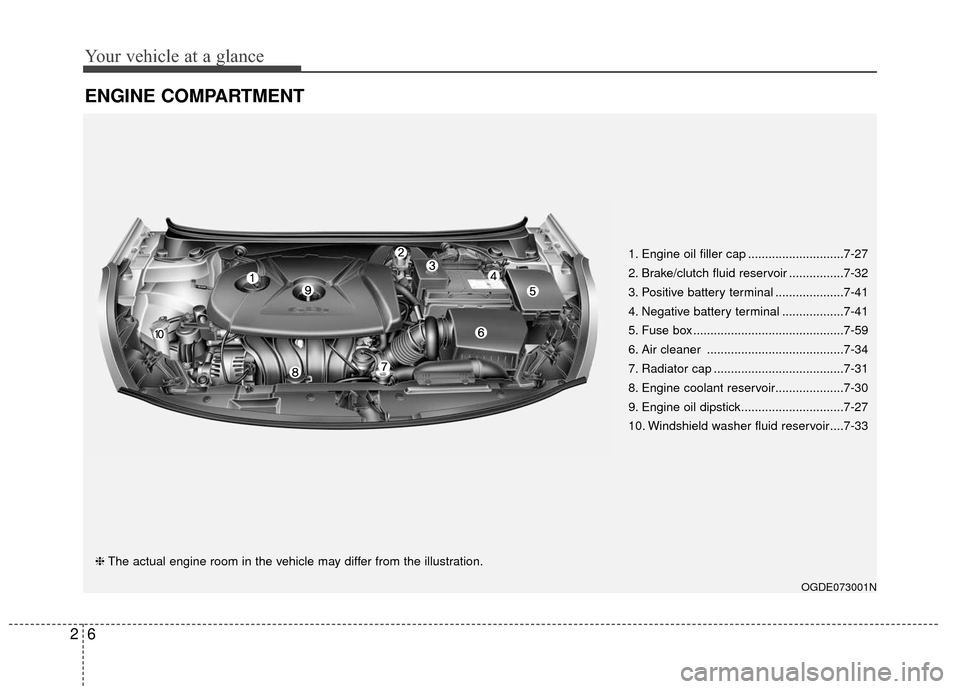
ENGINE COMPARTMENT
OGDE073001N
❈The actual engine room in the vehicle may differ from the illustration. 1. Engine oil filler cap ............................7-27
2. Brake/clutch fluid reservoir ................7-32
3. Positive battery terminal ....................7-41
4. Negative battery terminal ..................7-41
5. Fuse box ............................................7-59
6. Air cleaner ........................................7-34
7. Radiator cap ......................................7-31
8. Engine coolant reservoir....................7-30
9. Engine oil dipstick..............................7-27
10. Windshield washer fluid reservoir ....7-33
Page 170 of 493
483
Features of your vehicle
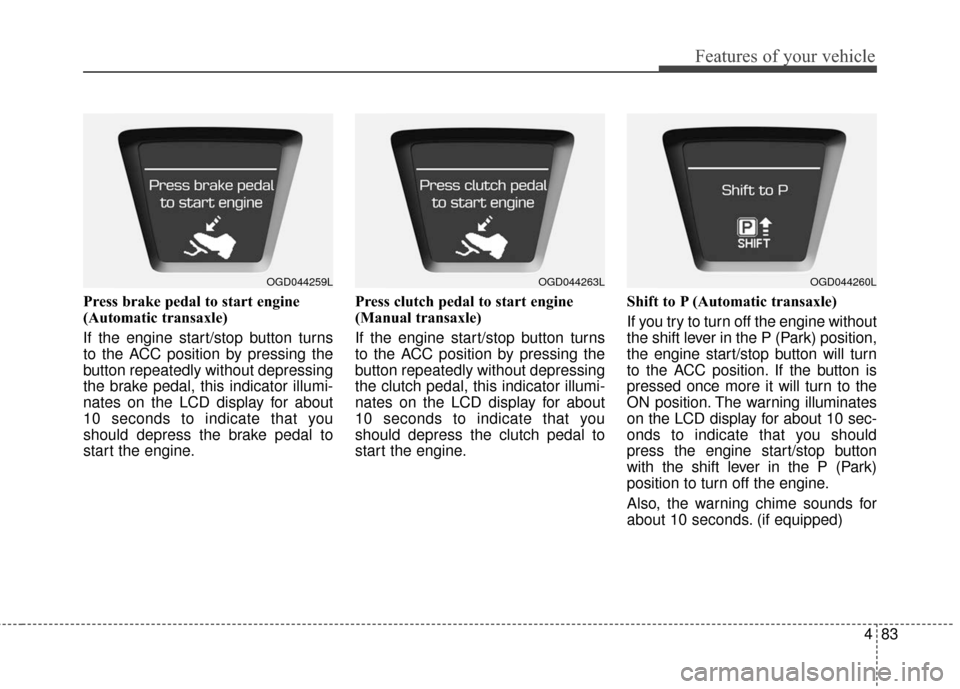
Press brake pedal to start engine
(Automatic transaxle)
If the engine start/stop button turns
to the ACC position by pressing the
button repeatedly without depressing
the brake pedal, this indicator illumi-
nates on the LCD display for about
10 seconds to indicate that you
should depress the brake pedal to
start the engine.Press clutch pedal to start engine
(Manual transaxle)
If the engine start/stop button turns
to the ACC position by pressing the
button repeatedly without depressing
the clutch pedal, this indicator illumi-
nates on the LCD display for about
10 seconds to indicate that you
should depress the clutch pedal to
start the engine.Shift to P (Automatic transaxle)
If you try to turn off the engine without
the shift lever in the P (Park) position,
the engine start/stop button will turn
to the ACC position. If the button is
pressed once more it will turn to the
ON position. The warning illuminates
on the LCD display for about 10 sec-
onds to indicate that you should
press the engine start/stop button
with the shift lever in the P (Park)
position to turn off the engine.
Also, the warning chime sounds for
about 10 seconds. (if equipped)
OGD044260LOGD044263LOGD044259L
Page 299 of 493
57
Driving your vehicle
Starting the engine
1. Make sure the parking brake isapplied.
2. Manual Transaxle - Depress the
clutch pedal fully and shift the
transaxle into Neutral. Keep the
clutch pedal and brake pedal
depressed while turning the igni-
tion switch to the start position.
The starter will not operate if the
clutch pedal is not fully depressed.
Automatic Transaxle - Place the
transaxle shift lever in P (Park).
Depress the brake pedal fully.
You can also start the engine when the shift lever is in the N(Neutral) position.
WARNING - Ignition
switch
Never turn the ignition switch to LOCK or ACC while the vehi-
cle is moving. This can result in
loss of directional control and
braking function, which could
cause an accident.
Before leaving the driver’s seat, always make sure the
shift lever is engaged in 1st
gear for the manual transaxle
or P (Park) for automatic
transaxle, set the parking
brake fully and shut the
engine off. Unexpected and
sudden vehicle movement
may occur if these precau-
tions are not taken.
(Continued)(Continued)
Never reach for the ignitionswitch, or any other controls
through the steering wheel
while the vehicle is in motion.
The presence of your hand or
arm in this area could cause a
loss of vehicle control, an
accident and serious bodily
injury or death.
Do not place any movable objects around the driver’s
seat as they may move while
driving, interfere with the driv-
er and lead to an accident.
WARNING
Always wear appropriate shoes
when operating your vehicle.
Unsuitable shoes (high heels,
ski boots,etc.) may interfere
with your ability to use the
brake, accelerator pedal, and
clutch (if equipped).
Page 302 of 493
Driving your vehicle
10
5
ACC(Accessory)
• with manual transaxle
Press the engine start/stop button
when the button is in the OFF posi-
tion without depressing the clutch
pedal.
• with automatic transaxle
Press the engine start/stop button
when the button is in the OFF posi-
tion without depressing the brake
pedal.
If you leave the engine start/stop but-
ton in the ACC position for more than
1 hour, the button is turned off auto-
matically to prevent the battery from
discharging.
ON
• with manual transaxle
Press the engine start/stop button
when the button is in the ACC posi-
tion without depressing the clutch
pedal.
• with automatic transaxle
Press the engine start/stop button
when the button is in the ACC posi-
tion without depressing the brake
pedal.
The warning lights can be checked
before the engine is started. Do not
leave the button in the ON position if
the engine is not running to prevent
the battery from discharging.
START
• with manual transaxle
To start the engine, depress the
clutch pedal and brake pedal, then
press the engine start/stop button
with the shift lever in the N(Neutral)
position.
• with automatic transaxle
To start the engine, depress the brake
pedal and press the engine start/stop
button with the shift lever in the
P(Park) or the N (Neutral) position.
✽ ✽
NOTICE
• If you press the engine start/stop
button without depressing the
clutch pedal on manual transaxle
vehicles or without depressing the
brake pedal on automatic
transaxle vehicles, the engine will
not start and the engine start/stop
button changes as follows:
OFF → →
ACC →
→
ON →
→
OFF
• If you leave the engine start/stop button in the ACC or the ON posi-
tion for a long time, the battery
may be discharged.
Page 303 of 493
511
Driving your vehicle
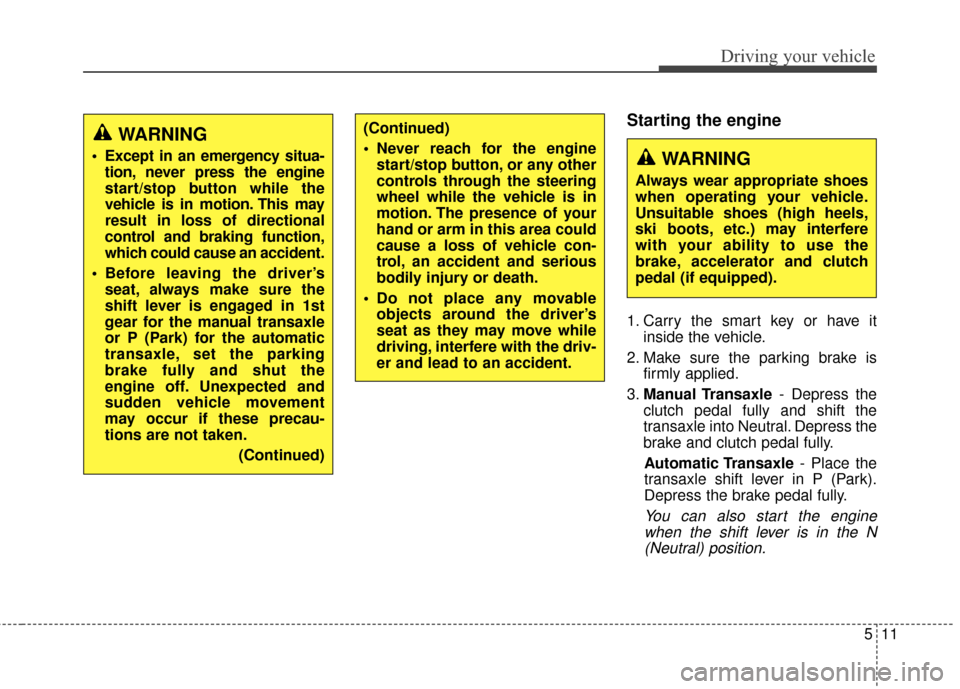
Starting the engine
1. Carry the smart key or have itinside the vehicle.
2. Make sure the parking brake is firmly applied.
3. Manual Transaxle - Depress the
clutch pedal fully and shift the
transaxle into Neutral. Depress the
brake and clutch pedal fully.
Automatic Transaxle - Place the
transaxle shift lever in P (Park).
Depress the brake pedal fully.
You can also start the engine when the shift lever is in the N(Neutral) position.
WARNING
Except in an emergency situa- tion, never press the engine
start/stop button while the
vehicle is in motion. This may
result in loss of directional
control and braking function,
which could cause an accident.
Before leaving the driver’s seat, always make sure the
shift lever is engaged in 1st
gear for the manual transaxle
or P (Park) for the automatic
transaxle, set the parking
brake fully and shut the
engine off. Unexpected and
sudden vehicle movement
may occur if these precau-
tions are not taken.
(Continued)
(Continued)
Never reach for the enginestart/stop button, or any other
controls through the steering
wheel while the vehicle is in
motion. The presence of your
hand or arm in this area could
cause a loss of vehicle con-
trol, an accident and serious
bodily injury or death.
Do not place any movable objects around the driver’s
seat as they may move while
driving, interfere with the driv-
er and lead to an accident.
WARNING
Always wear appropriate shoes
when operating your vehicle.
Unsuitable shoes (high heels,
ski boots, etc.) may interfere
with your ability to use the
brake, accelerator and clutch
pedal (if equipped).
Page 304 of 493
Driving your vehicle
12
5
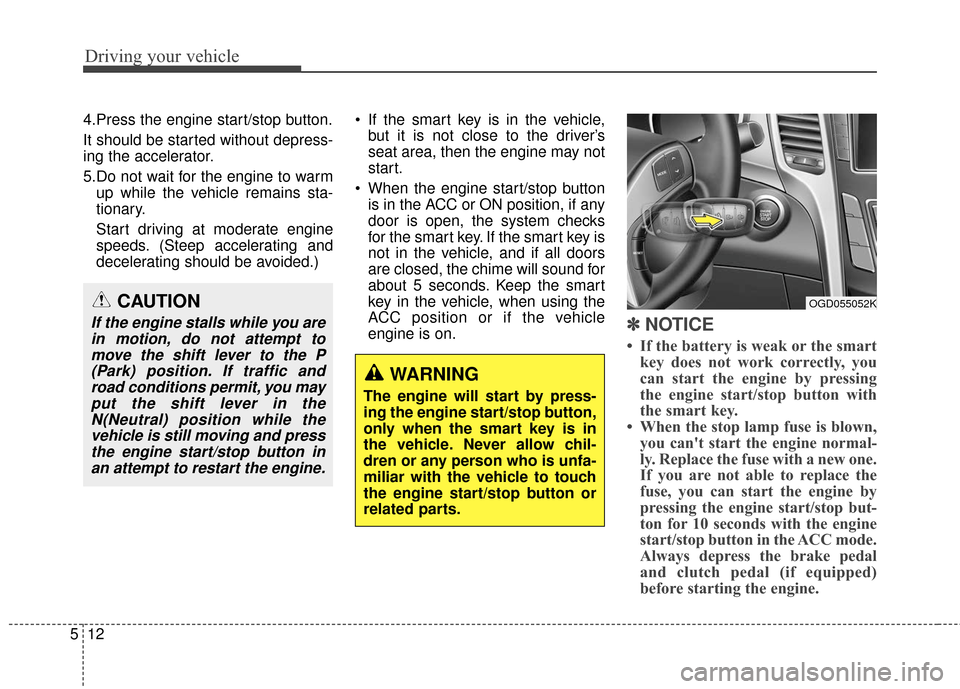
4.Press the engine start/stop button.
It should be started without depress-
ing the accelerator.
5.Do not wait for the engine to warm
up while the vehicle remains sta-
tionary.
Start driving at moderate engine
speeds. (Steep accelerating and
decelerating should be avoided.) If the smart key is in the vehicle,
but it is not close to the driver’s
seat area, then the engine may not
start.
When the engine start/stop button is in the ACC or ON position, if any
door is open, the system checks
for the smart key. If the smart key is
not in the vehicle, and if all doors
are closed, the chime will sound for
about 5 seconds. Keep the smart
key in the vehicle, when using the
ACC position or if the vehicle
engine is on.
✽ ✽ NOTICE
• If the battery is weak or the smart
key does not work correctly, you
can start the engine by pressing
the engine start/stop button with
the smart key.
• When the stop lamp fuse is blown, you can't start the engine normal-
ly. Replace the fuse with a new one.
If you are not able to replace the
fuse, you can start the engine by
pressing the engine start/stop but-
ton for 10 seconds with the engine
start/stop button in the ACC mode.
Always depress the brake pedal
and clutch pedal (if equipped)
before starting the engine.
WARNING
The engine will start by press-
ing the engine start/stop button,
only when the smart key is in
the vehicle. Never allow chil-
dren or any person who is unfa-
miliar with the vehicle to touch
the engine start/stop button or
related parts.
OGD055052KCAUTION
If the engine stalls while you are
in motion, do not attempt tomove the shift lever to the P(Park) position. If traffic androad conditions permit, you mayput the shift lever in theN(Neutral) position while thevehicle is still moving and pressthe engine start/stop button inan attempt to restart the engine.
Page 306 of 493
Driving your vehicle
14
5
Manual transaxle operation
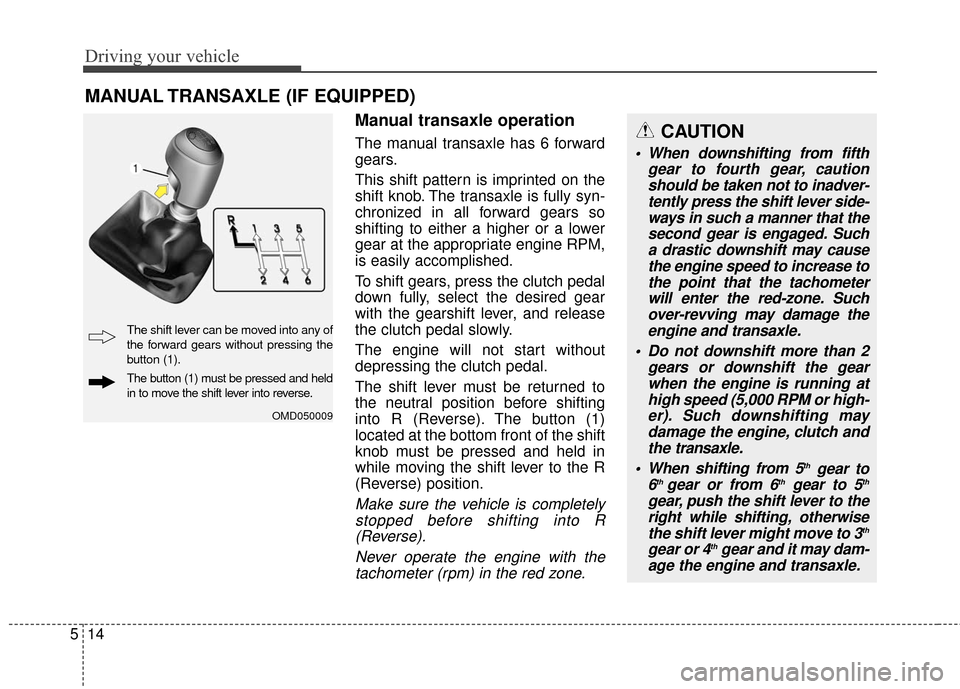
The manual transaxle has 6 forward
gears.
This shift pattern is imprinted on the
shift knob. The transaxle is fully syn-
chronized in all forward gears so
shifting to either a higher or a lower
gear at the appropriate engine RPM,
is easily accomplished.
To shift gears, press the clutch pedal
down fully, select the desired gear
with the gearshift lever, and release
the clutch pedal slowly.
The engine will not start without
depressing the clutch pedal.
The shift lever must be returned to
the neutral position before shifting
into R (Reverse). The button (1)
located at the bottom front of the shift
knob must be pressed and held in
while moving the shift lever to the R
(Reverse) position.
Make sure the vehicle is completely
stopped before shifting into R(Reverse).
Never operate the engine with thetachometer (rpm) in the red zone.
MANUAL TRANSAXLE (IF EQUIPPED)
OMD050009
The shift lever can be moved into any of
the forward gears without pressing the
button (1).
The button (1) must be pressed and held
in to move the shift lever into reverse.
CAUTION
When downshifting from fifth gear to fourth gear, cautionshould be taken not to inadver-tently press the shift lever side-ways in such a manner that thesecond gear is engaged. Sucha drastic downshift may causethe engine speed to increase tothe point that the tachometerwill enter the red-zone. Suchover-revving may damage theengine and transaxle.
Do not downshift more than 2 gears or downshift the gearwhen the engine is running athigh speed (5,000 RPM or high-er). Such downshifting maydamage the engine, clutch andthe transaxle.
When shifting from 5
thgear to
6th gear or from 6thgear to 5th
gear, push the shift lever to the right while shifti ng, otherwise
the shift lever might move to 3
th
gear or 4thgear and it may dam-
age the engine and transaxle.
Page 307 of 493
515
Driving your vehicle
During cold weather, shifting maybe difficult until the transaxle lubri-
cant is warmed up. This is normal
and not harmful to the transaxle.
If you've come to a complete stop and it is difficult to shift into 1st or
R (Reverse), leave the shift lever in
the neutral position and release the
clutch. Depress the clutch pedal
and then shift into 1st or R
(Reverse) gear position.Using the clutch
The clutch should be depressed all
the way to the floor before shifting,
then released slowly. The clutch
pedal should always be fully
released while driving. Do not rest
your foot on the clutch pedal while
driving. This can cause unnecessary
wear. Do not partially engage the
clutch to hold the vehicle on an
incline. This causes unnecessary
wear. Use the foot brake or parking
brake to hold the vehicle on an
incline. Do not operate the clutch
pedal rapidly and repeatedly.
Downshifting
It is important to downshift when you
must slow down in heavy traffic or
while driving up or down steep hills.
Downshifting reduces the chance of
stalling and gives better acceleration.
When the vehicle is traveling down
steep hills, downshifting helps main-
tain safe speed and prolongs brake
life.
WARNING
Before leaving the driver’s seat,
always set the parking brake
fully and shut the engine off.
Then make sure the transaxle is
shifted into 1st gear when the
vehicle is parked on a level or
uphill grade, and shifted into R
(Reverse) on a downhill grade.
Unexpected and sudden vehicle
movement can occur if these
precautions are not followed in
the order identified.
CAUTION
To avoid premature clutch wear and damage, do notdrive with your foot resting onthe clutch pedal. Also, do notuse the clutch to hold thevehicle stopped on an uphillgrade while waiting for a traf-fic light, etc.
Do not use the shift lever as a handrest during driving, asthis can result in prematurewear of the transaxle shiftforks.
(Continued)
(Continued) When operating the clutch pedal, press the clutch pedalfully.
If you don't press the clutchpedal fully, the clutch may bedamaged.
Page 328 of 493
Driving your vehicle
36
5
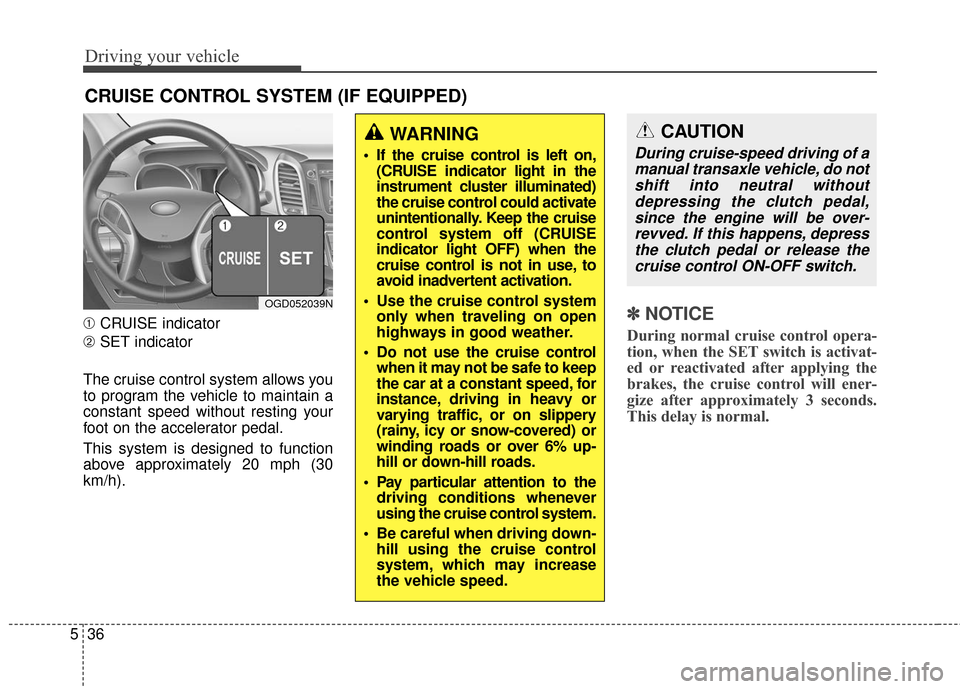
➀ CRUISE indicator
➁ SET indicator
The cruise control system allows you
to program the vehicle to maintain a
constant speed without resting your
foot on the accelerator pedal.
This system is designed to function
above approximately 20 mph (30
km/h).✽ ✽ NOTICE
During normal cruise control opera-
tion, when the SET switch is activat-
ed or reactivated after applying the
brakes, the cruise control will ener-
gize after approximately 3 seconds.
This delay is normal.
CRUISE CONTROL SYSTEM (IF EQUIPPED)
WARNING
If the cruise control is left on,
(CRUISE indicator light in the
instrument cluster illuminated)
the cruise control could activate
unintentionally. Keep the cruise
control system off (CRUISE
indicator light OFF) when the
cruise control is not in use, to
avoid inadvertent activation.
Use the cruise control system only when traveling on open
highways in good weather.
Do not use the cruise control when it may not be safe to keep
the car at a constant speed, for
instance, driving in heavy or
varying traffic, or on slippery
(rainy, icy or snow-covered) or
winding roads or over 6% up-
hill or down-hill roads.
Pay particular attention to the driving conditions whenever
using the cruise control system.
Be careful when driving down- hill using the cruise control
system, which may increase
the vehicle speed.
CAUTION
During cruise-speed driving of a
manual transaxle vehicle, do notshift into neutral withoutdepressing the clutch pedal,since the engine will be over-revved. If this happens, depressthe clutch pedal or release thecruise control ON-OFF switch.
OGD052039N
Page 330 of 493
Driving your vehicle
38
5
To decrease the cruising
speed:
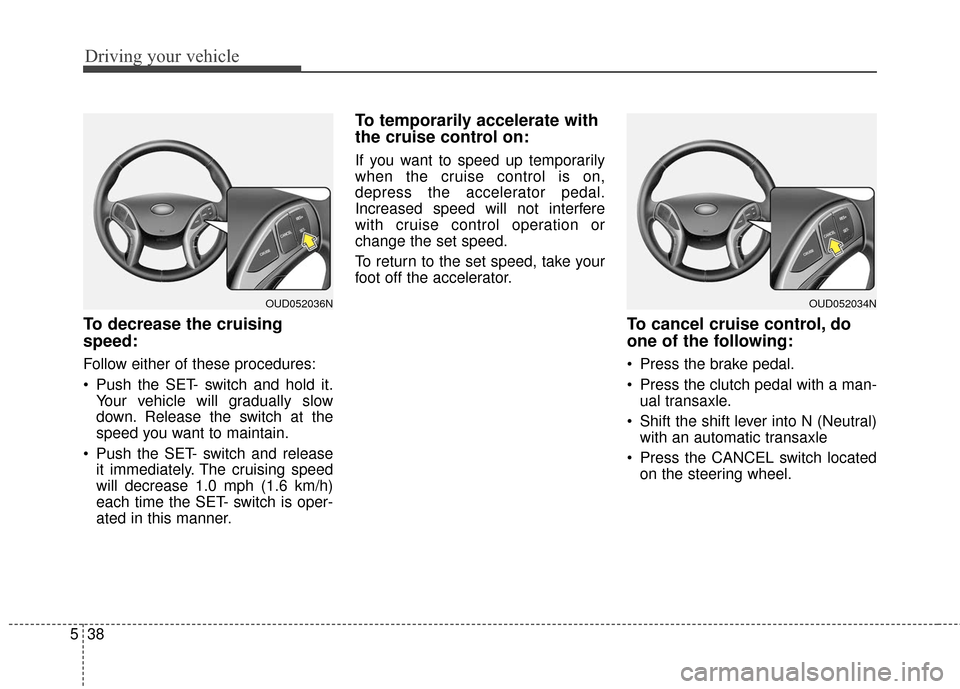
Follow either of these procedures:
Push the SET- switch and hold it.
Your vehicle will gradually slow
down. Release the switch at the
speed you want to maintain.
Push the SET- switch and release it immediately. The cruising speed
will decrease 1.0 mph (1.6 km/h)
each time the SET- switch is oper-
ated in this manner.
To temporarily accelerate with
the cruise control on:
If you want to speed up temporarily
when the cruise control is on,
depress the accelerator pedal.
Increased speed will not interfere
with cruise control operation or
change the set speed.
To return to the set speed, take your
foot off the accelerator.
To cancel cruise control, do
one of the following:
Press the brake pedal.
Press the clutch pedal with a man-ual transaxle.
Shift the shift lever into N (Neutral) with an automatic transaxle
Press the CANCEL switch located on the steering wheel.
OUD052036NOUD052034N