OIL HYUNDAI ELANTRA GT 2019 User Guide
[x] Cancel search | Manufacturer: HYUNDAI, Model Year: 2019, Model line: ELANTRA GT, Model: HYUNDAI ELANTRA GT 2019Pages: 486, PDF Size: 78.59 MB
Page 341 of 486
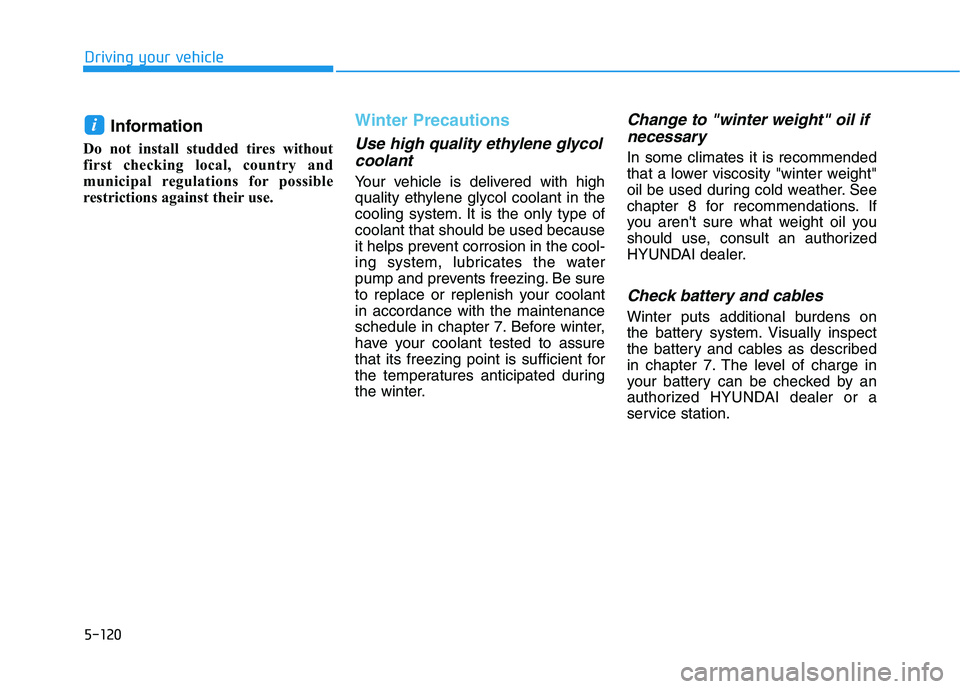
5-120
Driving your vehicle
Information
Do not install studded tires without
first checking local, country and
municipal regulations for possible
restrictions against their use.Winter Precautions
Use high quality ethylene glycol coolant
Your vehicle is delivered with high
quality ethylene glycol coolant in the
cooling system. It is the only type ofcoolant that should be used because
it helps prevent corrosion in the cool-
ing system, lubricates the water
pump and prevents freezing. Be sure
to replace or replenish your coolantin accordance with the maintenance
schedule in chapter 7. Before winter,
have your coolant tested to assure
that its freezing point is sufficient for
the temperatures anticipated during
the winter.
Change to "winter weight" oil ifnecessary
In some climates it is recommended
that a lower viscosity "winter weight"
oil be used during cold weather. See
chapter 8 for recommendations. If
you aren't sure what weight oil you
should use, consult an authorized
HYUNDAI dealer.
Check battery and cables
Winter puts additional burdens on
the battery system. Visually inspect
the battery and cables as described
in chapter 7. The level of charge in
your battery can be checked by an
authorized HYUNDAI dealer or a
service station.
i
Page 372 of 486
6-24
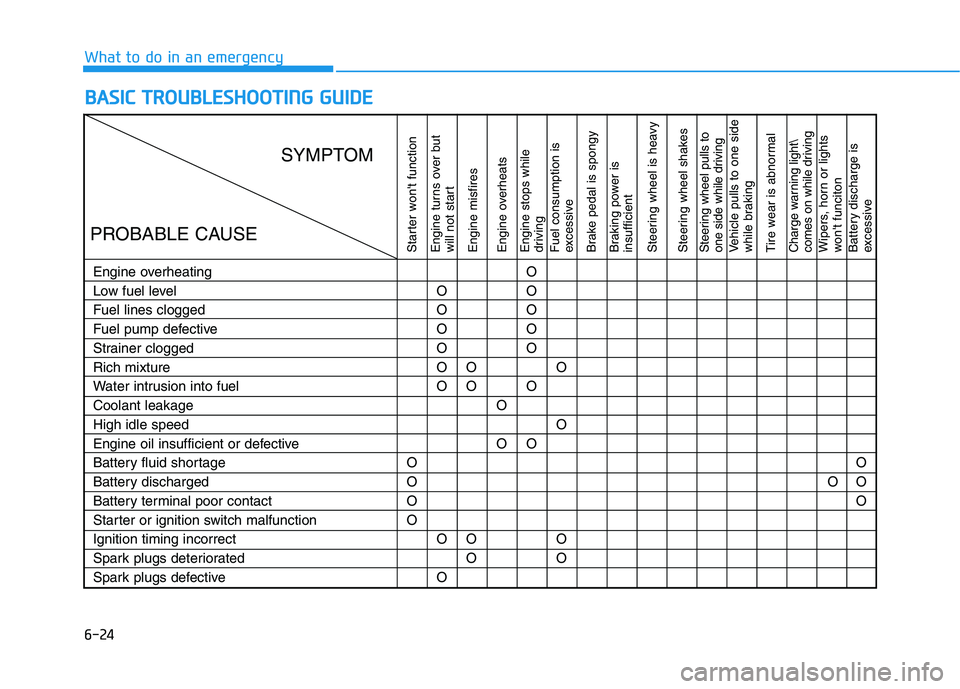
BBAA SSIICC TT RR OO UUBBLLEE SSHH OO OOTTIINN GG GG UU IIDD EE
What to do in an emergency
Starter won't function
Engine turns over but
will not start Engine misfires
Engine overheats Engine stops while
driving Fuel consumption is
excessive
Brake pedal is spongy
Braking power is insufficient
Steering wheel is heavy
Steering wheel shakesSteering wheel pulls to
one side while drivingVehicle pulls to one side
while braking
Tire wear is abnormalCharge warning light\
comes on while drivingWipers, horn or lights
won't funciton
Battery discharge is
excessive
Engine overheating
Low fuel levelFuel lines clogged
Fuel pump defective
Strainer cloggedRich mixture
Water intrusion into fuelCoolant leakageHigh idle speed
Engine oil insufficient or defective
Battery fluid shortage
Battery discharged
Battery terminal poor contact
Starter or ignition switch malfunctionIgnition timing incorrect
Spark plugs deteriorated
Spark plugs defective OOOOOOOOOO O O
O O O O
O OO OOOO O O
OO O O
O
OOO
SYMPTOM
PROBABLE CAUSE
Page 373 of 486
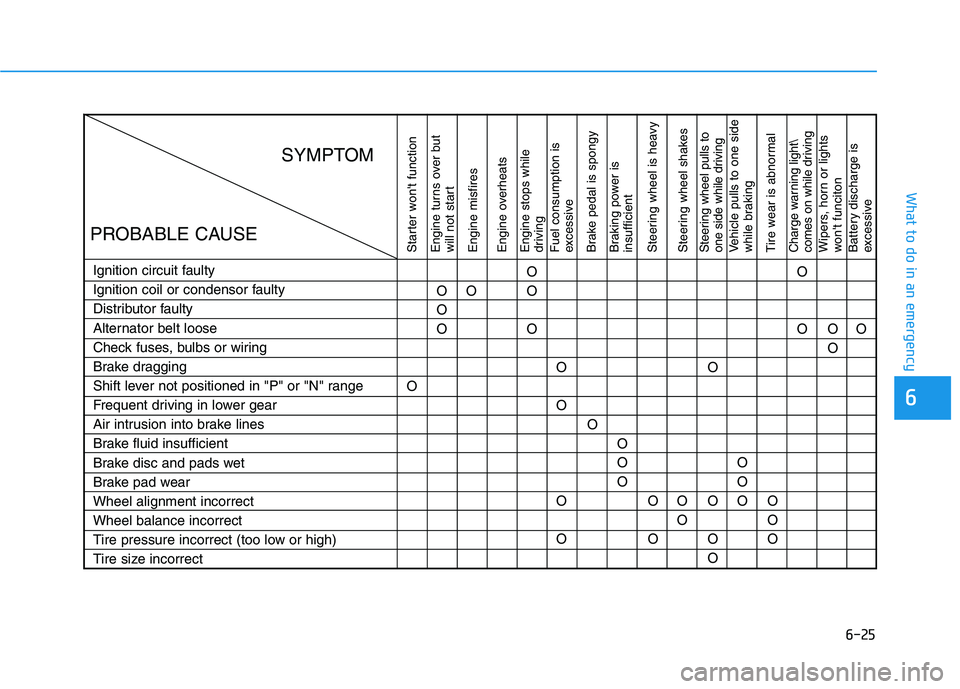
6-25
What to do in an emergency
6
Starter won't function
Engine turns over but
will not start Engine misfires
Engine overheats Engine stops while
driving Fuel consumption is
excessive
Brake pedal is spongy
Braking power is insufficient
Steering wheel is heavy
Steering wheel shakesSteering wheel pulls to
one side while drivingVehicle pulls to one side
while braking
Tire wear is abnormalCharge warning light\
comes on while drivingWipers, horn or lights
won't funciton
Battery discharge is
excessive
Ignition circuit faulty
Ignition coil or condensor faulty
Distributor faulty
Alternator belt loose
Check fuses, bulbs or wiring
Brake dragging
Shift lever not positioned in "P" or "N" range
Frequent driving in lower gear
Air intrusion into brake lines
Brake fluid insufficient
Brake disc and pads wet
Brake pad wearWheel alignment incorrectWheel balance incorrect
Tire pressure incorrect (too low or high)
Tire size incorrectO
O OO
O
OOOO O OO O O O O O
OOOO
OOO O
O O O
OO O O O O
O
SYMPTOM
PROBABLE CAUSE
Page 374 of 486
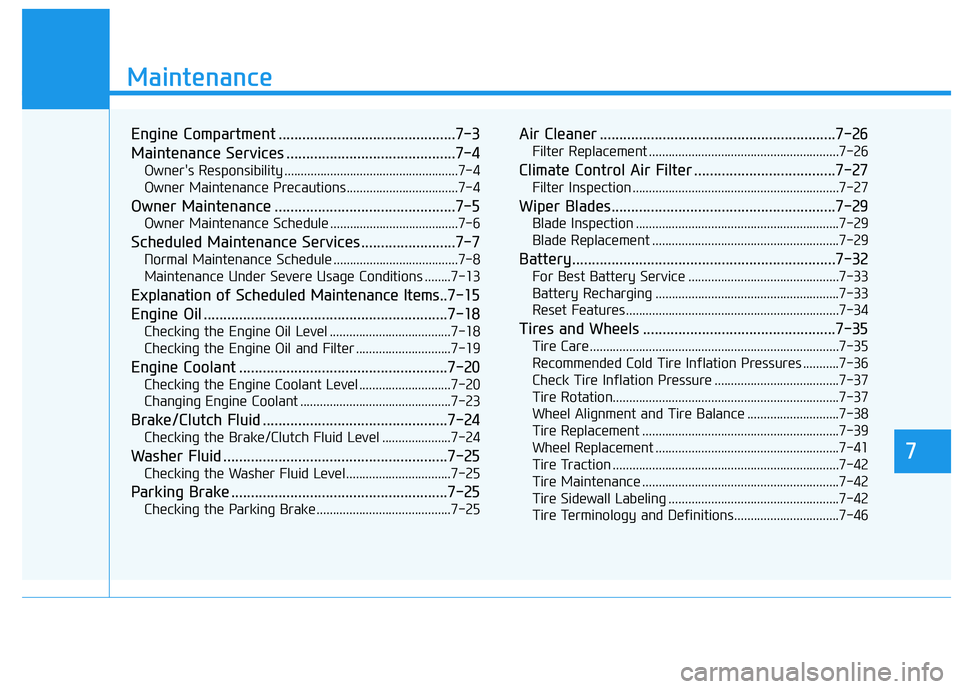
7
Maintenance
7
Maintenance
Engine Compartment .............................................7-3
Maintenance Services ...........................................7-4Owner's Responsibility .....................................................7-4
Owner Maintenance Precautions..................................7-4
Owner Maintenance ..............................................7-5 Owner Maintenance Schedule .......................................7-6
Scheduled Maintenance Services........................7-7 Normal Maintenance Schedule ......................................7-8
Maintenance Under Severe Usage Conditions ........7-13
Explanation of Scheduled Maintenance Items..7-15
Engine Oil ..............................................................7-18 Checking the Engine Oil Level .....................................7-18
Checking the Engine Oil and Filter .............................7-19
Engine Coolant .....................................................7-20 Checking the Engine Coolant Level ............................7-20
Changing Engine Coolant ..............................................7-23
Brake/Clutch Fluid ...............................................7-24 Checking the Brake/Clutch Fluid Level .....................7-24
Washer Fluid .........................................................7-25 Checking the Washer Fluid Level................................7-25
Parking Brake .......................................................7-25 Checking the Parking Brake .........................................7-25 Air Cleaner ............................................................7-26
Filter Replacement ..........................................................7-26
Climate Control Air Filter ....................................7-27 Filter Inspection ...............................................................7-27
Wiper Blades.........................................................7-29 Blade Inspection ..............................................................7-29
Blade Replacement .........................................................7-29
Battery...................................................................7-32 For Best Battery Service ..............................................7-33
Battery Recharging ........................................................7-33
Reset Features.................................................................7-34
Tires and Wheels .................................................7-35 Tire Care ............................................................................7-35
Recommended Cold Tire Inflation Pressures ...........7-36
Check Tire Inflation Pressure ......................................7-37
Tire Rotation.....................................................................7-37
Wheel Alignment and Tire Balance ............................7-38
Tire Replacement ............................................................7-39
Wheel Replacement ........................................................7-41
Tire Traction .....................................................................7-42
Tire Maintenance ............................................................7-42
Tire Sidewall Labeling ....................................................7-42
Tire Terminology and Definitions................................7-46
7
Page 376 of 486
7-3
7
Maintenance
EENN GGIINN EE CC OO MM PPAA RRTTMM EENN TT
OPD076002/OPD077098L
■■
2.0 GDI
■■1.6 T-GDI
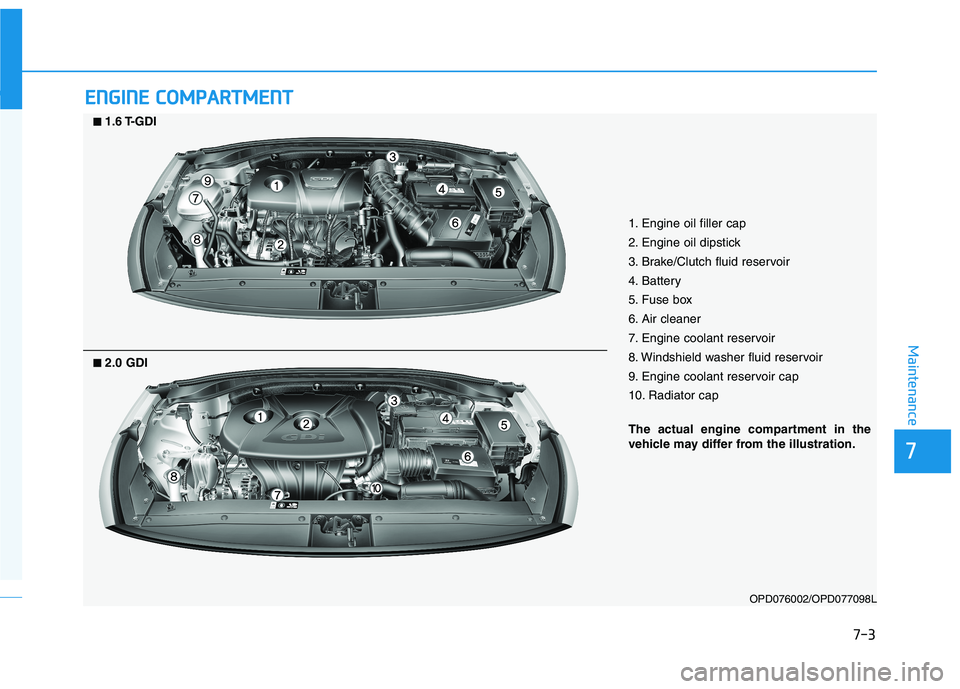
1. Engine oil filler cap
2. Engine oil dipstick
3. Brake/Clutch fluid reservoir
4. Battery
5. Fuse box
6. Air cleaner
7. Engine coolant reservoir
8. Windshield washer fluid reservoir
9. Engine coolant reservoir cap
10. Radiator cap
The actual engine compartment in the
vehicle may differ from the illustration.
Page 379 of 486
7-6
Maintenance
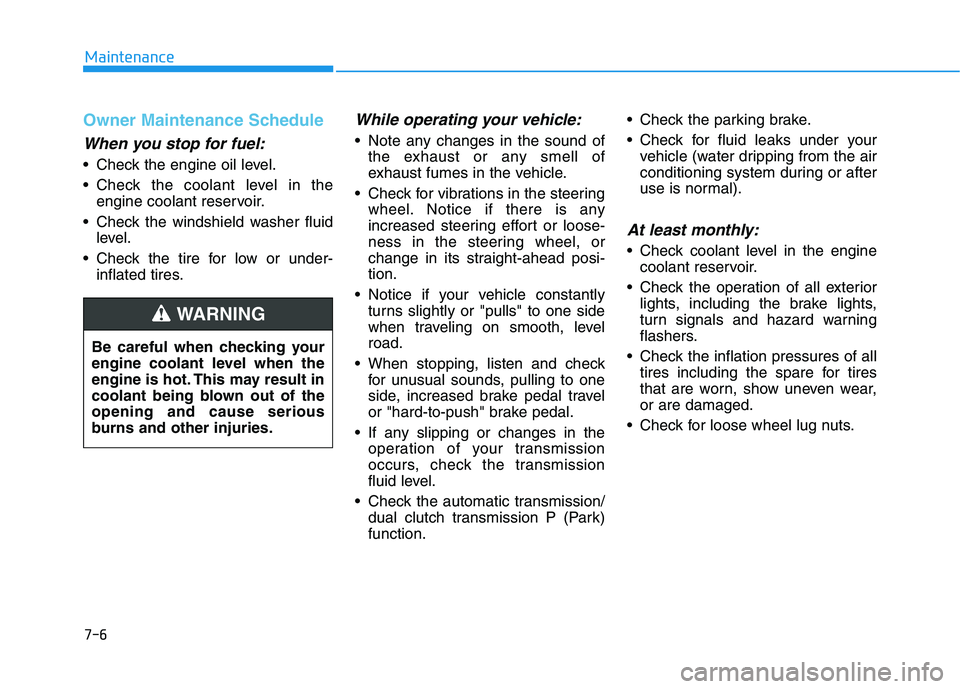
Owner Maintenance Schedule
When you stop for fuel:
Check the engine oil level.
Check the coolant level in theengine coolant reservoir.
Check the windshield washer fluid level.
Check the tire for low or under- inflated tires.
While operating your vehicle:
Note any changes in the sound ofthe exhaust or any smell of
exhaust fumes in the vehicle.
Check for vibrations in the steering wheel. Notice if there is any
increased steering effort or loose-
ness in the steering wheel, or
change in its straight-ahead posi-tion.
Notice if your vehicle constantly turns slightly or "pulls" to one side
when traveling on smooth, levelroad.
When stopping, listen and check for unusual sounds, pulling to one
side, increased brake pedal travel
or "hard-to-push" brake pedal.
If any slipping or changes in the operation of your transmission
occurs, check the transmission
fluid level.
Check the automatic transmission/ dual clutch transmission P (Park)function. Check the parking brake.
Check for fluid leaks under your
vehicle (water dripping from the air
conditioning system during or after
use is normal).
At least monthly:
Check coolant level in the enginecoolant reservoir.
Check the operation of all exterior lights, including the brake lights,
turn signals and hazard warning
flashers.
Check the inflation pressures of all tires including the spare for tires
that are worn, show uneven wear,or are damaged.
Check for loose wheel lug nuts.
Be careful when checking your
engine coolant level when the
engine is hot. This may result in
coolant being blown out of theopening and cause serious
burns and other injuries.
WARNING
Page 381 of 486
7-8
Maintenance
Normal Maintenance Schedule
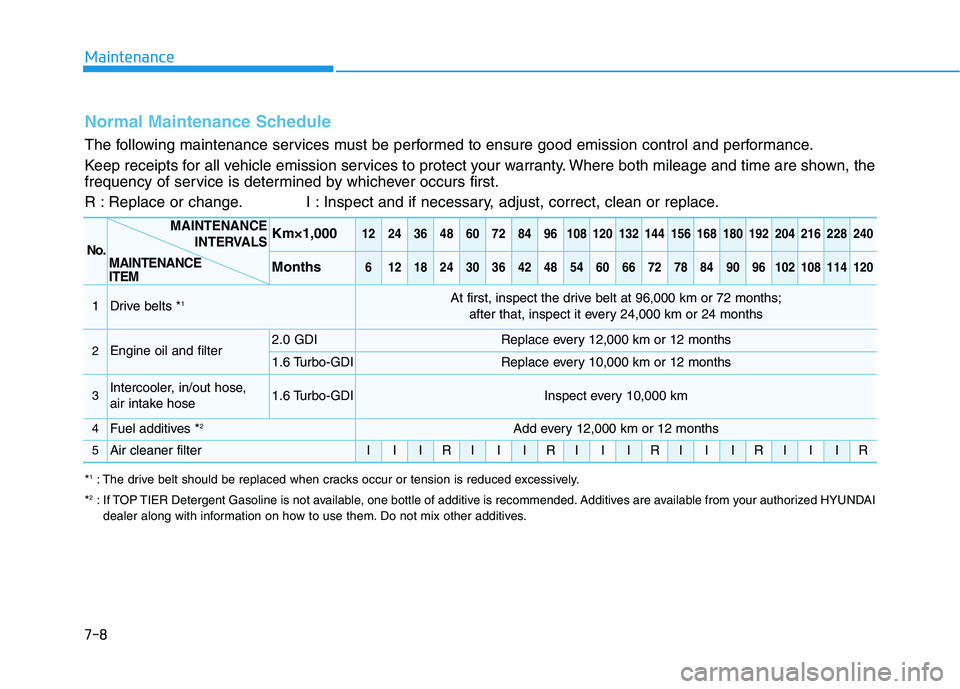
The following maintenance services must be performed to ensure good emission control and performance.
Keep receipts for all vehicle emission services to protect your warranty. Where both mileage and time are shown, the
frequency of service is determined by whichever occurs first.
R : Replace or change. I : Inspect and if necessary, adjust, correct, clean or replace.
No.
Km×1,0001224364860728496108120132144156168180192204216228240
Months6121824303642485460667278849096102108114120
1Drive belts *1At first, inspect the drive belt at 96,000 km or 72 months;
after that, inspect it every 24,000 km or 24 months
2Engine oil and filter2.0 GDIReplace every 12,000 km or 12 months
1.6 Turbo-GDIReplace every 10,000 km or 12 months
3Intercooler, in/out hose,
air intake hose1.6 Turbo-GDIInspect every 10,000 km
4Fuel additives * 2Add every 12,000 km or 12 months
5Air cleaner filterIIIRIIIRIIIRIIIRIIIR
*
1
: The drive belt should be replaced when cracks occur or tension is reduced excessively.
* 2
: If TOP TIER Detergent Gasoline is not available, one bottle of additive is recommended. Additives are available from your authorized HYUNDAI
dealer along with information on how to use them. Do not mix other additives.
MAINTENANCE
INTERVALS
MAINTENANCE ITEM
Page 386 of 486
7-13
7
Maintenance
Maintenance Under Severe Usage Conditions
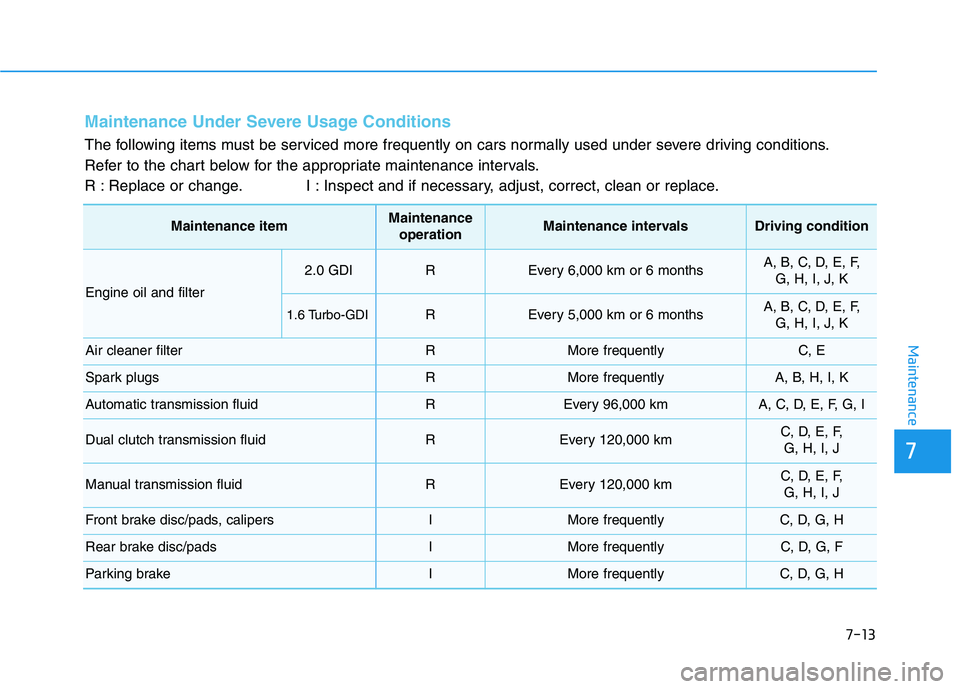
The following items must be serviced more frequently on cars normally used under severe driving conditions.
Refer to the chart below for the appropriate maintenance intervals.
R : Replace or change. I : Inspect and if necessary, adjust, correct, clean or replace.
Maintenance itemMaintenanceoperationMaintenance intervalsDriving condition
Engine oil and filter
2.0 GDIREvery 6,000 km or 6 monthsA, B, C, D, E, F, G, H, I, J, K
1.6 Turbo-GDIREvery 5,000 km or 6 monthsA, B, C, D, E, F, G, H, I, J, K
Air cleaner filterRMore frequentlyC, E
Spark plugsRMore frequentlyA, B, H, I, K
Automatic transmission fluidREvery 96,000 kmA, C, D, E, F, G, I
Dual clutch transmission fluidREvery 120,000 kmC, D, E, F, G, H, I, J
Manual transmission fluidREvery 120,000 kmC, D, E, F,G, H, I, J
Front brake disc/pads, calipersIMore frequentlyC, D, G, H
Rear brake disc/padsIMore frequentlyC, D, G, F
Parking brakeIMore frequentlyC, D, G, H
Page 388 of 486
7-15
7
Maintenance
EEXX PPLLAA NN AATTIIOO NN OO FF SS CC HH EEDD UU LLEE DD MM AAIINN TTEENN AANN CCEE IITT EEMM SS
Engine Oil and Filter
The engine oil and filter should be
changed at the intervals specified in
the maintenance schedule. If the
vehicle is being driven in severe con-
ditions, more frequent oil and filterchanges are required.
Drive Belts
Inspect all drive belts for evidence of
cuts, cracks, excessive wear or oil
saturation and replace if necessary.
Drive belts should be checked peri-
odically for proper tension and
adjusted as necessary.
Fuel Filter
A clogged-up fuel filter may limit the
vehicle driving speed, damage theemission system, and cause the
hard starting. When a considerable
amount of foreign substances are
accumulated in the fuel tank, the fuelfilter should be replaced.
Upon installing a new fuel filter, oper-
ate the engine for several minutes,
and check the connections for any
leakages. Fuel filters should be
installed by an authorized HYUNDAI
dealer.
Fuel Lines, Fuel Hoses and Connections
Check the fuel lines, fuel hoses and
connections for leakage and dam-
age. Have an authorized HYUNDAI
dealer replace any damaged or leak-
ing parts immediately.
Vapor Hose and Fuel Filler Cap
The vapor hose and fuel filler cap should be inspected at those inter-
vals specified in the maintenance
schedule. Make sure a new vaporhose or fuel filler cap is correctlyreplaced.
Vacuum Crankcase Ventilation Hoses (if equipped)
Inspect the surface of hoses for evi- dence of heat and/or mechanical
damage. Hard and brittle rubber,
cracking, tears, cuts, abrasions, and
excessive swelling indicate deterio-
ration. Particular attention should be
paid to examine those hose surfaces
nearest to high heat sources, such
as the exhaust manifold. Inspect the hose routing to ensure that the hoses do not come in con-
tact with any heat source, sharp
edges or moving component whichmight cause heat damage or
mechanical wear. Inspect all hose
connections, such as clamps and
couplings, to make sure they are
secure, and that no leaks are pres-
ent. Hoses should be replaced
immediately if there is any evidence
of deterioration or damage.
Page 391 of 486
7-18
MaintenanceE
E NN GGIINN EE OO IILL
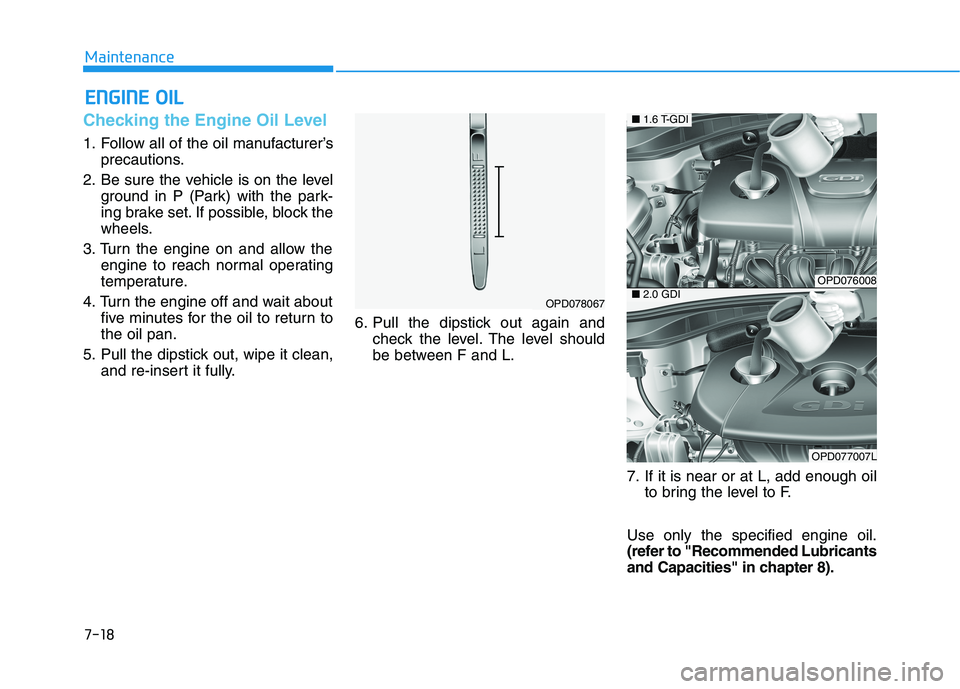
Checking the Engine Oil Level
1. Follow all of the oil manufacturer’s
precautions.
2. Be sure the vehicle is on the level ground in P (Park) with the park-
ing brake set. If possible, block the
wheels.
3. Turn the engine on and allow the engine to reach normal operating
temperature.
4. Turn the engine off and wait about five minutes for the oil to return tothe oil pan.
5. Pull the dipstick out, wipe it clean, and re-insert it fully. 6. Pull the dipstick out again and
check the level. The level should
be between F and L.
7. If it is near or at L, add enough oilto bring the level to F.
Use only the specified engine oil.
(refer to "Recommended Lubricants
and Capacities" in chapter 8).
OPD076008
OPD077007L
■ 1.6 T-GDI
■2.0 GDIOPD078067