belt HYUNDAI ELANTRA GT 2019 Repair Manual
[x] Cancel search | Manufacturer: HYUNDAI, Model Year: 2019, Model line: ELANTRA GT, Model: HYUNDAI ELANTRA GT 2019Pages: 486, PDF Size: 78.59 MB
Page 388 of 486
7-15
7
Maintenance
EEXX PPLLAA NN AATTIIOO NN OO FF SS CC HH EEDD UU LLEE DD MM AAIINN TTEENN AANN CCEE IITT EEMM SS
Engine Oil and Filter
The engine oil and filter should be
changed at the intervals specified in
the maintenance schedule. If the
vehicle is being driven in severe con-
ditions, more frequent oil and filterchanges are required.
Drive Belts
Inspect all drive belts for evidence of
cuts, cracks, excessive wear or oil
saturation and replace if necessary.
Drive belts should be checked peri-
odically for proper tension and
adjusted as necessary.
Fuel Filter
A clogged-up fuel filter may limit the
vehicle driving speed, damage theemission system, and cause the
hard starting. When a considerable
amount of foreign substances are
accumulated in the fuel tank, the fuelfilter should be replaced.
Upon installing a new fuel filter, oper-
ate the engine for several minutes,
and check the connections for any
leakages. Fuel filters should be
installed by an authorized HYUNDAI
dealer.
Fuel Lines, Fuel Hoses and Connections
Check the fuel lines, fuel hoses and
connections for leakage and dam-
age. Have an authorized HYUNDAI
dealer replace any damaged or leak-
ing parts immediately.
Vapor Hose and Fuel Filler Cap
The vapor hose and fuel filler cap should be inspected at those inter-
vals specified in the maintenance
schedule. Make sure a new vaporhose or fuel filler cap is correctlyreplaced.
Vacuum Crankcase Ventilation Hoses (if equipped)
Inspect the surface of hoses for evi- dence of heat and/or mechanical
damage. Hard and brittle rubber,
cracking, tears, cuts, abrasions, and
excessive swelling indicate deterio-
ration. Particular attention should be
paid to examine those hose surfaces
nearest to high heat sources, such
as the exhaust manifold. Inspect the hose routing to ensure that the hoses do not come in con-
tact with any heat source, sharp
edges or moving component whichmight cause heat damage or
mechanical wear. Inspect all hose
connections, such as clamps and
couplings, to make sure they are
secure, and that no leaks are pres-
ent. Hoses should be replaced
immediately if there is any evidence
of deterioration or damage.
Page 417 of 486
3. Checking tire life (TIN : TireIdentification Number)
Any tires that are over six years old,
based on the manufacturing date,(including the spare tire) should be
replaced by new ones. You can find
the manufacturing date on the tire
sidewall (possibly on the inside of the
wheel), displaying the DOT Code.
The DOT Code is a series of num-
bers on a tire consisting of numbers
and English letters. The manufactur-
ing date is designated by the last four
digits (characters) of the DOT code.
DOT : XXXX XXXX OOOO
The front part of the DOT shows a
plant code number, tire size and
tread pattern and the last four num-
bers indicate week and year manu-
factured.
For example:
DOT XXXX XXXX 1418 represents
that the tire was produced in the 14th
week of 2018.
4. Tire ply composition andmaterial
The number of layers or plies of rub-
ber-coated fabric in the tire. Tire
manufacturers also must indicate the
materials in the tire, which include
steel, nylon, polyester, and others.
The letter "R" means radial ply con-
struction; the letter "D" means diago-
nal or bias ply construction; and theletter "B" means belted-bias ply con-
struction.
5. Maximum permissible infla-tion pressure
This number is the greatest amountof air pressure that should be put in
the tire. Do not exceed the maximum
permissible inflation pressure. Refer
to the Tire and Loading Information
label for recommended inflation
pressure.
6. Maximum load rating
This number indicates the maximum
load in kilograms and pounds that
can be carried by the tire. When
replacing the tires on the vehicle,
always use a tire that has the same
load rating as the factory installed
tire.
7. Uniform tire quality grading
Quality grades can be found where
applicable on the tire sidewall
between tread shoulder and maxi-
mum section width.
For example:
TREAD WEAR 200
TRACTION AA
TEMPERATURE A
7-44
Maintenance
Page 419 of 486
7-46
Maintenance
Tire Terminology and Definitions
Air Pressure
The amount of air inside the tire
pressing outward on the tire. Air
pressure is expressed in pounds per
square inch (psi) or kilopascal (kPa).
Accessory Weight
This means the combined weight of
optional accessories. Some exam-
ples of optional accessories are
automatic transmission, power
seats, and air conditioning.
Aspect Ratio
The relationship of a tire's height toits width.
Belt
A rubber coated layer of cords that is
located between the plies and the
tread. Cords may be made from steel
or other reinforcing materials.
Bead
The tire bead contains steel wires
wrapped by steel cords that hold the
tire onto the rim.
Bias Ply Tire
A pneumatic tire in which the plies
are laid at alternate angles less than
90 degrees to the centerline of thetread.
Cold Tire Pressure
The amount of air pressure in a tire,measured in pounds per square inch
(psi) or kilopascals (kPa) before a tire
has built up heat from driving.
Curb Weight
This means the weight of a motor
vehicle with standard and optional
equipment including the maximum
capacity of fuel, oil and coolant, but
without passengers and cargo.
The temperature grade for this
tire is established for a tire that
is properly inflated and not
overloaded. Excessive speed,
under-inflation, over-inflation,
or excessive loading, either
separately or in combination,
can cause heat build-up and
possible sudden tire failure.
This may cause loss of vehicle
control resulting in an accident.
WARNING
Page 422 of 486
7-49
7
Maintenance
Vehicle Capacity Weight
The number of designated seating
positions multiplied by 68 kg (150
lbs.) plus the rated cargo and lug-gage load.
Vehicle Maximum Load on theTire
Load on an individual tire due to curb
and accessory weight plus maximum
occupant and cargo weight.
Vehicle Normal Load on the Tire
Load on an individual tire that is
determined by distributing to each
axle its share of the curb weight,
accessory weight, and normal occu-
pant weight and dividing by 2.
Vehicle Placard
A label permanently attached to a
vehicle showing the original equip-
ment tire size and recommended
inflation pressure.
All Season Tires
HYUNDAI specifies all season tires
on some models to provide good
performance for use all year round,
including snowy and icy road condi-
tions. All season tires are identified
by ALL SEASON and/or M+S (Mud
and Snow) on the tire sidewall. Snow
tires have better snow traction than
all season tires and may be more
appropriate in some areas.
Summer Tires
HYUNDAI specifies summer tires on
some models to provide superior
performance on dry roads. Summer
tire performance is substantially
reduced in snow and ice. Summer
tires do not have the tire traction rat-
ing M+S (Mud and Snow) on the tire
side wall. If you plan to operate your
vehicle in snowy or icy conditions,
HYUNDAI recommends the use of
snow tires or all season tires on all
four wheels.
Snow Tires
If you equip your car with snow tires,
they should be the same size and
have the same load capacity as the
original tires. Snow tires should be
installed on all four wheels; other-
wise, poor handling may result. Snow
tires should carry 28 kPa (4 psi)more air pressure than the pressure
recommended for the standard tires
on the tire label on the driver’s side of
the center pillar, or up to the maxi-
mum pressure shown on the tire
sidewall, whichever is less. Do not
drive faster than 120 km/h (75 mph)
when your vehicle is equipped with
snow tires.
Radial-Ply Tires
Radial-ply tires provide improved
tread life, road hazard resistance and
smoother high speed ride. The radi-
al-ply tires used on this vehicle are of
belted construction, and are selected
to complement the ride and handling
characteristics of your vehicle.
Page 423 of 486
7-50
Maintenance
Radial-ply tires have the same load
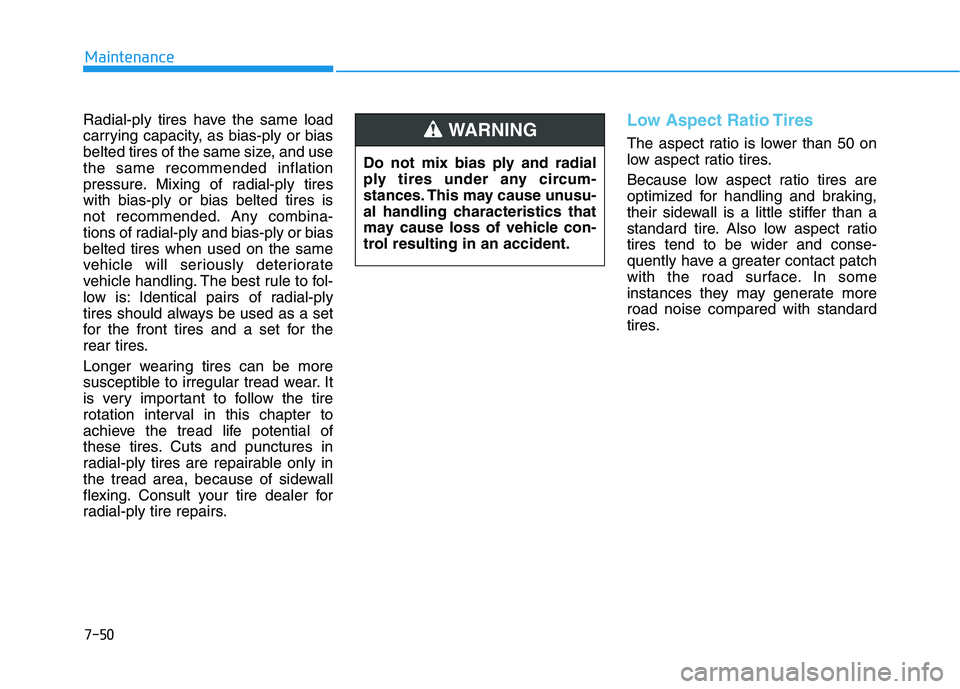
carrying capacity, as bias-ply or bias
belted tires of the same size, and usethe same recommended inflation
pressure. Mixing of radial-ply tireswith bias-ply or bias belted tires is
not recommended. Any combina-
tions of radial-ply and bias-ply or biasbelted tires when used on the same
vehicle will seriously deteriorate
vehicle handling. The best rule to fol-
low is: Identical pairs of radial-ply
tires should always be used as a set
for the front tires and a set for the
rear tires.
Longer wearing tires can be more
susceptible to irregular tread wear. It
is very important to follow the tire
rotation interval in this chapter to
achieve the tread life potential of
these tires. Cuts and punctures in
radial-ply tires are repairable only in
the tread area, because of sidewall
flexing. Consult your tire dealer for
radial-ply tire repairs.Low Aspect Ratio Tires
The aspect ratio is lower than 50 on
low aspect ratio tires.
Because low aspect ratio tires are
optimized for handling and braking,
their sidewall is a little stiffer than a
standard tire. Also low aspect ratiotires tend to be wider and conse-
quently have a greater contact patch
with the road surface. In some
instances they may generate moreroad noise compared with standard
tires.
Do not mix bias ply and radial
ply tires under any circum-
stances. This may cause unusu-
al handling characteristics that
may cause loss of vehicle con-
trol resulting in an accident.WARNING
Page 455 of 486
7-82
Maintenance
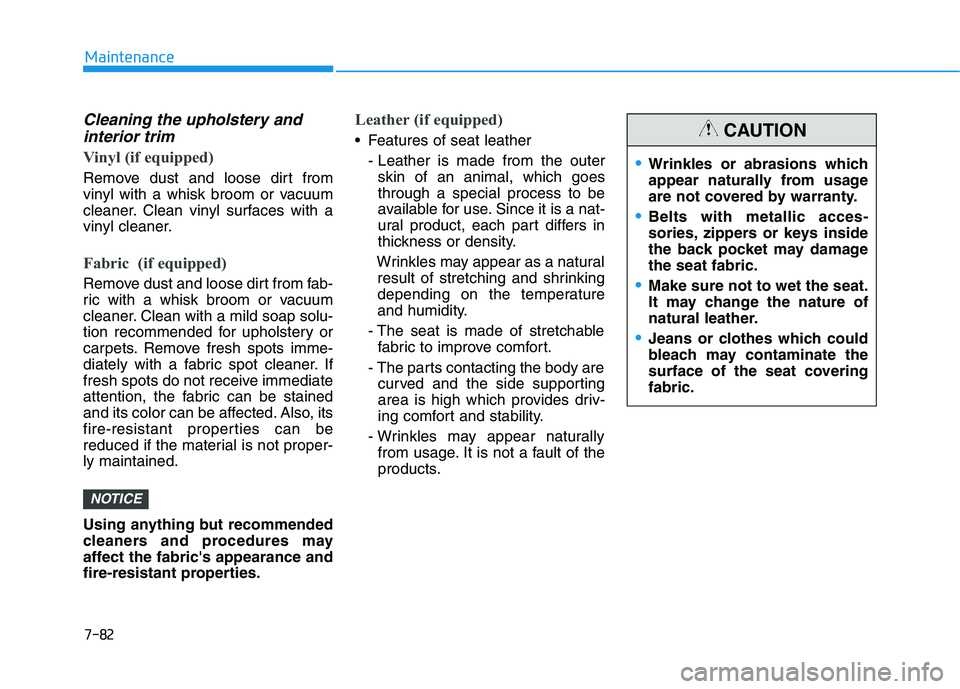
Cleaning the upholstery andinterior trim
Vinyl (if equipped)
Remove dust and loose dirt from
vinyl with a whisk broom or vacuum
cleaner. Clean vinyl surfaces with a
vinyl cleaner.
Fabric (if equipped)
Remove dust and loose dirt from fab-
ric with a whisk broom or vacuum
cleaner. Clean with a mild soap solu-
tion recommended for upholstery or
carpets. Remove fresh spots imme-
diately with a fabric spot cleaner. If
fresh spots do not receive immediate
attention, the fabric can be stained
and its color can be affected. Also, its
fire-resistant properties can be
reduced if the material is not proper-ly maintained.
Using anything but recommended
cleaners and procedures may
affect the fabric's appearance and
fire-resistant properties.
Leather (if equipped)
Features of seat leather
- Leather is made from the outerskin of an animal, which goes through a special process to be
available for use. Since it is a nat-
ural product, each part differs in
thickness or density.
Wrinkles may appear as a natural result of stretching and shrinking
depending on the temperature
and humidity.
- The seat is made of stretchable fabric to improve comfort.
- The parts contacting the body are curved and the side supporting
area is high which provides driv-
ing comfort and stability.
- Wrinkles may appear naturally from usage. It is not a fault of the
products.
NOTICE
Wrinkles or abrasions which
appear naturally from usage
are not covered by warranty.
Belts with metallic acces-
sories, zippers or keys inside
the back pocket may damagethe seat fabric.
Make sure not to wet the seat.
It may change the nature of
natural leather.
Jeans or clothes which could
bleach may contaminate the
surface of the seat coveringfabric.
CAUTION
Page 456 of 486

7-83
7
Maintenance
Caring for the leather seats- Vacuum the seat periodically toremove dust and sand on the
seat. It will prevent abrasion ordamage of the leather and main-
tain its quality.
- Wipe the natural leather seat cover often with dry or soft cloth.
- Use of proper leather protector may prevent abrasion of the
cover and helps maintain the
color. Be sure to read the instruc-tions and consult a specialistwhen using leather coating or
protective agent.
- Light colored (beige, cream beige) leather is easily contami-
nated and the stain is noticeable.
Clean the seats frequently.
- Avoid wiping with wet cloth. It may cause the surface to crack. Cleaning the leather seats
- Remove all contaminationsinstantly. Refer to instructions
below for removal of each con-taminant.
- Cosmetic products (sunscreen, foundation, etc.)
Apply cleansing cream on a clothand wipe the contaminated spot.
Wipe off the cream with a wet
cloth and remove water with a drycloth.
- Beverages (coffee, soft drink, etc.)
Apply a small amount of neutraldetergent and wipe until contami-
nations do not smear.
- Oil Remove oil instantly with
absorbable cloth and wipe with
stain remover used only for natu-
ral leather.
- Chewing gum Harden the gum with ice and
remove gradually.Cleaning the seat belt webbing
Clean the belt webbing with any mild
soap solution recommended for
cleaning upholstery or carpet. Follow
the instructions provided with the
soap. Do not bleach or re-dye the
webbing because this may weakenthe seat belt.
Cleaning the interior windowglass
If the interior glass surfaces of the
vehicle become fogged (that is, cov-
ered with an oily, greasy or waxy
film), they should be cleaned with
glass cleaner. Follow the directions
on the glass cleaner container.
Do not scrape or scratch the
inside of the rear window. This
may result in damage to the rear
window defroster grid.
NOTICE
Page 475 of 486
I-4
Camera (Rear view) ........................................................3-96
Capacities (Lubricants) .....................................................8-8
Care
Exterior care ...............................................................7-77
Interior care ................................................................7-81
Tire care ......................................................................7-35
Cargo area cover ...........................................................3-132
Cartridge type fuse..........................................................7-54
Cellular phone holder ...................................................3-128
Center console storage ..................................................3-123
Central door lock switch .................................................3-16
Certification label ...........................................................8-10
Check tire inflation pressure ...........................................7-37
Child restraint system (CRS) ..........................................2-35 Booster seats...............................................................2-38
Forward-facing child restraints ..................................2-37
Installing a child restraint system (CRS) ...................2-38
Lower anchors and tether for children .......................2-39
Rear-facing child seats ...............................................2-36
Securing a child restraint system seat with "Tether Anchor" system ..........................................2-41
Securing a child restraint system with a lap/ shoulder belt ............................................................2-42
Securing a child restraint system with LATCH anchors system ........................................................2-40
Selecting a child restraint system (CRS) ...................2-36 Child-protector rear door lock ........................................3-18
Climate control air filter replacement.............................7-27
Climate control system
Automatic climate control system............................3-106
Manual climate control system ..................................3-97
Clock .............................................................................3-130
Clothes hanger ..............................................................3-130
Cluster ionizer ...............................................................3-122
Combined instrument, see instrument cluster ................3-47
Compact spare tire replacement .....................................7-41
Coolant ............................................................................7-20
Cooling fluid, see engine coolant ...................................7-20
Crankcase emission control system ................................7-84
Cruise control system .....................................................5-88
Cup holder.....................................................................3-125
Curtain air bags ...............................................................2-49
Dashboard illumination, see instrument panel illumination..................................................................3-48
Dashboard, see instrument cluster ..................................3-47
Day/night rearview mirror ..............................................3-22
Daytime running light (DRL) .........................................3-83
Defogging (Windshield)................................................3-117
Defroster .......................................................................3-121
Rear window defroster .............................................3-121
Defrosting (Windshield)................................................3-117
Index
D
C
Page 478 of 486
I-7
Headlamp delay function ................................................3-89
Headlamp position ..........................................................3-84
Headlight bulb replacement ............................................7-66
High Beam Assist (HBA) system ...................................3-85
Highway driving ...........................................................5-118
Hill-start assist control (HAC)........................................5-53
Hood................................................................................3-41
Horn ................................................................................3-21
How to use this manual ....................................................F-6
If the engine doesn't turn over or turns over slowly.........6-3
If the engine overheats ......................................................6-6
If the engine stalls at a crossroad or crossing...................6-2
If the engine stalls while driving ......................................6-2
If the engine turns over normally but doesn't start ...........6-3
If the engine will not start.................................................6-3
If you have a flat tire while driving ..................................6-3
Ignition switch ..................................................................5-6
Engine Start/Stop button ..............................................5-9
Key ignition switch ......................................................5-6
Impact sensing door unlock ............................................3-18
Improtant safety precautions.............................................2-2 Air bag hazards ............................................................2-2
Always wear your seat belt ..........................................2-2
Control your speed .......................................................2-3
Driver distraction..........................................................2-2 Keep your vehicle in safe condition.............................2-3
Restrain all children .....................................................2-2
In case of emergency while driving..................................6-2
Indicator light..................................................................3-54
Inside rearview mirror ....................................................3-22
Instrument cluster ...........................................................3-47 Assist mode ................................................................3-74
Gauges and meters .....................................................3-49
Instrument cluster illumination ..................................3-48
LCD display control ...................................................3-71
LCD display messages ...............................................3-65
LCD display modes ....................................................3-72
Shift indicator pop-up ................................................3-53
Transmission shift indicator .......................................3-52
Trip computer mode ...................................................3-73
User settings mode .....................................................3-75
Warning and indicator lights ......................................3-54
Instrument panel fuse replacement .................................7-53
Instrument panel overview ...............................................1-5
Interior care .....................................................................7-81
Interior features Bottle holder .............................................................3-125
Cargo area cover.......................................................3-132
Cellular phone holder ...............................................3-128
Clock ........................................................................3-130
Clothes hanger ..........................................................3-130
Cup holder ................................................................3-125
Floor mat anchor(s) ..................................................3-131
I
Index
I
Page 479 of 486
I-8Luggage net (holder) ................................................3-132
Power outlet..............................................................3-127
Sliding armrest .........................................................3-126
Sunvisor ....................................................................3-126
Wireless cellular phone charging system .................3-128
Interior lamp AUTO cut..................................................3-89
Interior lights...................................................................3-89 Front lamps.................................................................3-90
Interior lamp AUTO cut .............................................3-89
Luggage compartment lamp .......................................3-91
Rear lamp ...................................................................3-91
Vanity mirror lamp .....................................................3-91
Interior overview...............................................................1-4
Jump starting .....................................................................6-4
Label
Refrigerant label .........................................................8-12
Tire loading information label..................................5-123
Tire sidewall labeling .................................................7-42
Tire specification and pressure label ..........................8-12
Vehicle certification label ...........................................8-11
Lane change signals ........................................................3-88
Lane Keeping Assist (LKA) System ..............................5-81
Lap/shoulder belt ............................................................2-24 LCD display
LCD display modes ....................................................3-72
Assist mode ................................................................3-74
Quick guide help ........................................................3-73
Trip computer mode ...................................................3-73
Turn By Turn (TBT) mode.........................................3-74
User settings mode .....................................................3-75
Warning mode ............................................................3-75
LCD display messages Check AEB system .....................................................3-70
Check BRAKE SWITCH fuse ...................................3-67
Check BSD System ....................................................3-70
Check driver attention alert system............................3-70
Check headlamp FAN ................................................3-70
Check headlamp LED ................................................3-70
Check headlight ..........................................................3-69
Check LKAS ..............................................................3-70
Check smart high beam system..................................3-70
Door, Hood, Tailgate open .........................................3-67
Engine has overheated................................................3-69
Key not detected .........................................................3-66
Key not in vehicle ......................................................3-66
Lights mode ................................................................3-68
Low fuel .....................................................................3-69
Low Key Battery ........................................................3-66
Low pressure ..............................................................3-68
Index
J
L