washer fluid HYUNDAI ELANTRA GT 2019 Owners Manual
[x] Cancel search | Manufacturer: HYUNDAI, Model Year: 2019, Model line: ELANTRA GT, Model: HYUNDAI ELANTRA GT 2019Pages: 486, PDF Size: 78.59 MB
Page 18 of 486
1-7
Your vehicle at a glance
1
EENN GGIINN EE CC OO MM PPAA RRTTMM EENN TT
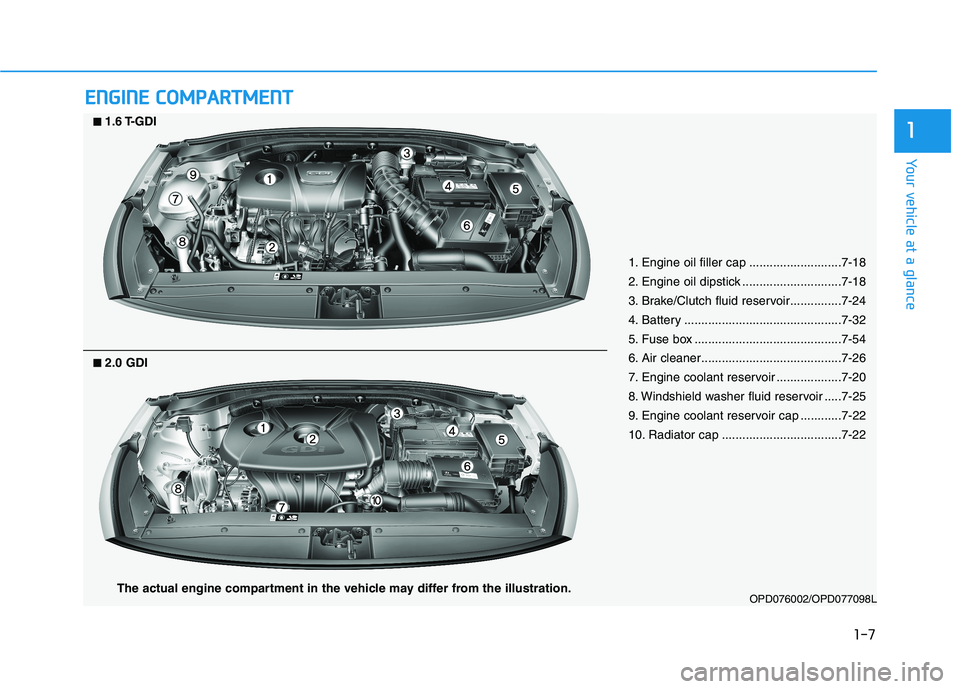
1. Engine oil filler cap ...........................7-18
2. Engine oil dipstick .............................7-18
3. Brake/Clutch fluid reservoir...............7-24
4. Battery ..............................................7-32
5. Fuse box ...........................................7-54
6. Air cleaner.........................................7-26
7. Engine coolant reservoir ...................7-20
8. Windshield washer fluid reservoir .....7-25
9. Engine coolant reservoir cap ............7-22
10. Radiator cap ...................................7-22
OPD076002/OPD077098L
■■1.6 T-GDI
The actual engine compartment in the vehicle may differ from the illustration.
■
■
2.0 GDI
Page 144 of 486
3-59
Convenient features of your vehicle
3
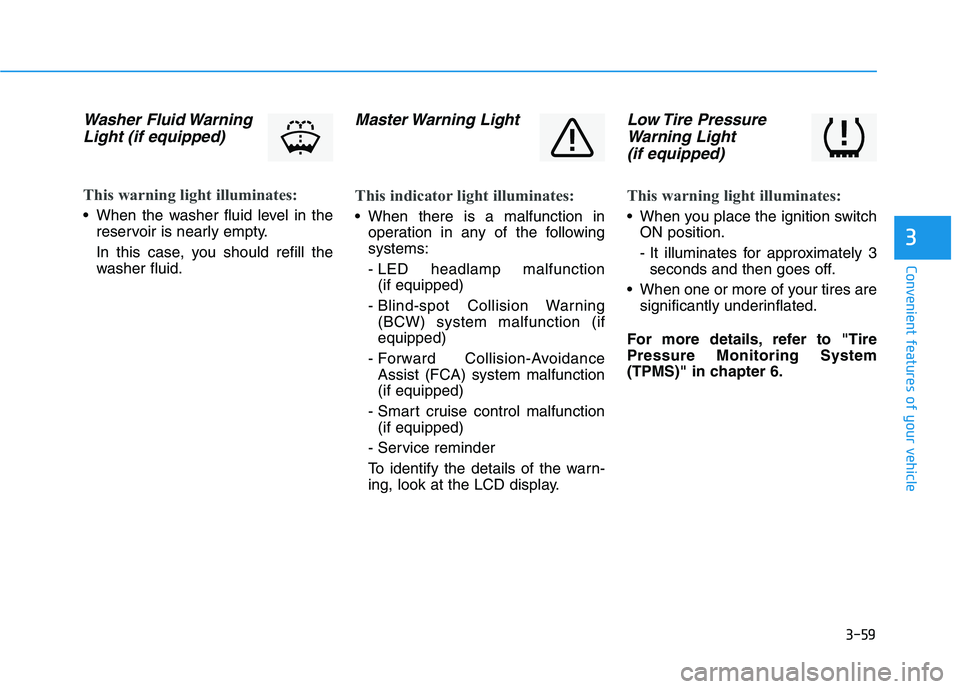
Washer Fluid WarningLight (if equipped)
This warning light illuminates:
When the washer fluid level in the reservoir is nearly empty.
In this case, you should refill the
washer fluid.
Master Warning Light
This indicator light illuminates:
When there is a malfunction inoperation in any of the following systems:
- LED headlamp malfunction (if equipped)
- Blind-spot Collision Warning (BCW) system malfunction (if equipped)
- Forward Collision-Avoidance Assist (FCA) system malfunction(if equipped)
- Smart cruise control malfunction (if equipped)
- Service reminder
To identify the details of the warn-
ing, look at the LCD display.
Low Tire Pressure Warning Light
(if equipped)
This warning light illuminates:
When you place the ignition switch ON position.
- It illuminates for approximately 3seconds and then goes off.
When one or more of your tires are significantly underinflated.
For more details, refer to "Tire Pressure Monitoring System
(TPMS)" in chapter 6.
Page 154 of 486
3-69
Convenient features of your vehicle
3
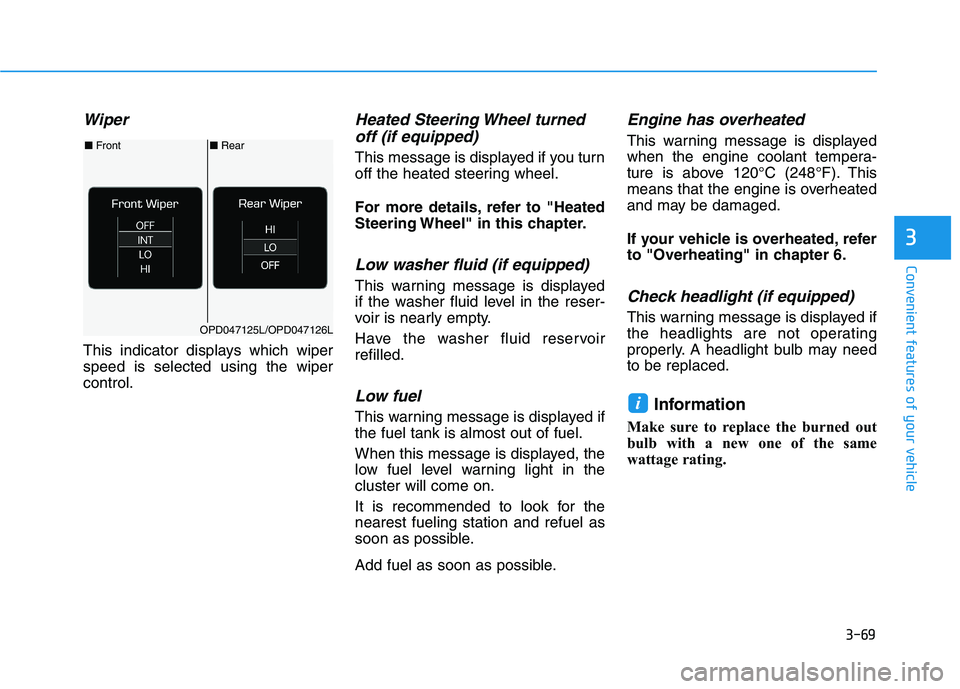
Wiper
This indicator displays which wiper speed is selected using the wipercontrol.
Heated Steering Wheel turnedoff (if equipped)
This message is displayed if you turn
off the heated steering wheel.
For more details, refer to "Heated
Steering Wheel" in this chapter.
Low washer fluid (if equipped)
This warning message is displayed
if the washer fluid level in the reser-
voir is nearly empty.
Have the washer fluid reservoir refilled.
Low fuel
This warning message is displayed ifthe fuel tank is almost out of fuel.
When this message is displayed, the
low fuel level warning light in thecluster will come on.
It is recommended to look for the nearest fueling station and refuel as
soon as possible.
Add fuel as soon as possible.
Engine has overheated
This warning message is displayed
when the engine coolant tempera-
ture is above 120°C (248°F). This
means that the engine is overheated
and may be damaged.
If your vehicle is overheated, refer
to "Overheating" in chapter 6.
Check headlight (if equipped)
This warning message is displayed if
the headlights are not operating
properly. A headlight bulb may needto be replaced.
Information
Make sure to replace the burned out
bulb with a new one of the same
wattage rating.
i
■ Rear
■ Front
OPD047125L/OPD047126L
Page 179 of 486
3-94
Convenient features of your vehicle
Windshield Washers
In the OFF position, pull the lever
gently toward you to spray washer
fluid on the windshield and to run the
wipers 1-3 cycles. The spray and
wiper operation will continue until
you release the lever. If the washer
does not work, you may need to add
washer fluid to the washer fluid
reservoir. To prevent possible damage to
the washer pump, do not operatethe washer when the fluid reser-
voir is empty.
To prevent possible damage to the wipers or windshield, do not
operate the wipers when the wind-
shield is dry.
To prevent damage to the wiper arms and other components, do
not attempt to move the wipers
manually.
To prevent possible damage to the wipers and washer system,use anti-freezing washer fluids in
the winter season or cold weather.
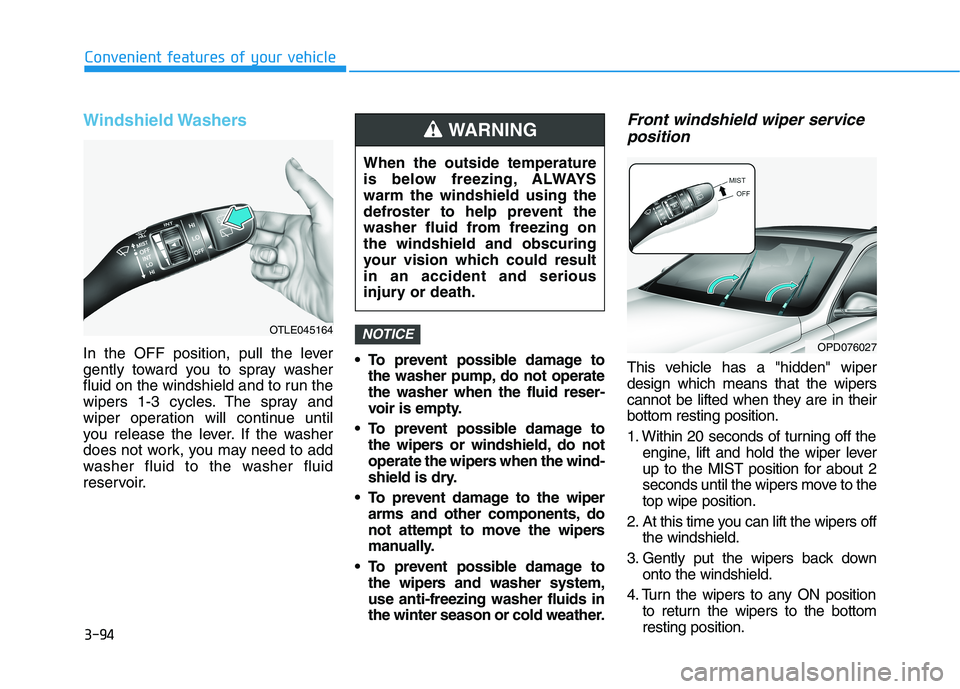
Front windshield wiper service
position
This vehicle has a "hidden" wiperdesign which means that the wipers
cannot be lifted when they are in theirbottom resting position.
1. Within 20 seconds of turning off the engine, lift and hold the wiper lever
up to the MIST position for about 2
seconds until the wipers move to thetop wipe position.
2. At this time you can lift the wipers off the windshield.
3. Gently put the wipers back down onto the windshield.
4. Turn the wipers to any ON position to return the wipers to the bottomresting position.
NOTICE
When the outside temperature
is below freezing, ALWAYSwarm the windshield using the
defroster to help prevent the
washer fluid from freezing onthe windshield and obscuring
your vision which could resultin an accident and serious
injury or death.
WARNING
OTLE045164
OPD076027
Page 180 of 486
3-95
Convenient features of your vehicle
Rear Window Wiper and Washer
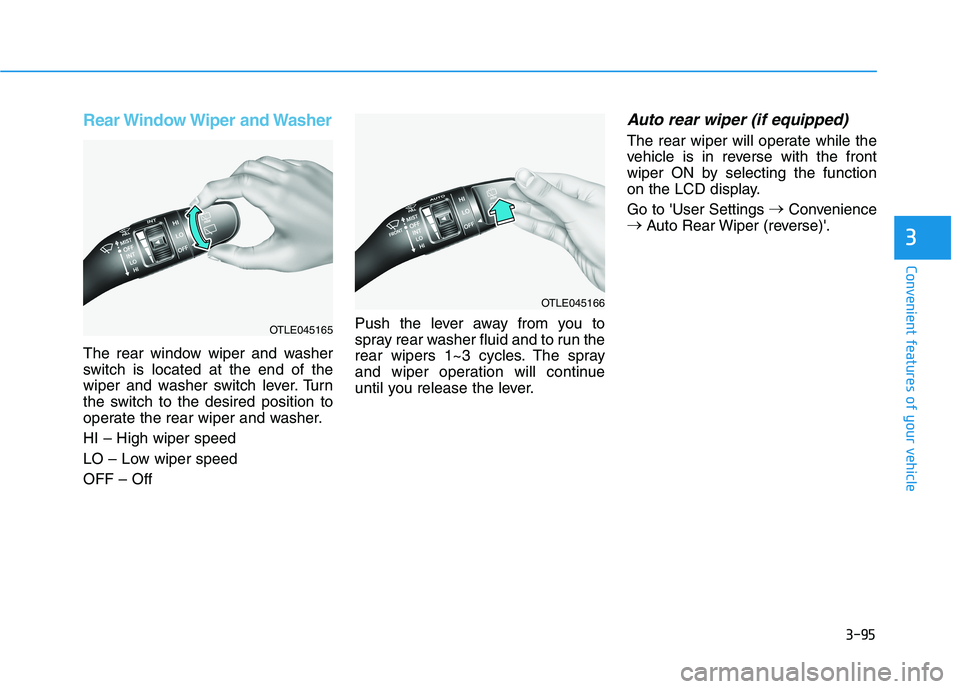
The rear window wiper and washer
switch is located at the end of the
wiper and washer switch lever. Turn
the switch to the desired position to
operate the rear wiper and washer. HI – High wiper speed
LO – Low wiper speed OFF – OffPush the lever away from you to
spray rear washer fluid and to run the
rear wipers 1~3 cycles. The spray
and wiper operation will continue
until you release the lever.
Auto rear wiper (if equipped)
The rear wiper will operate while the
vehicle is in reverse with the front
wiper ON by selecting the function
on the LCD display. Go to 'User Settings
Convenience
Auto Rear Wiper (reverse)'.
3
OTLE045165
OTLE045166
Page 342 of 486
5-121
Driving your vehicle
5
Check spark plugs and ignitionsystem
Inspect your spark plugs as
described in chapter 7 and replace
them if necessary. Also check all
ignition wiring and components to be
sure they are not cracked, worn or
damaged in any way.
Use approved window washeranti-freeze in system
To keep the water in the window
washer system from freezing, add an
approved window washer anti-freeze
solution in accordance with instruc-
tions on the container. Window wash-
er anti-freeze is available from an
authorized HYUNDAI dealer and
most auto parts outlets. Do not useengine coolant or other types of anti-
freeze as these may damage thepaint finish.
Do not let your parking brakefreeze
Under some conditions your parking
brake can freeze in the engaged
position. This is most likely to happen
when there is an accumulation of
snow or ice around or near the rear
brakes or if the brakes are wet. If
there is a risk the parking brake may
freeze, apply it only temporarily while
you put the gear selector lever in P
and block the rear wheels so the car
cannot roll. Then release the parking
brake.
Do not let ice and snow accu-mulate underneath
Under some conditions, snow and
ice can build up under the fenders
and interfere with the steering. When
driving in severe winter conditions
where this may happen, you should
periodically check underneath the
car to be sure the movement of the
front wheels and the steering com-
ponents is not obstructed.
Don't place foreign objects ormaterials in the engine com-
partment
Placement of foreign object or mate-
rials which prevent cooling of the
engine, in the engine compartment,
may cause a failure or combustion.
The manufacturer is not responsible
for the damage caused by suchplacement.
To keep locks from freezing
To keep the locks from freezing,
squirt an approved de-icer fluid or
glycerine into the key opening. If a
lock is covered with ice, squirt it with
an approved de-icing fluid to remove
the ice. If the lock is frozen internally,
you may be able to thaw it out by
using a heated key. Handle the heat-
ed key with care to avoid injury.
Page 374 of 486
7
Maintenance
7
Maintenance
Engine Compartment .............................................7-3
Maintenance Services ...........................................7-4Owner's Responsibility .....................................................7-4
Owner Maintenance Precautions..................................7-4
Owner Maintenance ..............................................7-5 Owner Maintenance Schedule .......................................7-6
Scheduled Maintenance Services........................7-7 Normal Maintenance Schedule ......................................7-8
Maintenance Under Severe Usage Conditions ........7-13
Explanation of Scheduled Maintenance Items..7-15
Engine Oil ..............................................................7-18 Checking the Engine Oil Level .....................................7-18
Checking the Engine Oil and Filter .............................7-19
Engine Coolant .....................................................7-20 Checking the Engine Coolant Level ............................7-20
Changing Engine Coolant ..............................................7-23
Brake/Clutch Fluid ...............................................7-24 Checking the Brake/Clutch Fluid Level .....................7-24
Washer Fluid .........................................................7-25 Checking the Washer Fluid Level................................7-25
Parking Brake .......................................................7-25 Checking the Parking Brake .........................................7-25 Air Cleaner ............................................................7-26
Filter Replacement ..........................................................7-26
Climate Control Air Filter ....................................7-27 Filter Inspection ...............................................................7-27
Wiper Blades.........................................................7-29 Blade Inspection ..............................................................7-29
Blade Replacement .........................................................7-29
Battery...................................................................7-32 For Best Battery Service ..............................................7-33
Battery Recharging ........................................................7-33
Reset Features.................................................................7-34
Tires and Wheels .................................................7-35 Tire Care ............................................................................7-35
Recommended Cold Tire Inflation Pressures ...........7-36
Check Tire Inflation Pressure ......................................7-37
Tire Rotation.....................................................................7-37
Wheel Alignment and Tire Balance ............................7-38
Tire Replacement ............................................................7-39
Wheel Replacement ........................................................7-41
Tire Traction .....................................................................7-42
Tire Maintenance ............................................................7-42
Tire Sidewall Labeling ....................................................7-42
Tire Terminology and Definitions................................7-46
7
Page 376 of 486
7-3
7
Maintenance
EENN GGIINN EE CC OO MM PPAA RRTTMM EENN TT
OPD076002/OPD077098L
■■
2.0 GDI
■■1.6 T-GDI
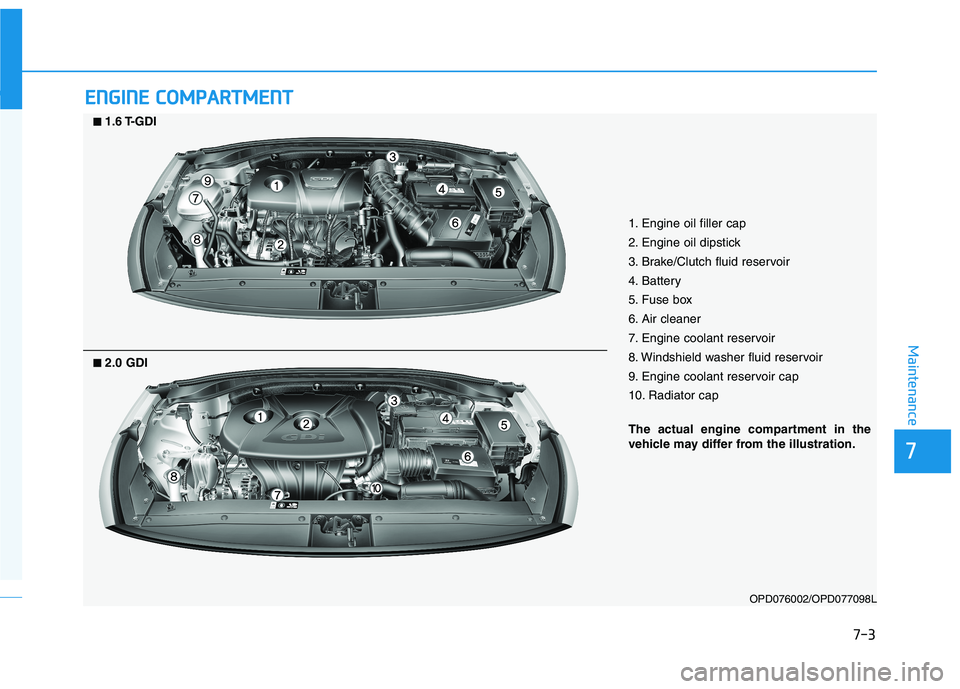
1. Engine oil filler cap
2. Engine oil dipstick
3. Brake/Clutch fluid reservoir
4. Battery
5. Fuse box
6. Air cleaner
7. Engine coolant reservoir
8. Windshield washer fluid reservoir
9. Engine coolant reservoir cap
10. Radiator cap
The actual engine compartment in the
vehicle may differ from the illustration.
Page 379 of 486
7-6
Maintenance
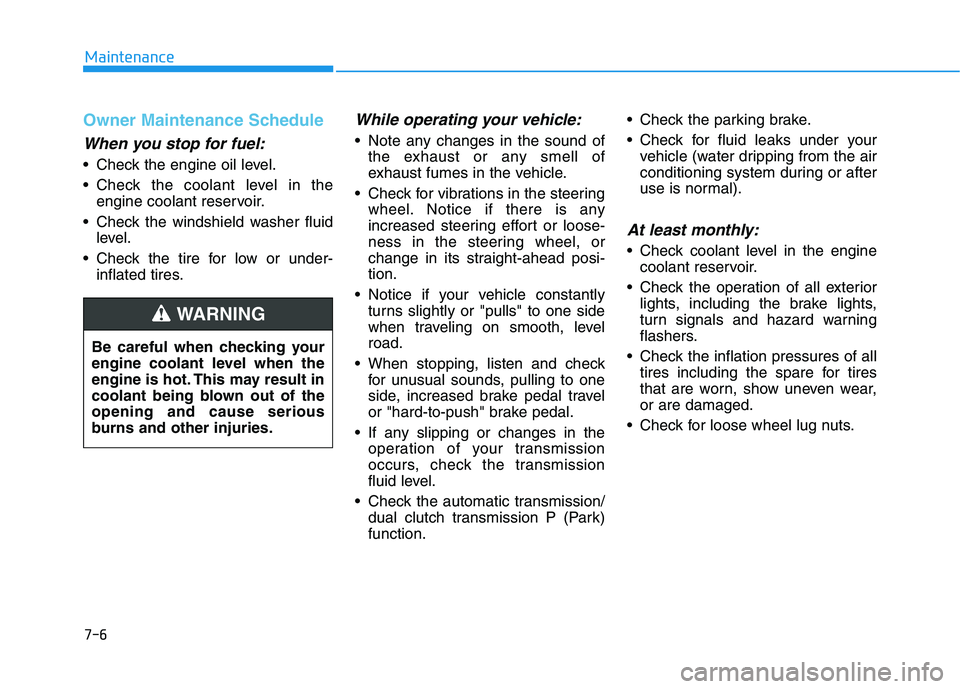
Owner Maintenance Schedule
When you stop for fuel:
Check the engine oil level.
Check the coolant level in theengine coolant reservoir.
Check the windshield washer fluid level.
Check the tire for low or under- inflated tires.
While operating your vehicle:
Note any changes in the sound ofthe exhaust or any smell of
exhaust fumes in the vehicle.
Check for vibrations in the steering wheel. Notice if there is any
increased steering effort or loose-
ness in the steering wheel, or
change in its straight-ahead posi-tion.
Notice if your vehicle constantly turns slightly or "pulls" to one side
when traveling on smooth, levelroad.
When stopping, listen and check for unusual sounds, pulling to one
side, increased brake pedal travel
or "hard-to-push" brake pedal.
If any slipping or changes in the operation of your transmission
occurs, check the transmission
fluid level.
Check the automatic transmission/ dual clutch transmission P (Park)function. Check the parking brake.
Check for fluid leaks under your
vehicle (water dripping from the air
conditioning system during or after
use is normal).
At least monthly:
Check coolant level in the enginecoolant reservoir.
Check the operation of all exterior lights, including the brake lights,
turn signals and hazard warning
flashers.
Check the inflation pressures of all tires including the spare for tires
that are worn, show uneven wear,or are damaged.
Check for loose wheel lug nuts.
Be careful when checking your
engine coolant level when the
engine is hot. This may result in
coolant being blown out of theopening and cause serious
burns and other injuries.
WARNING
Page 380 of 486
7-7
7
Maintenance
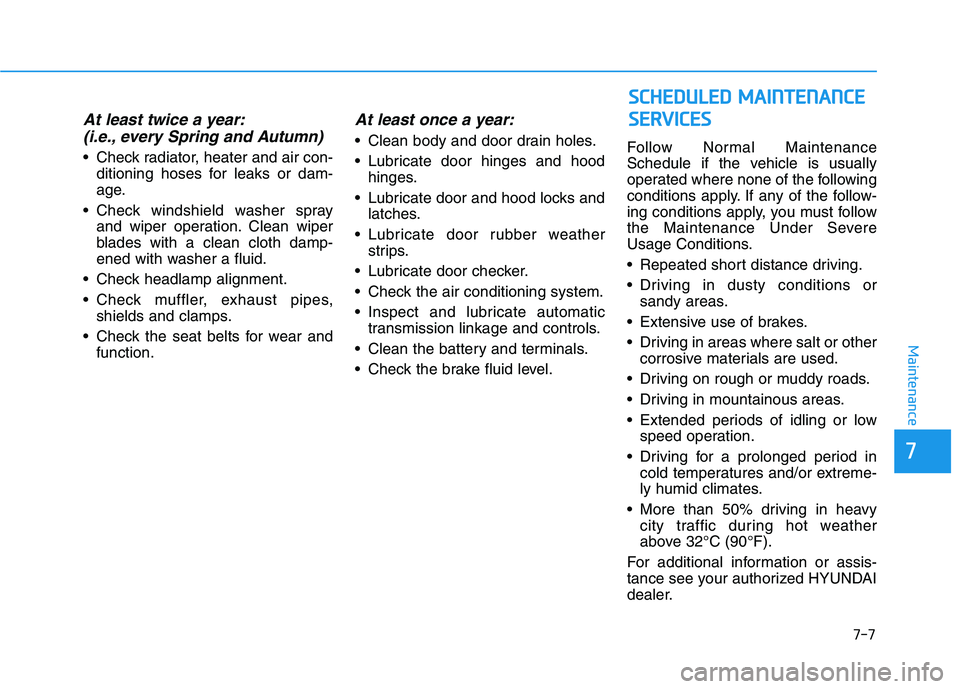
At least twice a year:(i.e., every Spring and Autumn)
Check radiator, heater and air con- ditioning hoses for leaks or dam-
age.
Check windshield washer spray and wiper operation. Clean wiper
blades with a clean cloth damp-
ened with washer a fluid.
Check headlamp alignment.
Check muffler, exhaust pipes, shields and clamps.
Check the seat belts for wear and function.
At least once a year:
Clean body and door drain holes.
Lubricate door hinges and hoodhinges.
Lubricate door and hood locks and latches.
Lubricate door rubber weather strips.
Lubricate door checker.
Check the air conditioning system.
Inspect and lubricate automatic transmission linkage and controls.
Clean the battery and terminals.
Check the brake fluid level. Follow Normal Maintenance
Schedule if the vehicle is usually
operated where none of the following
conditions apply. If any of the follow-
ing conditions apply, you must follow
the Maintenance Under Severe
Usage Conditions.
Repeated short distance driving.
Driving in dusty conditions or
sandy areas.
Extensive use of brakes.
Driving in areas where salt or other corrosive materials are used.
Driving on rough or muddy roads.
Driving in mountainous areas.
Extended periods of idling or low speed operation.
Driving for a prolonged period in cold temperatures and/or extreme-
ly humid climates.
More than 50% driving in heavy city traffic during hot weather
above 32°C (90°F).
For additional information or assis-
tance see your authorized HYUNDAI
dealer.
SS CC HH EEDD UU LLEE DD MM AAIINN TTEENN AANN CCEE
S
S EE RR VV IICC EE SS