engine oil HYUNDAI ELANTRA HYBRID 2021 User Guide
[x] Cancel search | Manufacturer: HYUNDAI, Model Year: 2021, Model line: ELANTRA HYBRID, Model: HYUNDAI ELANTRA HYBRID 2021Pages: 555, PDF Size: 56.08 MB
Page 308 of 555
6-40
Various driving situations, which you may
encounter in SMART mode
• The driving mode automatically
changes to SMART ECO mode after
a certain period of time, when you
gently depress the accelerator pedal
(Your driving is categorized to be
economic.).
• The driving mode automatically
changes from SMART ECO mode to
SMART NORMAL mode after a certain
period of time, when you sharply or
repetitively depress the accelerator
pedal.
• The driving mode automatically
changes to SMART NORMAL mode
with the same driving patterns, when
the vehicle starts to drive on an
upward slope of a certain angle. The
driving mode automatically returns to
SMART ECO mode, when the vehicle
enters a leveled road.
• The driving mode automatically
changes to SMART SPORT, when
you abruptly accelerate the vehicle
or repetitively operate the steering
wheel (Your driving is categorized
to be sporty.). In this mode, your
vehicle drives in a lower gear for
abrupt accelerating/decelerating
and increases the engine brake
performance.
• You may still sense the engine
braking performance, even when
you release the accelerator pedal in
SMART SPORT mode. It is because
your vehicle remains in lower gear
over a certain period of time for next
acceleration. Thus, it is a normal
driving situation, not indicating any
malfunction.
• The driving mode automatically
changes to SMART SPORT mode
only in harsh driving situations. In
most of the normal driving situations,
the driving mode sets to be either
in SMART ECO mode or in SMART
NORMAL mode. Limitation of SMART mode
The SMART mode may be limited in
following situations. (The OFF indicator
illuminates in those situations.)
•
The cruise control is activated :
The cruise control system may
deactivate the SMART mode when
the vehicle is controlled by the set
speed of Smart Cruise Control system.
(SMART mode is not deactivated
just by activating the cruise control
system.)
• The transmission oil temperature is
either extremely low or extremely
high :
The SMART mode can be active in
most of the normal driving situations.
However, an extremely high/ low
transmission oil temperature may
temporarily deactivate the SMART
mode, because the transmission
condition is out of normal operation
condition.
Driving your vehicle
Page 312 of 555
6-44
Driving in Flooded Areas
Avoid driving through flooded areas
unless you are sure the water is no
higher than the bottom of the wheel hub.
Drive through any water slowly. Allow
adequate stopping distance because
brake performance may be reduced.
After driving through water, dry the
brakes by gently applying them several
times while the vehicle is moving slowly.
Highway Driving
Tires
Adjust the tire inflation, as specified.
Under-inflation may overheat or damage
the tires.
Do not install worn-out or damaged tires,
which may reduce traction or adversely
affect vehicle handling. This could lead
to sudden tire failure that may cause
loss of vehicle control resulting in an
accident.
Information
Never over-inflate your tires above the
maximum inflation pressure, as specified
on your tires.
Fuel, engine coolant and engine oil
Driving at higher speeds on the highway
consumes more fuel and is less efficient
than driving at a slower, more moderate
speed. Maintain a moderate speed in
order to conserve fuel when driving on
the highway.
Be sure to check both the engine coolant
level and the engine oil before driving.
Drive belt
A loose or damaged drive belt may
overheat the engine.
Driving your vehicle
Page 315 of 555
06
6-47
Winter Precautions
Use high quality ethylene glycol
coolant
Your vehicle is delivered with high
quality ethylene glycol coolant in the
cooling system. It is the only type of
coolant that should be used because it
helps prevent corrosion in the cooling
system, lubricates the water pump and
prevents freezing. Be sure to replace or
replenish your coolant in accordance
with the maintenance schedule in
chapter 8. Before winter, have your
coolant tested to assure that its freezing
point is sufficient for the temperatures
anticipated during the winter.
Change to "winter weight" oil if
necessary
In some climates it is recommended that
a lower viscosity "winter weight" oil be
used during cold weather. See chapter 8
for recommendations. If you aren't sure
what weight oil you should use, consult
an authorized HYUNDAI dealer.
Check battery and cables
Winter puts additional burdens on the
battery system. Visually inspect the
battery and cables as described in
chapter 8. The level of charge in your
battery can be checked by an authorized
HYUNDAI dealer or a service station.
Check spark plugs and ignition
system
Inspect your spark plugs as described in
chapter 8 and replace them if necessary.
Also check all ignition wiring and
components to be sure they are not
cracked, worn or damaged in any way.
Use approved window washer anti-
freeze in system
To keep the water in the window washer
system from freezing, add an approved
window washer anti-freeze solution in
accordance with instructions on the
container. Window washer anti-freeze is available
from an authorized HYUNDAI dealer
and most auto parts outlets. Do not
use engine coolant or other types of
antifreeze as these may damage the
paint finish.
Do not let your parking brake freeze
Under some conditions your parking
brake can freeze in the engaged position.
This is most likely to happen when
there is an accumulation of snow or
ice around or near the rear brakes or
if the brakes are wet. If there is a risk
the parking brake may freeze, apply
it only temporarily while you put the
gear selector lever in P and block the
rear wheels so the car cannot roll. Then
release the parking brake.
Do not let ice and snow accumulate
underneath
Under some conditions, snow and ice
can build up under the fenders and
interfere with the steering. When driving
in severe winter conditions where this
may happen, you should periodically
check underneath the car to be sure the
movement of the front wheels and the
steering components is not obstructed.
Don't place foreign objects
or materials in the engine
compartment
Placement of foreign object or materials
which prevent cooling of the engine, in
the engine compartment, may cause a
failure or combustion. The manufacturer
is not responsible for the damage caused
by such placement.
To keep locks from freezing
To keep the locks from freezing, squirt
an approved de-icer fluid or glycerine
into the key opening. If a lock is covered
with ice, squirt it with an approved de-
icing fluid to remove the ice. If the lock
is frozen internally, you may be able to
thaw it out by using a heated key. Handle
the heated key with care to avoid injury.
Page 470 of 555

Engine Compartment ........................................................................\
............9-3
Maintenance Services
........................................................................\
...........9-4Owner’s Responsibility ........................................................................\
....................9-4
Owner Maintenance Precautions ........................................................................\
....9-4
Owner Maintenance ........................................................................\
..............9-5Owner Maintenance Schedule ........................................................................\
........9-5
Scheduled Maintenance Services ................................................................9 -7Normal maintenance schedule ........................................................................\
......9-8
Maintenance under severe usage conditions ......................................................9-12
Explanation of Scheduled Maintenance Items ..........................................9-14HSG (Hybrid Starter & Generator) Belt .................................................................9-14
Dual clutch transmission fluid ........................................................................\
.......9-15
Engine Oil ........................................................................\
.............................9-16Checking the Engine Oil Level ........................................................................\
........9-16
Checking the Engine Oil and Filter ........................................................................\
9-17
Engine coolant/Inverter coolant .................................................................9-18Checking the Coolant Level ........................................................................\
............ 9-18
Changing Engine Coolant ........................................................................\
...............9-21
Hybrid Starter & Generator (HSG) Belt .......................................................9-22Checking the Hybrid Starter & Generator (HSG) Belt ..........................................9-22
Brake/Clutch Fluid ........................................................................\
...............9-23Checking the Brake/Clutch Fluid Level ................................................................9-23
Washer Fluid ........................................................................\
.........................9-24Checking the Washer Fluid Level ........................................................................\
..9-24
Air Cleaner ........................................................................\
............................9-2 4Filter Replacement ........................................................................\
.........................9-24
Cabin Air Filter ........................................................................\
......................9-26Filter Inspection ........................................................................\
.............................. 9-26
Filter Replacement ........................................................................\
.........................9-26
Wiper Blades ........................................................................\
........................9-27Blade Inspection ........................................................................\
............................9-27
Blade Replacement ........................................................................\
........................9-27
Maintenance
9. Maintenance
9
Page 472 of 555

9-3
09
1. Engine coolant reservoir
2. Engine coolant reservoir cap
3. Inverter coolant reservoir
4. Brake fluid reservoir
5. Air cleaner
6. Engine oil dipstick
7. Engine oil filler cap
8. Windshield washer fluid reservoir
9. Fuse box
ENGINE COMPARTMENT
„„Gasoline 1.6 GDi HEV
The actual engine compartment in the vehicle may differ from the illustration.OCN7H090001
Page 474 of 555

09
9-5
WARNING
Performing maintenance work on a
vehicle can be dangerous. If you lack
sufficient knowledge and experience or
the proper tools and equipment to do
the work, have it done by an authorized
HYUNDAI dealer.
ALWAYS follow these precautions for
performing maintenance work:
• Park your vehicle on level ground,
move the shift button into the P
(Park) position, place the ignition
switch in the LOCK/OFF position.
• Block the tires (front and back) to
prevent the vehicle from moving.
Remove loose clothing or jewelry
that can become entangled in
moving parts.
• If you must run the engine during
maintenance, do so out doors or in
an area with plenty of ventilation.
• Keep flames, sparks, or smoking
materials away from the battery and
fuel-related parts. The following lists are vehicle checks and
inspections that should be performed
by the owner or an authorized HYUNDAI
dealer at the frequencies indicated to
help ensure safe, dependable operation
of your vehicle.
Any adverse conditions should be
brought to the attention of your dealer as
soon as possible.
These Owner Maintenance vehicle
checks are generally not covered by
warranties and you may be charged for
labor, parts and lubricants used.
Owner Maintenance Schedule
When you stop for fuel:
•
Check the engine oil level.
• Check the coolant level in the engine
coolant reservoir.
• Check the windshield washer fluid
level.
• Check the for low or under-inflated
tires.
• Check the radiator and condenser.
• Check if the front of the radiator and
condenser are clean and not blocked
with leaves, dirt or insects etc. If any
of the above parts are extremely dirty
or you are not sure of their condition,
we recommend that you contact an
authorized HYUNDAI dealer.
WARNING
Be careful when checking your engine
coolant level when the engine is hot.
This may result in coolant being blown
out of the opening and cause serious
burns and other injuries.
OWNER MAINTENANCE
Page 476 of 555

09
9 -7
Follow Normal Maintenance Schedule if the vehicle is usually operated where none of
the following conditions apply. If any of the following conditions apply, you must follow
the Maintenance Under Severe Usage Conditions.
• Repeatedly driving short distance of less than 8 km (5 miles) in normal temperature
of less than 16 km (10 miles) in freezing temperature.
• Extensive engine idling or low speed driving for long distances.
• Driving on rough, dusty, muddy, unpaved, graveled or salt- spread roads.
• Driving in areas using salt or other corrosive materials or in very cold weather.
• Driving in heavy dust condition.
• Driving in heavy traffic area.
• Driving on uphill, downhill, or mountain road repeatedly.
• Using for towing or camping, and driving with loading on the roof.
• Driving as a patrol car, taxi, other commercial use of vehicle towing.
• Frequently driving under high speed or rapid acceleration.
• Frequently driving in stop-and-go condition.
• Engine oil usage which is not recommended(Mineral type, Semisynthetic, Lower
grade spec, etc.)
SCHEDULED MAINTENANCE SERVICES
Page 477 of 555
Maintenance
9-8
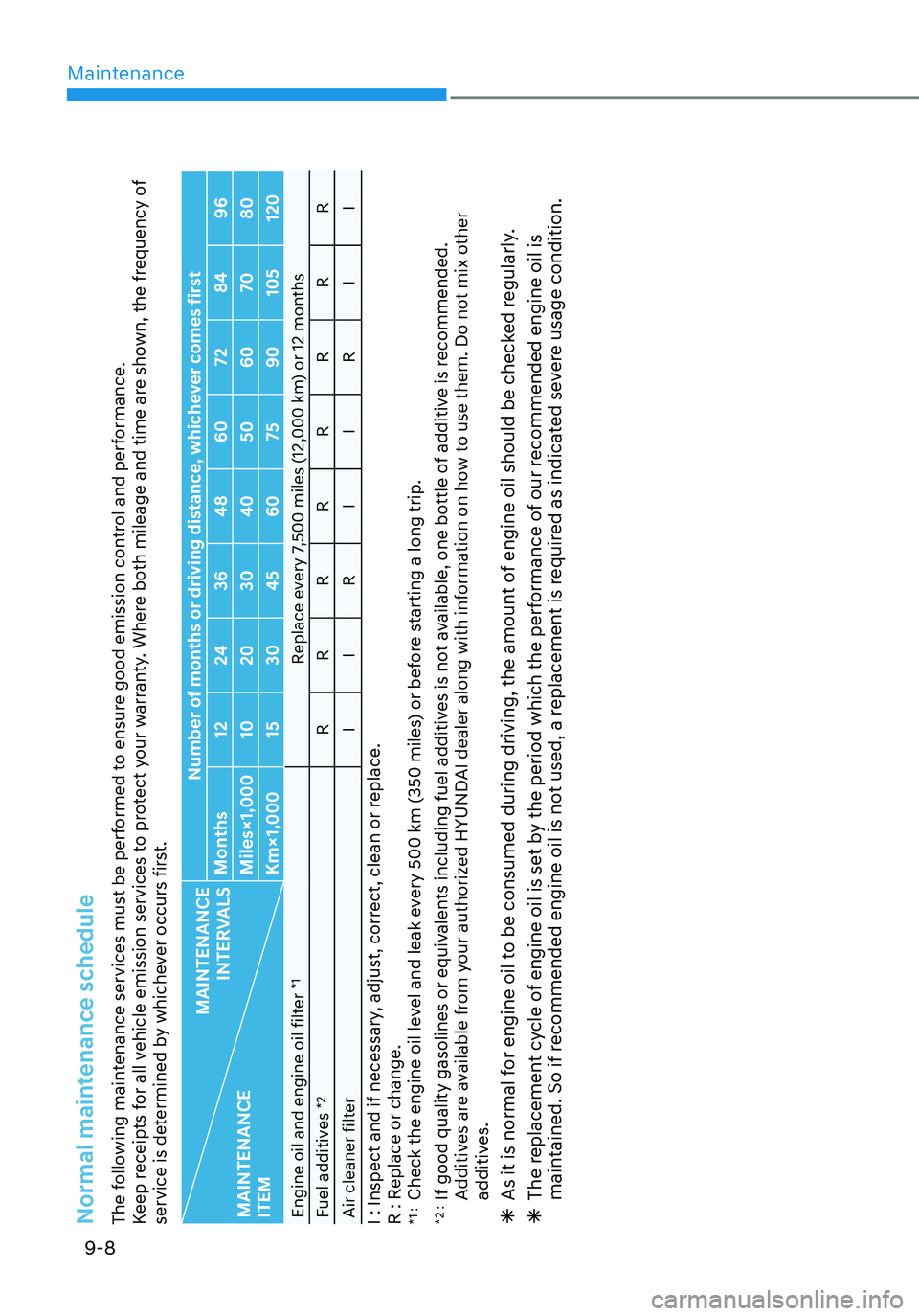
Normal maintenance schedule The following maintenance services must be performed to ensure good emission control and performance.
Keep receipts for all vehicle emission services to protect your warranty. Where both mileage and time are shown, the frequency of
service is determined by whichever occurs first.
MAINTENANCE
INTERVALS
MAINTENANCE
ITEM Number of months or driving distance, whichever comes first
Months 1224 3648 60 7284 96
Miles×1,000 1020 3040 5060 7080
Km×1,000 1530 4560 7590105 120
Engine oil and engine oil filter
*1
Replace every 7,500 miles (12,000 km) or 12 months
Fuel additives
*2
R RRRRRRR
Air cleaner filter IIR IIR II
I : Inspect and if necessary, adjust, correct, clean or replace.
R : Replace or change.*1 : Check the engine oil level and leak every 500 km (350 miles) or before starting a long trip.
*2 : If good quality gasolines or equivalents including fuel additives is not available, one bottle of additive is recommended.
Additives are available from your authorized HYUNDAI dealer along with information on how to use them. Do not mix other
additives. ÃAs it is normal for engine oil to be consumed during driving, the amount of engine oil should be checked regularly. ÃThe replacement cycle of engine oil is set by the period which the performance of our recommended engine oil is
maintained. So if recommended engine oil is not used, a replacement is required as indicated severe usage condition.
Page 481 of 555
Maintenance
9-12
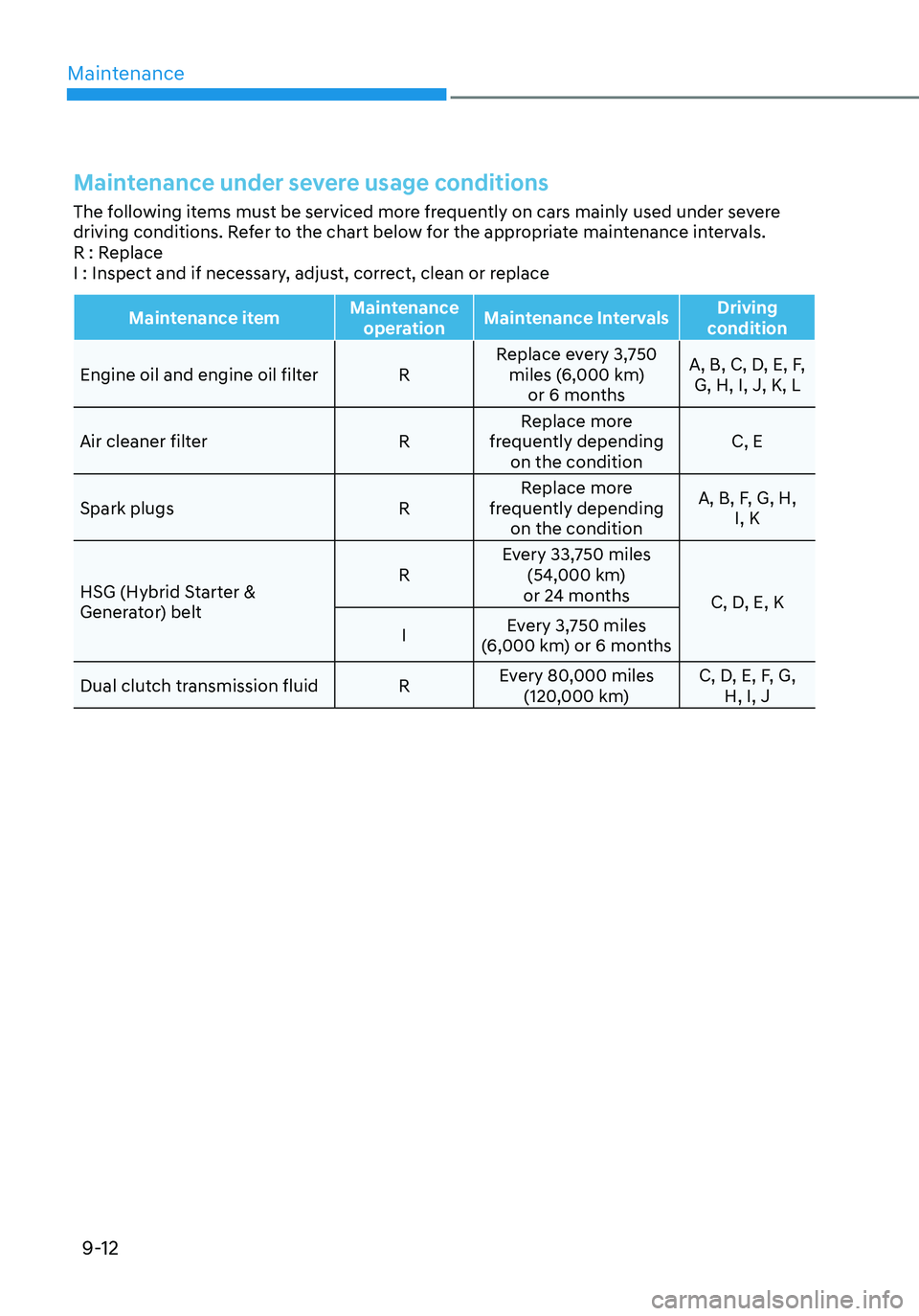
Maintenance under severe usage conditions
The following items must be serviced more frequently on cars mainly used under severe
driving conditions. Refer to the chart below for the appropriate maintenance intervals.
R : Replace
I : Inspect and if necessary, adjust, correct, clean or replace
Maintenance itemMaintenance
operation Maintenance Intervals Driving
condition
Engine oil and engine oil filter RReplace every 3,750
miles (6,000 km) or 6 months A, B, C, D, E, F,
G, H, I, J, K, L
Air cleaner filter RReplace more
frequently depending on the condition C, E
Spark plugs RReplace more
frequently depending on the condition A, B, F, G, H,
I, K
HSG (Hybrid Starter &
Generator) belt R
Every 33,750 miles
(54,000 km)
or 24 months C, D, E, K
I Every 3,750 miles
(6,000 km) or 6 months
Dual clutch transmission fluid REvery 80,000 miles
(120,000 km) C, D, E, F, G,
H, I, J
Page 482 of 555

09
9-13
Maintenance under severe usage conditions
Maintenance itemMaintenance
operation Maintenance Intervals
Driving condition
Steering gear rack,
linkage and boots IInspect more frequently
depending on the condition C, D, E, F, G
Front suspension ball
joints IInspect more frequently
depending on the condition C, D, E, F, G
Disc brakes and pads,
calipers and rotors IInspect more frequently
depending on the condition C, D, E, G, H
Parking brake IInspect more frequently
depending on the condition C, D, G, H
Driveshaft and boots IInspect more frequently
depending on the condition C, D, E, F, G, H, I, J
Cabin air filter RReplace more frequently
depending on the condition C, E
Severe driving conditions
A. Repeatedly driving short distance of less than 5 miles (8 km) in normal temperature
or less than 10 miles (16 km) in freezing temperature
B. Extensive engine idling or low speed driving for long distances
C. Driving on rough, dusty, muddy, unpaved, graveled or saltspread roads
D. Driving in areas using salt or other corrosive materials or in very cold weather
E. Driving in the condition of inflowing sand or dust into engine
F. Driving in heavy traffic area
G. Driving on uphill, downhill, or mountain roads
H. Using for towing or camping, and driving with loading on the roof.
I. Driving for patrol car, taxi, commercial car or vehicle towing
J. Frequently driving under high speed or rapid acceleration.
K. Frequently driving in stop-and-go conditions
L. Engine oil usage which is not recommended (Mineral type, Semi-synthetic, Lower
grade spec, etc.)