engine oil HYUNDAI ELANTRA HYBRID 2021 Owner's Manual
[x] Cancel search | Manufacturer: HYUNDAI, Model Year: 2021, Model line: ELANTRA HYBRID, Model: HYUNDAI ELANTRA HYBRID 2021Pages: 555, PDF Size: 56.08 MB
Page 483 of 555
Maintenance
9-14
Engine Oil and Filter
The engine oil and filter should be
changed at the intervals specified in the
maintenance schedule. If the vehicle
is being driven in severe conditions,
more frequent oil and filter changes are
required.
Drive Belts
Inspect all drive belts for evidence
of cuts, cracks, excessive wear or oil
saturation and replace if necessary. Drive
belts should be checked periodically
for proper tension and adjusted as
necessary.
Fuel Filter
A clogged-up fuel filter may limit the
vehicle driving speed, damage the
emission system, and cause the hard
starting. When a considerable amount
of foreign substances are accumulated
in the fuel tank, the fuel filter should be
replaced.
Upon installing a new fuel filter, operate
the engine for several minutes, and
check the connections for any leakages.
Fuel filters should be installed by an
authorized HYUNDAI dealer.
HSG (Hybrid Starter & Generator)
Belt
The HSG belt should be changed at the
intervals specified in the maintenance
schedule.
Fuel Lines, Fuel Hoses and
Connections
Check the fuel lines, fuel hoses and
connections for leakage and damage.
Have an authorized HYUNDAI dealer
replace any damaged or leaking parts
immediately.
Vapor Hose and Fuel Filler Cap
The vapor hose and fuel filler cap should
be inspected at those intervals specified
in the maintenance schedule. Make sure
a new vapor hose or fuel filler cap is
correctly replaced.
Air Cleaner Filter
A genuine HYUNDAI air cleaner filter
is recommended when the filter is
replaced.
Spark Plugs
Make sure to install new spark plugs of
the correct heat range.
Cooling System
Check cooling system components, such
as radiator, coolant reservoir, hoses and
connections for leakage and damage.
Replace any damaged parts.
EXPLANATION OF SCHEDULED MAINTENANCE ITEMS
Page 485 of 555
Maintenance
9-16
Checking the Engine Oil Level
Engine oil is used for lubrication and
cooling, so it is gradually consumed
during driving the vehicle.
Regularly check and manage the oil level
using the following procedure.
1. Follow all of the oil manufacturer’s
precautions.
2. Be sure the vehicle is on the level
ground in P (Park) with the parking
brake set. If possible, block the
wheels.
3. Turn the engine on and allow the
engine to reach normal operating
temperature.
4. Turn the engine off and wait about 15
minutes (with oil filler cap and dipstick
detached) for the oil to return to the
oil pan.
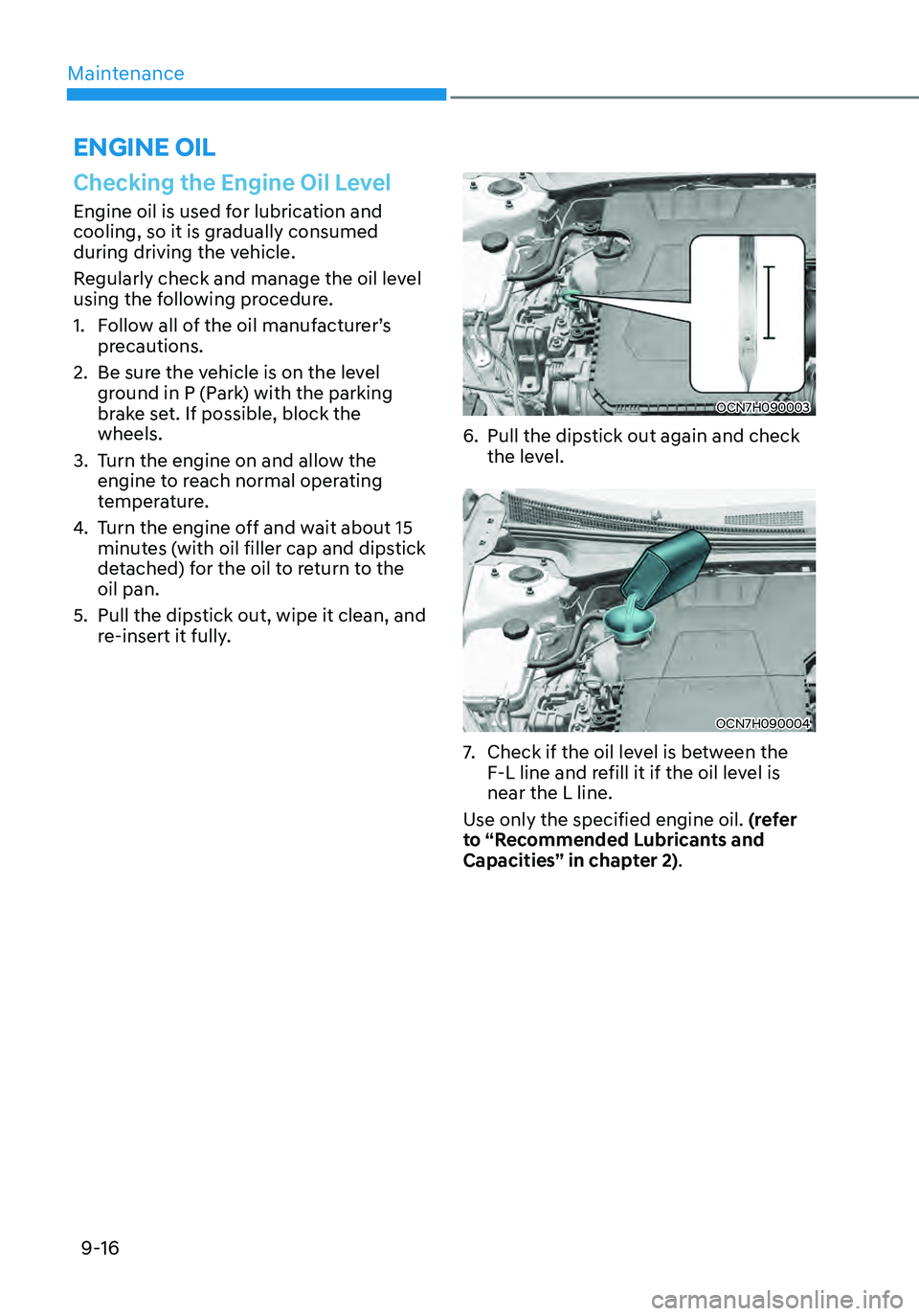
5. Pull the dipstick out, wipe it clean, and
re-insert it fully.
OCN7H090003
6. Pull the dipstick out again and check
the level.
OCN7H090004
7. Check if the oil level is between the
F-L line and refill it if the oil level is
near the L line.
Use only the specified engine oil. (refer
to “Recommended Lubricants and
Capacities” in chapter 2).
ENGINE OIL
Page 486 of 555
09
9-17
NOTICE
To prevent damage to your engine:
• Do not overfill with engine oil. Add oil
in small quantities and recheck level
to ensure engine is not overfilled.
• Do not spill engine oil when adding
or changing engine oil. Use a funnel
to help prevent oil from being spilled
on engine components. Wipe off
spilled oil immediately.
• The engine oil consumption may
increase while you break in a new
vehicle and it will be stabilized after
driving 6,000 km.
• The engine oil consumption can be
affected by driving habits, climate
conditions, traffic conditions,
oil quality, etc. Therefore, it is
recommended that you inspect the
engine oil level regularly and refill it
if necessary.
• The engine oil change interval is
set for the purpose of preventing
oil deterioration, and is not related
the amount of oil consumption; so,
check and refill the amount of the oil
regularly.
Checking the Engine Oil and
Filter
Have engine oil and filter changed by an authorized HYUNDAI dealer according
to the Maintenance Schedule at the
beginning of this chapter.
• If exceeding the maintenance
schedule for replacement of engine
oil, the engine oil performance
may deteriorate and the engine
condition may be affected. Therefore,
the replacement cycle should be
observed.
• To keep the engine in optimal
condition, use recommended engine
oil. If not using the recommended
oil, replace it according to the severe
usage maintenance conditions.
WARNING
CALIFORNIA PROPOSITION 65
WARNING
Engine oil contains chemicals known to
the State of California to cause cancer,
birth defects and reproductive harm.
Used engine oil may cause irritation or
cancer of the skin if left in contact with
the skin for prolonged periods of time.
Always protect your skin by washing
your hands thoroughly with soap and
warm water as soon as possible after
handling used oil.
Page 492 of 555
09
9-23
Checking the Brake/Clutch Fluid
Level
OCN7H090010
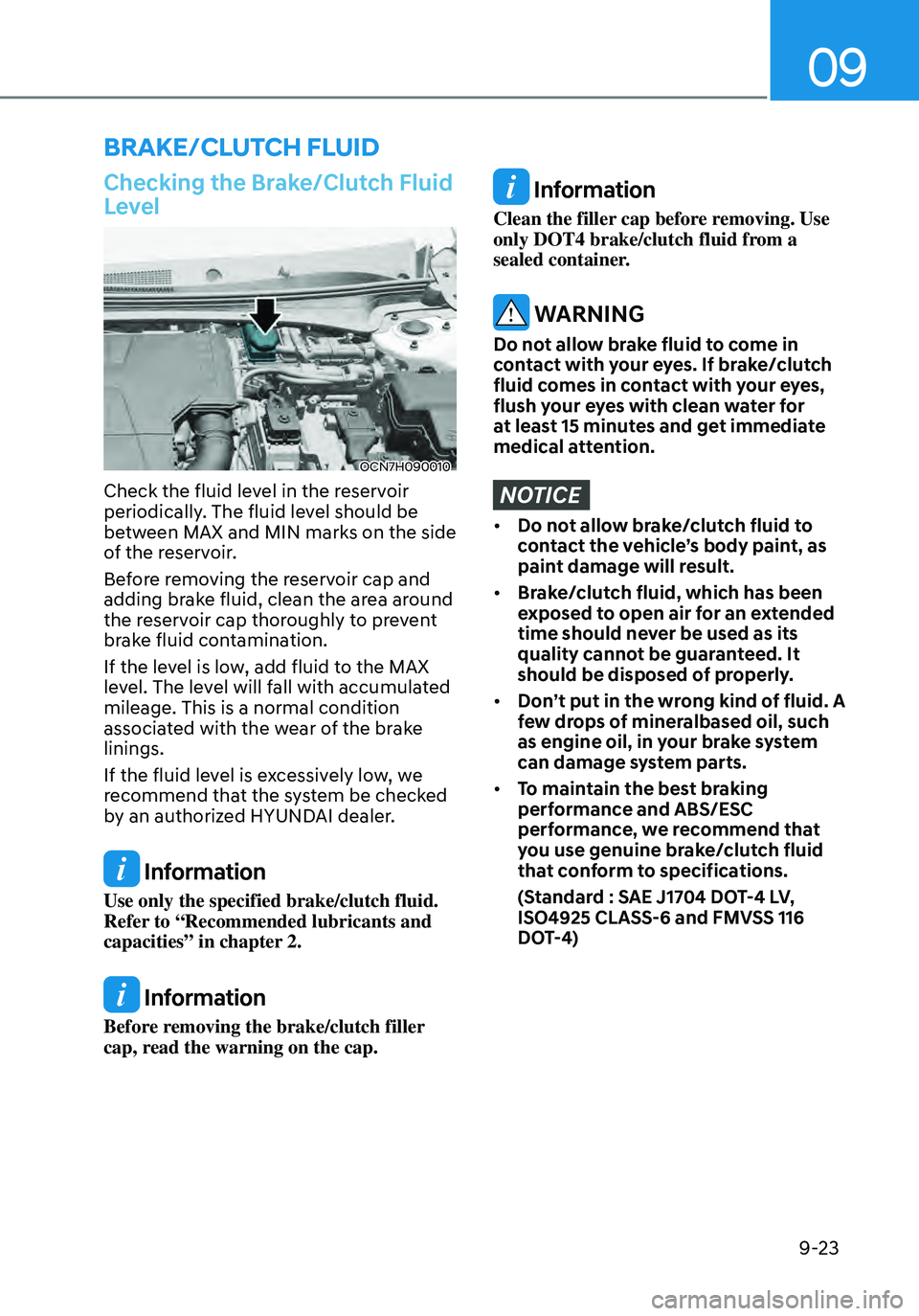
Check the fluid level in the reservoir
periodically. The fluid level should be
between MAX and MIN marks on the side
of the reservoir.
Before removing the reservoir cap and
adding brake fluid, clean the area around
the reservoir cap thoroughly to prevent
brake fluid contamination.
If the level is low, add fluid to the MAX
level. The level will fall with accumulated
mileage. This is a normal condition
associated with the wear of the brake
linings.
If the fluid level is excessively low, we
recommend that the system be checked
by an authorized HYUNDAI dealer.
Information
Use only the specified brake/clutch fluid.
Refer to “Recommended lubricants and
capacities” in chapter 2.
Information
Before removing the brake/clutch filler
cap, read the warning on the cap.
Information
Clean the filler cap before removing. Use
only DOT4 brake/clutch fluid from a
sealed container.
WARNING
Do not allow brake fluid to come in
contact with your eyes. If brake/clutch
fluid comes in contact with your eyes,
flush your eyes with clean water for
at least 15 minutes and get immediate
medical attention.
NOTICE
• Do not allow brake/clutch fluid to
contact the vehicle’s body paint, as
paint damage will result.
• Brake/clutch fluid, which has been
exposed to open air for an extended
time should never be used as its
quality cannot be guaranteed. It
should be disposed of properly.
• Don’t put in the wrong kind of fluid. A
few drops of mineralbased oil, such
as engine oil, in your brake system
can damage system parts.
• To maintain the best braking
performance and ABS/ESC
performance, we recommend that
you use genuine brake/clutch fluid
that conform to specifications.
(Standard : SAE J1704 DOT-4 LV,
ISO4925 CLASS-6 and FMVSS 116
DOT-4)
BRAKE/CLUTCH FLUID
Page 493 of 555
Maintenance
9-24
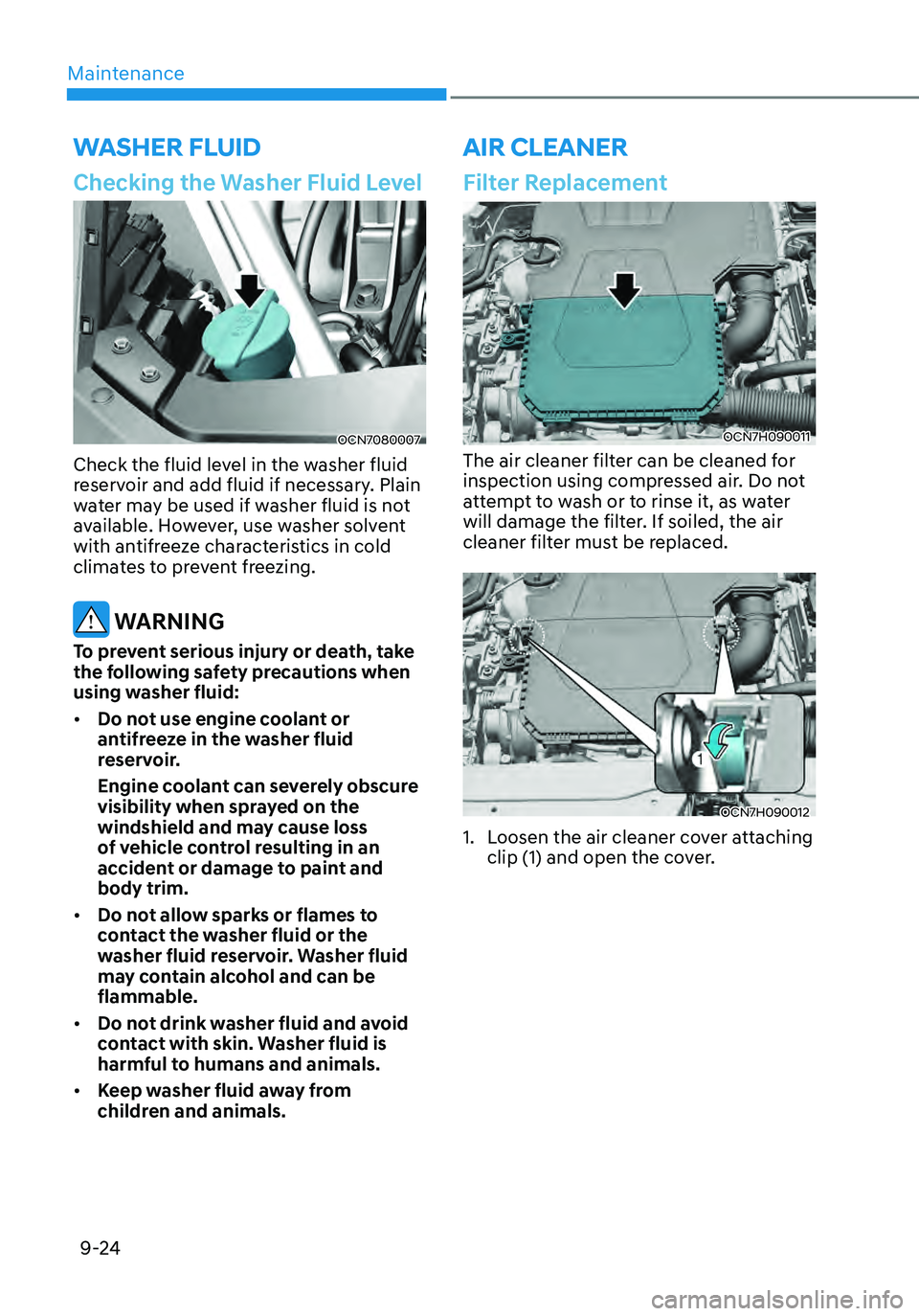
Checking the Washer Fluid Level
OCN7080007
Check the fluid level in the washer fluid
reservoir and add fluid if necessary. Plain
water may be used if washer fluid is not
available. However, use washer solvent
with antifreeze characteristics in cold
climates to prevent freezing.
WARNING
To prevent serious injury or death, take
the following safety precautions when
using washer fluid:
• Do not use engine coolant or
antifreeze in the washer fluid
reservoir.
Engine coolant can severely obscure
visibility when sprayed on the
windshield and may cause loss
of vehicle control resulting in an
accident or damage to paint and
body trim.
• Do not allow sparks or flames to
contact the washer fluid or the
washer fluid reservoir. Washer fluid
may contain alcohol and can be
flammable.
• Do not drink washer fluid and avoid
contact with skin. Washer fluid is
harmful to humans and animals.
• Keep washer fluid away from
children and animals.
WASHER FLUID
Filter Replacement
OCN7H090011
The air cleaner filter can be cleaned for
inspection using compressed air. Do not
attempt to wash or to rinse it, as water
will damage the filter. If soiled, the air
cleaner filter must be replaced.
OCN7H090012
1. Loosen the air cleaner cover attaching
clip (1) and open the cover.
AIR CLEANER
Page 511 of 555
Maintenance
9-42
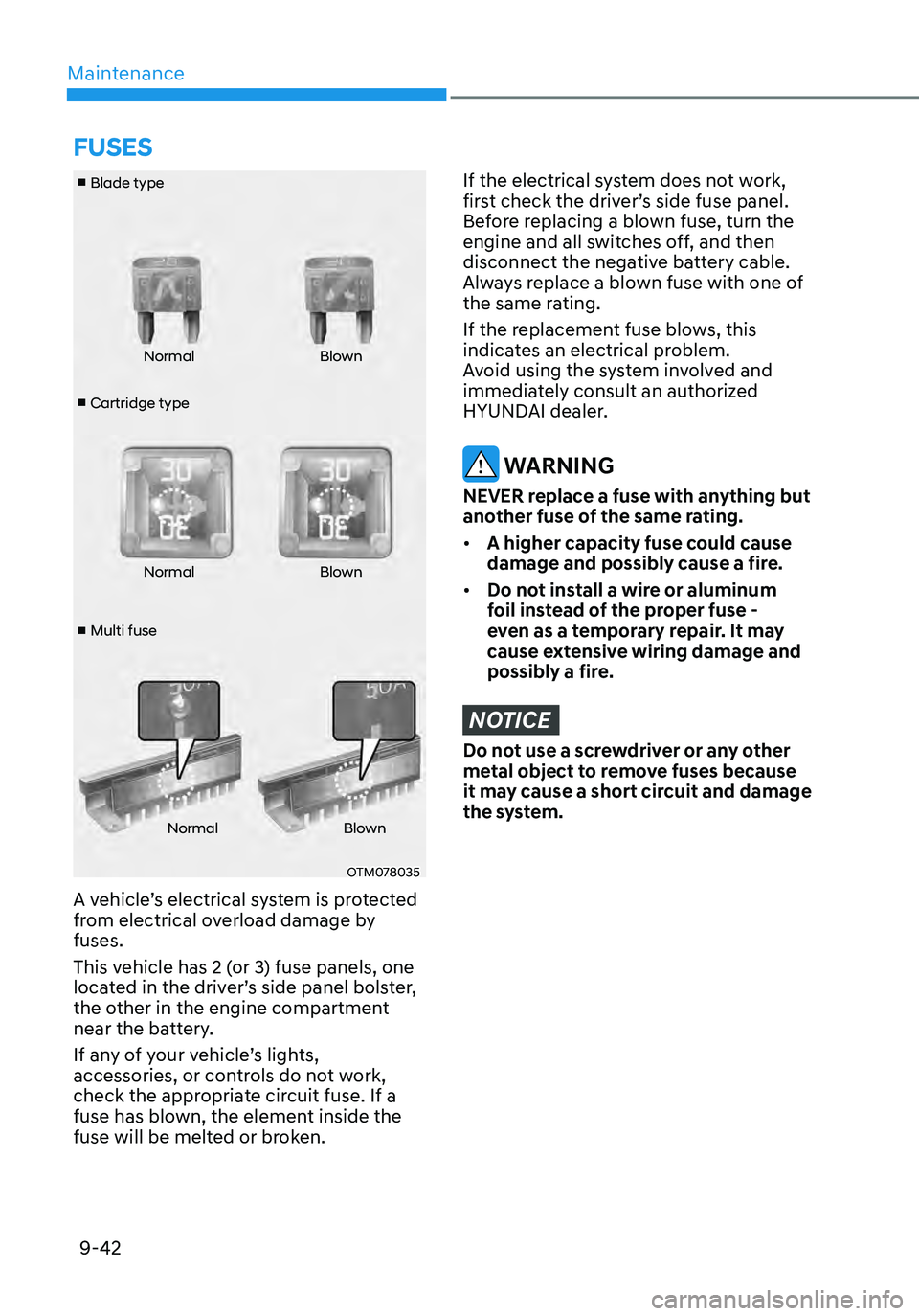
■ Cartridge type
■ Blade type
■ Multi fuse Normal
Blown
Normal Blown
Normal Blown
OTM078035
A vehicle’s electrical system is protected
from electrical overload damage by
fuses.
This vehicle has 2 (or 3) fuse panels, one
located in the driver’s side panel bolster,
the other in the engine compartment
near the battery.
If any of your vehicle’s lights,
accessories, or controls do not work,
check the appropriate circuit fuse. If a
fuse has blown, the element inside the
fuse will be melted or broken.
If the electrical system does not work,
first check the driver’s side fuse panel.
Before replacing a blown fuse, turn the
engine and all switches off, and then
disconnect the negative battery cable.
Always replace a blown fuse with one of
the same rating.
If the replacement fuse blows, this
indicates an electrical problem.
Avoid using the system involved and
immediately consult an authorized
HYUNDAI dealer.
WARNING
NEVER replace a fuse with anything but
another fuse of the same rating.
• A higher capacity fuse could cause
damage and possibly cause a fire.
• Do not install a wire or aluminum
foil instead of the proper fuse -
even as a temporary repair. It may
cause extensive wiring damage and
possibly a fire.
NOTICE
Do not use a screwdriver or any other
metal object to remove fuses because
it may cause a short circuit and damage
the system.
FUSES
Page 520 of 555
09
9-51
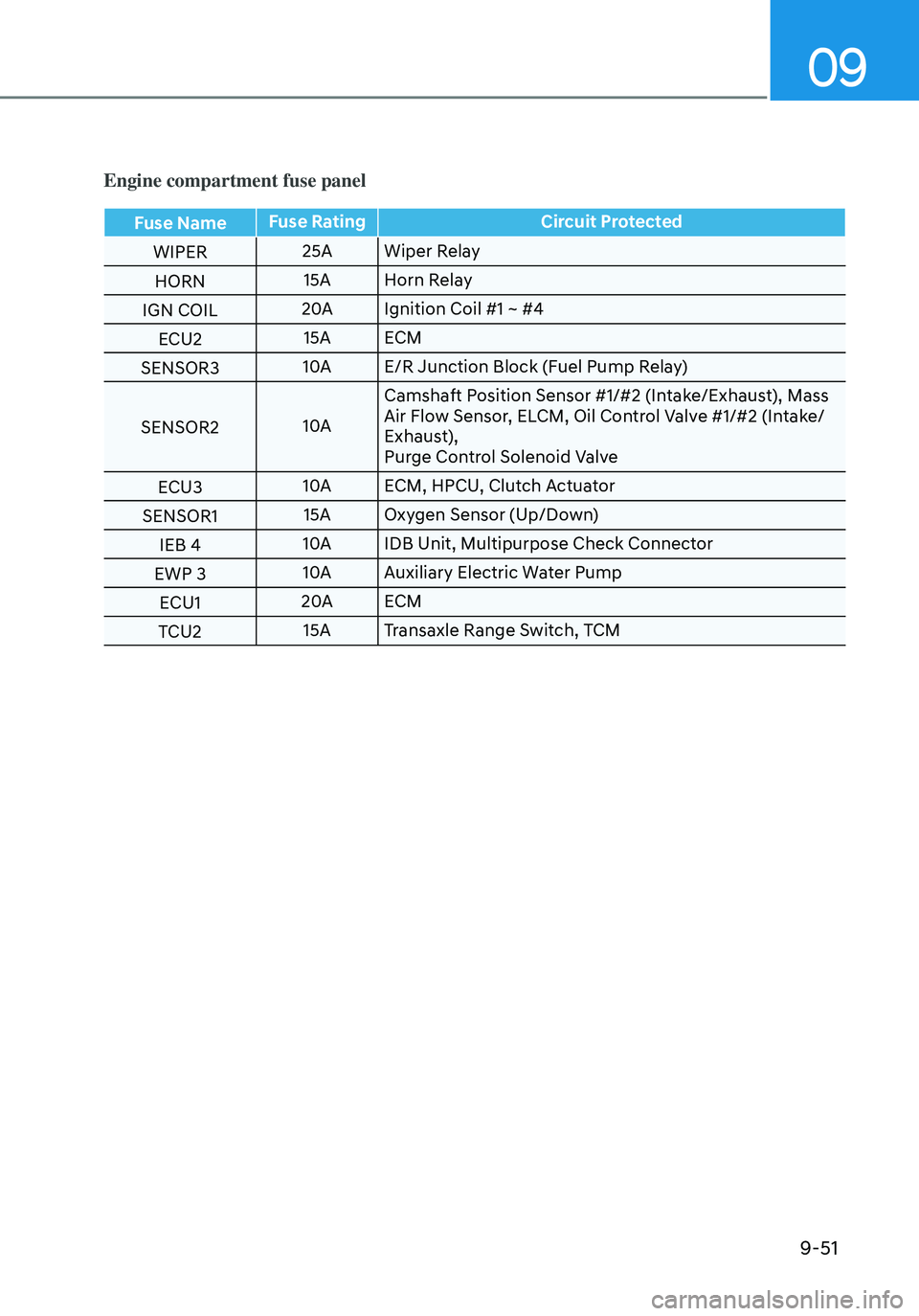
Engine compartment fuse panel
Fuse NameFuse Rating
Circuit Protected
WIPER 25A
Wiper Relay
HORN 15A
Horn Relay
IGN COIL 20A
Ignition Coil #1 ~ #4
ECU2 15A
ECM
SENSOR3 10A
E/R Junction Block (Fuel Pump Relay)
SENSOR2 10ACamshaft Position Sensor #1/#2 (Intake/Exhaust), Mass
Air Flow Sensor, ELCM, Oil Control Valve #1/#2 (Intake/
Exhaust),
Purge Control Solenoid Valve
ECU3 10A
ECM, HPCU, Clutch Actuator
SENSOR1 15A
Oxygen Sensor (Up/Down)
IEB 4 10A
IDB Unit, Multipurpose Check Connector
EWP 3 10A
Auxiliary Electric Water Pump
ECU1 20A
ECM
TCU2 15A
Transaxle Range Switch, TCM
Page 531 of 555
Maintenance
9-62
WARNING
After washing the vehicle, test the
brakes while driving slowly to see
if they have been affected by water
before getting on the road. If braking
performance is impaired, dry the
brakes by applying them lightly while
maintaining a slow forward speed.
NOTICE
• Do not use strong soap, chemical
detergents or hot water, and do not
wash the vehicle in direct sunlight
or when the body of the vehicle is
warm.
• Be careful when washing the side
windows of your vehicle.
Especially, with high-pressure water,
water may leak through the windows
and wet the interior.
• To prevent damage to the plastic
parts, do not clean with chemical
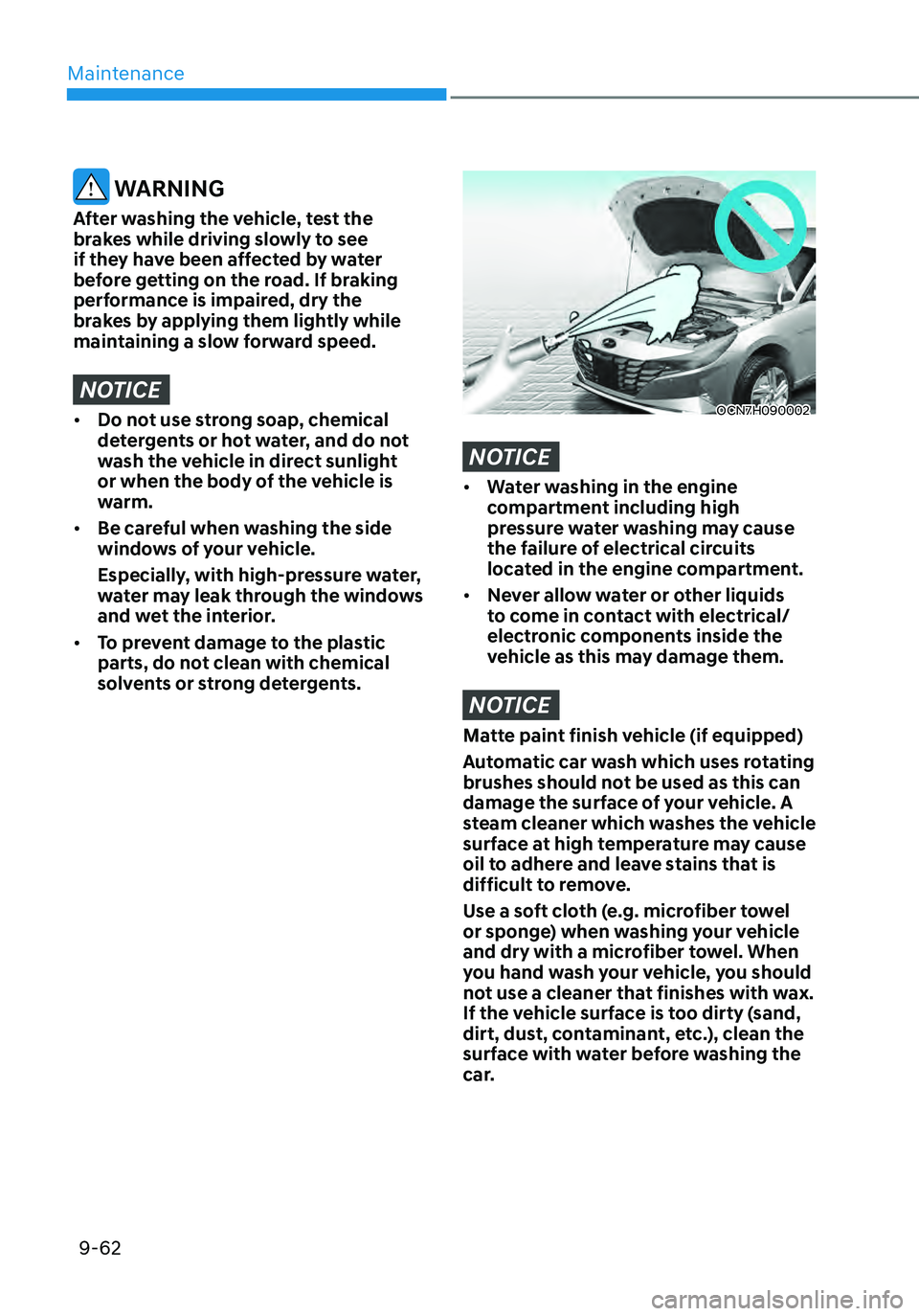
solvents or strong detergents.OCN7H090002
NOTICE
• Water washing in the engine
compartment including high
pressure water washing may cause
the failure of electrical circuits
located in the engine compartment.
• Never allow water or other liquids
to come in contact with electrical/
electronic components inside the
vehicle as this may damage them.
NOTICE
Matte paint finish vehicle (if equipped)
Automatic car wash which uses rotating
brushes should not be used as this can
damage the surface of your vehicle. A
steam cleaner which washes the vehicle
surface at high temperature may cause
oil to adhere and leave stains that is
difficult to remove.
Use a soft cloth (e.g. microfiber towel
or sponge) when washing your vehicle
and dry with a microfiber towel. When
you hand wash your vehicle, you should
not use a cleaner that finishes with wax.
If the vehicle surface is too dirty (sand,
dirt, dust, contaminant, etc.), clean the
surface with water before washing the
car.
Page 547 of 555

I
I-5
E
Emission Control System
........................................................................\
............9-70
Engine Compartment
........................................................................\
.............2-6/ 9-3
Engine coolant/Inverter coolant
........................................................................\
...9-18
Changing Engine Coolant ........................................................................\
........9-21
Checking the Coolant Level ........................................................................\
.....9-18
Engine Number
........................................................................\
............................2-14
Engine Oil
........................................................................\
....................................9-16
Checking the Engine Oil and Filter ..................................................................9-17
Checking the Engine Oil Level ........................................................................\
9-16
Engine specification ........................................................................\
....................... 2-7
Explanation of Scheduled Maintenance Items
....................................................9-14
Dual clutch transmission fluid ........................................................................\
.9-15
HSG (Hybrid Starter & Generator) Belt .........................................................9-14
Exterior Lights
........................................................................\
.............................5-72
Battery saver function ........................................................................\
..............5-75
Headlamp delay function ........................................................................\
.........5-75
High beam operation ........................................................................\
................5-73
Lighting control ........................................................................\
........................5-72
Turn signals and lane change signals ...............................................................5-74
Exterior Overview
........................................................................\
.........................2-2
F
Forward Collision–Avoidance Assist (FCA) (front view camera only)
................7-2
Function malfunction and limitations ................................................................7-7
Function operation ........................................................................\
......................7-5
Function settings ........................................................................\
........................7-3
Forward Collision–Avoidance Assist (FCA) (sensor fusion)
.............................7-14
Function malfunction and limitations ..............................................................7-22
Function operation ........................................................................\
....................7-18
Function settings ........................................................................\
......................7-16
Fuel filler door
........................................................................\
.............................5-69
Fuel Requirements
........................................................................\
.........................1-5
Fuses
........................................................................\
............................................9-42
Engine Compartment Panel Fuse Replacement ...............................................9-44
Fuse/Relay Panel Description ........................................................................\
..9-45
Instrument Panel Fuse Replacement ................................................................9-43