ABS HYUNDAI ELANTRA HYBRID 2022 User Guide
[x] Cancel search | Manufacturer: HYUNDAI, Model Year: 2022, Model line: ELANTRA HYBRID, Model: HYUNDAI ELANTRA HYBRID 2022Pages: 529, PDF Size: 38.79 MB
Page 366 of 529
07
7-69
OTM070142N
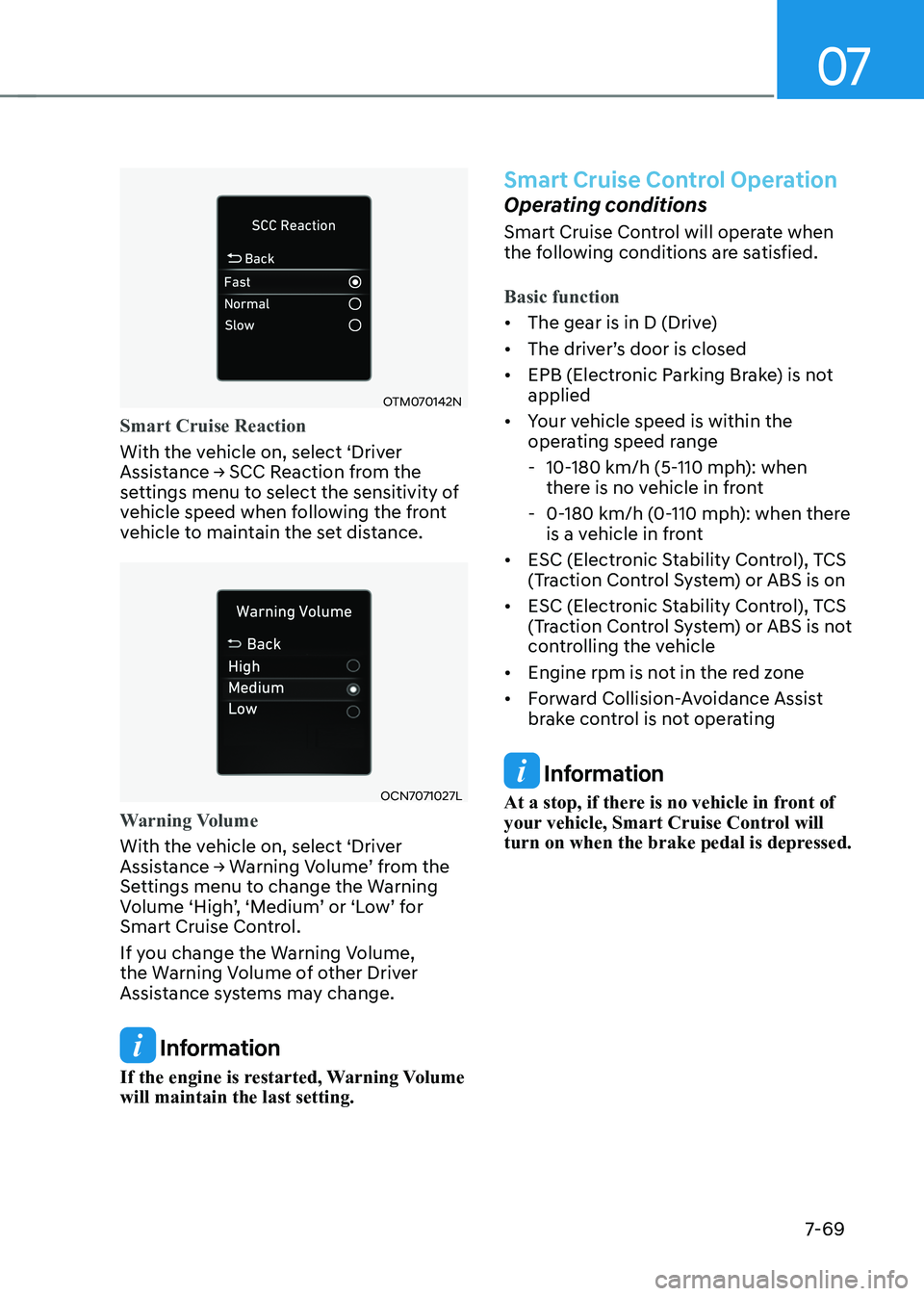
Smart Cruise Reaction
With the vehicle on, select ‘Driver
Assistance → SCC Reaction from the
settings menu to select the sensitivity of
vehicle speed when following the front
vehicle to maintain the set distance.
OCN7071027L
Warning Volume
With the vehicle on, select ‘Driver
Assistance → Warning Volume’ from the
Settings menu to change the Warning
Volume ‘High’, ‘Medium’ or ‘Low’ for
Smart Cruise Control.
If you change the Warning Volume,
the Warning Volume of other Driver
Assistance systems may change.
Information
If the engine is restarted, Warning Volume will maintain the last setting.
Smart Cruise Control Operation
Operating conditions
Smart Cruise Control will operate when
the following conditions are satisfied.
Basic function
• The gear is in D (Drive)
• The driver’s door is closed • EPB (Electronic Parking Brake) is not applied
• Your vehicle speed is within the
operating speed range
- 10-180 km/h (5-110 mph): when there is no vehicle in front
- 0-180 km/h (0-110 mph): when there is a vehicle in front
• ESC (Electronic Stability Control), TCS
(Traction Control System) or ABS is on
• ESC (Electronic Stability Control), TCS
(Traction Control System) or ABS is not
controlling the vehicle
• Engine rpm is not in the red zone
• Forward Collision-Avoidance Assist
brake control is not operating
Information
At a stop, if there is no vehicle in front of
your vehicle, Smart Cruise Control will
turn on when the brake pedal is depressed.
Page 412 of 529

07
7-115
WARNINg
• Reverse Parking Distance Warning
is a supplemental function. The
operation of the system can be
affected by several factors (including
environmental conditions). It is the
responsibility of the driver to always
check the rear view before and while parking.
• Your new vehicle warranty does not
cover any accidents or damage to
the vehicle.
• Pay close attention when driving
near objects, pedestrians, and
especially children. Some objects
may not be detected by the
ultrasonic sensors, due to the objects
distance, size or material, all of
which can limit the effectiveness of
the sensor.
Limitations of the Reverse Parking
Distance Warning • Reverse Parking Distance Warning
may not operate properly when:
- Moisture is frozen to the sensor
- Sensor is covered with foreign material, such as snow or water
(The system will operate properly
when such foreign material are
removed.)
- The weather is extremely hot or cold
- The sensor or sensor assembly is disassembled
- The surface of the sensor is pressed hard or hit with a hard object
- The surface of the sensor is scratched with a sharp object
- The sensors or its surrounding area is directly sprayed with high
pressure washer •
Reverse Parking Distance Warning
may malfunction when:
- Heavy rain or water spray is present
- Water flows on the surface of the sensor
- Affected by another vehicle’s
sensors
- The sensor is covered with snow or ice
- Driving on uneven road, gravel roads or bushes
- Objects that generates ultrasonic waves are near the sensor
- License plate is installed in a different spot from the original
location
- The vehicle bumper height or ultrasonic sensor installation has been modified
- Attaching equipment or accessories next to the ultrasonic sensors
• The following objects may not be
detected:
- Sharp or slim objects, such as ropes, chains or small poles.
- Objects, which tend to absorb sensor frequency, such as clothes,
spongy material or snow.
- Objects smaller than 100 cm (40 in.) in length and narrower than 14 cm
(6 in.) in diameter.
• Parking Distance Warning Indicators
may be displayed differently from
the actual detected location when
the obstacle is located between the
sensors.
• Parking Distance Warning indicator
may not occur sequentially depending
on vehicle speed or obstacle shape.
• If Reverse Parking Distance Warning
needs repair, have the vehicle
inspected by an authorized HYUNDAI
dealer.
Page 495 of 529

Maintenance
9-46
Driver’s side fuse panel
Fuse Name Fuse Rating Circuit Protected
MODULE2 10AE/R Junction Block (Power Outlet Relay), AMP, IBU,
IAU, Audio, Power Outside Mirror Switch, DC-DC
Converter (Smartstream G 2.0 Atkinson ISG only),
A/V & Navigation Head Unit
AIR BAG1 15ASRS Control Module, Passenger Occupant Detection Sensor
MODULE5 10AA/T Shift Lever Indicator, Front Wireless Charger,
A/C Controller, Electro Chromic Mirror, A/C Control
Module, Audio, A/V & Navigation Head Unit, AMP,
DC-DC Converter (Smartstream G 2.0 Atkinson ISG
only), Data Link Connector, Rear Seat Warmer Control
Module, Front Seat Warmer Control Module
AMP 25AAMP, DC-DC Converter (Smartstream G 2.0 Atkinson
ISG only)
HEATED MIRROR 10ADriver/Passenger Outside Mirror Heated, A/C Control
Module, A/C Controller, ECU (N Line only)
DOOR LOCK 20A Door Lock/Unlock Actuator
IAU 10A BLE Unit, IAU, Driver/Passenger Door NFC Module
MODULE3 7.5A Sport Mode Switch, Stop Lamp Switch, IAU
A/BAG IND 7.5A Instrument Cluster, Overhead Console Lamp
WASHER 15A Multifunction Switch
P/SEAT PASS 30A Passenger Power Seat
P/SEAT DRV 30A Passenger Power Seat
WIPER 10A PCM/ECM, IBU
MODULE1 10ADriver/Passenger Smart Key Outside Handle, Crash
Pad Switch, Sport Mode Switch, Data Link Connector,
Hazard Switch, Key Solenoid
SUNROOF 20A Sunroof Motor
USB CHARGER 15A Front USB Charger
IG1 25A PCB Block (Fuse - ABS3, ECU5, EOP2, TCU2)
Page 497 of 529
![HYUNDAI ELANTRA HYBRID 2022 User Guide Maintenance
9-48
Engine compartment fuse panel
Type Fuse NameFuse Rating Circuit Protected
MULTI
FUSE-3 ALT
150A
180A [Smartstream G 2.0 Atkinson with AMS2]
Alternator, (Fuse - ABS1, ABS2, EOP1, POW](/img/35/56241/w960_56241-496.png "HYUNDAI ELANTRA HYBRID 2022 User Guide Maintenance
9-48
Engine compartment fuse panel
Type Fuse NameFuse Rating Circuit Protected
MULTI
FUSE-3 ALT
150A
180A [Smartstream G 2.0 Atkinson with AMS2]
Alternator, (Fuse - ABS1, ABS2, EOP1, POW")
Maintenance
9-48
Engine compartment fuse panel
Type Fuse NameFuse Rating Circuit Protected
MULTI
FUSE-3 ALT
150A
180A [Smartstream G 2.0 Atkinson with AMS2]
Alternator, (Fuse - ABS1, ABS2, EOP1, POWER OUTLET1)
[Smartstream G 2.0 Atkinson & Smartstream
G1.6 T-GDi without AMS2] Alternator, (Fuse -
ABS1, ABS2, POWER OUTLET1)
MDPS1 80A MDPS Unit
MULTI
FUSE-2 COOLING
FAN2 60A [G4FP] Cooling Fan Controller
DCT3 40A [G4FP] SGA
MULTI
FUSE-1 B+5
60APCB Block (Engine Control Relay, Fuse -
ECU3, ECU4, HORN, WIPER, A/C)
B+1 60AICU Junction Block (IPS2/IPS5/IPS6/IPS7/
IPS14)
B+2 60AICU Junction Block (IPS1/IPS4/IPS8/IPS9/
IPS10)
B+3 50AICU Junction Block (Fuse - TRUNK, AMP,
SAFETY P/WINDOW DRV, P/SEAT DRV, P/
SEAT PASS, S/HEATER FRT, S/HEATER RR,
Long Term Load Latch Relay)
EPB 60A ESC Control Module
PTC HEATER 50A E/R Junction Block (PTC Heater Relay)
BLOWER 40A BLOWER Motor, Ecn7sd21100dn.EPS
IG1 40AE/R Junction Block (PDM (IG1/ACC) Relay),
Ignition Switch
IG2 40AE/R Junction Block (PDM (IG2) Relay, Start
Relay), Ignition Switch
Page 502 of 529
09
9-53
Headlamp/Daytime running light (DRL) / Parking lamp (LED type)
If the lamp (LED) does not operate, have
the system checked by an authorized
HYUNDAI dealer.
The LED lamps cannot be replaced as
a single unit because it is an integrated
unit. The LED lamps have to be replaced with the unit.
A skilled technician should check or
repair the LED lamp, for it may damage
related parts of the vehicle.
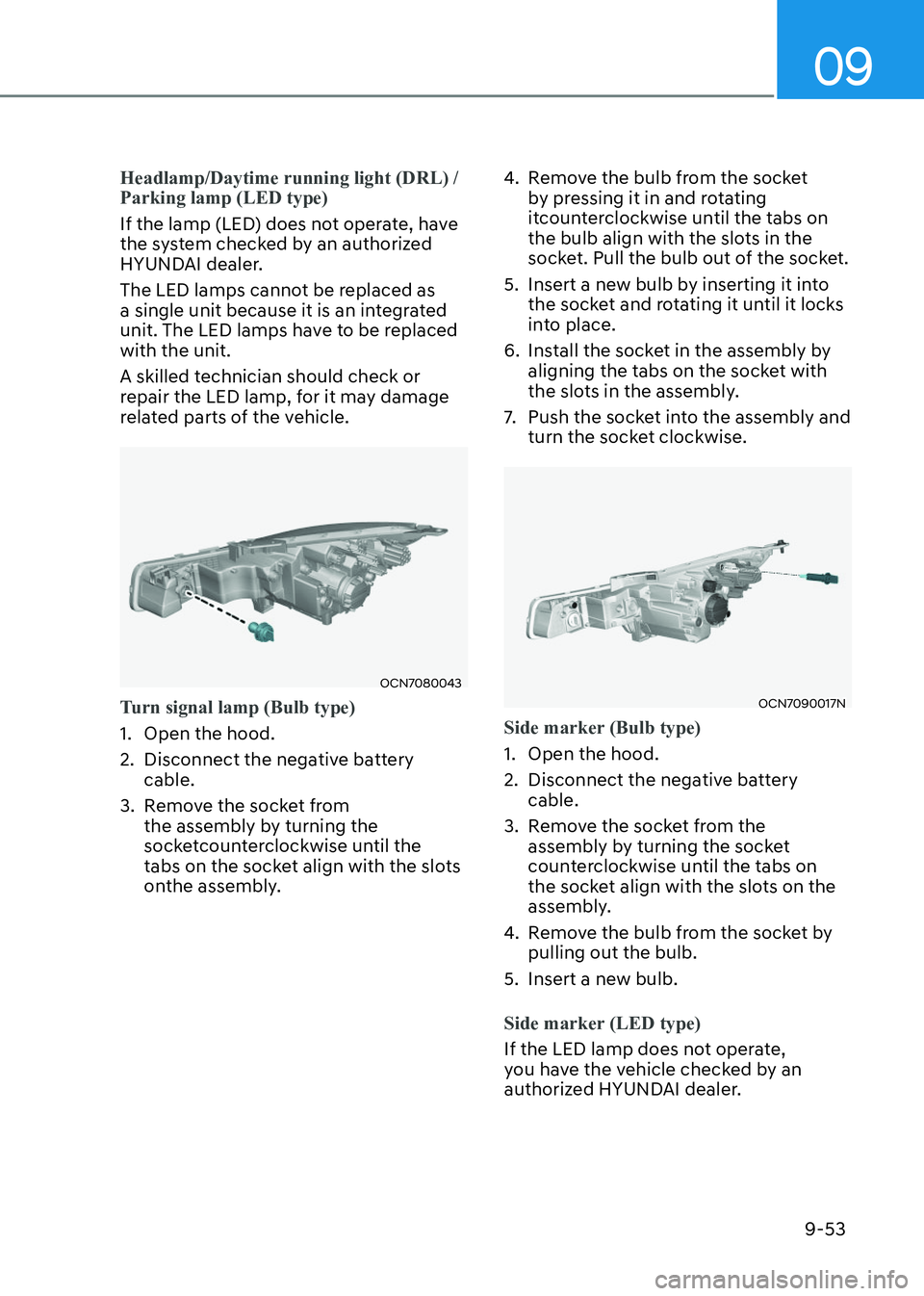
OCN7080043OCN7080043
Turn signal lamp (Bulb type)
1. Open the hood.
2. Disconnect the negative battery cable.
3. Remove the socket from the assembly by turning the
socketcounterclockwise until the
tabs on the socket align with the slots
onthe assembly. 4. Remove the bulb from the socket
by pressing it in and rotating
itcounterclockwise until the tabs on
the bulb align with the slots in the
socket. Pull the bulb out of the socket.
5. Insert a new bulb by inserting it into the socket and rotating it until it locks
into place.
6. Install the socket in the assembly by aligning the tabs on the socket with
the slots in the assembly.
7. Push the socket into the assembly and turn the socket clockwise.
OCN7090017NOCN7090017N
Side marker (Bulb type)
1. Open the hood.
2. Disconnect the negative battery cable.
3. Remove the socket from the assembly by turning the socket
counterclockwise until the tabs on
the socket align with the slots on the
assembly.
4. Remove the bulb from the socket by pulling out the bulb.
5. Insert a new bulb.
Side marker (LED type)
If the LED lamp does not operate,
you have the vehicle checked by an
authorized HYUNDAI dealer.
Page 504 of 529
09
9-55
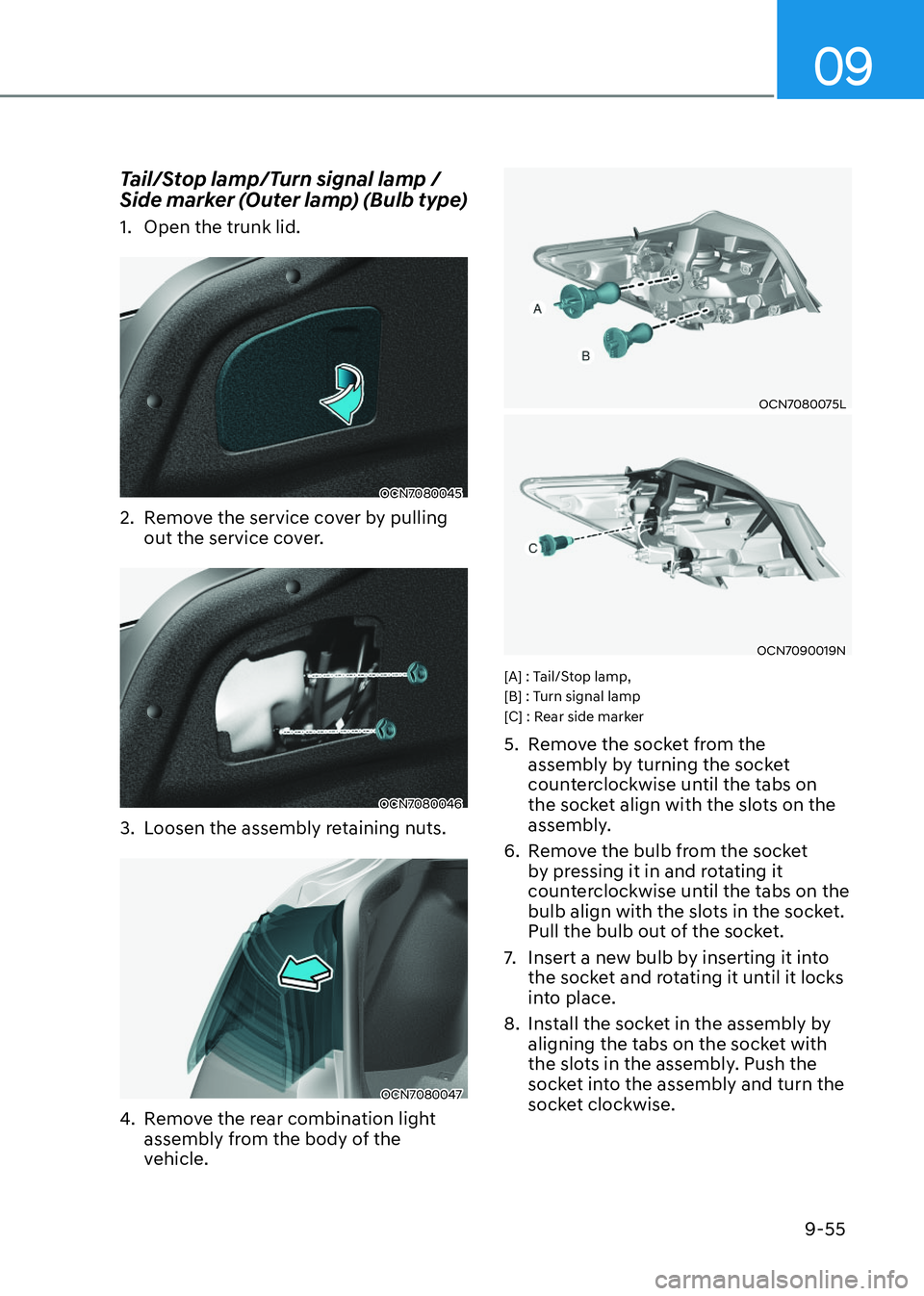
Tail/Stop lamp/Turn signal lamp /
Side marker (Outer lamp) (Bulb type)
1. Open the trunk lid.
OCN7080045OCN7080045
2. Remove the service cover by pulling out the service cover.
OCN7080046OCN7080046
3. Loosen the assembly retaining nuts.
OCN7080047OCN7080047
4. Remove the rear combination light assembly from the body of the
vehicle.
OCN7080075LOCN7080075L
OCN7090019NOCN7090019N
[A] : Tail/Stop lamp,
[B] : Turn signal lamp
[C] : Rear side marker
5. Remove the socket from the assembly by turning the socket
counterclockwise until the tabs on
the socket align with the slots on the
assembly.
6. Remove the bulb from the socket by pressing it in and rotating it
counterclockwise until the tabs on the
bulb align with the slots in the socket.
Pull the bulb out of the socket.
7. Insert a new bulb by inserting it into the socket and rotating it until it locks
into place.
8. Install the socket in the assembly by aligning the tabs on the socket with
the slots in the assembly. Push the
socket into the assembly and turn the
socket clockwise.
Page 505 of 529
Maintenance
9-56
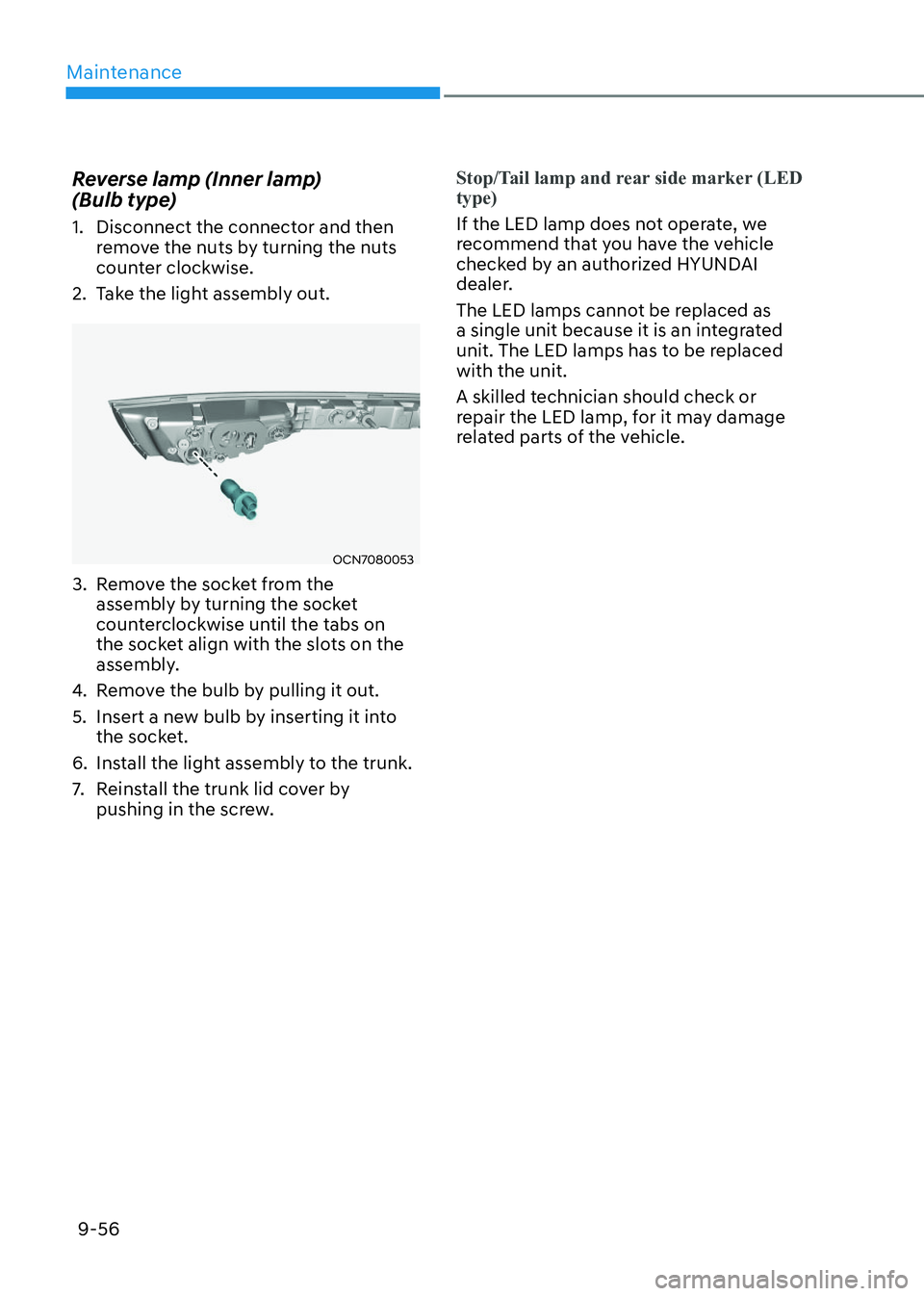
Reverse lamp (Inner lamp)
(Bulb type)
1. Disconnect the connector and then
remove the nuts by turning the nuts
counter clockwise.
2. Take the light assembly out.
OCN7080053OCN7080053
3. Remove the socket from the assembly by turning the socket
counterclockwise until the tabs on
the socket align with the slots on the
assembly.
4. Remove the bulb by pulling it out.
5. Insert a new bulb by inserting it into the socket.
6. Install the light assembly to the trunk.
7. Reinstall the trunk lid cover by pushing in the screw.
Stop/Tail lamp and rear side marker (LED type)
If the LED lamp does not operate, we
recommend that you have the vehicle
checked by an authorized HYUNDAI
dealer.
The LED lamps cannot be replaced as
a single unit because it is an integrated
unit. The LED lamps has to be replaced with the unit.
A skilled technician should check or
repair the LED lamp, for it may damage
related parts of the vehicle.
Page 506 of 529
![HYUNDAI ELANTRA HYBRID 2022 User Guide 09
9-57
High Mounted Stop Lamp
Replacement
OCN7080032OCN7080032
OAD075042OAD075042
[A] : High mounted stop lamp
1. Open the trunk.
2. Remove the socket by turning it
counterclockwise until the](/img/35/56241/w960_56241-505.png "HYUNDAI ELANTRA HYBRID 2022 User Guide 09
9-57
High Mounted Stop Lamp
Replacement
OCN7080032OCN7080032
OAD075042OAD075042
[A] : High mounted stop lamp
1. Open the trunk.
2. Remove the socket by turning it
counterclockwise until the")
09
9-57
High Mounted Stop Lamp
Replacement
OCN7080032OCN7080032
OAD075042OAD075042
[A] : High mounted stop lamp
1. Open the trunk.
2. Remove the socket by turning it
counterclockwise until the tabs on the
socket align with the slots.
3. Remove the bulb from the socket by pressing it in and rotating it
counterclockwise until the tabs on the
bulb align with the slots in the socket.
Pull the bulb out of the socket.
4. Insert a new bulb by inserting it into the socket and rotating it until it locks
into place.
5. Install the socket in the assembly by aligning the tabs on the socket with
the slots in the assembly.
Push the socket into the assembly and
turn the socket clockwise.
License Plate Light Bulb
Replacement
OCN7H090020OCN7H090020
1. Using a flat-blade screwdriver gently pry the lens cover from the lamp housing.
2. Remove the bulb by pulling it straight out.
3. Install a new bulb.
4. Reinstall in the reverse order.
Page 507 of 529
Maintenance
9-58
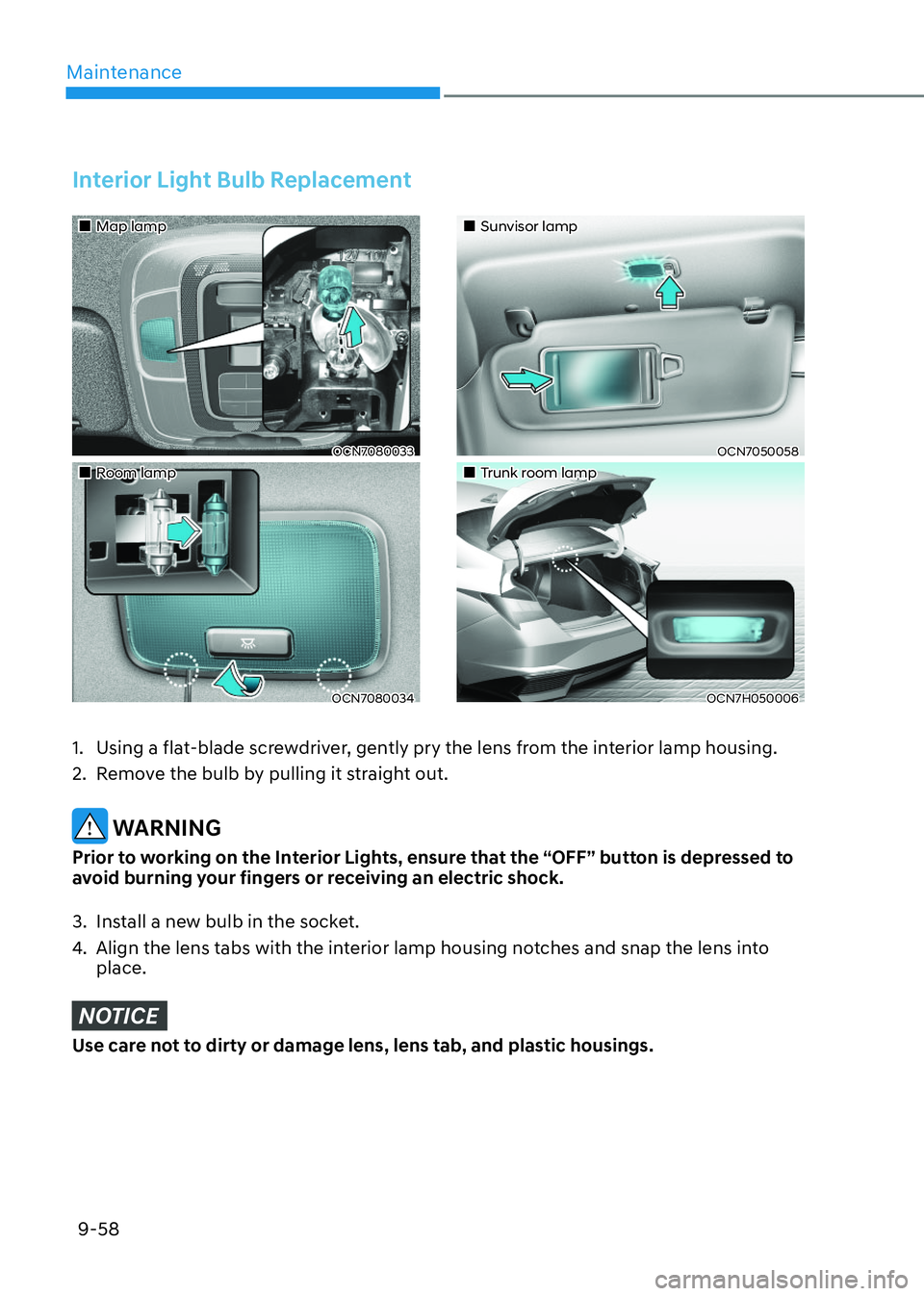
Interior Light Bulb Replacement
Map lampMap lamp
OCN7080033OCN7080033
Room lampRoom lamp
OCN7080034OCN7080034
Sunvisor lampSunvisor lamp
OCN7050058OCN7050058
Trunk room lampTrunk room lamp
OCN7H050006OCN7H050006
1. Using a flat-blade screwdriver, gently pry the lens from the interior lamp housing.
2. Remove the bulb by pulling it straight out.
WARNING
Prior to working on the Interior Lights, ensure that the “OFF” button is depressed to
avoid burning your fingers or receiving an electric shock.
3. Install a new bulb in the socket.
4. Align the lens tabs with the interior lamp housing notches and snap the lens into place.
NOTICE
Use care not to dirty or damage lens, lens tab, and plastic housings.
Page 519 of 529

Index
I-2
A
Accessing Your Vehicle ......................................................................................... 5-4
Immobilizer System ........................................................................................ 5-14
Remote Key ........................................................................................................ 5-4
Smart Key ........................................................................................................... 5-7
Air Bag - Advanced Supplemental Restraint System ..........................................3-36
Additional Safety Precautions .......................................................................... 3-56
Air Bag Warning Labels ................................................................................... 3-56
How Does the Air Bag System Operate? .........................................................3-41
Occupant Classification System (OCS) ...........................................................3-46
SRS Care .......................................................................................................... 3-55
What to Expect After an Air Bag Inflates ........................................................3-45
Where Are the Air Bags? .................................................................................. 3-38
Why Didn’t My Air Bag Go Off in a Collision? ..............................................3-51
Air Cleaner........................................................................................................... 9-22
Filter Replacement ........................................................................................... 9-22
Air Conditioning System ..................................................................................... 2-10
Anti-Lock Brake System (ABS) .......................................................................... 6-32
Electronic Stability Control (ESC) ................................................................... 6-33
Good Braking Practices .................................................................................... 6-37
Hill-Start Assist Control (HAC) ....................................................................... 6-36
Vehicle Stability Management (VSM) .............................................................6-35
Appearance Care .................................................................................................. 9-57
Interior Care ..................................................................................................... 9-62
Automatic Climate Control System ..................................................................... 5-68
Automatic Heating and Air Conditioning ........................................................5-69
Manual Heating and Air Conditioning .............................................................5-70
System Maintenance ........................................................................................ 5-78
System Operation ............................................................................................. 5-76
B
Basic Troubleshooting Guide .............................................................................. 8-27
Before Driving ....................................................................................................... 6-4
Before Entering the Vehicle ............................................................................... 6-4
Before Starting ................................................................................................... 6-4
Blind-Spot Collision-Avoidance Assist (BCA) ..................................................7-36
Detecting sensor ............................................................................................... 7-37
Limitations of Blind-Spot Collision-Avoidance Assist ....................................7-45