climate control HYUNDAI ELANTRA HYBRID 2022 User Guide
[x] Cancel search | Manufacturer: HYUNDAI, Model Year: 2022, Model line: ELANTRA HYBRID, Model: HYUNDAI ELANTRA HYBRID 2022Pages: 529, PDF Size: 38.79 MB
Page 223 of 529
Convenient Features
5 -76
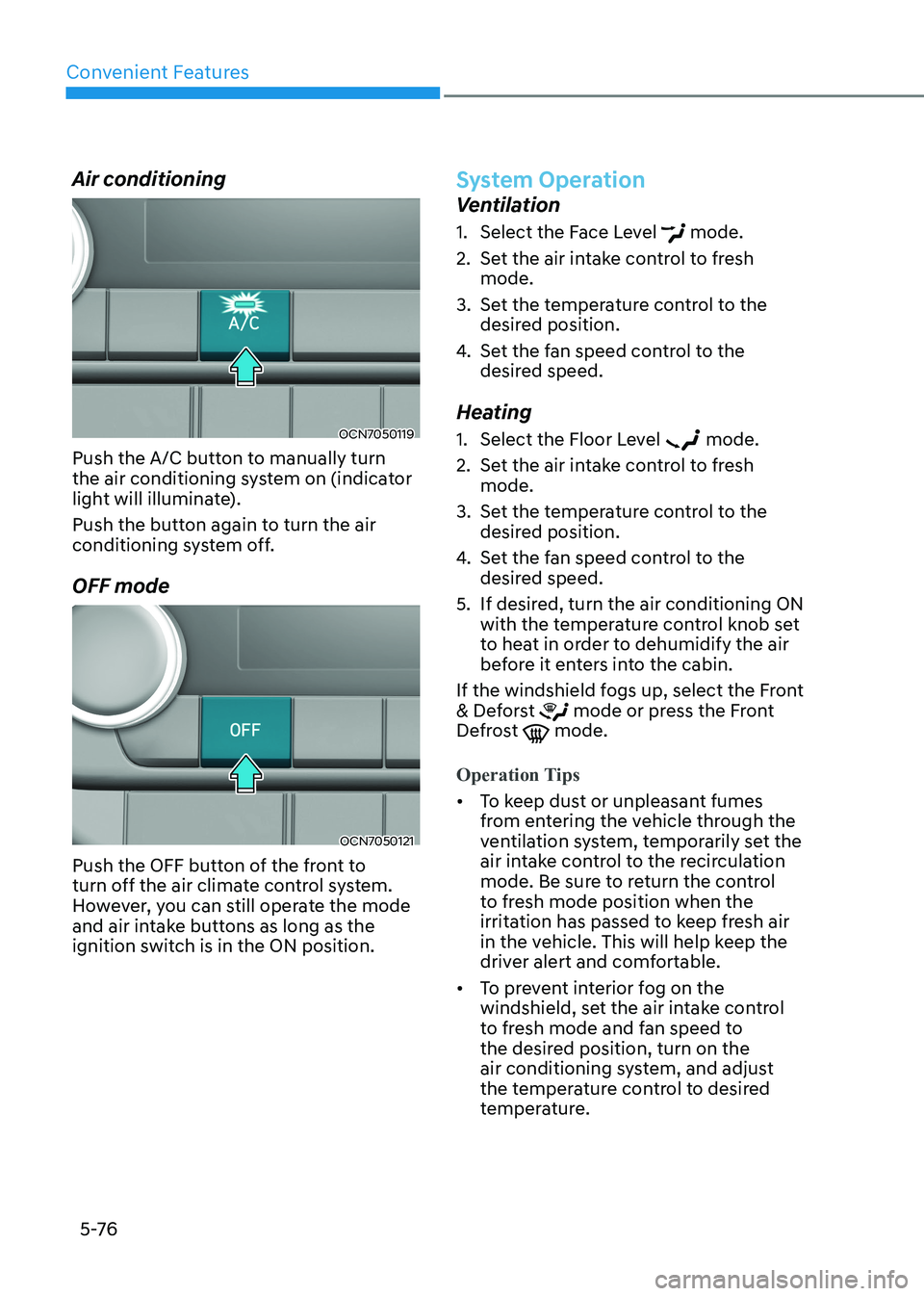
Air conditioning
OCN7050119
Push the A/C button to manually turn
the air conditioning system on (indicator
light will illuminate).
Push the button again to turn the air
conditioning system off. OFF mode
OCN7050121
Push the OFF button of the front to
turn off the air climate control system.
However, you can still operate the mode
and air intake buttons as long as the
ignition switch is in the ON position.
System Operation
Ventilation
1. Select the Face Level
mode.
2. Set the air intake control to fresh mode.
3. Set the temperature control to the desired position.
4. Set the fan speed control to the
desired speed.
Heating
1. Select the Floor Level
mode.
2. Set the air intake control to fresh mode.
3. Set the temperature control to the desired position.
4. Set the fan speed control to the
desired speed.
5. If desired, turn the air conditioning ON
with the temperature control knob set
to heat in order to dehumidify the air
before it enters into the cabin.
If the windshield fogs up, select the Front
& Deforst
mode or press the Front
Defrost mode.
Operation Tips
• To keep dust or unpleasant fumes
from entering the vehicle through the
ventilation system, temporarily set the
air intake control to the recirculation
mode. Be sure to return the control
to fresh mode position when the
irritation has passed to keep fresh air
in the vehicle. This will help keep the
driver alert and comfortable.
• To prevent interior fog on the
windshield, set the air intake control
to fresh mode and fan speed to
the desired position, turn on the
air conditioning system, and adjust
the temperature control to desired
temperature.
Page 228 of 529
05
5-81
WARNING
Windshield heating
Do not use the
or position
during cooling operation in extremely
humid weather. The difference between
the temperature of the outside air and
that of the windshield could cause the
outer surface of the windshield to fog
up, causing loss of visibility. In this case,
set the mode selection knob or button
to the
position and fan speed control
knob or button to lower speed. • For maximum defrost performance,
set the temperature control knob
to the highest temperature setting
(rotated all the way to the right) and
the fan speed control to the highest
setting.
• If warm air to the floor is desired while
defrosting or defogging, set the mode
to the floor-defrost position.
• Before driving, clear all snow and ice
from the windshield, rear window,
side view mirrors, and all side
windows.
• Clear all snow and ice from the
hood and air inlet in the cowl grill
to improve heater and defroster
efficiency and to reduce the
probability of fogging up inside of the windshield.
Automatic Climate Control
System
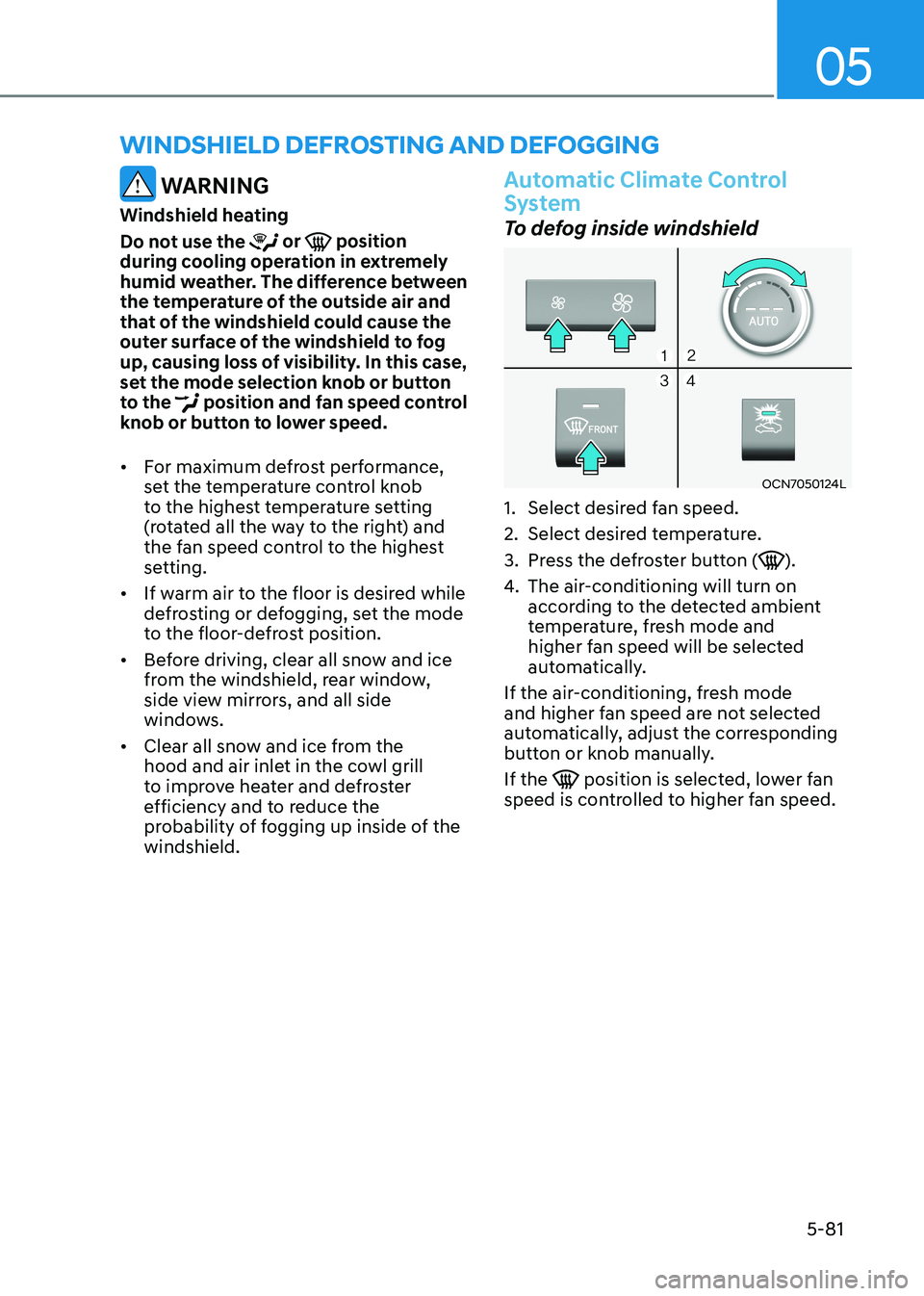
To defog inside windshield
OCN7050124L
1. Select desired fan speed.
2. Select desired temperature.
3. Press the defroster button (
).
4. The air-conditioning will turn on
according to the detected ambient
temperature, fresh mode and
higher fan speed will be selected
automatically.
If the air-conditioning, fresh mode
and higher fan speed are not selected
automatically, adjust the corresponding
button or knob manually. If the
position is selected, lower fan
speed is controlled to higher fan speed.
WinDshielD DeFrosting AnD DeFogging
Page 229 of 529
Convenient Features
5-82
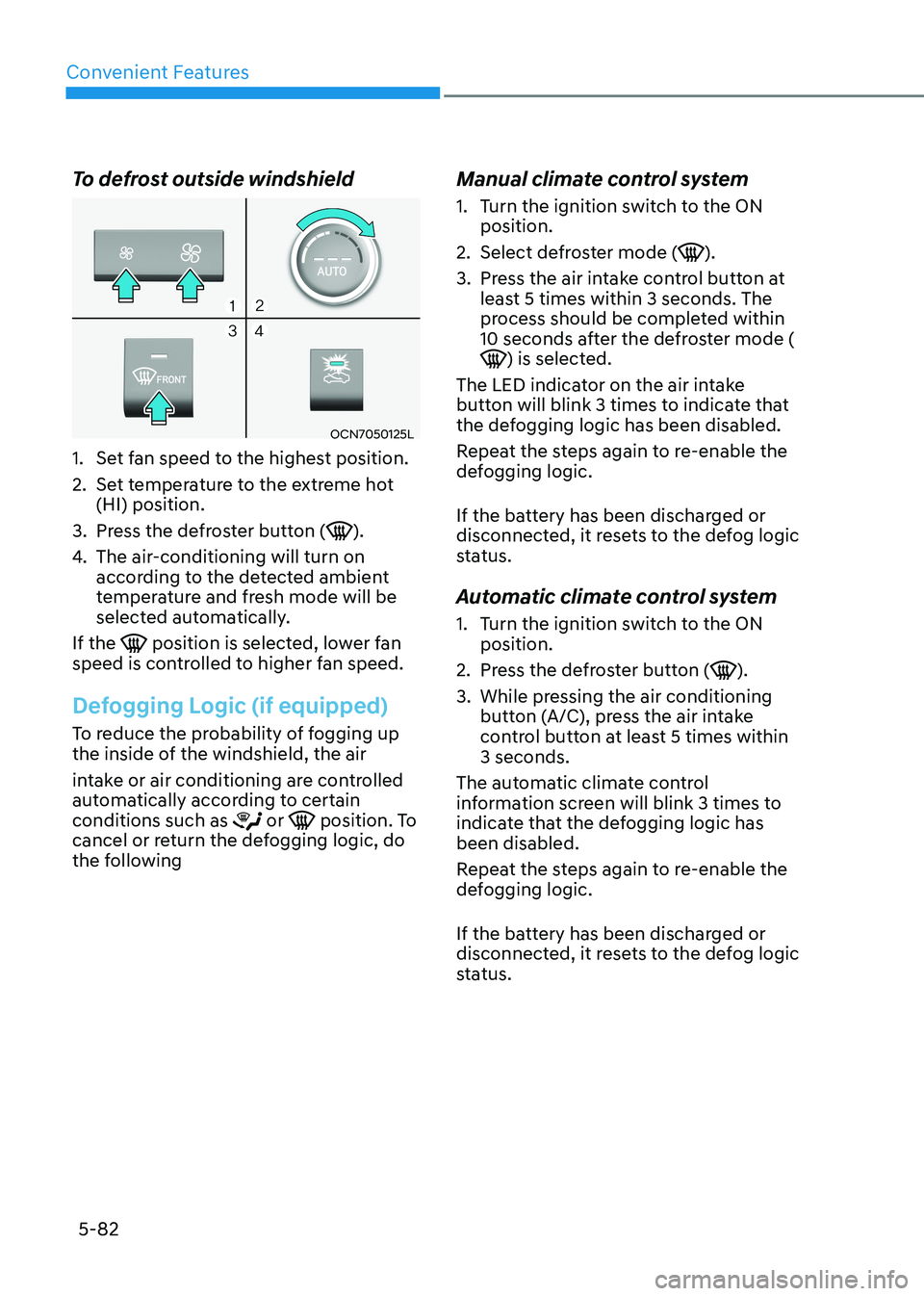
To defrost outside windshield
OCN7050125L
1. Set fan speed to the highest position.
2. Set temperature to the extreme hot (HI) position.
3. Press the defroster button (
).
4. The air-conditioning will turn on
according to the detected ambient
temperature and fresh mode will be
selected automatically.
If the
position is selected, lower fan
speed is controlled to higher fan speed.
Defogging Logic (if equipped)
To reduce the probability of fogging up
the inside of the windshield, the air
intake or air conditioning are controlled
automatically according to certain conditions such as
or position. To
cancel or return the defogging logic, do
the following Manual climate control system
1. Turn the ignition switch to the ON
position.
2. Select defroster mode (
).
3. Press the air intake control button at least 5 times within 3 seconds. The
process should be completed within
10 seconds after the defroster mode (
) is selected.
The LED indicator on the air intake
button will blink 3 times to indicate that
the defogging logic has been disabled.
Repeat the steps again to re-enable the
defogging logic.
If the battery has been discharged or
disconnected, it resets to the defog logic
status.
Automatic climate control system
1. Turn the ignition switch to the ON position.
2. Press the defroster button (
).
3. While pressing the air conditioning button (A/C), press the air intake
control button at least 5 times within 3 seconds.
The automatic climate control
information screen will blink 3 times to
indicate that the defogging logic has been disabled.
Repeat the steps again to re-enable the
defogging logic.
If the battery has been discharged or
disconnected, it resets to the defog logic
status.
Page 232 of 529
05
5-85
Sunroof Inside Air Recirculation (if equipped)
When the sunroof is opened, outside
(fresh) air will be automatically selected.
At this time, if you press the air intake
control button, recirculated air position
will be selected but will change back
to outside (fresh) air after 3 minutes.
When the sunroof is closed, the air
intake position will return to the original
position that was selected.
Auto Comfort Control
(for driver’s seat) (if equipped)
The temperature of the driver’s seat
warmer, air ventilation seat and
heated steering wheel is automatically
controlled depending on the inside and
outside temperature of the vehicle when the engine is running.
To use this function, it must be
activated from the Settings menu in the
Infotainment system screen. Select: - All menus → Setup → Vehicle → Heated
/ Ventilated Features
For more details on Auto Comfort
Control, refer to “Seat warmers and
air ventilation seat” in chapter 3, and
“Heated steering wheel” in chapter 5
Automatic Ventilation (if equipped)
The system automatically selects the
fresh mode when the climate control
system operates over a certain period of
time (approximately 30 minutes) in low
temperature with the recirculation mode
selected.
To cancel or reactivate the
Automatic Ventilation
When the air conditioning system is on,
select Face Level
mode and press the
air recirculation mode button at least 5
times within 3 seconds while pressing
the A/C button.
When the automatic ventilation is
canceled, the indicator blinks 3 times.
When the automatic ventilation is
activated, the indicator blinks 6 times.
climate cOntROl aDDitiOnal featuReS
Page 269 of 529
Driving your vehicle
6-24
Brake SyStem
Power Brakes
Your vehicle has power-assisted brakes
that adjust automatically through normal usage.
If the engine is not running or is turned
off while driving, the power assist for
the brakes will not work. You can still
stop your vehicle by applying greater
force to the brake pedal than typical.
The stopping distance, however, will be
longer than with power brakes.
When the engine is not running, the
reserve brake power is partially depleted
each time the brake pedal is applied.
Do not pump the brake pedal when the
power assist has been interrupted.
Only pump the brakes on slippery
surfaces if the power assist has been
interrupted to maintain steering control.
Do not pump the brakes on slippery
surfaces if the brakes are operating
normally.
WARNING
Take the following precautions: • Do not drive with your foot resting
on the brake pedal. This will create
abnormal high brake temperatures,
excessive brake lining and pad wear,
and increased stopping distances.
• When descending down a long or
steep hill, move the gear shift button
to Manual Shift Mode and manually
downshift to a lower gear in order
to control your speed without using
the brake pedal excessively. Applying
the brakes continuously will cause
the brakes to overheat and could
result in a temporary loss of braking
performance.
• Wet brakes may impair the vehicle's
ability to safely slow down; the
vehicle may also pull to one side
when the brakes are applied.
Applying the brakes lightly will
indicate whether they have been
affected in this way. Always test your
brakes in this fashion after driving
through deep water. To dry the
brakes, lightly tap the brake pedal to
heat up the brakes while maintaining
a safe forward speed until brake
performance returns to normal.
Avoid driving at high speeds until the
brakes function correctly.
Disc Brakes Wear Indicator
When your brake pads are worn and new
pads are required, you will hear a high
pitched warning sound from your front
or rear brakes. You may hear this sound
come and go or it may occur whenever
you depress the brake pedal.
Note that some driving conditions or
climates may cause a brake squeal
when you first apply (or lightly apply)
the brakes. This is normal and does not
indicate a problem with your brakes.
NOTICE
To avoid costly brake repairs, do not
continue to drive with worn brake pads.
Information
Always replace brake pads as complete
front or rear axle sets.
Page 426 of 529
08
8-5
Before Jump Starting
This vehicle does not have a regular 12V
battery that needs periodic replacement.
It is lithium ion polymer type integrated
into the HEV high voltage battery. The
vehicle has a 12V battery protection
system that cuts 12V battery from vehicle
draw to prevent full discharge.
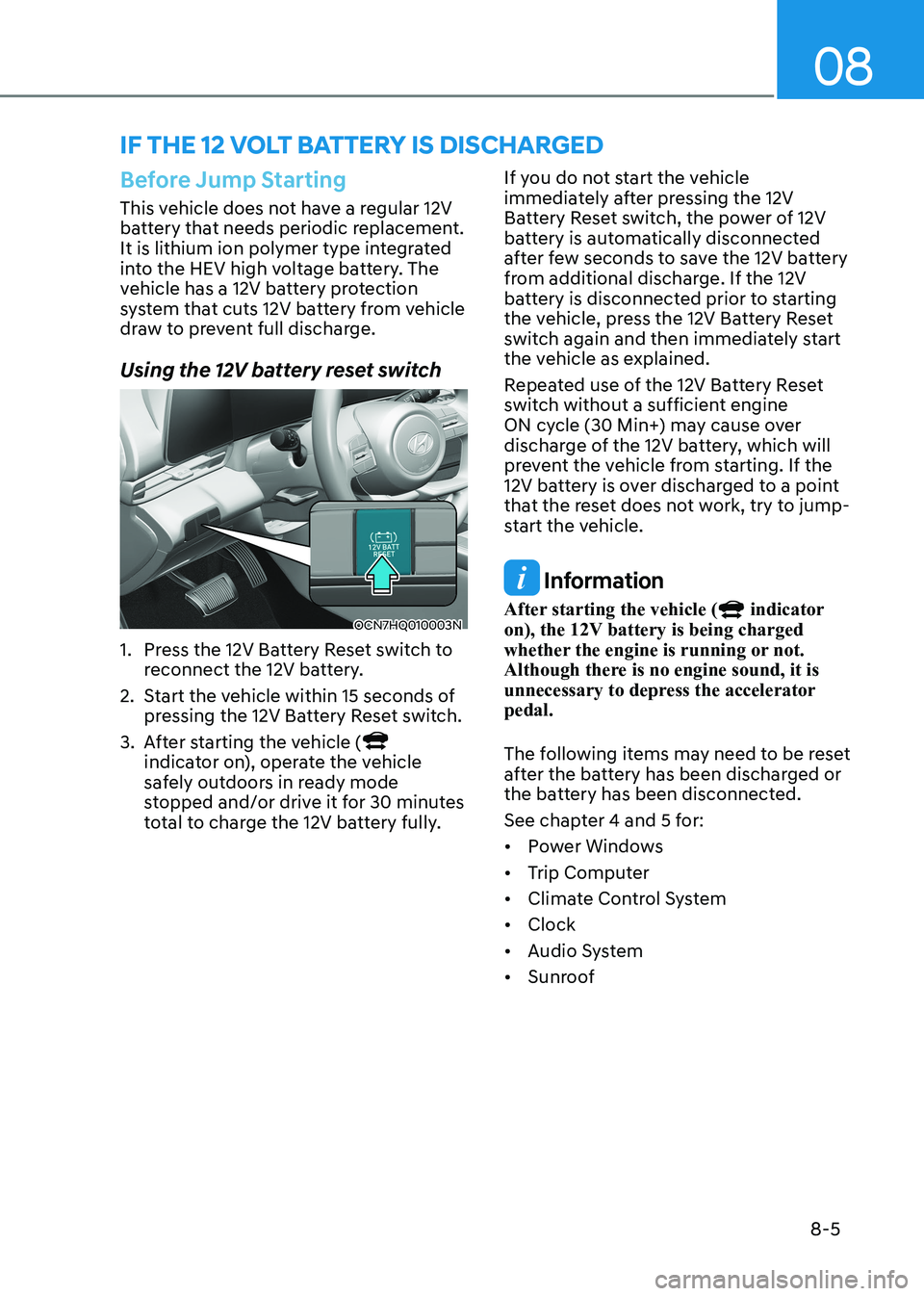
Using the 12V battery reset switch
OCN7HQ010003N
1. Press the 12V Battery Reset switch to reconnect the 12V battery.
2. Start the vehicle within 15 seconds of pressing the 12V Battery Reset switch.
3. After starting the vehicle (
indicator on), operate the vehicle
safely outdoors in ready mode
stopped and/or drive it for 30 minutes
total to charge the 12V battery fully. If you do not start the vehicle
immediately after pressing the 12V
Battery Reset switch, the power of 12V
battery is automatically disconnected
after few seconds to save the 12V battery
from additional discharge. If the 12V
battery is disconnected prior to starting
the vehicle, press the 12V Battery Reset
switch again and then immediately start
the vehicle as explained.
Repeated use of the 12V Battery Reset
switch without a sufficient engine
ON cycle (30 Min+) may cause over
discharge of the 12V battery, which will
prevent the vehicle from starting. If the
12V battery is over discharged to a point
that the reset does not work, try to jump-
start the vehicle.
Information
After starting the vehicle (
indicator
on), the 12V battery is being charged
whether the engine is running or not.
Although there is no engine sound, it is
unnecessary to depress the accelerator pedal.
The following items may need to be reset
after the battery has been discharged or
the battery has been disconnected.
See chapter 4 and 5 for:• Power Windows
• Trip Computer
• Climate Control System
• Clock
• Audio System
• Sunroof
iF tHe 12 volt Battery is disCHarged
Page 484 of 529
09
9-35
5. Maximum permissible inflation
pressure
This number is the greatest amount
of air pressure that should be put in
the tire. Do not exceed the maximum
permissible inflation pressure. Refer
to the Tire and Loading Information
label for recommended inflation
pressure.
6. Maximum load rating
This number indicates the maximum
load in kilograms and pounds that
can be carried by the tire. When
replacing the tires on the vehicle,
always use a tire that has the same
load rating as the factory installed
tire.
7. Uniform tire quality grading
Quality grades can be found where
applicable on the tire sidewall
between tread shoulder and maximum section width.
For example:TREAD WEAR 200
TRACTION AA
TEMPERATURE A
Tread wear
The tread wear grade is a
comparative rating based on the
wear rate of the tire when tested
under controlled conditions on a
specified government test course.
For example, a tire graded 150 would
wear one-and-a-half times (1½) as
well on the government course as a
tire graded 100.
The relative performance of tires depends upon the actual conditions
of their use, however, and may
depart significantly from the norm
due to variations in driving habits,
service practices and differences in
road characteristics and climate.
These grades are molded on the
sidewalls of passenger vehicle tires.
The tires available as standard or
optional equipment on your vehicle
may vary with respect to grade.
Traction AA, A, B & C
The traction grades, from highest
to lowest, are AA, A, B and C. Those
grades represent the tire’s ability to
stop on wet pavement as measured
under controlled conditions on
specified government test surfaces
of asphalt and concrete. A tire
marked C may have poor traction
performance.
Page 519 of 529

Index
I-2
A
Accessing Your Vehicle ......................................................................................... 5-4
Immobilizer System ........................................................................................ 5-14
Remote Key ........................................................................................................ 5-4
Smart Key ........................................................................................................... 5-7
Air Bag - Advanced Supplemental Restraint System ..........................................3-36
Additional Safety Precautions .......................................................................... 3-56
Air Bag Warning Labels ................................................................................... 3-56
How Does the Air Bag System Operate? .........................................................3-41
Occupant Classification System (OCS) ...........................................................3-46
SRS Care .......................................................................................................... 3-55
What to Expect After an Air Bag Inflates ........................................................3-45
Where Are the Air Bags? .................................................................................. 3-38
Why Didn’t My Air Bag Go Off in a Collision? ..............................................3-51
Air Cleaner........................................................................................................... 9-22
Filter Replacement ........................................................................................... 9-22
Air Conditioning System ..................................................................................... 2-10
Anti-Lock Brake System (ABS) .......................................................................... 6-32
Electronic Stability Control (ESC) ................................................................... 6-33
Good Braking Practices .................................................................................... 6-37
Hill-Start Assist Control (HAC) ....................................................................... 6-36
Vehicle Stability Management (VSM) .............................................................6-35
Appearance Care .................................................................................................. 9-57
Interior Care ..................................................................................................... 9-62
Automatic Climate Control System ..................................................................... 5-68
Automatic Heating and Air Conditioning ........................................................5-69
Manual Heating and Air Conditioning .............................................................5-70
System Maintenance ........................................................................................ 5-78
System Operation ............................................................................................. 5-76
B
Basic Troubleshooting Guide .............................................................................. 8-27
Before Driving ....................................................................................................... 6-4
Before Entering the Vehicle ............................................................................... 6-4
Before Starting ................................................................................................... 6-4
Blind-Spot Collision-Avoidance Assist (BCA) ..................................................7-36
Detecting sensor ............................................................................................... 7-37
Limitations of Blind-Spot Collision-Avoidance Assist ....................................7-45
Page 520 of 529

I
I-3
Brake System ....................................................................................................... 6-24
Auto Hold ......................................................................................................... 6-29
Disc Brakes Wear Indicator .............................................................................. 6-24
Electronic Parking Brake (EPB) ...................................................................... 6-25
Power Brakes .................................................................................................... 6-24
Brake/Clutch Fluid .............................................................................................. 9-20
Checking the Brake/Clutch Fluid Level ...........................................................9-20
Bulb Wattage .......................................................................................................... 2-8
CABIN Air Filter ................................................................................................. 9-24
Filter Inspection ................................................................................................ 9-24
Filter Replacement ........................................................................................... 9-24
C Child Restraint System (CRS) ............................................................................. 3-28
Children Always in the Rear ............................................................................ 3-28
Installing a Child Restraint System (CRS) .......................................................3-30
Selecting a Child Restraint System (CRS) .......................................................3-29
Climate Control Additional Features ................................................................... 5-85
Auto Comfort Control (for driver’s seat) ........................................................5-85
Automatic Ventilation ...................................................................................... 5-85
Sunroof Inside Air Recirculation ...................................................................... 5-85
Coasting Guide .................................................................................................... 6-23
Cruise Control (CC) ............................................................................................ 7-61
DDeclaration of Conormity .................................................................................. 7-124
Dimensions ............................................................................................................ 2-7
Door Locks .......................................................................................................... 5-16
Automatic Door Lock and Unlock Features ....................................................5-20
Child-Protector Rear Door Locks .................................................................... 5-20
Operating Door Locks from Inside the Vehicle................................................ 5-17
Operating Door Locks from Outside the Vehicle .............................................5-16
Drive Mode Integrated Control System ............................................................... 6-38
Drive Mode ...................................................................................................... 6-38
Smart shift on trip computer ............................................................................. 6-41
Driver Attention Warning (DAW) ...................................................................... 7-55
Detecting sensor ............................................................................................... 7-55
Limitations of Driver Attention Warning ........................................................7-58
Driver position memory system........................................................................... 5-23
Page 529 of 529
Index
I-12
W
Washer Fluid ........................................................................................................ 9-21
Checking the Washer Fluid Level .................................................................... 9-21
Windows .............................................................................................................. 5-39
Power Windows ................................................................................................ 5-40
Windshield Defrosting and Defogging ................................................................ 5-81
Auto Defogging System ................................................................................... 5-83
Automatic Climate Control System ................................................................. 5-81
Defogging Logic ............................................................................................. 5-82
Defroster ........................................................................................................... 5-84
Winter Driving ..................................................................................................... 6-45
Snow or Icy Conditions .................................................................................... 6-45
Winter Precautions ........................................................................................... 6-46
Wiper Blades ........................................................................................................ 9-25
Blade Inspection ............................................................................................... 9-25
Blade Replacement ........................................................................................... 9-25
Wipers and Washers ............................................................................................. 5-66
Windshield Washers ......................................................................................... 5-67
Windshield Wipers ........................................................................................... 5-66