cooling system HYUNDAI ELANTRA SE 2017 User Guide
[x] Cancel search | Manufacturer: HYUNDAI, Model Year: 2017, Model line: ELANTRA SE, Model: HYUNDAI ELANTRA SE 2017Pages: 586, PDF Size: 15.29 MB
Page 485 of 586
7-25
7
Maintenance
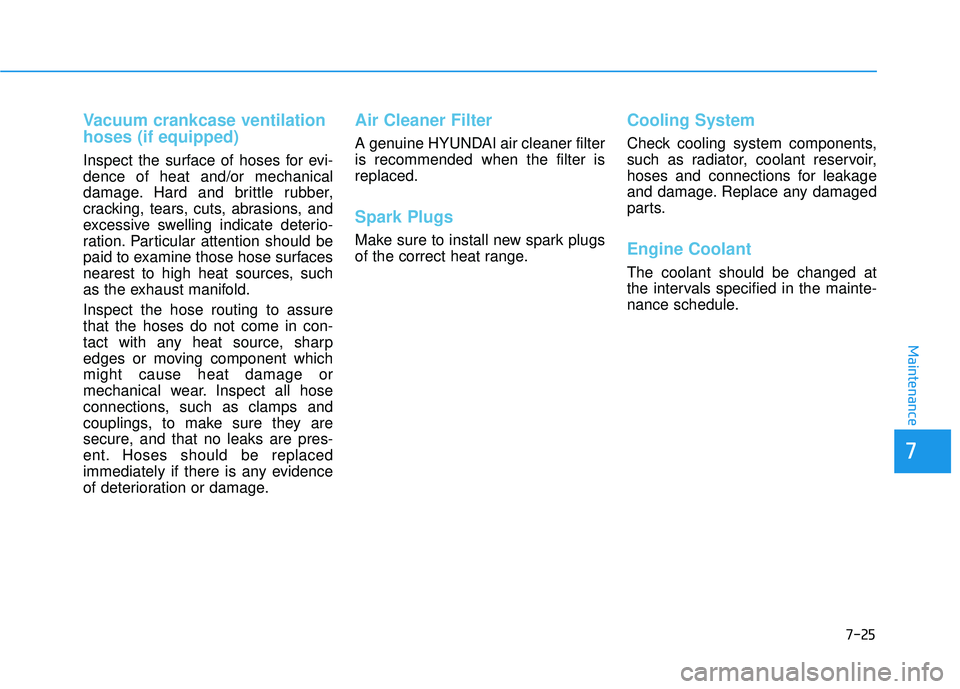
Vacuum crankcase ventilation
hoses (if equipped)
Inspect the surface of hoses for evi-
dence of heat and/or mechanical
damage. Hard and brittle rubber,
cracking, tears, cuts, abrasions, and
excessive swelling indicate deterio-
ration. Particular attention should be
paid to examine those hose surfaces
nearest to high heat sources, such
as the exhaust manifold.
Inspect the hose routing to assure
that the hoses do not come in con-
tact with any heat source, sharp
edges or moving component which
might cause heat damage or
mechanical wear. Inspect all hose
connections, such as clamps and
couplings, to make sure they are
secure, and that no leaks are pres-
ent. Hoses should be replaced
immediately if there is any evidence
of deterioration or damage.
Air Cleaner Filter
A genuine HYUNDAI air cleaner filter
is recommended when the filter is
replaced.
Spark Plugs
Make sure to install new spark plugs
of the correct heat range.
Cooling System
Check cooling system components,
such as radiator, coolant reservoir,
hoses and connections for leakage
and damage. Replace any damaged
parts.
Engine Coolant
The coolant should be changed at
the intervals specified in the mainte-
nance schedule.
Page 490 of 586
7-30
Maintenance
E
EN
N G
GI
IN
N E
E
C
C O
O O
OL
LA
A N
N T
T
The high-pressure cooling system
has a reservoir filled with year-round
antifreeze coolant. The reservoir is
filled at the factory.
Check the antifreeze protection and
coolant level at least once a year, at
the beginning of the winter season
and before traveling to a colder cli-
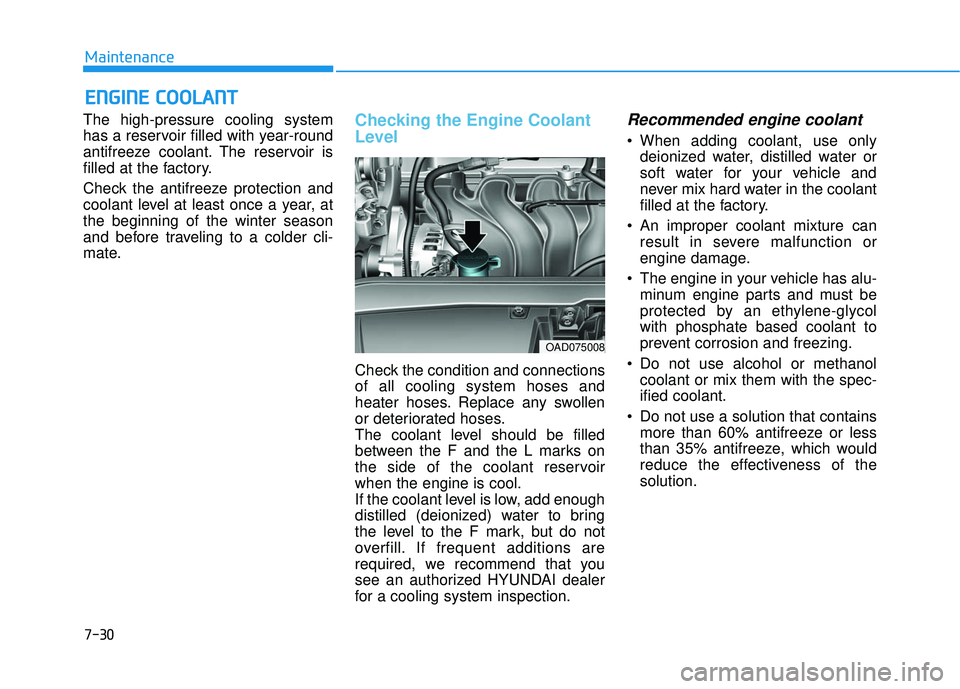
mate.Checking the Engine Coolant
Level
Check the condition and connections
of all cooling system hoses and
heater hoses. Replace any swollen
or deteriorated hoses.
The coolant level should be filled
between the F and the L marks on
the side of the coolant reservoir
when the engine is cool.
If the coolant level is low, add enough
distilled (deionized) water to bring
the level to the F mark, but do not
overfill. If frequent additions are
required, we recommend that you
see an authorized HYUNDAI dealer
for a cooling system inspection.
Recommended engine coolant
When adding coolant, use only
deionized water, distilled water or
soft water for your vehicle and
never mix hard water in the coolant
filled at the factory.
An improper coolant mixture can result in severe malfunction or
engine damage.
The engine in your vehicle has alu- minum engine parts and must be
protected by an ethylene-glycol
with phosphate based coolant to
prevent corrosion and freezing.
Do not use alcohol or methanol coolant or mix them with the spec-
ified coolant.
Do not use a solution that contains more than 60% antifreeze or less
than 35% antifreeze, which would
reduce the effectiveness of the
solution.
OAD075008
Page 491 of 586
7-31
7
Maintenance
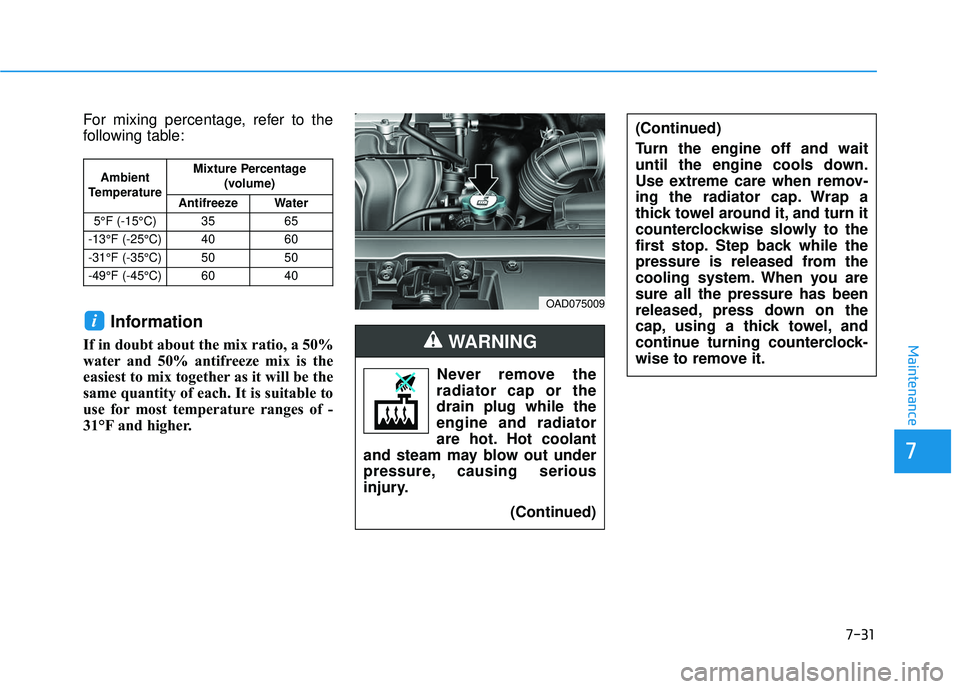
For mixing percentage, refer to the
following table:
Information
If in doubt about the mix ratio, a 50%
water and 50% antifreeze mix is the
easiest to mix together as it will be the
same quantity of each. It is suitable to
use for most temperature ranges of -
31°F and higher.
i
Ambient
Temperature Mixture Percentage
(volume)
Antifreeze Water
5°F (-15°C) 35 65
-13°F (-25°C) 40 60
-31°F (-35°C) 50 50
-49°F (-45°C) 60 40
Never remove the
radiator cap or the
drain plug while the
engine and radiator
are hot. Hot coolant
and steam may blow out under
pressure, causing serious
injury.
(Continued)
WARNING
(Continued)
Turn the engine off and wait
until the engine cools down.
Use extreme care when remov-
ing the radiator cap. Wrap a
thick towel around it, and turn it
counterclockwise slowly to the
first stop. Step back while the
pressure is released from the
cooling system. When you are
sure all the pressure has been
released, press down on the
cap, using a thick towel, and
continue turning counterclock-
wise to remove it.
OAD075009
Page 577 of 586
I-4
Bulb replacementFront parking lamp .....................................................7-73
Front turn signal lamp ................................................7-73
Headlamp....................................................................7-73\
High mounted stop lamp ............................................7-86
Interior light bulb .......................................................7-88
License plate light bulb ..............................................7-87
Rear combination light bulb .......................................7-82
Side marker lamp .......................................................7-73
Side repeater lamp ......................................................7-82
Bulb wattage .....................................................................8-3\
Button start/stop, see engine start/stop button ..................5-9
Capacities (Lubricants) .....................................................3-6
Care Exterior care ...............................................................7-89
Interior care ................................................................7-95
Tire care ......................................................................7-\
44
Cartridge type fuse..........................................................7-65
Center console storage ..................................................3-150
Central door lock switch .................................................3-16
Certification label ...........................................................8-10
Chains Tire chains ..................................................................5-96
Changing a Tire with TPMS ...........................................6-14
Checking tire inflation pressure ......................................7-46 Child restraint system (CRS) ..........................................2-35
Booster seats...............................................................2-38
Children always in the rear ........................................2-35
Forward-facing child restraint system........................2-38
Installing a child restraint system (CRS) ...................2-38
Lower anchors and tether for children (LATCH system) .....................................................2-38
Rearward-facing child restraint system......................2-37
Securing a child restraint seat with "Tether Anchor" system......................................................................2-\
42
Securing a child restraint system with the LATCH anchors system ........................................................2-41
Securing a child restraint with a lap/shoulder belt.....2-43
Selecting a child restraint system (CRS) ...................2-36
Child-protector rear door locks.......................................3-19
Climate control air filter .................................................7-37
Clock ........................................................................\
.....3-156
Clothes hanger ..............................................................3-157
Combined instrument, see instrument cluster ................3-61
Compact spare tire replacement .....................................7-49
Coolant ........................................................................\
....7-30
Cooling fluid, see engine coolant ...................................7-30
Crankcase emission control system ................................7-96
Cruise control system .....................................................5-70
Cup holder.....................................................................3-1\
53
Curtain air bags ...............................................................2-50
Index
C