air conditioning HYUNDAI ELANTRA SEL 2021 Owner's Guide
[x] Cancel search | Manufacturer: HYUNDAI, Model Year: 2021, Model line: ELANTRA SEL, Model: HYUNDAI ELANTRA SEL 2021Pages: 570, PDF Size: 52.21 MB
Page 469 of 570
Emergency Situations
8-6
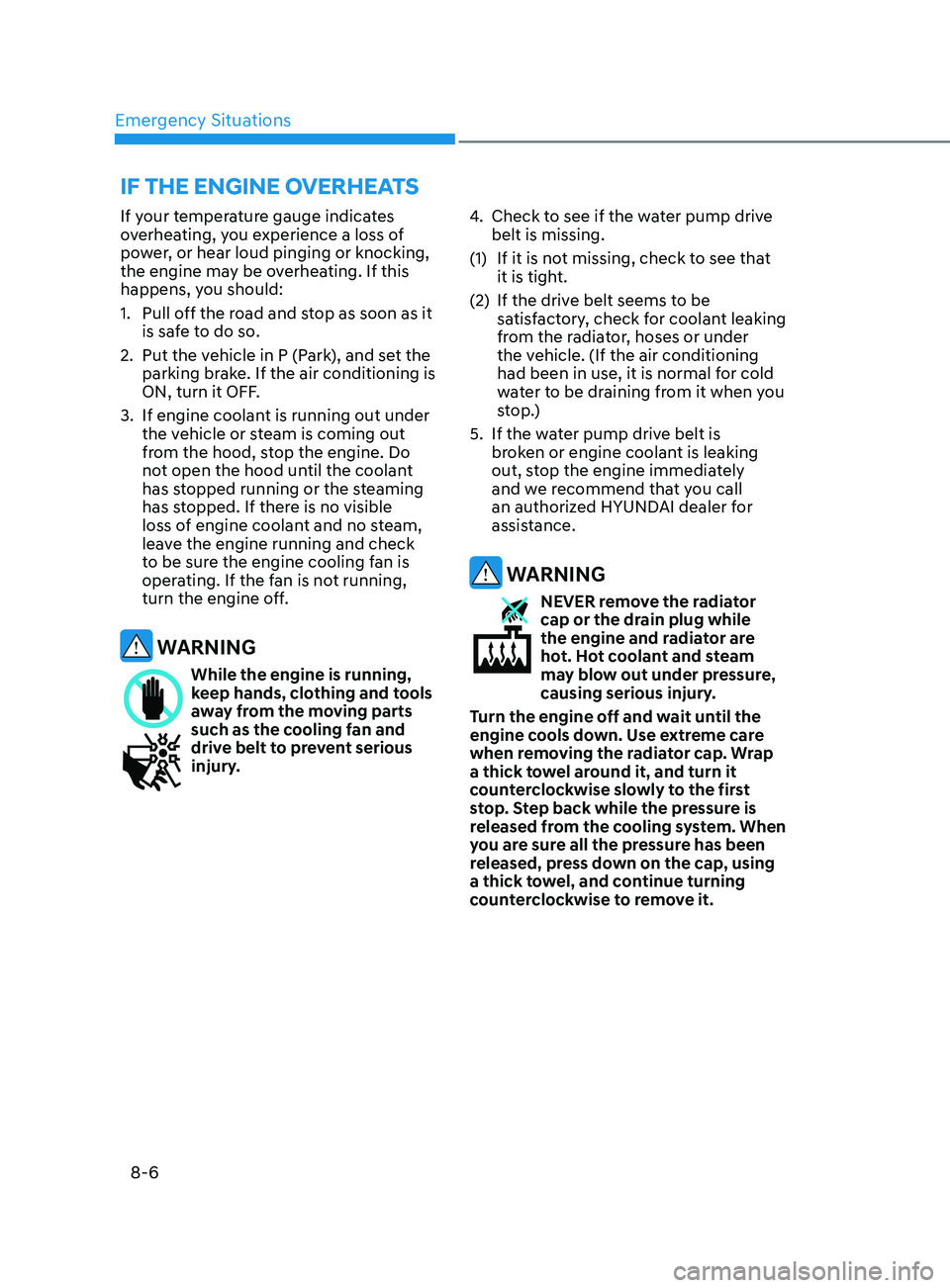
If your temperature gauge indicates
overheating, you experience a loss of
power, or hear loud pinging or knocking,
the engine may be overheating. If this
happens, you should:
1.
Pull off the r
oad and stop as soon as it
is safe to do so.
2.
Put the vehicle in P (P
ark), and set the
parking brake. If the air conditioning is
ON, turn it OFF.
3.
If engine coolant is running out under
the v
ehicle or steam is coming out
from the hood, stop the engine. Do
not open the hood until the coolant
has stopped running or the steaming
has stopped. If there is no visible
loss of engine coolant and no steam,
leave the engine running and check
to be sure the engine cooling fan is
operating. If the fan is not running,
turn the engine off.
WARNING
While the engine is running,
keep hands, clothing and tools
away from the moving parts
such as the cooling fan and
drive belt to prevent serious
injury. 4.
Check to see if the w
ater pump drive
belt is missing.
(1)
If it is not missing, check t
o see that
it is tight.
(2)
If the drive belt seems t
o be
satisfactory, check for coolant leaking
from the radiator, hoses or under
the vehicle. (If the air conditioning
had been in use, it is normal for cold
water to be draining from it when you
stop.)
5.
If the wa
ter pump drive belt is
broken or engine coolant is leaking
out, stop the engine immediately
and we recommend that you call
an authorized HYUNDAI dealer for
assistance.
WARNING
NEVER remove the radiator
cap or the drain plug while
the engine and radiator are
hot. Hot coolant and steam
may blow out under pressure,
causing serious injury.
Turn the engine off and wait until the
engine cools down. Use extreme care
when removing the radiator cap. Wrap
a thick towel around it, and turn it
counterclockwise slowly to the first
stop. Step back while the pressure is
released from the cooling system. When
you are sure all the pressure has been
released, press down on the cap, using
a thick towel, and continue turning
counterclockwise to remove it.
If the engIne overheats
Page 492 of 570

Maintenance
9-6
While operating your vehicle:
• Note any changes in the sound of the
exhaust or any smell of exhaust fumes
in the vehicle.
• Check for vibrations in the steering
wheel. Notice if there is any increased
steering effort or looseness in the
steering wheel, or change in its
straight-ahead position.
• Notice if your vehicle constantly turns
slightly or “pulls” to one side when
traveling on smooth, level road.
• When stopping, listen and check for
unusual sounds, pulling to one side,
increased brake pedal travel or “hard-
to-push” brake pedal.
• If any slipping or changes in the
operation of your transmission occurs,
check the transmission fluid level.
• Check the intelligent variable
transmission P (Park) function.
• Check the parking brake.
• Check for fluid leaks under your
vehicle (water dripping from the air
conditioning system during or after
use is normal).
At least monthly:
• Check coolant level in the engine
coolant reservoir.
• Check the operation of all exterior
lights, including the brake lights, turn
signals and hazard warning flashers.
• Check the inflation pressures of all
tires including the spare for tires that
are worn, show uneven wear, or are
damaged.
• Check for loose wheel lug nuts.
At least twice a year:
(i.e., every Spring and Autumn)
• Check radiator, heater and air
conditioning hoses for leaks or
damage.
• Check windshield washer spray and
wiper operation. Clean wiper blades
with a clean cloth dampened with
washer a fluid.
• Check headlamp alignment.
• Check muffler, exhaust pipes, shields
and clamps.
• Check the seat belts for wear and
function.
At least once a year:
• Clean body and door drain holes.
• Lubricate door hinges and hood
hinges.
• Lubricate door and hood locks and
latches.
• Lubricate door rubber weather strips.
• Lubricate door checker.
• Check the air conditioning system.
• Inspect and lubricate intelligent
variable transmission linkage and
controls.
• Clean the battery and terminals.
• Check the brake fluid level.
Page 500 of 570

Maintenance
9-14
Engine Coolant
The coolant should be changed at the
intervals specified in the maintenance
schedule.
Intelligent variable transmission
fluid (if equipped)
Intelligent variable transmission fluid
should not be checked under normal
usage conditions.
We recommend that the Intelligent
variable transmission fluid is changed by
an authorized HYUNDAI dealer according
to the maintenance schedule.
Brake Hoses and Lines
Visually check for proper installation,
chafing, cracks, deterioration and any
leakage. Replace any deteriorated or
damaged parts immediately.
Brake Fluid
Check the brake fluid level in the brake
fluid reservoir. The level should be
between the MIN and the MAX marks
on the side of the reservoir. Use only
hydraulic brake fluid conforming to DOT
4 specification.
Parking Brake
Inspect the parking brake system
including the parking brake pedal and
cables.
Brake Discs, Pads, Calipers and
Rotors
Check the pads for excessive wear, discs
for run out and wear, and calipers for
fluid leakage.
Suspension Mounting Bolts
Check the suspension connections for
looseness or damage. Retighten to the
specified torque.
Steering Gear Box, Linkage &
Boots/Lower Arm Ball Joint
With the vehicle stopped and the engine
off, check for excessive freeplay in the
steering wheel. Check the linkage for
bends or damage. Check the dust boots
and ball joints for deterioration, cracks,
or damage.
Replace any damaged parts.
Drive Shafts and Boots
Check the drive shafts, boots and clamps
for cracks, deterioration, or damage.
Replace any damaged parts and, if
necessary, repack the grease.
Air Conditioning Refrigerant
Check the air conditioning lines and
connections for leakage and damage.
Page 521 of 570
09
9-35
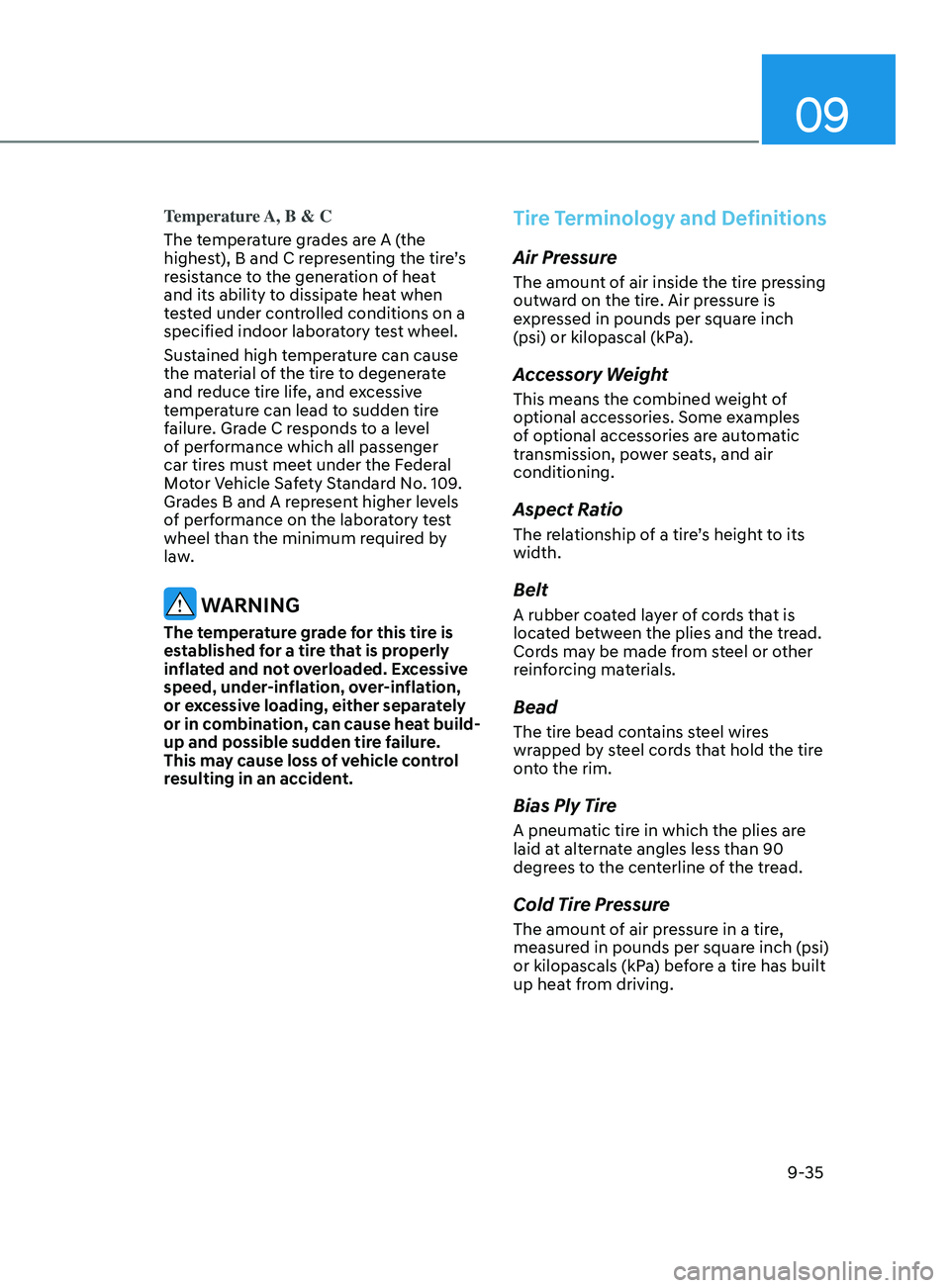
Temperature A, B & C
The temperature grades are A (the
highest), B and C representing the tire’s
resistance to the generation of heat
and its ability to dissipate heat when
tested under controlled conditions on a
specified indoor laboratory test wheel.
Sustained high temperature can cause
the material of the tire to degenerate
and reduce tire life, and excessive
temperature can lead to sudden tire
failure. Grade C responds to a level
of performance which all passenger
car tires must meet under the Federal
Motor Vehicle Safety Standard No. 109.
Grades B and A represent higher levels
of performance on the laboratory test
wheel than the minimum required by
law.
WARNING
The temperature grade for this tire is
established for a tire that is properly
inflated and not overloaded. Excessive
speed, under-inflation, over-inflation,
or excessive loading, either separately
or in combination, can cause heat build-
up and possible sudden tire failure.
This may cause loss of vehicle control
resulting in an accident.
Tire Terminology and Definitions
Air Pressure
The amount of air inside the tire pressing
outward on the tire. Air pressure is
expressed in pounds per square inch
(psi) or kilopascal (kPa).
Accessory Weight
This means the combined weight of
optional accessories. Some examples
of optional accessories are automatic
transmission, power seats, and air
conditioning.
Aspect Ratio
The relationship of a tire’s height to its
width.
Belt
A rubber coated layer of cords that is
located between the plies and the tread.
Cords may be made from steel or other
reinforcing materials.
Bead
The tire bead contains steel wires
wrapped by steel cords that hold the tire
onto the rim.
Bias Ply Tire
A pneumatic tire in which the plies are
laid at alternate angles less than 90
degrees to the centerline of the tread.
Cold Tire Pressure
The amount of air pressure in a tire,
measured in pounds per square inch (psi)
or kilopascals (kPa) before a tire has built
up heat from driving.
Page 559 of 570

Index
I-2
A
Accessing Your Vehicle
........................................................................\
.................5-4
Automatic Door Lock and Unlock Features ....................................................5-35
Child-Protector Rear Door Locks .................................................................... 5-35
Hyundai Digital Key ........................................................................\
................ 5-15
Immobilizer System ........................................................................\
................5-14
Operating Door Locks from Inside the V
ehicle................................................ 5-33
Operating Door Locks from Outside the V
ehicle
.............................................5-31
Rear Occupant Alert (ROA) System ................................................................ 5-36
Remote Key ........................................................................\
................................ 5-4
Smart Key ........................................................................\
................................... 5-7
Air Bag -
Advanced Supplemental Restraint System
.......................................... 3-35
Additional Safety Precautions ........................................................................\
.. 3-55
Air Bag W
arning Labels
........................................................................\
........... 3-55
How Does the Air Bag System Operate? .........................................................3-40
Occupant Classification System (OCS) ........................................................... 3-44
SRS Care ........................................................................\
.................................. 3-54
What to Expect After an
Air Bag Inflates
........................................................ 3-43
Where Are
the Air Bags?
........................................................................\
.......... 3-37
Why Didn’t My
Air Bag Go Off in a Collision?
.............................................. 3-50
Air Cleaner
........................................................................\
................................... 9-20
Filter replacement ........................................................................\
..................... 9-20
Air Conditioning System
........................................................................\
............. 2-10
Anti-lock Brake System (ABS)
........................................................................\
... 6-29
Electronic Stability Control (ESC) ..................................................................6-31
Good Braking Practices ........................................................................\
............ 6-34
Hill-Start Assist Control (HAC) .......................................................................6-34
Vehicle Stability Management (VSM) ............................................................6-33
Appearance Care
........................................................................\
.......................... 9-59
Exterior Care ........................................................................\
............................ 9-59
Interior Care ........................................................................\
............................. 9-65
Automatic Climate Control System
..................................................................... 5-92
Automatic heating and air conditioning ...........................................................5-93
Manual heating and air conditioning ................................................................ 5-94
System Maintenance ........................................................................\
.............. 5-102
System operation ........................................................................\
.................... 5-100
Page 566 of 570

I
I-9
Manual Climate Control System ........................................................................\
.5-81
Heating and Air Conditioning ........................................................................\
.. 5-82
System Maintenance ........................................................................\
................ 5-90
System operation ........................................................................\
...................... 5-88
Manual Speed Limit Assist (MSLA)
.................................................................. 7-63
System operation ........................................................................\
..................... 7-63
Mirrors
........................................................................\
......................................... 5-41
Inside Rearview Mirror ........................................................................\
............5-41
Side View
Mirrors
........................................................................\
.................... 5-49
N
Navigation-Based Smart Cruise Control (NSCC)
............................................... 7-98
Function operation ........................................................................\
.................... 7-99
Function settings ........................................................................\
...................... 7-98
Limitations of the function ........................................................................\
.....7-101
O
Owner Maintenance
........................................................................\
....................... 9-5
Owner Maintenance Schedule ........................................................................\
....9-5
P
Parking brake
........................................................................\
............................... 9-19
Checking the parking brake ........................................................................\
......9-19
R
Rear Cross-T
raffic Collision Warning (RCCW)
................................................ 7-120
Function malfunction and limitations ............................................................ 7-124
Function operation ........................................................................\
.................. 7-122
Function settings ........................................................................\
.................... 7-121
Rear Cross-T
raffic Collision-Avoidance Assist (RCCA)
................................. 7-128
Function malfunction and limitations ............................................................ 7-134
Function operation ........................................................................\
.................. 7-130
Function settings ........................................................................\
.................... 7-129
Rear
View Monitor (RVM)
........................................................................\
....... 7-1
16
Function malfunction and limitations ............................................................7-1
19
Function operation ........................................................................\
..................7-1
17
Function settings ........................................................................\
....................7-1
17