fuel HYUNDAI ELANTRA SPORT 2018 Service Manual
[x] Cancel search | Manufacturer: HYUNDAI, Model Year: 2018, Model line: ELANTRA SPORT, Model: HYUNDAI ELANTRA SPORT 2018Pages: 534, PDF Size: 51.51 MB
Page 425 of 534
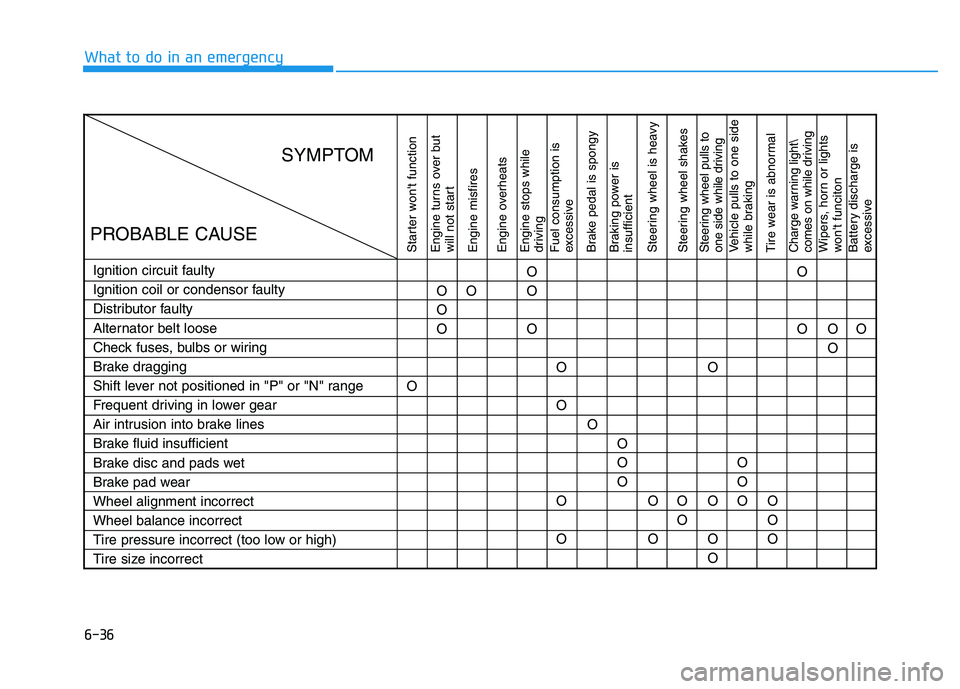
6-36
What to do in an emergency
Starter won't function
Engine turns over but
will not start Engine misfires
Engine overheats Engine stops while
driving Fuel consumption is
excessive
Brake pedal is spongy
Braking power is insufficient
Steering wheel is heavy
Steering wheel shakesSteering wheel pulls to
one side while drivingVehicle pulls to one side
while braking
Tire wear is abnormalCharge warning light\
comes on while drivingWipers, horn or lights
won't funciton
Battery discharge is
excessive
Ignition circuit faulty
Ignition coil or condensor faulty
Distributor faulty
Alternator belt loose
Check fuses, bulbs or wiring
Brake dragging
Shift lever not positioned in "P" or "N" range
Frequent driving in lower gear
Air intrusion into brake lines
Brake fluid insufficient
Brake disc and pads wet
Brake pad wearWheel alignment incorrectWheel balance incorrect
Tire pressure incorrect (too low or high)
Tire size incorrectO
O OO
O
OOOO O OO O O O O O
OOOO
OOO O
O O O
OO O O O O
O
SYMPTOM
PROBABLE CAUSE
Page 427 of 534
7
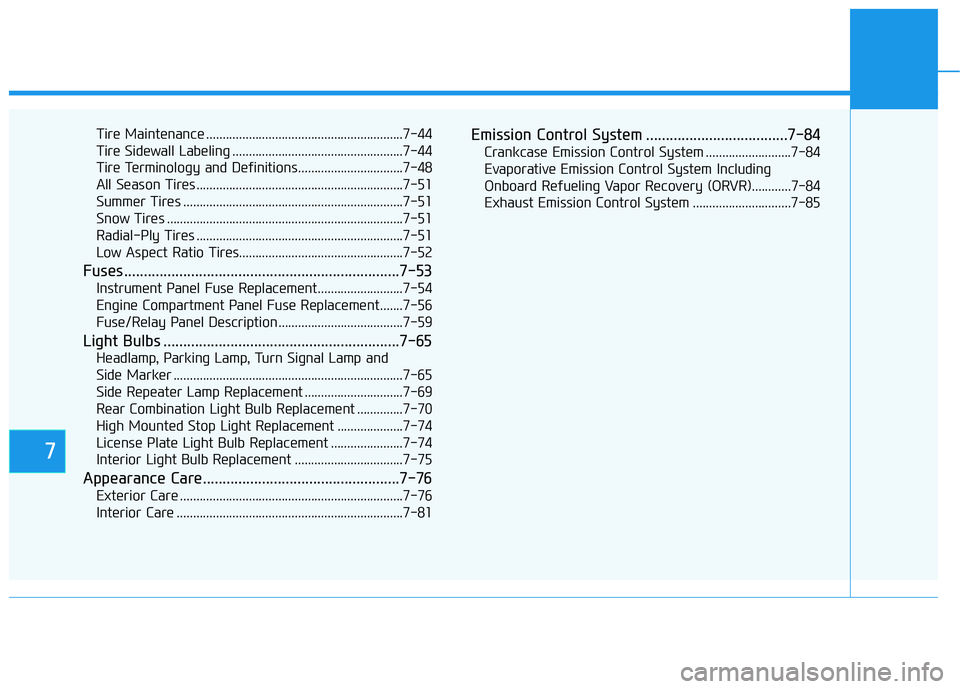
Tire Maintenance ............................................................7-44
Tire Sidewall Labeling ....................................................7-44
Tire Terminology and Definitions................................7-48
All Season Tires ...............................................................7-51
Summer Tires ...................................................................7-51
Snow Tires ........................................................................7-51
Radial-Ply Tires ...............................................................7-51
Low Aspect Ratio Tires..................................................7-52
Fuses ......................................................................7-53 Instrument Panel Fuse Replacement..........................7-54
Engine Compartment Panel Fuse Replacement.......7-56
Fuse/Relay Panel Description ......................................7-59
Light Bulbs ............................................................7-65 Headlamp, Parking Lamp, Turn Signal Lamp and
Side Marker ......................................................................7-65Side Repeater Lamp Replacement ..............................7-69
Rear Combination Light Bulb Replacement ..............7-70
High Mounted Stop Light Replacement ....................7-74
License Plate Light Bulb Replacement ......................7-74
Interior Light Bulb Replacement .................................7-75
Appearance Care..................................................7-76 Exterior Care ....................................................................7-76
Interior Care .....................................................................7-81 Emission Control System ....................................7-84
Crankcase Emission Control System ..........................7-84
Evaporative Emission Control System Including
Onboard Refueling Vapor Recovery (ORVR)............7-84 Exhaust Emission Control System ..............................7-85
Page 430 of 534

7-5
7
Maintenance
Improper owner maintenance dur-
ing the warranty period may affect
warranty coverage. For details,
read the separate Service
Passport provided with the vehi-
cle. If you're unsure about any
service or maintenance proce-
dure, have it done by an author-
ized HYUNDAI dealer.The following lists are vehicle checksand inspections that should be per-
formed by the owner or an author-
ized HYUNDAI dealer at the frequen-
cies indicated to help ensure safe,
dependable operation of your vehi-
cle.
Any adverse conditions should be
brought to the attention of your deal-
er as soon as possible.
These Owner Maintenance vehicle
checks are generally not covered by
warranties and you may be charged
for labor, parts and lubricants used.
NOTICE
Performing maintenance work
on a vehicle can be dangerous.
If you lack sufficient knowledge
and experience or the propertools and equipment to do the
work, have it done by an author-
ized HYUNDAI dealer.
ALWAYS follow these precau-
tions for performing mainte-
nance work:
•Park your vehicle on level
ground, move the shift lever
into the P (Park, for automatic
transmission/Dual clutch
transmission vehicle) position
or neutral (for manual trans-
mission vehicle), apply the
parking brake, place the igni-
tion switch in the LOCK/OFFposition.
Block the tires (front and
back) to prevent the vehicle
from moving.
Remove loose clothing or jew-
elry that can become entan-
gled in moving parts.
If you must run the engine
during maintenance, do so
out doors or in an area withplenty of ventilation.
Keep flames, sparks, or smok-
ing materials away from the
battery and fuel-related parts.
WARNING
OO
WW NNEERR MM AAIINN TTEENN AANN CCEE
Page 431 of 534
7-6
Maintenance
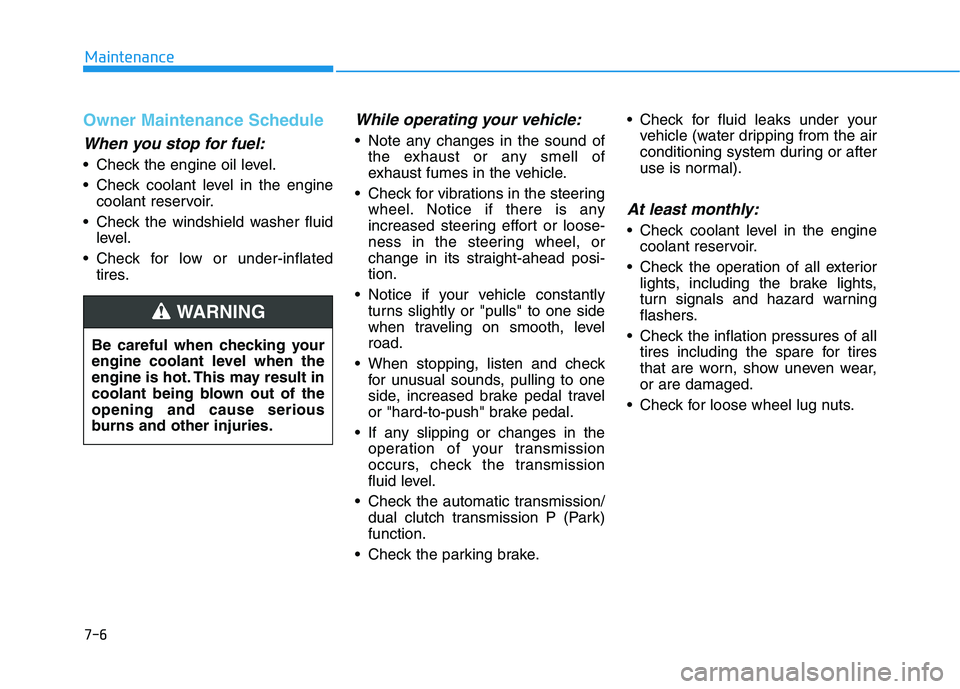
Owner Maintenance Schedule
When you stop for fuel:
Check the engine oil level.
Check coolant level in the enginecoolant reservoir.
Check the windshield washer fluid level.
Check for low or under-inflated tires.
While operating your vehicle:
Note any changes in the sound ofthe exhaust or any smell of
exhaust fumes in the vehicle.
Check for vibrations in the steering wheel. Notice if there is any
increased steering effort or loose-
ness in the steering wheel, or
change in its straight-ahead posi-tion.
Notice if your vehicle constantly turns slightly or "pulls" to one side
when traveling on smooth, levelroad.
When stopping, listen and check for unusual sounds, pulling to one
side, increased brake pedal travel
or "hard-to-push" brake pedal.
If any slipping or changes in the operation of your transmission
occurs, check the transmission
fluid level.
Check the automatic transmission/ dual clutch transmission P (Park)function.
Check the parking brake. Check for fluid leaks under your
vehicle (water dripping from the air
conditioning system during or after
use is normal).
At least monthly:
Check coolant level in the enginecoolant reservoir.
Check the operation of all exterior lights, including the brake lights,
turn signals and hazard warning
flashers.
Check the inflation pressures of all tires including the spare for tires
that are worn, show uneven wear,or are damaged.
Check for loose wheel lug nuts.
Be careful when checking your
engine coolant level when the
engine is hot. This may result in
coolant being blown out of theopening and cause serious
burns and other injuries.
WARNING
Page 433 of 534

7-8
Maintenance
I : Inspect and if necessary, adjust, correct, clean or replace.
R : Replace or change.*1
: If TOP TIER Detergent Gasoline is not available, one bottle of additive is recommended. Additives are available from your
authorized HYUNDAI dealer along with information on how to use them. Do not mix other additives.
* 2
: The drive belt should be replaced when cracks occur or tension is reduced excessively.
Normal Maintenance Schedule (2.0 MPI)
Months1224364860728496108120132144156168180
Km×1,0001224364860728496108120132144156168180
Engine oil and engine oil filterRRRRRRRRRRRRRRR
Fuel additives * 1Add fuel additives every 12,000 km or 12 months
Rotate tiresRotate tires every 12,000 km
Climate control air filterRRRRRRRRRRRRRRR
Air cleaner filterIIIRIIIRIIIRIII
Spark plugsReplace every 156,000 km
Drive belts *2At first, inspect at 96,000 km or 72 months.
Thereafter, inspect every 24,000 km or 24 months
Vacuum hoseIIIIIIIIIIIIIII
Engine coolantAt first, replace at 192,000 km or 10 years :
Thereafter, replace every 48,000 km or 24 month
Battery conditionIIIIIIIIIIIIIII
MAINTENANCE
INTERVALS
MAINTENANCE ITEM
Page 435 of 534

7-10
Maintenance
I : Inspect and if necessary, adjust, correct, clean or replace.
R : Replace or change.*3
: Fuel filter & Fuel tank air filter are considered to be maintenance free but periodic inspection is recommended for this maint e-
nance schedule depends on fuel quality. If there are some important safety matters like fuel flow restriction, surging, loss of
power, hard starting problem, etc. replace the fuel filter immediately regardless of maintenance schedule and consult an
authorized HYUNDAI dealer for details.
Normal Maintenance Schedule (2.0 MPI) (CONT)
Months1224364860728496108120132144156168180
Km×1,0001224364860728496108120132144156168180
Vapor hose, canister, fuel filler cap and fuel tankIIIIIII
Fuel tank air filter * 3IIIIIII
Fuel filter *3IIIIIII
Fuel lines, hoses and connections of
each partIII
Parking brakeIIIIIII
Brake/clutch (if equipped) fluidIIIIIII
All latch, hinges and locks IIIIIII
MAINTENANCE
INTERVALS
MAINTENANCE ITEM
After 180,000 km or 180 months continue to follow the prescribed maintenance intervals.
NOTICE
Page 438 of 534

7-13
7
Maintenance
I : Inspect and if necessary, adjust, correct, clean or replace.
R : Replace or change.*1
: If TOP TIER Detergent Gasoline is not available, one bottle of additive is recommended. Additives are available from your
authorized HYUNDAI dealer along with information on how to use them. Do not mix other additives.
* 2
: The drive belt should be replaced when cracks occur or tension is reduced excessively.
* 3
: Inspect for excessive valve noise and/or engine vibration and adjust if necessary. Have an authorized HYUNDAI dealer per-
form the operation.
Normal Maintenance Schedule (1.6 Turbo-GDI)
Months1224364860728496108120132144156168180
Km×1,000102030405060708090100110120130140150
Engine oil and engine oil filterRRRRRRRRRRRRRRR
Fuel additives * 1Add fuel additives every 10,000 km or 12 months
Rotate tiresRotate tires every 10,000 km
Climate control air filterRRRRRRRRRRRRRRR
Air cleaner filterIIIRIIIRIIIRIII
Spark plugsReplace every 70,000 km
Drive belts *2At first, inspect at 96,000 km or 72 months.
Thereafter, inspect every 20,000 km or 24 months
Valve clearance * 3Inspect every 90,000 km or 72 months
Vacuum hoseIIIIIIIIIIIIIII
Engine coolantAt first, replace at 192,000 km or 10 years :
Thereafter, replace every 48,000 km or 24 month
MAINTENANCE INTERVALS
MAINTENANCE ITEM
Page 440 of 534

7-15
7
Maintenance
I : Inspect and if necessary, adjust, correct, clean or replace.
R : Replace or change.*4
: Fuel filter & Fuel tank air filter are considered to be maintenance free but periodic inspection is recommended for this maint e-
nance schedule depends on fuel quality. If there are some important safety matters like fuel flow restriction, surging, loss of
power, hard starting problem, etc. replace the fuel filter immediately regardless of maintenance schedule and consult an
authorized HYUNDAI dealer for details.
Normal Maintenance Schedule (1.6 Turbo-GDI) (CONT)
Months1224364860728496108120132144156168180
Km×1,000102030405060708090100110120130140150
Vapor hose, canister, fuel filler cap and fuel tankIIIIIII
Fuel tank air filter * 4IIIIIII
Fuel filter *4IIIIIII
Fuel lines, hoses and
connections of each partIII
Parking brakeIIIIIII
Brake/clutch (if equipped) fluidIIIIIII
All latch, hinges and locks IIIIIII
MAINTENANCE
INTERVALS
MAINTENANCE ITEM
After 150,000 km or 180 months continue to follow the prescribed maintenance intervals.
NOTICE
Page 443 of 534

7-18
MaintenanceE
E XX PPLLAA NN AATTIIOO NN OO FF SS CC HH EEDD UU LLEE DD MM AAIINN TTEENN AANN CCEE IITT EEMM SS
Engine Oil and Filter
The engine oil and filter should be
changed at the intervals specified in
the maintenance schedule. If the car
is being driven in severe conditions,more frequent oil and filter changesare required.
Drive Belts
Inspect all drive belts for evidence of
cuts, cracks, excessive wear or oil
saturation and replace if necessary.
Drive belts should be checked peri-
odically for proper tension and
adjusted as necessary.
Fuel Filter
A clogged-up fuel filter may limit the
vehicle driving speed, damage theemission system, and cause the
hard starting. When a considerable
amount of foreign substances are
accumulated in the fuel tank, the fuelfilter should be replaced. Upon installing a new fuel filter, oper-
ate the engine for several minutes,
and check the connections for any
leakages. Fuel filters should be
installed by an authorized HYUNDAI
dealer.
Fuel Lines, Fuel Hoses and Connections
Check the fuel lines, fuel hoses and
connections for leakage and dam-
age. Have an authorized HYUNDAI
dealer replace any damaged or leak-
ing parts immediately.
Vapor Hose and Fuel Filler Cap
The vapor hose and fuel filler cap should be inspected at those inter-
vals specified in the maintenance
schedule. Make sure a new vaporhose or fuel filler cap is correctlyreplaced.
Vacuum Crankcase Ventilation Hoses (if equipped)
Inspect the surface of hoses for evi- dence of heat and/or mechanical
damage. Hard and brittle rubber,
cracking, tears, cuts, abrasions, and
excessive swelling indicate deterio-
ration. Particular attention should be
paid to examine those hose surfaces
nearest to high heat sources, such
as the exhaust manifold. Inspect the hose routing to assure that the hoses do not come in con-
tact with any heat source, sharp
edges or moving component whichmight cause heat damage or
mechanical wear.
Inspect all hose connections, such
as clamps and couplings, to make
sure they are secure, and that no
leaks are present. Hoses should be
replaced immediately if there is any
evidence of deterioration or damage.
Page 463 of 534

7-38
MaintenanceT
T IIRR EESS AA NN DD WW HHEEEELLSS
Tire Care
For proper maintenance, safety, and
maximum fuel economy, you must
always maintain recommended tire
inflation pressures and stay within
the load limits and weight distribution
recommended for your vehicle.Replace tires that are worn,
show uneven wear, or are
damaged. Worn tires can
cause loss of braking effec-
tiveness, steering control, ortraction.
ALWAYS replace tires with the
same size as each tire that
was originally supplied with
this vehicle. Using tires andwheels other than the recom-
mended sizes could cause
unusual handling characteris-
tics, poor vehicle control, or
negatively affect your vehi-
cle's Anti-Lock Brake System(ABS) resulting in a seriousaccident.
Tire failure may cause loss of
vehicle control resulting in an
accident. To reduce risk of
SERIOUS INJURY or DEATH,
take the following precautions:
Inspect your tires monthly for
proper inflation as well as
wear and damage.
The recommended cold tire
pressure for your vehicle can
be found in this manual andon the tire label located on the
driver's side center pillar.
Always use a tire pressure
gauge to measure tire pres-
sure. Tires with too much ortoo little pressure wear
unevenly causing poor han-dling.
Check the pressure of the
spare every time you checkthe pressure of the other tires
on your vehicle.
WARNING